Graphic Designer Resume Format, with 3 Full Samples
A graphic designer is hired on the strength of the portfolio, not the resume, but the resume is the gate the portfolio has to pass first. A studio lead or an agency HR desk skims a page in a few seconds to decide whether the folio link is worth opening, and most designer resumes waste that window on a paragraph about a passion for creativity and a skills bar showing Photoshop at ninety percent. Below are three complete resumes, one for a fresher out of a design course, one for a mid-level designer with agency and in-house experience, and one for an art director, followed by the format rules, where the portfolio link belongs, and the tool and craft keywords a studio actually reads for. Each sample is a full document in the order a reviewer expects, and every one leads a reader straight to the work rather than around it.
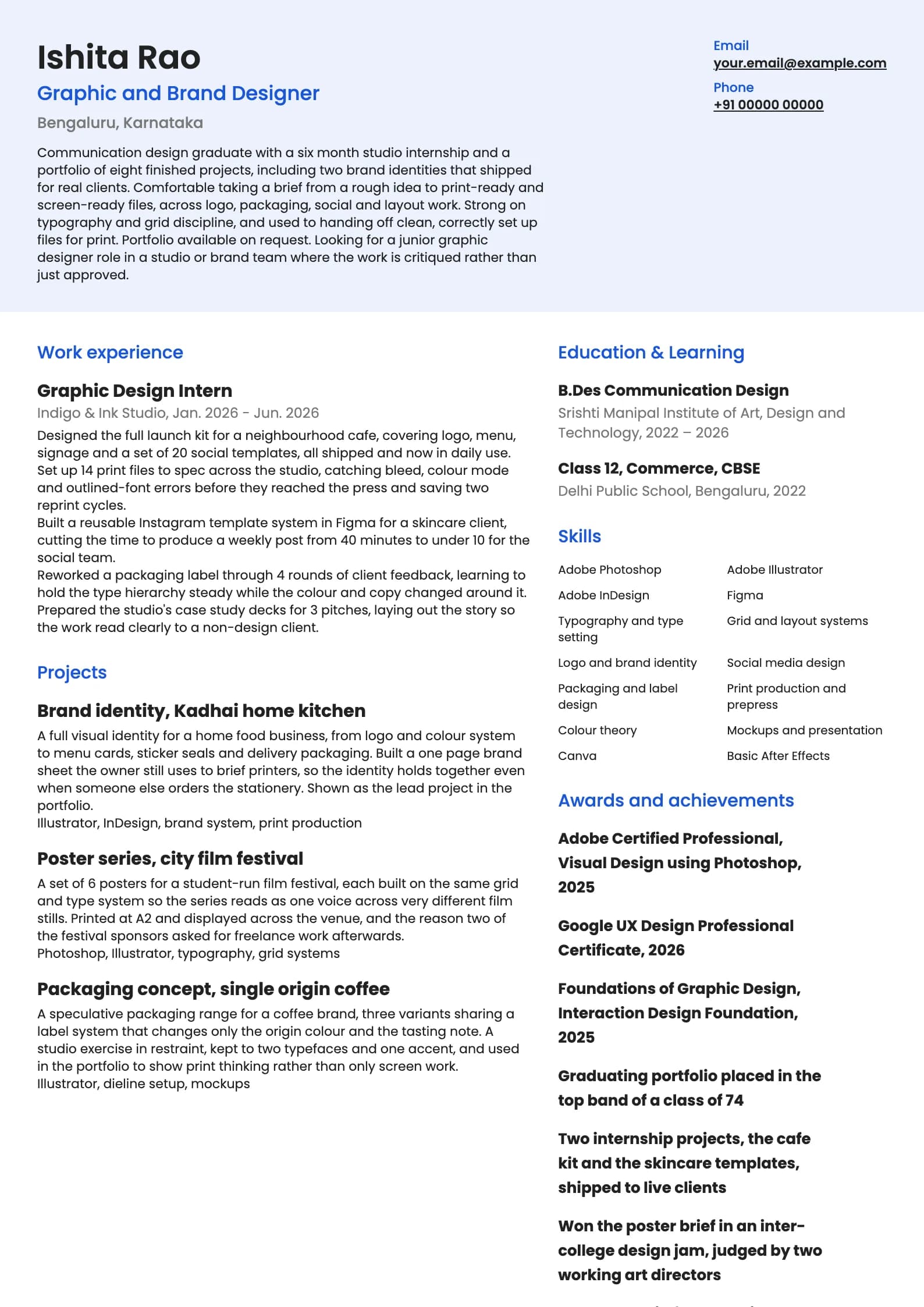
Build my resumeGraphic Designer resume example, Fresher (0 years)
modern templateIs your resume good enough?
Upload the resume you have now and see what an applicant tracking system reads before a graphic designer recruiter ever does.
Free to run. Sign in with your mobile number to see your score.
Graphic Designer resume example, Mid-level (4 years)
ai-era template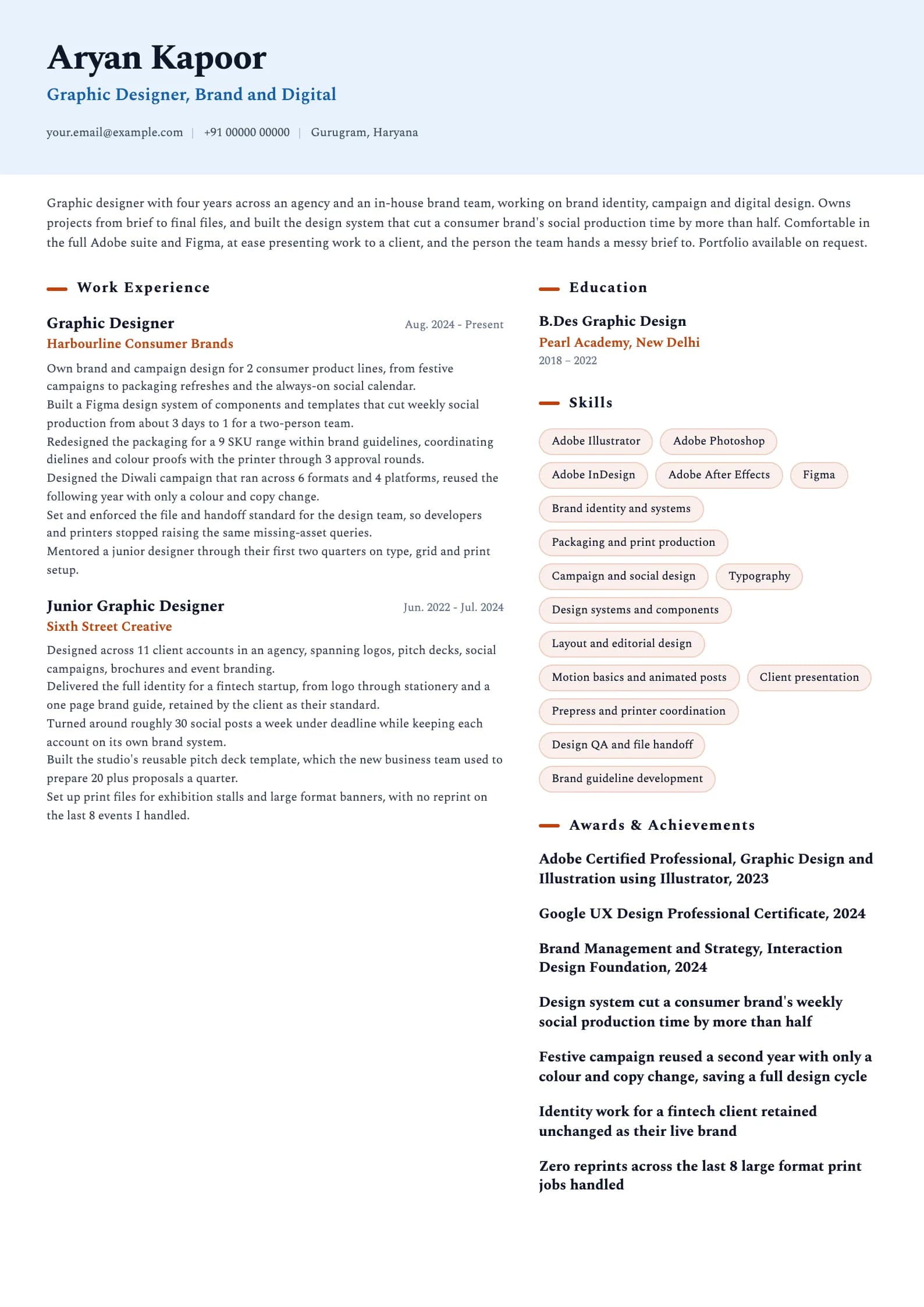
Want this structure with your own details? Build it in the resume builder.
Graphic Designer resume example, Art Director (9 years)
professional template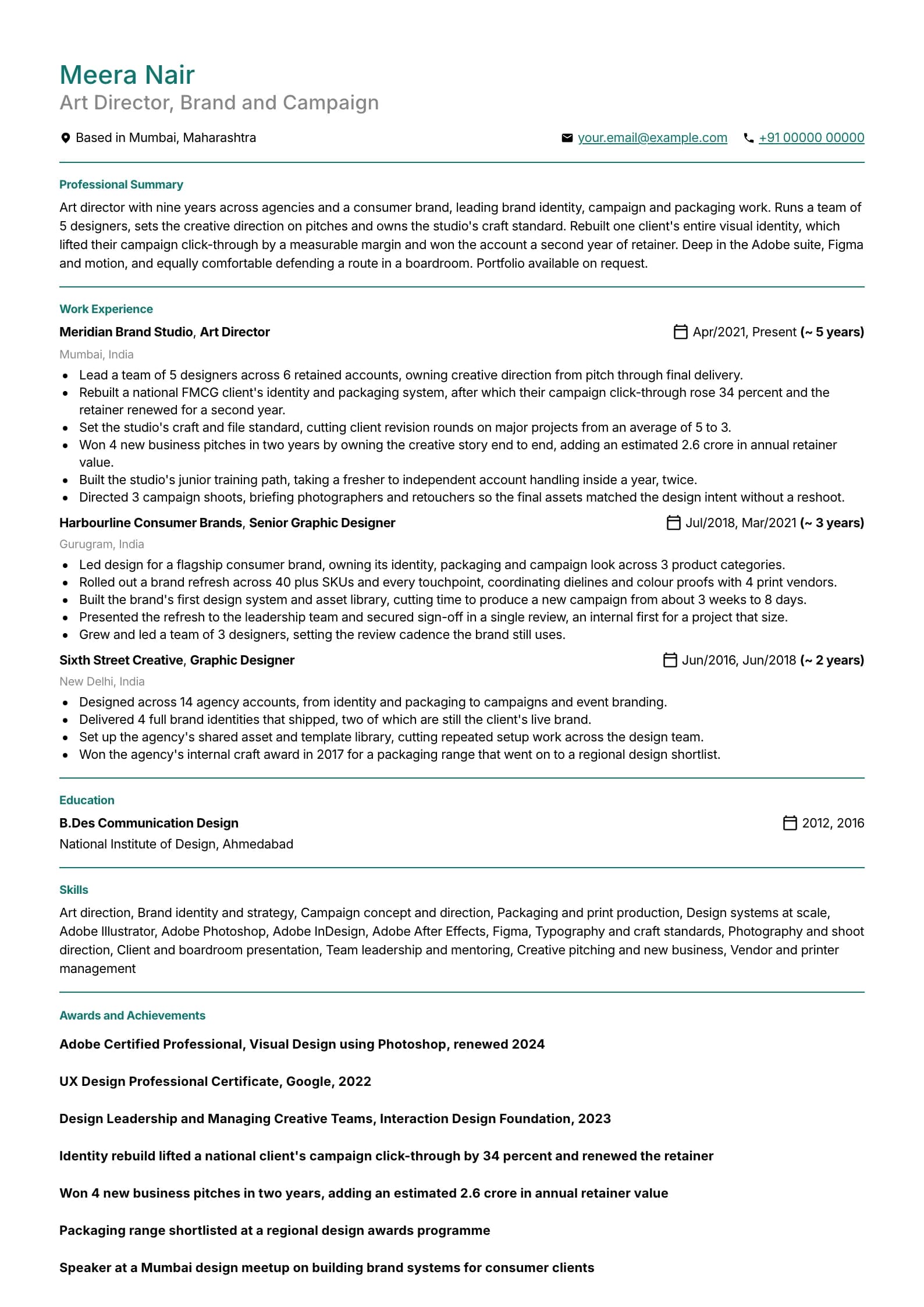
The format that works for graphic designer resumes in India
A designer resume has a strange job. It has to be well made, because a badly set resume from a designer is a portfolio piece that argues against you, and it has to stay simple, because the folio is where the real work lives and the resume only has to earn the click. Reverse chronological, one page up to roughly seven years, a second page only for an art director or a design lead with a genuine leadership history. Single column, two typefaces at most, a clear grid and real hierarchy. This is the one resume where the reviewer is silently judging your typesetting, so mismatched sizes, three fonts and a ragged baseline cost you more than they would in any other field. Do not paste your work into the resume. Thumbnails print as grey boxes on a studio laptop, they balloon the file size past what an email or a portal will accept, and an applicant tracking system reads an image as empty space. The resume names the portfolio and links it once, cleanly, near the top. The folio does the showing. Leave off the skills bars. A row of sliders claiming Photoshop at ninety percent and Illustrator at eighty-five is the single most common tell of a junior designer resume, because nobody has agreed what those numbers mean and a reviewer cannot act on them. List the tools as words instead, ordered by what you are strongest in. Keep the same things off the page that every Indian resume should drop: photo, date of birth, marital status, father's name and a declaration line. The section order below is what a studio lead expects, and it is built so the portfolio link and the tools are found in the first pass.
| Section | Where it goes | Why |
|---|---|---|
| Name and headline | Top, above everything | The headline is the role and the specialism: "Graphic Designer, Brand and Digital" beats "Creative Professional". |
| Portfolio link | In the header block, right under the name | It is the reason the resume exists. Make it the easiest thing on the page to find. |
| Summary | Directly under the header | Three lines. What you design, how long, the tools, and one result or shipped project. |
| Experience | Next, for anyone with a job | Most recent first. Name the studio, the type of work and what shipped. |
| Projects | Above experience for freshers, below it after that | For a fresher the projects are the portfolio in text. For everyone else, the folio covers this. |
| Skills and tools | Below experience | Words, not sliders. Grouped into software, craft and the work you do. |
| Education and certifications | Bottom, unless you are a fresher | Design school and degree, then Adobe and UX certifications with the year. |
The portfolio link is the most important line on the page
For a graphic designer, the resume is a trailer and the portfolio is the film. A studio lead decides whether to open the folio in the first few seconds of scanning, so the link has to be present, obvious and working, sitting in the header block right under your name. A designer resume with no portfolio link, or with a link that leads to a dead Behance page, is filtered before the experience is read, because the one thing a studio cannot hire without seeing is the work. Curate ruthlessly. Six to nine strong projects beat twenty, because a folio is judged on its weakest piece as much as its strongest, and one thin college exercise sitting next to good client work drags the whole page down. Lead with the project closest to the job you want. A studio hiring for packaging should see packaging in the first scroll, not a wedding invitation you are quietly proud of. Show the thinking, not only the final frame. A short line on the brief, the constraint and what you decided turns a pretty image into evidence of a designer. "Held two typefaces and one accent colour across a three variant range" tells a reviewer how you think, which is what they are actually buying. A few practical rules. Keep the link a real, clickable URL, not a QR code that a printed resume cannot open. Make sure it needs no password. If you use Behance, Dribbble or your own site, check it opens on a phone, because that is often where it gets opened first. And keep it current, because a folio that ends two years before your latest role reads as a designer who stopped growing.
- Put the portfolio URL in the header, directly under your name, as plain clickable text. It is the click the whole resume is trying to earn.
- Curate to 6 to 9 finished projects. A folio is judged by its weakest piece, so cut the thin ones rather than padding the count.
- Lead with the project closest to the role. Packaging first for a packaging job, brand first for a brand job.
- Add one line of thinking per project: the brief, the constraint, the decision. The image shows the what, the line shows the why.
- Use a real URL, not a QR code, and make sure it opens with no password and works on a phone.
- Keep it current. A folio that stops two years ago reads as a designer who stopped developing.
- Never paste thumbnails into the resume itself. They print as grey boxes, break the file size and read as blank space to a parser.
Portfolio reference on the resume
Weak
Portfolio: 40+ projects across various domains. Links available on request.
Strong
Portfolio: behance.net/ishitarao. 8 finished projects, brand identity and packaging first.
A working link in the header beats a promise of one, and a curated count reads as judgement while forty of everything reads as a dumping ground.
If a studio lead cannot find and open your portfolio in ten seconds, the strongest resume in the world has already lost. The link is not a footnote, it is the headline.
A summary that earns the portfolio click
The block under your name is read every time, and on a designer resume its only real job is to make the reviewer want to open the folio. It should carry what you design, how long you have designed it, the tools you work in, and one thing that shipped or one result that moved. Three lines, four at most, and no adjectives a reviewer cannot check. The line to delete is the one about being a passionate and creative designer looking for a challenging role. Every applicant wrote it, it describes a feeling rather than a skill, and it spends your most valuable three lines saying nothing. Replace it with specifics: brand and packaging designer, four years, Adobe suite and Figma, and the design system that halved a team's production time. Freshers often think they have nothing to summarise. Look at the fresher sample. It names the tools, states the length of the internship, and points at two projects that shipped to real clients. That is a genuine summary built from a course, one internship and freelance work, and it avoids the word creative entirely, because on a designer's resume creativity is shown in the folio and claimed nowhere. Match the summary to the job. A studio hiring a motion-leaning designer and a brand studio hiring an identity specialist are reading for different words, and rewriting three lines to lead with the right specialism takes two minutes and does more than any other edit on the page.
Professional summary, mid-level designer
Weak
Creative and passionate graphic designer with a keen eye for detail, seeking a challenging role in a dynamic organisation to showcase my creativity.
Strong
Graphic designer with four years across an agency and an in-house brand team, working in the Adobe suite and Figma. Built the design system that cut a consumer brand's social production time by more than half.
The rewrite swaps three feelings for a specialism, a toolset and one result a studio can picture using.
Experience bullets: what you designed, and what it did
Designers write the two weakest kinds of bullet more than most. The first is a list of the work touched, so responsible for creating social media posts, brochures and marketing materials, which describes a job title and separates you from nobody. The second is a claim of quality that only you can judge, so created visually stunning and engaging designs, which a reviewer cannot verify and therefore discounts. The pattern in all three samples is different: an action verb, the specific thing you designed, and what happened because of it. The objection is always that design outcomes are subjective and cannot be measured. Some can be, and more than designers assume. A design system cut production time. A campaign was reused a second year, saving a full cycle. A packaging refresh coordinated dielines across four vendors with no reprint. An identity was retained unchanged as the client's live brand. Click-through rose. Revision rounds fell. None of these require you to claim your work was beautiful, they state what changed, and the reviewer draws the quality conclusion themselves. Where a number genuinely does not exist, use scope and outcome instead. How many SKUs, how many accounts, how many formats, whether it shipped, whether it was reused, whether it survived as the client's standard. Shipped and still in use is a stronger claim than any adjective, because it means someone paid for the work and kept it. Allocate bullets by recency. The current role gets five or six, the previous one four or five, and the oldest role compresses to whatever still proves something the recent work does not, the way the art director sample keeps a two year old agency role only for the fact that two of those identities are still live.
| Level | What bullets must prove | Typical evidence |
|---|---|---|
| Fresher | You can take a brief to finished, print-ready files | Projects shipped, print files fixed, templates built, freelance jobs |
| 1 to 3 years | You own deliverables across accounts without hand-holding | Accounts handled, identities shipped, turnaround, print reliability |
| 4 to 6 years | You own a brand or a system, not just assets | Design systems, production time saved, packaging at scale, mentoring |
| 7 years and up | You direct work and move a client's numbers | Team led, pitches won, click-through or retainer, craft standard set |
Experience bullet, brand designer
Weak
Responsible for creating visually appealing social media creatives and other marketing materials for various clients.
Strong
Built a Figma design system of components and templates that cut weekly social production from about 3 days to 1 for a two-person team.
The first describes a job description; the rewrite names what was built and the time it gave a team back.
Experience bullet, packaging work
Weak
Designed attractive and eye-catching packaging designs for the company's products.
Strong
Redesigned packaging for a 9 SKU range within brand guidelines, coordinating dielines and colour proofs with the printer through 3 approval rounds.
Names the scale, the constraint and the production reality, which a studio can trust far more than the words attractive and eye-catching.
Shipped, reused, retained, no reprint. On a designer resume these plain words beat beautiful and creative every time, because they mean someone kept the work.
Tools and craft, grouped and honest, with no rating bars
A designer skills section fails in two ways. The first is the slider, a row of bars putting Photoshop at ninety percent and typography at seventy, which no reviewer can act on because nobody agreed what the numbers mean. The second is the everything list, thirty rows mixing software, mediums, buzzwords and soft skills into a wall the eye slides straight off. Group instead, and use words. Three groups cover almost every graphic designer. Software is the tools you actually work in, Adobe Illustrator, Photoshop, InDesign, After Effects, Figma, ordered with your strongest first. Craft is what you can do with them, brand identity, typography, packaging, layout, motion, design systems, print production. And the work covers how you operate, client presentation, art direction, printer coordination, mentoring. The exact headings matter less than the fact that a reviewer can read the section in one pass. Write the tool names the way the industry writes them, Adobe Illustrator not Adobe Illustration, InDesign not In Design, After Effects not AfterEffect. Studios and portals both match on strings. And keep the list to what you can defend, because every item is a question an interview panel might open with, and a designer who lists After Effects and cannot animate a two second logo has spent credibility that was hard to earn. One unglamorous group is the one juniors skip and studio leads quietly weigh: print production. Prepress, bleed, dielines, colour proofing and file handoff are the difference between a designer a studio can trust with a press job and one it has to check behind. If you have it, name it.
| Group | What goes in it | How many |
|---|---|---|
| Software | Illustrator, Photoshop, InDesign, After Effects, Figma, Canva | 3 to 6 |
| Craft | Brand identity, typography, packaging, layout, motion, design systems | 4 to 6 |
| Production | Prepress, dielines, colour proofing, print vendor coordination, file handoff | 2 to 4 |
| Ways of working | Client presentation, art direction, mentoring, brand guidelines | 2 to 4 |
Skills section
Weak
Photoshop 90%, Illustrator 85%, InDesign 70%, Creativity 95%, Teamwork 90%, Communication 80%
Strong
Software: Illustrator, Photoshop, InDesign, Figma, After Effects. Craft: brand identity, typography, packaging, design systems. Production: prepress, dielines, printer coordination.
Rating bars nobody can read become grouped, searchable terms, and creativity leaves the skills list to be proven in the folio where it belongs.
Getting a designer resume past the applicant tracking system
Not every design job is filtered by software. A small studio still opens every attachment and a walk-in still happens. But the larger agencies, the brand teams inside big companies and most job boards run your file through a parser first, and a designer resume is unusually easy to break because designers reach for exactly the layouts a parser cannot read. The failures are avoidable in a few minutes. The first is the image resume. A resume exported as a single flat image, or a design saved as a picture inside a PDF, has no text layer, so a parser reads it as blank and a search finds nothing on the page. Test yours by opening the PDF and trying to select a sentence with the cursor. If nothing highlights, the machine sees nothing. The second is the layout a designer instinctively builds: two columns with the skills in a sidebar, tools shown as icons, section labels replaced by graphics. A parser can read a two column resume down one side and then the other, interleaving your sidebar with your experience, and it reads an icon as nothing at all. Keep the resume itself linear and text based, and put the visual ambition in the folio where it belongs. On wording, use the terms the job posting uses, honestly. If it says brand identity, write brand identity, not visual storytelling. If it says Adobe Creative Suite, name the specific apps as well so both the phrase and the individual tools match. Spell out an abbreviation once, for example UI (user interface), so the search finds either form. And never hide a block of keywords in white text at the bottom, because parsers flag it and studios read it as exactly the kind of dishonesty a craft business cannot trust.
- Keep the resume itself text based, not an exported image. Test it by selecting a line of text in the PDF.
- Use a single column, linear layout. Save the two column, sidebar and icon-driven design for the portfolio.
- Name the specific Adobe apps and Figma as words, not as logos or rating bars.
- Mirror the posting's own terms honestly: brand identity, packaging, motion graphics, print production.
- Spell out abbreviations once, for example UI and UX, so both the short and long form are matchable.
- Use standard headings, Experience and Skills, not My Craft or Where I Have Worked.
- Never paste your work or hide keywords in white text. One breaks the parse, the other reads as dishonesty.
The paradox of a designer resume: the more beautifully you lay it out with columns and icons, the more likely a parser reads it as gibberish. Keep the resume plain and let the portfolio be the beautiful thing.
What gets graphic designer resumes rejected
Most rejections at the resume stage happen before the folio is even opened, and they come from a small set of repeating faults. The list below is ordered roughly by how much damage each one does, starting with the two that get a designer filtered in the first few seconds.
- No portfolio link, or a dead one. The single fastest rejection, because the work is the one thing a studio cannot hire without seeing.
- Skills shown as rating bars. Photoshop at ninety percent tells a reviewer nothing and marks the resume as junior.
- The whole resume saved as an image, so a parser reads a blank page and a search finds nothing.
- A bloated, uncurated folio of forty projects, judged by its weakest college exercise instead of its best client work.
- Adjective bullets: visually stunning, eye-catching, creative. Claims of quality only you can judge, which a reviewer discounts.
- Thumbnails pasted into the resume, which print as grey boxes, break the file size and read as blank to a parser.
- Two column and icon-heavy layouts that a parser reads out of order, scrambling the experience before a human sees it.
- A generic objective line about a passionate designer seeking a challenging role, in the slot a summary should hold.
- No print production anywhere, on a resume aimed at a studio that does real press work. Prepress is a trust signal, so name it.
- The same folio and resume sent to a packaging studio, a motion team and a UI role, with no reorder to lead with the relevant work.
Open your own resume as a reviewer would, click the portfolio link cold, and count the seconds to the first strong piece. Anything past ten seconds is a fix, not a preference.
Skills to put on a graphic designer resume
Technical
- Brand identity and systems
- Typography and type setting
- Layout and editorial design
- Packaging and label design
- Print production and prepress
- Social and campaign design
- Motion graphics and animated posts
- Design systems and components
- Grid and composition
- Colour theory and colour management
- Iconography and illustration
- Presentation and deck design
- Art direction
- Mockups and visualisation
Tools and platforms
- Adobe Illustrator
- Adobe Photoshop
- Adobe InDesign
- Adobe After Effects
- Figma
- Canva
- Adobe XD
- Procreate
- CorelDRAW
- Blender basics
- Google Slides and Keynote
- Behance and Dribbble portfolios
Working skills
- Client presentation
- Taking and interpreting a brief
- Receiving and giving design critique
- Printer and vendor coordination
- Mentoring junior designers
- Working to deadline under load
- Cross-team collaboration
- Attention to craft detail
- Managing revision rounds
- Storytelling and rationale
Certifications worth listing as a graphic designer
| Certification | Full name | Worth it for |
|---|---|---|
| ACP Photoshop | Adobe Certified Professional, Visual Design using Photoshop | A clean signal for a fresher or a career switcher who needs to prove tool fluency on paper before the folio is opened. Product studios that hire on portfolio alone care little, so treat it as an entry credential rather than a career-long one. |
| ACP Illustrator | Adobe Certified Professional, Graphic Design and Illustration using Illustrator | Worth it for designers whose work is vector heavy, logos, packaging and illustration, and who want the Illustrator keyword on the page. Pick the one Adobe certification that matches your core tool rather than collecting all of them. |
| Google UX Certificate | Google UX Design Professional Certificate | Genuinely useful if you are moving from print or brand work towards digital and product design, where a UX vocabulary is now expected. Of limited value if you intend to stay in pure brand and print, where a strong folio outweighs any online certificate. |
| IxDF | Interaction Design Foundation course certificates | A low-cost way to show structured learning in UX, design leadership or brand strategy, which reads well for a designer with no formal design degree. It supports the folio, it does not replace it, so do not stack certificates in place of finished work. |
| Motion or After Effects course | A recognised motion design certificate, for example School of Motion or an Adobe After Effects credential | For designers moving into motion and animated social, which studios increasingly ask of a graphic designer. Only worth listing if you have motion pieces in the folio to back it, because the interview will ask you to open one. |
| NID or design school certificate | A formal degree or diploma from a recognised design institute, for example NID, NIFT, Srishti or Pearl Academy | The strongest credential of all for a designer in India, and worth naming in full because studios and agencies recognise the institutes. If you hold one, it carries more weight than any short online certificate, so lead the education block with it. |
Keywords an ATS scans for in a graphic designer resume
These are the literal terms a parser matches against the job description. Use the ones that are true of you, in the sentences where you did the work, not as a list at the bottom.
- graphic designer
- brand identity
- visual design
- Adobe Photoshop
- Adobe Illustrator
- Adobe InDesign
- Figma
- typography
- packaging design
- print production
- prepress
- layout design
- social media design
- campaign design
- motion graphics
- design systems
- art direction
- UI and UX
- logo design
- portfolio
Graphic Designer resume FAQ
What is the correct resume format for a graphic designer in India?
Reverse chronological, single column, one page up to roughly seven years, with the portfolio link in the header directly under your name. Header with name, headline and folio link, then a three line summary, then experience with the studio and the work named, then skills and tools as words rather than rating bars, then education and Adobe or UX certifications. Keep the resume itself plain and text based and put the visual ambition into the portfolio, because a parser and a printed interview copy both read a linear layout more reliably.
Do I need a portfolio link on my resume, and where should it go?
Yes, and it is the most important line on the page. Put a clickable portfolio URL in the header block right under your name, because a studio decides whether to open the folio in the first few seconds and a designer resume without a working link is usually filtered before the experience is read. Curate the folio to six to nine strong projects, lead with the work closest to the job, and make sure the link opens with no password and works on a phone.
Should I use skill rating bars on a design resume?
No. A row of bars showing Photoshop at ninety percent and typography at seventy is the most common tell of a junior resume, because nobody has agreed what the numbers mean and a reviewer cannot act on them. List the tools and craft as words instead, grouped into software, craft and production, ordered with your strongest first. Your actual ability is judged in the portfolio and the interview, not on a slider.
How do I write a graphic designer resume as a fresher with no job?
Lead with projects and treat your course and internship work as the evidence. Give each project a line on the brief, the constraint and what shipped, and name the tools you used. The fresher sample above is built this way, with the internship as a real experience entry and three curated projects standing in for a track record. Keep your design school and degree near the top, and put the portfolio link in the header, because for a fresher the folio is doing almost all of the persuading.
What salary can a graphic designer expect in India?
It varies widely by city, studio and specialism, so treat these as broad bands rather than promises. A fresher in a small studio often starts around 2.5 to 4.5 LPA, a designer with three to five years and a strong folio commonly sits around 6 to 12 LPA, and an art director or design lead in a metro agency or a well-funded brand can reach 15 to 30 LPA and beyond. Motion and product-leaning designers tend to command more than pure print. Do not put a number on the resume itself; discuss it at the offer stage.
Will an applicant tracking system read a designer's resume?
At larger agencies and brand teams, yes, and a poorly parsed file ranks low enough to be a functional rejection. The two failures that hurt designers most are saving the whole resume as an image, which parses as a blank page, and building a two column layout with icons and a sidebar, which a parser reads out of order. Keep the resume linear and text based, test it by selecting a sentence in the PDF, and put the design ambition into the portfolio instead.
Should I list Photoshop, Illustrator and other tools separately?
Yes, name the specific applications as words rather than writing Adobe Creative Suite alone, because both a studio and a parser match on the individual tool. Group them under a software heading with your strongest first, and only list tools you can be interviewed on, since a panel may open with the one you claimed. Add a print production group if you can do prepress and dielines, because that is a trust signal a studio reads closely.
How long should a graphic designer resume be?
One page up to roughly seven years of experience. A second page is fine only for an art director or a design lead whose second page carries team leadership, pitch wins and client results rather than more assets. The portfolio, not the resume, is where length is allowed to grow, and even there curation beats volume. If you are struggling to fit one page, cut the oldest role to the one fact that still proves something and remove any tool you would not want to be interviewed on.
Do certifications help a graphic designer get hired in India?
They help most when you have no formal design degree or you are switching track, for example moving from print into UX, where an Adobe or Google UX certificate signals structured learning. They help least when you already have a strong portfolio, because the folio is the stronger credential. A degree or diploma from a recognised design institute such as NID, NIFT or Srishti outweighs any short online certificate, so lead the education block with it if you have one.
Should I tailor my portfolio and resume for each studio?
Tailor the order, not the whole thing. Reorder the folio so the work closest to the job appears first, and rewrite the three line summary to lead with the matching specialism, whether that is packaging, motion or brand. A studio hiring for packaging should see packaging in the first scroll. This takes a few minutes per application and does far more than rebuilding either document from scratch for every role.
Related resume examples and guides
Build your designer resume in any of these formats
Start from a blank resume or upload the one you have. Goodspace renders it in 24 templates, keeps the layout parser-safe, and flags what an applicant tracking system will miss, so the resume earns the portfolio click.
Build my resume