Fashion Designer Resume Format, with 3 Full Samples
A fashion designer in India is hired to move a collection from mood board to shipped garment, on a range plan and a margin, and the resume has to prove you can do that without romance. An export house, a fashion brand or a design studio reads a page for category, garment type, the buyers or markets worked for, and whether you speak the language of sampling, sourcing and tech packs. Most fashion resumes lose them on a paragraph about a lifelong passion for creativity and a list of software with no garments attached. Below are three complete resumes, one for a NIFT fresher, one for a mid-level apparel designer, and one for a design manager, followed by the format rules, where the portfolio and lookbook belong, and the production vocabulary a buyer reads for. Each sample is a full document, and every one keeps the craft anchored to what actually shipped.
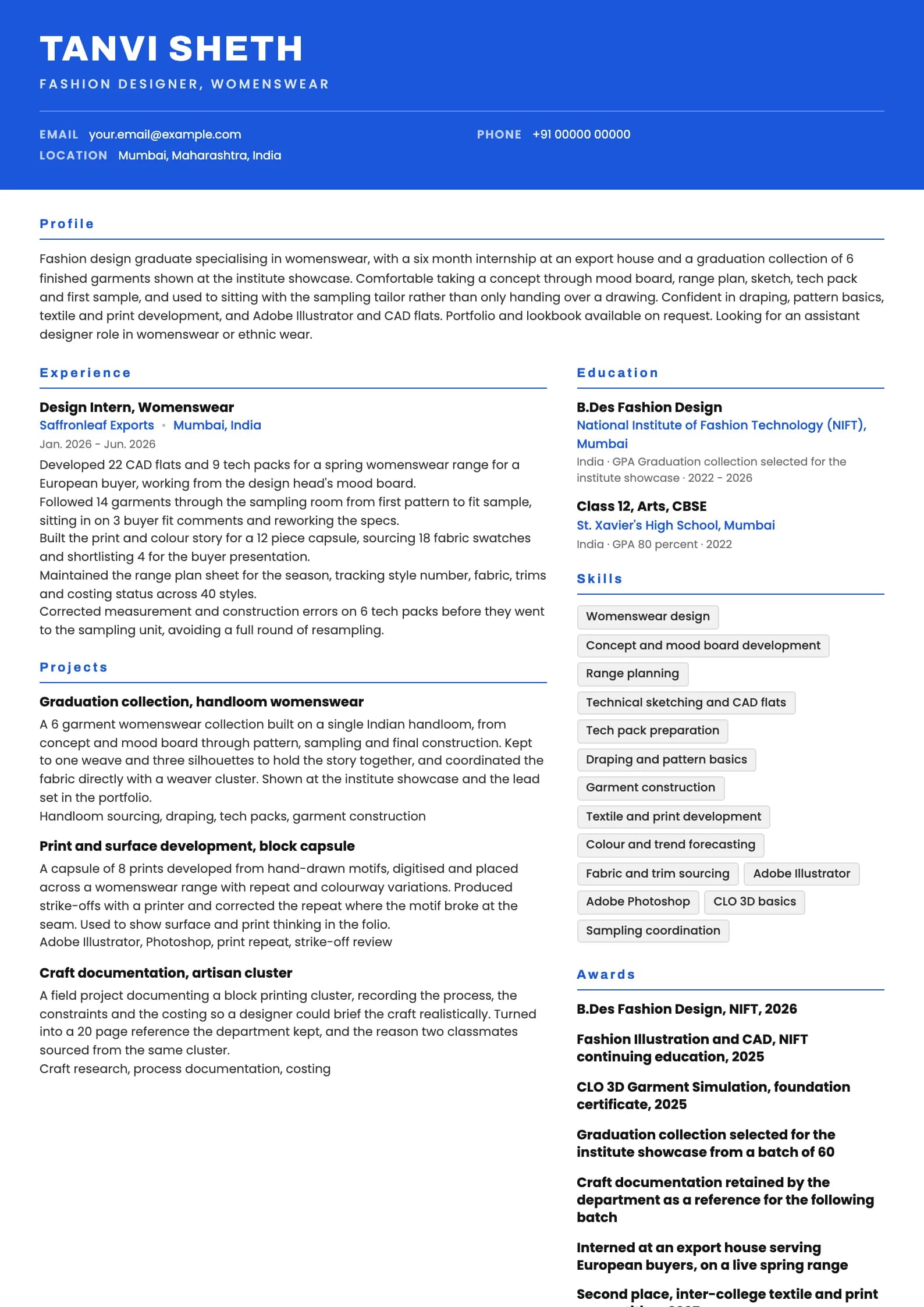
Build my resumeFashion Designer resume example, Fresher, NIFT graduate (0 years)
header-band templateIs your resume good enough?
Upload the resume you have now and see what an applicant tracking system reads before a fashion designer recruiter ever does.
Free to run. Sign in with your mobile number to see your score.
Fashion Designer resume example, Mid-level (5 years)
minimalist template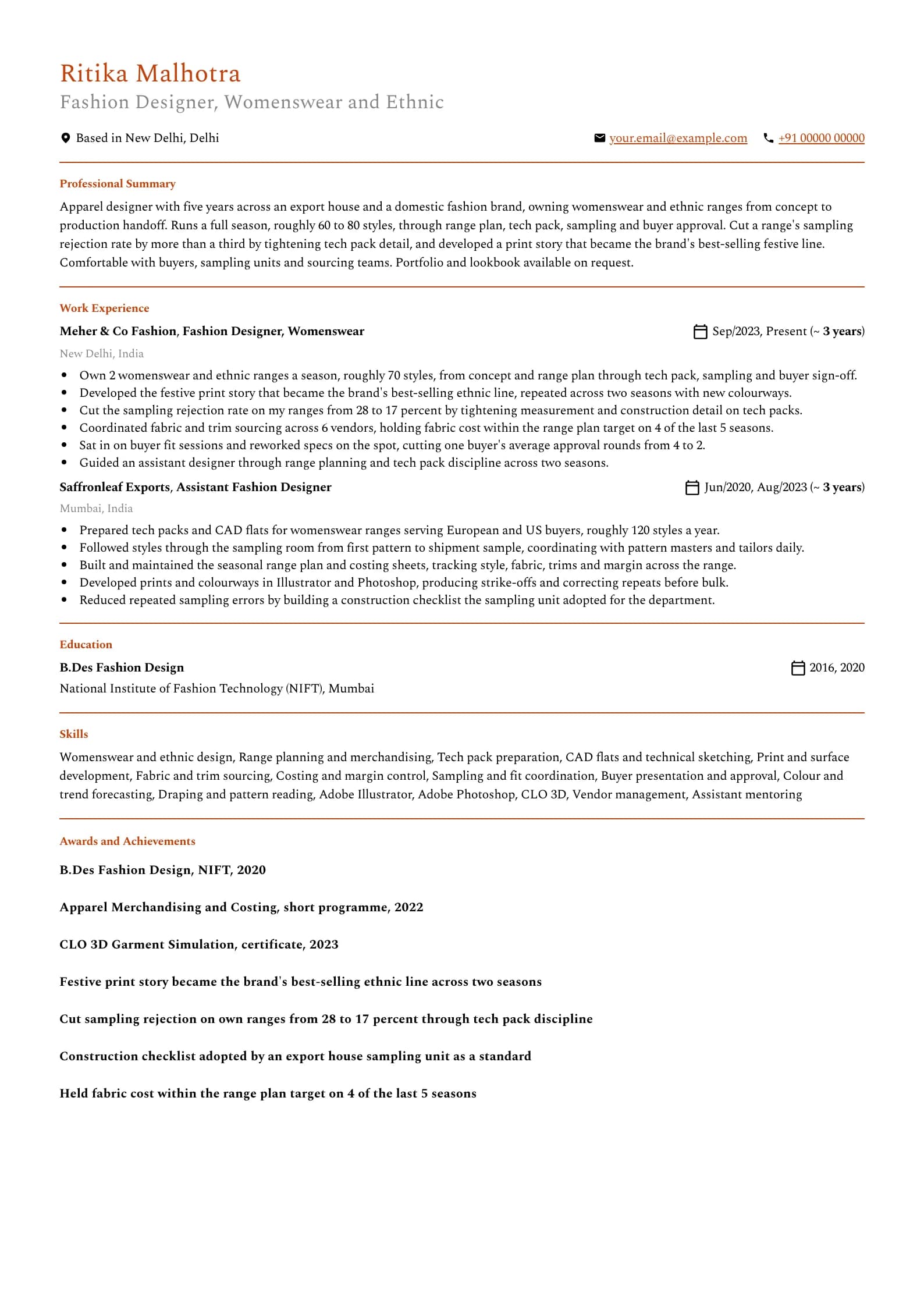
Want this structure with your own details? Build it in the resume builder.
Fashion Designer resume example, Design Manager (10 years)
modern template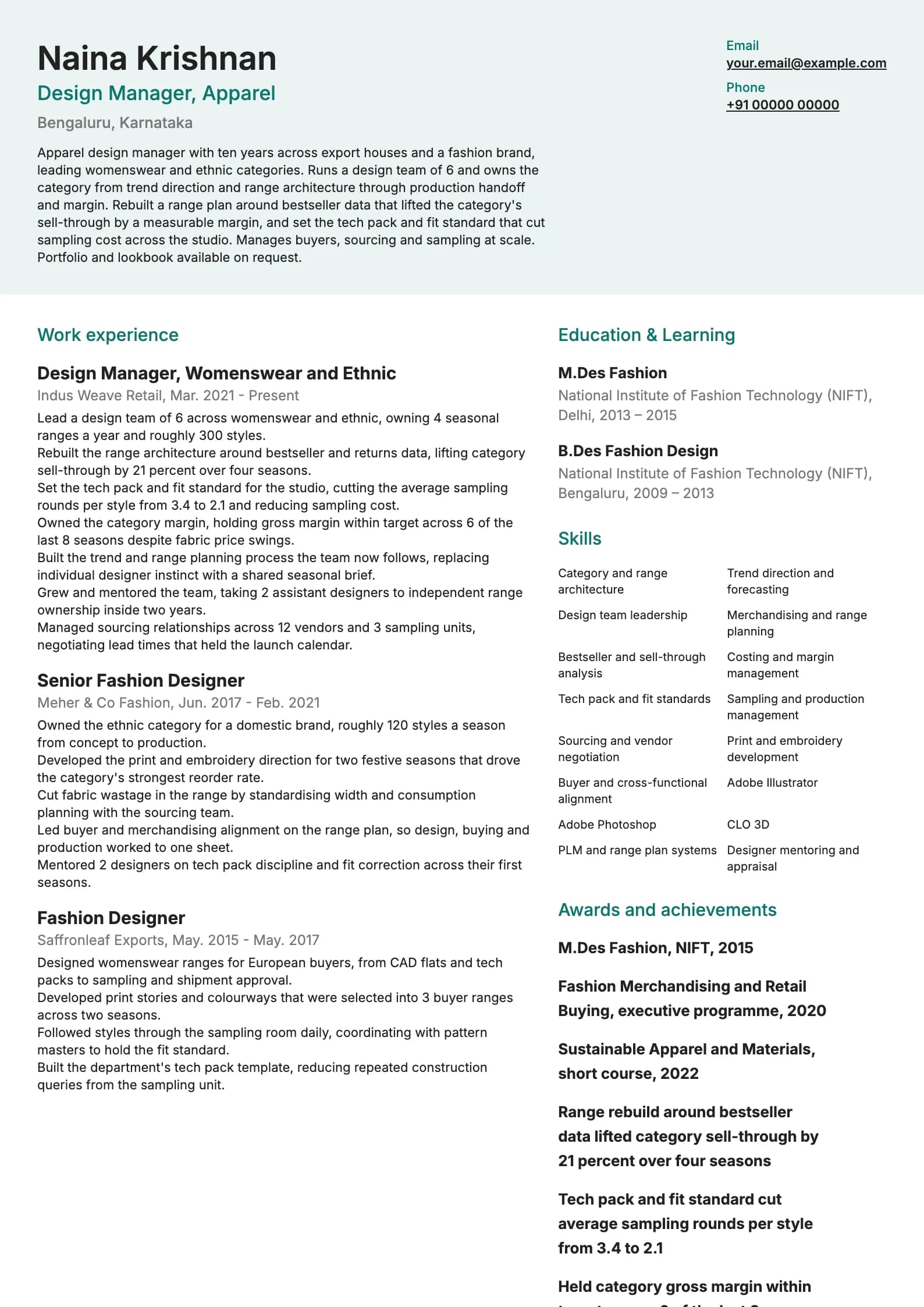
The format that works for fashion designer resumes in India
A fashion resume sits between two worlds. It is read by a design head who cares about taste and by a merchandiser or an export house owner who cares about margin, sampling and delivery, and it has to satisfy both without picking a side. Reverse chronological, one page up to roughly seven years, a second page only for a design manager or a category head with real leadership to show. Single column, clean type, a clear grid. Because you are a designer, the setting of the page is itself judged, so keep it disciplined rather than decorative. Do not turn the resume into a lookbook. Pasting garment photos into the document balloons the file, prints as muddy boxes on an office printer, and reads as blank space to an applicant tracking system. The garments live in the portfolio and the lookbook. The resume names them and links them once, near the top, and spends its space on what you designed, for whom, and what it did in production and in sales. Anchor the craft to the category and the market. Womenswear, menswear, kidswear, ethnic, occasion, western, lingerie, activewear, home textiles and accessories are different hires, and export, domestic retail, e-commerce private label and couture are different businesses. A resume that says fashion designer with no category and no market forces the reader to guess, and a reader with fifty resumes for one vacancy does not guess in your favour. Drop the usual clutter: photo, date of birth, marital status, father's name and a declaration. The section order below is what a design head and a merchandiser both expect, and it is arranged so the category, the market and the portfolio link surface in the first pass.
| Section | Where it goes | Why |
|---|---|---|
| Name and headline | Top, above everything | Name the category: "Fashion Designer, Womenswear" beats "Creative Fashion Professional". |
| Portfolio and lookbook link | In the header block, under the name | The work is judged in the folio. Make the link the easiest thing to find. |
| Summary | Directly under the header | Three lines. Category, years, market or buyers, and one production or sales result. |
| Experience | Next, for anyone with a job | Most recent first. Name the house, the category, the buyers or market, and what shipped. |
| Collections and projects | Above experience for freshers, below it after that | For a fresher the graduation collection and internship are the evidence. Later, the folio covers it. |
| Skills | Below experience | Grouped: design, technical and production, tools. Not a forty item wall. |
| Education and certifications | Bottom, unless you are a fresher | NIFT, NID, Pearl or the relevant institute and degree, then short courses with the year. |
The portfolio and lookbook, and where the link belongs
A fashion designer is hired on the collection, so the portfolio link is not optional and it is not a footnote. Put it in the header block under your name, as a clean working URL, because a design head decides whether to open it in the first few seconds of the scan. A fashion resume with no folio link, or a link to an empty page, is filtered before the experience is read, because the one thing a house cannot hire without seeing is the garment. Show finished garments, not only sketches. Illustrations and CAD flats prove you can draw, but a house is buying a designer who can get a drawing to a well-constructed sample, so photograph real garments on a form or a model wherever you have them. A folio that is all mood boards and croquis reads as a student who has not yet made anything, however beautiful the boards are. Curate to the category and the market you are applying for. An export house doing womenswear should see womenswear and tech packs in the first pages, not your couture graduation gown. Lead with the work closest to the job, keep it to a tight set of strong projects rather than everything you have ever touched, and show at least one project end to end, from concept through tech pack to the finished sample, because that arc is exactly what a designer is hired to walk. A few practical rules. Keep the link clickable and password free, and make sure it opens on a phone, because a design head often opens it between meetings. Include a range or a line sheet somewhere in the folio if you have done merchandised work, because it signals that you think in ranges and margins and not only in hero pieces. And keep it current, because a folio that stops before your most recent role reads as a designer who stopped developing.
- Put the portfolio and lookbook URL in the header, under your name, as plain clickable text. It is the click the resume is built to earn.
- Show finished, photographed garments, not only sketches and CAD flats. A house is buying construction, not just illustration.
- Curate to the category and market of the job. Lead with womenswear for a womenswear role, ethnic for an ethnic one.
- Include at least one project shown end to end, concept through tech pack to final sample, because that arc is the job.
- Add a range plan or line sheet if you have merchandised work, to signal you think in ranges and margins.
- Keep the link clickable, password free and working on a phone, and keep the folio current to your latest role.
- Never paste garment photos into the resume. They break the file size, print as muddy boxes and read as blank to a parser.
Portfolio reference on the resume
Weak
A creative portfolio of my best designs is available and can be shared upon request during the interview.
Strong
Portfolio and lookbook: behance.net/ritikamalhotra. Womenswear and ethnic ranges, tech packs and one collection shown end to end.
A working link in the header beats a promise to share later, and naming the category and the tech packs tells a house you think in production, not only pictures.
A gorgeous mood board with no finished garment behind it reads as a student. Show the sample, the fit and the range, because a house is hiring the person who gets the drawing made.
A summary that a design head and a merchandiser both read
The block under your name is the only part of a fashion resume that is read every time, and it has to satisfy two readers at once. The design head wants to know your category and your eye, the merchandiser wants to know your market and whether you can run a season on plan. So the summary carries both: what you design, how long, for which market or buyers, and one result that is either commercial or production, not a claim about your passion. Delete the line about a creative and passionate designer with a lifelong love of fashion seeking a challenging role. It is on almost every fashion resume, it describes a feeling every applicant shares, and it spends your best three lines saying nothing a house can act on. Replace it with specifics: womenswear and ethnic designer, five years across export and a domestic brand, roughly seventy styles a season, and a print story that became the brand's best-selling festive line. Freshers think they have nothing to summarise. The fresher sample shows otherwise: the category, the length of the internship, the fact that garments went through sampling, and a graduation collection that was shown. That is a real summary from a course and one internship, and it never uses the word passionate, because passion is assumed and evidence is not. Match the summary to the house. An export house reading for buyer and tech pack discipline and a domestic brand reading for range ownership and bestsellers want different words in the first line. Rewriting three lines to lead with the right market takes two minutes and does more than any other edit on the page.
Professional summary, mid-level designer
Weak
A passionate and creative fashion designer with a deep love for fashion, seeking a challenging position in a reputed fashion house to grow my career and creativity.
Strong
Womenswear and ethnic designer with five years across an export house and a domestic brand, owning ranges from concept to production. Developed the print story that became the brand's best-selling festive line.
The rewrite swaps a love of fashion for a category, a market, ownership and a garment that actually sold.
Experience bullets: what you designed, and what it did in production and in sales
Fashion designers write two weak bullets more than any others. The first lists the tasks, so responsible for designing garments and creating tech packs, which describes the job and separates you from no one. The second claims taste, so created beautiful and trendy designs loved by customers, which a reviewer cannot verify and quietly discounts. The samples do neither. Each bullet names an action, the specific thing you designed or the range you ran, and what changed in production, in cost or in sales. The objection is that fashion is subjective. Much of it is, but the parts a house hires on are not. Sampling rejection fell. Approval rounds dropped. Fabric cost held within the range plan. A print story became a bestseller and got reordered. Sell-through rose. Wastage fell. None of these claim your garments were beautiful, they state what happened around the garment, and a merchandiser trusts that far more than an adjective. Where a number does not exist, use scale and commercial fact. How many styles a season, how many buyers, how many vendors, which market, whether it went to bulk, whether it was reordered. Shipped and reordered is a stronger claim than any word about creativity, because it means the garment sold and the buyer came back. Allocate bullets by recency. The current role gets five or six, the previous one four or five, the oldest compresses to what still proves something the recent work does not, the way the design manager sample keeps a six year old export role only for its European buyer and tech pack discipline.
| Level | What bullets must prove | Typical evidence |
|---|---|---|
| Fresher | You can take a concept to a made sample | Garments through sampling, tech packs, CAD flats, a shown collection |
| 1 to 3 years | You run styles through production without hand-holding | Styles a season, tech pack accuracy, sampling coordination, sourcing |
| 4 to 6 years | You own a range and its numbers | Range size, rejection rate, cost within plan, bestsellers and reorders |
| 7 years and up | You own a category and lead a team | Sell-through, margin, sampling standard, team led, sourcing at scale |
Experience bullet, apparel designer
Weak
Responsible for designing new collections and creating trendy garments as per market requirements.
Strong
Own 2 womenswear ranges a season, roughly 70 styles, from concept and range plan through tech pack, sampling and buyer sign-off.
The first describes a job title; the rewrite names the scope, the range size and the whole production arc the designer actually owns.
Experience bullet, production quality
Weak
Made sure garments were of good quality and approved by buyers.
Strong
Cut the sampling rejection rate on my ranges from 28 to 17 percent by tightening measurement and construction detail on tech packs.
Names the metric, the before and after, and the specific action, which a merchandiser can trust and ask a real follow-up about.
Reordered, sold through, cost held, rejection cut. On a fashion resume these production and sales facts beat trendy and beautiful, because they mean the garment reached the shop floor and stayed there.
Design, production and tools, grouped and honest
A fashion skills section fails in the same two ways as most. Either it lists personality, so creative, hardworking, passionate and trendy, which every applicant claims and no reviewer can act on, or it runs to a wall of thirty ungrouped terms mixing draping, buyers, Illustrator and teamwork. Group it, and let each group answer a different question. Three groups cover almost every fashion designer. Design covers the creative craft, concept development, trend and colour forecasting, print and surface, silhouette and range building. Technical and production covers whether you can get a garment made, tech packs, pattern reading, sampling and fit, costing, sourcing and quality. Tools cover the software, Adobe Illustrator, Photoshop, CLO 3D and any PLM or range plan system. The technical and production group is the one juniors underweight and merchandisers read most closely, because a designer who understands tech packs and costing is one the house can trust with a season. Write the terms the way the industry writes them, tech pack not techpack, CAD flats, CLO 3D, sell-through. Houses and portals both match on strings. And keep the list to what you can defend in an interview, because a panel will ask about two of them, and a designer who lists draping and cannot drape a bodice has spent credibility that is hard to earn back. A useful test for each item: could you be handed that task on your first day without supervision? If you list costing, could you cost a style to margin? If not, it belongs in a training line or nowhere. Honesty in this section is what lets a merchandiser trust the rest of the page.
| Group | What belongs here | What does not |
|---|---|---|
| Design | Concept and mood boards, trend and colour forecasting, print and surface, silhouette, range building | Vague umbrellas like "creative design" that match nothing specific |
| Technical and production | Tech packs, CAD flats, pattern reading, sampling and fit, costing, sourcing, quality control | Skipping this group entirely, which is what marks a resume as decorative rather than production ready |
| Tools | Adobe Illustrator, Photoshop, CLO 3D, Browzwear, PLM and range plan systems | Rating bars, and generic MS Office padding on a design resume |
Skills section
Weak
Creative, hardworking, passionate about fashion, good at sketching, trendy, team player, Photoshop
Strong
Design: concept and range building, print and surface development, trend and colour forecasting. Technical: tech packs, CAD flats, sampling and fit, costing, sourcing. Tools: Adobe Illustrator, Photoshop, CLO 3D.
Character adjectives that match no search become grouped, searchable design and production terms that tell a merchandiser exactly what you can be handed.
Getting a fashion resume past the portal and the parser
A small boutique or a designer-led studio still reads every attachment by hand. But the large export houses, the retail fashion brands, the e-commerce private label teams and most job boards run your file through an applicant tracking system before a human opens it, and fashion designers break it in predictable ways because they reach for lookbook layouts. The fixes take a few minutes. The first failure is the image resume. A resume exported as a flat image, or a designed page saved as a picture inside a PDF, has no text layer, so a parser reads a blank document and a search for tech pack or womenswear finds nothing. Test yours by opening the PDF and trying to select a line with the cursor. If nothing highlights, the machine sees nothing on your page. The second is the layout. Two columns with a coloured sidebar, garment thumbnails standing in for content, and section labels replaced by icons all read out of order or as empty space. Keep the resume linear and text based, and move the visual storytelling into the portfolio and lookbook, which is where a design head expects to find it anyway. On wording, mirror the posting's own terms, honestly. If it asks for womenswear, tech packs and merchandising, use those exact words. Name your category and market plainly, because a search for ethnic wear or export house is matching on the specific phrase. Spell an abbreviation out once, for example CAD (computer aided design), so both forms match. And never hide a block of keywords in white text, because parsers flag it and a fashion house reads it as exactly the shortcut a production business cannot afford to trust.
- Keep the resume text based, not an exported image. Test it by selecting a sentence in the PDF.
- Use a single column, linear layout. Save the lookbook design for the portfolio itself.
- Name your category and market in words, womenswear, ethnic, export, retail private label, so a search matches them.
- Mirror the posting's terms honestly: tech packs, sampling, range planning, sourcing, merchandising.
- Spell out abbreviations once, for example CAD and PLM, so both the short and long form are matchable.
- Use standard headings, Experience and Skills, not My Collections or My Fashion Journey.
- Never paste garment photos or hide keywords. One breaks the parse, the other reads as dishonesty to a house.
The more your resume looks like a lookbook, with columns, thumbnails and icons, the less a parser can read it. Keep the resume plain and let the lookbook be the beautiful thing.
What gets fashion designer resumes rejected
Most rejections at the resume stage happen before the folio is opened, and they come from a short list of repeating faults. The list below is ordered roughly by how much damage each does, starting with the two that filter a designer in the first few seconds.
- No portfolio or lookbook link, or a dead one. The fastest rejection, because the garment is the one thing a house cannot hire without seeing.
- No category and no market. "Fashion designer" with no womenswear, ethnic, export or retail forces a guess the reader will not make in your favour.
- The whole resume saved as an image, so a parser reads a blank page and a search finds no tech pack, no sampling, nothing.
- A folio that is all mood boards and croquis with no finished, photographed garment, which reads as a student who has not made anything.
- Adjective bullets: beautiful, trendy, creative, loved by customers. Claims of taste only you can judge, which a reviewer discounts.
- No production vocabulary. A resume with no tech pack, sampling, costing or sourcing reads as decorative and a merchandiser passes.
- Garment photos pasted into the resume, which break the file size, print as muddy boxes and read as blank to a parser.
- Two column, icon and sidebar layouts that a parser reads out of order, scrambling the experience before a human sees it.
- A generic objective about a passion for fashion, in the slot a summary naming category, market and one result should hold.
- The same resume and folio sent to an export house, a couture label and an e-commerce private label, with no reorder to lead with the relevant work.
Read your resume as a merchandiser, not a designer. If it never says tech pack, sampling, costing or a garment that sold, it is a decoration, and a house is hiring someone to run a season.
Skills to put on a fashion designer resume
Technical
- Concept and mood board development
- Trend and colour forecasting
- Range planning and merchandising
- Print and surface development
- Silhouette and collection building
- Technical sketching and CAD flats
- Tech pack preparation
- Draping and pattern reading
- Garment construction knowledge
- Sampling and fit correction
- Costing and margin control
- Fabric and trim sourcing
- Quality control and specification
- Sell-through and bestseller analysis
Tools and platforms
- Adobe Illustrator
- Adobe Photoshop
- CLO 3D
- Browzwear
- Adobe InDesign
- CorelDRAW
- PLM and range plan systems
- Excel range and costing sheets
- CAD flat libraries
- Digital print and repeat tools
- Line sheet and lookbook software
- Trend and WGSN style services
Working skills
- Buyer presentation
- Working with sampling and pattern masters
- Vendor and sourcing negotiation
- Cross-functional alignment with merchandising
- Mentoring assistant designers
- Working to the season calendar
- Receiving and acting on fit comments
- Attention to construction detail
- Craft and artisan collaboration
- Managing revision and approval rounds
Certifications worth listing as a fashion designer
| Certification | Full name | Worth it for |
|---|---|---|
| NIFT degree | B.Des or M.Des Fashion Design, National Institute of Fashion Technology | The most recognised fashion credential in India, and worth naming in full because export houses and brands screen on it. If you hold it, lead the education block with it, since it outweighs any short online course. |
| NID or Pearl diploma | A degree or diploma from NID, Pearl Academy, Symbiosis or a comparable recognised institute | A strong alternative to NIFT that houses recognise. Name the institute and the specialisation, because a womenswear or accessory specialisation answers a question a plain design degree leaves open. |
| CAD or CLO 3D | A garment CAD or 3D simulation certificate, for example CLO 3D or Browzwear | Increasingly asked for as brands move to 3D sampling to cut physical samples. Worth it for designers who want to reduce sampling rounds, and only worth listing if you have 3D work in the folio to back it. |
| Merchandising and costing | An apparel merchandising, costing or retail buying short programme | Useful for a designer who wants to own a range and its margin, or to move towards design management. It signals you think commercially, which is what separates a designer a merchandiser trusts from one they have to police. |
| Sustainable apparel | A sustainable fashion, materials or circular design certificate | Genuinely relevant now that buyers and brands audit on sustainability, and a differentiator for roles in export and retail with compliance requirements. Take it if you work near sourcing and materials, less so for pure creative roles. |
Keywords an ATS scans for in a fashion designer resume
These are the literal terms a parser matches against the job description. Use the ones that are true of you, in the sentences where you did the work, not as a list at the bottom.
- fashion designer
- apparel design
- womenswear
- ethnic wear
- tech pack
- CAD flats
- range planning
- merchandising
- sampling and fit
- print and surface design
- costing
- sourcing
- trend forecasting
- Adobe Illustrator
- CLO 3D
- garment construction
- buyer approval
- export house
- collection development
- sell-through
Fashion Designer resume FAQ
What is the correct resume format for a fashion designer in India?
Reverse chronological, single column, one page up to roughly seven years, with the portfolio and lookbook link in the header under your name. Header with name, category headline and folio link, then a three line summary naming category and market, then experience with the house, buyers and what shipped, then skills grouped into design, production and tools, then education and certifications. Keep the resume itself plain and text based and put the garment photography into the portfolio, because a parser and a printed interview copy both read a linear layout reliably.
Do I need a portfolio, and where does the link go on the resume?
Yes, it is the most important line on the page. Put a clickable portfolio and lookbook URL in the header right under your name, because a design head decides whether to open it in the first few seconds, and a fashion resume without a working link is usually filtered before the experience is read. Show finished, photographed garments rather than only sketches, curate to the category and market of the job, and include at least one collection shown end to end from concept to sample.
How do I write a fashion designer resume as a NIFT or NID fresher?
Treat your graduation collection and internship as the experience, with real bullets: styles designed, tech packs and CAD flats prepared, garments taken through sampling, and the collection shown. The fresher sample above is built this way. Name your category, womenswear or ethnic, keep the design institute and degree near the top, and put the portfolio link in the header, because for a fresher the folio and the shown collection do most of the persuading.
What salary can a fashion designer expect in India?
It varies by city, house and category, so treat these as broad bands rather than promises. A fresher in an export house or a domestic brand often starts around 2.5 to 4.5 LPA, a designer with four to six years and range ownership commonly sits around 6 to 12 LPA, and a design manager or category head in a metro can reach 15 to 30 LPA and beyond. Export houses, retail brands and couture pay differently, and merchandising-heavy roles often pay more than pure creative ones. Do not put a figure on the resume; discuss it at the offer stage.
Should I mention tech packs, sampling and sourcing on a design resume?
Yes, prominently, because they are the vocabulary a merchandiser and an export house read for. A resume that names only the creative side reads as decorative, while one that shows tech pack discipline, sampling coordination, costing and sourcing reads as a designer who can run a season on plan. Put these in the technical and production group of your skills and in your experience bullets, and quantify them where you can, for example a sampling rejection rate you brought down.
Will an applicant tracking system read a fashion designer's resume?
At larger export houses, retail brands and e-commerce private label teams, yes, and a poorly parsed file ranks low enough to be a functional rejection. The two failures that hurt fashion designers most are saving the whole resume as an image, which parses as a blank page, and building a lookbook-style two column layout with thumbnails and icons, which a parser reads out of order. Keep the resume linear and text based, and put the visual storytelling into the portfolio.
How do I show experience across womenswear, ethnic and export work?
Keep the categories and markets named and separated rather than merged. Each role should state its category, its market or buyers, and what shipped, so a house hiring for ethnic finds your ethnic ranges and one hiring for export finds your tech pack and buyer discipline. What fails is a single line saying you designed various collections for various clients, because that matches no search and tells a reader nothing about which season you can run.
How long should a fashion designer resume be?
One page up to roughly seven years of experience. A second page is justified only for a design manager or a category head whose second page carries team leadership, category results and margin rather than more garments. The portfolio is where length is allowed to grow, and even there curation beats volume. If you are struggling to fit one page, cut the oldest role to the one fact that still proves a distinct capability and drop school marks once you have a full season behind you.
Do certifications help a fashion designer get hired in India?
A recognised design degree from NIFT, NID, Pearl or a comparable institute is the credential that carries real weight, so name it in full. Short courses help most when they add a production or commercial edge, a CLO 3D or a merchandising and costing programme, or when they signal compliance knowledge such as sustainable apparel. They help least when stacked in place of finished work, because a house hires on the collection first and the certificate second.
Related resume examples and guides
Build your fashion resume in any of these formats
Start from a blank resume or upload the one you have. Goodspace renders it in 24 templates, keeps the layout parser-safe, and flags what an export house or a brand's applicant tracking system will miss, so the resume earns the portfolio click.
Build my resume