Graphic Designer Resume for Freshers: 2 Samples Built on a Portfolio
A fresher graphic designer is hired on the portfolio, not the resume, so the resume has one job: get you shortlisted and get the recruiter to that portfolio link. The mistake freshers make is stuffing the resume with software names and treating the design degree as the qualification. Below are two complete fresher resumes at different starting points, one design graduate and one self-taught commerce graduate, each built around real projects and a curated portfolio, followed by the rules for framing college and freelance work when you have no full-time job.
Build my designer resume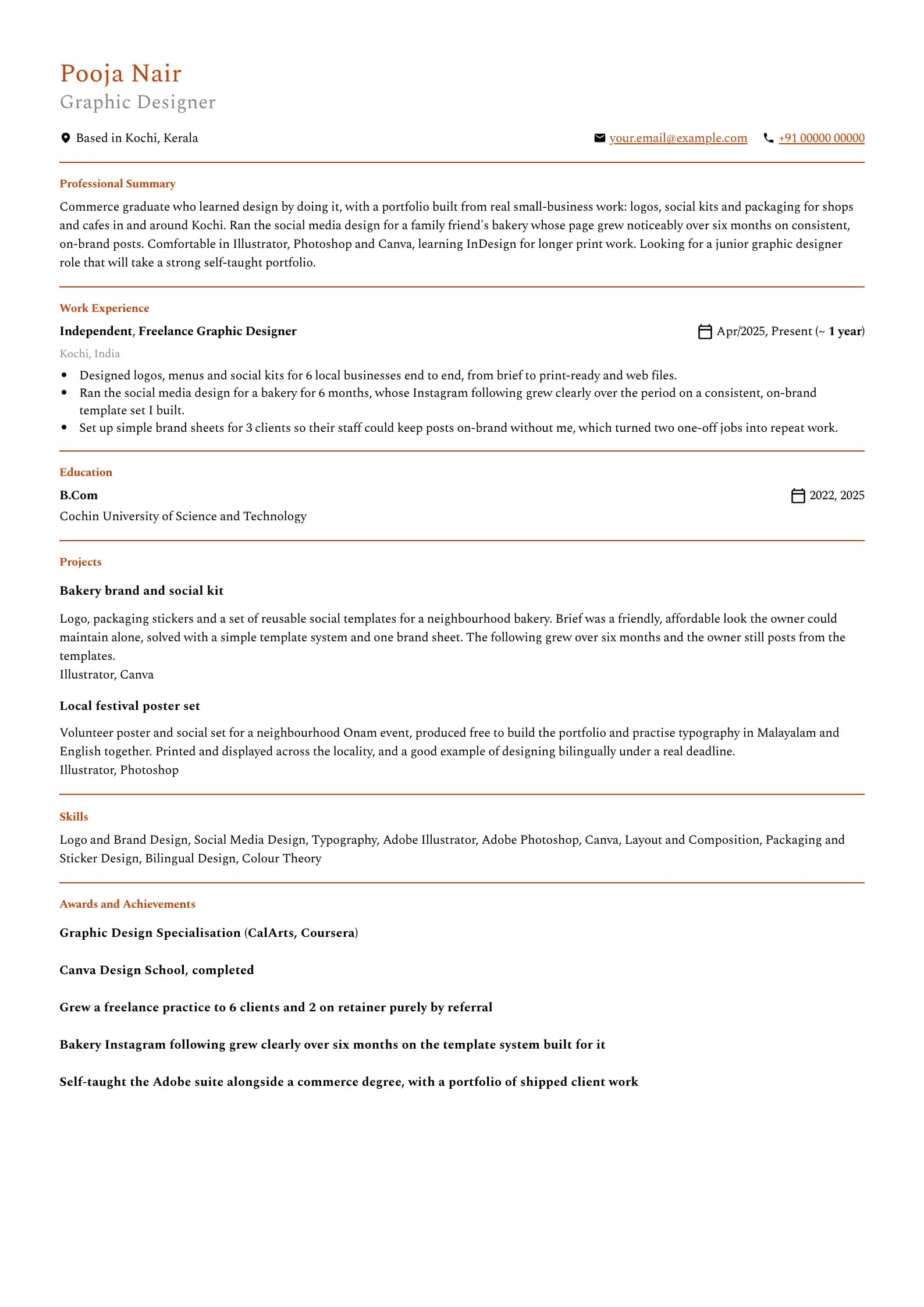
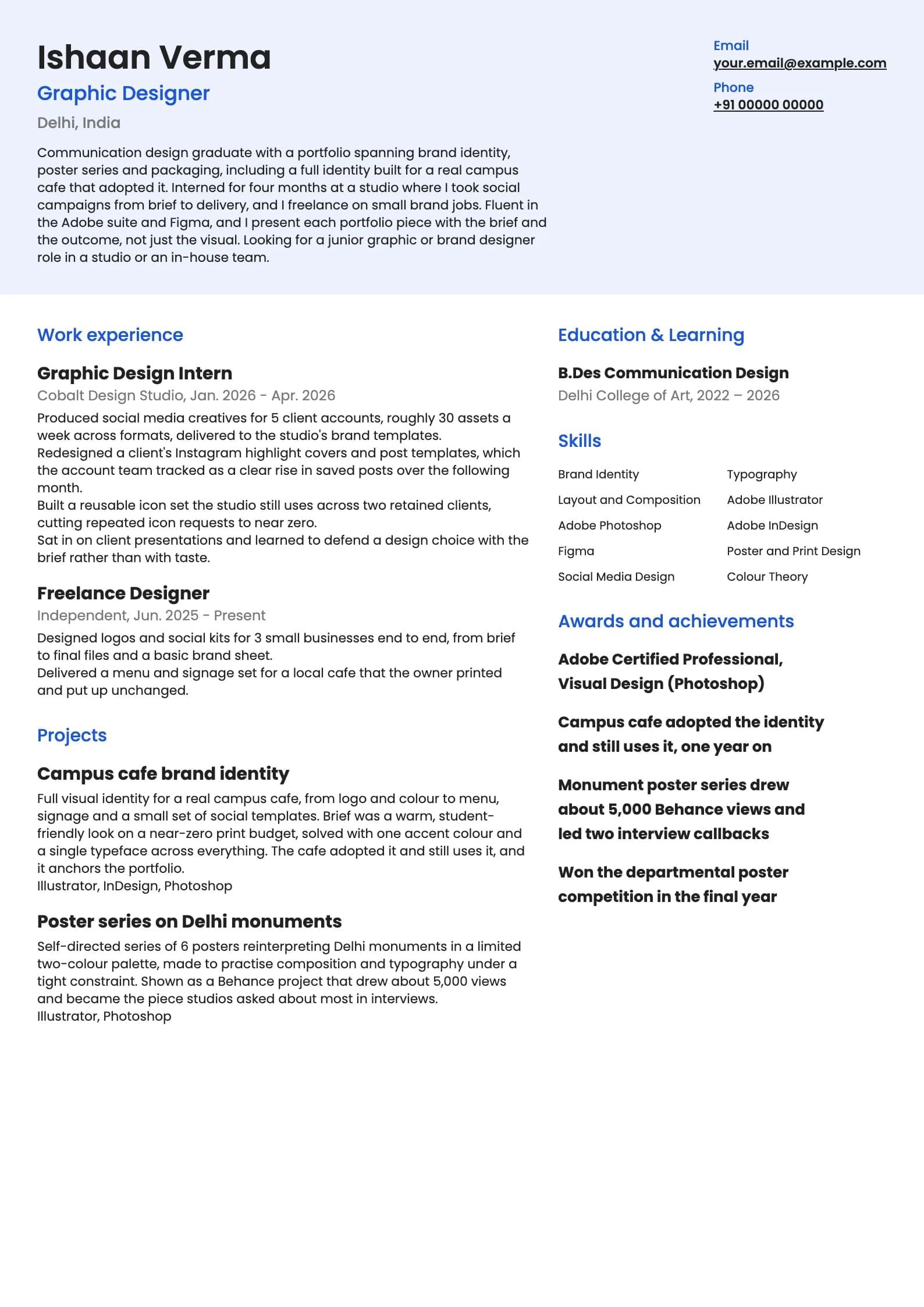
Graphic Designer resume example, Design graduate (0 years)
modern templateIs your resume good enough?
Upload the resume you have now and see what an applicant tracking system reads before a graphic designer recruiter ever does.
Free to run. Sign in with your mobile number to see your score.
Graphic Designer resume example, Self-taught, non-design degree (0 years)
minimalist templateFor a fresher designer, the resume serves the portfolio
A fresher graphic designer is hired on the portfolio, full stop. The resume is not where your visual ability is judged; it is a text document that gets you shortlisted, gets past the applicant tracking system, and gets the recruiter to click your portfolio link. Once you accept that, the resume gets easier to write, because it stops trying to be beautiful and starts trying to be clear and readable. So the portfolio link is the most important line on the page. Write the full URL as plain, selectable text near your name, not buried inside a styled word or an icon, because a parser reads the underlying text and a recruiter on a printout cannot click anything. Point it at a curated set of six to ten strong pieces, not everything you have made, since a recruiter spends under a minute in a portfolio and remembers the weakest thing they see. And make sure it works: a link that opens to a login wall, three placeholder projects or a coming soon banner does more harm than no link, because the recruiter clicked with intent and hit a dead end. Keep the resume itself a single column of real text and send it as a PDF with selectable text. It can still look considered through spacing, weight and one accent colour, as both samples do, but it must not depend on a two-column layout or text inside graphics, because that is what a parser reads out of order or not at all. The craft lives in the portfolio; the resume just has to be readable by software and skimmable by a person.
Open your portfolio link in a private browser window before sending. If it needs a login, shows placeholders or 404s, the line your whole resume points to is a dead end.
Projects: name the brief, the constraint and whether it got used
For a fresher designer, projects are the evidence, and how you describe them decides whether a reviewer sees a thinker or a software operator. The weak entry names a tool and an adjective: a modern and creative poster designed using Adobe Illustrator. The strong entry names the brief, the constraint you worked under, and what happened to the work: a campus cafe identity built to a near-zero print budget that the cafe adopted and still uses. Design is judged by decisions, and decisions only show when you state the constraint. A near-zero budget, a two-colour limit, a bilingual layout, a look the owner had to be able to maintain alone: each of these is a real problem you solved, and naming it is what an interviewer probes. A piece that looks good with no stated brief reads as decoration; the same piece with its constraint reads as design. Prefer work that got used over work that only looked good on your screen. A logo a shop actually prints, a template set a bakery still posts from, a poster displayed across a locality, all of these carry more weight than a slicker self-directed piece that never left the laptop, because adoption is proof someone trusted the work. Both self-taught and design-graduate samples above lean on adopted work for exactly this reason. And describe the project in text, do not paste a screenshot of it into the resume. The image parses as nothing, inflates the file, and the visual belongs in the portfolio anyway. Write what the brief was and what you decided, and let the link carry the picture.
Project description, fresher designer resume
Weak
Cafe Branding: A creative and modern logo and menu design project made using Adobe Illustrator and Photoshop with a clean and attractive look.
Strong
Campus cafe identity: logo, menu and signage built to a warm, student-friendly brief on a near-zero print budget, solved with one accent colour and a single typeface. The cafe adopted it and still uses it.
Replaces tool names and empty adjectives like creative and attractive with the brief, the real constraint, and the fact that the work got adopted.
Framing college and freelance work as experience
Fresher designers undersell themselves by deciding only a full-time studio job counts as experience. Several things count, as long as they produced work someone used. An internship goes in its own experience section with dates and results. Freelance or small-business design counts and is often stronger, because a client paid for and used the output, as both samples show. Volunteer design for a college fest, an NGO or a local event counts too, and is a legitimate way to build a portfolio when you are starting out. Beyond that, a reviewer values checkable evidence. A Behance or Dribbble project with real views, a design competition placement, a client whose page or print you can point to, a piece displayed publicly: each is a fact someone can verify. College projects count fully, provided you describe them by the brief and the decision rather than the tool, and provided the best of them sit in your portfolio where they will actually be seen. What does not help is inflating what you did. Do not present a class assignment as client work, do not list a tool you opened once, and do not claim motion or 3D skills on the strength of a single tutorial, because an interviewer will ask you to talk through the file. Naming a tool as learning, the way both samples handle InDesign, is safer than claiming it, since a stated gap costs nothing while an exposed bluff costs the interview.
- An internship: its own experience section, with dates and two or three specific results.
- Freelance or small-business design: also an experience section, because a client paid for and used the work.
- Volunteer design for a fest, an NGO or a local event: legitimate, real, and good portfolio material.
- A Behance or Dribbble project with real views, or a design competition placement.
- College projects, described by the brief and the decision, with the best of them in the portfolio.
- A tool you are still learning listed as learning, not claimed as a strength you cannot defend.
Skills and education for a fresher designer
List the software, because a recruiter and an applicant tracking system both search for it, but understand that the tools are the floor, not the pitch. Every fresher applying lists Illustrator, Photoshop and Figma, so the software gets you past the filter and the portfolio wins the screen. Write the names the way the industry writes them, Adobe Illustrator not Adobe illustrator, Figma not figma, and mix in the craft skills that actually describe you: typography, layout, brand identity, colour theory, print production. A designer who lists only software reads like an operator; the craft terms read like a designer. Be honest about proficiency. Every tool is a question in the interview, and design interviews are practical: if you list After Effects, expect to be asked what you have animated; if you list InDesign, expect a question about a multi-page layout. List a tool as learning if that is the truth, as both samples do, because a stated gap is safer than a claimed skill an interviewer can expose in five minutes. Drop the campus-template padding, MS Office, typing speed, internet, none of which is a design skill and all of which weaken the list. Education sits near the top for a fresher, since it is one of the few formal credentials you have, but for a designer it is never the qualification, the portfolio is. Put the degree, institution and years, and your CGPA while it is good. A non-design degree is not a barrier: own it in the summary and let the portfolio argue, as the self-taught sample does with a B.Com and shipped client work.
Skills section, fresher designer resume
Weak
Skills: Photoshop, Illustrator, CorelDRAW, InDesign, After Effects, Premiere Pro, 3D, Blender, Figma, HTML, CSS, MS Office, Typing, Creativity
Strong
Design: brand identity, typography, layout, colour theory. Tools: Adobe Illustrator, Adobe Photoshop, Figma. Learning: Adobe InDesign. Print: packaging and prepress basics.
Cuts the tools a fresher cannot defend and the padding like MS Office and typing, adds the craft skills that describe a designer, and marks InDesign honestly as learning.
Skills to put on a graphic designer resume
Technical
- Brand Identity
- Typography
- Layout and Composition
- Colour Theory
- Poster and Print Design
- Social Media Design
- Logo Design
- Packaging Basics
Tools and platforms
- Adobe Illustrator
- Adobe Photoshop
- Adobe InDesign
- Figma
- Canva
- CorelDRAW
Working skills
- Taking a brief
- Presenting and defending a design choice
- Taking feedback and iterating
- Working to deadlines
- Attention to detail
- Collaboration
Certifications worth listing as a graphic designer
| Certification | Full name | Worth it for |
|---|---|---|
| Adobe Certified Professional | Adobe Certified Professional, Visual Design | A clean entry-level signal for a fresher, especially from a non-design degree, because it validates Photoshop and Illustrator fluency by name for a recruiter who cannot yet judge you on a track record. Useful as a foot in the door; the portfolio quickly becomes the stronger credential. |
| Graphic Design Specialisation | Graphic Design Specialisation (CalArts, Coursera) | A structured, project-based course that gives a self-taught fresher a foundation in fundamentals and a set of portfolio pieces. Good for someone learning design outside a design degree; pair it with real client or volunteer work rather than leaning on the certificate alone. |
Keywords an ATS scans for in a graphic designer resume
These are the literal terms a parser matches against the job description. Use the ones that are true of you, in the sentences where you did the work, not as a list at the bottom.
- graphic designer fresher
- entry level graphic designer
- junior graphic designer
- brand identity
- typography
- layout
- Adobe Illustrator
- Adobe Photoshop
- Adobe InDesign
- Figma
- social media design
- logo design
- portfolio
- print design
- visual design
Graphic Designer resume FAQ
Do I need a portfolio for a fresher graphic designer resume?
Yes, absolutely. A fresher graphic designer is hired on the portfolio, not the resume, so the resume exists mainly to get you shortlisted and get the recruiter to click your portfolio link. Build a curated set of six to ten strong pieces, including college, freelance and volunteer work, present each with the brief and the outcome, and write the link as plain text near your name. A designer resume without a working portfolio link is missing the one thing the hire actually turns on.
What should a fresher graphic designer resume include with no experience?
A summary that points at your portfolio, two or three projects described by the brief and the decision, any internship or freelance work as an experience section, a grouped skills list, and your education. With no full-time job, projects and a curated portfolio are your evidence, so lead with them. Include volunteer and college work if it is real and used, and describe each piece by the constraint it solved rather than the software it was made in.
How do I make a fresher designer resume that gets past an ATS?
Keep the resume a single column of real text and send it as a PDF with selectable text, not a PNG or a flat image exported from a design tool. Write your portfolio link and all other information as plain text, not inside graphics or styled buttons, because a parser reads only text. You can still make it look considered with spacing, weight and one accent colour. The visual craft belongs in the portfolio, where it is actually judged, not in a resume layout that a parser cannot read.
Can I become a graphic designer without a design degree?
Yes, and many working designers in India are self-taught or come from other degrees. Own the background in your summary and let a portfolio of real work argue for you, as the self-taught sample above does with a B.Com and shipped client jobs. Learn the core tools to a defensible level, build a portfolio from freelance, volunteer and personal projects, and present each piece with the brief and the decision. Employers who hire on craft care about the work, not the degree name.
Should I list all the design software I know?
List the tools you can genuinely be interviewed on, and mark anything you are still learning as learning rather than claiming it. Design interviews are practical: if you list After Effects, you will be asked what you have animated; if you list InDesign, expect a layout question. A bluff an interviewer exposes in five minutes costs you more than the keyword gains. Also mix in craft skills, typography, layout, brand identity, colour theory, so the list reads like a designer rather than a software operator.
How long should a fresher graphic designer resume be?
One page. A fresher has less to say than an experienced designer, and the resume is only meant to get you to the portfolio, so keep it tight: a summary with your portfolio link, two or three projects, an internship or freelance section, a grouped skills list and your education. Cut the padding that fills a second page, a declaration paragraph, hobbies, a full address, a photo. The portfolio, not a longer resume, is where you show more.
Related resume examples and guides
Build a fresher designer resume that points to your best work
Start from a blank resume in Goodspace or upload a draft. The builder renders it in 24 templates, keeps your portfolio link readable as plain text, and flags what an applicant tracking system will miss.
Build my designer resume