Art Director Resume Format, with 3 Full Samples
An art director is hired on the work, not the resume. The portfolio decides it, and the resume exists to get that link opened and to survive the HR filter that sits in front of the creative lead. Below are three complete resumes, one for a design graduate stepping into an associate art director role, one for an art director with five years across agency and brand, and one for a senior art director running campaigns end to end. After the samples come the format rules, why the portfolio link is the single most important line on the page, how to write a craft-and-concept resume that a creative director will actually read, and the mistakes that get a strong book passed over before anyone clicks it.
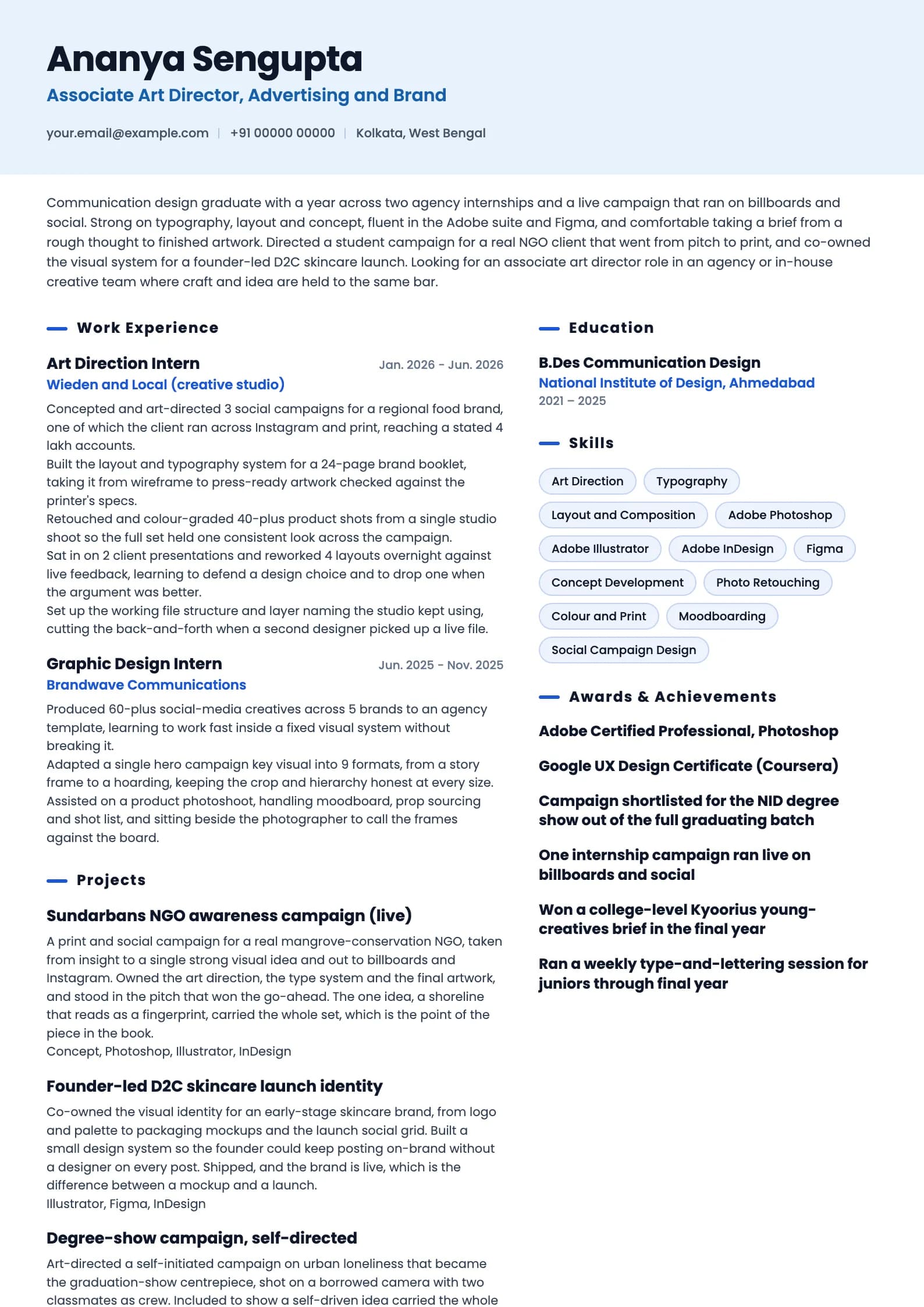
Build my resumeArt Director resume example, Entry (design graduate, 1 year)
ai-era templateIs your resume good enough?
Upload the resume you have now and see what an applicant tracking system reads before a art director recruiter ever does.
Free to run. Sign in with your mobile number to see your score.
Art Director resume example, Art Director (5 years)
professional template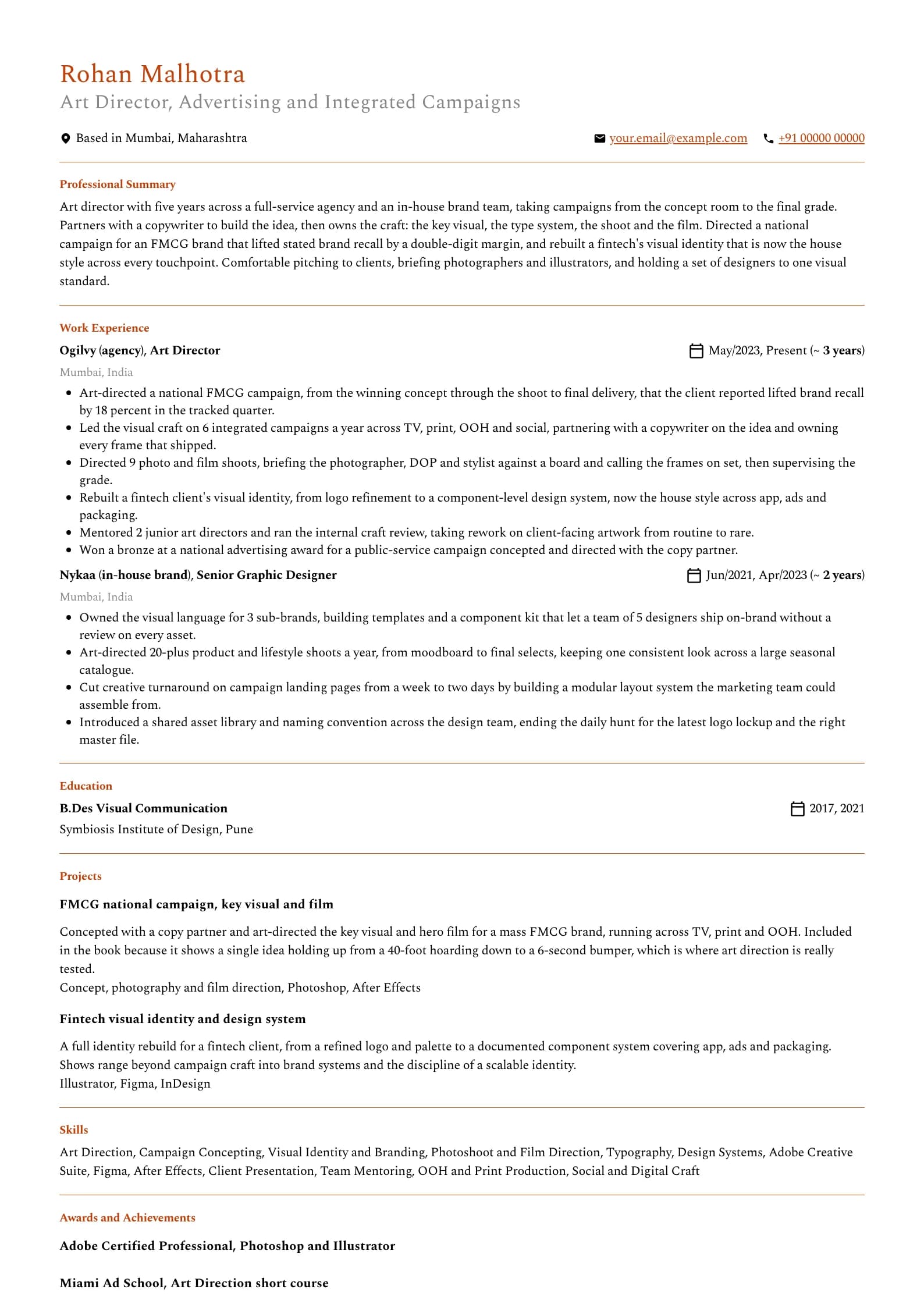
Want this structure with your own details? Build it in the resume builder.
Art Director resume example, Senior Art Director (9 years)
header-band template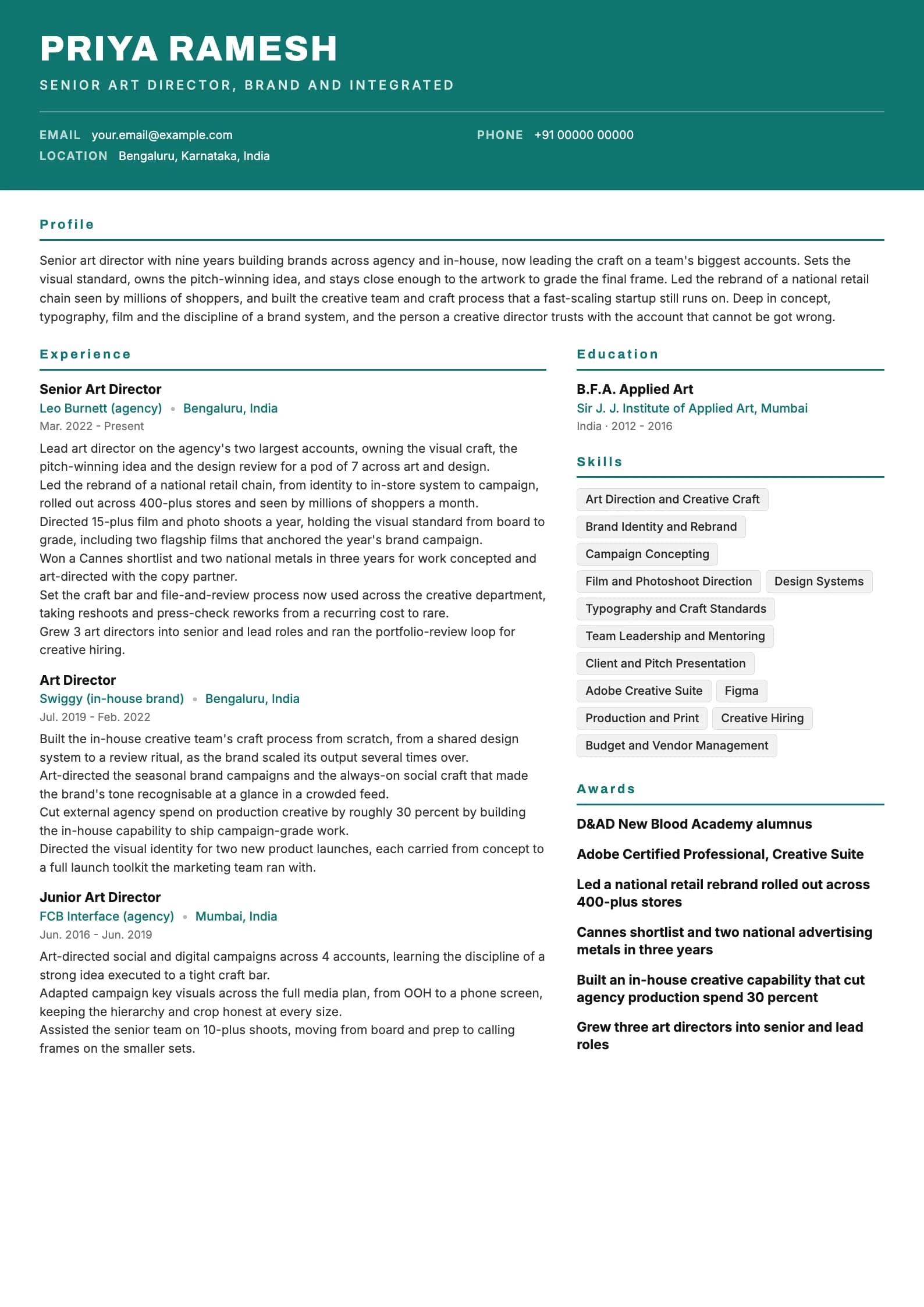
The format that works for art director resumes in India
Reverse chronological, most recent role first, dates in plain view. A creative resume that hides dates under a wall of skills reads the same way a developer's does, as a gap someone is trying to cover, and a creative director has seen the trick many times. One honest line about a gap beats a functional layout built to bury it. The portfolio link is not one line among many, it is the reason the page exists. Put a live, clickable link to your book in the header, right under your name, and make sure it works and is public. A creative lead will glance at the resume, click the link and decide from the work. A resume with no visible portfolio link, or a dead one, is often closed without a second look, no matter how good the writing is. One page is the target for almost everyone up to roughly eight years, because your best proof lives in the portfolio, not the resume. A second page is justified only when it carries real leadership and range, not a longer tools list. Nobody was ever hired as an art director because their software list reached page two. Send a PDF unless the posting asks otherwise, name the file with your own name and the role, and, ironically for a visual person, keep the resume itself clean and readable rather than turning it into a design piece. A resume that fights the reader with five typefaces and a dark-mode gradient sends the wrong signal about your judgement. Save the art for the book. The table below sets out the section order.
| Section | Where it goes | Why |
|---|---|---|
| Name, headline and portfolio link | Top, above everything | The portfolio link is the most important line on the page. Make it live, public and impossible to miss. |
| Professional summary | Directly under the header | Three lines. What you make, how long, and the strongest campaign or result. |
| Work experience | Next, for anyone with agency or brand time | Most recent first. Lead each role with the idea you owned and what it did. |
| Selected work or projects | Above experience for a fresher, below it after that | Name the campaign, the idea and where it ran. For a fresher this is the evidence. |
| Skills | Below experience | Grouped: craft, direction, tools. Not a 30-item software wall. |
| Awards and recognition | Its own short block if you have them | Cannes, Kyoorius, Abby, D&AD. Name the metal, the show and the year. |
| Education | Bottom, unless you are a fresher | Design or fine-art degree, institution, years. NID, MICA and JJ carry weight. |
The portfolio link is the job. The resume just opens the door
No other role on this site is as portfolio-first as art director. A developer is hired partly on how they describe their systems. An art director is hired on the work you can see, and the resume's real job is to get that work opened and to survive the HR keyword filter that sits between you and the creative lead. Treat the resume as the ticket, not the show. That means the link comes first, it is live, and it goes to a curated book, not a dumping ground. Ten strong pieces beat forty average ones, because a reviewer judges you on the weakest thing they see, not the best. If a project embarrasses you a little, it is dragging the whole book down, so cut it. Lead with your single strongest campaign, because many reviewers decide in the first two projects whether to keep scrolling. Curate the book to the job. An FMCG agency role wants mass-brand craft and film. A D2C brand wants packaging, social systems and a recognisable tone. A UX-adjacent product role wants systems thinking. The same person often needs two or three versions of the book, and the resume's selected-work section should mirror whichever one you sent. Make the link bulletproof. Test it in an incognito window, on a phone, and from a network that is not yours, because a book that asks for a password or shows a broken image is worse than no link at all. Behance, a personal site or a well-organised PDF all work. What does not work is a Google Drive folder of loose JPEGs named final_final_2, which tells a creative director exactly how organised you are before they have seen a single layout.
Before you send anything, open your own portfolio link on a phone you are not logged in on. If it asks for a login, loads slowly, or leads with a weak piece, fix that before you touch a single word of the resume. The link is the whole game.
Writing a summary a creative director actually reads
The block under your name is the part that gets read before the link is clicked, so it should carry three things: what you make, how long you have made it, and the single strongest campaign or result behind you. Three or four lines, no adjectives a portfolio would have to prove anyway. The words creative resumes lean on hardest are the emptiest. Passionate, creative, innovative, out-of-the-box, thinking-outside-the-box. A creative director reads dozens of these a week and they carry no information, because everyone applying claims them. Replace the adjective with the evidence: not creative art director but the art director who lifted brand recall 18 percent and rebuilt a fintech's identity. Name the kind of work you do. Advertising art direction, brand identity, packaging, social craft and film direction are not the same job, and a summary that says which one you own helps a reviewer match you to the brief. The mid-level sample says integrated campaigns and owns the frame, so a film-heavy agency knows to open the book. A useful test: could a classmate with the same degree and the same internships paste your summary onto their resume unchanged. If yes, it describes the course, not you. Add the specific campaign, the specific brand category and the specific result until it stops being transferable.
Professional summary, mid-level art director
Weak
Passionate and creative art director with 5+ years of experience and a keen eye for detail, seeking a challenging role in a reputed advertising agency to deliver innovative and out-of-the-box campaigns.
Strong
Art director with five years across agency and in-house brand, taking campaigns from the concept room to the final grade. Lifted stated brand recall 18 percent on a national FMCG campaign and rebuilt a fintech identity now used as the house style.
The rewrite drops five unprovable adjectives for a category, an ownership scope and two results a reviewer can go and verify in the book.
Experience bullets: idea, craft, result
Art direction is two jobs held at once, the idea and the execution, and the strongest bullets show both. Open with the idea or campaign you owned, name the craft you actually did, the shoot, the identity, the type system, and close with what it moved, a recall number, a rollout scale, a turnaround cut, an award. The idea shows you can think. The craft shows you can make. The result shows it worked. Write the campaign, not the task. Designers under-sell by describing process, worked on social media creatives for various brands, when the reviewer wants to know which campaign, what the idea was, and where it ran. Ask what was different in the market after your work shipped: a brand became recognisable, recall rose, a launch landed, a rebrand rolled out. Then write the sentence that ends in that fact. Quantify honestly, and not only with awards. Craft people reach for metals because they are countable, but a reviewer also reads reach, recall, rollout scale, production-spend saved, turnaround cut and team grown. A resume that is all awards and no business number reads as a portfolio in disguise, and one with no numbers at all reads as junior. Vary the proof. Where you cannot attach a number, give scale: how many shoots directed, how many brands owned, how many stores a rebrand reached, how large the team you set the standard for. "Directed 15-plus shoots a year, holding the standard from board to grade" carries weight without inventing a percentage.
| Level | What bullets must prove | Typical proof |
|---|---|---|
| Entry / associate | You can take a brief to finished, on-brand craft | Live campaign shipped, shoots assisted, formats adapted, a real client |
| Art director (3 to 6 yrs) | You own the idea and the craft on a campaign | Recall or reach, shoots directed, identity built, award, turnaround cut |
| Senior art director (7 yrs+) | You set the standard and lead the craft on the biggest work | Rebrand scale, metals, production-spend saved, team grown, process set |
| Toward creative director | You shape the creative product, not just the artwork | Accounts led, pitches won, creatives grown, house style owned |
Experience bullet, campaign work
Weak
Worked on various social media and print campaigns for multiple brands and delivered creatives as per client requirements on time.
Strong
Art-directed a national FMCG campaign from the winning concept through the shoot to final delivery, which the client reported lifted brand recall by 18 percent in the tracked quarter.
"Various" and "as per requirements" describe a job slot; the rewrite names one campaign, the ownership from concept to grade, and the business result.
Experience bullet, identity work
Weak
Responsible for designing logos, brand guidelines and other creative assets for clients using Adobe Creative Suite.
Strong
Rebuilt a fintech client's visual identity, from logo refinement to a component-level design system, now the house style across app, ads and packaging.
Trades a list of asset types and a tools name for one identity project and the fact that it became the standard, which shows it stuck.
If a bullet would read the same on any designer's resume, it is describing the department, not you. Name the campaign, the idea and the number until it only fits the work in your own book.
The skills section: craft and direction over a software wall
A creative resume's skills section has a specific failure mode: it becomes a list of every Adobe app plus a dozen more, as if the tools were the talent. Photoshop, Illustrator, InDesign, After Effects, Premiere, Lightroom, XD, Figma, Sketch, Procreate is ten items that tell a creative director almost nothing, because tool fluency is assumed for the role, the way a driver is assumed to know the pedals. Group by what you can do, not what you can open. Craft, direction, and tools is a grouping that works for almost any art director. Craft is typography, layout, colour, retouching. Direction is concepting, photoshoot and film direction, brand systems, art direction of other designers. Tools is the software, kept to one honest line at the end. The direction group is the one that separates an art director from a production designer, so give it the weight. Ten to sixteen skills is the working range, and the ones that matter are the direction skills, not the apps. Write the industry spelling: After Effects not AfterEffects, InDesign not Indesign. If you know motion, 3D or a specific film-craft skill, name it, because it is rarer than another Adobe logo and it is what gets you the shoot. Do not use star ratings or skill bars. Four stars in typography is an argument you cannot win and a claim the portfolio will settle in one glance anyway. Let the book prove the depth, and keep the skills list to a clean, grouped signal of range.
Skills section
Weak
Skills: Photoshop, Illustrator, InDesign, After Effects, Premiere Pro, Lightroom, XD, Figma, Sketch, Procreate, CorelDRAW, MS Office, Canva, Creativity, Teamwork, Communication, Time Management
Strong
Craft: typography, layout, colour and retouching. Direction: campaign concepting, photoshoot and film direction, brand systems, art-directing designers. Tools: Adobe Creative Suite, Figma, After Effects.
Collapses a ten-app wall and four generic soft skills into three groups that answer the real question, what can you actually direct, with the tools reduced to one honest line.
Selected work: name the campaign, the idea and where it ran
For a design graduate, selected work is the resume. It sits above experience, it gets the most space, and it is where a reviewer decides whether you can carry an idea from brief to something that shipped. For an experienced art director it moves below experience and shrinks to two or three flagship campaigns that show range the day job list does not. The common failure is describing the deliverable instead of the idea. A social media campaign for a food brand using Photoshop and Illustrator tells a creative director nothing, because it is true of a thousand resumes. Name the insight, the single idea that carried it, and where it actually ran. The fresher sample's shoreline-that-reads-as-a-fingerprint is stronger than a slicker project with no idea behind it, because art direction is judged on the idea and the resume states it. Lead with live, client-facing work over self-initiated pieces, because shipped proves the idea survived a client, a budget and a printer. A self-directed passion project earns a place only when it shows a skill the client work does not, and it should say so. Pick projects that show range: one mass-brand campaign, one identity or system, one craft-led or personal piece, rather than three variations of the same social grid. Always point selected work at the portfolio. The resume names the campaign in a line; the book shows it. Make sure the piece named here is actually in the linked book and easy to find, because a reviewer who reads the line and cannot find the work in the portfolio reads the gap as a resume that overclaims.
Project description, entry-level resume
Weak
NGO Campaign: designed a social media and print campaign for an NGO client using Photoshop, Illustrator and InDesign, including posters and Instagram posts.
Strong
Sundarbans NGO awareness campaign (live): took a mangrove-conservation brief to one idea, a shoreline that reads as a fingerprint, and out to billboards and Instagram. Owned the art direction and the type system, and stood in the pitch that won the go-ahead.
Swaps a deliverable-and-tools list for the single idea, the fact that it ran live, and the ownership, which is what an art direction reviewer is scanning for.
Where education, awards and certifications belong
Education goes at the bottom for anyone with agency or brand experience, and near the top for a fresher, who leads with the degree and the degree-show work. Design or fine-art degree, institution, years. A strong pedigree carries real weight in Indian creative hiring: NID, MICA, Srishti, Symbiosis, JJ School of Art and Pearl are names a creative director reads instantly, so make the institution visible if it is one of them. Marks matter far less here than in almost any other field. Nobody hires an art director on a CGPA, so a percentage is optional even as a fresher, and worth dropping entirely once you have shipped work. What replaces it is the degree-show or thesis project, which a fresher should name because it is often the strongest self-directed piece in the book. Awards deserve their own short block if you have them, above education, because in advertising they are currency. Name the metal, the show and the year: a Kyoorius gold, an Abby, a Cannes shortlist, a D&AD pencil. Do not inflate a shortlist into a win, because the industry is small and someone on the panel may be reading your resume. Certifications sit near skills or education and matter less than in technical roles, because the portfolio outranks any badge. An Adobe certification is a minor plus for a fresher and near-invisible after that. A short course at a respected school, Miami Ad School, D&AD, a well-known workshop, is worth naming while early, mostly for the network and the brief it put in your book. Beyond a few years, let the work be the credential.
Getting past the HR filter before a creative sees it
Art director resumes hit a filter that developer resumes rarely do: the first reader is often an HR recruiter or an applicant tracking system, not the creative director, and both are matching your page against a brief written in plain business language. The portfolio wins the job, but the resume has to survive this gate first, and creative people lose here more often than they should because they design the resume instead of formatting it. The layout rules are the same as anywhere. One column, so a two-column art-director resume with a sidebar of skills does not get read out of order. Standard section headings, Work Experience not My Journey, Skills not My Toolkit, because a parser files an unrecognised heading into a bucket the recruiter never searches. Real selectable text, not a resume exported as a single flat image, which is a genuine temptation for a visual person and reads to a parser as a blank page. On wording, mirror the brief where it is honest. If the posting says art director write art director, if it says brand identity write brand identity, if it says integrated campaigns use that phrase. An HR filter searching for art director will not credit visual storyteller, however much you prefer it, so keep the industry title on the page and save the flourish for the book. Put the portfolio link as plain, selectable text as well as a hyperlink, so a parser or a recruiter copying details into a system keeps it. A link that lives only inside a fancy button graphic can vanish when the file is parsed, and a portfolio link that does not survive the system is the one failure this whole page is trying to prevent.
Job title on the resume
Weak
Visual Storyteller and Brand Magician
Strong
Art Director
A recruiter and an ATS search for the real title; a clever one files your resume into a bucket nobody looks in, so the book never gets opened.
Test your own file before sending: copy the text out of the PDF into a plain editor. If your portfolio link, your title and your dates do not come through as readable text, the filter cannot read them either, and a beautiful resume that parses as a blank page is the worst of both worlds.
What gets art director resumes passed over
Most art director resumes are not rejected on a close call, they are passed over on a handful of recurring problems, and every one is fixable in an afternoon. The list below is what creative directors and creative recruiters in India see most often, in rough order of how much damage each does.
- No portfolio link, a dead link, or a link that asks for a password. This alone ends most applications, because the resume was only ever the ticket to the work.
- A book that leads with a weak piece or dumps forty average ones. You are judged on the weakest thing shown, so curate to ten strong pieces aimed at the job.
- A resume over-designed into a mini-portfolio, five typefaces and a gradient. It signals shaky judgement and, worse, it does not parse. Keep the resume clean, save the art for the book.
- Adjectives instead of evidence. Passionate, creative and out-of-the-box carry no information a portfolio would not prove anyway. State the campaign and the result.
- A skills section that is a wall of every Adobe app. Tool fluency is assumed. Lead with direction and craft, keep the software to one line.
- The deliverable described instead of the idea. Name the insight and the single idea that carried the campaign, not just posters and Instagram posts.
- Awards inflated: a shortlist written as a win, or a team credit claimed as solo. The industry is small and verification is a phone call.
- The clever job title, visual storyteller or brand ninja, that an HR filter searching for art director never matches.
- A resume exported as a flat image with no selectable text, which a parser reads as blank and a recruiter cannot copy the portfolio link out of.
- Selected work named on the resume that a reviewer then cannot find in the linked book, which reads as overclaiming.
Send your resume and portfolio link to one art director friend and one non-creative friend. The art director tells you if the work holds up. The non-creative tells you if the resume is readable and the link works, which is the half creatives usually skip.
Skills to put on a art director resume
Technical
- Art Direction
- Campaign Concepting
- Typography and Layout
- Brand Identity and Systems
- Photoshoot Direction
- Film and Motion Direction
- Colour and Retouching
- Print and Production
- Packaging Design
- Social and Digital Craft
- Storyboarding
- Design Systems
Tools and platforms
- Adobe Photoshop
- Adobe Illustrator
- Adobe InDesign
- Adobe After Effects
- Adobe Premiere Pro
- Figma
- Lightroom
- Procreate
- Behance
- Cinema 4D
Working skills
- Client presentation
- Concept pitching
- Creative direction of designers
- Copywriter partnership
- Feedback and critique
- Mentoring
- Deadline and production management
- Vendor and photographer briefing
- Storytelling
Certifications worth listing as a art director
| Certification | Full name | Worth it for |
|---|---|---|
| Adobe Certified Professional | Adobe Certified Professional (Photoshop, Illustrator, InDesign) | A minor plus for a design fresher or career switcher who wants a paper signal of tool fluency for a campus or HR filter. Near-invisible once you have a portfolio and shipped campaigns, since the book proves craft far better than a badge. Do not build a resume around it. |
| Miami Ad School | Miami Ad School, Art Direction programme or short course | Worth it early for the network, the mentorship and the brief-led work it puts in your book, especially if you are moving from design into advertising art direction. The real value is the portfolio pieces it produces, not the certificate line, so treat it as a book-builder. |
| D&AD Shift / New Blood | D&AD New Blood Academy or Shift night school | A strong early credential for creatives without a formal ad-school pedigree, respected across the industry and built to produce portfolio work. Most useful in the first few years when you are assembling a book and a network. The mentors and the awarded briefs matter more than the line itself. |
| Google UX Certificate | Google UX Design Certificate (Coursera) | Relevant only for an art director drifting toward product and digital-product design, where systems and interaction thinking are the currency. Signals you are serious about the pivot to a hiring manager who is not sure. For a pure advertising or brand art director it adds little. |
Keywords an ATS scans for in a art director resume
These are the literal terms a parser matches against the job description. Use the ones that are true of you, in the sentences where you did the work, not as a list at the bottom.
- art director
- advertising
- brand identity
- campaign
- concept development
- typography
- adobe creative suite
- photoshop
- illustrator
- indesign
- after effects
- figma
- photoshoot direction
- visual design
- design systems
- creative direction
- layout
- packaging
- social media
- portfolio
Art Director resume FAQ
What salary can an art director expect in India?
An associate or junior art director typically starts around 5 to 9 LPA, higher at the top agencies and product-led brands. A mid-level art director with four to six years usually sits in the 12 to 22 LPA band, and a senior art director with eight years and above commonly earns 22 to 40 LPA, more at leading agencies and in-house brand teams. Awarded work, film-direction experience and a strong book all push the top of every band upward, and in-house brand roles at large tech and consumer companies often pay above agency scale.
How long should an art director resume be?
One page up to about eight years, because your real proof lives in the portfolio, not the resume. A second page is justified only when it carries genuine leadership and range, never a longer software list. The resume's job is to get the portfolio link opened and to pass the HR filter, so keep it tight and readable and let the book do the persuading.
Do I really need a portfolio for an art director role?
Yes, without exception. The portfolio is the single most important thing in the application, and the resume exists mainly to get it opened. Put a live, public, clickable link in the header, curate it to ten strong pieces aimed at the specific job, and lead with your best campaign. A resume with no portfolio link, or a dead one, is usually closed without a second look, however good the writing is.
Should my resume itself be heavily designed?
No, and this trips up a lot of creative people. The resume should be clean, readable and easy to parse, because the first reader is often an HR recruiter or an applicant tracking system, and an over-designed page with five typefaces and a gradient both signals shaky judgement and fails to parse. Save your design skill for the portfolio, which is where it is actually being judged, and let the resume just deliver the link and the facts.
How do I write an art director resume with little experience?
Lead with selected work, then education and the degree-show project, then skills. Treat every project as a campaign: the brief, the single idea that carried it, and where it ran or how it shipped. Live client work, even from an internship, outweighs a slicker piece that never left your laptop, because shipped proves the idea survived a client. Point everything at a curated portfolio link, and make sure the pieces you name are easy to find inside it.
Do awards actually matter on an art director resume?
In advertising they are real currency, so name any genuine metal, the show and the year, whether it is a Kyoorius, an Abby, a Cannes shortlist or a D&AD pencil, in a short block above education. But do not inflate a shortlist into a win or claim a team credit as solo, because the industry is small and verification is a phone call. In-house brand and product roles weight awards less and business results, recall, reach and rollout, more.
Should I list every Adobe app in my skills section?
No. Tool fluency is assumed for the role, so a wall of ten Adobe apps tells a creative director almost nothing. Group your skills into craft, direction and tools, give the most weight to the direction skills, concepting, photoshoot and film direction, brand systems, that separate an art director from a production designer, and keep the software to one honest line. Skip star ratings entirely, because the portfolio settles the depth question in a glance.
How is an art director resume different from a graphic designer one?
A graphic designer resume can lead on craft and execution, the layouts, the assets, the tools. An art director resume has to prove two things at once: the idea and the craft. Reviewers look for evidence you concepted the campaign, not only executed it, and that you can direct others, a shoot, an illustrator, a team of designers, to one standard. So an art director resume leads bullets with the campaign and the idea you owned, and shows scope, shoots directed, brands owned, a team held to a bar, that a designer resume does not.
Does an ATS or HR filter reject creative resumes?
It can quietly drop them, which is worse than a visible rejection. The most common causes are a two-column layout parsed out of order, a resume exported as a flat image with no selectable text, a clever job title like visual storyteller that a search for art director never matches, and a portfolio link buried inside a button graphic that does not survive parsing. Use one column, standard headings, the real job title, and a plain-text portfolio link, then copy your own text out of the PDF to confirm it all reads.
Related resume examples and guides
Build your own in any of these formats
Start from a blank resume or upload the one you have. Goodspace renders it in 24 clean, parser-safe templates, keeps your portfolio link front and centre, and flags the campaign and craft keywords an HR filter looks for, so the page does its one job: getting your book opened.
Build my resume