Product Designer Resume Format, with 3 Full Samples
A product designer is hired on outcomes and thinking, not on pretty screens. The portfolio proves the process, the resume proves the impact, and the strongest candidates make both agree. Below are three complete resumes, one for a design graduate with internships targeting a junior product design role, one for a product designer with four years shipping features that moved real metrics, and one for a senior product designer owning a design system and mentoring a team. After the samples come the format rules, why a product design resume leads with impact over tools, how to prove UX thinking on paper, and the mistakes that get a good designer filtered before a hiring manager sees the work.
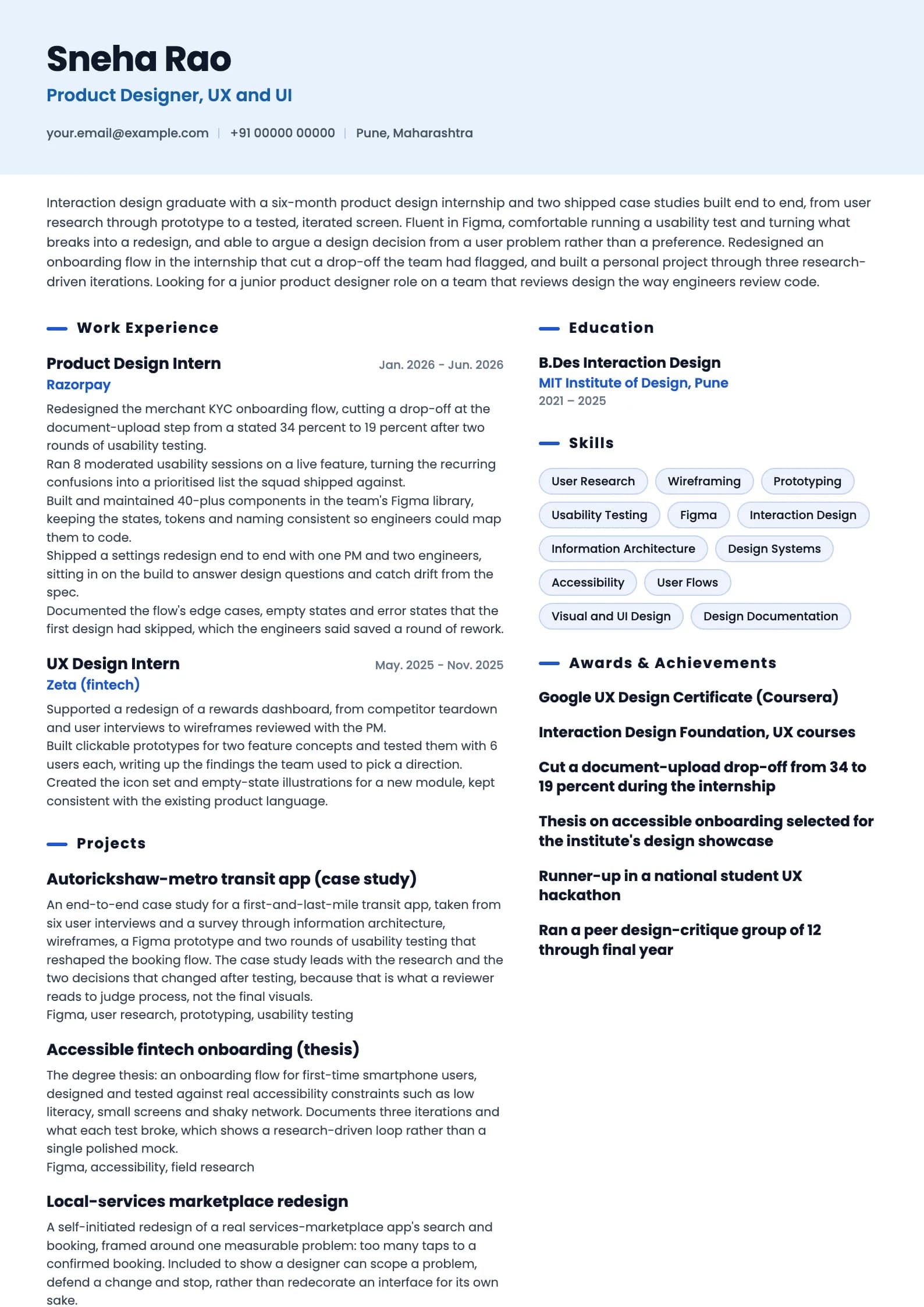
Build my resumeProduct Designer resume example, Fresher (design graduate, 0 to 1 year)
ai-era templateIs your resume good enough?
Upload the resume you have now and see what an applicant tracking system reads before a product designer recruiter ever does.
Free to run. Sign in with your mobile number to see your score.
Product Designer resume example, Mid-level (4 years)
modern template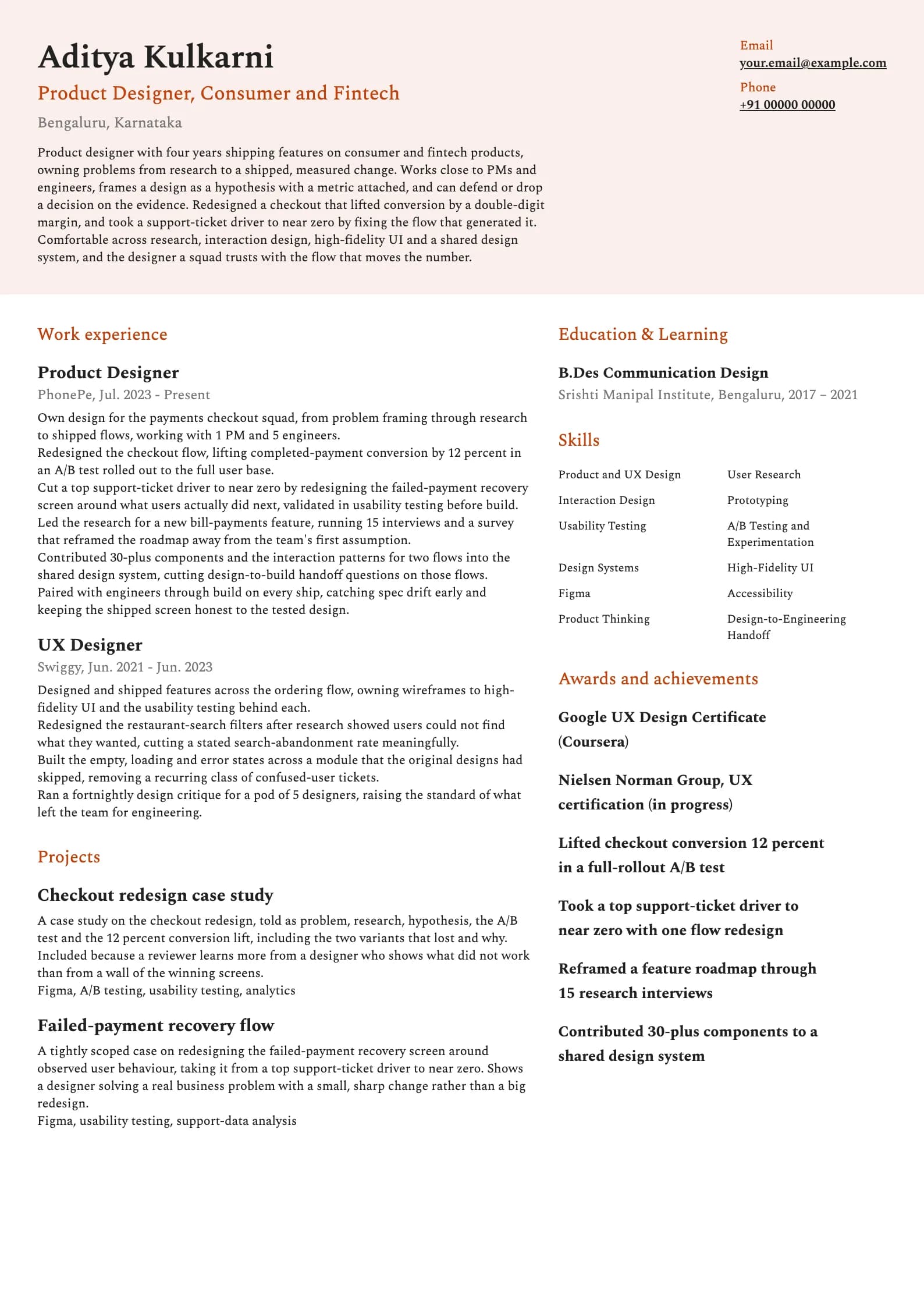
Want this structure with your own details? Build it in the resume builder.
Product Designer resume example, Senior (8 years)
header-band template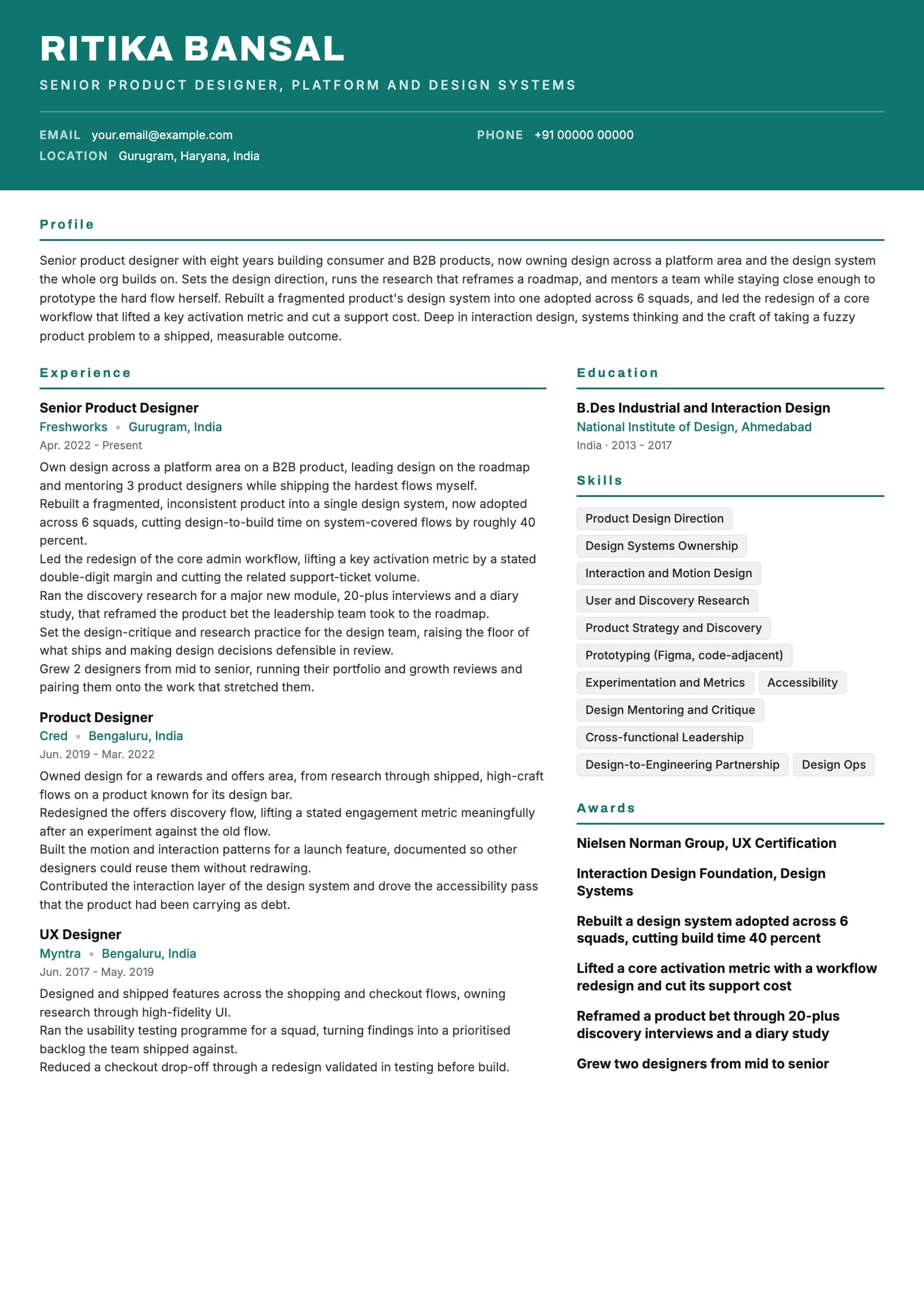
The format that works for product designer resumes in India
Reverse chronological, most recent role first, dates in plain view. A product design resume that hides dates behind a grid of skills reads as a covered gap, and a design manager who reviews resumes the way they review design will notice the misdirection. A gap explained in one honest line is far better than a functional layout built to bury it. The portfolio link is not one line among many, it is the reason the resume gets a second look. Put a live, public, clickable link to your case studies in the header, right under your name, and test that it actually works. A hiring manager reads the resume for impact and thinking, then clicks through to judge the process. A product design resume with no visible portfolio link, or a broken one, is frequently closed unopened, however strong the writing is. One page is the target up to roughly six or seven years, because your depth lives in the case studies, not the resume. A second page is justified only when it carries real design leadership and systems ownership, not a longer tools list. Nobody was hired as a product designer because their software list ran onto a second page. Send a PDF unless asked otherwise, name it with your own name and the role, and keep the resume itself clean and highly readable. It is tempting for a visual designer to turn the resume into a portfolio piece, but the first reader is often a recruiter or an applicant tracking system, and a heavily designed page both signals the wrong instinct and fails to parse. Save the craft for the case studies. The table below sets out the section order.
| Section | Where it goes | Why |
|---|---|---|
| Name, headline and portfolio link | Top, above everything | The portfolio link is the highest-value line. Make it live, public and impossible to miss. |
| Professional summary | Directly under the header | Three lines. What you design, how long, and the strongest shipped, measured outcome. |
| Work experience | Next, for anyone with a design job | Most recent first. Lead each role with the problem owned and the metric it moved. |
| Case studies or projects | Above experience for a fresher, below it after that | Problem, research, decision, outcome. For a fresher this is the core evidence. |
| Skills | Below experience | Grouped: research and UX, interaction and UI, tools. Not a 30-item wall. |
| Education | Bottom, unless you are a fresher | Design degree, institution, years. NID, MIT-ID, Srishti and IDC carry weight. |
| Certifications | After education, or beside skills if only one or two | Google UX, NN/g, IDF. Useful early, less so once you have shipped. |
Lead with impact and thinking, not screens and tools
The most common product design resume failure is one that reads like a portfolio caption: designed screens for the app, created wireframes and prototypes in Figma, worked on the UI of several features. It describes activity, and it could belong to any designer on any product. What a hiring manager is actually screening for is whether you can take a fuzzy product problem, understand the user, make a decision, ship it, and move a number. So lead with the problem and the outcome, not the deliverable. Not redesigned the checkout screen but redesigned the checkout, lifting completed-payment conversion by 12 percent in an A/B test. The screen is the artefact. The conversion lift is the reason the company employs designers. A resume that names the outcome speaks the language product teams are organised around, and one that only names the artefact reads as a decorator. Product design is judged on process as much as pixels, so let the resume gesture at the thinking the portfolio will prove. Bullets that mention the research that reframed a roadmap, the usability test that changed a decision, the variant that lost and why, all signal a designer who reasons from evidence rather than taste. This is the single biggest thing that separates a product designer from a visual designer in a hiring manager's mind, so make it visible on the page. Tools are assumed, not impressive. Figma is table stakes for the whole field, so a resume that leads with software has buried the thing that matters under the thing that does not. Name the tools once, briefly, and spend the page on problems owned, decisions made and outcomes shipped.
For every bullet, ask: does this name a deliverable or an outcome. A product design resume needs mostly outcomes, the metric moved, the problem solved, the roadmap reframed. If your page is a list of screens and prototypes made, you have written a portfolio caption, not a resume.
Writing a summary a design manager actually reads
The block under your name is the part that gets read before the portfolio is clicked, so it should carry three things: what you design and for what kind of product, how long you have done it, and the single strongest shipped, measured outcome behind you. Three or four lines, no adjectives the case studies would have to prove anyway. The emptiest words on a design resume are the ones designers reach for first. Passionate, creative, user-centric, pixel-perfect, detail-oriented. Every applicant claims them, so they carry no signal. User-centric is especially self-defeating, because it is the baseline expectation of the entire field, not a differentiator. Replace the adjective with the evidence: not user-centric product designer but the designer who lifted checkout conversion 12 percent and took a support-ticket driver to zero. Name the kind of product and problem you work on. Consumer versus B2B, fintech versus commerce, zero-to-one versus scaling a mature product, feature design versus design systems, these are genuinely different jobs, and a summary that says which one helps a manager match you to the team. The mid-level sample says consumer and fintech, shipping features that moved metrics, so a growth-stage fintech knows to open the portfolio. A useful test: could a classmate with the same degree and the same first job sign their name to your summary. If yes, it describes the path, not you. Add the specific product area, the specific metric and the specific ownership until it could only describe your work.
Professional summary, mid-level product designer
Weak
Passionate and user-centric product designer with 4+ years of experience creating pixel-perfect, intuitive and delightful user experiences, proficient in Figma, seeking a challenging role at a product company.
Strong
Product designer with four years shipping features on consumer and fintech products, owning problems from research to a shipped, measured change. Redesigned a checkout that lifted conversion 12 percent and took a support-ticket driver to near zero.
The rewrite drops five baseline adjectives and a tool name for a product area, an ownership scope and two shipped outcomes a manager can go and verify in the portfolio.
Experience bullets: problem, decision, outcome
Every strong bullet in the samples follows the same shape. It names the problem you owned, the decision or design you made to address it, and the outcome that moved. The problem shows you work on things that matter. The decision shows you can reason, not just render. The outcome does the persuading, because it is the reason product teams hire designers at all. Start from the outcome and work backwards. Designers instinctively write the deliverable first, then struggle to attach a result, which produces designed a new onboarding flow with improved UX. Instead ask what measurably changed after it shipped: a conversion rose, a drop-off fell, a support-ticket driver disappeared, an activation metric moved, a roadmap was reframed by research. Then write the sentence that ends in that fact. Vary the kind of proof, because product design impact shows up on several axes. Conversion, activation and retention. Drop-off, task-completion and error rate. Support-ticket volume. Research that changed a decision. Design-system adoption and build-time saved. A resume that is all one metric reads as a single trick, and one with no metrics reads as junior. The mid and senior samples deliberately mix outcome types. Where a number is genuinely confidential, give scale and direction honestly: lifted a stated engagement metric meaningfully, adopted across 6 squads, reframed the product bet leadership took forward. And keep the thinking visible: a bullet that mentions the usability test behind the change, or the variant that lost, signals evidence-driven design in a way a bare outcome does not.
| Level | What bullets must prove | Typical proof |
|---|---|---|
| Fresher / junior | You can run the process and ship something that works | Drop-off cut, usability tests run, components built, a flow shipped, edge cases covered |
| Product designer (2 to 5 yrs) | You own a problem end to end and move a metric | Conversion, activation, support tickets, research that reframed the roadmap, A/B wins |
| Senior (6 yrs+) | You own an area, a system, and lift the whole team | Design-system adoption, build-time saved, discovery that changed the bet, designers grown |
| Lead / staff | You set design direction and strategy across the org | Cross-team outcomes, design practice set, product bets shaped, leaders grown |
Experience bullet, feature design
Weak
Designed and delivered new features for the app using Figma and improved the overall user experience of the product.
Strong
Redesigned the checkout flow, lifting completed-payment conversion by 12 percent in an A/B test rolled out to the full user base.
"Improved the overall user experience" is unmeasurable and could be anyone; the rewrite names the flow, the experiment and the business number it moved.
Experience bullet, research work
Weak
Conducted user research and usability testing to gather insights and improve the design of the product.
Strong
Led the research for a new bill-payments feature, running 15 interviews and a survey that reframed the roadmap away from the team's first assumption.
Trades a generic description of doing research for the specific research, its scale, and the fact that it changed what the team decided to build.
If a bullet would read the same on any designer's resume, it is describing the craft, not you. Name the problem, the decision and the metric until it only fits the flow you actually owned and shipped.
The portfolio and case studies: process over gallery
For a product designer at any level, the portfolio is where the hire is really decided, and the resume's job is to get it opened and to survive the recruiter filter in front of the hiring manager. But a product design portfolio is judged differently from a visual designer's. A gallery of beautiful final screens is the classic mistake, because it shows the output and hides the thinking, and thinking is exactly what a product team is buying. Structure each case study as a story, not a gallery: the problem and who had it, the research, the decisions you made and the ones you rejected, what you shipped, and what changed. The strongest case studies show the messy middle, the variant that tested badly, the assumption the research killed, the constraint that forced a rethink, because that is the evidence you can actually reason and not just render. A candidate who shows what did not work is trusted more than one who shows only wins. Curate hard and lead with your strongest. Three deep case studies beat ten thin ones, because a reviewer judges you on the weakest thing they see and rarely reaches the tenth. Order them best-first, because many reviewers decide within the first case study whether to keep reading. And tailor the set to the role: a systems-heavy team wants a design-system case, a zero-to-one startup wants a discovery-to-ship story, and the resume's project section should mirror whichever set you sent. Make the link bulletproof and honest. Test it in an incognito window and on a phone, because a book that asks for a password or shows broken frames is worse than none. And be truthful about your role in team work: a reviewer will ask what exactly you did on a shipped flow, so a case study that quietly claims a squad's work as solo unravels in the first interview.
Case study framing in the portfolio
Weak
A gallery of the final high-fidelity screens for the redesigned checkout, captioned with the tools used and the visual style.
Strong
A checkout case study told as problem, research, hypothesis, the A/B test and the 12 percent conversion lift, including the two variants that lost and why.
The gallery shows output and hides reasoning; the story shows the process, the evidence and the outcome, which is what a product team is actually hiring for.
The skills section: grouped, current, and honest
A product design resume's skills section has two audiences with different needs. A recruiter or an applicant tracking system wants literal, matchable terms, user research, Figma, design systems, usability testing. A hiring manager wants a short, organised list that signals what kind of designer you are. Grouping serves both without turning into a wall. Group by capability rather than one long line. Research and UX, interaction and UI, and tools is a grouping that works for almost every product designer. Research and UX is user research, usability testing, information architecture, flows. Interaction and UI is interaction design, prototyping, visual design, motion, accessibility. Tools is Figma and the rest, kept to one line, because tools are the least differentiating thing on the page. Ten to sixteen skills is the working range, and the research and interaction skills carry more weight than the software. Write the current, industry spelling, Figma not figma, design systems not UI kit, and keep the list to skills you would be comfortable being interviewed on, because each one is a question a portfolio review can open. Drop dead tools, listing Sketch, Adobe XD and InVision as three separate skills in 2026 signals a designer who has not moved with the field. Do not use star ratings or skill bars. Four stars in interaction design is an argument you cannot win, and the portfolio settles depth in a glance regardless. Let the case studies prove the level and keep the skills list as a clean, grouped signal of range.
Skills section, product designer
Weak
Skills: Figma, Sketch, Adobe XD, InVision, Photoshop, Illustrator, Zeplin, Miro, UI Design, UX Design, Wireframing, Prototyping, Creativity, Teamwork, Communication, Problem Solving
Strong
Research and UX: user research, usability testing, information architecture, user flows. Interaction and UI: interaction design, prototyping, visual design, accessibility. Tools: Figma, Maze, Miro.
Collapses a wall of overlapping and dead tools plus four generic soft skills into three capability groups that answer the real question, what can you actually do, with current tools on one line.
Where education and certifications belong
Education goes at the bottom for anyone with a design job, and near the top for a fresher, who leads with the degree and the thesis or capstone project. A design degree, the institution and the years is the whole entry for most people. Pedigree registers in Indian design hiring: NID, MIT Institute of Design, Srishti, IDC at IIT Bombay and DJ Academy are names a design manager reads instantly, so make the institution visible if it is one of them. Marks matter less here than in engineering, so a percentage is optional even for a fresher and worth dropping once you have shipped work. What replaces it is the thesis or capstone project, which a fresher should name and put in the portfolio, because it is often the strongest end-to-end, self-driven case study a new designer has. A non-design degree with a strong self-built portfolio is completely normal in this field, so a career switcher should lead with the case studies and let the degree sit quietly below. Coursework lines are for freshers only and only when relevant. Human-computer interaction, design research and interaction design are worth naming for a product role. A general list of every subject is not. Skip school details once you have a degree and a job. Certifications sit near skills or education and matter most early. The Google UX Design Certificate is a reasonable entry signal for a fresher or a switcher who needs to prove UX fundamentals on paper, and the Nielsen Norman Group and Interaction Design Foundation credentials carry more weight with UX-serious teams. All of them fade fast once you have shipped product and have case studies to point at, so keep the list short and let the work be the credential.
Getting past the recruiter filter before a designer sees it
A product design resume usually meets a recruiter or an applicant tracking system before it reaches the design manager, and both are matching your page against a job description written in plain product language. The portfolio wins the job, but the resume has to clear this gate first, and designers lose here in a specific way: they design the document instead of formatting it, or write it in craft language a non-designer screener does not match. The layout rules are the same as any field. One column, so a two-column resume with a sidebar of skills does not parse out of order. Standard section headings, Work Experience not My Journey, Skills not My Toolkit, because a parser files an unrecognised heading into a bucket the recruiter never searches. Real selectable text, never a resume exported as a single flat image, which is a genuine temptation for a visual person and reads to a parser as an empty page. Mirror the job description's language where it is honest. If the posting says product designer write product designer, if it says user research and design systems use those exact phrases, if it says A/B testing and it is true of your work, include it. A recruiter searching for product designer will not credit experience architect, and a resume written only in bespoke craft terms can miss the very keywords the role is defined by. Put the portfolio link as plain, selectable text as well as a hyperlink, so a parser or a recruiter copying details keeps it. A link buried inside a button graphic can vanish when the file is parsed, and a portfolio link that does not survive the system is precisely the failure this whole page exists to prevent.
Test your own file before sending it: copy the text out of the PDF into a plain editor. If your portfolio link, your title and your dates do not come through as readable text, neither the parser nor the recruiter can read them, and a beautifully designed resume that parses as a blank page is the worst outcome of all.
What gets product designer resumes filtered
Most product designer resumes are not rejected on a close call, they are filtered on a handful of recurring problems, and every one is fixable in an afternoon. The list below is what product design hiring managers and recruiters in India see most often, in rough order of how much damage each does.
- No portfolio link, a dead link, or one that needs a password. This ends most applications, because the resume was only ever the ticket to the case studies.
- A portfolio that is a gallery of final screens with no process. It hides the thinking, which is exactly what a product team is buying, so show the research and the decisions.
- Leading with tools and deliverables. Figma is table stakes and screens are output. Lead with the problem owned and the metric moved instead.
- No outcomes anywhere. Conversion, activation, drop-off, support tickets, research that changed a decision. A resume of pretty work with no numbers reads as a decorator.
- Baseline adjectives as differentiators: user-centric, pixel-perfect, passionate. They are the expectation of the whole field, so they signal nothing. State the evidence.
- The resume itself over-designed into a portfolio piece, which signals the wrong instinct and fails to parse in the ATS a recruiter runs it through.
- Dead tools listed as skills, Sketch, Adobe XD and InVision in 2026, which reads as a designer who has not moved with the field.
- Team work quietly claimed as solo, which unravels the moment an interviewer asks exactly what you did on a shipped flow.
- A clever job title, experience architect or UX unicorn, that a recruiter searching for product designer never matches.
- Case studies with no measurable result and no reflection, all polish and no what-I-learned, which reads as a student portfolio rather than a working designer's.
Send your resume and portfolio link to one designer friend and one PM or engineer friend. The designer tells you if the craft holds up. The PM or engineer tells you if the impact and the thinking come through, which is the half designers most often leave out.
Skills to put on a product designer resume
Technical
- User Research
- Usability Testing
- Interaction Design
- Information Architecture
- Wireframing and Prototyping
- High-Fidelity UI Design
- Design Systems
- Accessibility
- A/B Testing and Experimentation
- Product Thinking
- User Flows and Journeys
- Design Documentation
Tools and platforms
- Figma
- FigJam
- Maze
- Miro
- Notion
- ProtoPie
- Framer
- Dovetail
- Amplitude
- Storybook
Working skills
- Product-designer collaboration
- Design critique
- Stakeholder communication
- Design-to-engineering handoff
- Mentoring
- Prioritisation
- User empathy
- Presenting design decisions
- Cross-functional collaboration
Certifications worth listing as a product designer
| Certification | Full name | Worth it for |
|---|---|---|
| Google UX Certificate | Google UX Design Certificate (Coursera) | A reasonable entry signal for a fresher or a career switcher who needs to prove UX fundamentals on paper and does not have a design degree. It gets you a first structured portfolio project too. It fades fast once you have shipped product and real case studies, so treat it as an on-ramp, not a career-long credential. |
| NN/g UX Certification | Nielsen Norman Group UX Certification | Carries real weight with UX-serious and research-heavy teams, because NN/g is a recognised authority and the courses are rigorous. Most valuable in the early-to-mid range when you want to signal depth in research and usability. Beyond that, shipped, measured work outranks the badge, so let the case studies carry it. |
| IDF membership | Interaction Design Foundation, UX and design-systems courses | An affordable, broad way for freshers and switchers to build UX fundamentals and show self-driven learning, with certificates across topics like design systems and interaction design. Useful as a learning path and a resume line early on. Once you have a portfolio and shipped work, it becomes background rather than a differentiator. |
| DesignLab / Springboard | DesignLab UX Academy or Springboard UX/UI bootcamp | Worth it for a career switcher who needs structure, mentorship and a set of guided portfolio projects to break into product design. The mentored case studies are the real value, not the certificate. Hiring managers care about the portfolio it produces, so choose the programme on the strength of the work it will help you build. |
Keywords an ATS scans for in a product designer resume
These are the literal terms a parser matches against the job description. Use the ones that are true of you, in the sentences where you did the work, not as a list at the bottom.
- product designer
- ux designer
- ui designer
- user research
- usability testing
- interaction design
- figma
- design systems
- prototyping
- wireframing
- information architecture
- accessibility
- user flows
- a/b testing
- product thinking
- high-fidelity ui
- user experience
- design critique
- user-centered design
- portfolio
Product Designer resume FAQ
What salary can a product designer expect in India?
A fresher or junior product designer typically starts around 6 to 12 LPA, higher at strong product companies and well-funded startups. A product designer with four to six years shipping measured work usually sits in the 15 to 30 LPA band, and a senior product designer with eight years and above commonly earns 30 to 55 LPA, more at top product companies and for design-system or design-leadership roles. A portfolio full of shipped, measured outcomes and depth in research or systems pushes the top of every band upward.
How long should a product designer resume be?
One page up to about six or seven years, because your depth lives in the case studies, not the resume. A second page is justified only when it carries genuine design leadership and systems ownership, never a longer tools list. The resume's job is to get the portfolio opened and to pass the recruiter filter, so keep it tight and outcome-led and let the case studies do the deep persuading.
Do I need a portfolio for a product designer role?
Yes, without exception, and it is where the hire is really decided. Put a live, public, clickable link in the header and curate three to four deep case studies rather than a large gallery. Crucially, tell each as a story, problem, research, decisions, what shipped and what changed, because a product team is buying your thinking, not just your final screens. A resume with no portfolio link, or a dead one, is usually closed unopened.
What is the difference between a product designer and a UX or UI designer resume?
The titles overlap, but a product designer resume has to prove end-to-end ownership and business impact, not just research or visual craft. A UI-leaning resume can foreground the interface, and a UX-leaning one the research, but a product designer is expected to take a problem from discovery through a shipped, measured outcome. So a product designer resume leads bullets with the problem owned and the metric moved, and shows the whole loop from research to ship, which is broader than either UX or UI alone.
How do I write a product designer resume with no experience?
Lead with case studies, then education and your thesis or capstone, then skills. Treat each case study as a real project: the problem and who had it, the research, the decisions you made and rejected, what you built and what changed after testing. A redesign you scoped around one measurable problem counts, a thesis tested against real constraints counts, and an internship outcome, even a small one, counts. Point everything at a curated portfolio link and make the named projects easy to find inside it.
Should my resume be heavily designed since I am a designer?
No, and this trips up many designers. Keep the resume clean, readable and parser-safe, because the first reader is often a recruiter or an applicant tracking system, and an over-designed page both signals the wrong instinct and fails to parse. Save your craft for the portfolio, which is where it is actually judged, and let the resume simply deliver the portfolio link, the impact and the thinking in a form both a human and a parser can read.
Do certifications like Google UX or NN/g help a product designer?
They help most when you have little professional experience or are switching into design, and least once you have shipped product with real case studies. The Google UX Certificate is a fine entry signal, and the Nielsen Norman Group and Interaction Design Foundation credentials carry more weight with UX-serious teams. For mid and senior roles, shipped, measured work and portfolio depth matter far more than any certificate, so keep the list short and let the work be the credential.
Which tools should I list on a product designer resume?
List the current, industry-standard ones you actually use, and keep them to one line, because tools are the least differentiating thing on the page. Figma is table stakes, so leading with it buries what matters. Add relevant supporting tools like Maze, Dovetail, Miro or an analytics tool if you use them, and drop dead tools, listing Sketch, Adobe XD and InVision as three skills in 2026 signals a designer who has not moved with the field. Spend the rest of the page on outcomes, not software.
Does an ATS reject product designer resumes?
It can quietly filter them, which is worse than a visible rejection. The usual causes are a two-column layout parsed out of order, a resume exported as a flat image with no selectable text, a clever job title like experience architect that a search for product designer never matches, and a portfolio link trapped inside a button graphic that does not survive parsing. Use one column, standard headings, the real job title, mirror the posting's keywords, and keep a plain-text portfolio link, then copy your own text out of the PDF to confirm it all reads.
Related resume examples and guides
Build your own in any of these formats
Start from a blank resume or upload the one you have. Goodspace renders it in 24 clean, parser-safe templates, keeps your portfolio link front and centre, and flags the research, systems and outcome keywords a product team looks for, so your resume proves impact and thinking, not just screens.
Build my resume