Walk-In Interview: How to Prepare and Get Selected [2026]
A walk-in interview is the only hiring format in India where you can leave home jobless at 8 am and hold an offer letter by 6 pm. It is also the format where most candidates are rejected before they finish a sentence. Both facts have one cause: the company is screening hundreds of people in a single day, so the filters are fast, blunt, and applied by tired recruiters.
Below: what a walk-in actually is, which Indian sectors run them, the day hour by hour, the documents to carry, the questions that repeat, the mistakes that filter people in the first two minutes, and how to tell a genuine drive from a fee-charging scam.
What Is a Walk-In Interview?
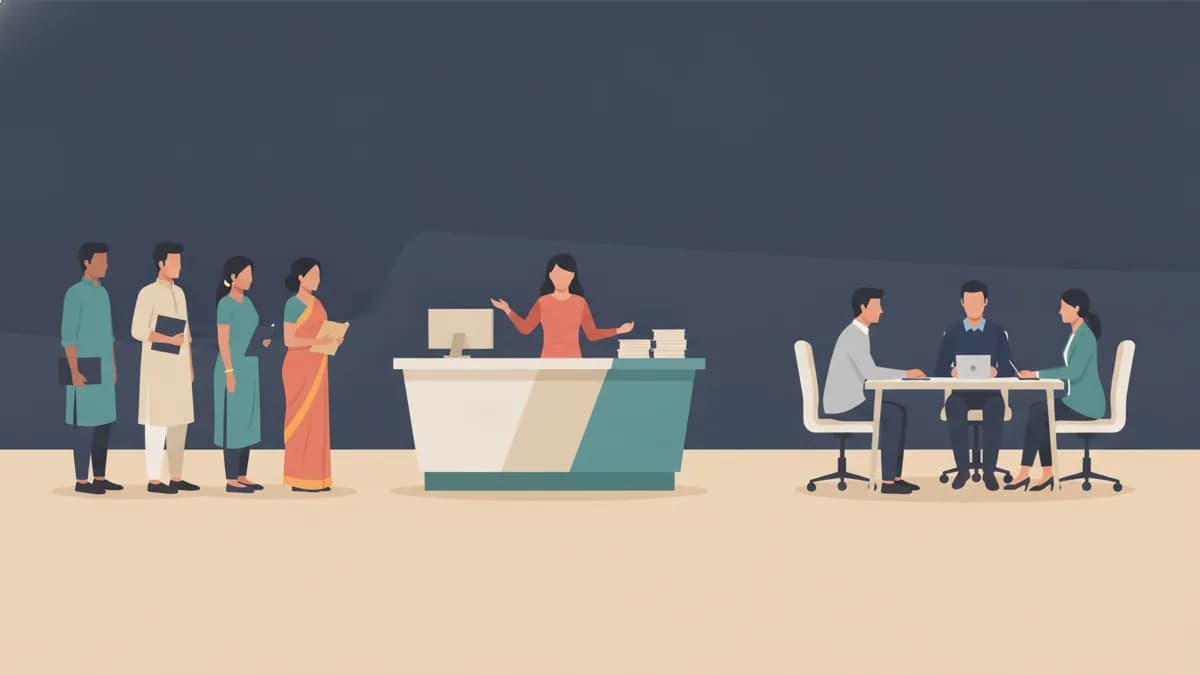
A walk-in interview is an open hiring event where anyone meeting a stated eligibility bar can turn up at a published venue within a published time window and be interviewed the same day, with no individual invitation and usually no prior application. The company posts the role, the eligibility, the venue and the reporting time. You show up with documents and join the queue.
The word "interview" undersells it. A walk-in is a selection drive. Screening, aptitude testing, group activities, a technical round, an HR discussion and sometimes the offer itself get compressed into one day, because the company has a bulk headcount target and cannot run a two week scheduling cycle per candidate.
Walk-In vs Scheduled Interview
| Factor | Scheduled interview | Walk-in interview |
|---|---|---|
| How you get in | Apply, get shortlisted, receive a slot | Turn up within the published window |
| Competition that day | A handful of shortlisted candidates | Often 100 to 1,000 plus in one venue |
| Preparation time | Days, with the job description in hand | Hours, often with only a one-line role title |
| Time with the interviewer | 30 to 60 minutes | 5 to 15 minutes per round, sometimes less |
| Documents | Emailed later, verified after selection | Hard copies checked at the gate, no copies means no entry |
| Decision speed | One to three weeks | Same day, or within 48 hours |
The practical consequence: you cannot research the company deeply, so your preparation must be generic but sharp. Your self introduction, your reason for applying and your salary expectation have to exist as spoken answers before you leave home. There is no thinking time in the room.
Which Sectors Run Walk-In Drives in India
Walk-ins cluster in sectors hiring volume for standardised roles, where a slow process costs more than a rough filter.
| Sector | Typical roles | What the drive really tests | Rounds to expect |
|---|---|---|---|
| IT services mass hiring | Engineer trainee, support engineer, QA, service desk | Aptitude, coding basics, communication, relocation and shift willingness | Aptitude or online test, technical round, HR round |
| BPO and customer support | Voice and non-voice associate, chat support, collections | Spoken English, accent neutrality, listening, rotational shift acceptance | Screening, voice or versant test, operations round, HR round |
| Banking and insurance sales | Relationship officer, sales officer, agency manager, branch operations | Confidence, persuasion, local language, comfort with targets and field work | Screening, pitch or roleplay, branch or cluster manager round |
| Retail and quick commerce | Store associate, cashier, supervisor, hub operations | Presentability, customer handling, standing shifts, weekend availability | Screening, store manager round, sometimes on-floor observation |
| Healthcare | Staff nurse, lab technician, pharmacist, front office, medical coder | Registration validity, clinical basics, night duty acceptance | Document verification, clinical or technical round, HR round |
| Manufacturing and engineering | ITI and diploma trades, machine operator, quality inspector, GET | Trade knowledge, safety awareness, fitness, plant location acceptance | Written trade test, practical or shop-floor round, HR round |
Two patterns hold across all six. Much of the decision is logistical rather than skill-based, so shifts, location, joining date and salary band are asked early and a wrong answer ends things regardless of ability. And the technical bar is the fundamentals of your stated skill, not depth, because there is no time for depth.
What a Walk-In Interview Day Actually Looks Like
A notice saying 9:30 am to 1:00 pm gives the reporting window, not the length of your day. Block out the whole day and warn anyone expecting you that you will be unreachable in stretches.
- 7:00 am to 8:30 am, arrival. Serious candidates reach before the gates open. Many drives cap tokens, so arriving late inside the official window still gets you turned away once the cap is hit.
- 8:30 am to 10:00 am, queue and gate check. Security checks ID, a coordinator checks resume copies and eligibility, you get a token number or a registration form. People are eliminated here for missing photocopies, a mismatched percentage, or an experience band outside the stated range.
- 10:00 am to 11:30 am, the first filter. An aptitude or trade test, a voice test, or a two minute recruiter screening at a desk. Large batches run in halls with a proctor, so carry your own pen.
- 11:30 am to 1:00 pm, the long wait. Results are announced by token number. You may be moved between floors or asked to wait outside, and nobody will tell you how long.
- 1:00 pm to 2:30 pm, group round. BPO, sales and retail drives commonly use a group discussion or activity to cut the shortlist further. Ten to twelve candidates, one topic, six to eight minutes.
- 2:30 pm to 4:30 pm, technical or operations round. Back to back and short. You may face two interviewers within the same hour, and the second usually has not read the first one's notes, so repeat your basics cleanly instead of assuming context.
- 4:30 pm to 6:30 pm, HR round and documentation. Salary, notice period, shifts, relocation, joining date. If cleared, document verification and sometimes a provisional offer on the spot.
Carry water and a snack, since canteen access is not guaranteed and you may not want to lose your place in a queue. Keep your phone charged with a power bank, because your document backups and travel bookings live on it.
Walk-In Interview Documents Checklist
Document failures cause more same-day rejections than weak answers do, because they are checked first and there is no appeal. Assemble this the night before, in one folder that closes.
- Resume, four to six printed copies. One page for freshers, two maximum for experienced. Each interviewer keeps one and you will meet more people than you expect.
- Photo ID, original plus two photocopies. Aadhaar as standard, PAN as second ID. Many venues will not clear security without an original.
- Passport size photographs, four to six. Recent, formal, plain background.
- Educational documents. 10th and 12th marksheets, all semester marksheets, provisional or degree certificate. Originals for verification plus one photocopy set.
- Experience documents, if applicable. Offer letter, last three payslips, relieving letter or experience certificate, previous employer ID card.
- Sector-specific proof. Nursing council registration for healthcare, ITI or diploma trade certificate for manufacturing, IRDAI or NISM certification for financial products, driving licence for field sales.
- The advertisement itself. A printout of the notice with date, venue and role, useful at the gate when security has a different list.
- A pen and a small notepad. Loose paper in a plastic bag reads as unprepared before you speak.
- Phone backups. Every document as PDF in one folder, resume emailed to yourself. Treat this as backup only, most venues will not accept soft copies for verification.
If the resume itself is the weak link, fix it before printing. A one page, single column layout survives both a recruiter's ten second scan and the ATS upload afterwards, covered in our resume builder guide and ATS guide.
How to Dress for a Walk-In Interview
You are being sorted visually in a hall of hundreds, so look unmistakably like someone who could start work tomorrow. Formal, plain, well fitted, comfortable enough to sit in for ten hours.
For men, a light formal shirt tucked in, dark formal trousers, a belt, closed formal shoes with socks. For women, a formal shirt with trousers, a plain salwar suit, or a saree, in muted colours, with flat closed shoes since you will stand for long periods. Keep patterns quiet, perfume light, accessories minimal, and carry a spare handkerchief. Manufacturing drives with a shop-floor round often require closed hard-soled shoes for entry.
Two common errors: denim and sneakers, fine in a product office and still casual at a mass drive run by an operations manager, and a heavy blazer in an Indian summer queue, which looks worse damp than a crisp shirt does alone.
The Rounds: Preparing When You Cannot Prepare Per-Company
At a scheduled interview you tailor to the job description. At a walk-in you often learn the exact role at the venue, so you prepare a reusable core instead.
The technical or skill round
Expect fundamentals, asked fast, with follow-ups only if your first answer lands. IT drives lean on core language concepts, basic data structures, SQL, OOP and one project walkthrough. BPO drives test comprehension and spoken clarity over theory. Manufacturing drives test trade knowledge, drawings, measuring instruments and safety. Sales drives ask you to sell something in the room.
The reliable preparation is one crisp two minute walkthrough of your strongest project or current work: the problem, what you personally built, the tools, the outcome. Prepare it once and it survives every round of every drive. Our technical interview preparation guide covers what is worth revising the night before.
The group discussion or group activity round
Used mainly by BPO, sales, retail and some IT services drives, and used less to find the best speaker than to cut fifty people to fifteen quickly. Ten to twelve candidates, a general topic like work from home versus office, social media, or a current affairs subject, and six to eight minutes total. That is roughly forty seconds of airtime each if everyone speaks.
What gets you through is not dominating. Enter in the first ninety seconds, because candidates who speak only at the end are often already marked. Make two or three clear contributions rather than eight interruptions, address the group instead of the evaluator, and build on someone else's point by name before adding yours, which reads as listening. If the discussion stalls or turns into a shouting match, summarising the two positions so far and redirecting is the single highest-scoring move available. Volume, aggression and talking over people are what evaluators note against you, not silence alone.
The HR round
At a walk-in this is mostly a fit and logistics check: rotational shifts, weekend working, relocation, notice period, current and expected CTC, joining timeline, and stability given past tenures. Answer in plain numbers, not hedges. "I can join within 30 days" moves you forward, "I will have to check" usually does not. The full pattern is in our HR interview questions guide.
Standing Out When You Are One of Hundreds
You cannot out-credential a room of similar candidates in ten minutes. You can out-clarify them, which is what recruiters reward at volume.
- Memorise a 45 second self introduction. Who you are, what you do, one proof point, what you want next. It opens almost every round, and our self introduction guide has the structure.
- Lead with the number. "I handled 60 to 70 calls a day at under four minutes average handling time" is memorable. "I was in customer service" is not.
- Say the role name back. Referring to the exact designation on the notice shows you read it, which few in the queue have.
- Be the calm one. By the third round the panel has met eighty anxious people. Steady pace and eye contact register disproportionately.
- Ask one real question. Team size, a typical day, what separates a strong performer in the first six months. One is enough to turn a screening into a conversation.
- Get a name and a contact. Written follow-up is impossible without one, and almost nobody asks.
Common Walk-In Interview Questions
The same set repeats across sectors because the panel has minutes, not hours. Rehearse spoken answers aloud and timed, because the failure mode at walk-ins is rambling past your slot rather than not knowing.
- "Tell me about yourself." 45 seconds. Present role first, then relevant background, then what you want next. Never start at 10th standard.
- "Why are you looking for a change?" Forward-looking and neutral. Name what the next role offers, not what the last one lacked.
- "Why this company?" You may not know much, so be specific about the role and sector rather than faking research: the scale of the operation, the product category, the location.
- "Current and expected CTC?" Current as a number, expected as a narrow band in lakhs per annum: "I am looking at 6 to 7 LPA fixed, and I am open if the overall structure works." A blank refusal usually ends a walk-in conversation.
- "Comfortable with shifts, weekends and relocation?" State your actual constraint clearly. Agreeing to a night shift you cannot sustain wastes both sides two months later.
- "How soon can you join?" Give a date. Immediate joiners are frequently the differentiator in a walk-in shortlist.
- "Walk me through your last project." The two minute structure above, rehearsed.
- "Why should we hire you?" Two sentences tying one proven strength to the role's core task, not a personality list.
The highest-return preparation is saying these out loud under a timer, because the room gives no second attempt. A structured mock interview the night before does that better than re-reading notes.
Mistakes That Get You Filtered in the First Two Minutes
- Arriving inside the window but late in the queue. Token caps are real and no recruiter reopens a closed hall.
- One resume copy, or none. An instant, unarguable rejection at the gate.
- Not meeting stated eligibility. Percentage cutoffs, year of passing, backlogs and experience bands are checked literally. Attending anyway burns a day.
- Asking "what is this job?" at the desk. It says you came for any job, not this one.
- A phone ringing mid-round. Silent, not vibrate, from the moment you enter.
- Running down your current employer. The fastest way to be read as a future problem.
- Bringing a friend or parent into the hall. Common at fresher drives, consistently damaging.
- Contradicting your own resume. Dates, tenure and CTC get cross-checked against payslips at the same table.
- Leaving during the waiting gap. Shortlists are called by token number once, and if you are not there you are skipped.
What to Do While You Wait
Waiting is the longest part of the day and most people spend it scrolling until their energy is gone. Better uses: reread the notice for the exact role and eligibility, revise your two minute walkthrough silently, note what the panel asked candidates who came out before you, since walk-in panels reuse their question set all day, and talk to people around you to learn which floor is running which round. Keep your folder on your lap, stay hydrated, and avoid heavy food, because the afternoon rounds are where people fade.
Finding Genuine Walk-In Drives in the Major Hiring Cities
Walk-in volume concentrates in the metro hiring corridors: the IT and BPO belts around Chennai, Bengaluru, Hyderabad, Pune and Gurugram, BFSI and retail hiring in Mumbai and Delhi NCR, and manufacturing clusters around Pune, Chennai and Ahmedabad. Rather than chasing forwarded lists, use the filters that separate a real drive from noise.
- Use the walk-in filters on the major portals. Naukri's walk-in section and LinkedIn job search both filter by city and date, and company career pages often post drives that never reach aggregators.
- Check the posting is current. Walk-in notices get recirculated on WhatsApp and Telegram for months after the drive is over. Read the posted date, not just the text.
- Confirm the venue on the company's own domain. A genuine large drive is almost always on the careers page or sent from an official domain email, not only as a forwarded image.
- Read eligibility line by line before you travel. Year of passing, percentage, backlog policy, experience range, named skills. Travelling three hours to be filtered on a cutoff you could have read is the most common wasted day in this format.
- Note the reporting cutoff separately. Many notices state a hard registration cutoff earlier than the window's end.
- Plan the commute for the worst case. Tech park and industrial estate venues take longer to reach than maps suggest on a weekday morning, and gates open early.
Related reading: How to Make Your Naukri Profile Visible to Recruiters.
How to Spot a Fake or Fee-Charging Walk-In Drive
Mass hiring attracts fraud, because a queue of hopeful candidates is exactly the audience a scam wants. The rules are simple and have no useful exceptions.
- No legitimate employer charges you to attend or be selected. Registration fee, security deposit, training fee, kit or uniform charge, document processing fee. Any money requested before a signed offer ends the conversation.
- Never surrender originals. Originals are shown for verification and returned immediately. Anyone holding your marksheets or Aadhaar overnight is not a recruiter.
- Distrust pay far above the market. An entry-level role advertising an implausible package is bait for a fee, or a commission-only scheme presented as a salaried job.
- Check the entity name. A consultancy recruiting for an unnamed "leading MNC client" that will not name the client until you pay is a standard pattern.
- Look at the venue. Genuine bulk drives run from company campuses, hotels or recognised institute halls with visible branding and staff. A single unmarked room with one laptop is a warning sign.
- Read the offer before signing. Same-day offers are common and legitimate, but check designation, fixed versus variable split, bond or service agreement clauses, probation and notice period. A bond with a large recovery amount deserves a night to think, and a recruiter who refuses that is telling you something.
- Watch for the commission-only bait. A common variant advertises a salaried sales role, then reveals at the offer stage that the fixed component is negligible and earnings depend on policies or accounts sourced. Ask for the fixed monthly figure in writing before agreeing to anything.
- Keep a record. Save the notice, the venue address, the names you met and a photo of anything you signed. It costs nothing and matters if something goes wrong later.
How to Follow Up After a Walk-In Interview
Most candidates leave the venue and wait. A short, specific follow-up costs ten minutes and is rare enough to be noticed. Before leaving, ask for the timeline and the contact: "When can I expect to hear back, and who should I follow up with?" Write the answer down.
That evening, send a four line email to the recruiter you met. Reference the drive date and venue, the role, your token or reference number, one line on why you fit, and attach your resume as a PDF. Keep the subject factual: "Walk-in on [date], [venue], [role], [your name]".
Then wait out the stated timeline before one polite follow-up. If they said a week, follow up on day eight, once. After that treat it as closed, because volume drives frequently send no rejection communication at all. Keep applying in the meantime, since a same-day interview only helps if the next opportunity is already moving.
Your Night-Before Checklist
- Reread the notice: role, eligibility, venue, reporting time, hard cutoff.
- Print four to six resumes, assemble originals plus one photocopy set in a folder.
- Rehearse aloud: 45 second introduction, two minute project walkthrough, CTC and joining date.
- Iron the outfit, polish the shoes, keep the ID on top of the folder.
- Plan the route and set an alarm to reach before the gates open.
- Charge the phone and power bank, pack water and a snack.
A walk-in rewards preparation that is portable rather than company-specific. The people who convert are rarely the most qualified in the hall, they are the ones whose documents were in order, whose answers were rehearsed, and who were still composed at 4 pm in the fourth round. Practise the spoken part under time with a timed AI mock interview, and print from a clean single column format using the resume builder, so nothing in your paperwork gives the gate a reason to stop you.