Getting the personal details in a resume right is the quiet difference between a recruiter calling you back and your application disappearing into a database. This one small block sits at the very top of the page, yet most Indian job seekers still stuff it with information that recruiters no longer want, and leave out the two or three things that actually help them get hired. In this guide we break down exactly what belongs in your personal details section, what to leave out and why, and how the rules shift between Indian hiring norms and global standards.
By the end you will have copy-ready header blocks, a clear include-versus-exclude table, and answers to the questions freshers and experienced professionals ask most often.
What Are Personal Details in a Resume?
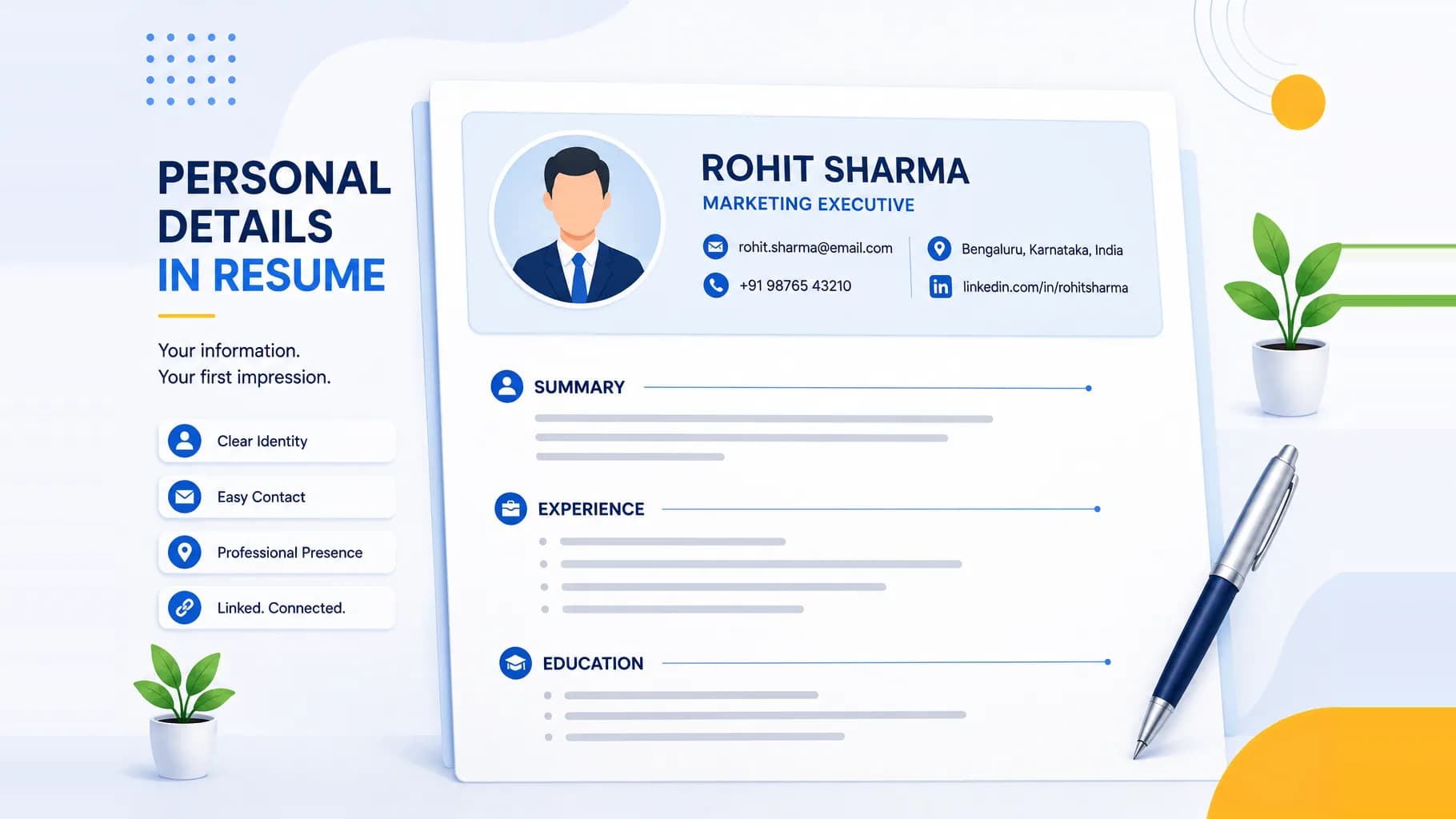
Personal details in a resume are the identifying and contact information a recruiter uses to know who you are and how to reach you. In practice this is the header, the first thing anyone sees before your summary, experience, or skills.
There is an important distinction to understand. Personal details are not the same as personal information in the old sense of the word. A generation ago, Indian resumes routinely opened with date of birth, father's name, marital status, and a passport photo. That format is now outdated for most private-sector and multinational roles. Today, personal details mean the professional essentials: your name, phone number, email, location, and relevant online profiles. Everything else is either optional, situational, or better left off entirely.
Think of this section as functional, not biographical. Its only job is to make you easy to identify and easy to contact. Space on a resume is expensive, so every line here should earn its place.
What to Include in Your Personal Details
These are the elements that should appear on almost every resume, in almost every industry, in India and abroad.
1. Full Name
Your name is the headline of your resume. Put it at the top in the largest text on the page, typically 16 to 22 points, in a clean, readable font. Use the name you go by professionally and the way you want to be addressed. If your legal name and preferred name differ, it is fine to lead with the preferred version, but keep it consistent with your official documents where verification matters.
Avoid stylised fonts, all-caps decorative treatments, or nicknames in quotation marks. Clarity beats personality here.
2. Phone Number
For India, use a clean 10-digit mobile number. Recruiters overwhelmingly prefer mobile numbers because they can call or send a WhatsApp message directly. If you are applying to international roles or are open to relocation abroad, add the country code, for example +91 98XXX XXXXX, so the number works from anywhere.
List only one number. Two or three numbers signal that you are unsure which one you actually answer.
3. Email Address
Your email should be professional and, ideally, some variation of your real name, such as firstname.lastname@gmail.com. Playful handles from your student days, like coolguy_rahul99@ or something meant to be funny, quietly cost you credibility before anyone reads a single line of your experience. If your name is common and taken, add a middle initial, a number that is not your birth year, or your profession.
Use an email you check daily. A missed interview invite because you never opened that inbox is a painful and avoidable loss.
4. Location
City and state are enough. For example, Bengaluru, Karnataka. You do not need your full house number, street, and PIN code on a modern resume. A general location tells recruiters whether you are local, whether relocation is involved, and which office you might join, which is all they need at the application stage.
If you are actively targeting jobs in another city, you can write something like Chennai, Tamil Nadu (open to relocating to Hyderabad) to signal intent without clutter.
5. LinkedIn and Relevant Links
A LinkedIn URL has become a near-standard part of personal details, and Indian recruiters increasingly check it. Customise your public URL so it reads cleanly, for example linkedin.com/in/yourname, rather than a string of random numbers.
Beyond LinkedIn, add links only when they are relevant to the role. A GitHub profile for developers, a Behance or Dribbble portfolio for designers, a personal website for writers and marketers, or a Google Scholar page for researchers all add real value. Skip Instagram, Facebook, and any social handle that is not professionally relevant.
If you want a header that is formatted correctly and ATS-friendly without fiddling with fonts and spacing, the Goodspace AI Resume Builder generates a clean personal details block for you and keeps everything aligned.
What to Leave Out, and Why
This is where most Indian resumes go wrong. The following details were once standard and are now, in most cases, either useless or actively harmful to include. The core reason is simple: they invite bias, waste space, or expose you to privacy risk, while adding nothing to your candidacy.
Age and Date of Birth
Your ability to do the job has nothing to do with your birth year. Including your date of birth invites age-based assumptions, one way or the other, before anyone reads your experience. Leave it off unless a specific application form or government rule requires it (more on that below).
Marital Status, Spouse, and Children
Whether you are married, single, or have children is nobody's business at the shortlisting stage, and it can trigger unfair assumptions about availability, relocation, or commitment. This applies equally to men and women. Remove it.
Religion, Caste, and Community
These have no bearing on job performance and can only introduce bias. Leave them off entirely. The only exceptions are roles at institutions that are explicitly faith-based or that legally require such information, which are rare.
Gender
Recruiters can usually infer this from your name, and it should not affect the decision anyway. There is no need to state it in a dedicated field.
Photo (In Most Cases)
For the majority of corporate, tech, finance, and professional roles in India, a photo is unnecessary and can introduce appearance-based bias. Global norms, especially in the UK and US, actively discourage photos. There are genuine exceptions, covered in the India section below.
Full Postal Address and PIN Code
Your complete home address is a privacy and safety liability, and it serves no purpose at the application stage. City and state are enough.
ID and Government Numbers
Never put your Aadhaar number, PAN, passport number, driving licence number, or bank details on a resume. Resumes get forwarded, uploaded, and stored in ways you cannot control, and these numbers are the raw material for identity theft. Share them only through official, secure channels after you are hired or when a legitimate verification step requires it.
Father's or Husband's Name
A relic of older Indian formats. It is not needed on a professional resume and adds nothing. Drop it.
Current Salary and Nationality
Salary is a negotiation topic, not a header field, and stating it early can anchor an offer against you. Nationality is only relevant when work authorisation is genuinely in question, such as cross-border applications, and even then it is usually handled in the application form, not the resume header.
India Nuance: Local Expectations vs Global Norms
Here is where a purely Western template can steer Indian job seekers wrong. The global best practice is to strip the header down to contact essentials, and for most private-sector, startup, IT, and multinational roles in India, that advice holds perfectly. But India is not a single hiring market, and a few local realities still matter.
Languages known. In India's multilingual workplaces, listing the languages you speak, read, and write is genuinely useful, especially for sales, customer support, operations, field, and regional roles. This is one addition that global templates often omit but that carries real weight here. Keep it short: for example, English, Hindi, Kannada, Tamil. You can place it in a dedicated skills area rather than the top header if space is tight.
Government and public-sector jobs. Government application forms frequently require date of birth (because of age-limit rules), category, and sometimes a photo. When you are filling out an official Sarkari or PSU form, follow the form's instructions exactly. This is a form-driven exception, not a reason to load your general resume with the same fields.
Roles that legitimately need a photo or physical details. Aviation (cabin crew, ground staff), hospitality front-office, modelling, acting, broadcasting, and some retail and field roles may ask for a photograph, and occasionally height or weight, because appearance or physical requirements are part of the job. Defence and some uniformed services may ask for date of birth and marital status. In these cases, provide what is asked, using a neat, professional photo where relevant.
Campus and mass-recruitment drives. Some large Indian employers and campus placement portals still use standardised forms that request date of birth or a photo. Again, follow the portal, but keep your master resume clean and add these fields only where the specific process demands them.
The guiding principle: build a lean, modern resume as your default, and add traditionally-excluded details only when a specific employer, form, or role explicitly requires them. When in doubt, less is safer than more.
How to Format the Personal Details Section
Formatting is simple, but it is where small mistakes cost you. Keep the block compact, readable, and machine-friendly, because applicant tracking systems parse this header first.
A few rules:
- Name in the largest text, 16 to 22 points, bold.
- Contact details below it in 10 to 12 point text.
- Separate items on a single line with a pipe or a bullet, not commas that blur together.
- Use real hyperlinks for LinkedIn and portfolios so they are clickable in a PDF.
- No icons that break in older ATS parsers; if you use them, make sure the text still reads on its own.
- One line, or at most two, for the whole block.
Here are copy-ready example header blocks you can adapt.
Standard professional header:
PRIYA SHARMA
Bengaluru, Karnataka  |  +91 98XXX XXXXX  |  priya.sharma@gmail.com  |  linkedin.com/in/priyasharma
Header for a developer with a portfolio:
ARJUN MENON
Software Engineer
Kochi, Kerala  |  +91 97XXX XXXXX  |  arjun.menon@gmail.com
linkedin.com/in/arjunmenon  |  github.com/arjunmenon
Header for a fresher, open to relocation, with languages:
NEHA VERMA
Pune, Maharashtra (open to relocation)  |  +91 90XXX XXXXX  |  neha.verma@gmail.com
linkedin.com/in/nehaverma  |  Languages: English, Hindi, Marathi
Notice what is absent from all three: no date of birth, no marital status, no father's name, no photo, no full address. That absence is deliberate, and it makes each header cleaner and faster to scan.
Personal Details for Freshers vs Experienced Professionals
The good news is that the personal details block barely changes with experience, and that consistency is the point. But there are small differences worth knowing.
Freshers. With little work history, your links do heavier lifting. A LinkedIn profile is close to mandatory, and a GitHub, Behance, or personal project site can substitute for the experience you do not yet have. Including languages known is often smart for freshers targeting regional or client-facing roles. What freshers should resist is the temptation to pad the header with date of birth, hobbies, or a photo to fill space. Padding reads as inexperience. Let the header stay lean and put your energy into a strong summary and projects section.
Experienced professionals. Your header should be even more ruthless, because your track record speaks for you. A polished LinkedIn URL matters here, since recruiters will check it and expect it to match your resume. Drop anything biographical. If you are senior enough to have published work, a talk, or a professional site, a single relevant link can be worth adding. Everything else is noise.
Across both groups, the header stays essentially identical: name, phone, email, location, and one or two relevant links. If you want to compare how the same details look across different layouts, the Goodspace AI Resume Builder lets you switch templates while keeping your personal details clean and consistent.
Privacy and Safety Tips
Your resume travels further than you think. It gets emailed, uploaded to job boards, forwarded between recruiters, and stored in databases for months or years. Treat the personal details section as public information, because effectively it is.
- Never include Aadhaar, PAN, passport, driving licence, or bank account numbers. These enable identity theft and have no place on a resume.
- Skip your full home address. City and state protect your privacy while giving recruiters what they need.
- Use a professional email you can monitor, and consider a dedicated job-search inbox if you are applying widely.
- Be cautious with photos. Beyond bias, a photo on a widely-circulated document is more personal data in the wild than most jobs require.
- When a legitimate employer needs sensitive details for verification, provide them through a secure, official channel after an offer, not on the open resume.
- Before uploading to any portal, check what fields are truly mandatory. Many let you skip optional personal fields you would rather not broadcast.
A clean header is not just about looking modern. It is a small but real act of protecting yourself.
Frequently Asked Questions
Should I include a photo on my resume in India? For most corporate, IT, finance, and professional roles, no. A photo adds nothing and can introduce appearance-based bias. Include one only when the role or employer specifically asks for it, such as aviation, hospitality front-office, modelling, acting, or certain government forms.
Is date of birth required on an Indian resume? Not for general private-sector applications. Leave it off. The main exceptions are government and public-sector application forms with age-limit rules, and some campus or defence processes, where the form itself asks for it. Follow the form, not habit.
Do I need to put my full address? No. City and state are enough. Your full address is a privacy risk and serves no purpose at the application stage. If relocation is relevant, you can note your target city instead.
Should I mention languages I know? In India, yes, especially for sales, support, operations, and regional roles. Listing the languages you speak, read, and write is a genuine advantage in multilingual workplaces. Keep it brief and factual.
Is a LinkedIn URL necessary? It is close to expected in 2026, and recruiters do check it. Include a customised LinkedIn URL and make sure the profile matches your resume. For freshers especially, LinkedIn and a portfolio link help compensate for limited experience.
What personal details should I never put on a resume? Aadhaar, PAN, passport and licence numbers, bank details, marital status, religion, caste, current salary, father's or husband's name, and, in most cases, date of birth and photo. These invite bias, waste space, or expose you to identity theft.
Final Word
The personal details section is small, but it sets the tone for everything a recruiter reads next. Keep it lean, professional, and honest: name, phone, email, location, and the online profiles that genuinely help you. Add languages where the Indian market rewards them, and add traditionally-excluded details only when a specific form or role truly requires them. Get this block right and you free up space, sidestep bias, protect your privacy, and make it effortless for the right recruiter to reach you.