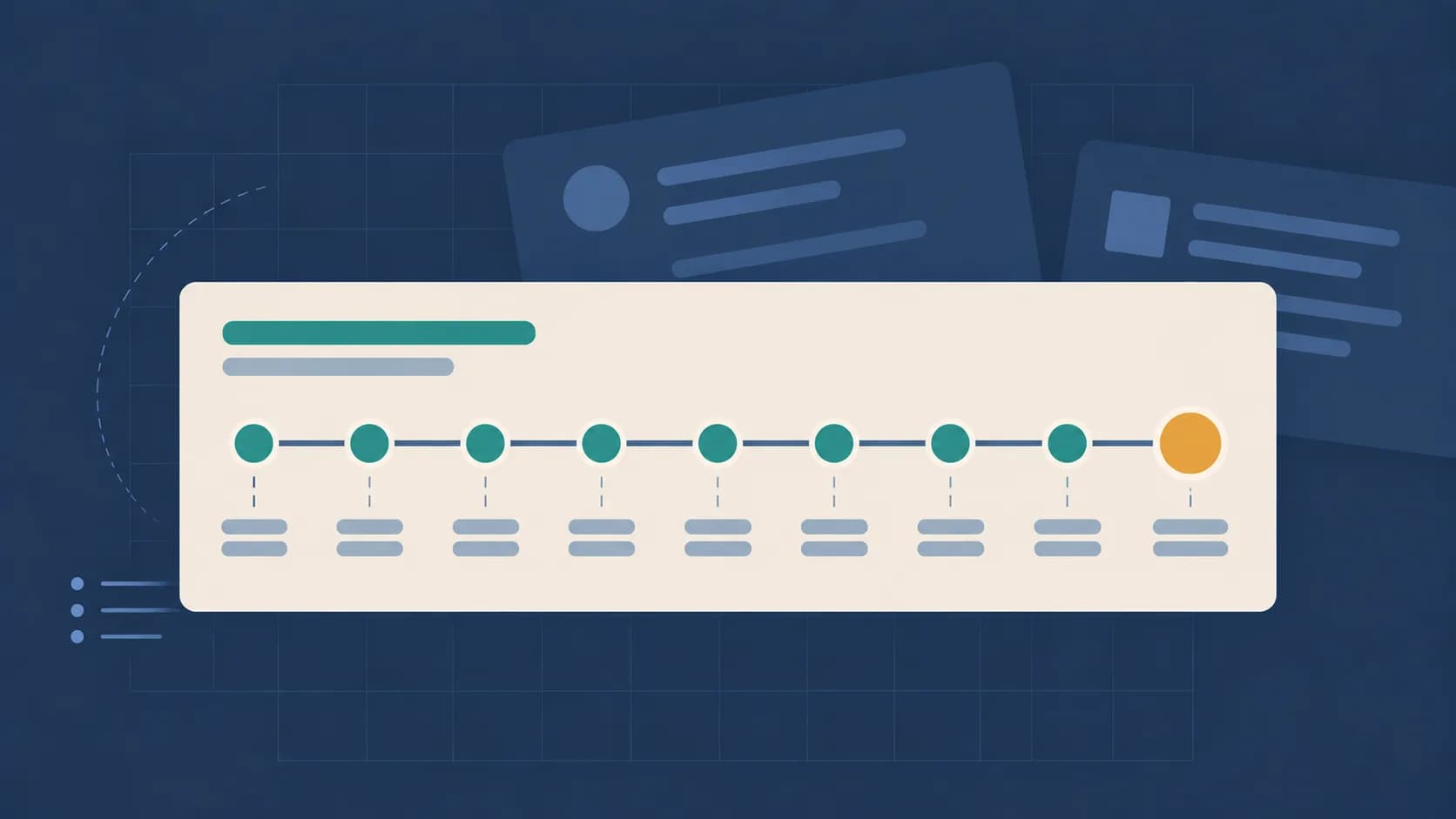
The recruitment and hiring process is the sequence a company follows from identifying a need through to a new employee becoming productive. Done properly it has nine stages: need identification, role definition, sourcing, screening, interviewing, assessment and decision, offer, pre-joining, and onboarding.
Most companies have all nine in some form. What separates fast hiring from slow hiring is almost never the number of stages. It is latency between them, and the fact that nobody owns the gaps.
Process sound but slow? Goodspace runs hiring end to end and closes roles in 7 days. See how it works
What are the stages of the hiring process?
Nine stages, each with an owner, an output and a realistic duration.
| # | Stage | Output | Typical duration |
|---|---|---|---|
| 1 | Need identification | Approved requirement | 2 to 10 days |
| 2 | Role definition | Job description and scorecard | 1 to 3 days |
| 3 | Sourcing | Candidate pool | 3 to 15 days |
| 4 | Screening | Shortlist | 2 to 7 days |
| 5 | Interviewing | Assessed candidates | 7 to 21 days |
| 6 | Assessment and decision | Selected candidate | 2 to 7 days |
| 7 | Offer | Signed acceptance | 3 to 14 days |
| 8 | Pre-joining | Verified, engaged joiner | 30 to 90 days |
| 9 | Onboarding | Productive employee | 14 to 60 days |
Two things stand out. Stage 8 dominates the calendar because Indian notice periods run 30 to 90 days. And stages 1 and 6, the two decision stages, are where most avoidable delay hides, because nobody tracks them.
Stage 1: Need identification
The output is an approved requirement, not a job title. The useful question is what the business cannot do today, because a meaningful share of hiring requests dissolve when asked.
What should happen:
- The requesting manager states the outcome that is not being delivered
- Alternatives are tested: reprioritisation, training, internal move, contract, automation
- If a hire is genuinely needed, budget and band are approved
- A required-by date is set, in the business, not a joining date
Where it goes wrong: approval sitting in a queue for three weeks while everyone assumes recruitment has started. Set a service level on approval and track it, because it is invisible time that nobody counts as hiring time.
Stage 2: Role definition
The output is a job description plus a scorecard. The scorecard is the part most companies skip, and it is the part that makes the rest of the process consistent.
A scorecard names:
- The two or three outcomes this person must deliver in their first year
- The competencies required to deliver them
- How each competency will be assessed, and by whom
- What "good" looks like, in words, so the panel calibrates before interviewing rather than arguing after
Without a scorecard, every interviewer applies their own bar, feedback is unusable because it compares different things, and the decision defaults to whoever argues hardest. Writing one takes an hour and saves the whole loop.
Stage 3: Sourcing
The output is a candidate pool of sufficient quality, not sufficient size. Channel choice is determined by role type, which is covered in candidate sourcing strategies.
The planning question that matters: is inbound realistically going to produce this hire? For operational and entry roles, usually yes. Above mid-level, usually not, and posting the role and waiting is the most common cause of a stalled senior search.
Stage 4: Screening
The output is a shortlist with a stated reason for each inclusion. Screening is filtering, and it can only ever be as good as the pool it filters.
Practical rules:
- Screen against the scorecard, not against a general impression
- Define must-haves honestly, usually two, not eight
- Rank rather than reject where volume allows a human decision point
- Sample the rejections periodically, because false negatives are invisible otherwise
- Include a short screening call for anything above entry level, because CVs are a weaker signal than they were
Stage 5: Interviewing
The output is assessed candidates with comparable evidence. The most common failure is not the questions, it is inconsistency: different candidates asked different things, so the comparison at decision time is between impressions rather than evidence.
What works:
Structured interviews. The same core questions for every candidate for a role, mapped to the scorecard competencies. This is the single largest quality improvement available to most companies and it costs nothing.
A defined loop, published to the candidate. How many rounds, with whom, over what period. Candidates drop out of ambiguity.
Work samples over hypotheticals. What someone has actually done, or can do in a short exercise, predicts better than what they say they would do.
Feedback within 24 hours, written, against the scorecard. Verbal feedback in a corridor is not evidence.
A cap on rounds. Four is usually enough. Beyond five, you are not learning more, you are losing candidates and signalling indecision.
Stage 6: Assessment and decision
The output is a decision, made quickly. This stage is short in theory and frequently long in practice, because it requires someone to commit.
Run it as a single meeting with the panel, comparing written feedback against the scorecard, ending with a decision and a compensation number. Common failures: waiting to see one more candidate, deferring for an absent stakeholder, and reopening the bar mid-process.
A useful discipline: if the panel cannot agree, the answer is usually no. Hires made by exhausted consensus underperform, and everyone involved usually knew.
Stage 7: Offer
The output is a signed acceptance. Speed matters more here than anywhere else in the process, because your best candidate is your competitor's best candidate.
What works:
- Verbal offer within 24 hours of the decision, from the hiring manager, not from HR
- Written offer within 48 hours
- Compensation discussed honestly earlier in the process, so the number is not a surprise
- A named person available for questions during the decision window
- A realistic deadline, usually 3 to 5 working days, not 24 hours
Indian specifics that matter: candidates frequently hold multiple offers, and counter-offers from current employers are common and often successful. Assume both. Ask directly what else they are considering and what would make them decline, because the answer is usually given honestly and tells you what to address.
The offer letter itself, including the clauses that matter, is covered in offer letter format in India.
Stage 8: Pre-joining
The output is a candidate who actually turns up. This is the longest stage and the most neglected, and offer drop-off in India is a real and significant loss.
What reduces drop-off:
Stay in contact. A candidate who hears nothing for 60 days is being courted by someone who is in contact. A fortnightly check-in is enough.
Complete verification early, not in the final week. Background verification is covered in employee background verification.
Send documentation and onboarding information in advance, so joining feels real.
Introduce them to the team before day one. A single call with their future manager materially reduces drop-off.
Have a plan for the counter-offer conversation, because it will happen, usually at resignation.
Treating this stage as dead time is the most expensive mistake in the entire process, because a drop-out here costs you the full cycle again.
Stage 9: Onboarding
The output is a productive employee, and the metric is time to productivity rather than time to fill.
The basics that are routinely missed: access and equipment ready on day one, a named buddy, a 30-60-90 plan with a real first deliverable, manager one-to-ones scheduled for the first month, and a check-in at 30 days that asks whether the role matches what was described during hiring.
That last question is the early warning for 90 day attrition, and it is answerable while it is still fixable.
Where does the time actually go?
Almost always in the gaps between stages, not inside them.
The four biggest sources of avoidable delay:
- Requisition approval, invisible because nobody starts the clock until recruitment receives it
- Interview scheduling, which is usually the single largest block of process latency
- Feedback delay, where a two day lag per round becomes eight days across a loop
- Decision deferral, waiting for one more candidate or one more stakeholder
None of these are recruitment capability problems. All are process discipline problems, and all are fixable without spending anything. Measuring stage-by-stage duration, and attributing overdue feedback by name, changes behaviour faster than any tooling purchase.
Nine stages, seven days. Goodspace compresses sourcing and screening so your team spends its time on interviews and decisions. Talk to Goodspace
How Goodspace fits into the process
Goodspace covers stages 3 and 4, where most time and effort is consumed, and supports stages 5 through 8.
Goodex for stage 3: search, unlock and reach across more than 10 million verified profiles, as a dashboard or API.
Job posting with AI shortlisting for stage 4, ranking applicants against your scorecard rather than keyword matching.
A dedicated recruiter who coordinates scheduling and keeps candidates engaged through the pre-joining window, which is where drop-off happens.
Flat success fee, charged on hires who join.
Conclusion
The nine stages are not the problem. Every company has them. The difference between a two week hire and a two month hire is the latency between stages, and three specific gaps account for most of it: approval, scheduling and feedback.
Fix those before buying anything. Write a scorecard so interviews produce comparable evidence, set a 24 hour feedback rule and track who breaks it, and treat the pre-joining period as active work rather than waiting. Those three changes cost nothing and typically compress a hiring cycle more than any tool will.
FAQs About the Recruitment and Hiring Process
What are the stages of the recruitment process? Nine stages: need identification, role definition, sourcing, screening, interviewing, assessment and decision, offer, pre-joining, and onboarding. Most companies have all nine. The difference between fast and slow hiring is latency between them.
How long should hiring take in India? From approved requirement to signed acceptance, four to eight weeks is realistic for a mid-level role. Joining adds another 30 to 90 days for notice period, so from approval to a productive employee is commonly three to five months.
What is a hiring scorecard? A document naming the two or three outcomes the hire must deliver in their first year, the competencies required, how each will be assessed and by whom, and what good looks like. It is what makes interview feedback comparable across a panel.
Where does most of the delay in hiring come from? The gaps between stages rather than the stages themselves. Requisition approval, interview scheduling, feedback delay and decision deferral account for most avoidable time, and none of them are recruitment capability problems.
How many interview rounds should there be? Four is usually sufficient. Beyond five you are rarely learning more, and you are losing candidates and signalling indecision. Cap the loop and publish it to candidates so they know what to expect.
How do you reduce offer drop-off in India? Treat the notice period as active work rather than waiting. Stay in contact fortnightly, complete verification early, send onboarding material in advance, arrange a call with the future manager, and prepare for the counter-offer conversation, which is common.
What should happen in the first 30 days of onboarding? Access and equipment ready on day one, a named buddy, a 30-60-90 plan with a real first deliverable, scheduled manager one-to-ones, and a 30 day check-in asking whether the role matches what was described during hiring.
How do we speed up hiring without lowering the bar? Attack latency, not standards. Set a service level on requisition approval, block interview slots in advance, enforce 24 hour written feedback, and cap the number of rounds. These compress the cycle without changing who you hire.
Further Reading: Related Hiring and HR Guides
- How to write a job description that attracts candidates
- Candidate sourcing strategies that actually fill roles
- Offer letter format in India: templates and clauses
- Employee background verification in India
Related Articles
- Recruitment strategy and hiring plan
- Cost per hire: formula and benchmarks
- Free job posting sites in India
Additional Resources
- Your applicant tracking system's stage-by-stage duration data, which is where your real bottleneck is visible
- Your offer acceptance and drop-off records, for measuring the pre-joining stage properly
- Your 90 day attrition data, the clearest signal of whether roles are being represented honestly during hiring
Hiring for a role right now?
Fix the gaps later. If the role is open today, see how Goodspace closes roles in 7 days, or use Goodex if sourcing is the stage where you are stuck.