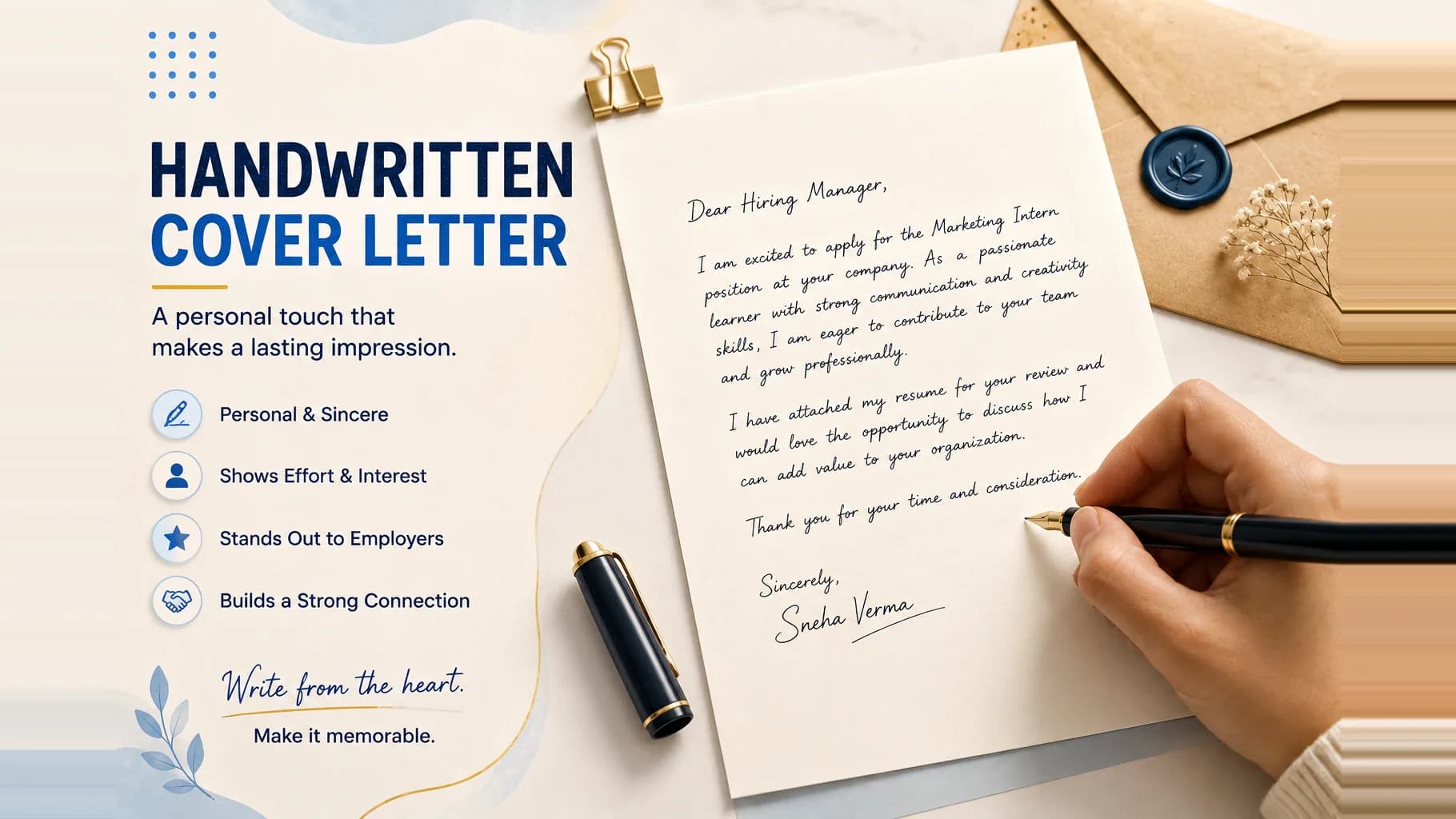
A handwritten cover letter is a job application letter that you write out by hand on paper instead of typing it. In India it still shows up in very specific places, walk-in interviews, government and PSU offices, small local firms, retail and shop-floor hiring, and off-campus drives where you hand over documents in person. This guide covers what a handwritten cover letter is, when it actually helps you (and when a typed one is expected instead), the correct format, presentation tips, and several copy-ready samples you can adapt for your own job application.
Let us be honest up front. For the vast majority of jobs you apply to today, especially anything online, corporate, or through a job portal, a typed cover letter is what employers expect. But the handwritten version has not disappeared. There are real situations across India where a neat, sincere, hand-written letter still lands better than a printed one, and knowing the difference can save you from looking out of place.
What is a Handwritten Cover Letter?
A cover letter is the short letter that goes along with your resume. It introduces you, tells the employer which role you are applying for, and explains in a few lines why you are a good fit. A handwritten cover letter is simply that same letter produced by hand, usually on plain A4 paper or ruled paper, in blue or black ink, and signed at the bottom.
The purpose is identical to a typed one. What changes is the impression. Handwriting signals effort and personal attention. It says you sat down, thought about this specific job, and took the time to write it out. In the right setting that effort reads as sincerity. In the wrong setting it can read as unprofessional or outdated, so the setting matters more than anything else.
People sometimes confuse a handwritten "application" with a cover letter. In many Indian offices, a handwritten application is a short leave, request, or formal note to an authority (for example, an application for a day off or for a certificate). A cover letter is specifically the document that accompanies your resume when you apply for a job. They follow a similar letter format, but a cover letter is about selling your candidacy for a role, not making an internal request.
When a Handwritten Cover Letter is Still Used in India
Here are the situations where writing your cover letter by hand still makes practical sense:
- Walk-in interviews. Many companies in India advertise walk-in drives where you show up with your resume and documents. If you are handing over a physical file, a neatly handwritten cover letter on top can add a personal touch and show you came prepared rather than just forwarding a generic PDF.
- Government and PSU applications. Some government departments, public sector units, and older institutions still accept or expect physical applications submitted by post or in person. A handwritten covering letter fits the formal, paper-based culture of these offices.
- Small firms and family-run businesses. Local shops, small manufacturers, clinics, coaching centres, and family-run companies often hire informally. Here the owner may personally read what you submit, and a handwritten note can feel warmer and more direct than a printed template.
- Retail, hospitality, and shop-floor roles. For counter staff, store assistants, delivery, housekeeping, or similar front-line jobs, applications are often dropped off in person. A clear handwritten letter is perfectly acceptable and sometimes preferred.
- Off-campus and on-campus drives. During campus placements or off-campus recruitment events, students sometimes submit a physical form or file. A short handwritten cover letter can accompany the resume when documents are collected by hand.
- When you are specifically asked to. Occasionally an ad or a recruiter says "submit a handwritten application" or "bring a covering letter in your own handwriting." Some employers even use it informally to check your handwriting, English, and neatness. When asked, always comply exactly.
If none of these describe your situation, you are almost certainly better off with a typed letter. Do not handwrite a cover letter for a role you found on a job portal, an email application, or a large multinational. It will look out of step with how that company works.
Handwritten vs Typed Cover Letter: When to Use Each
The choice is not about which is "better." It is about matching the format to how the employer receives applications and what kind of organisation they are.
Use a typed cover letter when:
- You are applying online, by email, or through a job portal like Naukri, LinkedIn, or a company careers page.
- The employer is a large company, MNC, startup, or anything corporate.
- The job description asks for a PDF or Word document.
- You want it to be searchable, consistent, and easy to forward internally.
Use a handwritten cover letter when:
- You are physically handing over documents at a walk-in, a small office, or a placement drive.
- The employer explicitly requests it in your own handwriting.
- The organisation is small, local, government, or traditional and receives paper applications.
- Your handwriting is genuinely neat and legible, so the effort works in your favour rather than against you.
Here is a side-by-side comparison to make the decision quick.
| Factor | Handwritten cover letter | Typed cover letter |
|---|---|---|
| Best for | Walk-ins, small firms, PSU/government, in-person submission | Online, email, portals, corporate roles |
| Impression it gives | Personal, sincere, effortful | Professional, clean, standard |
| Speed | Slow, one letter at a time | Fast, easy to reuse and edit |
| Editing | Hard, mistakes mean rewriting | Easy, correct in seconds |
| Legibility risk | Depends on your handwriting | Always readable |
| Searchable or trackable | No | Yes, ATS-friendly |
| Signature | Naturally handwritten | Needs a scanned or typed sign-off |
| Expected in 2026 | Only in specific in-person contexts | Default for most applications |
A smart middle path many candidates use: draft the wording first with the AI Cover Letter generator so the content is tight and error-free, then write that exact text out neatly by hand for the walk-in or in-person submission. You get strong wording and the personal touch of handwriting, without struggling to compose good sentences on the spot.
Format and Structure of a Handwritten Cover Letter
A handwritten cover letter follows the standard business-letter layout. Because you are writing by hand, keep it to one page and leave clean margins on all sides. Here is the structure from top to bottom.
1. Your details (top). Start with your name, phone number, email, and city at the top. In a handwritten letter you can place these at the top left. Keep it to three or four lines.
2. Date. Below your details, write the full date, for example 31 July 2026. Leave a blank line after it.
3. Recipient's details. Write the name and designation of the person you are addressing if you know it (for example, "The HR Manager" or a named person), followed by the company name and location. If you do not have a name, "The Hiring Manager" or "The HR Manager" is fine.
4. Subject line. A short subject helps in Indian formal letters. For example: "Subject: Application for the post of Sales Executive." This is common and expected in India, especially for government and formal roles.
5. Salutation. Open with "Dear Sir/Madam," if you do not know the name, or "Dear Mr Sharma," / "Dear Ms Iyer," if you do. Use a comma after it.
6. Body. Keep it to three short paragraphs.
- The first paragraph states the role you are applying for and where you saw it, plus a one-line hook about why you are interested.
- The second paragraph covers your relevant qualifications, skills, and any experience, tied to what the job needs.
- The third paragraph thanks the reader, says you have attached your resume, and expresses your hope for an interview.
7. Closing. Use "Yours sincerely," or "Yours faithfully," (faithfully when you did not name the person, sincerely when you did). Leave two lines of space, then write your full name. Sign in the gap above your printed name.
Keep the whole thing tight. A handwritten cover letter should fit comfortably on one side of one page. If you are running out of space, your paragraphs are too long.
Handwriting and Presentation Tips
The content matters, but with a handwritten letter presentation is half the battle. A brilliant letter that is hard to read defeats the purpose. Follow these:
- Draft it first, then copy it out. Never write your final letter cold. Write the full text on rough paper (or type it), fix every mistake, then copy the clean version onto your final sheet in your best handwriting. This single habit prevents almost all crossing-out.
- Use good paper and ink. Plain white A4 or clean ruled paper. Blue or black ink only. Avoid gel pens that smudge and never use pencil.
- Write slightly larger than usual. Slightly bigger, well-spaced letters read as neater and more confident than cramped writing.
- Keep margins and spacing even. Leave a clear margin on the left and space between paragraphs. White space makes it look organised.
- No cross-outs, no whitener. If you make a mistake on the final copy, start a fresh sheet. Overwriting and correction fluid look careless.
- Get someone to read it. Ask a friend or family member to read it back to you. If they stumble on any word, rewrite that part more clearly.
- Proofread for spelling and grammar. A handwritten letter cannot rely on autocorrect, so check every word. Formal, polite English with no slang.
- Sign by hand. Always sign in ink above your printed name. This is the one place a real signature genuinely adds value.
- Keep it clean on delivery. Carry it flat in a folder so it does not get creased, stained, or crumpled before you hand it over.
Sample Handwritten Cover Letters
Below are copy-ready samples you can adapt. Write them out by hand once you have swapped in your own details. Keep the layout described above.
Sample 1: General Job Application
Rahul Verma +91 98xxxxxxxx rahul.verma@email.com Pune
31 July 2026
The HR Manager Sunrise Textiles Pvt Ltd Pune
Subject: Application for the post of Sales Executive
Dear Sir/Madam,
I am writing to apply for the post of Sales Executive at Sunrise Textiles, which I saw advertised for your walk-in interview. I have two years of experience in retail sales and am keen to contribute to your growing team.
In my current role at a garment showroom, I handle customer service, meet monthly sales targets, and maintain billing records. I am confident, comfortable speaking with customers in Hindi and English, and quick to learn new products. I believe these strengths fit the requirements of this role.
I have attached my resume for your review. Thank you for considering my application. I would welcome the opportunity to discuss how I can add value to your team, and I am available for an interview at your convenience.
Yours faithfully, (signature) Rahul Verma
Sample 2: For Freshers (No Experience)
Ananya Nair +91 90xxxxxxxx ananya.nair@email.com Kochi
31 July 2026
The Hiring Manager BrightEdge Solutions Kochi
Subject: Application for the post of Junior Associate
Dear Sir/Madam,
I am a recent B.Com graduate applying for the post of Junior Associate at BrightEdge Solutions. Although I am at the start of my career, I am hardworking, eager to learn, and ready to give my best to this role.
During my degree I completed a three-month internship in accounts, where I learned to work with spreadsheets, maintain records, and meet deadlines. I am comfortable with MS Office and pick up new tasks quickly. I am confident I can grow into a reliable member of your team.
My resume is attached for your reference. Thank you for taking the time to consider my application. I would be grateful for the chance to attend an interview and show my willingness to contribute.
Yours faithfully, (signature) Ananya Nair
Sample 3: For a Specific Role (Named Manager)
Imran Sheikh +91 99xxxxxxxx imran.sheikh@email.com Hyderabad
31 July 2026
Mr Arjun Rao Branch Manager Metro Logistics Hyderabad
Subject: Application for the post of Warehouse Supervisor
Dear Mr Rao,
I am writing to apply for the post of Warehouse Supervisor at Metro Logistics. With four years of experience in warehouse operations, I am excited by the chance to bring my skills to your branch.
In my present role I supervise a team of eight, manage inventory, and ensure daily dispatch targets are met with zero errors. I have reduced stock discrepancies through better record-keeping and am trained in basic safety procedures. I am confident these strengths match what you need for this position.
Please find my resume attached. Thank you for considering my application, Mr Rao. I would be glad to meet you for an interview and discuss how I can support your team's goals.
Yours sincerely, (signature) Imran Sheikh
Sample 4: Short Version (Quick Walk-in Note)
Priya Deshmukh +91 88xxxxxxxx priya.d@email.com
31 July 2026
The HR Manager GreenLeaf Retail
Dear Sir/Madam,
I would like to apply for the post of Store Assistant at your walk-in interview today. I have one year of retail experience, enjoy working with customers, and am available to join immediately.
My resume is attached. Thank you for your time. I look forward to the opportunity of an interview.
Yours faithfully, (signature) Priya Deshmukh
Notice how each sample stays short and specific. You name the role, give two or three concrete reasons you fit, thank the reader, and sign off. That is all a cover letter needs to do, whether typed or handwritten.
How to Write It, Then Present It Neatly: A Simple Workflow
Follow this order and you will never hand over a messy letter.
- Read the job details. Note the exact role title, the company name, and any name of a contact person. You will use these in your subject line and salutation.
- Draft the wording. Write the text roughly, or draft it faster with the AI Cover Letter generator, then trim it to three short paragraphs in your own voice. Composing on paper under pressure at a walk-in leads to mistakes, so get the words right before you touch your final sheet.
- Proofread the draft. Fix spelling, grammar, and awkward phrasing. Check the role title and company name are spelled correctly.
- Copy it out by hand. On clean A4 or ruled paper, in blue or black ink, copy your finished text using your best, slightly larger handwriting. Keep even margins and spacing.
- Sign it. Sign in ink above your printed name.
- Check the final copy. No cross-outs, no smudges, no stains. If anything looks off, rewrite on a fresh sheet.
- Protect and deliver. Slip it into a folder with your resume so it stays flat and clean, and hand it over neatly at the interview or office.
This same workflow lets you keep your best wording on file and simply rewrite it whenever you need a fresh handwritten copy for another walk-in or drive.
Frequently Asked Questions
Are handwritten cover letters still accepted in India in 2026? Yes, but only in specific situations. Walk-in interviews, small and family-run firms, government and PSU offices, retail and shop-floor roles, and some off-campus drives still accept or even prefer handwritten letters when documents are submitted in person. For online, email, and corporate applications, a typed cover letter is expected.
Is a handwritten cover letter better than a typed one? Neither is universally better. A handwritten letter shows personal effort and works well in person, while a typed letter is faster, always legible, and standard for online and corporate applications. Choose based on how the employer receives applications, not on which one you prefer.
What is the difference between a handwritten application and a cover letter? A cover letter accompanies your resume and sells your candidacy for a specific job. A handwritten application, in the Indian sense, is often a formal request to an authority, such as an application for leave or a certificate. They share a similar letter format, but their purpose differs.
How long should a handwritten cover letter be? One page, and ideally less. Aim for three short paragraphs plus your details, subject line, salutation, and sign-off. If it does not fit neatly on one side of a page, shorten your paragraphs.
Can I type my cover letter and just sign it by hand? Yes, and for most situations that is the safest option. A typed letter with a genuine handwritten signature gives you clean, readable content plus a personal touch. Reserve a fully handwritten letter for walk-ins, small or traditional employers, and cases where handwriting is specifically requested.
What if my handwriting is not very neat? If your handwriting is hard to read, a handwritten letter can hurt more than help. In that case type the letter, sign it by hand, and hand over the printed copy. If a handwritten version is required, draft the wording first, write slowly in slightly larger letters, and have someone check that every word is legible before you submit it.
Final Word
A handwritten cover letter is a tool for a particular moment, the in-person application, the walk-in, the small office, the government file. Used there, it shows sincerity and sets you apart. Used in the wrong place, like an online corporate application, it looks out of step. Get the setting right, keep the format clean, draft your wording carefully before you write, and present a neat one-page letter. Do that and your handwritten cover letter will do exactly what it is meant to do: make a real person want to meet you.