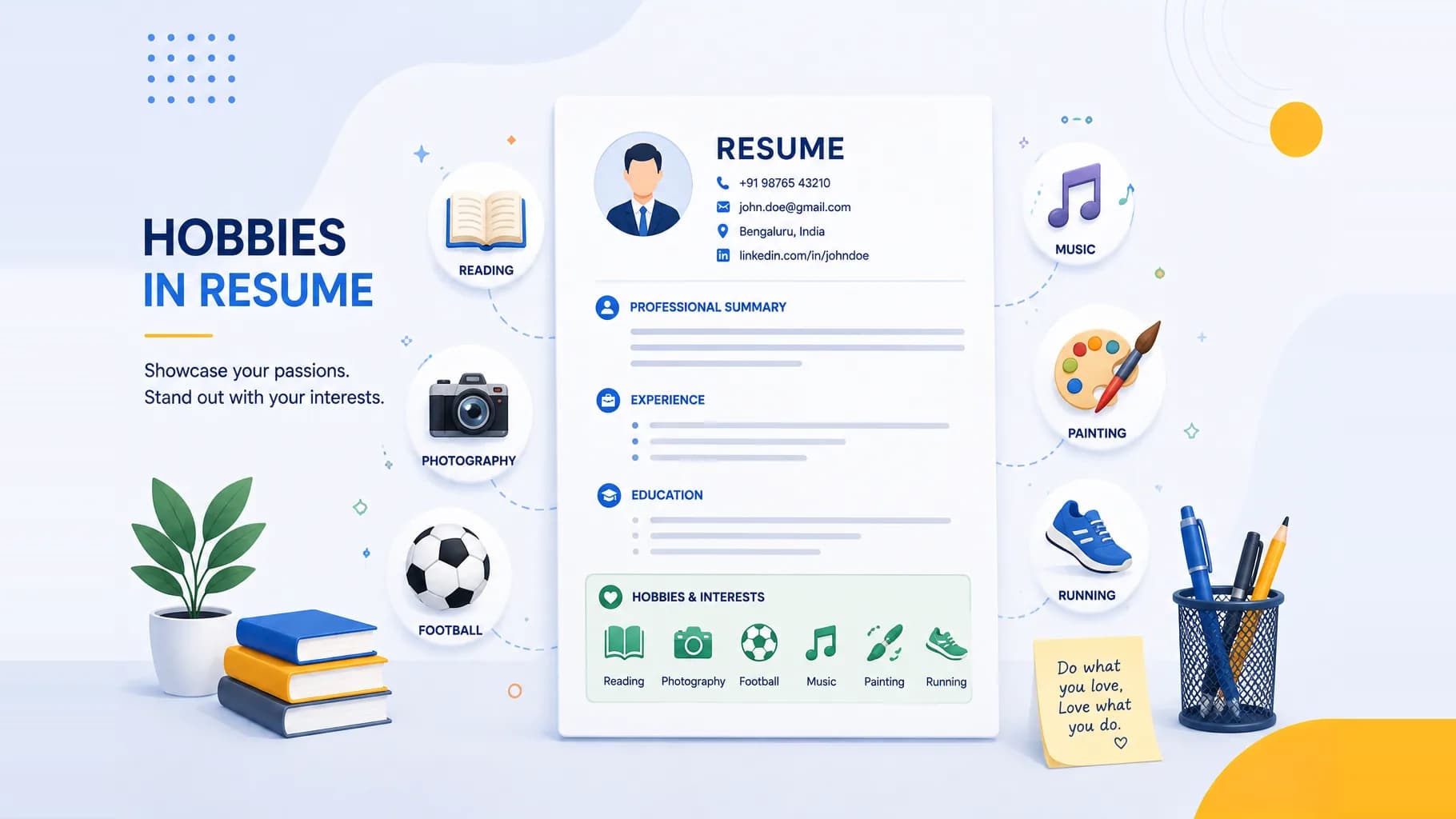
Deciding what to put in the hobbies in resume section trips up more candidates than almost any other part of the CV. Add the wrong ones and you look unfocused. Skip them entirely and a fresher resume can feel thin. Add the right ones, described the right way, and you hand the recruiter a reason to remember you and a question to open the interview with. This guide walks through exactly when hobbies help, when they hurt, how Indian recruiters read them, and gives you more than 60 curated examples grouped by the skill each one signals, by job role, and by career stage.
By the end you will know how to write a hobbies section that adds signal instead of filler, and you will have a copy-and-adapt library to pull from.
Should You Put Hobbies on a Resume?
The honest answer is: sometimes. Hobbies are the optional, movable furniture of a resume. Your header, education, work experience, projects, and skills are load-bearing. Hobbies fill remaining space and add colour. So the decision comes down to how much space you have and how much your hobbies actually say about you.
When you SHOULD include hobbies
- You are a fresher or student. With little or no work experience, hobbies and extracurriculars are legitimate evidence of soft skills like discipline, teamwork, and initiative. In India, campus recruiters routinely scan them to gauge personality and cultural fit.
- You are changing careers or re-entering after a gap. A relevant hobby can bridge the story between where you were and where you want to go.
- The hobby demonstrates a skill the job needs. Competitive coding for a software role, debating for a law or sales role, event management for a project coordinator role.
- It reinforces the company culture. A startup that talks about ownership and grit will read marathon training or building a side project as a good sign.
- The job posting or application form specifically asks for it. Many Indian company application portals and campus forms have a dedicated field.
When you should NOT include hobbies
- Your resume is already full. For experienced professionals with strong work history, space is better spent on achievements. If you are pushing past two pages, hobbies are the first thing to cut.
- The hobbies are generic filler. "Listening to music, watching movies, reading" tells a recruiter nothing that separates you from a thousand other applicants.
- They could invite bias. Anything overtly political, religious, or controversial can work against you with an unknown reader. Leave it out unless it is directly job-relevant.
- You cannot talk about it. If you list "photography" but own no portfolio and shoot twice a year, a curious interviewer will expose the gap in thirty seconds.
A useful rule: every hobby on your resume should earn its place by either signalling a relevant skill or giving the interviewer a genuine, interesting hook. If it does neither, delete it.
Hobbies vs Interests: What Is the Difference?
Recruiters use the terms loosely, but the distinction is worth understanding because it changes how you write the section.
- A hobby is something you actively and regularly do. Playing badminton every weekend, maintaining a blog, restoring old bicycles, competitive chess. Hobbies produce evidence: results, output, a portfolio, a routine.
- An interest is a broader area of curiosity you may not practise hands-on. Interested in behavioural economics, artificial intelligence, Indian classical music history, or geopolitics. Interests show intellectual direction and what you pay attention to.
Why it matters: hobbies are almost always stronger on a resume because they come with proof. "Interested in fitness" is weak. "Completed the 2025 Tata Mumbai Marathon (half)" is a hobby with a result attached. When you have a choice, lead with hobbies that have evidence, and use interests only when they align tightly with the role, for example listing an interest in machine learning on a data analyst resume.
You can title the section "Hobbies," "Interests," or "Hobbies & Interests." All three are accepted by Indian recruiters. Pick whichever matches what you are actually listing.
How to List Hobbies on a Resume
A few formatting rules keep this section clean and professional.
- Place it at the bottom. After experience, projects, and skills. It should never push more important content down.
- Keep it short: 3 to 6 items. A long list dilutes signal and reads as padding. Quality beats quantity every time.
- Be specific, not generic. "Reading" is weak. "Reading non-fiction on behavioural economics" is specific and memorable.
- Choose hobbies that map to the job. Mirror the traits in the job description. If it asks for collaboration, a team sport helps. If it asks for creativity, a making or design hobby helps.
- Use a consistent format. Either a single comma-separated line for a compact look, or short bullets when you want to add a describing phrase.
- Only list what you can defend. Assume every item is a possible interview question.
Compact single-line example:
Hobbies: Competitive chess (state-level), long-distance running, cooking regional Indian cuisine, open-source contributing
Descriptive bullet example:
- Chess: State-ranked player; captained college team to two inter-university finals
- Running: Completed two half-marathons; train four mornings a week
If you are building the section from scratch, the Goodspace AI Resume Builder can format and place it cleanly for you and suggest role-relevant options based on the job you are targeting.
Best Hobbies by What They Signal
This is the heart of a good hobbies section. Do not pick hobbies because they sound impressive. Pick them because of the specific quality they prove. Below are curated lists grouped by the signal they send.
Leadership and influence
These show you can take charge, organise people, and communicate publicly.
- Captaining a sports team
- Organising college fests or community events
- NCC or NSS leadership roles
- Debating and Model United Nations
- Public speaking and Toastmasters
- Mentoring or tutoring juniors
- Running a student club or society
- Podcasting or hosting
Creativity
These show original thinking, aesthetic judgement, and the patience to make something finished.
- Photography
- Sketching, painting, or digital illustration
- Creative and content writing
- Blogging or vlogging
- Playing a musical instrument
- Graphic design
- Filmmaking and video editing
- Pottery, calligraphy, or DIY crafts
- Cooking and baking experimentally
Analytical and problem-solving
These show logic, patience, and structured thinking. Strong for tech, finance, and consulting roles.
- Chess and strategy board games
- Competitive coding and hackathons
- Solving Rubik's cubes or puzzles
- Sudoku and crosswords
- Personal finance and stock market analysis
- Data-driven fantasy sports
- Astronomy and stargazing
- Learning new programming languages for fun
Teamwork and collaboration
These show you work well with others and handle shared goals. Highly valued by Indian recruiters for entry roles.
- Team sports: cricket, football, hockey, kabaddi, basketball
- Doubles badminton or table tennis
- Playing in a band or orchestra
- Community theatre or drama
- Volunteering with an NGO
- Group trekking or expedition clubs
Discipline and resilience
These show consistency, grit, and the ability to stick with something hard.
- Long-distance running and marathons
- Gym training and strength progression
- Yoga and daily meditation
- Learning a classical dance form (Bharatanatyam, Kathak)
- Learning a new language
- Cycling and endurance events
- Martial arts and belt progression
- Swimming
Curiosity and continuous learning
These signal you keep growing on your own, which every employer likes.
- Reading non-fiction across a topic
- Taking online courses (MOOCs)
- Journalling and note-taking systems
- Learning languages on apps
- Following a specialist newsletter or field closely
Hobbies by Role or Field
Tailoring beats a one-size-fits-all list. Here are hobbies that reinforce specific career tracks common in India.
IT and software
The goal is to signal genuine technical curiosity beyond the job description.
- Competitive programming (LeetCode, Codeforces)
- Contributing to open-source projects
- Building side projects or apps
- Participating in hackathons
- Chess and logic puzzles
- Home lab or Raspberry Pi tinkering
- Tech blogging
Management and business
Signal organising ability, people skills, and decision-making.
- Organising events and fests
- Debating and Model UN
- Leading a student or community club
- Team sports as captain
- Personal finance and investing
- Strategy board games
Design and creative
Your hobbies should double as proof of taste and craft.
- Photography with a public portfolio
- Illustration and digital art
- UI experiments and design challenges
- Typography and calligraphy
- Filmmaking and editing
- Sketching and painting
Sales and marketing
Signal communication, persuasion, and audience-building.
- Blogging or running a content page
- Growing a social media following
- Public speaking and Toastmasters
- Debating
- Podcasting
- Community organising
Finance and analytics
Signal numeracy, discipline, and analytical rigour.
- Stock market and mutual fund analysis
- Chess and strategy games
- Sudoku and mathematical puzzles
- Fantasy sports with a data approach
- Reading on economics and markets
Teaching and education
Signal communication, patience, and a genuine drive to help others learn.
- Tutoring and mentoring
- Reading widely across subjects
- Drama and theatre
- Public speaking
- Volunteering in education NGOs
- Storytelling
Good Hobbies for Freshers and Students in India
For a fresher resume, the hobbies section carries more weight because it substitutes for missing work experience. Indian campus recruiters, especially in IT services, banking, and FMCG, use it to judge personality, initiative, and cultural fit. Choose hobbies that show you did something with your time beyond attending classes.
Strong choices for students and freshers:
- NSS, NCC, or Rotaract involvement
- Captaining or playing a college sports team
- Organising a technical or cultural fest
- Competitive coding and hackathons
- Debating, quizzing, or Model UN
- Volunteering with an NGO
- Blogging, YouTube, or a creative side project
- Learning a classical art form or instrument
- Running a small college startup or society
Wherever you can, attach a small result: a rank, a role, a number, an event you ran. A fresher who writes "organised college tech fest with 500+ attendees" instantly outshines one who writes "interested in events." The Goodspace AI Resume Builder has fresher-friendly templates that give this section the right prominence without letting it overwhelm your education and projects.
Hobbies to Avoid on a Resume
Some hobbies add nothing or actively hurt you. Steer clear of these.
- Generic filler: "Watching TV, listening to music, browsing the internet, sleeping." These are default activities, not distinguishing ones.
- Anything political or religious that is not directly job-relevant. You cannot predict the reader's views, and it invites unconscious bias.
- Risky or dangerous pursuits stated without context, such as extreme stunts. They can read as reckless to a conservative recruiter.
- Passive or solitary-to-a-fault activities with no signal, like "collecting" hobbies you cannot discuss meaningfully.
- Anything you exaggerated. Do not write "expert guitarist" if you know three chords. Interviewers probe.
- Controversial or edgy hobbies that could split opinion. When unsure, leave it out.
- Outdated achievements from a decade ago with nothing recent to back them.
- Gaming, stated bluntly, is a mixed signal. For most corporate Indian roles it reads as a time sink. For a game studio or an esports-adjacent role, frame it as competitive achievement instead.
The test is simple: if a hobby could make a neutral recruiter think less of you, and it does not clearly help, cut it.
Good vs Risky Hobbies: A Quick Comparison
| Good hobbies (add signal) | Risky or weak hobbies (add doubt) |
|---|---|
| Chess, strategy games | "Gaming" with no context |
| Marathon running, yoga | Extreme or dangerous stunts |
| Volunteering with an NGO | Political or religious activism |
| Blogging, photography with a portfolio | "Browsing social media" |
| Debating, public speaking | Controversial or edgy interests |
| Team sports, captaincy | "Watching TV, sleeping" |
| Learning languages, MOOCs | Exaggerated skill claims |
| Playing an instrument | Vague "collecting" with no story |
How to Describe a Hobby Well: Before and After
A named hobby is fine. A described hobby is far stronger, because it carries proof and a story. The formula: hobby + specificity + result or scale. Here are before-and-after rewrites you can adapt.
-
Before: Chess After: Competitive chess player, state-ranked; captained college team to two inter-university finals
-
Before: Running After: Long-distance runner; completed two half-marathons and train four mornings a week
-
Before: Photography After: Street and travel photographer with a 3,000-follower Instagram portfolio
-
Before: Cooking After: Home cook specialising in regional Indian cuisine; documented 40+ recipes on a personal blog
-
Before: Blogging After: Maintain a personal tech blog averaging 2,000 monthly readers on cloud and DevOps topics
-
Before: Volunteering After: Volunteer with a local education NGO; taught weekend maths to 20+ underserved students for a year
-
Before: Coding After: Build side projects for fun; shipped a Telegram bot with 500+ active users
-
Before: Public speaking After: Toastmasters member; delivered 15+ prepared speeches and competed at area level
-
Before: Music After: Self-taught guitarist; perform with a college band at inter-college events
-
Before: Reading After: Avid reader of behavioural economics; write monthly book summaries for a peer group
Notice the pattern in every "after": a specific detail plus a number, rank, or output. That is what turns a throwaway line into an interview opener. Do not invent numbers. Use real, modest, true figures. A true "20+ students" beats a fabricated "hundreds" every time.
Frequently Asked Questions
How many hobbies should I list on my resume? Three to six. Fewer than three can look sparse, and more than six reads as padding. Pick the ones most relevant to the role and most defensible in an interview.
Are hobbies necessary on an Indian resume? Not mandatory, but recommended for freshers and students because they help recruiters judge personality and fit when work experience is thin. For senior professionals with strong experience, hobbies are optional and should be cut if space is tight.
Should hobbies and interests be one section or two? One combined section is cleanest and saves space. Title it "Hobbies & Interests" and list the strongest items. Only split them if you have a specific reason and plenty of room.
Where should the hobbies section go on my resume? At the very bottom, after education, experience, projects, and skills. It should be the last thing a recruiter reads, never something that pushes core qualifications down the page.
Can hobbies actually get me hired? Rarely on their own, but they tip close decisions and create rapport. A shared hobby or an interesting one gives the interviewer a warm opening and makes you more memorable among similar candidates.
What if my hobbies are common, like cricket or reading? Common is fine if you make it specific. "Cricket" is weak, but "opening batsman for the district under-19 team" is strong. Add the detail that makes your version of a common hobby distinctive.
Final Takeaway
The hobbies section is small, optional, and easy to get wrong, which is exactly why doing it well sets you apart. Keep it to three to six items, choose each one for the skill it signals or the story it opens, describe the best ones with a specific result, and cut anything generic or divisive. For a fresher in India especially, a sharp hobbies section can be the difference between a resume that reads as a template and one that reads as a person worth interviewing. Choose deliberately, describe honestly, and let this section do quiet, useful work at the bottom of your page.