TGT Teacher Resume Format, with 3 Full Samples
A TGT resume is read by a principal or a headmistress hiring the person who will take a subject through the middle and secondary years, Classes 6 to 10, and be answerable for the Class 10 board result and for a classroom of thirteen-year-olds who are hard to hold. What they screen for is specific: your graduate subject and B.Ed, whether you hold CTET Paper 2, the Class 10 board results your students produced, and whether you can run a class as a class teacher and not only deliver a lesson. Most TGT resumes lose them on a paragraph about a passion for teaching and a qualification line buried under school marks. Below are three complete resumes, one for a graduate fresher fresh out of B.Ed, one for a TGT with several years and a board record, and one for a senior TGT moving towards a coordinator role, followed by the format rules, where CTET Paper 2 belongs, and the secondary-school vocabulary a school reads for.
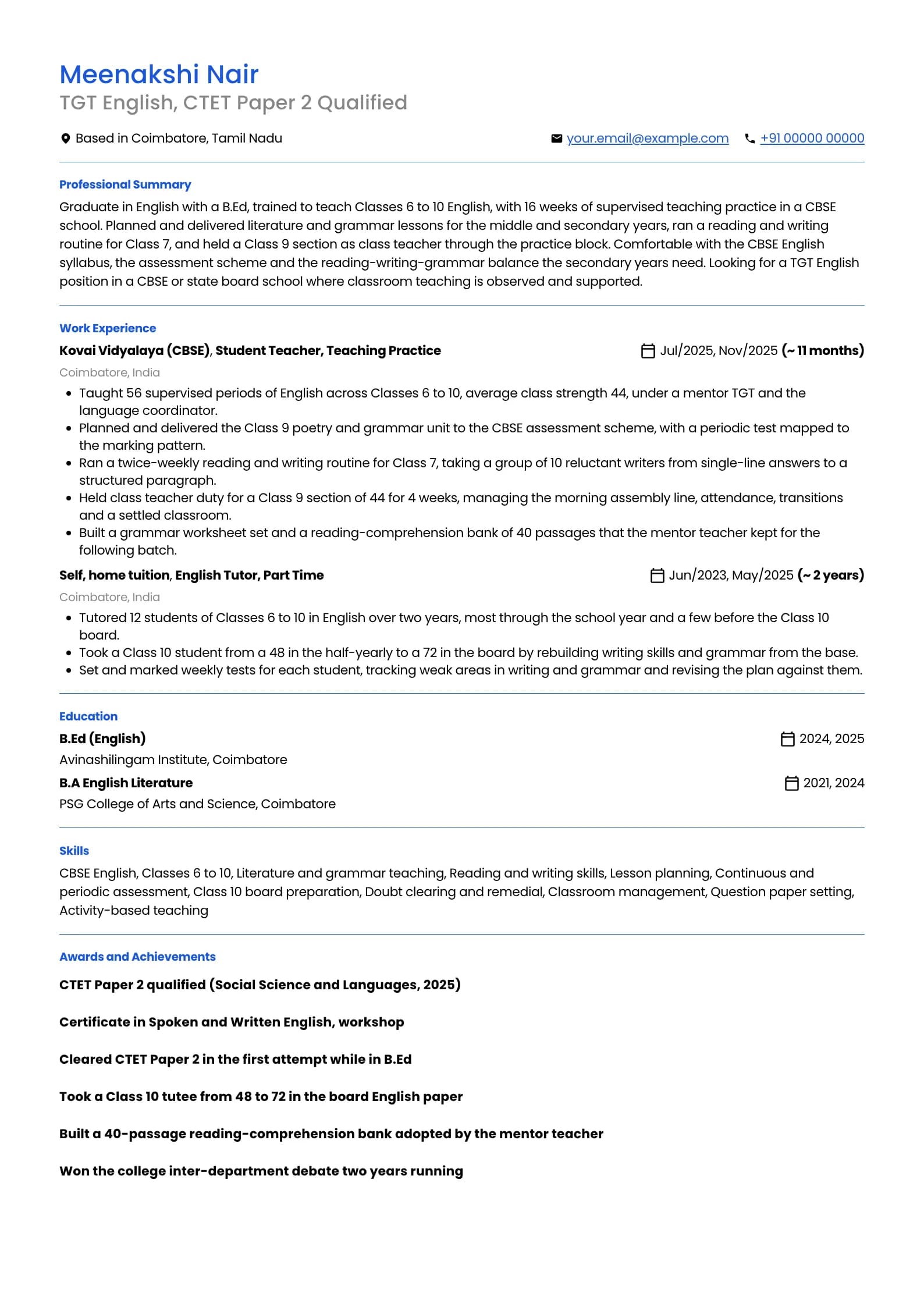
Build my resumeTGT Teacher resume example, Fresher, B.A plus B.Ed (0 years)
minimalist templateIs your resume good enough?
Upload the resume you have now and see what an applicant tracking system reads before a tgt teacher recruiter ever does.
Free to run. Sign in with your mobile number to see your score.
TGT Teacher resume example, TGT with a board record (5 years)
professional template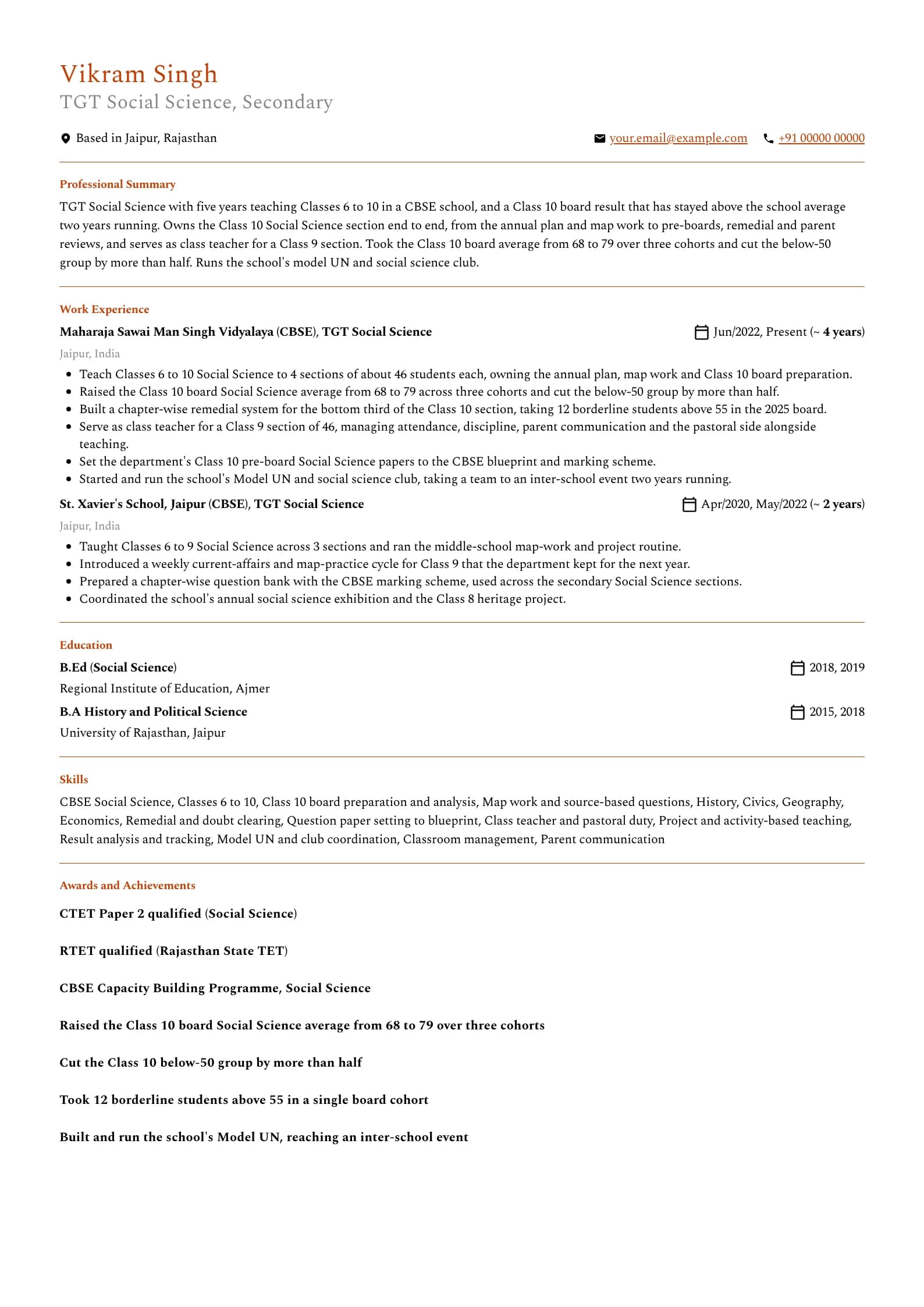
Want this structure with your own details? Build it in the resume builder.
TGT Teacher resume example, Senior TGT moving to coordinator (10 years)
header-band template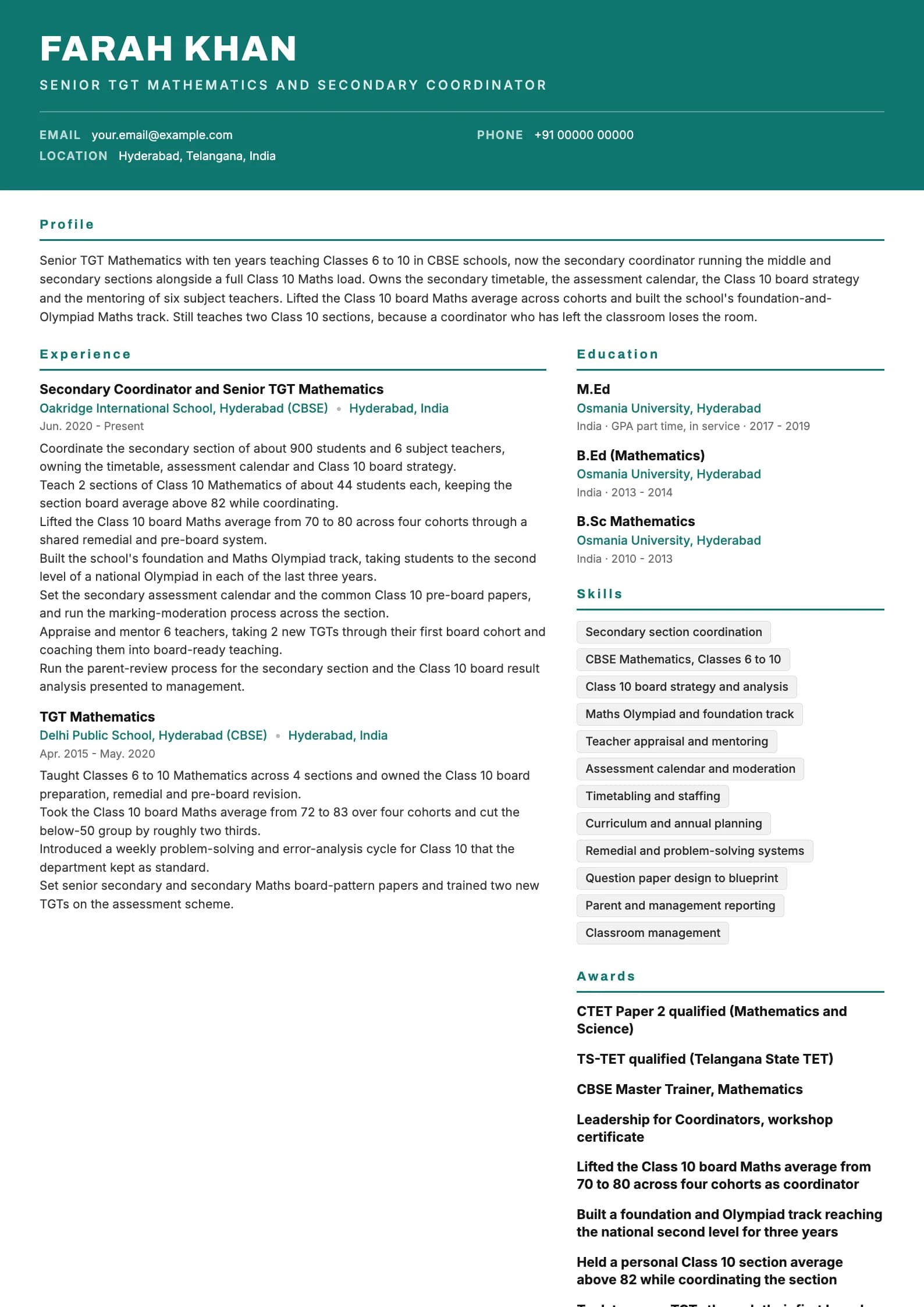
The format that works for a TGT resume in India
Reverse chronological is the layout a school expects. Most recent post first, work backwards, dates in plain view. A functional resume that groups everything under a Teaching Skills block and drops the dates reads as an attempt to hide a gap or a run of short stints, and a principal treats it that way. One honest line explaining a break beats a layout built to obscure it. The order that matters most for a TGT is qualification, subject, class band and board result, all visible before a reader reaches the bottom of the first page. A TGT is a subject teacher for Classes 6 to 10, so the headline names the subject, TGT Maths or TGT Social Science, not just teacher. The eligibility for the post is a graduate degree in the subject with a B.Ed, and for many schools CTET Paper 2, so those must be easy to find. Length is one page for a fresher and most TGTs up to roughly six years, and a second page is justified once you carry a real Class 10 board record, a class-teacher and club load, or a coordinator role that needs the space. A second page built from a philosophy-of-education paragraph and a list of workshops is a padded one-page resume. Four things do not belong on the page: a photograph unless the posting asks for one, date of birth, marital status and father's name. They come from an older campus template and take space a board result should occupy. Send a PDF unless the school asks for DOCX, name the file with your name and the subject, and keep to a single column so the parsing stays clean. The table below sets out the section order.
| Section | Where it goes | Why |
|---|---|---|
| Name and headline | Top, above everything | Headline names subject and level, e.g. TGT Mathematics, Secondary. Principals filter on it. |
| Professional summary | Directly under the header | Three to four lines: subject, years, class band, and the strongest board result. |
| Qualifications | High for a fresher, visible for all | Graduate degree in the subject plus B.Ed, and CTET Paper 2, decide eligibility. |
| Teaching experience | Next, most recent first | Newest role gets the most bullets. Class 10 board result leads each entry. |
| Class teacher and co-curricular | Inside experience | Class-teacher duty, clubs and events are real load a school needs covered. |
| Skills | Below experience | Subject, board prep, assessment, classroom management. Not a 30-item wall. |
| Certifications | After education, or beside skills if few | CTET Paper 2, state TET, CBSE trainings with the year. |
The Class 10 board result is the point, so lead with it
A TGT who teaches a board class is hired to move a number: the Class 10 board average and pass percentage in the subject. Everything else supports that. Yet most TGT resumes describe the teaching in general terms, taught Social Science to secondary classes with dedication, and never state a result. A principal reading that cannot tell a teacher whose sections score 79 from one whose sections score 62. State the result honestly and specifically. A board average lifted from 68 to 79 over three cohorts, a below-fifty group cut by half, twelve borderline students taken above fifty-five. If you know the school average, say how your section compared, because sitting above it is the cleanest evidence a TGT can offer. If you handle a non-board class, the equivalent evidence is a section average lifted across terms, or a group taken from below a threshold to above it. Be careful not to claim a whole cohort's result when several teachers shared the subject. Write what you owned: your section, your remedial group, your batch. A specific, smaller, true number reads as more credible than a school-wide figure you cannot fully claim. Where a fresher has no board cohort yet, the closest evidence is a tutee or a practice-block group taken from a low mark to a real one. The fresher sample uses exactly that: a Class 10 tutee taken from 48 to 72. It is the same currency, just a smaller amount.
If your resume names no board average, no pass rate and no student outcome, a principal cannot tell you apart from every other TGT who taught the subject. The result is the difference, so it belongs in the summary and the first bullet.
Writing a summary a principal actually reads
The block under your name is the part you can be reasonably sure is read, so it should carry four facts: your subject, how long you have taught it in the secondary years, the class band and board, and the strongest result your students produced. Three or four lines, no adjectives a reader cannot check. The old objective line, seeking a challenging position in a reputed institution to impart quality education and mould young minds, tells a principal nothing. It appears on thousands of teacher resumes and carries no information about you. Replace it with a summary. An objective says what you want, a summary says what your students have already achieved, and only one is evidence. Freshers often think they have nothing to summarise. Look at the fresher sample: it names the subject and class band, states the B.Ed and the teaching practice, points at the poetry unit and the writing routine, and names a real tutee result. That is a genuine summary built from a degree, a practice block and tuition. What it avoids is passionate educator, a phrase so common it now signals nothing. A practical test: read your summary and ask whether another TGT with the same B.A and B.Ed could paste it onto their resume unchanged. If they could, it describes the qualification, not you. Add the subject, the board number and the class you ran until it stops being transferable.
Professional summary, experienced TGT
Weak
Sincere and dedicated TGT with 5+ years of teaching experience looking for a challenging role in a reputed school to impart quality education and mould young minds.
Strong
TGT Social Science with five years teaching Classes 6 to 10 in a CBSE school, owning Class 10 board preparation and serving as class teacher for a Class 9 section. Raised the board average from 68 to 79 over three cohorts.
The rewrite trades a wish and self-praise for a subject, a class-teacher scope and a verifiable board result.
Experience bullets: verb, class, result
Every strong bullet in the samples has the same shape. It opens with an action verb, names the class, section or batch you taught, and closes with what measurably changed. The verb says you did it. The class tells the principal exactly what level and load you carried. The number does the persuading. Start from the outcome and work backwards. Teachers usually write the duty first, taught Social Science to Classes 6 to 10, then have nothing to attach. Instead ask what was different after a cohort passed through you: a board average rose, a below-fifty group shrank, a class settled, a club produced a result, an assessment routine got built. Then write the sentence that ends in that fact. Vary the evidence. Not every bullet can be a board average, or it reads as one number restated. Across a real role you can honestly reach for pass rate, section average versus school average, remedial outcomes, class-teacher and pastoral work, clubs and events, papers set and teachers mentored. The experienced sample moves across several, which reads as range. Where you lack a number, give scope: how many sections, how many students, how many periods, which classes and board. Serving as class teacher for a section of forty-six is real load stated plainly. Allocate bullets by recency: current post gets five or six, the previous post four or five, anything older two or three.
| Level | What the bullets must prove | Typical evidence |
|---|---|---|
| Fresher | You can hold a secondary class and teach the subject | Practice-block periods, a unit taught to scheme, a tutee result |
| 1 to 4 years | You own a subject section and can be a class teacher | Section board or term average, remedial outcomes, class-teacher duty |
| 5 to 8 years | Your sections beat the average and you build systems | Board average lifted over cohorts, clubs run, papers set |
| Senior TGT and coordinator | You own a section's results and its teachers | Section-wide average, tracks built, teachers appraised and grown |
Experience bullet, board preparation
Weak
Responsible for teaching Social Science to secondary classes and preparing students for the Class 10 board examination as per the syllabus.
Strong
Raised the Class 10 board Social Science average from 68 to 79 across three cohorts and cut the below-50 group by more than half.
"Responsible for" is a job description; the rewrite names the exact result three cohorts of students produced.
Experience bullet, class-teacher duty
Weak
Handled class teacher responsibilities and maintained discipline in the classroom.
Strong
Serve as class teacher for a Class 9 section of 46, managing attendance, discipline, parent communication and the pastoral side alongside teaching.
Replaces a vague duty with the real load, the section size and the specific pastoral work a school needs covered.
If a bullet would read identically on another TGT's resume, it is describing the syllabus, not you. Rewrite it until it only fits the section, batch or result you actually owned.
The skills section: grouped, honest, and about the subject
A TGT skills section has two readers with different needs. A parsing system wants literal terms it can match, the subject, the board, board exam preparation, classroom management. A principal wants a short, organised list that signals what kind of teacher you are. Grouping serves both. Group by function rather than one long line. Subject and level, board and assessment, pedagogy, and classroom and co-curricular is a grouping that fits almost any TGT. The exact headings matter less than the fact that structure exists. Lead with the subject and the board, because that is the first match a school makes: CBSE Mathematics, Classes 6 to 10, not just teaching. Twelve to sixteen skills is the working range. Below eight it looks thin. Above twenty it stops being a signal and starts reading as padding, which for a teacher usually means a wall of soft phrases, dedicated, hardworking, good communication, passionate, that say nothing a principal can test. Keep the soft skills to a few and let the results prove them. Do not add a proficiency bar or a star rating. Nobody agrees what four stars in classroom management means, and it invites an argument you cannot win. The board results and the class-teacher record are the depth gauge. Write the terms the way a school writes them: CBSE not cbse, Class 10 not X if the posting says Class 10, Social Science not SST.
| Group | What goes in it | How many |
|---|---|---|
| Subject and level | The subject, the board, the classes: CBSE Science, Classes 6 to 10 | 2 to 3 |
| Board and assessment | Class 10 board prep, question paper setting, result analysis | 3 to 4 |
| Pedagogy | Activity-based teaching, lesson planning, remedial, doubt clearing | 3 to 4 |
| Classroom and pastoral | Classroom management, class teacher duty, parent communication | 2 to 3 |
| Co-curricular | Clubs, events, exhibitions, house and competition coordination | 1 to 2 |
Skills section
Weak
Skills: Teaching, Hardworking, Dedicated, Good communication, Passionate, Team player, Punctual, Subject knowledge, MS Office, Discipline, Motivated, Sincere, Time management, Patience
Strong
Subject: CBSE Mathematics, Classes 6 to 10. Board: Class 10 board preparation, question paper setting, result analysis. Pedagogy: problem-solving approach, lesson planning, remedial. Classroom: management, class teacher duty, parent communication. Co-curricular: Maths club, Olympiad coordination.
Cuts a wall of untestable adjectives, leads with the subject and board a school filters on, and groups the rest into things a principal can check.
Class teacher duty, clubs and events: the load beyond the timetable
For a TGT, the work that separates a strong resume from a generic one is the load beyond teaching: the class-teacher and pastoral duty, the clubs and events you run, the papers you set, and the systems you build. Schools hire a TGT to do more than deliver periods, and these are the parts a principal reads to tell whether you can carry a class and a section, not just a lesson. Name the class-teacher duty plainly. Serving as class teacher for a section means owning attendance, discipline, the morning assembly line, transitions, parent communication and the pastoral side for forty-odd thirteen-year-olds, and it is real responsibility that most resumes leave out. A school with a class-teacher vacancy needs exactly this, so state it. Co-curricular work is a genuine edge where you have it. Starting and running a club, coordinating the science exhibition or the heritage project, taking a Model UN or debate team to an inter-school event, running a house through the year, all show initiative beyond the timetable that schools value and pay for. Name the activity, your role and the outcome, honestly. Question paper setting is undersold and worth stating. A TGT who sets pre-board and periodic papers to the CBSE blueprint and marking scheme is doing work a school depends on, and it signals you know the board pattern from the inside, which is exactly what a board class needs.
Class-teacher duty, the clubs you run and the papers you set are not filler, they are the load a school most needs a TGT to carry. Left off the page, they read as gaps, so state them plainly.
Where qualifications and certifications belong
For a TGT the qualification is the eligibility for the post, so it must be easy to find. The eligibility is a graduate degree in the teaching subject, plus a B.Ed, and for many schools and all government routes, CTET Paper 2 or the state TET. Write them clearly: the B.A, B.Sc or B.Com in the subject with the year and class, and the B.Ed with its specialisation. A fresher leads with these; an experienced TGT keeps them visible but lets experience come first. Keep the percentage or class on the graduate degree while you are a fresher and it is good, because campus and early-career screening still filters on it. Once you have a teaching record, the marks matter less than the board results you have produced. School results and Class 12 marks can be dropped once you have your degrees and a few years in. Certifications sit just below education, or beside skills if you hold only one or two. Write the full name, the body and the year. CTET Paper 2 covers Classes 6 to 8, which overlaps the TGT band, so it is directly relevant and often required, more clearly than it is for a PGT. State TETs matter for government and aided posts in that state. CBSE capacity-building and subject trainings carry weight because they are board-specific and current. An expired or overstated qualification is easy to catch, because appointments involve document verification. List the class of degree you actually hold, and the certifications you have actually cleared, with the year.
Getting past the shortlisting filter
Large school groups and government recruitment increasingly run resumes through an applicant tracking system before a human reads them, and even a manual shortlist is a keyword scan under time pressure. Both are parsers of a kind: they read your file, try to break it into name, qualifications, subject, board and experience, and file the result. Almost every problem is a parsing problem, and parsing problems come from layout, not wording. The layout rules are short. One column. Standard section headings, so use Teaching Experience rather than My Journey, and Qualifications rather than Academic Voyage. No text inside images, because a school-logo strip reads as empty space. Keep the subject, the board and the qualification out of the header or footer region, which some parsers drop. Avoid text boxes and nested tables in the body. On wording, mirror the posting where it is honest. If the vacancy says TGT Maths, write TGT Mathematics, not senior teacher. If it says CBSE, write CBSE. If it says Classes 6 to 10, use that rather than VI to X. Spell out an acronym once alongside its short form, for example CTET (Central Teacher Eligibility Test) and TGT (Trained Graduate Teacher), so both searches find you. Keyword stuffing does not work. A hidden block of every subject and board in white text is caught quickly, and the outcome is worse than being filtered. Write real bullets that naturally carry the right terms, because a bullet describing the Class 10 board result contains board, Class 10 and the subject in a context that survives human review too. Save as PDF from a tool that embeds real text, then open the file and confirm you can select and copy a sentence. If you cannot select the text, neither can the parser.
Section heading
Weak
My Passion for Teaching
Strong
Teaching Experience
Parsers and rushed shortlisters look for standard headings; a creative one can push the whole block into an unread bucket.
Test your own file before you send it. Copy the text out of the PDF into a plain text editor. Whatever you can read there is roughly what the parser and the rushed screener see, and anything scrambled is a real risk.
What gets TGT resumes rejected
Most rejections at the resume stage are not close calls. They come from a small set of recurring problems, and all of them are fixable in an afternoon. The list below covers what principals and coordinators screening Indian TGT resumes see most often, in rough order of how much damage each one does.
- No board or class result anywhere. Average, pass rate, a section against the school figure. Without a number a TGT is indistinguishable from every other.
- The subject and class band not in the headline, so a principal filtering for a Class 6 to 10 vacancy cannot tell what you teach at a glance.
- CTET Paper 2 or the state TET missing or hidden, when it is often the eligibility for the post and a first filter for government routes.
- A wall of soft adjectives, dedicated, passionate, hardworking, in place of anything a principal can test.
- A generic objective about moulding young minds instead of a summary that states subject, years, class band and a result.
- Duties copied from the syllabus, taught the prescribed chapters, instead of what your students achieved. "Responsible for" is the tell.
- A photo, date of birth, marital status or father's name from an old campus template, taking space a result should use.
- Class-teacher duty, clubs and papers set left off, so the load a school most needs a TGT to carry reads as a gap.
- Job hops with no reason and unexplained gaps in a functional layout, which reads as concealment during verification.
- Overstated marks or a claimed CTET or degree that document verification and board records will contradict.
Read your resume once as a principal with forty applications and ten minutes. If it does not tell them your subject, your class band, your CTET status and a result within the first fifteen seconds, move those four things up.
Skills to put on a tgt teacher resume
Technical
- CBSE and state board syllabus, Classes 6 to 10
- Subject specialisation (English, Maths, Science, Social Science, Hindi, Sanskrit)
- Class 10 board exam preparation
- Question paper setting and marking scheme
- Continuous and comprehensive evaluation
- Result and gap analysis
- Activity and inquiry-based teaching
- Lesson and unit planning
- Remedial and enrichment teaching
- Map work, projects and practicals
- Foundation and Olympiad preparation
- Periodic and formative assessment
Tools and platforms
- Smart board and projector teaching
- Google Classroom
- MS Office and Google Workspace
- School ERP and gradebook
- Online assessment tools
- NCERT and reference resources
- Educational apps and videos
- Diksha and e-content
Working skills
- Classroom management
- Class teacher and pastoral care
- Student counselling
- Parent communication
- Mentoring junior teachers
- Time and syllabus management
- Patience and empathy
- Team and section coordination
Certifications worth listing as a tgt teacher
| Certification | Full name | Worth it for |
|---|---|---|
| CTET Paper 2 | Central Teacher Eligibility Test, Paper 2 (Classes 6 to 8) | Directly relevant to a TGT, since Paper 2 covers Classes 6 to 8, which overlaps the TGT band, and it is required for government, KVS and NVS posts and expected by many private schools. The most important single certification for a TGT to hold, so clear it early and list it near the top. |
| State TET | State Teacher Eligibility Test (UPTET, RTET, TS-TET and others) | The state-level equivalent of CTET, needed for government and aided school posts in that state. Worth holding for any TGT who might apply to state board or government secondary schools, and stackable with CTET for the widest reach across states. |
| CBSE CBP | CBSE Capacity Building Programme (subject specific) | Board-run training in the subject and its assessment, and a credible, current line on a CBSE TGT resume because it is board-specific. Worth attending and listing for any TGT in a CBSE school, since it signals you know the assessment pattern from the inside. |
| TET (Language) | Teacher Eligibility Test, language paper (for Hindi, Sanskrit, English TGTs) | The relevant TET paper for language TGTs, needed for government language-teacher posts. Worth clearing for anyone targeting a TGT Hindi, Sanskrit or English role in the government or aided sector, where the language paper is the eligibility filter. |
| M.Ed | Master of Education | A postgraduate education degree that strengthens a case for senior TGT, coordinator and academic-leadership roles rather than a first TGT post. Worth it for a mid-career TGT eyeing a coordinator track, and often done part time and in service. |
Keywords an ATS scans for in a tgt teacher resume
These are the literal terms a parser matches against the job description. Use the ones that are true of you, in the sentences where you did the work, not as a list at the bottom.
- tgt teacher
- trained graduate teacher
- secondary teacher
- class 6 to 10
- CBSE
- board exam preparation
- subject teacher
- graduate
- B.Ed
- CTET
- lesson planning
- classroom management
- class teacher
- question paper setting
- result analysis
- remedial classes
- continuous evaluation
- curriculum
- student assessment
- co-curricular
TGT Teacher resume FAQ
What salary can a TGT teacher expect in India?
A TGT fresher in a private CBSE school usually starts around 2.5 to 4.5 LPA, with strong metro schools paying more. A TGT with five to eight years and a good Class 10 board record commonly sits in the 4.5 to 8 LPA band in reputed private schools. In government service, a KVS or NVS TGT enters at Pay Level 7 with a gross of roughly 6 to 8 LPA and a defined career progression. Coordinators and senior TGTs at premium schools go higher, and Maths, Science and English tend to command a small premium.
What qualification do I need to become a TGT?
A TGT teaches Classes 6 to 10, so the eligibility is a graduate degree in the teaching subject plus a B.Ed. For government and many private posts, CTET Paper 2 or the state TET is also required. For example, a TGT Science needs a B.Sc and a B.Ed, and usually a cleared CTET Paper 2. List the graduate degree, the B.Ed with its specialisation, and your CTET or TET status clearly, because a screener checks eligibility first.
How long should a TGT resume be?
One page for a fresher and most TGTs up to about six years, and two pages once you carry a real Class 10 board record, a class-teacher and club load, or a coordinator role that needs the space. Nobody has been rejected for a resume that was easy to read. If you are struggling to fit one page, cut the oldest role to a line, remove workshops that add nothing, and delete a philosophy-of-education paragraph that says what everyone else's does.
Is CTET Paper 2 compulsory for a TGT?
For government, KVS and NVS posts it is compulsory, and for a large number of private CBSE schools it is expected or preferred. CTET Paper 2 covers Classes 6 to 8, which overlaps the TGT band, so it is directly relevant, more clearly than it is for a PGT teaching Classes 11 and 12. If you are targeting the government or aided sector, clearing CTET Paper 2 or the state TET is close to non-negotiable, so do it early and list it near the top.
How does a TGT fresher write a resume with no board cohort yet?
Lead with the qualification, then the teaching practice, then any tuition or coaching. Treat the practice block like a job: the periods taught, a full unit delivered to the assessment scheme, a class-teacher stint, a reading or writing routine you ran. For a result, use the closest true number you have, usually a tutee or practice group taken from a low mark to a real one. Add a cleared CTET Paper 2, because a verifiable credential outweighs adjectives.
Should I put my class-teacher and club work on the resume?
Yes. Schools hire a TGT to carry more than periods, so class-teacher duty, clubs, exhibitions and competition teams are real load a principal needs covered, and most resumes leave them out. Name the class-teacher section and what it involved, the club you ran and its outcome, and the events you coordinated. It shows you can hold a class and a section, not just deliver a lesson, which is exactly what a class-teacher vacancy is looking for.
How is a TGT resume different from a PGT resume?
A TGT teaches Classes 6 to 10 with a graduate degree plus B.Ed, and CTET Paper 2 is directly relevant, so the resume centres on the Class 10 board, classroom management across a wider age range, and class-teacher duty. A PGT teaches Classes 11 and 12 with a master's degree plus B.Ed, and the resume centres on senior secondary board results, practicals, question-paper setting and entrance support. Match the headline, the qualification you lead with, and the class band to the post.
Do I need a photo on a TGT resume in India?
No. A photo is not expected on a teaching resume unless the posting specifically asks for one, and it takes space a board result or a class-teacher line should use. The same goes for date of birth, marital status, father's name, nationality and a declaration paragraph, all of which come from an older template that spread through campus placement cells. Keep the page about your subject, your qualification, your CTET status and what your students scored.
Related resume examples and guides
Build your TGT resume in any of these formats
Start from a blank resume or upload the one you have. Goodspace renders it in 24 templates and flags the subject, board, CTET and board-result keywords a school will look for, and the philosophy-of-education padding it will not credit.
Build my resume