Retail Manager Resume Format, with 3 Full Samples
A retail manager is hired on evidence of a floor that made money: sales target beaten, margin protected, shrinkage held down, a team that stayed, and stock that turned. Yet most retail manager resumes read as a duty list, responsible for sales, staff and operations, with no P&L number behind any of it. Below are three complete resumes, one for a department or assistant manager stepping into a full retail manager role, one for a mid-level manager running a large-format store, and one for a senior retail operations manager owning several outlets. After the samples come the format rules, the retail numbers that carry weight, the terms a parser matches, and the mistakes that end a screening early.
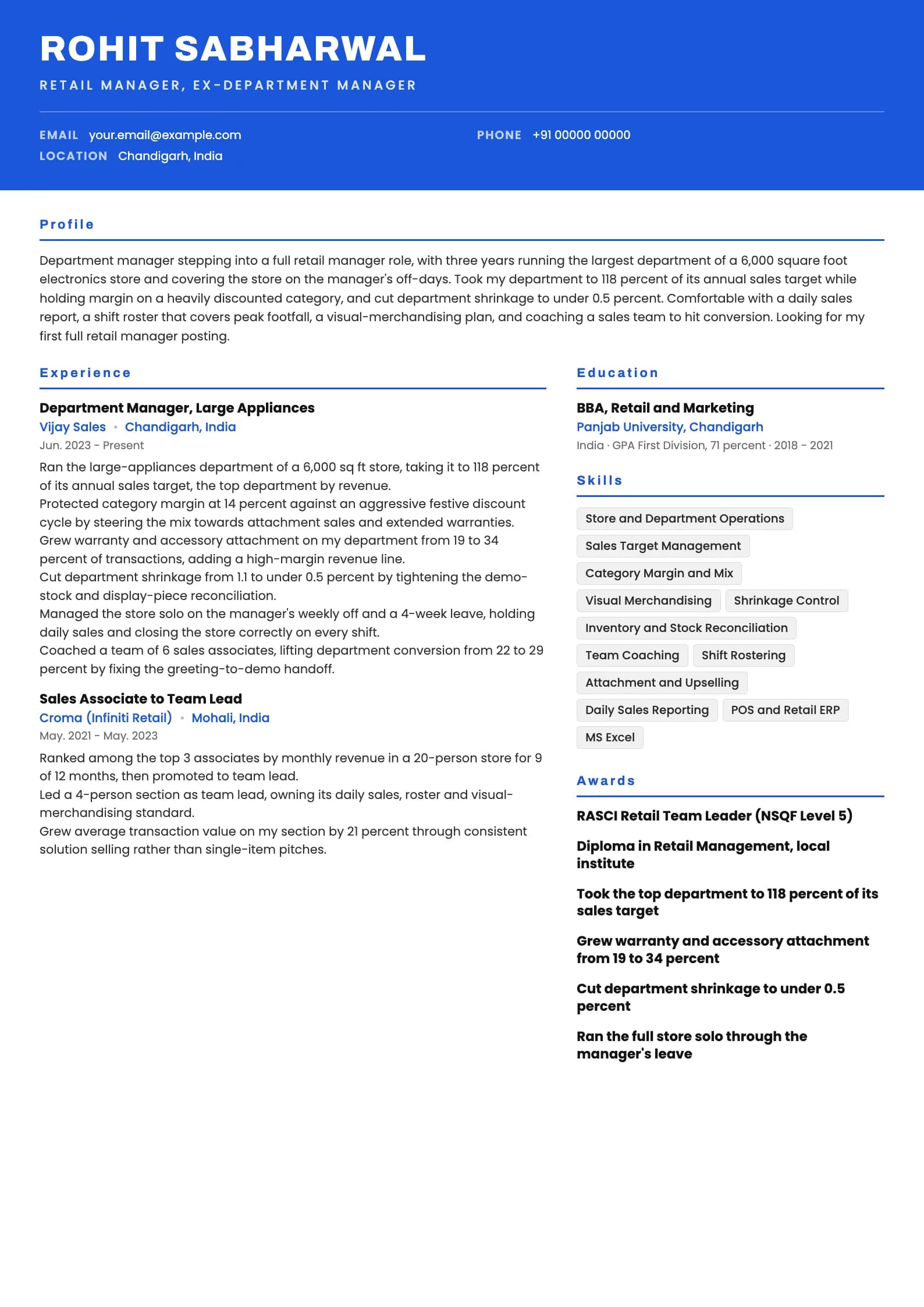
Build my resumeRetail Manager resume example, New Retail Manager (3 years)
header-band templateIs your resume good enough?
Upload the resume you have now and see what an applicant tracking system reads before a retail manager recruiter ever does.
Free to run. Sign in with your mobile number to see your score.
Retail Manager resume example, Retail Manager (6 years)
professional template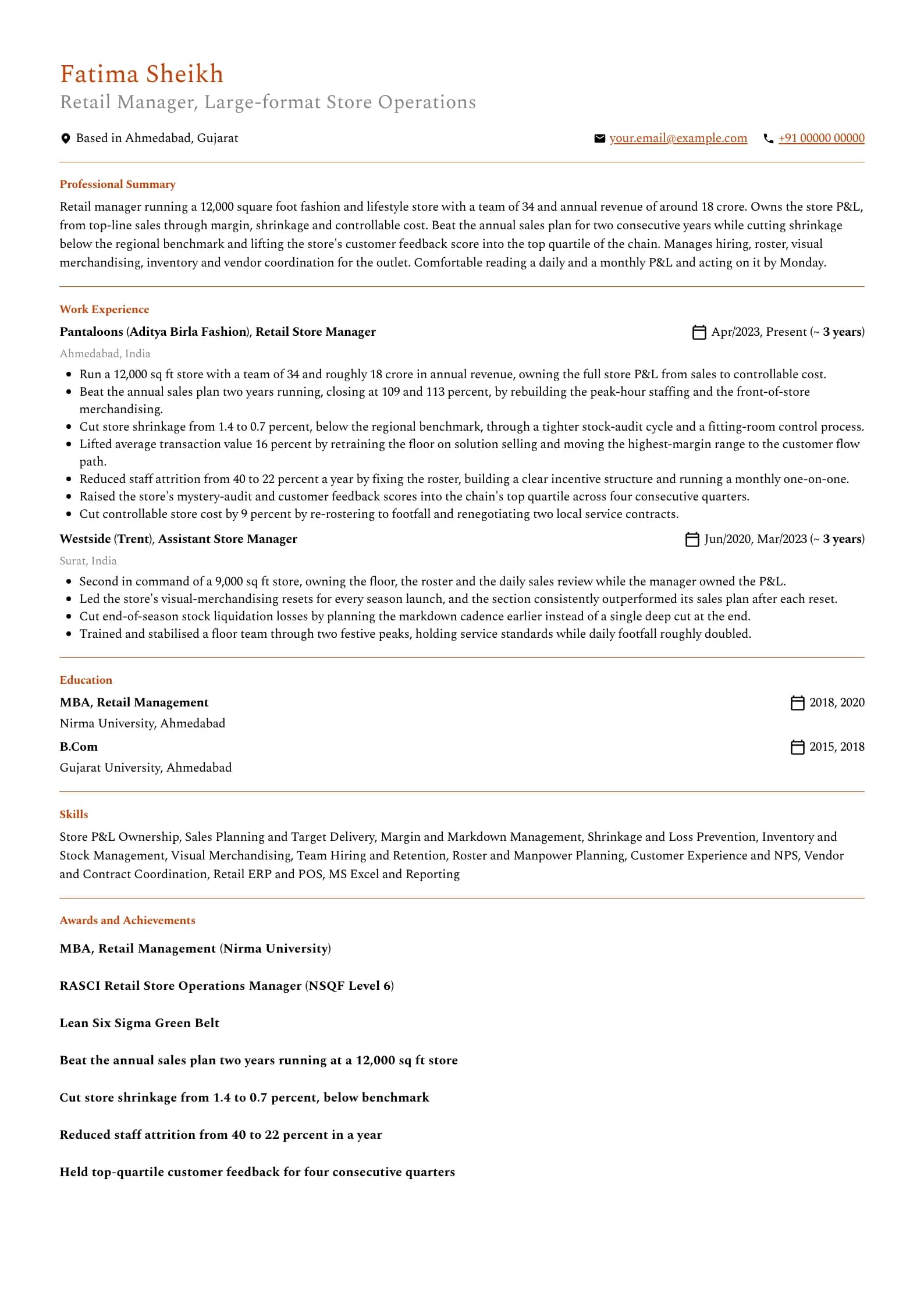
Want this structure with your own details? Build it in the resume builder.
Retail Manager resume example, Senior Retail Operations Manager (13 years)
ai-era template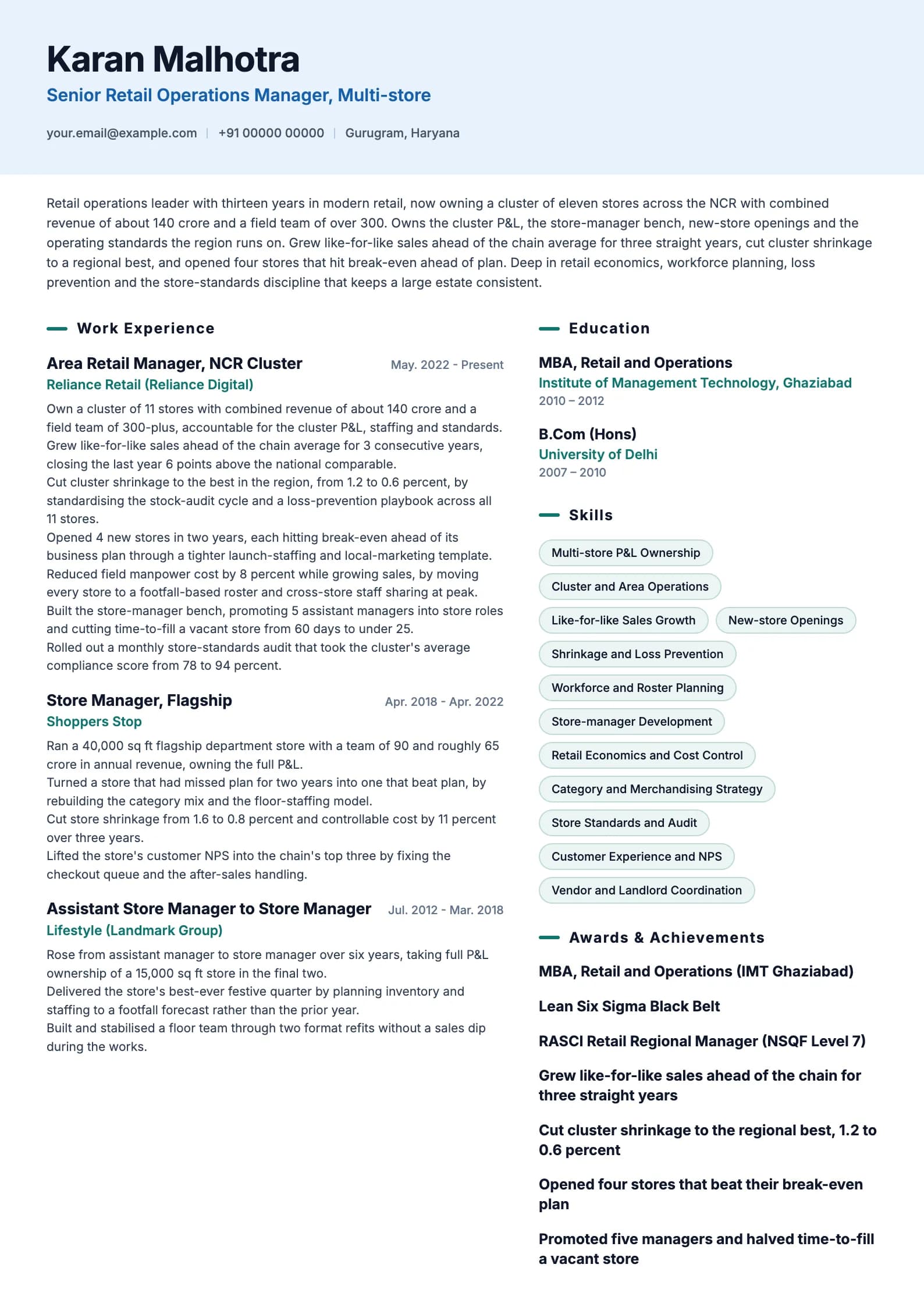
The format that works for a retail manager resume in India
Reverse chronological is the only layout worth using. Most recent store or cluster first, work backwards, dates in plain view. A regional or HR interviewer screening retail managers is checking that your responsibility grew over time and that the story holds together. A functional layout that groups everything under Skills and drops the dates reads as an attempt to hide a demotion or a gap, and reviewers treat it that way. Length follows scope. A new retail manager and most managers up to about eight years fit one page. A senior operations manager with a cluster, new-store openings and a promotion track can justify a second page, but only if it carries real P&L and estate work rather than a longer duty list. A page two built from a hobbies line and a declaration is a padded one-pager. Leave off the photograph, date of birth, marital status and father's name. They come from an older campus template and add nothing to a retail leadership screen, where the interviewer wants your sales-to-plan, your shrinkage and your team numbers. Every line they occupy is a line a business result could have used. Name the file with your own name and the words retail manager, and send a PDF unless asked otherwise. Use a single column all the way down, since a two-column layout with a sidebar can scramble in a parser. The table below sets the section order.
| Section | Where it goes | Why |
|---|---|---|
| Name and headline | Top, above everything | Headline names the level: Retail Manager, or Retail Operations Manager. |
| Professional summary | Directly under the header | Three or four lines. Store or cluster size, years, and your strongest P&L result. |
| Work experience | Next | Most recent store or cluster first. Newest role gets the most bullets. |
| Key achievements | Optional, under the summary | Three or four numbers a senior manager wants read even if the bullets are skimmed. |
| Skills | Below experience | P&L, shrinkage, VM, roster, inventory. Grouped, not a 30-item wall. |
| Education | Bottom, unless you are early-career | Degree, MBA if you have one, institution, years. |
| Certifications | After education | MBA retail, Six Sigma and a RASCI level earn their place here. |
A retail manager is judged on the P&L, not the sales line
The single most common retail manager resume failure is treating the role as a sales job. The resume lists sales target hit and revenue grown, and stops there, as if the store were a big cash till. But a retail manager owns a profit-and-loss statement, and a reviewer who runs a region reads the resume looking for whether you understand that. Sales is only the top line. Below it sit the numbers that decide whether the store actually made money: margin and markdown discipline, shrinkage, controllable cost, and the labour line. A manager who beat the sales plan by discounting the store into the ground did not do the job. The mid-level sample beats the sales plan and cuts shrinkage below benchmark and cuts controllable cost, which reads as a manager who ran a business, not just a floor. Name the specific levers. Attachment and warranty mix, markdown cadence, footfall-based rostering, stock-audit cycle, staff attrition. These are the things a retailer actually pulls, and naming them shows you know how the P&L moves rather than only that it should. "Cut controllable store cost by 9 percent by re-rostering to footfall and renegotiating two service contracts" tells a reviewer exactly how you did it. Do not confuse activity with impact. "Conducted daily briefings and floor walks" is activity every manager does. What changed because of it is the impact, and only the impact belongs on the page.
For every sales number on your resume, ask whether there is a matching margin, shrinkage or cost number beside it. A sales figure alone can be bought with discount. The profit figures are what prove you ran the store well.
Writing a summary a regional manager actually reads
The block under your name is the part you can be sure gets read, so it should carry the scope of what you run, how long you have run it, and your single strongest business result. For a store manager that is store size, team size and revenue. For a cluster lead it is the number of stores and the combined revenue. Three or four lines, no adjectives a reviewer cannot check. The old objective line, seeking a challenging retail management position in a growth-oriented organisation, tells the reader nothing. Replace it with a summary. An objective says what you want; a summary says what you have already delivered, and only one of those earns an interview. A manager stepping up from a department role often struggles to summarise, thinking they have not run a store. Look at the new-manager sample: it names the department size, the store size, the sales-to-plan and the cover-for-the-store stint. That is a genuine summary built from a department role plus solo store cover, and the cover is the bridge that makes it credible for a store posting. A quick test: read your summary and ask whether another manager in the same chain could paste it onto their resume unchanged. If they could, it describes the format, not you. Add your store, your P&L number and your specific result until it stops being transferable.
Professional summary, mid-level retail manager
Weak
Result-oriented retail management professional with 6+ years of experience in store operations, sales, team handling and customer service, seeking a challenging role in a reputed retail organisation.
Strong
Retail manager running a 12,000 sq ft fashion store with a team of 34 and around 18 crore in annual revenue, owning the full P&L. Beat the sales plan two years running while cutting shrinkage below benchmark.
The rewrite trades a keyword list and a wish for the scope of the store, the P&L ownership and two results that prove the store made money, not just noise.
Experience bullets: verb, lever, business result
Every strong bullet in the samples follows the same shape. It opens with an action verb, names the specific retail lever you pulled, and closes with the business result that moved. The verb says you did it. The lever tells a retail reviewer you know how a store works. The number does the persuading. Start with the result and work backwards. Managers tend to write the responsibility first, then cannot attach a number, which produces "responsible for overall store operations, sales and staff". Instead ask what was different in the store's numbers because you ran it: sales to plan, shrinkage, attrition, ATV, cost, NPS. Then write the sentence that ends in that fact and names how you got there. Vary the metric. Five sales numbers in a row read as one trick, and worse, they suggest you only watch the top line. Across a real role you can honestly reach for sales-to-plan, margin, shrinkage, attrition, ATV, conversion, controllable cost, audit score and NPS. The mid-level sample moves across most of these, which reads as a manager who runs a whole P&L. Where you lack a clean number, give scope: store square footage, team size, revenue, number of stores, footfall. "Ran a 40,000 sq ft flagship with a team of 90 and roughly 65 crore in annual revenue" carries weight without a single percentage. Allocate bullets by recency. Current role gets six or seven, the previous four or five, anything older two or three.
| Level | What bullets must prove | Typical metric |
|---|---|---|
| New manager | You have carried a department and covered a store | Department sales-to-plan, margin, shrinkage, conversion |
| Store manager | You own a full store P&L end to end | Sales-to-plan, shrinkage, attrition, ATV, cost, NPS |
| Multi-store | You run an estate and grow the managers in it | Like-for-like growth, cluster shrinkage, new stores, bench |
| Operations lead | You set the standards a region runs on | Audit compliance, cost per store, time-to-fill, LFL |
Experience bullet, store manager
Weak
Responsible for achieving sales targets, managing staff and ensuring smooth store operations on a daily basis.
Strong
Beat the annual sales plan two years running, at 109 and 113 percent, by rebuilding the peak-hour staffing and the front-of-store merchandising.
"Responsible for" restates a job description; the rewrite names the result, the two years and the two specific levers that produced it.
Experience bullet, cost and people
Weak
Worked on reducing costs and improving staff retention across the store.
Strong
Reduced staff attrition from 40 to 22 percent a year by fixing the roster, building a clear incentive structure and running a monthly one-on-one.
Swaps a vague claim for a before-and-after number and the three concrete actions behind it, so a reviewer can ask a real follow-up.
If a bullet would read identically on any manager's resume in your chain, it is describing the role, not you. Rewrite it until it only fits the store or cluster you actually ran.
The skills section: grouped, honest and about running a business
A retail manager's skills section has two readers with opposite tastes. A parser wants literal terms it can match, P&L, shrinkage, visual merchandising, inventory. A human wants a short, organised list that says what kind of manager you are. Grouping satisfies both. Group by function rather than one long line. Commercial, so P&L, sales planning and margin; operations, so inventory, shrinkage and audit; people, so hiring, roster and retention; and customer, so experience and NPS. The exact headings matter less than the fact that structure exists. Write the terms the way the trade writes them: P&L not PNL, like-for-like not LFL only, visual merchandising spelled out at least once. Twelve to sixteen skills is the working range. Below ten the section looks thin for a management role. Above twenty it stops being a signal. Do not pad it with generic office skills for a role that is about running a store's numbers and its people. Every item is a question you have agreed to answer. Skip the star ratings. Nobody agrees what four stars in inventory management means, and it invites an argument you cannot win. Let the experience carry the depth.
| Group | What goes in it | How many |
|---|---|---|
| Commercial | P&L ownership, sales planning, margin, markdown, cost control | 3 to 5 |
| Operations | Inventory, stock audit, shrinkage, loss prevention, VM | 3 to 5 |
| People | Hiring, roster and manpower planning, retention, coaching | 3 to 4 |
| Customer and systems | Customer experience, NPS, retail ERP and POS, reporting | 2 to 4 |
Skills section
Weak
Skills: Leadership, Hardworking, Team management, Communication, Sales, Operations, MS Office, Customer handling, Target achievement, Multitasking, Time management
Strong
Commercial: store P&L, sales planning, margin and markdown, cost control. Operations: inventory, stock audit, shrinkage and loss prevention, visual merchandising. People: hiring, roster planning, retention. Customer: NPS, retail ERP.
Cuts the leadership adjectives a parser cannot use and a reviewer discounts, keeps the literal retail terms a chain searches for, and groups them so the reader sees the shape of the job in one pass.
The key-achievements block: your best four numbers up top
A retail manager resume benefits from a short key-achievements block directly under the summary, before the experience. A regional or HR reviewer skims fast, and this block guarantees your four strongest numbers are read even if the bullets below are only glanced at. Think of it as the highlight reel a busy interviewer sees first. Pick numbers that span the P&L, not four versions of the same thing. One growth number, sales-to-plan or like-for-like. One profit-protection number, shrinkage or margin or cost. One people number, attrition or promotions or bench. One customer or standards number, NPS or audit compliance. Four numbers across those four areas tell a reviewer in five seconds that you run a whole business. Keep each line to a single result with its number, not a paragraph. "Cut store shrinkage from 1.4 to 0.7 percent, below the regional benchmark" is a complete achievement line. It repeats a bullet from below, and that repetition is deliberate: the block is a summary of your best work, not new information. Do not stuff it with soft claims. "Recognised as a strong team player" is not an achievement, it is an opinion. If a line has no number and no verifiable outcome, it belongs in a bullet or nowhere, not in the block meant to carry your hardest evidence.
Put your four best numbers in a key-achievements block under the summary, one each from growth, profit, people and customer. It is the part a fast reviewer is guaranteed to read, so spend the four strongest numbers there.
Getting a retail manager resume through the applicant tracking system
Large retailers and search firms run manager resumes through an applicant tracking system before a human sees them. It is a parser and a search index, not a judge: it reads your file, splits it into name, dates, employers, titles and skills, and stores the result so a recruiter can search across candidates. Almost every problem is a parsing problem, and parsing problems come from layout, not wording. The layout rules are short. One column. Standard headings, so use Work Experience rather than My Career, and Skills rather than My Expertise. No text inside images, because a strip of store logos reads as empty space. Keep nothing important in the header or footer, which some parsers drop. Avoid text boxes and nested tables in the body. On wording, mirror the job posting where it is honest. If it says store operations, write store operations; if it says P&L, write P&L and spell it out once as profit and loss. Include the expansion alongside an acronym at least once, for example "LFL (like-for-like) sales", so both searches find you. Keyword stuffing does not work, and it is beneath a management resume anyway. A hidden block of every retail term is easy to catch and the outcome is worse than being filtered. Write real bullets that carry the right terms, because a bullet about cutting shrinkage through a stock-audit cycle already contains shrinkage and audit in a context that survives a human read too. Save as a PDF that holds real text, then open it and confirm you can select and copy a sentence. If you cannot select the text, neither can the parser.
Section heading
Weak
My Leadership Journey
Strong
Work Experience
A parser looks for standard headings; a creative one can push the whole block into an unclassified bucket a recruiter never searches.
Test your own file before sending it. Copy the text out of the PDF into a plain notepad. Whatever reads cleanly there is roughly what the parser sees, and anything scrambled is a real risk.
What gets retail manager resumes rejected
Most rejections at the resume stage for a retail manager are not close calls. They come from a short list of recurring problems, and all of them are fixable in an afternoon. The list below covers what regional managers and retail recruiters see most often, in rough order of how much damage each does.
- Sales numbers with no margin, shrinkage or cost beside them, which reads as a manager who watches only the top line.
- Duties copied from the job description instead of results. "Responsible for overall store operations" is the tell.
- No P&L or scope anywhere, so a reviewer cannot tell whether you ran a kirana-sized store or a 40,000 sq ft flagship.
- A wall of leadership adjectives as skills, dynamic, result-oriented, hardworking, none of which a parser can use or an interviewer can verify.
- A photo, date of birth, marital status or father's name taking space a business number should have.
- No people number, when retention and team development are where a manager is most tested and most bleeds cost.
- A generic objective line instead of a summary that states store size, years and a P&L result.
- Inflated titles or revenue figures that will not survive a reference check, since chains do verify the last role.
- The same five sales figures repeated across every role, so the resume reads as one trick rather than a career of range.
- No mention of shrinkage or loss prevention, a red flag for a role whose core job is protecting the store's margin.
Read your resume once as if you were the regional manager who would inherit you. Any line that does not tell them how the store's numbers moved is a line to rewrite before it reaches them.
Skills to put on a retail manager resume
Technical
- Store and Multi-store P&L
- Sales Planning and Target Delivery
- Margin and Markdown Management
- Shrinkage and Loss Prevention
- Inventory and Stock Management
- Visual Merchandising
- Retail Cost Control
- Like-for-like Sales Analysis
- New-store Openings
- Category and Assortment Planning
- Store Standards and Audit
- Sales and Footfall Reporting
Tools and platforms
- Retail ERP (SAP Retail or similar)
- POS Systems
- MS Excel
- Inventory Management Systems
- Workforce and Roster Software
- Customer Feedback and NPS Tools
Working skills
- Team Hiring and Retention
- Coaching and Manager Development
- Manpower and Roster Planning
- Customer Experience Focus
- Vendor and Landlord Coordination
- Decision-making Under Pressure
- Cross-functional Coordination
- Commercial Judgement
Certifications worth listing as a retail manager
| Certification | Full name | Worth it for |
|---|---|---|
| MBA Retail | MBA or PGDM in Retail Management | The strongest single credential for a retail manager who wants to move into multi-store or head-office roles, worth it for someone building a long retail career. Most valuable early to mid-career; once you own a cluster P&L and a promotion track, the shipped results outrank the degree, so let the numbers lead and keep the MBA in the education line. |
| RASCI Store Operations | Retailers Association's Skill Council of India, Retail Store Operations Manager (NSQF Level 6) | A recognised skill-standard credential for a store or retail manager, worth it for someone without an MBA who wants a named qualification a chain trusts. It certifies store-operations competence in a language large Indian retailers use, so pair it with a real store P&L result on the resume. |
| Lean Six Sigma | Lean Six Sigma Green or Black Belt | Worth it for a retail manager focused on process, cost and shrinkage, since it gives a structured language for the operational improvement a P&L role lives on. The Green Belt suits store and area managers; the Black Belt fits an operations or process lead. Back it with a specific cost or shrinkage number, or it reads as decoration. |
| RASCI Regional Manager | Retailers Association's Skill Council of India, Retail Regional Manager (NSQF Level 7) | A senior skill-standard credential for a manager moving into cluster or area operations, worth it for someone stepping up from single-store to multi-store leadership. Most credible when paired with real multi-store P&L, new-store or bench-building results, since at this level the estate you have run matters more than the certificate. |
Keywords an ATS scans for in a retail manager resume
These are the literal terms a parser matches against the job description. Use the ones that are true of you, in the sentences where you did the work, not as a list at the bottom.
- retail manager
- store manager
- retail operations
- store P&L
- sales target
- shrinkage control
- loss prevention
- inventory management
- visual merchandising
- like-for-like sales
- margin management
- staff retention
- roster planning
- customer experience
- retail ERP
- new store opening
Retail Manager resume FAQ
What salary can a retail manager expect in India?
A new retail manager stepping up from a department role typically starts around 4 to 6.5 LPA. A store manager running a full outlet with three to seven years usually sits in the 8 to 16 LPA band, depending on store size and chain. A senior retail operations or area manager owning a cluster with ten years and above commonly earns 18 to 35 LPA and more at large chains and premium formats. A strong shrinkage and P&L record, an MBA and multi-store experience push the top of every band upward.
How long should a retail manager resume be?
One page for a new manager and most managers up to about eight years. A senior operations manager with a cluster, new-store openings and a clear promotion track can justify two pages, but only if the second page carries real P&L and estate work rather than a longer duty list. Nobody has been rejected for a resume that was easy to read; if you are struggling to fit one page, cut the oldest role to a line and remove any duty that is not a result.
What is the difference between a retail manager and a store manager resume?
They overlap heavily, and many roles use the titles interchangeably. In practice a store manager resume centres on running one outlet end to end, while a retail manager or retail operations manager resume often spans broader retail responsibility: a large-format store, a category, or a cluster of outlets. Lead with whatever scope you actually own. If you run one store, own that P&L clearly; if you run several, put the number of stores and the combined revenue up front.
What numbers matter most on a retail manager resume?
Four, spanning the P&L. A growth number, sales-to-plan or like-for-like. A profit-protection number, shrinkage or margin or controllable cost. A people number, attrition or promotions or bench. A customer or standards number, NPS or audit compliance. A resume that shows only sales reads as a manager who watches the top line and buys it with discount. The profit, people and customer numbers are what prove you ran the store well.
Do I need an MBA to be a retail manager?
No. Plenty of strong retail managers rose from the floor without one, and a real P&L track record outweighs a degree at every level above entry. An MBA in retail helps most when you are early-career or aiming for multi-store and head-office roles, and a RASCI store-operations credential is a good named alternative for someone without one. For a senior role, the stores you have run and the managers you have grown matter far more than the qualification.
How do I move from a department manager to a retail manager role?
Show that you have already carried the whole store, not just your department. The strongest line a department manager can put on a resume is covering the full store during the manager's leave or off-days, because it proves you have run the floor, the roster and the close. Beyond that, show department results that read like a business: sales-to-plan, margin protection, shrinkage and attachment, not just revenue. That combination is what makes a step-up credible to a hiring regional manager.
Does a retail manager resume go through an ATS?
In large chains and search firms, yes. The system parses your file and lets a recruiter search across candidates, so use a single-column layout, standard headings like Work Experience and Skills, and the literal terms from the posting such as store operations, P&L, shrinkage and visual merchandising. Test your file by copying the text out of the PDF into a notepad; if it reads in order there, it will most likely parse correctly for the recruiter.
Should I put shrinkage and loss-prevention numbers on my resume?
Yes, and their absence is a red flag. Protecting the store's margin from theft, damage and process leakage is a core part of a retail manager's job, so a resume with no shrinkage or loss-prevention number reads as if you did not own that responsibility. A line like "cut store shrinkage from 1.4 to 0.7 percent, below the regional benchmark" is one of the most credible things a retail manager can write, because it is a number a chain measures and cares about directly.
Related resume examples and guides
Build your own retail manager resume in any of these formats
Start from a blank resume or upload the one you have. Goodspace renders it in 24 templates and flags the P&L, shrinkage and store-operations keywords a retail recruiter's applicant tracking system looks for, and the leadership filler it will not credit.
Build my resume