Area Sales Manager Resume Format, with 3 Full Samples
An area sales manager is hired on two numbers at once: the area's sales target and the health of the team and distribution that delivers it. Yet most ASM resumes read like a senior sales rep's, all personal selling and no sign of managing a team, a distributor network or a territory. Below are three complete resumes, one for a rep newly promoted into ASM, one for an established ASM running a multi-town area, and one for a senior ASM close to the regional level. After the samples come the format rules, the difference between individual selling and area management, the terms an applicant tracking system matches, and the mistakes that end a screening before a sales head sees the page.
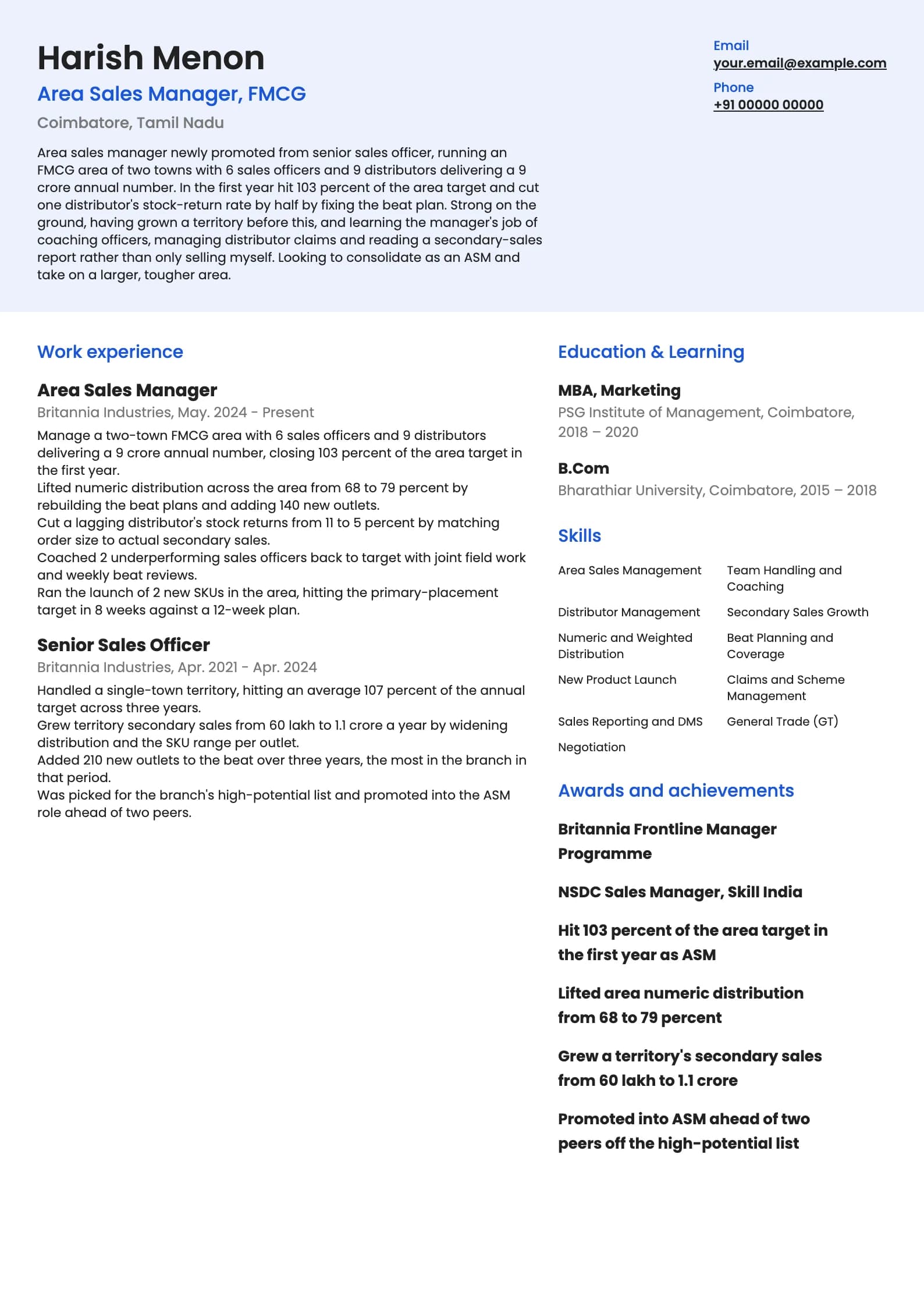
Build my resumeArea Sales Manager resume example, Newly promoted ASM (5 years)
modern templateIs your resume good enough?
Upload the resume you have now and see what an applicant tracking system reads before a area sales manager recruiter ever does.
Free to run. Sign in with your mobile number to see your score.
Area Sales Manager resume example, Established ASM (9 years)
professional template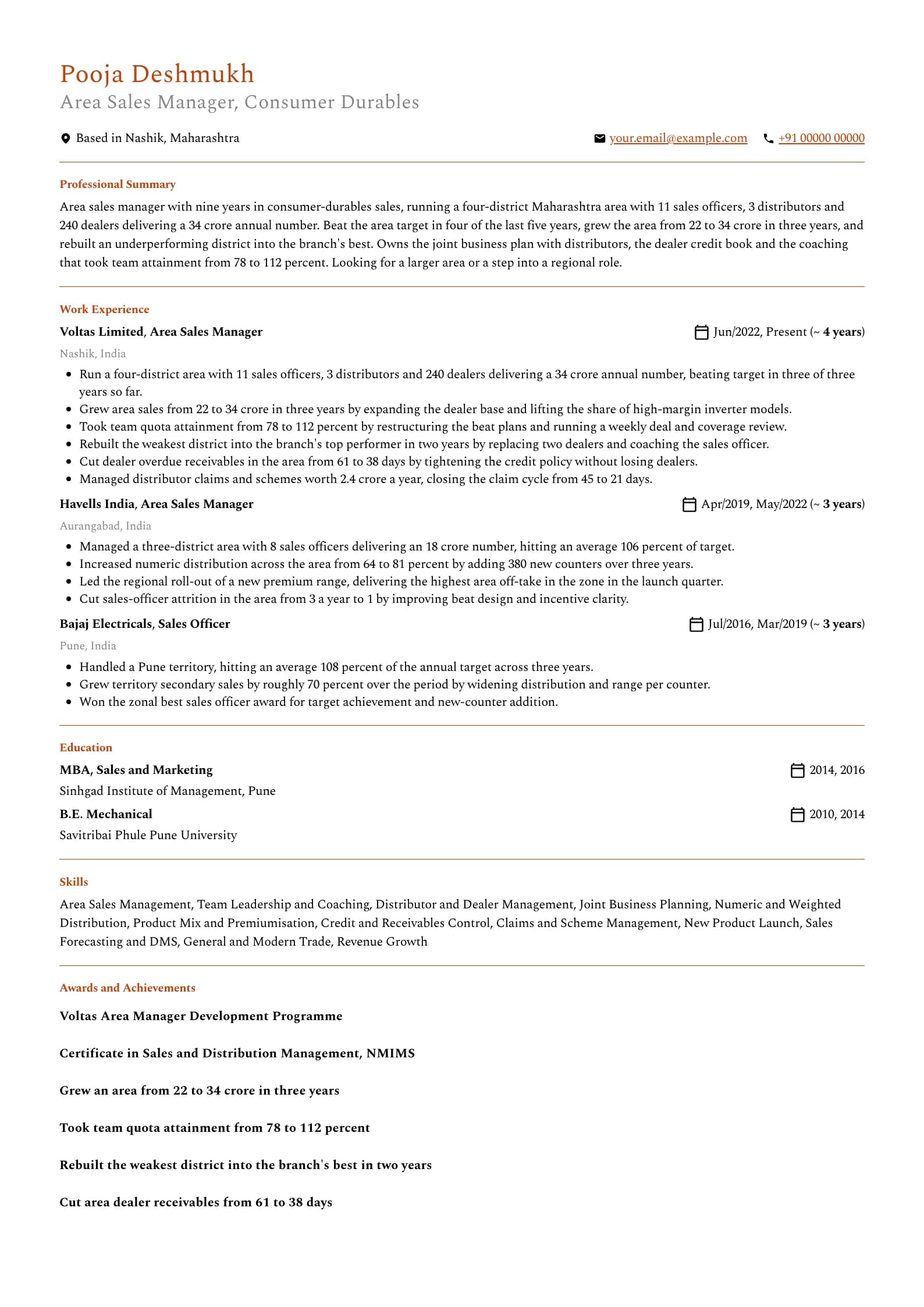
Want this structure with your own details? Build it in the resume builder.
Area Sales Manager resume example, Senior ASM (14 years)
header-band template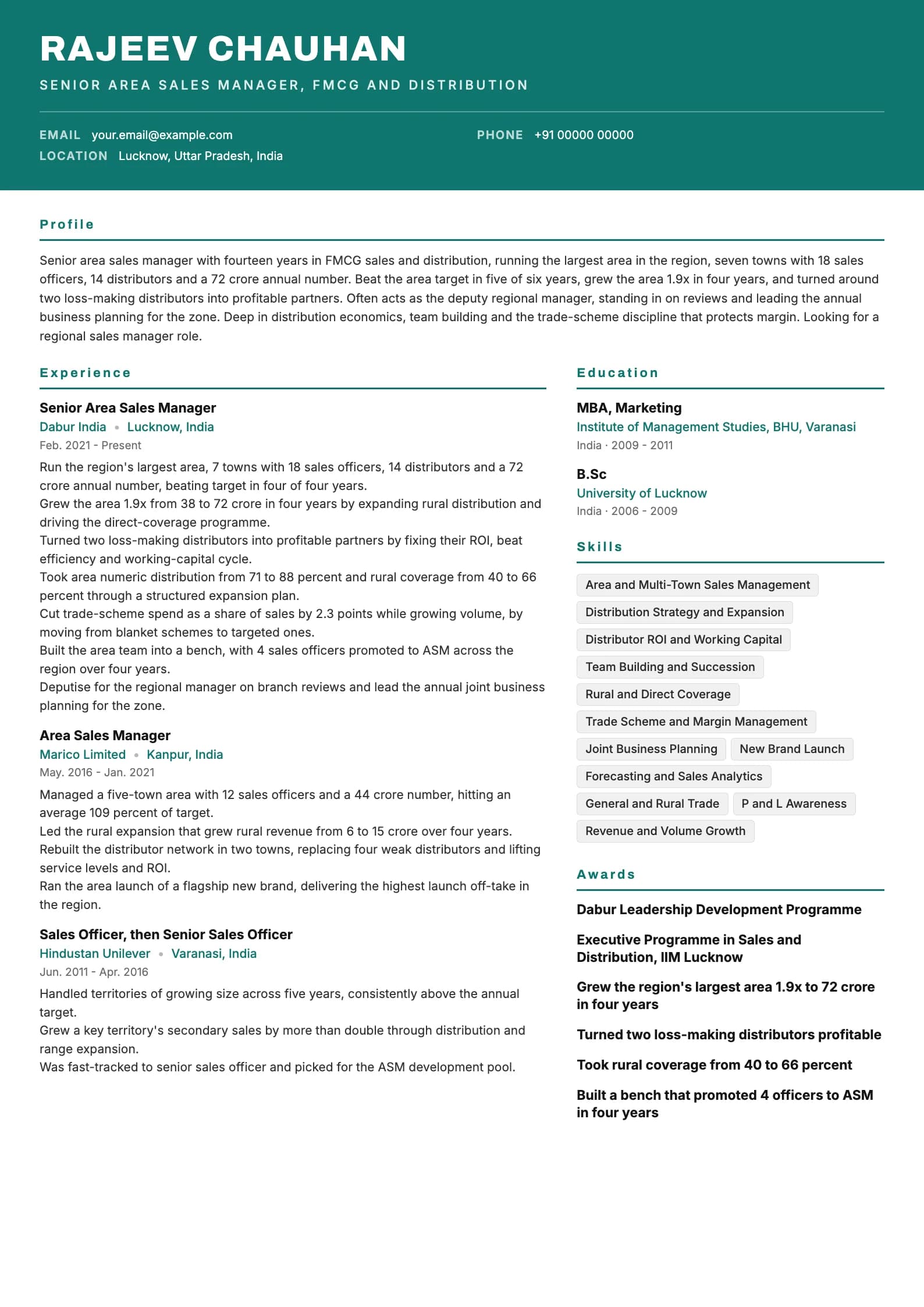
The format that works for area sales manager resumes in India
Reverse chronological is the layout a sales head expects. Most recent role first, then work backwards, dates in plain view. A functional resume that groups everything under Skills and hides the timeline reads as a cover-up, and in sales management, where each year against the area number is a data point, hiding the timeline invites suspicion rather than avoiding it. Length follows evidence. One page holds a newly promoted ASM. An established or senior ASM with multiple areas, a team and a decade of numbers can run to two, but only if the second page carries real area, team and distribution results rather than a longer duties list. A page built from a mission statement and a hobbies line is a padded one-pager. Four things belong nowhere on a professional sales resume: a photograph, date of birth, marital status and father's name. They come from an older campus-placement template. A sales head screening for an ASM is looking for area target achievement, team attainment and distribution health, not a passport detail, and every line these occupy is a line a result could have used. Put a short results band near the top. An ASM resume benefits from a strip of figures under the summary, area number, team size, distributor count, distribution, because the reader is scanning for exactly the scale of the system you have run. Send a PDF unless the posting asks for DOCX, name the file with your own name and the role, and keep to a single column so a parser does not scramble a sidebar into your experience. The table below sets the section order.
| Section | Where it goes | Why |
|---|---|---|
| Name and headline | Top, above everything | Headline is the role and sector, Area Sales Manager, FMCG. Recruiters match on it. |
| Professional summary | Directly under the header | Three lines. Area size, team and distributor count, and the strongest result. |
| Key results band | Just below the summary | Area number, team size, distribution, growth. The scale a sales head scans for. |
| Work experience | Next, most recent first | Every role should carry the area number and its attainment where honest. |
| Skills | Below experience | Grouped: management, distribution, commercial. Not a wall of soft-skill words. |
| Education and certifications | Bottom | MBA and manager-development programmes earn a line; degree, institution, years. |
Individual selling is not the same as area management
The single most common ASM resume failure is a page that reads like a senior sales rep's. Achieved sales targets, built customer relationships, promoted products in the area. It is all personal selling, and a sales head reading it cannot tell whether you have ever managed a team, run a distributor network or owned an area number rather than a personal one. The fix is to write from the manager's chair. An ASM is measured on a system: a team of officers, a set of distributors and dealers, and an area target that is the sum of their work. So the leading bullet is not achieved my sales target, it is run a four-district area with 11 sales officers and 240 dealers delivering a 34 crore number, beating target in three of three years. The scale of the system comes first, then how you moved it. Show the three things only a manager does. First, team: how many officers you handle, how you coached the laggards, what attainment you took the team to, whether anyone you developed got promoted. Second, distribution and channel: distributor count and ROI, numeric and weighted distribution, new outlets, receivables and claims. Third, planning and commercial: joint business plans, trade schemes, product mix, forecasting. A resume that covers all three reads as a manager. One that covers only personal sales reads as a rep who has not made the jump. The newly promoted sample is deliberate about this. It keeps the strong sales-officer record that earned the promotion, but leads the ASM role with coaching officers, fixing a distributor's returns and managing claims, because those are the manager tasks a sales head is checking for.
Before you send it, count the bullets that only a manager could write: team coached, distributor ROI fixed, attainment moved, officer promoted. If almost every bullet could sit on a rep's resume, you are applying as a rep for a manager's job.
Writing a summary a sales head actually reads
The block under your name is the part you can be sure gets read, so it must carry three facts: the scale of the area and team you run, how long you have managed at that level, and the single strongest result you have produced. Three or four lines, no adjectives a sales head cannot verify in a reference check. The old objective line, a dynamic and result-oriented sales manager seeking a challenging role in a growth-oriented organisation, is worthless because it fits every applicant and commits to nothing. Result-oriented with no result and no area size on the page is a claim, not evidence. Replace it with a summary. An objective says what you want, a summary says what area you have run and what it delivered, and only one of those wins a management interview. Be specific about scale and sector. An FMCG area with 18 officers and 14 distributors is a very different job from a consumer-durables area with a dealer network, and a sales head is hiring for one of them. A summary that names a four-district area with 11 sales officers, 3 distributors and 240 dealers delivering 34 crore tells the reader instantly whether you fit the scale, and saves both sides a wasted round. A practical test: read your summary and ask whether another ASM at the same company could paste it onto their resume unchanged. If they could, it describes the grade, not you. Add the specific area size, the specific attainment and the specific turnaround until it stops being transferable.
Professional summary, established ASM
Weak
Dynamic and result-oriented area sales manager with 9 years of experience in sales and distribution seeking a challenging role in a reputed FMCG organisation.
Strong
Area sales manager with nine years in consumer durables, running a four-district area with 11 sales officers, 3 distributors and 240 dealers delivering 34 crore. Grew the area from 22 to 34 crore in three years and took team attainment from 78 to 112 percent.
The rewrite trades self-description for the exact scale of the system managed and two verifiable results, one commercial and one about the team.
Experience bullets: system, action, area result
Every strong bullet in the samples follows the same shape. It names the system you ran, the specific action you took, and the area, team or distribution result that moved. The system establishes scale. The action establishes that you did it, not the team by default. The number does the persuading. Start with the result and work backwards. ASMs habitually write the task first, responsible for achieving the area sales target through the team, then cannot attach a number. Instead ask what was different after the year: the area number grew, team attainment rose, a district turned around, distribution widened, receivables tightened, scheme spend fell. Then write the sentence that ends in that fact. Vary the metric so the page does not read as one trick. Across a real ASM career you can honestly reach for area sales and growth, team quota attainment, numeric and weighted distribution, new outlets and dealers, distributor ROI, receivable days, claim-cycle days, scheme spend and officers promoted. A page that is only area-target percentages misses the team and distribution work that is half the job. Where a rupee figure is confidential, give scale instead: number of towns, officers, distributors, dealers, and relative growth. Run a four-district area with 11 sales officers and 240 dealers, grew it 1.5x carries weight without printing an exact number a company would object to. Allocate bullets by recency. Current role gets six or seven, the previous role four or five, anything older two or three.
| Level | What bullets must prove | Typical metric |
|---|---|---|
| Newly promoted ASM | You have shifted from selling to managing | Area target hit, officers coached, distribution lifted, returns cut |
| Established ASM | You grow an area and its team together | Area growth, team attainment, distributor ROI, receivable days |
| Senior ASM | You fix broken systems and build a bench | District turnaround, scheme-spend control, officers promoted, rural coverage |
| ASM to RSM step-up | You already do parts of the regional job | Deputising, zonal planning, multi-area results, bench built |
Experience bullet, established ASM
Weak
Responsible for achieving the area sales target through a team of sales officers and managing the distributor network in the assigned area.
Strong
Grew area sales from 22 to 34 crore in three years by expanding the dealer base and lifting the share of high-margin inverter models.
"Responsible for" describes a job description; the rewrite states the area growth and the two levers, distribution and product mix, that produced it.
Experience bullet, team
Weak
Managed and motivated the sales team to improve their performance and achieve their monthly targets.
Strong
Took team quota attainment from 78 to 112 percent by restructuring the beat plans and running a weekly deal and coverage review.
Names the before and after and the two management actions, so a sales head can ask a real follow-up instead of nodding at motivate the team.
If a bullet would read identically on your sales officers' resumes, it is describing their work, not your management of it. Rewrite it until it names what you, the manager, decided and changed.
The skills section: grouped, honest, and defensible
An ASM skills section has two audiences with opposite preferences. The parser wants literal terms it can match, area sales management, distributor management, team handling, secondary sales. A sales head wants a short, organised list that signals what kind of manager you are. Grouping satisfies both. Group by function rather than one long line. Sales management, distribution and channel, and commercial is a grouping that works for almost every ASM. The exact headings matter less than the fact that structure exists. Write the trade terms the way the industry writes them, numeric distribution, joint business plan, secondary sales, ROI, because the parser matches on strings and the sales head reads the wall. Twelve to sixteen skills is the working range. Below eight it looks thin, above twenty it stops being a signal. ASM resumes are especially prone to a soft-skill wall, leadership, motivation, hardworking, team player, listed as if any of it were checkable. It is not, and it costs credibility. One or two soft skills you can prove with a bullet, a turnaround, a promoted officer, are worth more than ten you cannot. Name the management and distribution craft that marks a real ASM: distributor ROI, joint business planning, beat design, claims and scheme management, credit control, forecasting. These are the terms a sales head searches for and respects, and they separate you from a candidate who only knows the word sales. Do not include a proficiency bar. Star ratings on leadership invite an argument you cannot win. Let the area and team numbers prove the depth instead.
| Group | What goes in it | How many |
|---|---|---|
| Sales management | Area management, team handling, coaching, forecasting | 3 to 5 |
| Distribution and channel | Distributor and dealer management, distribution, beat planning, coverage | 3 to 5 |
| Commercial | Distributor ROI, credit and receivables, claims, scheme and margin | 2 to 4 |
| Growth levers | New product launch, product mix, rural expansion, premiumisation | 2 to 3 |
| Tools and channel type | DMS, sales analytics, general trade, modern trade, rural trade | 2 to 3 |
Skills section
Weak
Skills: Leadership, Team management, Motivation, Hardworking, Target achievement, Communication, Sales, Marketing, Distribution, Convincing skills, MS Office, Time management
Strong
Sales management: area management, team coaching, forecasting. Distribution: distributor management, numeric distribution, beat planning. Commercial: distributor ROI, receivables, scheme management. Growth: new product launch, rural expansion.
Cuts the unprovable soft-skill wall, adds the distribution and commercial craft a parser and a sales head actually search for, and groups the rest so a human reads it in one pass.
Area, team and distribution: the numbers that prove you can manage
An ASM resume lives or dies on how it handles scale and system numbers. A page with no area size and no team size reads as someone who has never really run an area, and a page of vague good performance claims reads as someone hiding a soft year. The middle path is to state the size of the system, the target and result against it, and the team and distribution numbers that prove you managed the whole thing, not just sold. Always state the scale of the area. Delivered good growth is not a number. Ran a four-district area with 11 officers, 240 dealers and a 34 crore number, grew it to 34 from 22 crore is complete, because the reader now knows both the size of the machine and how much you moved it. Relative growth, 1.5x, 1.9x, is a clean way to show impact when the absolute figure is sensitive. Show the team and distribution health, not just the sales line. Team quota attainment, officer attrition, officers promoted, numeric distribution, distributor ROI, receivable days and claim-cycle days are the metrics that separate a manager who runs a healthy system from one whose area is quietly rotting under a good top-line. A sales head reads took attainment from 78 to 112 percent and cut receivables from 61 to 38 days as proof you manage the whole thing. When exact figures are confidential, and they often are, switch to relative growth, percentages, ranks and counts, which reveal performance without breaching a company policy. The table below maps the numbers that matter across an ASM's remit, so you can pick the ones that are honest for your area.
| Area of the job | Metric that proves it | Example phrasing |
|---|---|---|
| Scale | Area number, towns, team and channel size | Four districts, 11 officers, 240 dealers, 34 crore a year |
| Area result | Target achievement and growth | Grew the area from 22 to 34 crore, beating target three years running |
| Team | Attainment, attrition, promotions | Took team attainment from 78 to 112 percent; promoted 4 officers to ASM |
| Distribution | Numeric or weighted distribution, new outlets | Lifted numeric distribution from 68 to 88 percent |
| Channel health | Distributor ROI, receivable days, claim cycle | Cut receivables from 61 to 38 days; turned two distributors profitable |
| Margin | Scheme spend, product mix, premiumisation | Cut scheme spend by 2.3 points while growing volume |
If company policy stops you printing the area's rupee figure, name the scale and the relative growth instead. Ran an 18-officer, 14-distributor area and grew it 1.9x in four years says everything an absolute number would, and breaches nothing.
Where education and certifications belong
Education goes at the bottom for any ASM, who has a management record far more predictive than a degree. Degree, institution, years. An MBA is worth naming because sales-management hiring still reads it as a signal, and many ASM roles list it as a preference, but it never outranks a record of running an area and should not sit above the experience. CGPA or percentage is not worth carrying for an ASM. You are years past the point where a grade predicts anything about whether you can run an area, and the space is better spent on area and team results. Drop it entirely once you are in management. Manager-development and sales-distribution certifications carry specific weight and belong just below education, or beside skills if you hold only one or two. Write the full name, the issuing body and the year. A company frontline-manager or area-manager development programme signals you were invested in and identified as management material. An executive programme in sales and distribution from a recognised institute signals formal grounding in the channel economics an ASM lives in. Both are worth a line. Do not pad the certification list with generic online leadership webinars that carry no sales-management signal. They add nothing and drag down the real programmes beside them. Keep the list to credentials a sales head recognises and would ask you about, and let the area numbers be the real credential.
Getting through the applicant tracking system
An applicant tracking system is a parser and a search index, not a judge. It reads your file, breaks it into name, dates, employers, titles and skills, and stores the result so a recruiter can search across candidates. Almost every ATS problem is a parsing problem, and parsing problems come from layout, not wording. The layout rules are short. One column. Standard section headings, so use Work Experience rather than My Leadership Journey, and Skills rather than My Strengths. No text inside images, because a strip of brand logos reads as empty space. No critical information in the header or footer region, which some parsers drop. Avoid text boxes and nested tables in the resume body. On wording, mirror the job description where it is honest. If the posting says area sales manager, put that exact phrase in your headline. If it says FMCG or general trade or distributor management, and that is your experience, write it. Include the expansion beside an acronym at least once, for example "ASM (area sales manager)" or "JBP (joint business plan)", so both searches find you. Recruiters often search by sector and by channel type, general trade, modern trade, so having those on the page as literal text helps. Keyword stuffing does not work. A hidden block of sales, sales, area, target in white text is found quickly, and the outcome is worse than being filtered. Write real bullets that naturally contain the right terms, because a bullet naming an area number, a team of officers and a distribution figure contains area, team and distribution in a context that survives human review too. Save as PDF from a tool that embeds real text, then open the file and confirm you can select and copy a sentence. If you cannot select the text, neither can the parser.
Section heading
Weak
My Journey to the Top
Strong
Work Experience
Parsers look for standard headings; a creative one can push the entire block into an unclassified bucket the recruiter never searches.
What gets area sales manager resumes rejected
Most rejections at the resume stage are not close calls. They come from a small set of recurring problems, and all of them are fixable in an afternoon. The list below covers what sales heads reviewing Indian ASM resumes see most often, in rough order of how much damage each one does.
- A resume that reads like a rep's. All personal selling, no team, no distributors, no area number. A sales head cannot tell you have made the jump to managing.
- No scale stated. Ran an area is not a size. Without the town count, team size, distributor count and area number, the reader cannot place your grade.
- Sales-only numbers with no team or distribution health. A good top-line can hide a rotting system, so a sales head looks for attainment, ROI and receivables too.
- A soft-skill wall. Leadership, motivation, hardworking, none of it checkable, all of it costing credibility beside a real area and team figure.
- Job duties copied from the JD instead of your results. "Responsible for achieving the area target through the team" is the tell that you never say by how much.
- A generic objective line. Replace it with a summary that states area scale, years in management, and one result, one commercial and one about the team.
- A photo, date of birth, marital status or father's name. None of it belongs on an ASM resume, and it takes an area result's space.
- Padding the certification list with generic leadership webinars that carry no sales-management signal, dragging down the real programmes beside them.
- Inflated area numbers or titles that do not match your appointment letters and payslips. Reference checks with the previous RSM are standard at this level.
- Typos in the trade terms you claim to know. Writing "distribution" or "distributor ROI" wrong undoes an otherwise strong management page.
Read your resume as if you were the regional manager deciding whether to trust you with an area worth crores. Every line that would not survive that manager asking so what did you change in the system is a line to cut or rewrite with a number.
Skills to put on a area sales manager resume
Technical
- Area Sales Management
- Team Handling and Coaching
- Distributor and Dealer Management
- Distributor ROI and Working Capital
- Numeric and Weighted Distribution
- Beat Planning and Coverage
- Secondary Sales Growth
- Joint Business Planning
- New Product Launch
- Credit and Receivables Control
- Trade Scheme and Margin Management
- Sales Forecasting
Tools and platforms
- Distributor Management System (DMS)
- Salesforce / Zoho CRM
- SAP Sales module
- Sales Analytics Dashboards
- MS Excel
- Secondary Sales Reporting Apps
- Beat and Route Planning Tools
Working skills
- Team leadership
- Coaching and development
- Distributor negotiation
- Decision making under pressure
- Commercial judgement
- Conflict resolution
- Planning and prioritisation
- Cross-functional collaboration
Certifications worth listing as a area sales manager
| Certification | Full name | Worth it for |
|---|---|---|
| Manager Development Programme | Company Frontline or Area Manager Development Programme | Worth naming for any ASM, because being selected for a company's manager-development programme signals you were identified and invested in as management material. Especially useful for a newly promoted ASM proving the step up was earned. Keep the most relevant one and let the area numbers carry the rest. |
| Sales and Distribution | Executive Programme / Certificate in Sales and Distribution Management | A strong signal for an ASM or aspiring RSM, since it certifies formal grounding in the channel and distribution economics the role lives in, distributor ROI, working capital, coverage. Most valuable from an IIM, NMIMS or similar recognised institute. Worth a line at every level of area management. |
| MBA (Sales and Marketing) | Master of Business Administration, Sales and Marketing | Preferred for many ASM postings and read as a baseline signal for sales-management hiring in FMCG and durables. It never outranks a record of running an area, so list it under experience, not above. A distance or executive MBA still counts for candidates who rose through the field. |
| Leadership Programme | Company Leadership Development Programme | Relevant for senior ASMs on a track towards regional management, signalling you are in the succession pipeline. Only list a real, sponsored programme, not a generic online leadership course, which carries no sales-management signal and dilutes the credible items beside it. |
Keywords an ATS scans for in a area sales manager resume
These are the literal terms a parser matches against the job description. Use the ones that are true of you, in the sentences where you did the work, not as a list at the bottom.
- area sales manager
- ASM
- sales management
- distributor management
- team handling
- secondary sales
- numeric distribution
- target achievement
- channel sales
- general trade
- modern trade
- beat planning
- sales forecasting
- joint business plan
- new product launch
- dealer management
- receivables
- trade scheme
- FMCG
- revenue growth
Area Sales Manager resume FAQ
What salary can an area sales manager expect in India?
A newly promoted ASM typically earns 6 to 12 LPA fixed plus a variable tied to area target, depending on sector and company. An established ASM with seven to ten years running a sizeable area usually sits in the 12 to 22 LPA band, with total earnings higher in a strong year. Senior ASMs and those close to the regional level commonly earn 22 to 35 LPA and above, particularly in large FMCG and consumer-durables companies. Sector, area size and the company's scale drive the band as much as years do, and a record of beating the area target and building the team moves the top of every band up.
How long should an area sales manager resume be?
One page for a newly promoted ASM, and up to two for an established or senior ASM whose second page carries real area, team and distribution results rather than a longer duties list. Sales heads skim, so a tight resume that leads with the area number and team attainment beats a padded one. If you are struggling to fit the space, cut the oldest role to a line, drop CGPA, and remove any certificate a sales head would not ask you about.
How is an ASM resume different from a sales representative resume?
A sales representative resume is about individual selling, target achievement, coverage and personal relationships. An area sales manager resume must show you manage a system: a team of sales officers, a distributor and dealer network, and an area number that is the sum of their work. So the ASM resume leads with the scale of the area, then covers three things a rep cannot claim, team attainment and coaching, distributor ROI and distribution, and planning like joint business plans and trade schemes. A resume that only shows personal selling reads as a rep applying for a manager's job.
I was just promoted to ASM. How do I write the resume?
Keep the strong sales-officer record that earned the promotion, but lead the ASM role with the manager tasks: coaching officers back to target, fixing a distributor's returns, managing claims, running a launch across the area. The newly promoted sample does exactly this. State the area scale even if it is modest, two towns, six officers, nine distributors, because it shows you now own a system. Then let both roles support each other honestly, the ground record proving pedigree and the ASM bullets proving the jump.
How do I show my area's numbers if they are confidential?
Switch to scale and relative growth, which reveal performance without breaching a company policy. Ran a four-district area with 11 officers and 240 dealers, grew it 1.5x in three years, took team attainment from 78 to 112 percent, all tell a sales head exactly how good you are without printing an absolute rupee figure. Distribution percentages, receivable days and officers promoted are also safe to state and are among the strongest ASM signals. Only name the area's absolute number where you are sure company policy allows it.
Which certifications help an area sales manager resume?
The ones with a real sales-management signal: a company frontline or area-manager development programme, which shows you were identified as management material, and an executive programme or certificate in sales and distribution management from a recognised institute like an IIM or NMIMS, which certifies channel and distribution economics. An MBA in sales and marketing is a preferred baseline for many ASM postings. Avoid padding with generic online leadership webinars, which carry no sales-management signal and dilute the credible items beside them.
Do applicant tracking systems reject resumes with two columns?
They do not reject them outright, but some parsers read multi-column layouts out of order, which interleaves your sidebar with your experience and produces nonsense in the recruiter's view. A single-column layout removes the risk, which is why the samples above use one. Test your own file by copying the text out of the PDF into a plain text editor, and if it reads in order there, it will most likely parse correctly.
What keywords matter most on an area sales manager resume?
Mirror the job description first, since that is what the recruiter searches on. Beyond that, the terms that matter most are area sales manager, ASM, sales management, distributor management, team handling, secondary sales, numeric distribution, target achievement, general trade or modern trade, and joint business planning. Put them inside real bullets rather than a keyword block, because a bullet naming an area number, a team of officers and a distribution figure contains those terms in a context that survives human review too.
Do I need a photo on an area sales manager resume in India?
No. Sales heads do not expect one, and it takes space an area result should occupy. The same goes for date of birth, marital status, father's name, nationality and a declaration paragraph, all of which come from an older campus template and add nothing to a sales-management screen. The only exception is a role that explicitly asks for a photograph in the posting, which is uncommon in professional sales management.
Related resume examples and guides
Build your own in any of these formats
Start from a blank resume or upload the one you have. Goodspace renders it in 24 templates and flags the area, team and distribution keywords an applicant tracking system will look for, and the personal-selling padding it will not credit for a manager's role.
Build my resume