Medical Representative Resume Format, with 3 Full Samples
A medical representative is a pharma salesperson, hired on evidence of a territory grown, doctors converted and targets met, yet most MR resumes read like a job description of daily calls with no number attached. The products get listed, the responsibilities get copied from the appointment letter, and the sales growth the person actually delivered goes missing. Below are three complete resumes, one for a B.Sc fresher entering pharma sales, one for a working MR with four years across a territory, and one for an area sales manager leading a field team. After the samples come the format rules, the sales metrics an MR resume must carry, the detailing and reporting keywords a parser matches, and the mistakes that end a screening early.
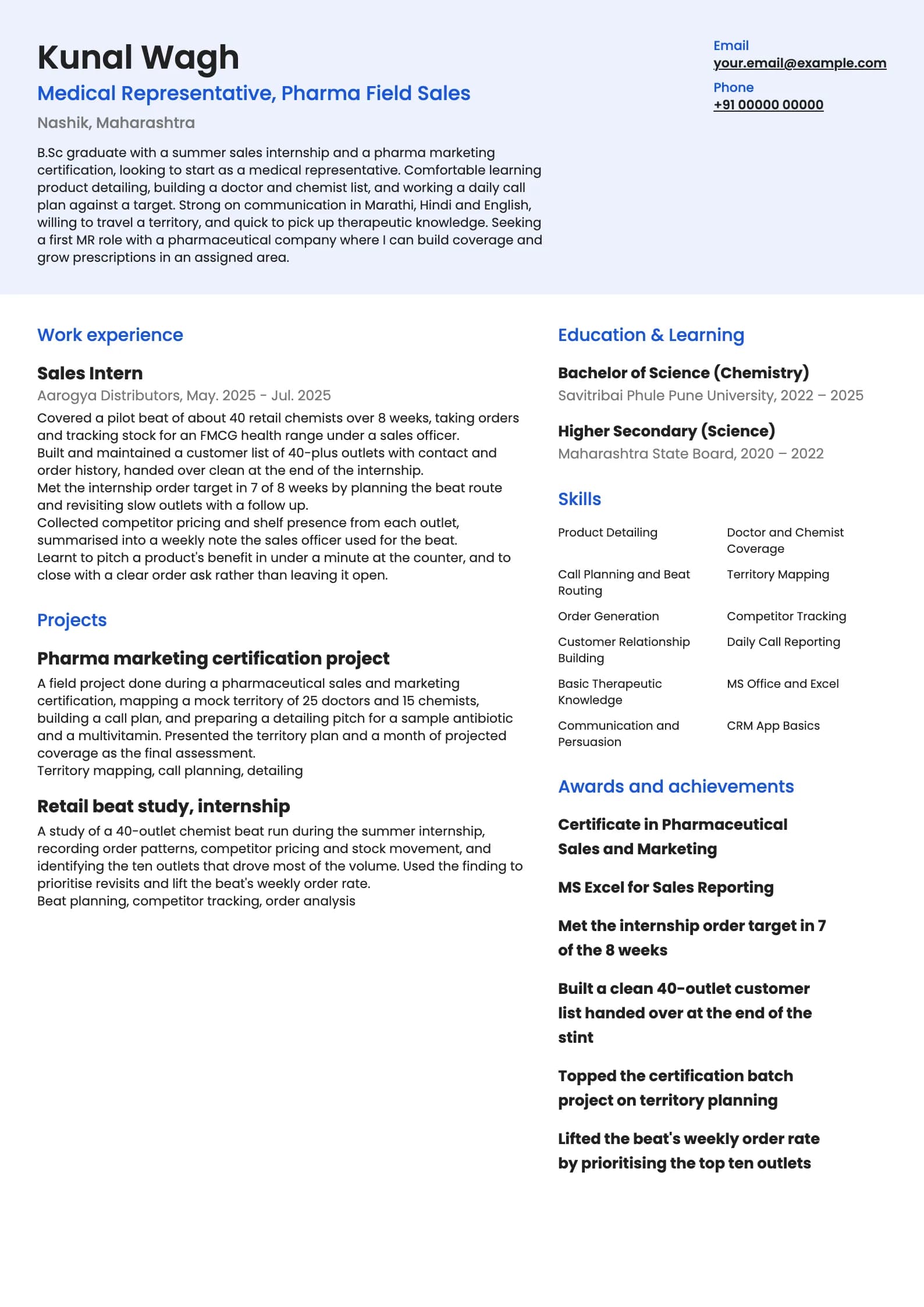
Build my resumeMedical Representative resume example, Fresher (0 years)
modern templateIs your resume good enough?
Upload the resume you have now and see what an applicant tracking system reads before a medical representative recruiter ever does.
Free to run. Sign in with your mobile number to see your score.
Medical Representative resume example, Mid-level (4 years)
header-band template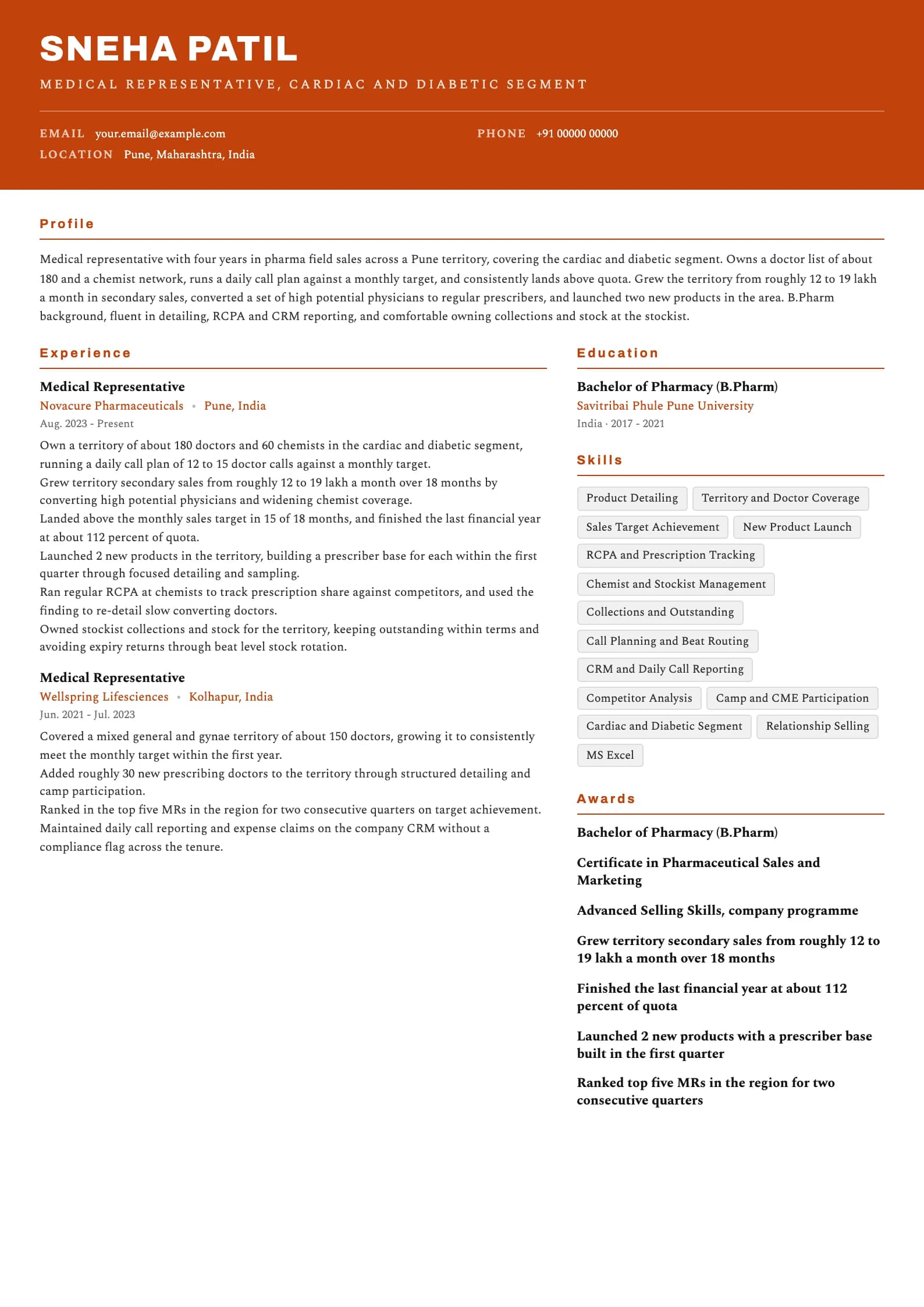
Want this structure with your own details? Build it in the resume builder.
Medical Representative resume example, Senior (9 years)
ai-era template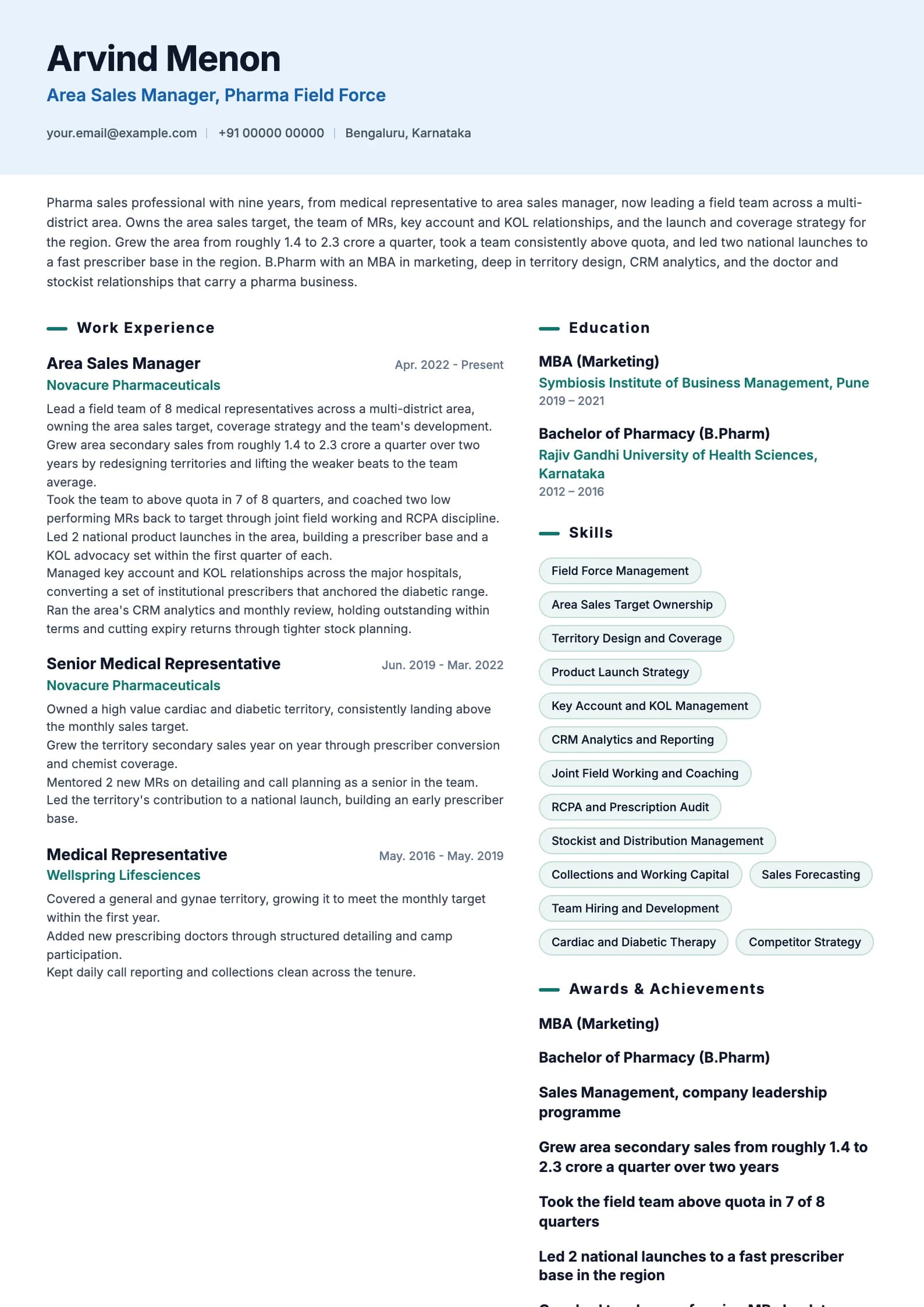
The format that works for medical representative resumes in India
Reverse chronological is the layout to use. Put the most recent role first, work backwards, and let the dates sit in plain view. Functional resumes that group everything under Areas of Expertise and quietly drop the dates read as an attempt to hide a gap or a short stint, and pharma managers, who watch tenure closely, treat them that way. The single most important thing to understand about this resume is that a medical representative is a salesperson, not a clinician. The job is to grow prescriptions and hit a territory target, so the resume must read like a sales resume: territory size, target achievement, sales growth in rupees, doctors converted. A B.Sc or B.Pharm gives you the therapeutic base to hold a detailing conversation, but the degree is the entry ticket, not the story. The story is what you sold and grew. Length is decided by evidence. One page holds everything a fresher and most MRs up to roughly six years have to say. Past that, into area or regional management, a second page is fine when it carries team and area results rather than a longer product list. Four things belong nowhere here: a photograph, date of birth, marital status and father's name. Send a PDF unless the posting asks otherwise, name the file with your own name and the role, and use a single column so the parser reads it cleanly. The table below sets out the section order.
| Section | Where it goes | Why |
|---|---|---|
| Name and title | Top, above everything | Medical Representative, plus the territory or city you can work. |
| Professional summary | Directly under the header | Three lines. Years, segment, and the strongest sales or growth number. |
| Work experience | Next, for anyone with a job | Most recent first. Newest role gets the most bullets and the numbers. |
| Key achievements | Beside or after experience | Quota percentages, growth in rupees, launches, rankings. |
| Skills | Below experience | Grouped: selling, territory, reporting, therapy area. Not a wall. |
| Education | Bottom, unless you are a fresher | B.Sc or B.Pharm, and an MBA if you have one. |
| Certifications and languages | Near the foot | Pharma selling course, plus the languages you can detail in. |
This is a sales resume, so write it like one
The most common mistake on an MR resume is treating it like a healthcare resume. Candidates coming from a science background describe products in clinical detail, list therapeutic knowledge, and forget that the person hiring runs a sales team with a number to hit. A pharma manager reading your resume is asking one question: will this person grow my territory. Answer it. That means the resume leads with sales facts. The size of the territory you cover, the number of doctors and chemists, the monthly or quarterly sales figure in rupees, the percentage of target you achieved, the growth you drove, the new products you launched and the prescribers you converted. These are the lines that get an MR shortlisted. Clinical or product knowledge matters only insofar as it helps you detail and sell, and it is assumed from your degree. Use the language of pharma field sales, because it signals you know the job. Detailing, RCPA, secondary sales, primary sales, prescriber base, coverage, call average, beat plan, stockist, collections. An MR who writes "did marketing of medicines to doctors" sounds like an outsider; one who writes "grew secondary sales through prescriber conversion and RCPA driven re-detailing" sounds like someone already in the field. Honesty still governs the numbers. Do not claim 200 percent of target or a growth figure you cannot defend, because a sales interview will probe every number. Give the real figure, the real quota percentage, the real territory size, and let it stand.
Before you send it, ask whether the resume tells a sales manager how much you sold and grew. If it only tells them what you know about medicine, you have written a science resume for a sales job.
Writing a summary a sales manager actually reads
The block under your name is the part you can be reasonably sure gets read, so it should carry three facts: how long you have been in pharma sales and in what segment, the size of the territory you own, and the strongest sales result you have delivered. Three or four lines, no adjectives that cannot be checked. The old objective line, seeking a challenging position in a reputed pharma company to utilise my skills, tells the reader nothing they did not assume from the application. Replace it with a summary. An objective describes what you want, a summary describes what you have already sold, and only one gets a sales candidate an interview. Freshers often believe they have nothing to summarise. Look at the fresher sample: it names the B.Sc and the pharma selling certification, cites a summer sales internship, and points at order targets met and a beat run. That is a genuine summary built from a degree, one internship and a project. What it avoids is "enthusiastic and dynamic individual", a phrase so common it now carries no information. A practical test: read your summary and ask whether another MR with the same tenure could paste it onto their resume unchanged. If they could, it describes the job, not you. Add the specific segment, the specific territory size and the specific number until it stops being transferable.
Professional summary, working MR
Weak
Enthusiastic and dynamic medical representative with 4+ years of experience seeking a challenging position in a reputed pharmaceutical company to utilise my sales and communication skills.
Strong
Medical representative with four years in the cardiac and diabetic segment, owning a territory of about 180 doctors in Pune. Grew territory secondary sales from roughly 12 to 19 lakh a month and finished the last year at about 112 percent of quota.
The rewrite trades self-description for the segment, the territory size and two sales numbers a pharma manager screens on before anything else.
Experience bullets: verb, territory action, sales consequence
Every strong bullet in the samples follows the same shape. It opens with an action verb, names the specific territory action you took, and closes with the sales result. The verb establishes that you did it. The action tells a reviewer the scale of the territory. The number, the growth in rupees or the percentage of quota, does the persuading. Start with the outcome and work backwards. MRs usually write the activity first, then leave it vague, which produces bullets like "met doctors daily and promoted company products". Instead ask what actually happened: secondary sales grew from one figure to another, quota was beaten by a percentage, a new product built a prescriber base, RCPA lifted prescription share, outstanding stayed within terms. Then write the sentence that ends in that fact. Pharma sales rewards a specific kind of metric: sales value in lakhs or crores, percentage of target achieved, territory and doctor coverage, number of prescribers converted, launch performance, RCPA share, collections and expiry. "Grew territory secondary sales from roughly 12 to 19 lakh a month" carries the scale and the result in one line. Vary the metric so the resume does not read as one number repeated. Where you genuinely lack a rupee figure, give scope: the number of doctors and chemists covered, the call average, the prescribers added, the ranking you held. "Ranked top five MRs in the region for two consecutive quarters" is a real, checkable claim. Allocate bullets by recency. Current role gets five or six, the previous role four or five, anything older two or three.
| Level | What bullets must prove | Typical metric |
|---|---|---|
| Fresher | You can run a beat and close an order | Order targets met, outlets covered, list built |
| 1 to 4 years | You own a territory and hit the number | Sales in lakhs, percent of quota, prescribers added, launches |
| 5 to 7 years | You beat quota and grow the territory | Growth in rupees, quota percentage, rankings, RCPA share |
| 8 years and up | You lead a team and own an area number | Area sales in crores, team quota, launches, coaching results |
Experience bullet, working MR
Weak
Responsible for meeting doctors and chemists daily and promoting company products in the assigned territory as per company targets.
Strong
Grew territory secondary sales from roughly 12 to 19 lakh a month over 18 months by converting high potential physicians and widening chemist coverage.
"Responsible for" describes the daily routine; the rewrite names the coverage action and the rupee growth it produced.
Experience bullet, target achievement
Weak
Achieved good sales figures and maintained a healthy relationship with doctors and stockists throughout the year.
Strong
Landed above the monthly sales target in 15 of 18 months, and finished the last financial year at about 112 percent of quota.
Swaps a vague claim of good figures for a hit rate and a quota percentage a sales manager can verify against records.
If a bullet would read identically on another MR's resume, it is describing the job, not your territory. Rewrite it until it only fits the area and the number you actually delivered.
The sales numbers an MR resume must carry
Pharma field sales is measured tightly, and every MR resume is read against that measurement. The manager knows what secondary sales, quota achievement and prescriber coverage mean, and a resume that avoids all three reads as someone hiding a weak number. The strongest resumes lead with the figures. The anchor numbers are the sales value and the percentage of target. Sales value belongs in rupees at the scale you worked: lakhs a month for a territory, crores a quarter for an area. Percentage of quota, the achievement, is the cleanest single measure of an MR, so if you beat target, say by how much and how often. Growth from one figure to another over a stated period is more persuasive than a single snapshot, because it shows you moved the territory. Coverage and conversion carry the story further: the number of doctors and chemists you cover, your call average, the prescribers you converted, the new products you launched and how fast they built a base. RCPA, the retail chemist prescription audit, is the field tool that proves your prescription share, so a bullet tied to RCPA reads as someone who works the territory properly. The commercial hygiene numbers matter more than freshers expect: collections held within terms, outstanding controlled, expiry returns avoided. A manager values an MR who grows the territory without leaving a mess at the stockist, so a clean collections line is worth including. Never inflate. A quota claim that cannot survive a records check, or a growth figure with no basis, is the fastest way to lose a pharma sales interview, where the numbers are the whole conversation.
Achievement line, sales result
Weak
Consistently achieved sales targets and contributed significantly to the growth of the territory during my tenure.
Strong
Finished the last financial year at about 112 percent of quota and grew territory secondary sales from roughly 12 to 19 lakh a month over 18 months.
Swaps a vague growth claim for a quota percentage and a rupee growth over a stated period, both of which a manager can check against the CRM.
The skills section: grouped, honest, defendable
An MR's skills section has two audiences with opposite preferences. The parser wants literal terms it can match, detailing and RCPA and CRM. A human wants a short, organised list that signals what kind of MR you are and which segment you know. Grouping satisfies both. Group by function rather than one long line. Selling and detailing, territory and coverage, reporting and analytics, therapy area is a grouping that works for most MRs. The exact headings matter less than the fact that structure exists. Write the terms the field uses: RCPA, secondary sales, KOL, stockist. A parser matches on strings, and a manager reads them as proof you know the job. Name the segment you actually work, because it lets a recruiter match you to the division hiring. Cardiac and diabetic, gynae, ortho, respiratory, derma, and so on. An MR moving into a cardiac division is helped enormously by a resume that already says cardiac and diabetic segment. Twelve to sixteen skills is the working range. Below eight the section looks thin. Above twenty it stops being a signal. The list is a contract: every item is a question you have agreed to answer in a sales interview. Do not include a proficiency bar. Let the quota and growth numbers prove the depth instead.
| Group | What goes in it | How many |
|---|---|---|
| Selling and detailing | Product detailing, relationship selling, order generation | 2 to 4 |
| Territory and coverage | Territory management, call planning, beat routing, coverage | 2 to 4 |
| Reporting and analytics | CRM, daily call report, RCPA, competitor analysis | 2 to 4 |
| Commercials | Stockist management, collections, stock and expiry | 1 to 3 |
| Therapy area | Cardiac, diabetic, gynae, ortho and the segment you know | 1 to 2 |
Skills section
Weak
Skills: sales, marketing, communication, doctors, chemists, targets, detailing, hard working, honest, dynamic, motivated, MS Office, travel, English, Hindi, team player
Strong
Selling: product detailing, relationship selling. Territory: coverage, call planning, beat routing. Reporting: CRM, RCPA, competitor analysis. Commercials: stockist, collections. Therapy: cardiac and diabetic segment.
Cuts the vague fragments and the soft skills masquerading as selling terms, then groups the rest so a manager reads your capability in one pass.
Where education, certifications and languages belong
Education goes at the bottom for anyone with a job, and higher for a fresher. B.Sc or B.Pharm is the standard entry qualification for an MR, and companies want the science base because it lets you hold a detailing conversation with a doctor. Name the degree and institution plainly. An MBA in marketing, especially for someone moving toward area or regional management, earns a place and signals the strategy layer above field selling. For a fresher, the degree and any pharma sales certification move higher because they are much of the evidence. A certificate in pharmaceutical sales and marketing is a reasonable early signal that you understand detailing, territory planning and RCPA before your first job, so it is worth naming with the institute. Languages matter more for an MR than for most roles, because you detail doctors and deal with chemists in the local language of the territory. List the languages you can actually detail and negotiate in, because a company posting you to a Marathi or Kannada speaking belt will value fluency directly. Put them near the foot, but do include them. Keep percentages or CGPA only while you are a fresher and they are good. Once you have a sales record, the quota and growth numbers carry the resume and the marks add nothing. Never list a lapsed certification as current, and write each qualification with its institute and year.
Getting through the applicant tracking system
Large pharmaceutical companies and the portals they recruit through run an applicant tracking system, so the same parsing rules apply to MRs as to any other field. The system reads your file, tries to break it into name, dates, employers, titles and skills, and stores the result for search. Almost every ATS problem is a parsing problem, and parsing problems come from layout, not wording. The layout rules are short. One column. Standard section headings, so use Work Experience rather than My Sales Career, and Skills rather than My Strengths. No tables or text boxes for your core content, because some parsers scramble them. No critical information in the header or footer region, which some parsers drop. On wording, mirror the language of the job description where it is honest. If the posting says secondary sales, write secondary sales. If it names a segment like cardiac or diabetic, and you have worked it, write it. If it says CRM, name the CRM you used. Include the expansion alongside an acronym at least once, for example "RCPA (retail chemist prescription audit)", so both searches find you. Keyword stuffing does not work. A hidden block of pharma terms helps nothing, because an MR is judged in a numbers-heavy interview a stuffed resume rarely reaches. Write real bullets that naturally contain the right terms. Save as PDF from a tool that embeds real text, then open the file and confirm you can select and copy a sentence. If you cannot select the text, neither can the parser.
Section heading
Weak
My Sales Career Highlights
Strong
Work Experience
Parsers look for standard headings; a decorative one can push your roles and, worse, your sales numbers into an unclassified bucket the recruiter never searches.
Mirror the exact segment and CRM the posting names, in plain text. A recruiter searching the tracking system for a cardiac MR on a specific CRM will only surface resumes that carry those literal terms.
What gets medical representative resumes rejected
Most rejections at the resume stage are not close calls. They come from a small set of recurring problems, and all of them are fixable in an afternoon. The list below covers what pharma sales managers reviewing Indian MR resumes see most often, in rough order of how much damage each one does.
- No sales numbers. A territory covered with no rupee figure, no quota percentage and no growth reads as someone who did calls, not sales.
- Writing it as a clinical or science resume, heavy on product knowledge and light on what was sold and grown.
- Job duties copied from the appointment letter. "Responsible for meeting doctors and promoting products" is the tell.
- Inflated numbers that cannot survive a records check, such as an unrealistic quota percentage or an unexplained growth figure.
- Frequent short stints with no explanation, which pharma managers watch closely and read as instability unless addressed.
- Missing the segment, so a recruiter cannot tell whether you can slot into the cardiac, gynae or ortho division that is hiring.
- A wall of generic skills, sales and communication and hard working, with none of the field's real vocabulary.
- No mention of collections, stock or expiry, leaving a manager unsure whether you keep a territory commercially clean.
- A photo, date of birth, marital status or father's name. None of it belongs on a professional resume here.
- A generic objective line. Replace it with a summary that states years, segment, territory size and one sales number.
Read your resume once as if you were the manager who has to defend hiring you to a regional head chasing a number. Any line that does not help answer will this person grow the territory is a line to sharpen or cut.
Skills to put on a medical representative resume
Technical
- Product Detailing
- Territory Management
- Sales Target Achievement
- Doctor and Chemist Coverage
- New Product Launch
- RCPA and Prescription Tracking
- Call Planning and Beat Routing
- Stockist and Distribution
- Collections and Outstanding
- Competitor Analysis
- Sales Forecasting
- Key Account and KOL Management
- Camp and CME Participation
- Therapeutic Segment Knowledge
Tools and platforms
- Salesforce or company CRM
- MS Excel
- Daily Call Reporting App
- Expense and Tour Reporting App
- SFA and Field Force Automation
- MS PowerPoint
- Visual Aid and Detailing App
- WhatsApp Business
- Order and Stock Software
Working skills
- Persuasion and relationship selling
- Doctor and chemist rapport
- Objection handling
- Negotiation
- Territory discipline and planning
- Resilience and persistence
- Communication in local languages
- Team coaching
- Time and route management
Certifications worth listing as a medical representative
| Certification | Full name | Worth it for |
|---|---|---|
| B.Pharm | Bachelor of Pharmacy | The strongest entry qualification for an MR, since it gives the therapeutic base to detail a doctor with credibility. Preferred by many companies for prescription-heavy divisions, and worth naming plainly. A B.Sc is widely accepted too, so the degree is the ticket, not the differentiator. |
| B.Sc | Bachelor of Science, usually Chemistry, Biology or a life science | A common and accepted entry qualification for pharma field sales, giving enough science base to learn detailing. For a fresher it is the credential that gets the interview; from there the sales evidence carries the resume. Pair it with a pharma selling certificate to signal intent. |
| MBA Marketing | Master of Business Administration, Marketing or Pharma Management | Genuinely useful for MRs aiming at area and regional management, since it signals the strategy, analytics and team layer above field selling. Most valuable paired with a real field record and a launch or coaching result, rather than listed on its own by someone with no territory numbers. |
| Pharma Selling Certificate | Certificate in Pharmaceutical Sales and Marketing | A reasonable early-career signal that a fresher understands detailing, territory planning and RCPA before the first job. Worth naming with the institute for someone entering the field, and less relevant once a working sales record exists to speak for itself. |
| Advanced Selling Skills | Company or industry advanced selling and detailing programme | An internal or short external programme many companies run, worth a line because it shows structured selling training beyond on-the-job learning. Best listed with the provider, and treated as a supporting credential rather than a headline, since the quota numbers matter more. |
| MS Excel | MS Excel for sales reporting and analysis | A small but practical skill line, since MRs and especially first-line managers work call reports, coverage data and RCPA in Excel. Worth listing early in a career, and increasingly assumed later, where CRM and analytics fluency shown through results says more than a certificate. |
Keywords an ATS scans for in a medical representative resume
These are the literal terms a parser matches against the job description. Use the ones that are true of you, in the sentences where you did the work, not as a list at the bottom.
- medical representative
- pharma sales
- product detailing
- secondary sales
- primary sales
- territory management
- doctor coverage
- chemist
- stockist
- RCPA
- prescription
- sales target
- quota achievement
- product launch
- KOL
- CRM
- daily call report
- collections
- B.Pharm
- cardiac diabetic segment
Medical Representative resume FAQ
What salary can a medical representative expect in India?
A fresher MR typically starts around 2.4 to 4 LPA in fixed pay, often quoted as roughly 20,000 to 33,000 a month, plus incentives on target and daily allowances for travel and stay. A working MR with four to seven years usually sits in the 4 to 8 LPA fixed band, with incentives that can add meaningfully in a strong territory. Area sales managers with eight years and above commonly earn 9 to 20 LPA and more, with a larger variable component tied to the area number. Multinational and speciality divisions tend to pay above the general segment.
Do I need a B.Pharm to become a medical representative?
No, though a science degree helps. Many companies accept a B.Sc, especially in chemistry or a life science, and some accept any graduate for general divisions. A B.Pharm is preferred for prescription-heavy and speciality segments because it gives a stronger therapeutic base to detail a doctor. The degree is the entry ticket; once you have a sales record, the territory and quota numbers matter far more than which science degree you hold.
What numbers should I put on an MR resume?
Lead with the sales value and the percentage of target. Sales value in rupees at your scale, lakhs a month for a territory or crores a quarter for an area, and quota achievement as a percentage, ideally as growth from one figure to another over a stated period. Add coverage figures like the number of doctors and chemists, prescribers converted, launch performance and RCPA share, plus commercial hygiene such as collections within terms. Never claim a number you could not defend in a sales interview.
How does a fresher write an MR resume with no experience?
Lead with the science degree, then treat any sales internship, retail beat, campaign or pharma selling certification as the evidence that you can run a territory and close an order. Look at the fresher sample: it carries order targets met, a 40-outlet beat run and a certification project on territory planning. That reads as a sales resume, which is exactly what a pharma manager wants, rather than a science resume that lists what you know about chemistry.
Should I mention the therapeutic segment I work in?
Yes, clearly, because it lets a recruiter match you to the division that is hiring. An MR who writes cardiac and diabetic segment, or gynae, or ortho, is far easier to slot than one who only says pharma sales. Name it in the summary and in your skills, and let your prescriber conversions and launch bullets show depth in that area. It also signals therapeutic knowledge without turning the resume into a clinical document.
How long should a medical representative resume be?
One page up to about six years of experience, two pages after that only if you have moved into area or regional management and the second page carries team and area results rather than a longer product list. Keep the strongest sales numbers on page one where a manager catches them. If you are struggling to fit one page, cut the oldest role to a line, remove marks, and drop generic skills that add nothing.
Do frequent job changes hurt an MR resume?
Pharma managers watch tenure closely, so a string of short stints with no explanation reads as instability and can cost you a shortlist. If you have moved often for genuine reasons, a better division, a relocation, a company restructuring, address it in one honest line rather than leaving a reader to assume. What offsets it most is a clear record of hitting quota in each role, since a manager forgives movement more easily when the numbers came with you.
Do I need a photo on an MR resume in India?
No. Pharma companies do not expect one, and it takes space a sales number should occupy. The same goes for date of birth, marital status, father's name, nationality and a declaration paragraph. These come from an older template and add nothing to a sales hire. Put that space toward the territory size, the quota percentage and the growth you drove, which is what actually gets a medical representative shortlisted.
Related resume examples and guides
Build your own in any of these formats
Start from a blank resume or upload the one you have. Goodspace renders it in 24 templates, puts your territory numbers and quota achievement where a sales manager catches them, and flags what an applicant tracking system will miss.
Build my resume