Regional Sales Manager Resume Format, with 3 Full Samples
A regional sales manager is hired on a number: the primary and secondary sales they moved, the distributors they kept solvent and the team they held together through a target cycle. Yet most RSM resumes read like a job description, all territories handled and teams managed with not one figure a reviewer can act on. Below are three complete resumes, one for an area sales manager stepping up into a regional role, one for an established RSM running a multi-state region, and one for a senior sales leader owning a zone. After the samples come the format rules, the difference between managing a region and growing one, the terms a parser matches, and the mistakes that get a strong track record filtered before a human reads it.
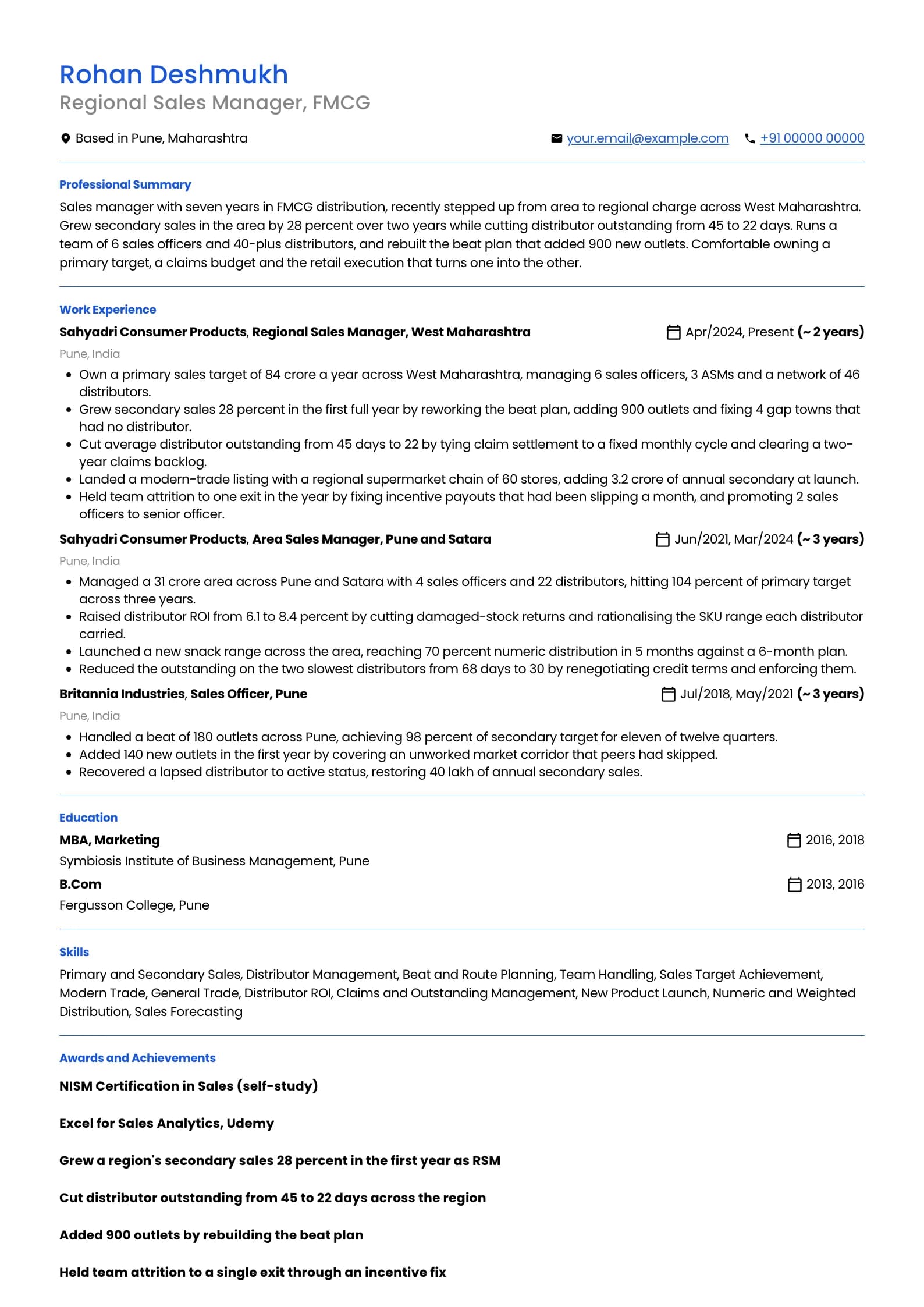
Build my resumeRegional Sales Manager resume example, Newly promoted RSM (7 years)
professional templateIs your resume good enough?
Upload the resume you have now and see what an applicant tracking system reads before a regional sales manager recruiter ever does.
Free to run. Sign in with your mobile number to see your score.
Regional Sales Manager resume example, Established RSM (12 years)
header-band template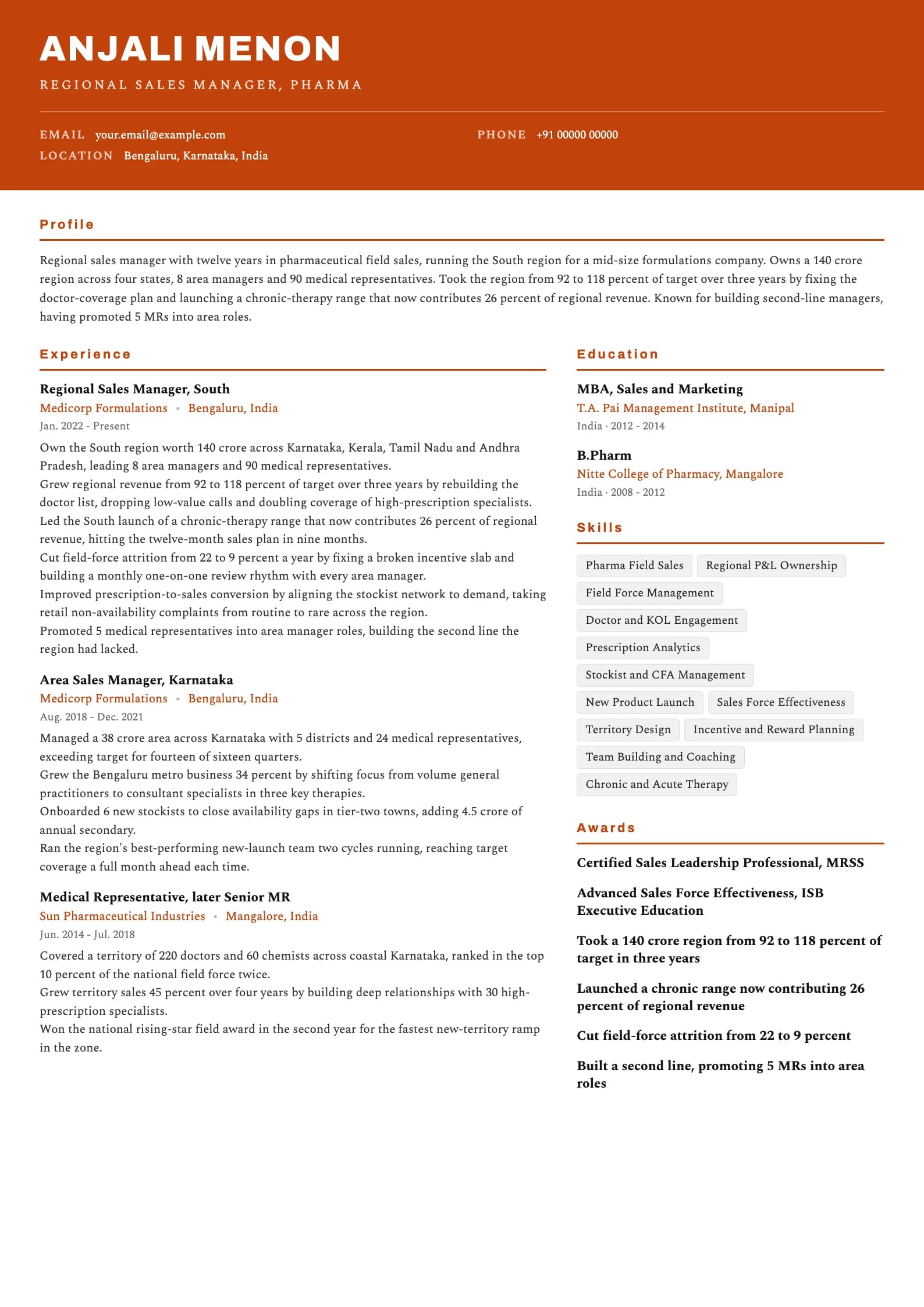
Want this structure with your own details? Build it in the resume builder.
Regional Sales Manager resume example, Senior sales leader, zonal (18 years)
modern template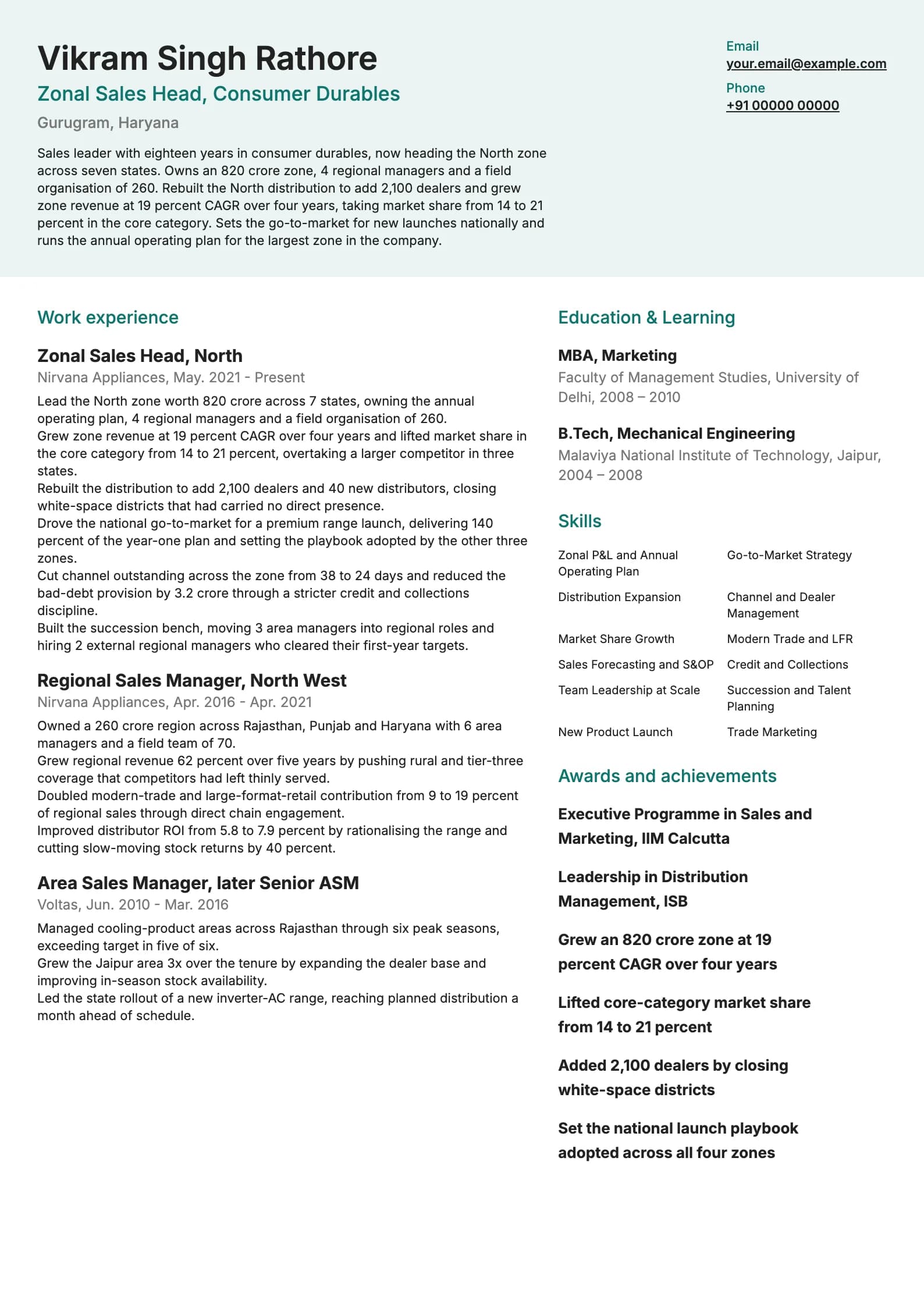
The format that works for regional sales manager resumes in India
Reverse chronological is the layout to use. Most recent role first, work backwards, and keep the dates in plain view. A functional resume that groups everything under achievements and drops the dates reads as an attempt to hide a job-hop or a gap, and sales hiring managers, who look at tenure closely, treat it exactly that way. If you have moved often, explain it in a line rather than hiding it in the layout. Length follows seniority. A newly promoted RSM fits comfortably on one page, sometimes spilling to a second for the earlier roles. An established RSM or a zonal head usually runs to two pages, because there are genuinely three or four roles of real scope to describe. What does not earn a second page is a longer skills list or a paragraph of self-description. Lead every role with scope, then results. A reviewer needs to know the size of the P&L, the team and the geography before a single achievement means anything. "Own a 140 crore region across four states, 8 area managers and 90 MRs" is the sentence that lets the numbers below it land. Without it, 26 percent growth could mean 26 percent of a 2 crore territory. Four things belong nowhere on a management resume: a photograph, date of birth, marital status and father's name. They come from an older campus template and take space a distributor number or a share figure should hold. Send a PDF unless the posting asks otherwise, name the file with your own name and RSM, and keep a single column so the layout parses cleanly. The table below sets out the section order.
| Section | Where it goes | Why |
|---|---|---|
| Name and headline | Top, above everything | The headline is the role and industry, Regional Sales Manager, FMCG. Recruiters match on it. |
| Professional summary | Directly under the header | Three or four lines. Years, industry, region size and the single strongest growth number. |
| Work experience | Next, always the core of the page | Each role opens with scope, then results. Current role gets the most bullets. |
| Key achievements | Optional band under the summary or after experience | Four lines a busy reviewer reads first: growth, share, team, collections. |
| Skills | Below experience | Grouped: sales, channel, team, planning. Not a 30-item wall. |
| Education and certifications | Bottom for experienced managers | MBA and any sales-leadership programme. Drop the percentage after your first job. |
| Languages | Bottom, one line | Regional languages matter for field roles. State the ones you actually work in. |
Managing a region is not the same as growing one
The single most common RSM resume failure is a page full of responsibilities and empty of results. "Handled the West region, managed a team of sales officers, achieved sales targets and maintained distributor relationships" describes the job the title already implies. It gives a hiring manager nothing to choose between you and every other applicant with the same title. The fix is to turn each responsibility into a number that moved. You managed distributors, so by how much did outstanding fall, or ROI rise. You achieved targets, so at what percentage, and did the region grow year on year or merely hold. You handled a team, so what happened to attrition, and how many did you promote. The samples above do this in every bullet: 92 to 118 percent, 45 to 22 days, 22 to 9 percent attrition. Each is a claim a reviewer can test in the interview, which is exactly why it carries weight. Distinguish primary from secondary sales, because a sophisticated reviewer knows the difference and looks for it. Primary is what you sold into the trade and is easy to inflate at quarter-end. Secondary is what the trade sold onward to the retailer, and is the honest read on whether the market absorbed your stock. A resume that leads with secondary growth and falling outstanding reads as more credible than one that quotes only primary target achievement. Size every number. "Grew sales 30 percent" means little without the base. "Grew a 260 crore region 62 percent over five years" tells a reviewer both the scale of the job and the scale of the result. A percentage without a base is the number a weak resume hides behind.
Experience bullet, RSM role
Weak
Responsible for managing the entire West region, handling a team of sales officers and distributors and ensuring achievement of monthly sales targets.
Strong
Grew secondary sales 28 percent in the first full year by reworking the beat plan, adding 900 outlets and fixing 4 gap towns that had no distributor.
The rewrite trades a restated job description for a growth number, the base it grew on and the three specific actions behind it.
For every responsibility on your resume, ask what number it moved. Managed distributors becomes outstanding cut from 45 to 22 days. Achieved targets becomes grew the region from 92 to 118 percent. If a line has no number and no base, it is describing the title, not you.
Writing a summary a sales director actually reads
The block under your name is the part you can be sure a busy sales director scans, so it must carry the facts that decide whether to keep reading: how many years, which industry, how big a region and the single strongest thing that happened because of you. Three or four lines, no adjectives a reviewer cannot verify. The old objective line, seeking a challenging and growth-oriented position in a reputed organisation to utilise my sales and leadership skills, tells the reader nothing they did not assume from the application. Replace it with a summary. An objective describes what you want; a summary describes what you have already delivered, and only one is evidence. Be industry-specific from the first line. FMCG, pharma and consumer durables sales look similar from a distance and are run very differently up close: pharma sells to prescribers through a field force and stockists, FMCG runs on beats and distributor ROI, durables on dealers and seasonality. A summary that names the industry and its native metrics signals you know the terrain. "Twelve years in pharmaceutical field sales, running the South region" places you immediately. A practical test: read your summary and ask whether another RSM in your company could paste it onto their resume unchanged. If they could, it describes the role, not you. Add the specific region size, the specific growth number and the specific team scope until it stops being transferable.
Professional summary, established RSM
Weak
Dynamic and results-oriented sales professional with 12+ years of experience in achieving sales targets, team management and building distributor relationships in a reputed organisation.
Strong
Regional sales manager with twelve years in pharmaceutical field sales, running a 140 crore South region across four states with 8 area managers and 90 MRs. Took the region from 92 to 118 percent of target over three years.
The rewrite swaps generic self-description for the industry, the region size, the team scope and one verifiable growth result.
Experience bullets: scope, action, result
Every strong bullet in the samples follows the same shape. It names the action you took, the specific lever you pulled, and the number that moved because of it. The action shows you drove it. The lever tells a reviewer you understand how sales actually grows, through beats and coverage and credit terms and range, not through effort in the abstract. The number does the persuading. Start with the result and work backwards. Sales managers usually write the activity first, then struggle to attach an outcome, which produces bullets like "conducted regular market visits and monitored distributor performance". Instead ask what was different at the end of the year: the region grew, outstanding fell, a launch hit plan early, share moved, attrition dropped. Then write the sentence that ends in that fact and names the lever that caused it. Vary the metric. A page of nothing but target-achievement percentages reads as one trick. Across a real region you can honestly reach for revenue growth, secondary sales, market share, distributor ROI, days outstanding, numeric distribution, new outlets or dealers, team attrition and people promoted. The established RSM sample moves across several of these, which reads as command of the whole job rather than one corner of it. Where you lack a clean percentage, give scope: how many distributors, how many outlets added, how many states, how many people promoted. "Onboarded 6 new stockists to close availability gaps, adding 4.5 crore of annual secondary" carries weight without a growth-rate at all. Allocate bullets by recency. Current role gets five or six, the previous role four, anything older two or three.
| Level | What bullets must prove | Typical metric |
|---|---|---|
| Sales officer / MR | You can grow a territory and hit a beat | Secondary target percent, outlets added, territory growth |
| Area sales manager | You own an area and a small team | Area growth, distributor ROI, launch coverage, target percent |
| Regional sales manager | You grow a region and hold a field team | Region growth, share, outstanding, attrition, people promoted |
| Zonal / national head | You set go-to-market and grow share at scale | Zone CAGR, market share, distribution expansion, succession |
Experience bullet, distributor work
Weak
Maintained good relationships with all distributors and ensured timely collection of payments and resolution of their issues.
Strong
Cut average distributor outstanding from 45 days to 22 by tying claim settlement to a fixed monthly cycle and clearing a two-year claims backlog.
Names the before and after and the two mechanisms, so a reviewer can ask how you enforced the cycle instead of nodding at a vague relationship claim.
If a bullet would read identically on another RSM's resume, it is describing the title, not you. Rewrite it until it only fits the region you actually ran, with the base, the lever and the number that moved.
The skills section: grouped, honest, and native to your industry
A sales manager's skills section has two audiences with opposite preferences. The applicant tracking system wants literal terms it can match, distributor management and secondary sales and modern trade. A human wants a short, organised list that signals what kind of sales leader you are. Grouping satisfies both. Group by function rather than one long line. Sales and revenue, channel and distribution, team and leadership, and planning and analytics is a grouping that works for almost every RSM. The exact headings matter less than the fact that structure exists. Use the industry's own words: secondary sales, primary sales, numeric distribution, distributor ROI, days outstanding, S&OP. A reviewer from the trade reads these as a shared language; a generic list of soft skills reads as someone who learned the words from a job posting. Ten to fourteen skills is the working range. Below eight the section looks thin for a manager. Above eighteen it stops being a signal and starts looking like keyword stuffing. Keep it to the levers you have actually pulled, because every item is a question you have agreed to answer in the interview. Do not fill the section with unprovable soft skills. "Leadership, communication, negotiation, hard-working, team player" is a list of adjectives no reviewer can test, and it crowds out the concrete channel and sales terms that carry real weight. Let one strong bullet prove your leadership rather than a word claiming it.
| Group | What goes in it | How many |
|---|---|---|
| Sales and revenue | Primary and secondary sales, target achievement, forecasting | 3 to 4 |
| Channel and distribution | Distributor management, ROI, modern trade, beat planning | 3 to 4 |
| Team and leadership | Field-force management, coaching, incentive planning, succession | 2 to 3 |
| Planning and analytics | S&OP, numeric distribution, credit and collections, sales analytics | 2 to 3 |
Skills section
Weak
Skills: Leadership, Communication, Team Management, Hard Working, Target Achievement, Negotiation, Sales, Marketing, Relationship Building, MS Office, Time Management, Team Player
Strong
Sales: primary and secondary sales, target achievement, forecasting. Channel: distributor management, distributor ROI, modern trade, beat planning. Team: field-force management, incentive planning, coaching. Analytics: numeric distribution, credit and collections.
Cuts the untestable adjectives, keeps the industry-native levers a trade reviewer respects, and groups them so a human reads the shape of the role in one pass.
The achievements band: four lines a director reads first
A regional or zonal manager benefits from a short achievements band, four lines, placed under the summary or just after the experience. A senior sales director skims before reading, and this band is what they skim. It should carry your four strongest, most varied results, pulled up from the experience so they are not buried in a role three jobs down. Choose for range, not repetition. One growth number, one share or coverage number, one people number and one financial-discipline number covers the four dimensions a sales leader is judged on: did the business grow, did it beat the market, did the team stay and develop, and did the money come back cleanly. Four target-achievement percentages in a row waste the band; four different proof points make the whole page look complete before it is read. Quantify each line and keep it self-contained, because a reviewer may read this band and nothing else on a first pass. "Grew an 820 crore zone at 19 percent CAGR over four years" works alone. "Consistently exceeded targets and grew the business significantly" does not, because it has no number, no base and no timeframe. Do not repeat the exact wording from the experience section. The band is a highlight reel, so tighten each line to its strongest form and let the detail live below in the role it came from.
Where education, MBA and certifications belong
Education goes at the bottom for any experienced sales manager. Degree, institution, years, and the MBA if you have one, because an MBA in marketing or sales still carries weight in Indian FMCG and pharma hiring, especially from a recognised school. That is the whole entry for most managers. Percentage or CGPA is worth keeping only while you are early in your career and it is strong. Once you have a decade of P&L behind you, a college number from fifteen years ago competes for space with region growth figures that are far more predictive, so drop it. The MBA institution is worth naming permanently; the undergraduate percentage is not. Sales-leadership programmes are worth listing when they are real. An executive programme from an IIM or ISB, or a recognised sales-force-effectiveness or distribution-management course, signals continued investment in the craft and reads well for a senior candidate. A one-day webinar or a generic online completion certificate adds little, so keep the list to the programmes you would be comfortable discussing. Domain qualifications matter in some industries. A B.Pharm behind a pharma RSM is a genuine signal, because it means you can hold a technical conversation with a prescriber and understand the therapy, so keep it visible even years on. For FMCG and durables, the commercial degree and the MBA are what count.
Getting through the applicant tracking system
Large FMCG, pharma and durables companies screen sales applications through an applicant tracking system before a manager sees them. The system is a parser and a search index, not a judge. It reads your file, breaks it into name, dates, employers, titles and skills, and stores the result so a recruiter can search across hundreds of candidates. Almost every ATS problem is a parsing problem, and parsing problems come from layout, not wording. The layout rules are short. One column. Standard section headings, so use Work Experience rather than My Career Journey, and Skills rather than My Strengths. No text inside images or logos, which parse as empty space. No critical information in the header or footer region, which some parsers drop. Avoid text boxes and nested tables in the body of the resume. On wording, mirror the language of the job description where it is honest. If the posting says secondary sales, write secondary sales, not just sales. If it says distributor management, use that phrase rather than dealer handling. If it names a channel such as modern trade or general trade, include the one that matches your experience. Spell an acronym out at least once, for example "RSM (regional sales manager)", so both searches find you. Keyword stuffing does not work. A hidden block of every sales term in white text is caught quickly, and the outcome is worse than being filtered. Write real bullets that naturally carry the right terms, because a bullet describing how you cut distributor outstanding contains distributor and outstanding in a context that survives human review too. Save as PDF from a tool that embeds real text, then open the file and confirm you can select and copy a sentence. If you cannot select the text, neither can the parser.
Section heading
Weak
My Sales Success Story
Strong
Work Experience
Parsers look for standard headings; a creative one can push the whole block into an unclassified bucket the recruiter never searches.
Test your own file before you send it. Copy the text out of the PDF into a plain text editor. Whatever you can read there is roughly what the parser sees, and anything scrambled, especially your numbers and dates, is a real risk.
What gets regional sales manager resumes rejected
Most rejections at the resume stage are not close calls. They come from a small set of recurring problems, and all of them are fixable in an afternoon. The list below covers what reviewers of Indian sales manager resumes see most often, in rough order of how much damage each one does.
- Responsibilities with no results. "Handled the region, managed the team, achieved targets" restates the title and proves nothing. Every line needs a number that moved.
- Percentages with no base. "Grew sales 30 percent" is meaningless without whether it was a 3 crore territory or a 300 crore region.
- Only primary target achievement, never secondary or outstanding. A sophisticated reviewer reads this as hiding whether the market actually absorbed the stock.
- No team or leadership metric. For a manager, attrition held, people promoted and second line built matter as much as the sales figure.
- A generic objective line. Replace it with a summary that states years, industry, region size and one growth number.
- A wall of soft-skill adjectives instead of industry levers. Leadership and hard-working are untestable; distributor ROI and beat planning are not.
- A photo, date of birth, marital status or father's name. None of it belongs on a management resume, and it takes a distributor number's space.
- Unexplained short stints. Sales hiring looks hard at tenure; a run of one-year roles with no context reads as a pattern, so explain it in a line.
- Inflated titles or region sizes that will not survive a reference check. Sales backgrounds are checked closely and a mismatch ends the process.
- The same four target percentages restated as an achievements band. Vary the proof: growth, share, team, collections.
Read your resume as if you were the interviewing sales director. For every line, ask: could I defend this number if you asked me how. Any line you could not is a line to fix before you send it.
Skills to put on a regional sales manager resume
Technical
- Primary and Secondary Sales
- Regional P&L Ownership
- Sales Target Achievement
- Distributor and Channel Management
- Distributor ROI
- Beat and Route Planning
- Numeric and Weighted Distribution
- Modern Trade and General Trade
- Sales Forecasting and S&OP
- New Product Launch
- Credit and Collections
- Market Share Growth
Tools and platforms
- SAP Sales and Distribution
- Salesforce CRM
- Microsoft Excel
- Power BI
- Distributor Management System (DMS)
- Sales Force Automation (Bizom, FieldAssist)
- Google Sheets
- Tally (for distributor claims)
Working skills
- Team leadership
- Coaching and mentoring
- Negotiation
- Stakeholder management
- Incentive and reward design
- Territory planning
- Conflict resolution
- Business review and reporting
Certifications worth listing as a regional sales manager
| Certification | Full name | Worth it for |
|---|---|---|
| MBA (Sales/Marketing) | Master of Business Administration, Sales and Marketing | The default expectation for a regional sales role at most large FMCG, pharma and durables companies, and a genuine door-opener from a recognised school. Worth naming permanently. If you rose through the field without one, strong region numbers can outweigh it, but the degree still shortens the shortlisting for external moves. |
| SFE Programme | Sales Force Effectiveness / Sales Leadership Programme (ISB, IIM or MRSS) | A useful mid-career signal for an area or regional manager investing in the craft of running a field force: coverage design, incentive structures, analytics. Reads well on an RSM resume and above. Choose a recognised institution's programme over a generic online certificate, which adds little. |
| B.Pharm | Bachelor of Pharmacy | A real, lasting signal for pharma sales specifically, because it means you can hold a technical conversation with a prescriber and understand the therapy area. Keep it visible even years into a management career. Not relevant for FMCG or durables, where the commercial degree carries the weight instead. |
| Distribution Management | Certificate in Distribution / Channel Management | Worth it for managers whose edge is the channel: distributor economics, ROI, days outstanding, route design. Signals depth on the commercial mechanics of a region rather than just the selling. Most valuable for FMCG and consumer-durables roles where distribution reach is the game. |
Keywords an ATS scans for in a regional sales manager resume
These are the literal terms a parser matches against the job description. Use the ones that are true of you, in the sentences where you did the work, not as a list at the bottom.
- regional sales manager
- area sales manager
- primary sales
- secondary sales
- distributor management
- channel sales
- sales target achievement
- team management
- modern trade
- general trade
- beat planning
- numeric distribution
- distributor ROI
- sales forecasting
- new product launch
- market share
- collections
- field force
- FMCG sales
- P&L
Regional Sales Manager resume FAQ
What salary can a regional sales manager expect in India?
A newly promoted RSM in FMCG or pharma typically earns 18 to 28 LPA, depending on the company and region size, usually with a meaningful variable component tied to target achievement. An established RSM running a large multi-state region sits around 28 to 42 LPA. Senior sales leaders and zonal heads with fifteen years and above commonly earn 45 to 80 LPA and more at large consumer companies, again heavily weighted to variable pay. A bigger P&L, a stronger brand and a track record of share growth push the top of every band upward.
How long should a regional sales manager resume be?
One page for a newly promoted RSM is achievable and reads well, but two pages is entirely acceptable and often better for an established regional or zonal manager who has three or four roles of real scope to describe. What does not earn a second page is a longer skills list or a paragraph of self-description. If you are past a decade, use the space for scope and results, and cut the oldest role to two or three lines.
Should I show primary sales or secondary sales numbers?
Show both, and lead with secondary where you can. Primary sales is what you sold into the trade and is easy to inflate at quarter-end, so a sophisticated reviewer treats it cautiously. Secondary sales is what the trade sold onward and is the honest read on whether the market absorbed your stock. A resume that pairs secondary growth with falling distributor outstanding reads as far more credible than one quoting only primary target achievement.
Do I need an MBA to become a regional sales manager?
It helps and is the default expectation at most large FMCG, pharma and durables companies, where an MBA from a recognised school shortens the shortlisting for external moves. That said, many strong RSMs rose through the field without one, and a genuine track record of region growth, share gain and team building can outweigh the missing degree. If you have the MBA, name the institution; if you do not, let the region numbers carry the page.
How do I show team and leadership on a sales manager resume?
With numbers, the same as sales. State the team size and structure in the scope line, then prove leadership with results: attrition held or cut, people promoted into the next role, a second line built. "Cut field-force attrition from 22 to 9 percent" and "promoted 5 MRs into area roles" say more than the word leadership ever will. For a manager, holding and developing a team through a target cycle is judged as closely as the sales figure.
Should I list every distributor and client by name?
No. Naming individual distributors clutters the page and can breach confidentiality. Instead quantify the network: how many distributors, how many outlets, how many states, and what happened to the metrics that matter, ROI and days outstanding. Name a marquee channel win in category terms, such as landing a 60-store regional supermarket chain, rather than listing the client, since the scale of the win is the point, not the name.
Does an ATS reject sales resumes with two columns?
It does not reject them outright, but some parsers read multi-column layouts out of order, which interleaves a skills sidebar with your experience and scrambles the recruiter's view of your numbers and dates. A single-column layout removes the risk, which is why the samples above use one. Test your own file by copying the text out of the PDF into a plain text editor, and if your region sizes and growth figures read in order there, it will most likely parse correctly.
How do I explain short stints or a job change on a sales resume?
Address it directly in a short line rather than hoping the layout hides it, because sales hiring looks hard at tenure. A company exiting a market, a territory restructure or a genuine step up in scope are all legitimate reasons that read fine when stated plainly. What reads badly is an unexplained run of one-year roles with a functional layout that drops the dates, which a reviewer interprets as something you are trying not to show.
What certifications help a regional sales manager in India?
For most RSM roles the MBA is the credential that matters, ideally from a recognised school. Beyond it, a sales-force-effectiveness or sales-leadership programme from an IIM, ISB or a respected training body signals investment in the craft and reads well mid-career. In pharma, a B.Pharm is a genuine lasting signal because it lets you hold a technical conversation with prescribers. Keep the list short and to programmes you would be comfortable discussing in the interview.
Related resume examples and guides
Build your own in any of these formats
Start from a blank resume or upload the one you have. Goodspace renders it in 24 templates and flags the primary and secondary sales, distributor and channel keywords an applicant tracking system will look for, and the vague responsibility lines it will not credit.
Build my resume