Key Account Manager Resume Format, with 3 Full Samples
A key account manager is hired on evidence that they keep large customers, grow the revenue inside them and stop the ones that matter from leaving, yet most account-management resumes read like a relationship-building poem with no numbers. Below are three complete resumes, one for an account manager two years in owning a mid-market book, one for a key account manager carrying a strategic portfolio, and one for a senior KAM leading a team and the largest accounts. After the samples come the format rules, the difference between claiming you "maintained relationships" and proving retention and growth, the terms a parser matches literally, and the mistakes that get a KAM resume screened out.
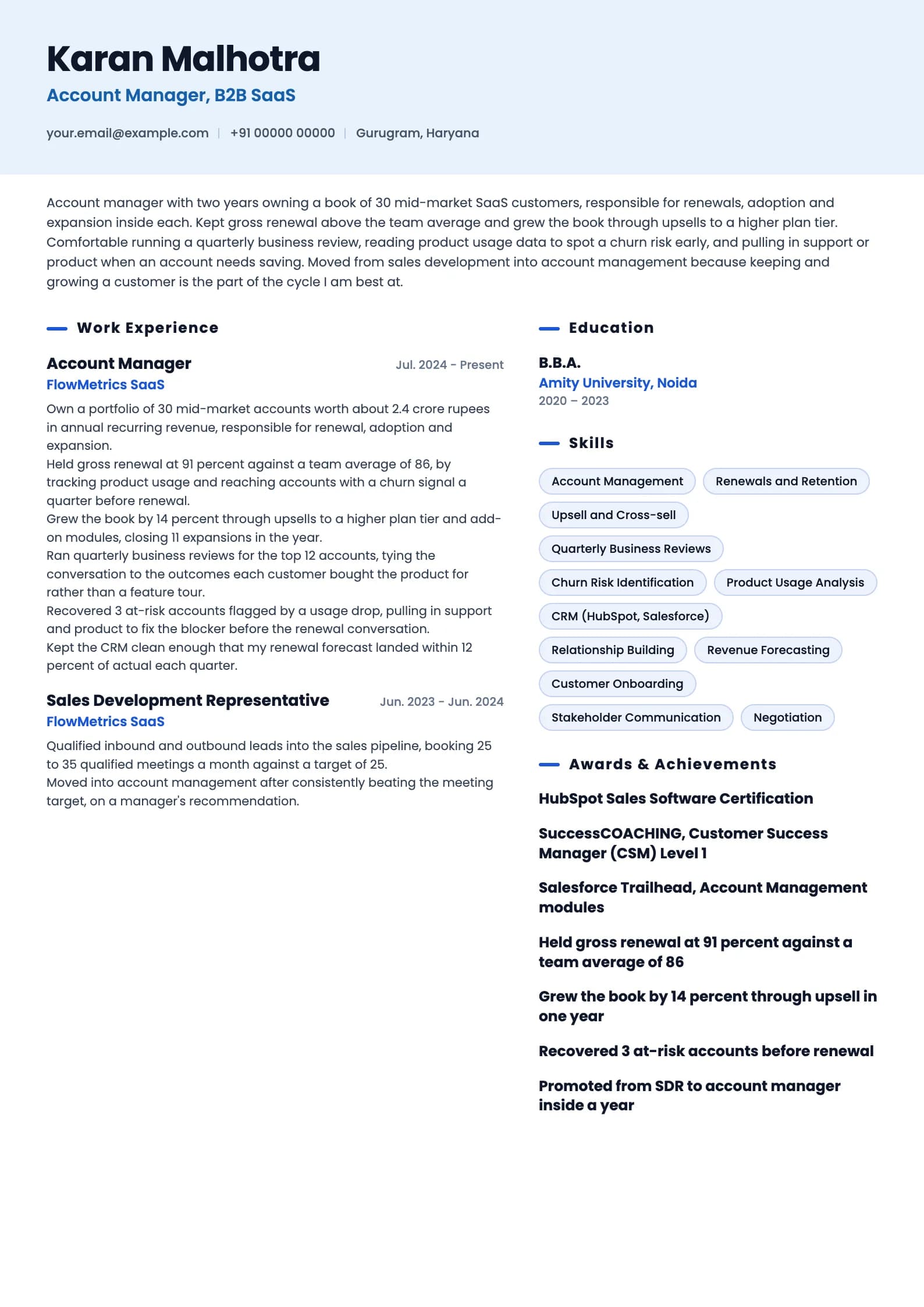
Build my resumeKey Account Manager resume example, Account Manager (2 years)
ai-era templateIs your resume good enough?
Upload the resume you have now and see what an applicant tracking system reads before a key account manager recruiter ever does.
Free to run. Sign in with your mobile number to see your score.
Key Account Manager resume example, Key Account Manager (6 years)
professional template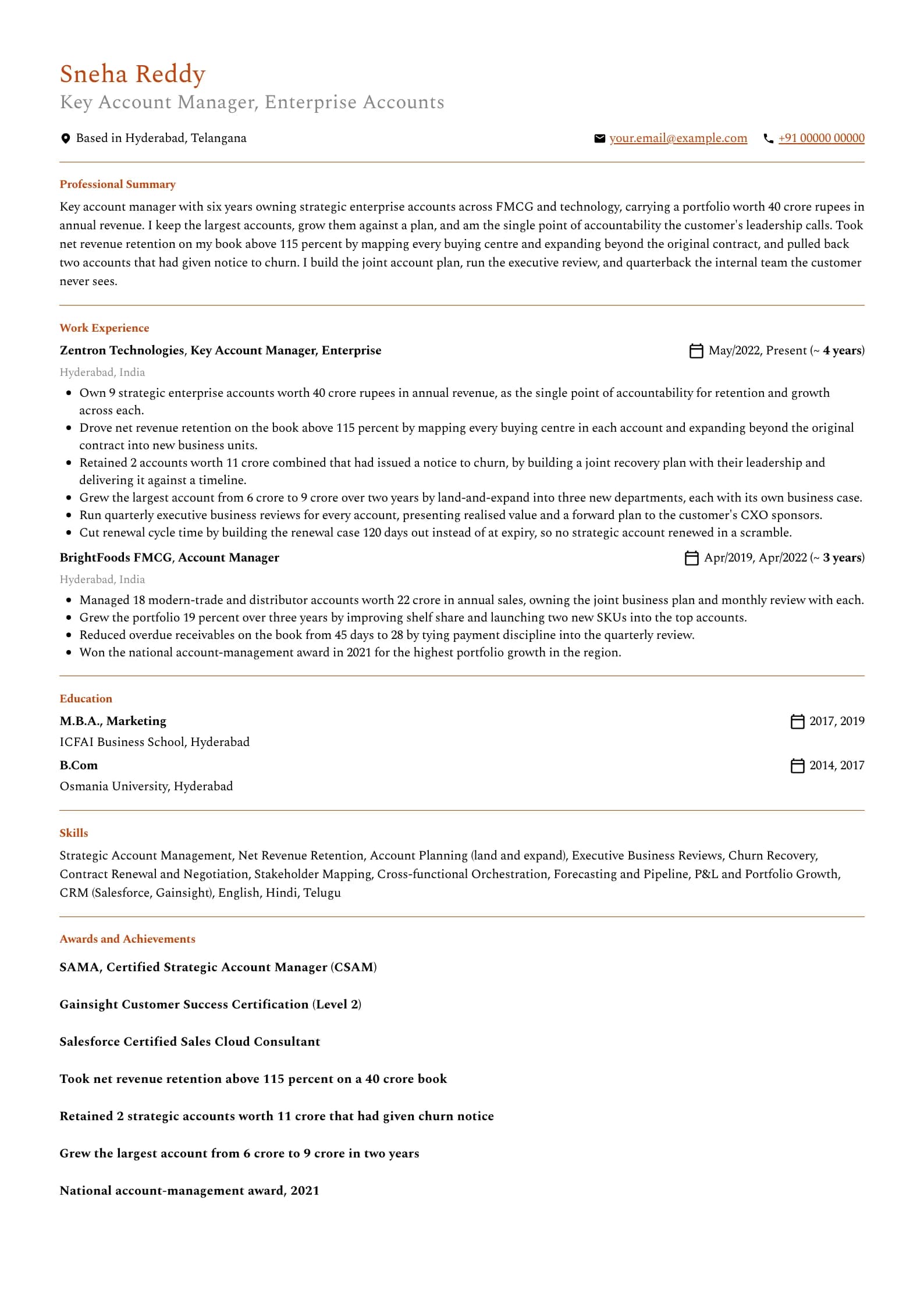
Want this structure with your own details? Build it in the resume builder.
Key Account Manager resume example, Senior KAM / Lead (12 years)
header-band template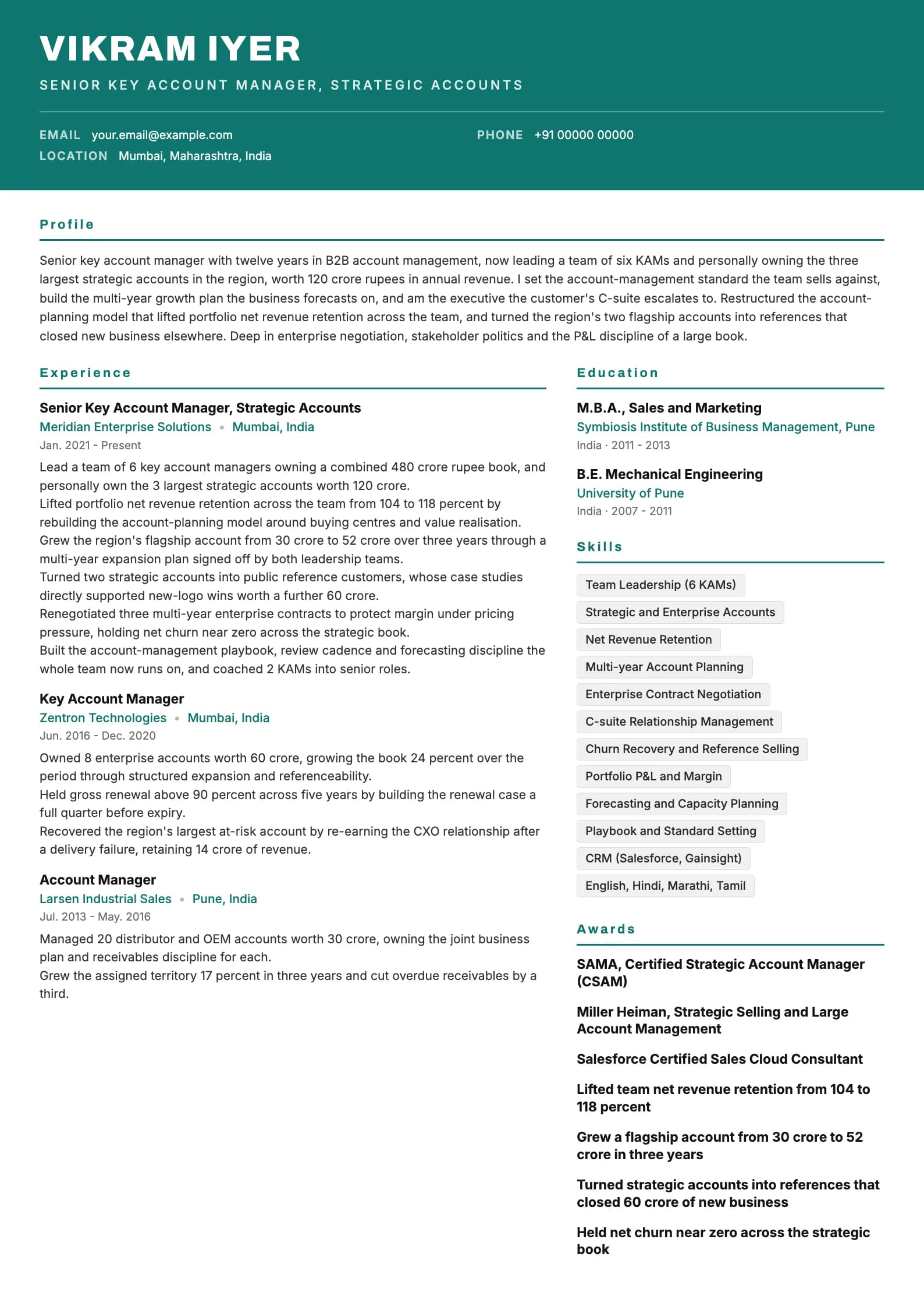
The format that works for key account manager resumes in India
Reverse chronological is the layout to use. Most recent role first, work backwards, dates in plain view. Account management is a role of longevity and trust, so a reviewer reads your resume for a pattern of holding and growing books, and a functional layout that hides the dates under a Skills grouping reads as concealment. If a role was short, keep it and let the retention and growth numbers carry it. One page is right up to roughly six or seven years. A senior KAM leading a team, or someone carrying a decade of strategic accounts, can run to a second page, but only if it carries real portfolio work, retention numbers, named account growth, contract wins, rather than a longer list of soft skills. A page two built from a competencies grid is a padded one-page resume. Four things do not belong on this resume: a photograph, date of birth, marital status and father's name. They come from an older campus template and add nothing to an account-management screen, which is entirely about the book you kept and grew. Every line they take is a line an account result could have used. Send a PDF unless the posting asks otherwise, and name the file with your own name and key account manager. Keep it a single column, because a two-column layout with a competencies sidebar can parse out of order in an applicant tracking system. The table below sets the section order.
| Section | Where it goes | Why |
|---|---|---|
| Name and headline | Top, above everything | Headline names the role, key account manager or strategic account manager. Recruiters match on it. |
| Professional summary | Directly under the header | Three lines. Years, portfolio size, and your strongest retention or growth number. |
| Work experience | Next, for anyone with a job | Most recent first. Lead every bullet with a book result, not a duty. |
| Skills | Below experience | Grouped: account management, commercial, tools. Not a competencies wall. |
| Education | Bottom, unless early-career | Degree, institution, years. An MBA is worth naming; drop the percentage after your first role. |
| Certifications | After education | CSAM, Gainsight, a recognised strategic-selling course. Name and year. |
| Languages | Short line if regionally relevant | Useful where your accounts are in a specific region. |
Prove you kept and grew the book, not that you "built relationships"
The single most common KAM resume failure is a page full of "built strong relationships", "maintained client rapport" and "ensured customer satisfaction" with no retention or growth number anywhere. Relationship building is the means, not the result. The job is to keep large customers and grow the revenue inside them, and the resume has to show that happened. There are four numbers a hiring manager looks for on an account-management resume, and you almost certainly have at least two. Retention, as gross renewal or logo retention, ideally against a benchmark. Growth, as net revenue retention above 100 percent, or portfolio growth in rupees or percent, or named-account expansion. Portfolio size, so scope is clear, how many accounts and what annual revenue. And churn recovery, an at-risk or churning account you pulled back, which is the single most persuasive account-management line because so few can show it. Write net revenue retention where you can, because it is the number a senior account-management interview opens on. NRR above 100 percent says the book grew even after any churn, which is exactly the KAM job in one figure. If you do not track NRR, use gross renewal plus a separate expansion number, which says the same thing in two lines. Be specific about the account. "Grew the largest account from 6 crore to 9 crore through expansion into three departments" is worth more than "grew key accounts significantly", because it is a named, checkable result rather than a claim that could belong to the whole team.
For every KAM bullet, ask: does this show retention, growth, portfolio size or a save. If it only shows a relationship or an activity, either attach the number it produced or cut it. "Built strong relationships" with no result is invisible on an account-management resume.
A summary a sales director reads and believes
A KAM hire is a trust hire, so the three lines under your name have to establish scope and credibility fast. They should say how long you have managed accounts, how big a book you carry, and your single strongest retention or growth number. No adjectives that cannot be checked. The old objective, seeking a challenging account-management role in a growth-oriented organisation to leverage my relationship-building skills, tells the reader nothing new. Replace it with a summary. An objective is about what you want, a summary is about the book you have already kept and grown, and only one of those earns an interview for a role where the company is handing you its largest customers. Early-career account managers think they have too little to summarise. Look at the two-year sample: it names the 30-account book, the renewal held above the team average, and the 14 percent growth through upsell. That is a real summary built from one account-management role and an SDR stint. What it avoids is "passionate about customer success and relationship management", a line that appears on every account-management resume and now carries no information. A test: read your summary and ask whether another AM at your company could paste it onto their resume unchanged. If they could, it describes the job, not you. Add your specific portfolio size, your specific retention figure and a named account result until it only fits you.
Professional summary, key account manager
Weak
Result-oriented key account manager with 6+ years of experience in building and maintaining strong client relationships, ensuring customer satisfaction and achieving business growth in a competitive environment.
Strong
Key account manager with six years owning strategic enterprise accounts worth 40 crore in annual revenue. Drove net revenue retention above 115 percent by expanding beyond the original contract, and pulled back two accounts worth 11 crore that had given churn notice.
The rewrite trades relationship adjectives for portfolio size, a net revenue retention figure and a concrete churn recovery, all checkable.
Experience bullets: verb, account action, revenue result
Every strong bullet in the samples follows the same shape. It opens with an action verb, names what you did with an account or the portfolio, and closes with the retention or revenue number that moved. The verb shows ownership. The action tells a hiring manager whether the motion transfers. The number does the persuading. Start from the result and work backwards. Account managers tend to write the activity first, "managed accounts, conducted reviews, handled escalations", and never reach the outcome. Instead ask what changed on the book because you owned it: an account renewed that was at risk, revenue expanded, NRR crossed 100 percent, a churning account came back, receivables tightened. Then write the sentence that ends in that fact. Vary the metric so the resume does not read as one number repeated. Account management honestly gives you gross renewal, net revenue retention, portfolio growth, named-account expansion, churn saved, contract value, receivables days and reference wins. The mid-level sample uses several of these, which reads as range and depth rather than a single trick. Where a hard number is genuinely unavailable, give scope: how many accounts, what portfolio value, how many buying centres mapped, how many executive reviews run. "Own 9 strategic enterprise accounts worth 40 crore as the single point of accountability" carries weight without inventing a percentage. Allocate bullets by recency and seniority. Current role gets five or six, the previous role three or four, anything older two.
| Level | What bullets must prove | Typical metric |
|---|---|---|
| Account Manager (early) | You keep a book and grow it a bit | Gross renewal vs team, upsell growth, accounts owned, forecast accuracy |
| Key Account Manager | You keep and expand strategic accounts | Net revenue retention, named-account growth, churn saved, portfolio value |
| Senior / Lead KAM | You set the standard and own the largest accounts | Team NRR, multi-year growth, reference wins, contracts renegotiated, margin held |
Experience bullet, account management
Weak
Responsible for managing key accounts, maintaining relationships and ensuring customer satisfaction to achieve business targets.
Strong
Drove net revenue retention above 115 percent on a 40 crore book by mapping every buying centre and expanding beyond the original contract into new business units.
"Responsible for managing" restates a job description; the rewrite names the metric, the book size and the expansion motion behind it.
Experience bullet, churn work
Weak
Worked closely with at-risk clients to improve satisfaction and reduce churn across the portfolio.
Strong
Retained 2 accounts worth 11 crore combined that had issued a notice to churn, by building a joint recovery plan with their leadership and delivering it against a timeline.
Turns a vague "reduce churn" into a named, quantified save with the exact mechanism, which a director can probe in the interview.
If a bullet would read identically on a colleague's resume, it is describing the team, not you. Rewrite it around the specific account you owned, the retention you held and the revenue you grew.
The skills section: account management, commercial, and tools
A KAM skills section has two readers. An applicant tracking system wants literal terms it can match, account management, retention, upselling, forecasting. A human sales leader wants a short, organised list that signals what kind of account manager you are, transactional or strategic, mid-market or enterprise. Grouping serves both. Group by function rather than one long line. Account management, commercial, and tools is a grouping that fits almost every KAM. Under account management put the real capabilities: strategic account planning, renewals, net revenue retention, churn recovery, executive business reviews, stakeholder mapping. Under commercial put negotiation, contract renewal, portfolio P&L, forecasting. Under tools put the CRM and customer-success platform you actually used by name, Salesforce, HubSpot, Gainsight. Twelve to sixteen skills is the working range. Below eight the section looks thin. Above twenty it becomes a competencies wall, and account-management resumes are prone to a specific version of it: a grid of "communication, negotiation, relationship management, customer focus, teamwork, leadership" that could describe any commercial role. Two or three of those as supporting items are fine; a wall of them signals a resume with no account numbers to show. Name the CRM and the customer-success tool. "CRM" alone is weaker than "Salesforce and Gainsight", because a hiring manager wants to know whether you have run a book on their stack. Do not add a proficiency bar. Nobody agrees what four stars in "relationship management" means, and it invites an argument you cannot win. Let the retention and growth numbers prove the depth.
| Group | What goes in it | How many |
|---|---|---|
| Account management | Strategic account planning, renewals, NRR, churn recovery, QBRs | 4 to 6 |
| Commercial | Negotiation, contract renewal, portfolio P&L, forecasting | 3 to 4 |
| Stakeholder | Stakeholder mapping, C-suite relationships, cross-functional orchestration | 2 to 3 |
| Tools | Salesforce, HubSpot, Gainsight, Excel, BI dashboards | 2 to 4 |
| Domain (optional) | The sector you sell into: SaaS, FMCG, BFSI, manufacturing | 1 to 2 |
Skills section
Weak
Skills: Communication, Negotiation, Relationship Management, Customer Focus, Team Player, Leadership, Problem Solving, Time Management, Business Development, Sales, Client Handling, Presentation Skills, MS Office
Strong
Account management: strategic account planning, net revenue retention, churn recovery, QBRs. Commercial: enterprise contract negotiation, forecasting, portfolio P&L. Tools: Salesforce, Gainsight. Domain: B2B SaaS.
Cuts the generic competencies grid to real account-management and commercial capabilities, names the actual tools and the sector, and stops describing every commercial role at once.
Account planning and QBRs: the evidence of a real KAM
The line that separates a genuine key account manager from a relationship-holder is structured account planning. A KAM does not wait for the renewal, they build a plan for each account, map who buys and who blocks, and run a review cadence that keeps the customer's leadership close. The resume should show this apparatus, because it is what a hiring manager is really testing for. Describe the account plan, not just the accounts. "Ran quarterly business reviews for the top 12 accounts, tying the conversation to the outcomes each customer bought the product for" tells a reviewer you run a value conversation, not a feature tour. Naming the buying-centre mapping, the multi-year expansion plan, the joint business plan signals a KAM who works the account like a small business, which is exactly the senior motion. Quantify the plan's result. Account planning is only credible if it moved a number: an account grew from X to Y, NRR crossed 100 percent, a renewal came 120 days early instead of in a scramble. The mid-level and senior samples both tie the planning apparatus to a revenue or retention figure, which is what turns process into proof. Show the cross-functional orchestration. A strategic account is won and kept by a team the customer never sees, product, support, delivery, finance, and the KAM quarterbacks it. "Pulled in support and product to fix the blocker before the renewal conversation" is a small line that signals you can mobilise an internal team, which is a core KAM skill and one most resumes forget to claim.
Account planning bullet
Weak
Conducted regular meetings and reviews with key clients to discuss their requirements and maintain a good working relationship.
Strong
Ran quarterly executive business reviews for every account, presenting realised value and a forward plan to the customer's CXO sponsors, and grew the largest account from 6 to 9 crore.
Swaps "regular meetings" for a named cadence aimed at the CXO, tied to realised value and a concrete account-growth number.
Where education and certifications belong
Education goes near the bottom for anyone with account-management experience, and a little higher for someone early-career. Degree, institution, years. An MBA is worth naming clearly, because it is common and valued in Indian account-management hiring, especially for enterprise and strategic roles, so give it its own line rather than burying it. Keep your graduation or MBA percentage only while you are early-career and it is strong. Once you have a real retention and growth track record, the number from years ago competes for space with results that predict the job far better. Drop it. Certifications carry moderate weight in account management, more than in many sales roles because the discipline has recognised credentials. The SAMA Certified Strategic Account Manager (CSAM) is the most relevant for a strategic KAM. A Gainsight or customer-success certification helps for SaaS account management. A recognised strategic-selling programme, Miller Heiman Strategic Selling or Large Account Management Process, signals method, not just instinct, and stands out on a resume where most have none. Write certifications with the full name, the issuing body and the year. These credentials are checkable, and a lapsed or misstated one is easy to catch, so keep the list honest. For an early KAM, an accessible customer-success certification you actually completed beats an impressive-sounding one you cannot speak to in an interview.
Getting through the applicant tracking system
Enterprise employers run account-management applications through an applicant tracking system before a human reads them. It is a parser and a search index, not a judge. It reads your file, tries to break it into name, dates, employers, titles and skills, and stores that so a recruiter can search across candidates. Almost every problem is a parsing problem, and parsing problems come from layout, not wording. The layout rules are short. One column, so a competencies sidebar does not interleave with your experience. Standard headings, Work Experience not "My Track Record", Skills not "Core Competencies" in a graphic. No text inside images, because a client-logo strip reads as blank space. Nothing critical in the header or footer region, which some parsers drop. On wording, mirror the job posting where it is honest. If the ad says key account manager, put that exact phrase on the page even if your last title was account manager. If it says net revenue retention, upselling, account planning, or a named CRM, and you have done it, use those exact words. Spell an acronym out once alongside its short form, for example "NRR (net revenue retention) of 115 percent", so both searches find you. Keyword stuffing does not work and is easy to spot: a hidden block of "key account management enterprise strategic B2B" in white text gets you filtered, not shortlisted. Write real bullets that naturally carry the right terms, because a bullet about the enterprise account you grew already contains the words a recruiter searches. Save as a PDF that contains real text, then open it and confirm you can select and copy a sentence. If you cannot select the text, neither can the parser.
Section heading
Weak
My Client Success Story
Strong
Work Experience
Parsers look for standard headings; a creative one can push the whole block into an unclassified bucket the recruiter never searches.
Test your own file before you send it. Copy the text out of the PDF into a plain notepad. Whatever reads cleanly there is roughly what the ATS sees, and anything scrambled is a real risk to fix.
What gets key account manager resumes rejected
Most account-management rejections at the resume stage are not close calls. They come from a small set of recurring problems, and every one is fixable in an afternoon. The list below covers what recruiters of Indian KAM resumes see most often, in rough order of how much damage each does.
- "Built strong relationships" and "ensured customer satisfaction" everywhere, with no retention or growth number to back them.
- No portfolio size, so a hiring manager cannot tell whether you managed 5 accounts or 50, worth 2 crore or 200.
- No net revenue retention or renewal figure, the two numbers a senior account-management interview opens on.
- "Responsible for managing key accounts" duties copied from the job description instead of what you kept and grew.
- A generic competencies grid, communication, negotiation, leadership, that describes every commercial role and none in particular.
- No named-account result, only a portfolio total that could belong to the whole team rather than to you.
- The strongest available line, a churning account you pulled back, left off because it felt like admitting a problem existed.
- A photo, date of birth, marital status or father's name, none of which belongs on an account-management screen.
- A generic objective about a "challenging role in a growth-oriented organisation" where a summary with a number belongs.
- Inflated portfolio values or titles that will not survive reference checks, which are standard for senior commercial hires.
Read your resume as a sales director deciding who to trust with the company's largest customers. If a bullet does not show retention, growth or scope, it will not build that trust, so give it a number or cut it.
Skills to put on a key account manager resume
Technical
- Strategic Account Management
- Net Revenue Retention
- Renewals and Churn Recovery
- Account Planning (land and expand)
- Executive Business Reviews
- Contract Renewal and Negotiation
- Stakeholder Mapping
- Cross-functional Orchestration
- Revenue Forecasting
- Portfolio P&L and Margin
- Upsell and Cross-sell
- Reference and Advocacy Building
Tools and platforms
- Salesforce
- HubSpot CRM
- Gainsight
- Zoho CRM
- Microsoft Excel
- Power BI
- LinkedIn Sales Navigator
- Tableau
Working skills
- Executive relationship building
- Negotiation
- Commercial judgement
- Consultative communication
- Influence without authority
- Composure in escalations
- Coaching and mentoring
- Business storytelling
Certifications worth listing as a key account manager
| Certification | Full name | Worth it for |
|---|---|---|
| CSAM | SAMA Certified Strategic Account Manager | The most relevant credential for a strategic or enterprise KAM, since it certifies the account-planning and value-management discipline the role is judged on. Most valuable for mid-to-senior account managers moving into strategic accounts. Less necessary for a transactional, mid-market book. |
| Gainsight CSM | Gainsight Customer Success Certification | Worth it for account managers in B2B SaaS whose work runs through a customer-success platform, since it proves you can operationalise retention and expansion with data. Pairs naturally with a SaaS account-management role. Little value outside software. |
| Strategic Selling | Miller Heiman Strategic Selling / Large Account Management Process | A recognised methodology credential that signals a KAM works accounts by a method, not just instinct. Valued in enterprise and complex B2B selling, and a genuine differentiator on a resume where most candidates list none. Overkill for an early, small-book role. |
| Salesforce Sales Cloud | Salesforce Certified Sales Cloud Consultant | Useful for a senior KAM or team lead who configures and reports on the CRM the book runs in, not just uses it. Signals you can build the pipeline and forecasting discipline a team depends on. Not needed for someone who only enters their own accounts. |
| MBA | Master of Business Administration (Sales / Marketing) | Not a certification but the credential that most helps an Indian account-management career, especially for enterprise and strategic roles, where an MBA is common among peers. Worth naming clearly on the resume. Its weight fades as your retention and growth track record grows. |
Keywords an ATS scans for in a key account manager resume
These are the literal terms a parser matches against the job description. Use the ones that are true of you, in the sentences where you did the work, not as a list at the bottom.
- key account manager
- strategic account manager
- account management
- net revenue retention
- customer retention
- renewals
- upsell
- cross-sell
- account planning
- churn
- quarterly business review
- stakeholder management
- revenue growth
- forecasting
- CRM
- Salesforce
- Gainsight
- contract negotiation
- portfolio management
- B2B sales
Key Account Manager resume FAQ
What salary can a key account manager expect in India?
An early account manager with two to three years typically earns around 6 to 12 LPA. A key account manager with five to seven years carrying a strategic book usually sits in the 14 to 28 LPA band, with a meaningful variable component tied to retention and growth. Senior KAMs and account-management leads with a decade and a large portfolio commonly earn 30 to 55 LPA and more at strong enterprise and SaaS companies. A proven net revenue retention record above 110 percent and enterprise-negotiation experience push the top of every band upward.
How long should a key account manager resume be?
One page up to roughly six or seven years. A senior KAM leading a team or carrying a decade of strategic accounts can use a second page, but only if it holds real portfolio work, retention figures, named-account growth, contract wins, rather than a longer competencies grid. Nobody has been rejected for a resume that was too easy to read. If you are struggling to fit one page, cut the oldest role to a line and remove the generic soft-skill list.
What is the single most important number on a KAM resume?
Net revenue retention, written as a percentage. NRR above 100 percent says the revenue in your book grew even after any churn, which is the key account manager's job captured in one figure, so it is where a senior account-management interview opens. If your company does not track NRR, use gross renewal plus a separate expansion or growth number, which says the same thing in two lines. Whatever you use, benchmark it against the team average where you can.
How do I show a churning account that I saved?
Name it, quantify it and state the mechanism, because a recovered account is the single most persuasive line on a KAM resume. "Retained 2 accounts worth 11 crore that had issued a notice to churn, by building a joint recovery plan with their leadership" is far stronger than "reduced churn across the portfolio". A save is proof of the exact skill every account manager claims and few can demonstrate, so lead with it rather than hiding it as an admission that a problem existed.
Do certifications like CSAM or Gainsight help a KAM?
They help more here than in many sales roles, because account management has recognised credentials. The SAMA CSAM is the most relevant for strategic accounts, a Gainsight certification suits SaaS account management, and a strategic-selling programme like Miller Heiman signals method over instinct. They matter most for mid-career candidates moving into enterprise accounts, and least once you have a strong retention and growth record to point at. Keep the list short and let the numbers lead.
What is the difference between an account manager and a key account manager resume?
Scope and the size of what you kept. An account manager resume shows you can hold a mid-market book and grow it modestly, with metrics like gross renewal and upsell. A key account manager resume shows you keep and expand strategic, high-value accounts, with net revenue retention, named-account growth, churn recovery and executive business reviews. If you are targeting KAM roles, foreground the largest accounts you owned, the buying-centre mapping and the multi-year planning, not the length of your account list.
Should I put an MBA on my key account manager resume?
Yes, and give it its own line rather than burying it. An MBA is common and valued in Indian account-management hiring, especially for enterprise and strategic roles, so it is worth naming clearly. Keep the graduation or MBA percentage only while you are early-career and it is strong. Once you have a real retention and growth track record, drop the percentage, because results that predict the job outweigh a number from years ago.
Does an ATS reject two-column KAM resumes?
It does not reject them outright, but some parsers read a two-column layout out of order and interleave your competencies sidebar with your experience, producing nonsense in the recruiter's view. A single column removes the risk, which is why all three samples above use one. Test your own file by copying the text out of the PDF into a plain notepad, and if it reads in order there, it will most likely parse correctly.
Do I need a photo on a key account manager resume in India?
No. An account-management screen is about the book you kept and grew, not your appearance, and a photo only takes space a retention or growth number could occupy. The same goes for date of birth, marital status, father's name and a declaration paragraph, all of which come from an older campus template and add nothing to a commercial screen. The only exception is a posting that explicitly asks for a photograph.
Related resume examples and guides
Build your own in any of these formats
Start from a blank resume or upload the one you have. Goodspace renders it in 24 templates and flags the retention, net revenue retention and account-planning keywords a sales director and an applicant tracking system look for, and the relationship-building padding neither of them credits.
Build my resume