Floor Manager Resume Format, with 3 Full Samples
A floor manager is hired on proof that the shift ran well: the floor was staffed to the rush, customers were served and turned around, complaints were closed on the spot, and the close was clean. Yet most floor manager resumes read like a shift checklist, supervised staff, managed the floor, ensured customer satisfaction, with no number showing any of it worked. Below are three complete resumes, one for a floor supervisor stepping into a floor manager role, one for a restaurant floor manager running the service, and one for a senior floor operations manager across a large store. After the samples come the format rules, the shift and service numbers that carry weight, the terms a parser matches, and the mistakes that end a screening early.
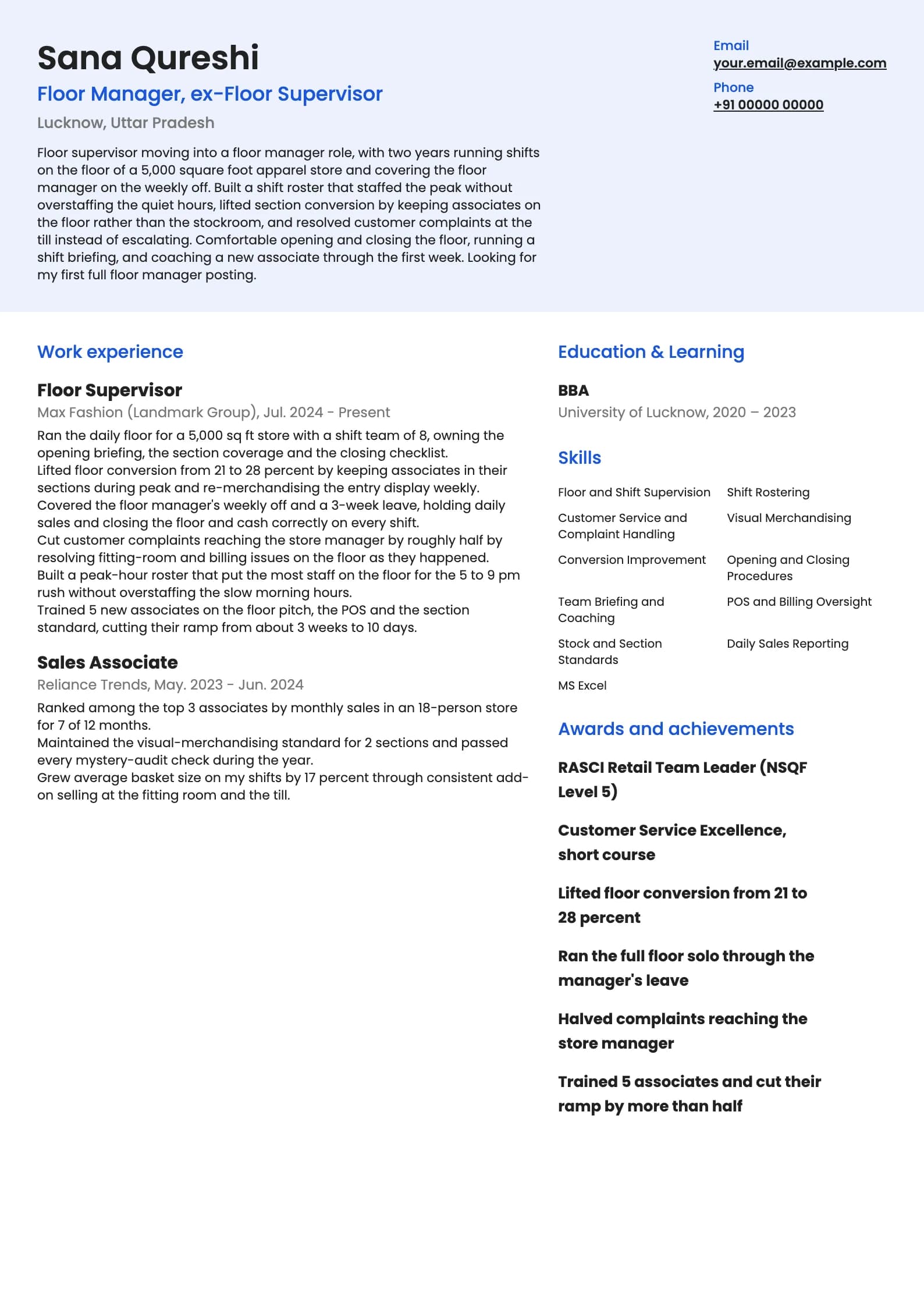
Build my resumeFloor Manager resume example, Floor Supervisor stepping up (2 years)
modern templateIs your resume good enough?
Upload the resume you have now and see what an applicant tracking system reads before a floor manager recruiter ever does.
Free to run. Sign in with your mobile number to see your score.
Floor Manager resume example, Restaurant Floor Manager (5 years)
minimalist template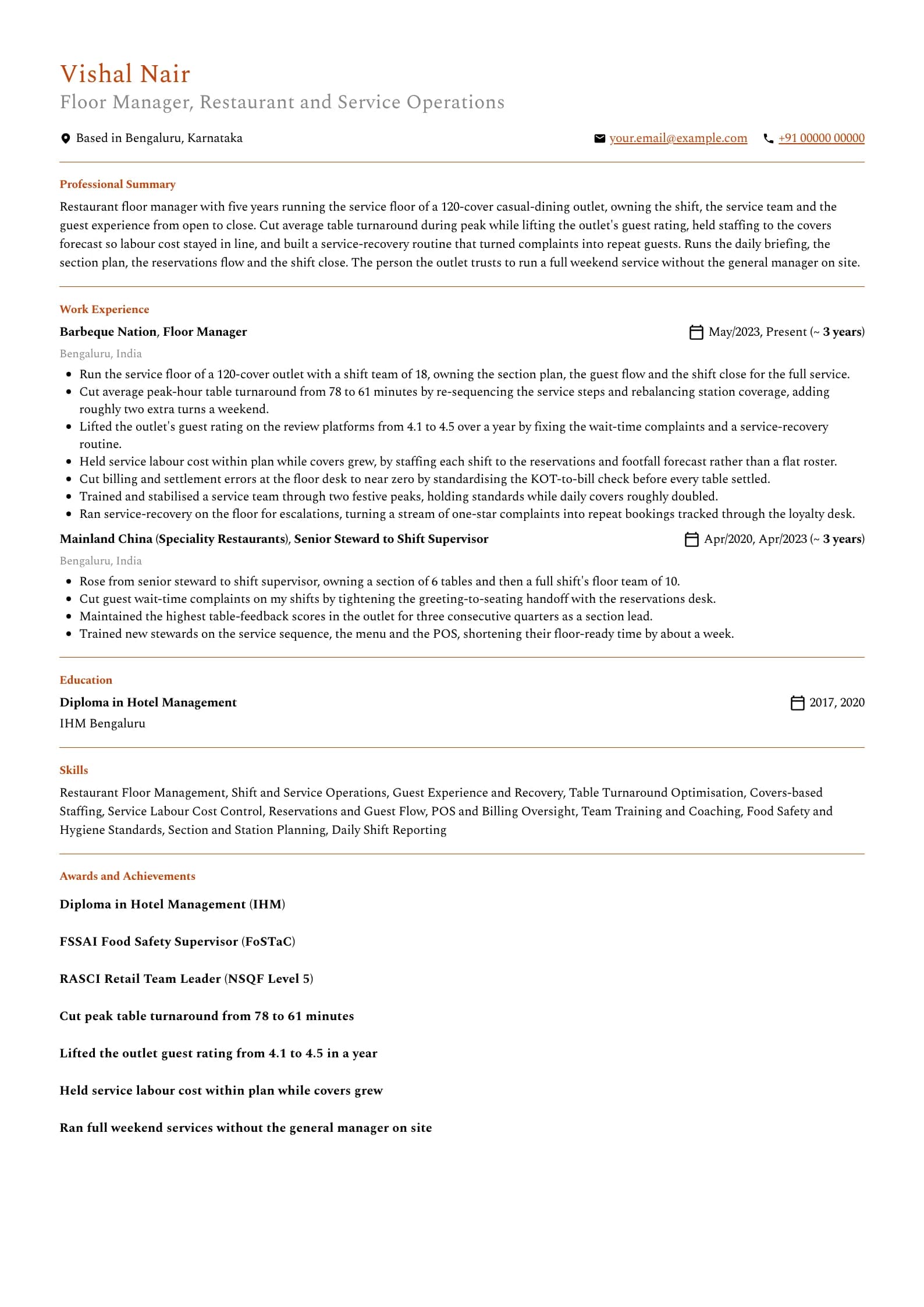
Want this structure with your own details? Build it in the resume builder.
Floor Manager resume example, Senior Floor Operations Manager (10 years)
header-band template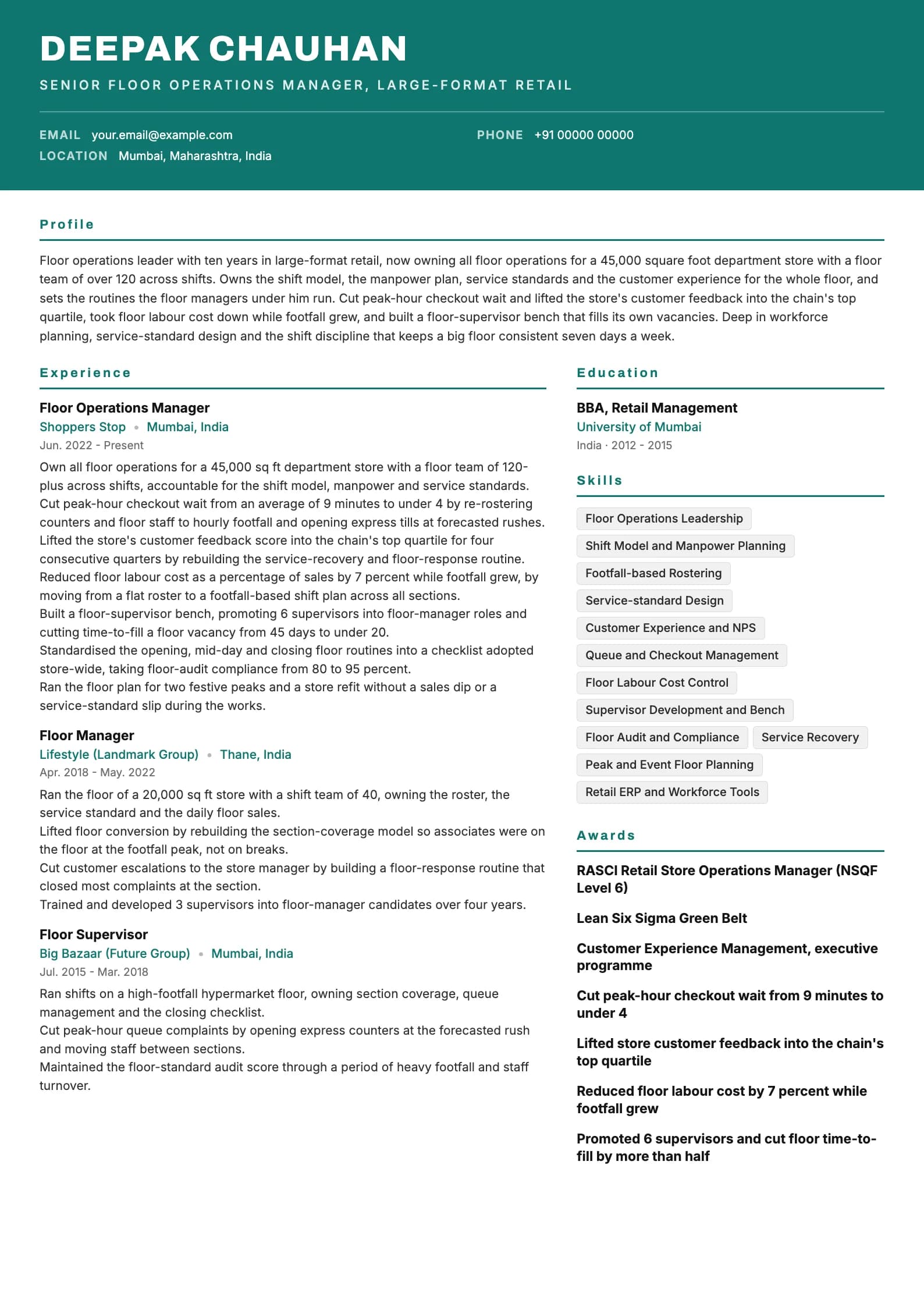
The format that works for a floor manager resume in India
Reverse chronological is the layout to use. Most recent floor or outlet first, work backwards, dates in plain view. A store or general manager screening floor managers is checking that your responsibility grew from associate to supervisor to manager and that the shifts you ran got bigger. A functional layout that groups everything under Skills and hides the dates reads as an attempt to cover a gap, and reviewers treat it that way. Length follows scope. A floor supervisor stepping up and most floor managers up to about seven years fit one page. A senior floor operations manager with a large team, a promotion track and a bench can justify a second page, but only if it carries real shift and service work rather than a longer duty list. A page two built from a hobbies line and a declaration is a padded one-pager. Leave off the photograph, date of birth, marital status and father's name. They come from an older campus template and add nothing to a floor-operations screen, where the interviewer wants your conversion, your turnaround, your labour cost and your service scores. Every line they take is a line a real number could have used. Name the file with your own name and the words floor manager, and send a PDF unless asked otherwise. Use a single column all the way down, since a two-column sidebar can scramble in a parser. The table below sets the section order.
| Section | Where it goes | Why |
|---|---|---|
| Name and headline | Top, above everything | Headline names the role and setting: Floor Manager, Retail or Restaurant. |
| Professional summary | Directly under the header | Three or four lines. Floor or outlet size, team, years, strongest result. |
| Work experience | Next | Most recent floor first. Newest role gets the most bullets. |
| Key achievements | Optional, under the summary | Three or four numbers a busy reviewer should see even on a skim. |
| Skills | Below experience | Shift, roster, service, conversion or turnaround. Grouped, not a wall. |
| Education | Bottom, unless you are early-career | Degree or hotel-management diploma, institution, years. |
| Certifications | After education | RASCI level, food-safety for restaurants, service courses. |
A floor manager is judged on the shift, not the job title
The single most common floor manager resume failure is describing the responsibility instead of the shift's result. The resume says supervised the floor staff, ensured customer satisfaction and maintained store standards, which every floor manager everywhere would write, and which tells a reviewer nothing about whether your shifts actually ran well. A floor manager owns what happens during a shift, and shifts have outcomes you can measure. In retail the levers are conversion, queue and checkout wait, section coverage and complaints closed on the floor. In a restaurant they are table turnaround, guest wait-time, covers served and the guest rating. In both, staffing to the peak and holding labour cost while the floor got busier is the number that separates a manager from a supervisor who was simply promoted. Name the specific lever and the result together. "Cut average peak-hour table turnaround from 78 to 61 minutes by re-sequencing the service steps" shows exactly what you changed and what it bought. "Ensured smooth service during peak hours" shows nothing, because there is no before, no after and no action. Do not confuse presence with impact. "Was present on the floor during all peak shifts" is attendance, not achievement. What changed on the floor because you were running it, the faster turnaround, the higher conversion, the closed complaint, is the impact, and only the impact belongs on the page.
For every "ensured" or "supervised" line on your resume, ask what actually changed on the shift and by how much. If nothing measurable changed, it is a duty, not an achievement, and a duty persuades no one.
Writing a summary a hiring manager actually reads
The block under your name is the part you can be sure gets read, so it should carry the scale of the floor you run, how long you have run it, and your single strongest shift result. Floor or outlet size, team size, years, and the one number, conversion, turnaround, wait-time or service score, that proves the floor worked. Three or four lines, no adjectives a reviewer cannot check. The old objective line, seeking a challenging floor manager position in a reputed organisation to utilise my skills, tells the reader nothing. Replace it with a summary. An objective says what you want; a summary says what you have already run well, and only one of those earns an interview. A supervisor stepping up often struggles to summarise, thinking they have not managed a floor. Look at the fresher sample: it names the store size, the shift team, the conversion lift and the cover-for-the-manager stint. That is a genuine summary built from a supervisor role plus solo floor cover, and the cover is the bridge that makes it credible for a manager posting. A quick test: read your summary and ask whether another supervisor in the same store or outlet could paste it onto their resume unchanged. If they could, it describes the shift pattern, not you. Add your floor, your team size and your specific number until it stops being transferable.
Professional summary, restaurant floor manager
Weak
Dedicated and dynamic floor manager with 5+ years of experience in managing restaurant floor operations, staff and customer service, seeking a challenging role in a reputed hospitality organisation.
Strong
Restaurant floor manager with five years running the service floor of a 120-cover outlet with a shift team of 18. Cut peak table turnaround from 78 to 61 minutes and lifted the outlet guest rating from 4.1 to 4.5.
The rewrite trades a keyword list and a wish for the size of the floor, the team and two verifiable shift results, one of which the hiring outlet can check on a review site.
Experience bullets: verb, lever, shift result
Every strong bullet in the samples follows the same shape. It opens with an action verb, names the specific floor lever you pulled, and closes with the shift result that moved. The verb says you did it. The lever tells a reviewer you know how a floor works. The number does the persuading. Start with the result and work backwards. Floor managers tend to write the duty first, then cannot attach a number, which produces "managed the floor staff and ensured smooth operations during shifts". Instead ask what was different on the shift because you ran it: conversion, turnaround, wait-time, complaints closed, labour cost, covers served. Then write the sentence that ends in that fact and names the action behind it. Vary the metric. Five service-score lines in a row read as one trick. Across a real role you can honestly reach for conversion, table turnaround, queue or checkout wait, guest rating, labour cost, covers or footfall served, complaints resolved and staff trained. The restaurant sample moves across most of these, which reads as a manager who runs a whole shift, not one metric. Where you lack a clean number, give scope: floor square footage, shift team size, covers or footfall a day, how long you covered the manager. "Ran the service floor of a 120-cover outlet with a shift team of 18" carries weight without a single percentage. Allocate bullets by recency. Current role gets six or seven, the previous four or five, anything older two or three.
| Level | What bullets must prove | Typical metric |
|---|---|---|
| Supervisor | You can run a shift and cover the manager | Conversion, complaints closed, associates trained, cover stints |
| Retail floor manager | You own the floor's conversion and service | Conversion, checkout wait, labour to plan, feedback score |
| Restaurant floor manager | You own turnaround, covers and the guest rating | Table turnaround, guest rating, covers served, labour cost |
| Floor operations lead | You set the shift model and grow supervisors | Wait-time, labour percentage, audit score, bench and time-to-fill |
Experience bullet, retail floor manager
Weak
Managed the floor staff and ensured smooth operations and customer satisfaction during all shifts.
Strong
Lifted floor conversion from 21 to 28 percent by keeping associates in their sections during peak and re-merchandising the entry display weekly.
"Ensured smooth operations" is a duty every floor manager claims; the rewrite names the result, the before-and-after and the two actions that produced it.
Experience bullet, staffing to demand
Weak
Prepared the staff roster and managed manpower for the floor as per requirement.
Strong
Reduced floor labour cost as a percentage of sales by 7 percent while footfall grew, by moving from a flat roster to a footfall-based shift plan.
Swaps a task anyone does for a cost result and the specific rostering change behind it, which shows you treat the shift as a cost line, not just a schedule.
If a bullet would read identically on any floor manager's resume, it is describing the shift pattern, not you. Rewrite it until it only fits the floor you actually ran.
The skills section: grouped, honest and about running a shift
A floor manager's skills section has two readers with opposite tastes. A parser wants literal terms it can match, shift management, rostering, service recovery, conversion. A human wants a short, organised list that says what kind of floor manager you are and in what setting. Grouping satisfies both. Group by function rather than one long line. Shift and operations, so shift supervision, rostering and opening and closing; service and customer, so complaint handling, service recovery and guest experience; performance, so conversion or turnaround, labour cost and audit; and people, so briefing, training and coaching. The exact headings matter less than the fact that structure exists. Write the terms the way the trade writes them, and spell out a setting-specific one such as table turnaround or checkout wait so a reviewer knows which floor you have run. Twelve to sixteen skills is the working range. Below ten the section looks thin for a management role. Above twenty it stops being a signal. Do not pad it with generic office skills for a role that is about a live floor and a shift team. Every item is a question you have agreed to answer. Skip the star ratings. Nobody agrees what four stars in service recovery means, and it invites an argument you cannot win. Let the experience carry the depth.
| Group | What goes in it | How many |
|---|---|---|
| Shift and operations | Shift supervision, rostering, opening and closing, section planning | 3 to 5 |
| Service and customer | Complaint handling, service recovery, guest or customer experience | 3 to 4 |
| Performance | Conversion or table turnaround, labour cost, floor audit, reporting | 3 to 4 |
| People | Shift briefing, training, coaching, supervisor development | 2 to 4 |
Skills section
Weak
Skills: Leadership, Dynamic, Hardworking, Team management, Communication, Customer service, Floor management, MS Office, Multitasking, Time management, Fast learner
Strong
Shift: shift supervision, footfall-based rostering, opening and closing. Service: complaint handling, service recovery, guest experience. Performance: conversion, checkout-wait control, floor audit. People: shift briefing, supervisor coaching.
Cuts the personality adjectives a parser cannot use and a reviewer discounts, keeps the literal shift and service terms a chain searches for, and groups them so the reader sees the shape of the role in one pass.
Retail floor versus restaurant floor: tailor to the setting
Floor manager is one title across two quite different worlds, and a resume that ignores which one it is aimed at reads as generic. A retail floor manager runs conversion, section coverage, checkout wait and visual standards. A restaurant floor manager runs table turnaround, covers, guest wait-time, the reservations flow and food-safety standards. The core skill, running a shift and a floor team well, transfers, but the numbers and the vocabulary do not. Lead with the setting's own metrics. For a restaurant role, table turnaround, covers served, the guest rating on the review platforms and service labour cost are the numbers a hiring outlet reads first, as the restaurant sample shows. For a retail role, conversion, checkout wait, average transaction value and the mystery-audit score are the equivalents. Putting the right metrics up front tells a reviewer you have actually run their kind of floor. If you are moving between the two, name the transferable core explicitly. Shift management, staffing to a demand forecast, service recovery and complaint handling, and developing a floor team are genuinely portable, so a retail floor manager applying to hospitality should foreground those and translate the metrics rather than pretend the settings are identical. For a restaurant role, a food-safety credential matters. An FSSAI food-safety supervisor certification through the FoSTaC programme is close to expected for anyone running a restaurant floor, so name it. For a retail role it is irrelevant, so leave it off and give the space to a retail credential instead.
Decide before you write whether this resume is aimed at a retail floor or a restaurant floor, and lead with that setting's metrics. Table turnaround for a restaurant, conversion and checkout wait for retail. A generic floor resume reads as if you have run neither.
Getting a floor manager resume through the applicant tracking system
Larger retail chains and restaurant groups run resumes through an applicant tracking system before a human sees them. It is a parser and a search index, not a judge: it reads your file, splits it into name, dates, employers, titles and skills, and stores the result so a recruiter can search across candidates. Almost every problem is a parsing problem, and parsing problems come from layout, not wording. The layout rules are short. One column. Standard headings, so use Work Experience rather than My Journey, and Skills rather than My Strengths. No text inside images, because a strip of brand logos reads as empty space. Keep nothing important in the header or footer, which some parsers drop. Avoid text boxes and nested tables in the body. On wording, mirror the job posting where it is honest. If it says floor operations, write floor operations; if it says shift management, write shift management. Include a setting term the posting uses, such as covers, turnaround or conversion, and spell out an acronym alongside itself once, for example "KOT (kitchen order ticket)", so both searches find you. Keyword stuffing does not work. A hidden block of every retail and restaurant term is easy to catch and the outcome is worse than being filtered. Write real bullets that carry the right terms, because a bullet about cutting table turnaround already contains turnaround in a context that survives a human read too. Save as a PDF that holds real text, then open it and confirm you can select and copy a sentence. If you cannot select the text, neither can the parser.
Section heading
Weak
My Floor Adventures
Strong
Work Experience
A parser looks for standard headings; a creative one can push the whole block into an unclassified bucket a recruiter never searches.
Test your own file before sending it. Copy the text out of the PDF into a plain notepad. Whatever reads cleanly there is roughly what the parser sees, and anything scrambled is a real risk.
What gets floor manager resumes rejected
Most rejections at the resume stage for a floor manager are not close calls. They come from a short list of recurring problems, and all of them are fixable in an afternoon. The list below covers what store and general managers see most often on floor manager resumes, in rough order of how much damage each does.
- Duty lines with no shift result. "Supervised staff and ensured customer satisfaction" tells a reviewer nothing about whether your shifts worked.
- No floor number anywhere, so the reviewer cannot tell whether you ran a quiet section or a full peak service.
- A resume that ignores the setting, using generic floor language when the role is clearly retail or clearly restaurant with its own metrics.
- A wall of leadership adjectives as skills, dynamic, dedicated, hardworking, none of which a parser can use or an interviewer can verify.
- A photo, date of birth, marital status or father's name taking space a conversion or turnaround number should have.
- No staffing-to-demand or labour-cost number, when staffing the floor to the rush is a core part of the job.
- A generic objective line instead of a summary that states floor size, team, years and a shift result.
- For a restaurant role, no food-safety credential, which a hiring outlet close to expects for anyone running the floor.
- Inflated titles or team sizes that will not survive a reference check, since chains and outlets do call the last employer.
- Confusing presence with impact, listing that you were on the floor during peak rather than what changed because you were running it.
Read your resume once as if you were the manager who would hand you a Saturday-night shift. Any line that does not tell them how that shift would go better is a line to rewrite before it reaches them.
Skills to put on a floor manager resume
Technical
- Floor and Shift Management
- Footfall or Covers-based Rostering
- Opening and Closing Procedures
- Conversion or Table Turnaround
- Queue and Checkout Management
- Service Recovery and Complaint Handling
- Floor Labour Cost Control
- Section and Station Planning
- Visual Merchandising Standards
- Floor Audit and Compliance
- POS and Billing Oversight
- Daily Shift Reporting
Tools and platforms
- Retail or Restaurant POS
- Workforce and Roster Software
- MS Excel
- Reservations and Table-management Systems
- Customer Feedback and Review Platforms
- Retail ERP
Working skills
- Shift Briefing and Team Leadership
- Coaching and Supervisor Development
- Customer and Guest Experience Focus
- Composure Under Peak Pressure
- Conflict and Escalation Handling
- Cross-team Coordination
- Decision-making on the Floor
- Reliability and Ownership
Certifications worth listing as a floor manager
| Certification | Full name | Worth it for |
|---|---|---|
| RASCI Retail Team Leader | Retailers Association's Skill Council of India, Retail Team Leader (NSQF Level 5) | A recognised skill-standard credential for a retail floor supervisor or floor manager, worth it for someone without a management degree who wants a named qualification a chain trusts. It certifies floor-supervision, roster and team competencies, so pair it with a real conversion or service result on the resume. |
| RASCI Store Operations | Retailers Association's Skill Council of India, Retail Store Operations Manager (NSQF Level 6) | The next step up, worth it for a senior floor or floor operations manager moving towards full store responsibility. It certifies broader store-operations competence in a language large retailers use, and reads best next to a real floor-labour-cost or audit-compliance number. |
| FSSAI Food Safety Supervisor | FSSAI Food Safety Supervisor certification via FoSTaC | Close to expected for a restaurant or hospitality floor manager, since food-safety compliance sits with whoever runs the floor. Worth it for anyone managing a restaurant, cafe or QSR floor, and pointless for a pure retail floor role, so include it only when the setting is food service. |
| Diploma in Hotel Management | Diploma or degree in Hotel Management (IHM or equivalent) | The standard foundation for a restaurant floor manager, worth naming for anyone on the hospitality track. It signals formal service training a hotel or restaurant group values, and matters most early to mid-career; once you have run full services and lifted a guest rating, the results carry more weight than the diploma. |
Keywords an ATS scans for in a floor manager resume
These are the literal terms a parser matches against the job description. Use the ones that are true of you, in the sentences where you did the work, not as a list at the bottom.
- floor manager
- floor operations
- shift management
- staff rostering
- customer service
- service recovery
- conversion
- table turnaround
- queue management
- checkout wait
- labour cost control
- visual merchandising
- team training
- floor audit
- guest experience
- peak hour staffing
Floor Manager resume FAQ
What salary can a floor manager expect in India?
A floor supervisor stepping up typically starts around 2.4 to 4 LPA. A retail or restaurant floor manager with three to six years usually sits in the 4 to 8 LPA band, depending on the format and the city. A senior floor operations manager across a large store with eight years and above commonly earns 9 to 16 LPA. Large-format retail, premium hospitality and a strong labour-cost and service record push the top of every band upward.
How long should a floor manager resume be?
One page for a supervisor and most floor managers up to about seven years. A senior floor operations manager with a large team, a promotion track and a supervisor bench can justify two pages, but only if the second page carries real shift and service work rather than a longer duty list. Nobody has been rejected for a resume that was easy to read; if you are struggling to fit one page, cut the oldest role to a line and remove any duty that is not a result.
What is the difference between a retail floor manager and a restaurant floor manager resume?
The core skill, running a shift and a floor team well, is the same, but the metrics and vocabulary differ. A retail floor manager leads with conversion, checkout wait, section coverage and the mystery-audit score. A restaurant floor manager leads with table turnaround, covers served, guest wait-time and the guest rating on the review platforms. Decide which setting the role is in and lead with that setting's numbers; a food-safety credential belongs on a restaurant resume and not a retail one.
What numbers matter most on a floor manager resume?
The ones that measure the shift. For a retail floor, conversion, checkout wait and floor labour cost. For a restaurant floor, table turnaround, covers served, the guest rating and service labour cost. Across both, staffing the floor to the peak and holding labour cost while footfall or covers grew is the number that separates a manager from a supervisor. A resume of pure duty lines with no shift result reads as if the floors you ran never actually improved.
How do I move from a floor supervisor to a floor manager role?
Show that you have already carried the whole shift, not just your section. The strongest line a supervisor can put on a resume is covering the floor manager during their leave or off-days, because it proves you have run the full floor, the roster and the close. Beyond that, show a floor result, conversion lifted, complaints closed on the floor, a peak-hour roster built, rather than a list of supervisory duties. That combination is what makes the step-up credible to a hiring store manager.
Do I need a certification to be a floor manager?
It is not mandatory, but the right one helps. A RASCI retail team-leader credential is a recognised named qualification for a retail floor manager without a management degree. For a restaurant floor, an FSSAI food-safety supervisor certification through FoSTaC is close to expected, and a hotel-management diploma is the standard foundation. For anyone experienced, real floor and shift results outweigh any certificate, so keep the list short and let the numbers lead.
Does a floor manager resume go through an ATS?
In large retail chains and restaurant groups, yes. The system parses your file and lets a recruiter search across candidates, so use a single-column layout, standard headings like Work Experience and Skills, and the literal terms from the posting such as floor operations, shift management and service recovery. Test your file by copying the text out of the PDF into a notepad; if it reads in order there, it will most likely parse correctly for the recruiter.
How do I write a floor manager resume with limited experience?
Lead with a summary, then your supervisor or associate experience, then education and skills. Treat every shift you ran as evidence: the team you led, the conversion or service you lifted, the complaints you closed, the roster you built, and any stint covering the manager. A short customer-service or team-leader course and a first-division degree are verifiable facts that beat adjectives. What does not help is a paragraph about being dynamic and hardworking, since every floor manager resume says that and none of it can be checked.
Related resume examples and guides
Build your own floor manager resume in any of these formats
Start from a blank resume or upload the one you have. Goodspace renders it in 24 templates and flags the shift, service and floor-operations keywords a retail or restaurant recruiter's applicant tracking system looks for, and the duty-list filler it will not credit.
Build my resume