3 Store Manager Resume Examples, Format and Guide
A store manager resume in India is read for proof that you ran a profitable floor: sales target hit, shrinkage controlled, a team retained, customers who came back. Below are three complete resumes, one for an assistant or department manager stepping up, one for a mid-level store manager running a full outlet, and one for a senior cluster or area manager owning several stores. Each is a full document, followed by the format rules and the exact keywords that survive both a recruiter skim and an applicant tracking system.
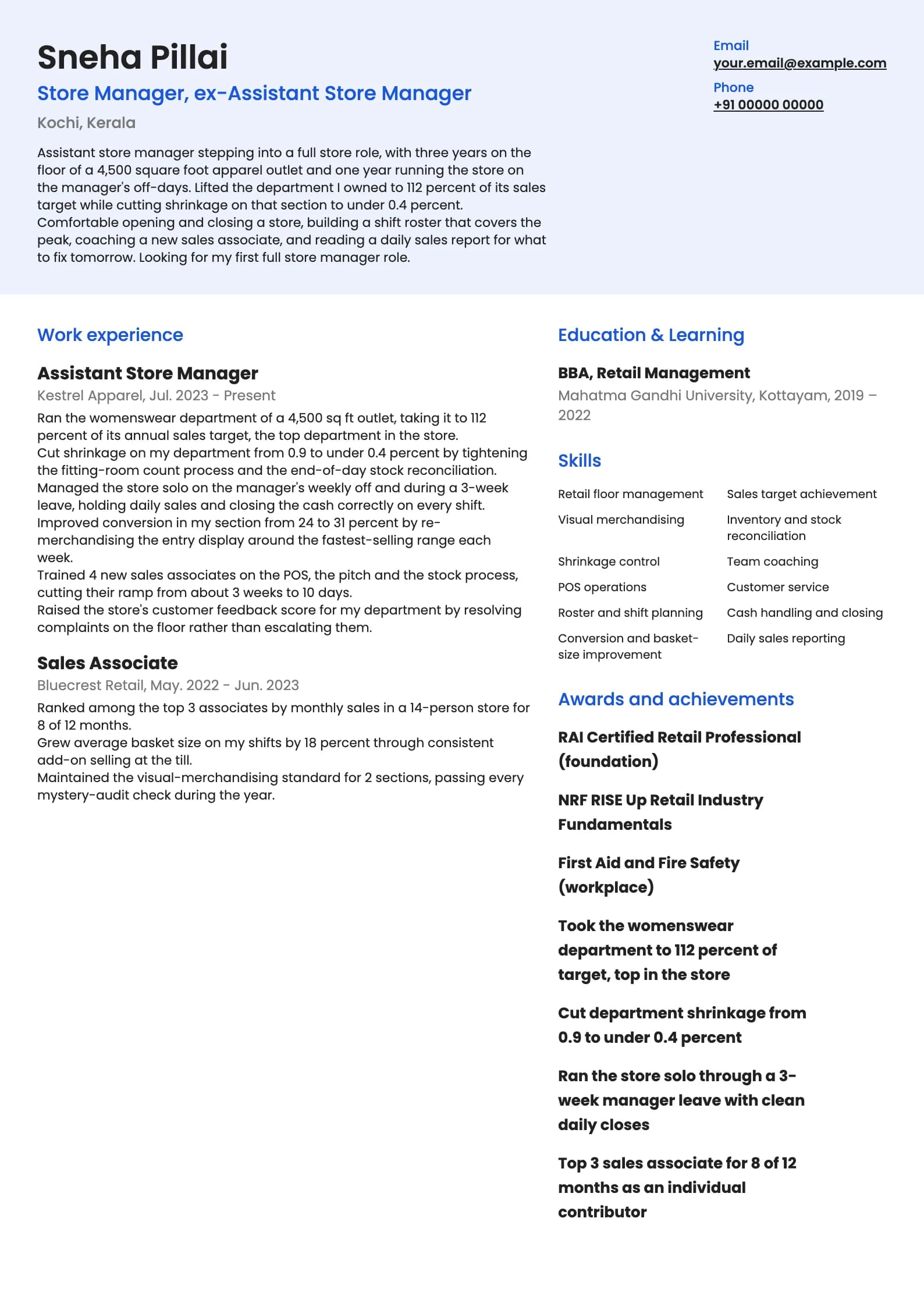
Build my resumeStore Manager resume example, New store manager (2 to 3 years)
modern templateIs your resume good enough?
Upload the resume you have now and see what an applicant tracking system reads before a store manager recruiter ever does.
Free to run. Sign in with your mobile number to see your score.
Store Manager resume example, Mid-level store manager (5 years)
professional template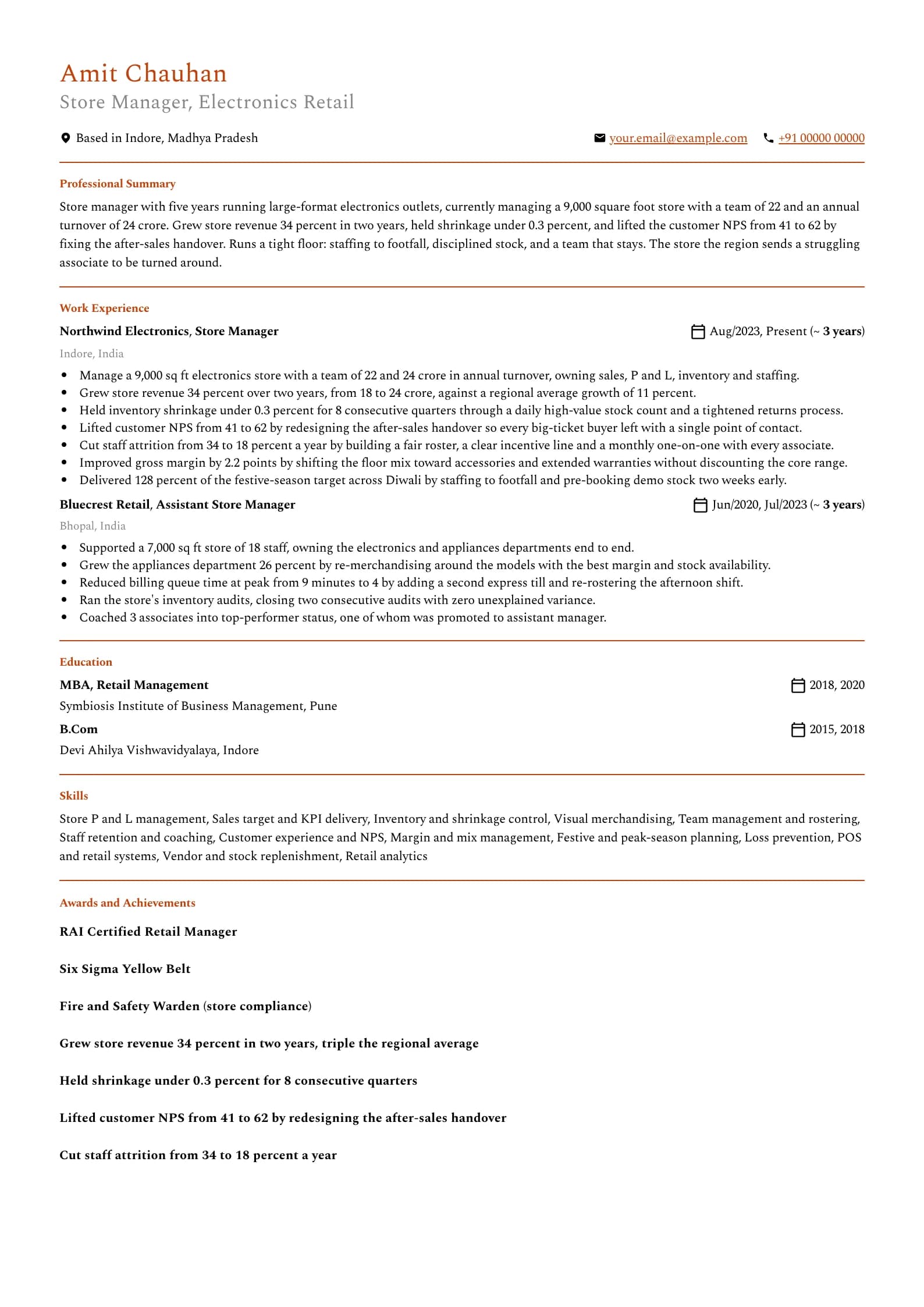
Want this structure with your own details? Build it in the resume builder.
Store Manager resume example, Senior cluster manager (12 years)
header-band template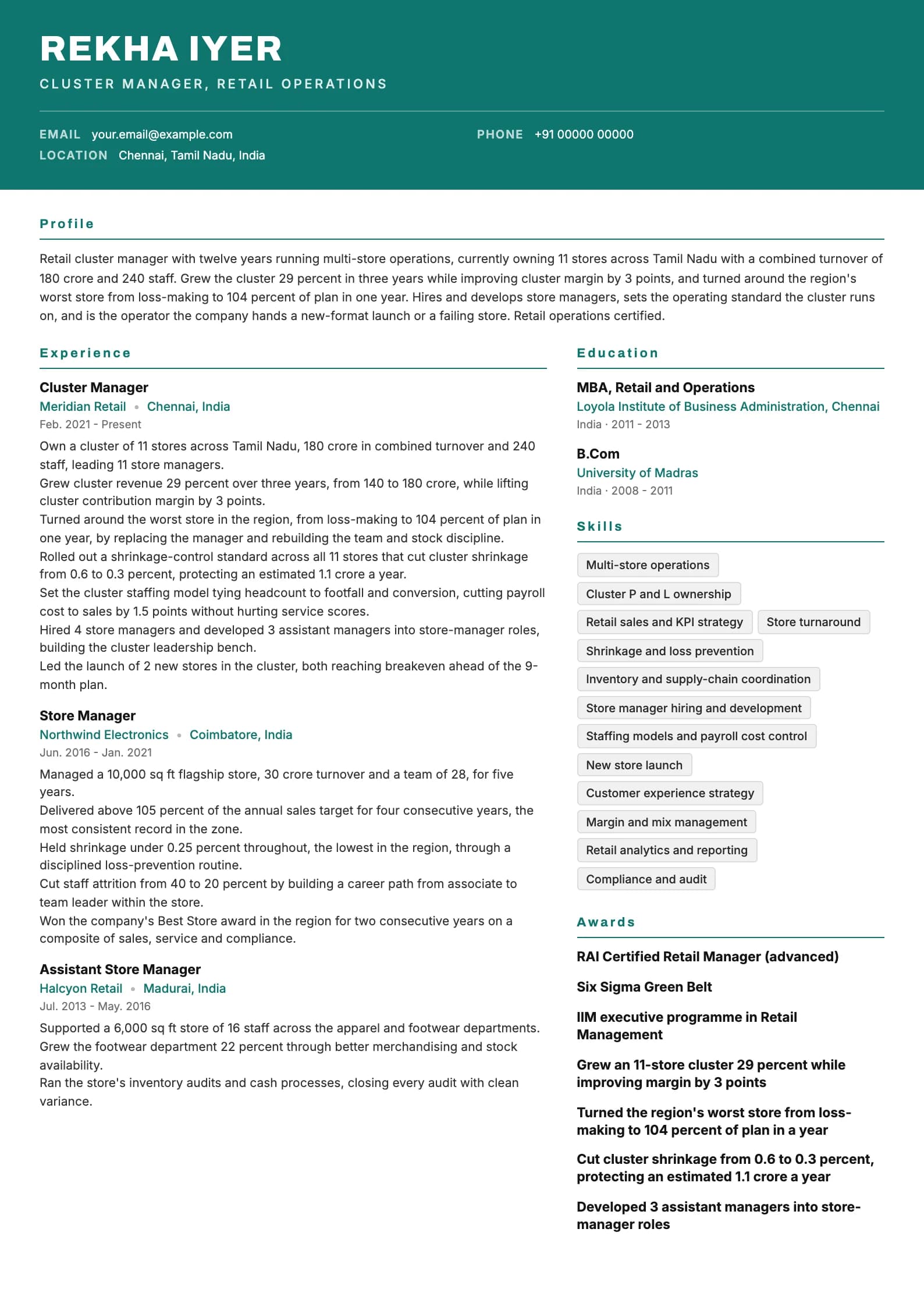
The format that works for store manager resumes in India
Reverse chronological is the layout to use for a store manager resume in India. A store manager is hired on a record of running a profitable floor over time, and a functional resume that groups achievements and drops the dates removes exactly what a hiring manager wants to verify, that you delivered store after store, season after season. Most recent role first, work backwards, dates in plain view. If you are an assistant or department manager stepping up, keep the format and let the summary and bullets carry the step, rather than claiming a full store-manager title you did not hold. Length is set by evidence. One page holds a new manager and most store managers up to about six or seven years. A senior cluster or area manager with a genuine multi-store record can run to a second page, provided it carries store P and L, turnaround and team outcomes rather than a longer list of duties. A retail resume padded with a soft-skills wall and a hobbies line reads as thin experience dressed up, which is a poor signal for a floor role. Four things belong nowhere on a retail resume here: a photograph, date of birth, marital status and father's name. They are residue from an older campus template and they take space a store metric should own. Send a PDF unless the posting asks for DOCX, and name the file with your own name and the target role. Use a single column throughout, because the numbers in your experience section are the whole argument and you cannot afford a parser to scramble them. The table below sets out the section order.
| Section | Where it goes | Why |
|---|---|---|
| Name and headline | Top, above everything | The headline states the retail role and format: store manager, cluster manager, apparel or electronics. Recruiters match on it. |
| Professional summary | Directly under the header | Three lines. Format and size, years, and the strongest number: sales grown or a store turned around. |
| Work experience | Next, for anyone with a role | Most recent first. Newest role gets the most bullets and the biggest store. |
| Key achievements | Optional block, or folded into experience | Best Store award, a turnaround, a festive result. Quantified wins read well up top. |
| Skills | Below experience | Grouped: retail operations, commercial, people, systems. Not a soft-skills wall. |
| Certifications | After skills | RAI, Six Sigma, safety. Name and issuing body. |
| Education | Bottom, unless you are early | Degree, institution, years. The retail MBA sits here once you have store numbers. |
Writing a store manager summary a hiring manager actually reads
The block under your name is the one part a retail hiring manager reliably reads, so it must carry the facts they screen for: the format and size of store you run, how long you have run it, and the single strongest number, sales grown, a store turned around, or a scorecard held. Three or four lines. No adjective a reference could puncture. The old objective line, a hardworking retail professional seeking a challenging store manager role in a reputed organisation, tells the reader nothing beyond the fact that you applied. Replace it with a summary. An objective describes what you want; a summary states the store you grew 34 percent or the shrinkage you held under 0.3 percent, and in retail those numbers are the whole case. An assistant stepping up often leads with duties rather than a result. The first sample leads with a department at 112 percent of target and running the store solo through a 3-week leave, which is exactly what a store-manager screen wants: proof you can own the number and proof you have already done the job. What it avoids is passionate about delivering great customer experiences, a phrase so common it now signals only that the writer had no store number to lead with. A practical test: read your summary and ask whether another store manager applying to the same company could paste it onto their resume unchanged. If they could, it describes the title rather than you. Add the specific store size, the specific number, the specific format until it stops being transferable. Rewrite the summary for each meaningfully different role. An apparel format and an electronics format want different lead numbers, and moving the right one to the front takes two minutes.
Professional summary, mid-level store manager
Weak
Hardworking and customer-focused retail professional with 5+ years of experience seeking a challenging store manager role in a reputed organisation to deliver great customer experiences.
Strong
Store manager with five years running large-format electronics outlets, currently a 9,000 sq ft store with 22 staff and 24 crore turnover. Grew revenue 34 percent in two years and held shrinkage under 0.3 percent.
The rewrite replaces adjectives with a format, a store size, a team size, a turnover and two numbers a hiring manager can verify.
Experience bullets: action, retail metric, and beat the region
Every strong bullet in the three samples has the same spine. It opens with what you did or owned, names the store or department, and closes with a retail metric, sales to target, shrinkage, conversion, NPS, attrition, margin. Retail is a heavily measured world, so a store-manager bullet without a number reads as a job description rather than a result. Start with the number and work backwards. Store managers often write the responsibility first, then leave off the outcome, producing lines like responsible for managing store operations and ensuring smooth functioning. Instead, ask what the number actually did: sales grew from X to Y, shrinkage fell, conversion rose, NPS improved, attrition dropped, margin lifted, the festive target was beaten. Then write the sentence that ends in that fact. Wherever you can, show that you beat the region or the plan, not just that the number went up. Grew the store 34 percent against a regional average of 11 percent removes the doubt that a good location or a rising market did the work. This one habit separates a retail resume that sounds strong from one that is credible. Use the full retail scorecard, not only sales. A resume that only ever grows revenue hides the operator in you. A store manager can honestly reach for sales to target, shrinkage, conversion, average basket, NPS, staff attrition, gross margin, payroll to sales and audit variance. The mid-level sample moves across revenue, shrinkage, NPS, attrition and margin, which reads as someone who runs the whole store, not just the till. Allocate bullets by recency. Current role gets five to seven, the previous role four or five, anything older two or three lines.
| Level | What bullets must prove | Typical metric |
|---|---|---|
| New / assistant | You can own a section and stand in for the manager | Department to target, shrinkage on your section, conversion, ran the store solo |
| Store manager / 4 to 6 years | You run a full store's scorecard | Store revenue growth, shrinkage, NPS, attrition, margin, festive result |
| Senior / cluster | You run several stores and fix failing ones | Cluster revenue, margin, turnaround, cluster shrinkage, payroll to sales |
| Operations leadership | You set the standard and build the manager bench | Standards rolled out, new-store launches, store managers hired and developed |
Experience bullet, store manager
Weak
Responsible for managing overall store operations and ensuring smooth day-to-day functioning and customer satisfaction.
Strong
Grew store revenue 34 percent over two years, from 18 to 24 crore, against a regional average growth of 11 percent, while holding shrinkage under 0.3 percent.
Responsible for operations describes a duty; the rewrite names the revenue growth, beats it against the region, and adds the shrinkage the store held.
Experience bullet, people result
Weak
Handled staff management and worked on improving team performance and reducing employee turnover in the store.
Strong
Cut staff attrition from 34 to 18 percent a year by building a fair roster, a clear incentive line and a monthly one-on-one with every associate.
Names the attrition before and after and the specific actions, which is how a retail hiring manager judges real people management.
Every store bullet should end in a retail metric, and the best ones show you beat the region or the plan, not just that the number rose.
The skills section: operations, commercial, people and systems
A store manager's skills section has two readers with opposite tastes. The parser wants literal terms, inventory management, visual merchandising, shrinkage control, P and L, that it can match to the posting. A hiring manager wants a short, organised list that signals what kind of operator you are. Grouping serves both: the terms are present for the machine, the structure is legible for the human. Group by function. Retail operations covers inventory, merchandising, loss prevention and store systems. Commercial covers sales target delivery, margin, mix and P and L. People covers team management, rostering, coaching and retention. Systems covers the POS and analytics tools you use. The exact headings matter less than the fact that structure exists, so a reviewer sees at a glance whether you are a sales-led floor manager, an operations-led one or a people-led one. Twelve to sixteen skills is the working range. Below eight it looks thin behind real store numbers. Above about twenty it stops signalling. Avoid filling the section with soft skills, because hardworking, customer-focused and team player describe every applicant and distinguish none; put the emphasis on the concrete retail levers you actually pull. Include the metrics you own as skills, because a store manager is defined by the scorecard they run. Shrinkage control, conversion improvement, NPS and attrition management are all legitimate skill lines that signal you manage by the numbers, not by feel. Write names the way the industry writes them, POS not p.o.s, and skip proficiency bars, which invite an argument nobody can win.
| Group | What goes in it | How many |
|---|---|---|
| Retail operations | Inventory, merchandising, shrinkage and loss prevention, store systems | 4 to 6 |
| Commercial | Sales target delivery, P and L, margin and mix, festive planning | 3 to 5 |
| People | Team management, rostering, coaching, retention | 2 to 4 |
| Systems | POS, retail ERP, inventory software, retail analytics | 2 to 4 |
Skills section
Weak
Skills: Leadership, Customer Service, Hardworking, Team Player, Communication, MS Office, Sales, Management, Multitasking, Inventory, Cash Handling, Time Management, Discipline
Strong
Operations: inventory management, visual merchandising, shrinkage control, loss prevention. Commercial: sales target delivery, P and L, margin and mix. People: rostering, coaching, retention. Systems: POS, retail ERP.
Cuts the personality traits and vague single words, keeps the concrete retail levers, and groups them so a hiring manager reads it in one pass.
Key achievements: awards, turnarounds and peak results
A store manager benefits from a short key-achievements block, because a named award, a turnaround and a festive result are strong, checkable signals of an operator who delivers. This can be a small section of its own or folded into experience, but either way, quantify each achievement and, where you can, make it verifiable. The common failure is claiming achievements with no number. Consistently achieved store targets and received appreciation from management tells a reviewer nothing, because it is unfalsifiable and every applicant writes it. Name the achievement precisely: Best Store award in the region two years running, worst store turned to 104 percent of plan, 128 percent of the festive target, shrinkage the lowest in the region. A precise, checkable win is worth ten vague ones. Pick achievements that show range, not three versions of the same quarter. One sales or award achievement, one operational win such as a shrinkage or audit result, and one people result such as a retention improvement or an associate you promoted together prove you run the whole store, not one metric. Turnarounds and people results in particular are undersold by managers who think only the sales line counts. Where an achievement is an award, name it as the company names it, Best Store, Store of the Year, a composite performance award, and give the year, because a named, dated award is checkable in a reference call and a vague one is not. For a new manager, the department result and the stand-in period belong here as much as anything, because a first store-manager role is won on evidence that you have already run a floor, not only assisted on one.
Key achievement entry
Weak
Consistently achieved store sales targets and received appreciation and recognition from senior management for good performance.
Strong
Won the company's Best Store award in the region for two consecutive years on a composite of sales, service and compliance, while holding shrinkage the lowest in the region.
Swaps an unfalsifiable claim for a named, dated award, the basis it was judged on, and the operational number behind it.
Where education, the MBA and certifications belong
Education goes at the bottom for any working store manager, and near the top only for someone very early. Degree, institution, years. A retail or general MBA sits in this block and helps for the jump into cluster and area management, but it belongs below your store numbers once you have them, because in retail the scorecard outranks the pedigree. CGPA or percentage is worth keeping only while you are very early and it is genuinely good. Once you have a store record, drop the undergraduate number. Nobody evaluating a store manager against a shrinkage figure is weighing a college percentage. Certifications in retail are useful but secondary to the numbers. A Retailers Association of India (RAI) certification is a recognised, checkable retail credential in India and belongs on the page when it is real. A Six Sigma belt signals process discipline, which reads well for loss-prevention and operations-heavy roles. Safety and compliance certifications, fire warden, first aid, are worth naming because a store manager is legally responsible for the floor, and they show you take that seriously. A caution specific to this role: no certification substitutes for a store record. A store manager with a strong sales, shrinkage and retention record and no certifications outranks one with a page of certificates and thin store numbers. Use certifications to show operational and safety fluency, not to fill a gap where results should be. If a certification requires renewal and has lapsed, keep it current or remove it. A lapsed safety certification listed as current is exactly the kind of claim a careful retailer will check, given the compliance stakes on a store floor.
Getting a store manager resume through the applicant tracking system
An applicant tracking system is a parser and a search index, not a judge. It reads your file, breaks it into name, dates, employers, titles and skills, and stores the result so a recruiter can search across candidates. Almost every ATS problem is a parsing problem, and parsing problems come from layout, not from wording. The layout rules are short. One column. Standard section headings, Work Experience rather than My Retail Journey, Skills rather than What I Offer. No text inside images, since a badge or an award graphic reads as empty space. No critical information in the header or footer region, which some parsers drop. Avoid text boxes and nested tables in the body. A simple skills grid usually survives, but do not gamble your experience section on it. On wording, mirror the posting where it is honest. If it says shrinkage control, write shrinkage control, not reducing losses. If it says P and L, use those exact letters. Retail titles vary, store manager, outlet manager, retail manager, branch manager, cluster manager, so include the exact title from the posting somewhere honest on the page if it matches your work, because recruiters search on titles. What does not work is keyword stuffing. A hidden block of terms or a paragraph listing every duty is found quickly and read as a red flag. Write real bullets that naturally contain the right terms, because a bullet about controlling shrinkage contains shrinkage in a context that survives human review too. Save as PDF from a tool that embeds real text, then open the file and confirm you can select and copy a sentence. If you cannot select the text, neither can the parser.
Section heading
Weak
My Retail Journey
Strong
Work Experience
Parsers look for standard headings; a creative one can push the whole block into an unclassified bucket the recruiter never searches.
Test your own file before you send it. Copy the text out of the PDF into a plain text editor. Whatever reads there is roughly what the parser sees, and any scrambled numbers are a real risk.
What gets store manager resumes rejected
Most store-manager rejections at the resume stage are not close calls. They come from a small set of recurring problems, all fixable in an afternoon. The list below covers what reviewers of Indian retail store manager resumes see most often, in rough order of how much damage each one does.
- No numbers. Sales to target, shrinkage, conversion, NPS, attrition. A store resume without figures reads as a duty list, not a track record.
- Growth with no context, so a reviewer cannot tell whether you grew the store or the location did. Beat the region or the plan where you can.
- Only sales, no operations or people metrics, which hides half of what a store manager actually owns.
- Claiming full store-manager scope you did not hold, or a store size larger than you ran. Retail reference checks catch this.
- A skills wall of soft skills, hardworking, customer-focused, team player, that describe every applicant and distinguish none.
- Duties instead of results. Responsible for managing store operations is the tell.
- Awards with no name or date, received appreciation from management, which is unfalsifiable and reads as filler.
- The same resume sent to an apparel format and an electronics format, when the mix, the ticket size and the metrics differ.
- A photo, date of birth, marital status or father's name, none of which belong on a retail resume and all of which take space a store number needs.
- Dates or titles that do not match your offer letters. Background verification is standard in organised retail and a mismatch is fatal.
For every achievement, ask whether a former area manager could confirm the exact number. If they would hesitate, the claim is too vague or too inflated.
Skills to put on a store manager resume
Technical
- Store operations management
- Inventory management
- Shrinkage and loss prevention
- Visual merchandising
- Sales target and KPI delivery
- Store P and L management
- Margin and mix management
- Stock replenishment and vendor coordination
- Festive and peak-season planning
- Retail compliance and audit
- Conversion and basket-size improvement
- Customer experience and NPS
Tools and platforms
- POS systems
- Retail ERP
- Inventory management software
- SAP Retail
- MS Excel
- Power BI
- Workforce and rostering software
- CRM and loyalty systems
Working skills
- Team leadership and coaching
- Rostering and shift planning
- Staff retention
- Customer service and complaint resolution
- Conflict resolution
- Cross-functional coordination
- Decision making under pressure
- Training and onboarding
Certifications worth listing as a store manager
| Certification | Full name | Worth it for |
|---|---|---|
| RAI Certified Retail | Retailers Association of India (RAI) retail certification | The most recognised India-specific retail credential, offered at foundation through manager levels. A checkable signal of formal retail grounding, worth it for those stepping into or up within store management, and understood by organised-retail recruiters. |
| NRF RISE Up | National Retail Federation RISE Up Retail Fundamentals | An entry retail credential useful for new and assistant managers wanting to show fundamentals of selling, service and operations. Carries less weight than a store record once you have one, so treat it as an early signal. |
| Six Sigma (Yellow/Green Belt) | Six Sigma Yellow or Green Belt | Signals process discipline, which reads well for loss-prevention, inventory-accuracy and operations-heavy store roles. A Green Belt is a genuine differentiator for cluster and operations-leadership candidates; a Yellow Belt is a lighter entry signal. |
| Diploma in Retail Management | Diploma or PG Diploma in Retail Management | Offered by several Indian institutes and useful for candidates without a retail-focused degree who want formal grounding. Most valuable early in a retail career, and secondary to store performance later. |
| Fire and Safety Warden | Workplace Fire and Safety, First Aid certification | Worth naming because a store manager is legally responsible for floor safety and compliance. A small but real credential that shows you take the statutory side of running a store seriously, especially for large-format outlets. |
| SAP Retail | SAP for Retail (module training) | Relevant for managers in large chains that run store operations on SAP, where systems fluency speeds up inventory, replenishment and reporting work. Of limited value at smaller retailers on simpler POS and ERP systems. |
Keywords an ATS scans for in a store manager resume
These are the literal terms a parser matches against the job description. Use the ones that are true of you, in the sentences where you did the work, not as a list at the bottom.
- store manager
- retail store manager
- retail operations
- store operations
- inventory management
- shrinkage control
- loss prevention
- visual merchandising
- sales target
- P and L
- customer experience
- team management
- staff retention
- KPI
- footfall and conversion
- POS
- stock management
- gross margin
- cluster manager
- retail sales
Store Manager resume FAQ
How long should a store manager resume be?
One page up to about six or seven years, and two pages for a senior cluster or area manager whose second page carries real store P and L, turnaround and team outcomes rather than a longer duty list. Retail hiring managers read for the scorecard you ran, so a tight, quantified single page usually beats a padded two-pager. If you cannot fit one page, cut the oldest role to a line, drop coursework, and remove any soft skill that describes every retail worker.
What metrics should a store manager put on a resume?
The full retail scorecard, not just sales. Sales to target and revenue growth, shrinkage, conversion, average basket size, customer NPS, staff attrition and gross margin are the lines a store manager owns, and moving several of them is far stronger than only growing revenue. Where you can, show you beat the region or the plan, for example growing a store 34 percent while the region grew 11 percent, because that proves your work moved the number rather than the location.
What salary can a store manager expect in India?
It varies by format, chain and city, but as a rough 2026 guide, a first-time store manager often sits around 4 to 8 LPA, a manager of a large-format outlet around 7 to 14 LPA, and a senior cluster or area manager owning several stores can reach 15 to 30 LPA and beyond. Electronics, luxury and large-format retail tend to pay more than small-format or grocery at the same level. Your resume's job is to show the store size, turnover and scorecard that justify the higher end.
How do I move from assistant store manager to store manager?
Prove you have already run a store, not just assisted on one. The first sample on this page does exactly this: a department taken to 112 percent of target and the store run solo through the manager's leave. Do not claim a full store-manager title you did not hold; instead show the section you owned, the times you stood in, and the retail metrics you moved on your patch. A first store-manager role is won on evidence that you can own the floor and its scorecard.
Do I need a degree or MBA to be a store manager in India?
Not necessarily. Retail is one of the more experience-driven functions, and many strong store managers rise from the floor without a specialised degree. A retail or general MBA helps for the jump into cluster and area management and is common on the resumes of managers at larger chains, but it sits below your store numbers once you have them. If you do not have one, lead with your sales, shrinkage and retention record, and it rarely holds you back at chains that hire on performance.
How do I show shrinkage and loss-prevention results on my resume?
State the shrinkage percentage as a before-and-after or against a benchmark, and name what you did to achieve it. Held shrinkage under 0.3 percent for eight quarters through a daily high-value count and a tightened returns process is far stronger than reduced losses. Where you can, translate it into money protected, for example an estimated amount saved a year across a cluster. Loss prevention is a first-class store-manager result, so give it the same numeric treatment as sales.
Should apparel and electronics store managers use the same resume?
Keep one base resume but tailor it, because the formats reward different things. Apparel is read on merchandising, basket size, conversion and range management; electronics on ticket size, attach rate for accessories and warranties, margin mix and after-sales. Adjust the summary, the segment in your headline and the lead numbers to the format you are applying into, and name the exact title the posting uses if it matches your work, so both the recruiter and the parser find you.
How do I show people-management results as a store manager?
Treat retention, coaching and promotions as first-class metrics, because in retail a stable team sells more and costs less. Cut attrition from 34 to 18 percent, coached three associates to top-performer status, promoted one to assistant manager are concrete people results that a hiring manager values as much as sales. Name the number, the action you took, and the outcome, rather than writing that you managed staff and improved team performance.
Do I need a photo on a store manager resume in India?
No. Indian retailers do not expect one on a store-manager resume, and it takes space a store metric should occupy. The same goes for date of birth, marital status, father's name and a declaration paragraph, which are residue from an older campus template. The only exception is a role that explicitly asks for a photograph in the posting, which is uncommon for store management positions.
Do retail certifications like RAI help you get hired?
They help, and never substitute for a store record. A Retailers Association of India certification is a recognised, checkable retail credential in India, and a Six Sigma belt signals process discipline that reads well for operations-heavy and loss-prevention roles. Safety and compliance certifications matter because a store manager is legally responsible for the floor. But a manager with a strong sales, shrinkage and retention record and no certifications outranks one with a page of certificates and thin store numbers, so use them to add to a record, not to replace it.
Related resume examples and guides
Build your own in any of these formats
Start from a blank resume or upload the one you have. The Goodspace builder renders it in 24 templates and flags what an applicant tracking system will miss.
Build my resume