Hotel Manager Resume Format, with 3 Full Samples
A hotel manager is hired on evidence that occupancy, revenue and guest scores moved in the right direction while the team stayed together, yet most hospitality resumes list departments handled without a single number attached. The property gets named, the duties get copied from the job description, and the RevPAR lift or the guest satisfaction gain the person actually delivered goes missing. Below are three complete resumes, one for an IHM fresher entering operations, one for a front office and operations manager with five years, and one for a general manager running a full property. After the samples come the format rules, the metrics a hospitality resume must carry, the operations and revenue keywords a parser matches, and the mistakes that end a screening early.
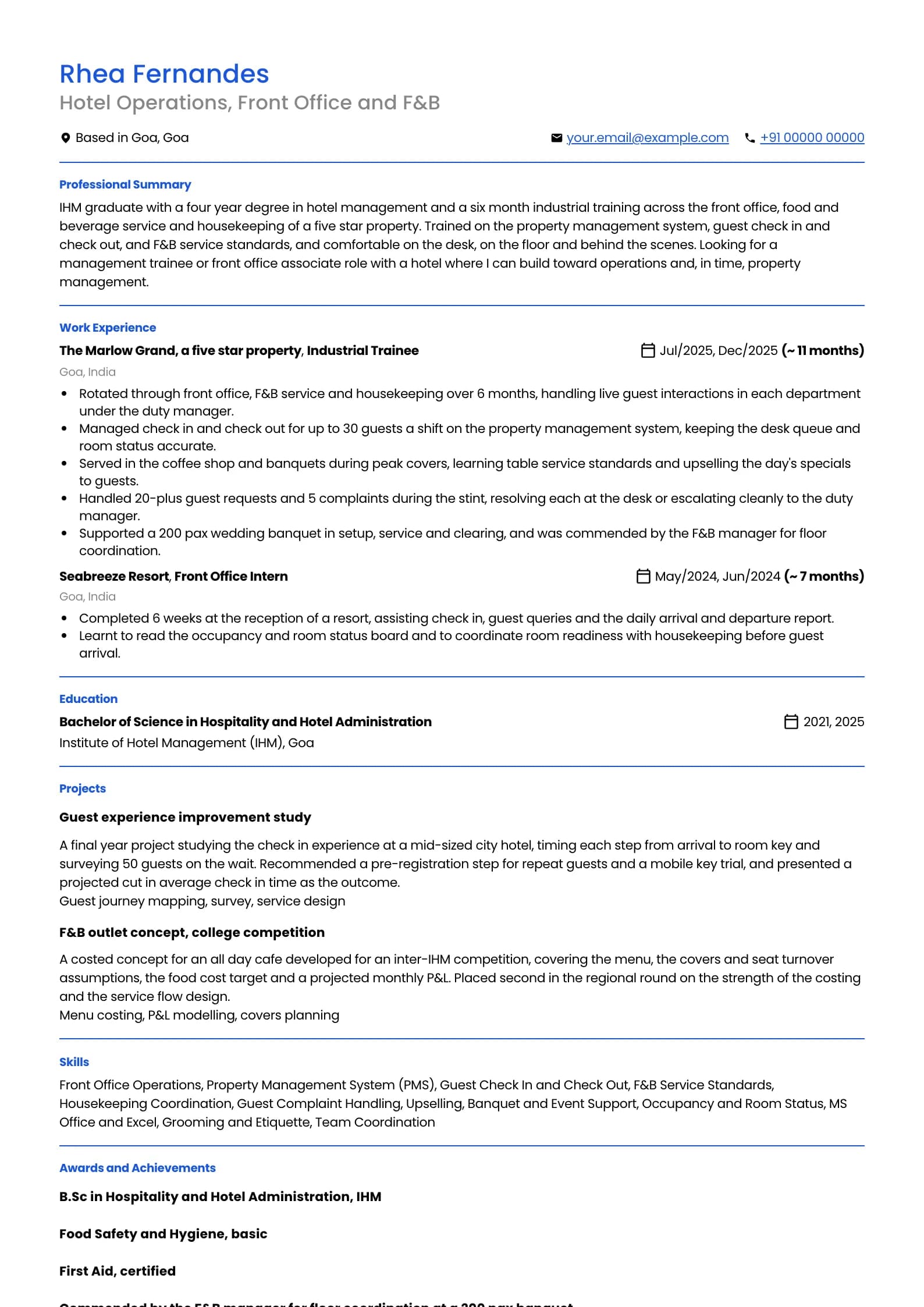
Build my resumeHotel Manager resume example, Fresher (0 years)
professional templateIs your resume good enough?
Upload the resume you have now and see what an applicant tracking system reads before a hotel manager recruiter ever does.
Free to run. Sign in with your mobile number to see your score.
Hotel Manager resume example, Mid-level (5 years)
modern template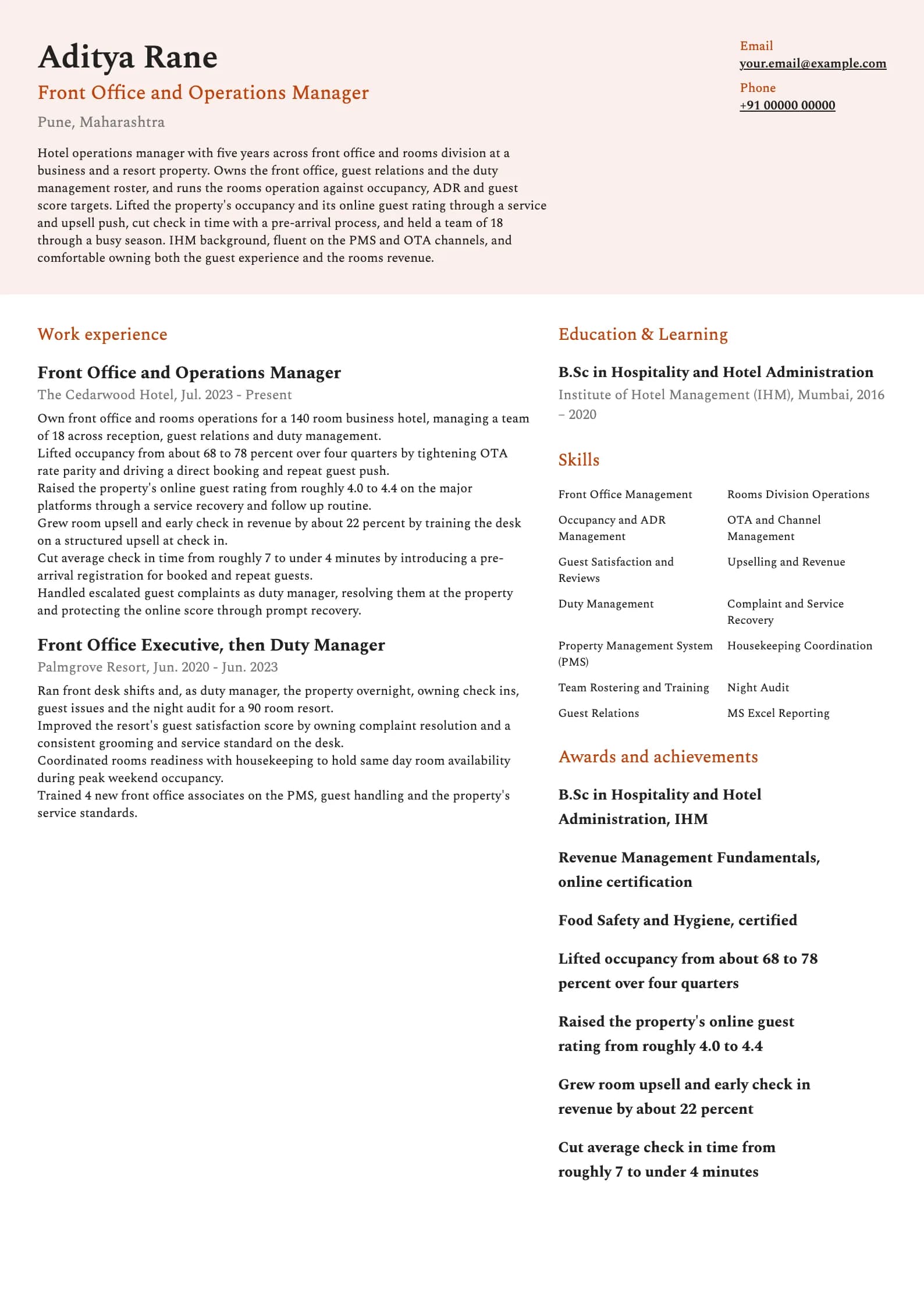
Want this structure with your own details? Build it in the resume builder.
Hotel Manager resume example, Senior (12 years)
minimalist template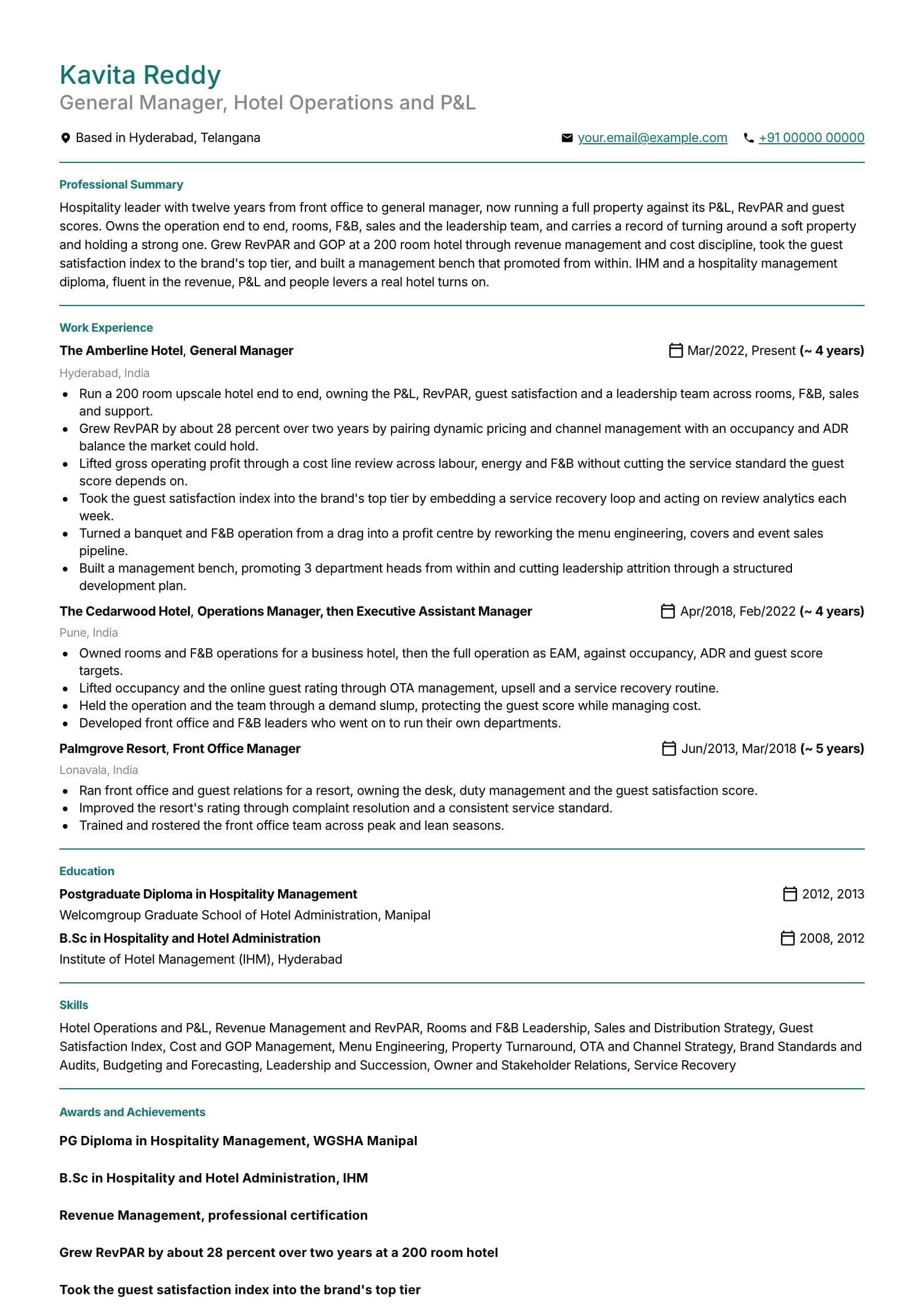
The format that works for hotel manager resumes in India
Reverse chronological is the layout to use. Put the most recent role first, work backwards, and let the dates sit in plain view. Functional resumes that group everything under Areas of Expertise and quietly drop the dates read as an attempt to hide a gap or a short stint, and hospitality reviewers, who track property and brand movement closely, treat them that way. Hospitality is a numbers business, and the resume has to read like one. A hotel manager is measured on occupancy, average daily rate, RevPAR, guest satisfaction scores and the P&L, so those are the terms the summary and the bullets should carry. Naming the property type and size matters too, because running a 200 room upscale city hotel is a different job from a 40 room boutique resort, and a recruiter reads the scale immediately. Lead with what you managed and what moved. Length is decided by evidence. One page holds everything a fresher and most managers up to roughly six years have to say. Past that, into general management, a second page is fine when it carries P&L and revenue results rather than a longer list of departments. Four things belong nowhere here: a photograph, date of birth, marital status and father's name. Some client-facing hospitality roles do ask for a photo, so add one only when the posting requests it. Send a PDF unless told otherwise, name the file with your own name and the role, and use a single column so the parser reads it cleanly. The table below sets out the section order.
| Section | Where it goes | Why |
|---|---|---|
| Name and title | Top, above everything | Hotel Manager or the exact role, plus the city or region. |
| Professional summary | Directly under the header | Three lines. Years, property type and size, and the strongest metric. |
| Work experience | Next, for anyone with a job | Most recent first. Name the property scale and the numbers moved. |
| Key achievements | Beside or after experience | Occupancy, ADR, RevPAR, guest score, GOP, upsell revenue. |
| Skills | Below experience | Grouped: operations, revenue, guest, people. Not a wall. |
| Education | Bottom, unless you are a fresher | IHM degree and any hospitality management diploma. |
| Certifications and languages | Near the foot | Revenue, food safety, plus the languages you serve guests in. |
The metrics a hospitality resume must carry
A hotel manager who describes departments handled without a number reads like someone who occupied a role rather than moved a property. The people hiring, an area general manager, an owner, a brand, live inside a set of metrics, and a resume that speaks those metrics signals you already run the business the way they measure it. The rooms revenue trio is the anchor: occupancy, average daily rate and RevPAR, revenue per available room, which combines the two. If you lifted occupancy, moved ADR or grew RevPAR, those are your headline numbers, expressed honestly as a change over a stated period. RevPAR is the single figure a revenue-minded reviewer respects most, because it captures whether you filled the rooms and at what price. Guest satisfaction is the second anchor, and it is now heavily online. The guest score on the major review and OTA platforms, the brand's guest satisfaction index, and the movement you drove in either are real, checkable results. "Raised the online rating from 4.0 to 4.4" tells a story that matters to revenue as much as to service. At the operations and general management level, the P&L enters: gross operating profit, cost lines like labour, energy and F&B, and profit centre performance for banquets and outlets. Menu engineering, covers and average check carry the F&B story. Where you genuinely lack a headline figure, use scale and scope: rooms managed, team size, covers served, banquet pax, OTA channels handled. The point is to move from "managed operations" to a fact a hotelier can picture. Never inflate a RevPAR or a guest score, because a hospitality interview will probe both.
Before you send it, ask whether the resume tells a hotelier what moved: occupancy, RevPAR, the guest score, the GOP. If it only lists departments and duties, you have described the role, not your result.
Writing a summary a hotelier actually reads
The block under your name is the part you can be reasonably sure gets read, so it should carry three facts: how long you have worked and in what part of the operation, the type and size of property you manage, and the strongest metric you have moved. Three or four lines, no adjectives that cannot be checked. The old objective line, seeking a challenging position in a reputed hotel to utilise my hospitality skills, tells the reader nothing they did not assume from the application. Replace it with a summary. An objective describes what you want, a summary describes what you have already delivered, and only one gets a hotelier to read on. Freshers often believe they have nothing to summarise. Look at the fresher sample: it names the IHM degree, cites a six month five star industrial training across three departments, and points at check ins handled and a banquet worked. That is a genuine summary built from a degree, a training rotation and live guest contact. What it avoids is "hardworking and passionate hospitality professional", a phrase so common it now carries no information. A practical test: read your summary and ask whether another manager with the same tenure could paste it onto their resume unchanged. If they could, it describes the role, not you. Add the specific property size, the specific department and the specific number until it stops being transferable.
Professional summary, operations manager
Weak
Hardworking and passionate hospitality professional with 5+ years of experience seeking a challenging position in a reputed hotel to utilise my operational and guest service skills.
Strong
Hotel operations manager with five years in front office and rooms division, running a 140 room business hotel and a team of 18. Lifted occupancy from about 68 to 78 percent and raised the online guest rating from roughly 4.0 to 4.4.
The rewrite trades self-description for the property size, the team, and two metrics a hotelier screens on before anything else.
Experience bullets: verb, operations action, business consequence
Every strong bullet in the samples follows the same shape. It opens with an action verb, names the specific operations action you took, and closes with the business result. The verb establishes that you did it. The action tells a reviewer the part of the hotel you ran. The number, the occupancy point, the RevPAR lift, the guest score, does the persuading. Start with the outcome and work backwards. Hotel managers usually write the duty first, then leave it vague, which produces bullets like "handled front office operations and ensured guest satisfaction". Instead ask what actually happened: occupancy rose from one figure to another, the online rating climbed, upsell revenue grew, check in time fell, an F&B outlet turned profitable. Then write the sentence that ends in that fact. Hospitality rewards a specific kind of metric: occupancy percentage, ADR and RevPAR, guest satisfaction score, GOP and cost lines, upsell and F&B revenue, covers and average check, team size. "Lifted occupancy from about 68 to 78 percent over four quarters" carries the scale and the result in one line. Vary the metric so the resume does not read as one number repeated. Where you genuinely lack a percentage, give scope: the rooms managed, the team size, the covers served, the banquet pax, the OTA channels handled. "Managed a team of 18 across reception, guest relations and duty management" is a real, checkable claim. Allocate bullets by recency. Current role gets five or six, the previous role four or five, anything older two or three.
| Level | What bullets must prove | Typical metric |
|---|---|---|
| Fresher | You can face guests and run a shift | Check ins handled, covers served, complaints resolved, banquet pax |
| 1 to 5 years | You run a department against targets | Occupancy, ADR, guest score, upsell revenue, team size |
| 6 to 10 years | You own operations and the guest index | RevPAR, guest satisfaction index, cost lines, F&B profit |
| 10 years and up | You own the P&L and turn the property | RevPAR, GOP, turnaround, brand index, leadership bench |
Experience bullet, operations manager
Weak
Responsible for handling front office operations and ensuring guest satisfaction at all times in the assigned property.
Strong
Raised the property's online guest rating from roughly 4.0 to 4.4 on the major platforms through a service recovery and follow up routine.
"Responsible for" describes the duty; the rewrite names the service action and the rating movement it produced.
Experience bullet, revenue
Weak
Worked on improving hotel revenue and occupancy through various sales and marketing initiatives during my tenure.
Strong
Lifted occupancy from about 68 to 78 percent over four quarters by tightening OTA rate parity and driving a direct booking and repeat guest push.
Names the occupancy movement, the period and the specific revenue levers, so a hotelier can judge the real result rather than take the claim on trust.
If a bullet would read identically on another manager's resume, it is describing the role, not your property. Rewrite it until it only fits the hotel and the number you actually moved.
Showing the departments and the scale you have run
Hospitality careers move across departments and property types, and a hotelier reads that movement carefully. So the resume should make clear, without a paragraph of prose, which parts of the operation you have owned and at what scale. Front office and rooms division, food and beverage service and production, housekeeping, sales and revenue, banquets and events, and eventually the whole operation. Naming them tells a reviewer which management job you are ready for next. Scale is read alongside department. A 40 room boutique property, a 140 room business hotel and a 300 room resort are three different operating challenges, and the number of rooms, the team size and the outlet count place you instantly. Include the property size in the role line or the first bullet, so a reader never has to guess whether you ran a large operation or a small one. Brand and segment context helps a specialist recruiter. Whether the property was luxury, upscale, midscale or budget, independent or part of a chain, city or resort, shapes the skills you carry. You do not need to labour it, but a phrase like a 200 room upscale city hotel does a lot of work. The trap is claiming breadth you do not have. Listing every department as though you led each one, when you rotated through some as a trainee, collapses in an interview where a specific operation is discussed. Be precise about what you owned versus what you were exposed to, and let the depth in your strongest department carry the resume.
Role scope line
Weak
Managed all departments of the hotel including front office, F&B, housekeeping, sales, and administration successfully.
Strong
Owned front office and rooms operations for a 140 room business hotel, managing a team of 18 across reception, guest relations and duty management.
Swaps an unbelievable claim of running everything for the precise department, property size and team a reviewer can picture and probe.
The skills section: grouped, honest, defendable
A hotel manager's skills section has two audiences with opposite preferences. The parser wants literal terms it can match, PMS and RevPAR and OTA. A human wants a short, organised list that signals what kind of hotelier you are. Grouping satisfies both. Group by function rather than one long line. Operations, revenue and distribution, guest experience, people and leadership is a grouping that works for most managers. The exact headings matter less than the fact that structure exists. Write the systems and terms the industry uses: property management system and the name if it is a known one, RevPAR, ADR, OTA, guest satisfaction index. A parser matches on strings, and a hotelier reads them as proof you know the levers. Name the systems you actually work in and can be tested on. The PMS, the channel manager, the revenue tool, the review analytics platform. Match the emphasis to the role: revenue and distribution for a commercially focused job, guest experience and service recovery for a guest-facing one, P&L and cost for a general management one. Twelve to sixteen skills is the working range. Below eight the section looks thin. Above twenty it stops being a signal. The list is a contract: every item is a question you have agreed to answer in an interview. Do not include a proficiency bar. Let the occupancy, RevPAR and guest score numbers prove the depth instead.
| Group | What goes in it | How many |
|---|---|---|
| Operations | Front office, rooms division, housekeeping, F&B, duty management | 3 to 5 |
| Revenue and distribution | RevPAR, ADR, occupancy, OTA and channel management, forecasting | 2 to 4 |
| Guest experience | Guest satisfaction, reviews, service recovery, upselling | 2 to 3 |
| People and leadership | Rostering, training, team development, succession | 2 to 3 |
| Systems and compliance | PMS, channel manager, food safety, brand standards | 1 to 3 |
Skills section
Weak
Skills: hospitality, front office, F&B, housekeeping, guest service, management, hard working, punctual, honest, dedicated, MS Office, communication, leadership, teamwork, smart
Strong
Operations: front office, rooms division, F&B, duty management. Revenue: RevPAR, ADR, OTA management. Guest: satisfaction index, service recovery, upselling. People: rostering, training. Systems: PMS, food safety.
Cuts the vague fragments and the soft skills masquerading as capability, then groups the rest so a hotelier reads your levers in one pass.
Where education, certifications and languages belong
Education goes at the bottom for anyone with a job, and higher for a fresher. A degree from an Institute of Hotel Management, the IHM system, or a comparable hospitality school is the standard qualification, and it carries real weight in Indian hospitality, so name the institute plainly. A postgraduate diploma in hospitality management from a recognised school signals depth for someone moving toward general management. For a fresher, the IHM degree and the industrial training rotation move higher because they are much of the evidence. Employers know the four year IHM degree includes a substantial hotel training component, so make the property and the departments you rotated through clear. Certifications that carry weight are practical ones. A revenue management certification signals you understand the ADR, RevPAR and distribution side, which is increasingly what separates a manager from an operator. Food safety and hygiene certification matters for anyone near F&B, and is often a compliance expectation. Name each with the provider and keep them current. Languages matter in hospitality because you serve guests from many regions and countries. List the languages you can genuinely converse in with a guest, and a foreign language is a real asset in a tourist or luxury property. Put languages near the foot, but do include them. Keep marks only while you are a fresher and they are good; once you have occupancy and RevPAR numbers, the results carry the resume.
Getting through the applicant tracking system
Hotel chains and the portals they recruit through run an applicant tracking system, so the same parsing rules apply to hoteliers as to any other field. The system reads your file, tries to break it into name, dates, employers, titles and skills, and stores the result for search. Almost every ATS problem is a parsing problem, and parsing problems come from layout, not wording. The layout rules are short. One column. Standard section headings, so use Work Experience rather than My Hospitality Journey, and Skills rather than My Strengths. No tables or text boxes for your core content, because some parsers scramble them. No critical information in the header or footer region, which some parsers drop. On wording, mirror the language of the job description where it is honest. If the posting says RevPAR, write RevPAR. If it says rooms division, write rooms division rather than only front office. If it names a PMS or a brand standard, and you know it, include it. Include the expansion alongside an acronym at least once, for example "ADR (average daily rate)", so both searches find you. Keyword stuffing does not work. A hidden block of hospitality terms helps nothing, because a hotel manager is judged in an interview a stuffed resume rarely reaches. Write real bullets that naturally contain the right terms. Save as PDF from a tool that embeds real text, then open the file and confirm you can select and copy a sentence. If you cannot select the text, neither can the parser.
Section heading
Weak
My Hospitality Journey
Strong
Work Experience
Parsers look for standard headings; a decorative one can push your roles and your occupancy and RevPAR numbers into an unclassified bucket the recruiter never searches.
Put the exact metrics and systems a posting names, RevPAR, a specific PMS, a brand standard, in plain text. A recruiter searching the tracking system for a revenue-literate manager will only surface resumes that carry those literal terms.
What gets hotel manager resumes rejected
Most rejections at the resume stage are not close calls. They come from a small set of recurring problems, and all of them are fixable in an afternoon. The list below covers what hospitality reviewers of Indian hotel manager resumes see most often, in rough order of how much damage each one does.
- No business numbers. Departments handled with no occupancy, ADR, RevPAR or guest score reads as someone who occupied the role, not moved it.
- Claiming to have managed every department, when some were only a trainee rotation, which collapses when a specific operation is discussed.
- Job duties copied from the job description. "Responsible for front office and guest satisfaction" is the tell.
- No property scale, so a reviewer cannot tell whether you ran a 40 room boutique or a 300 room resort.
- Guest experience described with no online rating or index, in a market where the review score drives revenue.
- No revenue or P&L awareness at a level where it is expected, leaving a general management resume reading like an operations one.
- A wall of generic skills, hospitality and hard working and dedicated, with none of the industry's real vocabulary.
- Unexplained short stints across many properties, which reviewers read as instability unless addressed in a line.
- Date of birth, marital status or father's name padding the top of the page, none of which belongs on a professional resume here.
- A generic objective line. Replace it with a summary that states years, property type and size, and one metric moved.
Read your resume once as if you were the owner or the area general manager deciding who runs the property. Any line that does not help answer will this person move occupancy, RevPAR and the guest score is a line to sharpen or cut.
Skills to put on a hotel manager resume
Technical
- Front Office and Rooms Operations
- Food and Beverage Operations
- Revenue Management and RevPAR
- Occupancy and ADR
- OTA and Channel Management
- Guest Satisfaction and Reviews
- P&L and Cost Management
- Menu Engineering
- Banquet and Event Operations
- Housekeeping Standards
- Upselling and Ancillary Revenue
- Budgeting and Forecasting
- Brand Standards and Audits
- Duty Management
Tools and platforms
- Property Management System (Opera or similar)
- Channel Manager
- Revenue Management System
- Review Analytics Platform
- POS System
- MS Excel
- OTA Extranets
- Booking Engine
- MS PowerPoint
Working skills
- Guest relations and empathy
- Service recovery under pressure
- Team leadership and rostering
- Cross-department coordination
- Grooming and etiquette
- Owner and stakeholder relations
- Coaching and development
- Communication in multiple languages
- Decision making at pace
Certifications worth listing as a hotel manager
| Certification | Full name | Worth it for |
|---|---|---|
| IHM Degree | B.Sc in Hospitality and Hotel Administration, Institute of Hotel Management | The standard and well recognised qualification for Indian hospitality, valued because the four year degree includes a substantial hotel training component. Worth naming with the specific IHM, and the anchor credential for a fresher entering operations. From there the property numbers carry the resume. |
| PG Diploma Hospitality Management | Postgraduate Diploma in Hospitality or Hotel Management | A depth signal for managers moving toward general management, especially from a recognised school. Worth naming clearly, and most valuable when it sits alongside a real operations record. On its own, without occupancy and RevPAR results, it carries less than the numbers do. |
| Revenue Management | Revenue Management or Hotel Revenue Management certification | Increasingly the credential that separates a manager from an operator, since it signals command of ADR, RevPAR, forecasting and distribution. Genuinely useful for anyone on a commercial or rooms revenue track, and best paired with a bullet showing a RevPAR or occupancy lift you actually drove. |
| Food Safety and Hygiene | Food Safety and Hygiene, FSSAI aligned certification | A practical and often expected credential for anyone near F&B operations, since food safety is a compliance and brand standard requirement. Worth a line with the provider, particularly for F&B and general management roles, and treated as hygiene rather than a headline. |
| Rooms Division Management | Rooms Division or Front Office Management certification | A useful specialist signal for a front office and rooms track, showing structured knowledge of the desk, housekeeping interface and rooms revenue. Most relevant early to mid career, and best supported by real occupancy, upsell and guest score numbers from the operation you ran. |
| Foreign Language | A foreign language such as French, German or Japanese | A real asset in luxury, tourist and international properties, where guests come from many countries, so it earns a line for anyone targeting those segments. List only a language you can genuinely converse in with a guest, and place it near the languages section rather than overstate the level. |
Keywords an ATS scans for in a hotel manager resume
These are the literal terms a parser matches against the job description. Use the ones that are true of you, in the sentences where you did the work, not as a list at the bottom.
- hotel manager
- hotel operations
- front office
- rooms division
- food and beverage
- occupancy
- ADR
- RevPAR
- revenue management
- guest satisfaction
- OTA
- property management system
- PMS
- P&L
- gross operating profit
- upselling
- banquet
- duty manager
- IHM
- hospitality management
Hotel Manager resume FAQ
What salary can a hotel manager expect in India?
An IHM fresher entering as a management trainee or front office associate typically starts around 2.4 to 4 LPA, often quoted as roughly 20,000 to 33,000 a month, plus service charge and tips at many properties. A front office or operations manager with five to eight years usually sits in the 5 to 12 LPA band, higher in large branded city hotels. General managers of full properties with ten years and above commonly earn 15 to 40 LPA and more, scaling with the property size, brand and location. Luxury and metro properties pay above resort and midscale ones.
Do I need an IHM degree to become a hotel manager?
It is the standard and most recognised path, and it helps significantly, but it is not the only one. A degree from an IHM or a comparable hospitality school gives the training foundation employers expect and includes real hotel exposure. That said, people do rise into management from strong operational track records with a diploma or on-the-job progression. What the resume must show at every level is the operational result, occupancy, guest score, revenue, since that is what a hotelier ultimately hires on.
What metrics should I put on a hotel manager resume?
Lead with the rooms revenue trio, occupancy, ADR and RevPAR, expressed as honest changes over a stated period, since RevPAR is the figure a revenue-minded reviewer respects most. Add the guest satisfaction score or online rating and the movement you drove, because the review score drives revenue. At operations and general management level, include P&L measures like gross operating profit, cost lines and F&B profit. Where you lack a headline figure, use scale: rooms managed, team size, covers, banquet pax.
How does a fresher write a hotel manager resume?
Lead with the IHM degree and the industrial training rotation, then treat live guest contact as the evidence: check ins handled, covers served, complaints resolved, a banquet worked. Look at the fresher sample: it names a six month five star training across three departments and carries real numbers even at entry level. Aim for a management trainee or front office associate role, and show that you have already faced real guests and understand that hospitality is measured in numbers.
How long should a hotel manager resume be?
One page up to about six years of experience, two pages after that only if you have moved into general management and the second page carries P&L and revenue results rather than a longer list of departments. Keep the strongest occupancy, RevPAR and guest score numbers on page one where a hotelier catches them. If you are struggling to fit one page, cut the oldest role to a line, remove marks, and drop generic skills that add nothing.
Should I show every department I have worked in?
Name the departments you have genuinely owned and be precise about scale, but do not claim to have led every department when some were a trainee rotation, because that collapses in an interview about a specific operation. A hotelier reads the departments and property size to judge which management job you are ready for next, so front office and rooms for one candidate, F&B and banquets for another, tells a clearer story than a vague claim of running everything.
Do I need a photo on a hotel manager resume in India?
Sometimes. Unlike most fields, some client-facing hospitality roles do ask for a photograph, and a few properties expect one, so add a clean professional photo only when the posting requests it. Date of birth, marital status, father's name and a declaration paragraph, though, add nothing and should come off. Put that space toward the occupancy, RevPAR and guest score numbers, which is what actually gets a hotel manager shortlisted.
Does a revenue management certification help a hotelier's resume?
Yes, increasingly, because it signals command of the commercial side, ADR, RevPAR, forecasting and distribution, which is what separates a manager from an operator. It is genuinely useful for anyone on a rooms revenue or commercial track, and it reads best when paired with a bullet showing a RevPAR or occupancy lift you actually drove. Listed on its own, without a result behind it, it carries less than the number would.
Related resume examples and guides
Build your own in any of these formats
Start from a blank resume or upload the one you have. Goodspace renders it in 24 templates, puts your occupancy, RevPAR and guest score numbers where a hotelier catches them, and flags what an applicant tracking system will miss.
Build my resume