Chef Resume Format, with 3 Full Samples
A chef is hired to run a section or a kitchen to a standard, a cover count and a food cost, and the resume is read by a hotel HR desk, a chef recruiter or an executive chef who has run a pass and knows exactly what to look for. They scan a page for cuisine, the section or station you own, the covers you have handled, and whether you speak the language of food cost, HACCP and consistency. Most chef resumes lose them on a paragraph about a passion for cooking and a list of dishes with no kitchen behind them. Below are three complete resumes, one for an IHM commis fresher, one for a chef de partie moving to sous, and one for an executive chef, followed by the format rules, where kitchen and cuisine detail belongs, and the operational vocabulary a hotel actually reads for. Each sample is a full document, and every one keeps the cooking anchored to the pass.
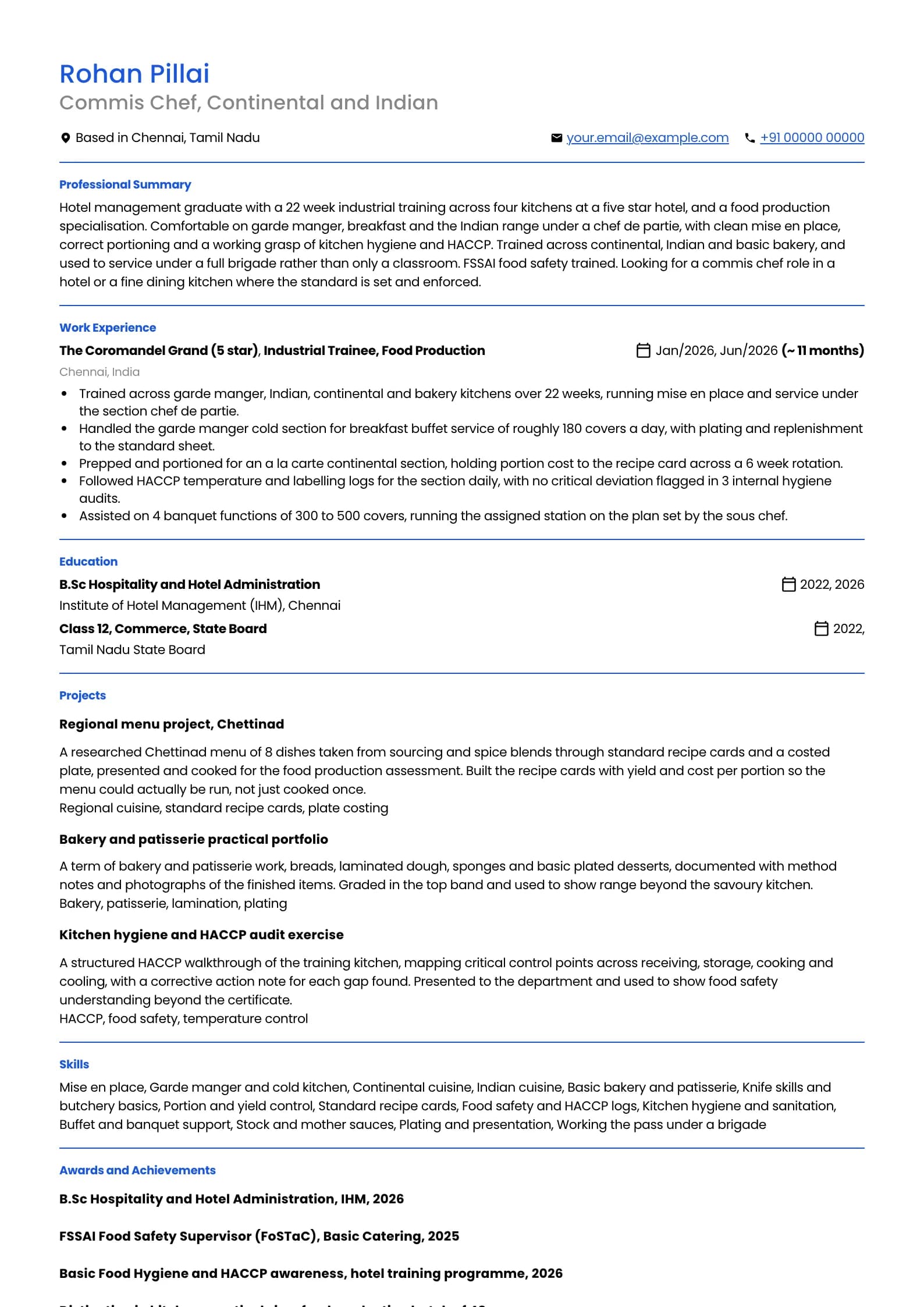
Build my resumeChef resume example, Commis, IHM graduate (0 years)
professional templateIs your resume good enough?
Upload the resume you have now and see what an applicant tracking system reads before a chef recruiter ever does.
Free to run. Sign in with your mobile number to see your score.
Chef resume example, Chef de Partie to Sous (5 years)
header-band template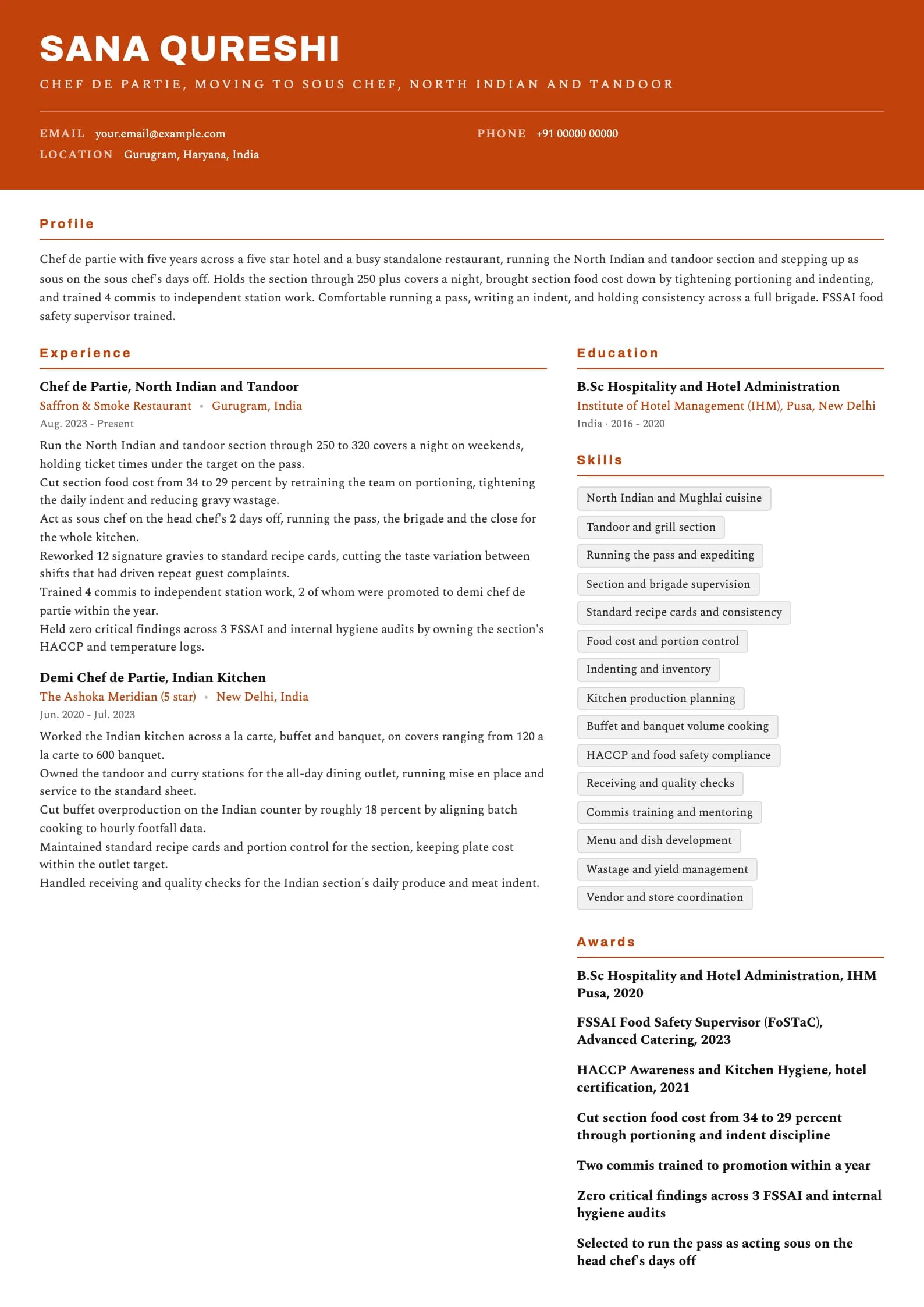
Want this structure with your own details? Build it in the resume builder.
Chef resume example, Executive Chef (12 years)
ai-era template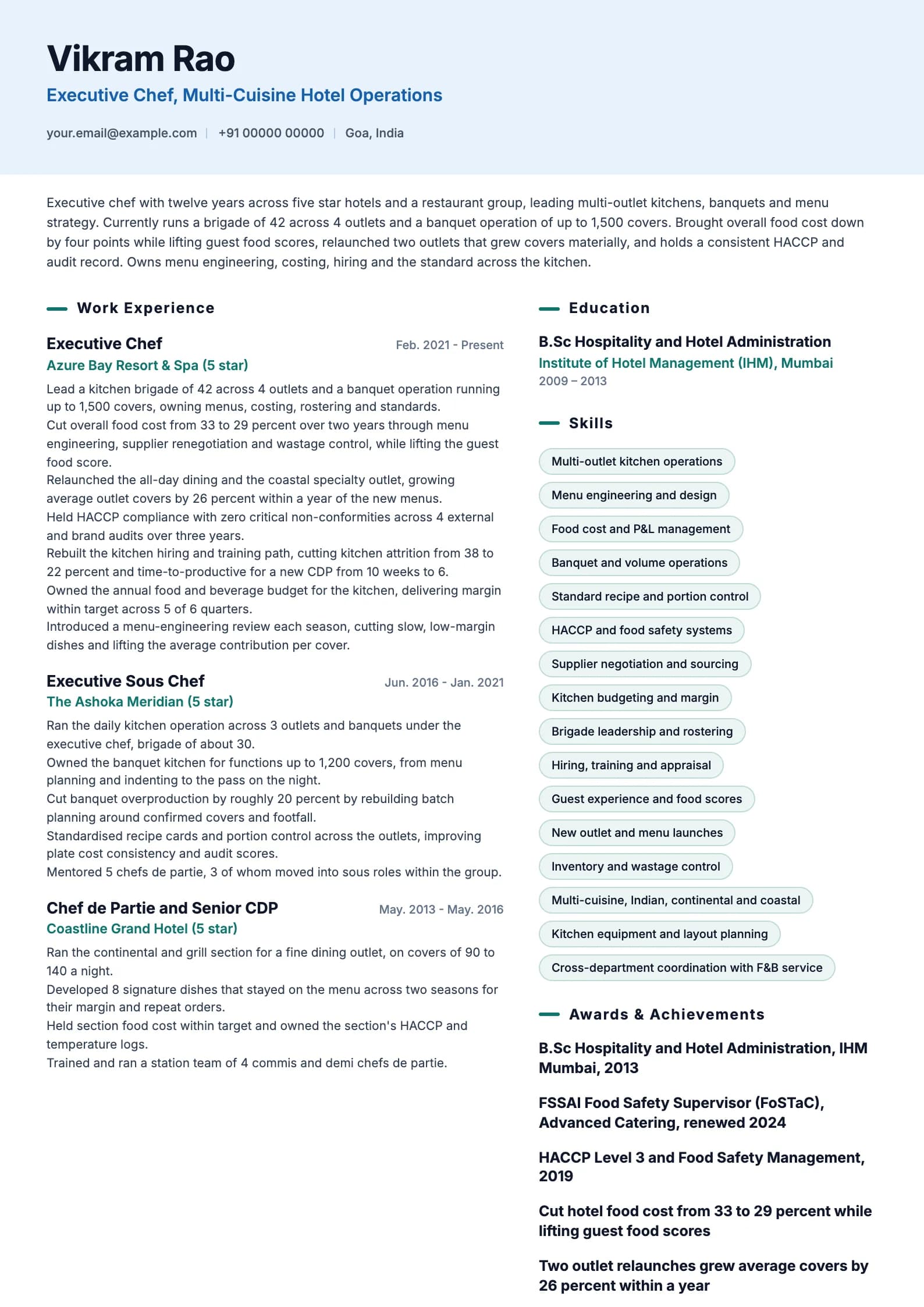
The format that works for chef resumes in India
A chef resume is read fast by someone who has stood on a pass, so it has to answer the kitchen questions before it answers anything else. Reverse chronological, one page up to roughly seven years, a second page only for a sous, executive sous or executive chef with real operational scope. Single column, plain type, tight bullets. A hotel HR desk and an executive chef both read for the same four things in the first pass: which cuisine, which section or station, how many covers, and whether you respect food cost and hygiene. Do not decorate it with dish photographs or a colour band that eats the toner on a hotel printer. Save any plating photography for a separate one page visual sheet or a link, and keep the resume itself linear and text based so a parser and a printed shortlist copy both read it cleanly. The space belongs to sections run, covers handled, cuisines owned, and the operational numbers a kitchen decides on. Anchor the cooking to the operation. A chef who writes only that they cooked North Indian food has told the reader nothing about whether they can hold a section through 300 covers, keep food cost on target and pass a hygiene audit. Name the cuisine, the section, the cover count, the food cost and the HACCP record, because those are the lines a hiring chef stops on. Leave off the usual clutter: photo, date of birth, marital status, father's name and a declaration. Keep the file name plain, your name and the post. The section order below is what a hotel and a restaurant group both expect, and it is arranged so cuisine, section and covers surface first.
| Section | Where it goes | Why |
|---|---|---|
| Name and headline | Top, above everything | Name the post and cuisine: "Chef de Partie, North Indian and Tandoor" beats "Passionate Chef". |
| Professional summary | Directly under the header | Three to four lines. Post, cuisine, covers held, years, and one cost or consistency result. |
| Kitchen experience | Next, for anyone who has worked a station | Most recent first. Name the property, the section, the cuisine and the covers in the first bullet. |
| Industrial training and projects | In place of experience for a fresher | Give it a title, a property, dates and bullets. Trainee kitchen work is supervised production, so it counts. |
| Cuisine and specialities | Near skills | The cuisines and sections you can walk into. This is what a kitchen filters on. |
| Skills | Below experience | Grouped: culinary craft, kitchen operations, food safety. Not a forty item wall. |
| Certifications and education | Bottom, unless you are a fresher | IHM or culinary school, then FSSAI and HACCP with the year and level. |
Cuisine, section and covers: the three facts a kitchen searches on
The single most common weakness in an Indian chef resume is a cuisine named without a section and a cover count. Cooked Indian food could mean plating 40 fine dining covers a night or turning out 800 at a wedding buffet, and those are entirely different chefs. Every kitchen role should carry the property, the cuisine, the section you owned and the covers you held, because that is exactly the shape of the vacancy the reader is filling. Name the section and the station. Garde manger, tandoor, curry, continental, grill, sauce, patisserie, bakery, cold kitchen and pastry are distinct skills, and a hotel hiring for the tandoor is searching for tandoor, not for a general kitchen line. If your career has spanned sections and cuisines, that is range rather than dilution, provided you keep them separated and named. State the covers, and be honest about the type. Covers at a la carte fine dining, all-day dining, buffet and banquet mean very different things about your speed and your consistency, so write both the number and the setting. "Held the section through 250 to 320 covers a night" and "ran the banquet kitchen for functions up to 1,200 covers" tell a chef precisely what pressure you have worked under. The titles matter too, because the brigade is a ladder and a hiring chef places you on it. Commis, demi chef de partie, chef de partie, senior chef de partie, sous chef, executive sous chef and executive chef map to responsibility and station ownership. Match your headline to the post you are applying for, name the acting-up work if you have done it, and let the covers and the food cost prove you belong on that rung.
| Level | Kitchen responsibility | What the resume must show |
|---|---|---|
| Commis | Runs a station under a chef de partie | Sections trained on, mise en place, portioning, covers assisted, hygiene logs |
| Chef de Partie | Owns a section and its team | Cuisine and section, covers held, food cost on the section, commis trained |
| Sous Chef | Runs the pass and the brigade under the head chef | Brigade size, outlets or banquets, food cost, rostering, standards enforced |
| Executive Chef | Owns the whole kitchen operation and its P&L | Multi-outlet scope, food cost points, cover growth, audits, hiring, budget |
Kitchen experience heading and first line
Weak
Chef, Saffron & Smoke Restaurant, 2023 to present. Cooked Indian dishes and managed kitchen work.
Strong
Chef de Partie, North Indian and Tandoor, Saffron & Smoke Restaurant, Gurugram, Aug 2023 to Present. Run the section through 250 to 320 covers a night.
The post, the section, the cuisine and the cover count let a hiring chef place the candidate on the brigade without a phone call.
A resume that says only which cuisine you cook has answered a third of the question. Name the section and the covers, because a kitchen is hiring for a station and a pressure, not a flavour.
The summary that replaces the passion line
Almost every chef resume opens with a line about a lifelong passion for cooking and a dream of creating memorable dining experiences. It is the most skippable sentence in hospitality recruitment, and it costs you the most valuable lines on the page. Replace it with a summary that answers what a hiring chef is actually holding the resume to find: your post and cuisine, how many covers you hold, how long you have cooked, and one result about cost or consistency rather than about your love of food. Lead with the noun. "Chef de partie with five years running the North Indian and tandoor section" places you instantly; "passionate and dedicated culinary professional" places you nowhere, because everyone in the pile wrote it. Put your strongest single result in the second or third line, and make it operational: a food cost you brought down, a cover count you hold, a consistency problem you fixed, an audit record you keep. These are the facts a kitchen decides on. A fresher has a summary too. The commis sample names the training kitchens, the covers handled on garde manger, the portion discipline and the food safety training. That is real evidence from industrial training, and it never uses the word passionate, because passion is assumed in anyone who chose the kitchen and evidence is not. Write the summary last, after the experience section, because by then you know which number is your strongest and can lift it to the top. And match it to the property: a fine dining restaurant reading for consistency and craft and a banquet-heavy hotel reading for volume and food cost want different first lines, and rewriting three lines to lead with the right one takes two minutes.
Summary opening line
Weak
A passionate and hardworking chef with a love for cooking, seeking a challenging position in a reputed hotel to showcase my culinary skills and creativity.
Strong
Chef de partie with five years across a five star hotel and a busy restaurant, running the North Indian and tandoor section through 250 plus covers a night, with section food cost brought down to 29 percent.
The first line says nothing a chef can act on; the second gives post, cuisine, covers and a food cost number before they finish reading it.
Kitchen bullets: station, covers, and what you held or saved
Chef bullets fail in two familiar ways. The first is the duty list, so responsible for food preparation, cooking and maintaining hygiene in the kitchen, which describes every chef on the shortlist. The second is the menu recital, so prepared a variety of delicious Indian and continental dishes, which tells a reader what a cuisine is but nothing about you. The pattern in all three samples is the same: an action verb, the section and the covers, and what you held, cut or saved. The objection is that cooking is a craft, not a spreadsheet. The craft is real, but a kitchen runs on numbers and you already have them. Food cost percentage, cover count, ticket times on the pass, portion and yield, wastage cut, audit findings, commis trained, attrition, outlet covers. Every one of these is a number a chef respects, and none of them require you to overstate the food. Put the action next to the number and the reader draws the conclusion. Where a figure genuinely does not exist, use scope and setting. Which section, how many covers, which cuisine, a la carte or banquet, how many in the brigade, whether a dish held its place on the menu across seasons. "Kept 8 signature dishes on the menu across two seasons for their margin and repeat orders" carries weight without a percentage nobody tracked. Order bullets by strength inside a role, since the first two are the ones read, and allocate by recency across roles. The current section gets five or six bullets, older roles compress to four or five, and the oldest survives on the one craft or cost fact that still proves something the recent work does not.
- Weak: "Responsible for food preparation and cooking in the kitchen."
- Strong: "Run the North Indian and tandoor section through 250 to 320 covers a night, holding ticket times under target on the pass."
- Weak: "Maintained food cost and reduced wastage."
- Strong: "Cut section food cost from 34 to 29 percent by retraining the team on portioning and tightening the daily indent."
- Weak: "Followed hygiene and food safety standards."
- Strong: "Held zero critical findings across 3 FSSAI and internal hygiene audits by owning the section's HACCP and temperature logs."
- Weak: "Trained junior kitchen staff."
- Strong: "Trained 4 commis to independent station work, 2 of whom were promoted to demi chef de partie within the year."
Experience bullet, consistency
Weak
Prepared a variety of delicious gravies and dishes appreciated by guests.
Strong
Reworked 12 signature gravies to standard recipe cards, cutting the taste variation between shifts that had driven repeat guest complaints.
The first claims the food was delicious, which only you can judge. The second names a consistency problem, the action that fixed it and the complaint it removed.
Food cost, covers, ticket times, audit findings, commis promoted. Pick whichever is honest for your section and put it in the bullet, because these are the numbers a hiring chef trusts.
Culinary craft, kitchen operations and food safety, in three groups
A chef skills section fails in two directions. Either it lists character, so hardworking, passionate, team player and creative, which every applicant claims and no reviewer can act on, or it becomes a menu, a wall of thirty dishes and cuisines with no operation behind it. Group it instead, and let each group prove a different thing. Three groups cover almost every chef. Culinary craft covers the cooking, the cuisines and sections, knife skills, sauces, plating and dish development. Kitchen operations covers whether you can run it, food cost, portion and yield control, indenting and inventory, production planning, rostering and the pass. Food safety covers hygiene, HACCP, temperature control and the FSSAI training a kitchen is now audited on. The operations and food safety groups are the ones cooks underweight and hiring chefs read most closely, because a chef who understands cost and hygiene is one a property can trust with a section and an audit. Write the terms the way the industry writes them, chef de partie, mise en place, HACCP, food cost, garde manger. Kitchens and portals both match on strings, and a misspelt culinary term on a chef's resume reads the way a typo in a technology reads on an engineer's. Keep the list to what you can defend on the pass. Every item is a question an interview or a trial shift can open with, and a chef who lists tandoor and cannot judge a naan or hold a seekh has spent credibility that is hard to rebuild. A useful test for each skill: could you be put on that station on your first shift without supervision? If not, it belongs in a training line or nowhere.
| Group | What belongs here | What does not |
|---|---|---|
| Culinary craft | Cuisines and sections, knife skills, mother sauces, tandoor, grill, patisserie, plating, dish development | A long list of individual dish names, which reads as a menu rather than a skill set |
| Kitchen operations | Food cost, portion and yield control, indenting, inventory, production planning, rostering, running the pass | Skipping this group, which is what marks a resume as a cook rather than a chef who can run a section |
| Food safety and hygiene | HACCP, temperature and labelling logs, FSSAI, cross-contamination control, kitchen sanitation | Vague claims like "maintains cleanliness" with no HACCP or FSSAI behind them |
Skills section
Weak
Hardworking, passionate about cooking, creative, team player, good with all cuisines, punctual
Strong
Craft: North Indian, Mughlai, tandoor and grill, dish development. Operations: food cost, portion control, indenting, running the pass. Food safety: HACCP, temperature logs, FSSAI advanced.
Character adjectives that match no search become grouped, searchable craft, operations and safety terms that tell a hiring chef exactly what you can be handed.
Getting a chef resume past the hotel portal and the parser
A small restaurant still hires on a trial shift and a walk-in. But the hotel chains, the large restaurant groups, the cloud kitchen companies and most hospitality job boards run your file through an applicant tracking system before a human sees it, and government and cruise line applications impose their own rigid forms. All of them reward the same plain, single column, text based document with conventional headings. The first failure is the image resume. A resume exported as a picture, or a designed page saved as an image inside a PDF, has no text layer, so a parser reads a blank document and a search for chef de partie or HACCP finds nothing. Test yours by opening the PDF and trying to select a line with the cursor. If nothing highlights, the machine sees nothing. The second is the layout. Two columns with a sidebar, dish photographs standing in for content, and icons replacing section labels all read out of order or as empty space. Keep the resume linear, and if you want to show plating, put it on a separate visual sheet or a link rather than inside the parsed document. On wording, mirror the posting honestly. If it asks for a chef de partie for the Indian kitchen with food cost responsibility, use those exact words: chef de partie, Indian, food cost. Name the cuisine and the section plainly, because a search for tandoor or continental matches the specific term. Spell out an abbreviation once, for example HACCP (hazard analysis and critical control points), so both forms match. Keep dates in one format across every role, since a mixed format is a common reason a parser drops a job. And never hide a keyword block in white text, because parsers flag it and a hotel reads it as the kind of shortcut a food business cannot trust.
- Keep the resume text based, not an exported image. Test it by selecting a sentence in the PDF.
- Use a single column, linear layout. Put any plating photos on a separate sheet or a link, not in the parsed file.
- Name the cuisine and section in words, tandoor, garde manger, continental, so a search matches them.
- Mirror the posting's terms honestly: chef de partie, sous chef, food cost, HACCP, banquet.
- Spell out abbreviations once, for example HACCP and FSSAI, so both the short and long form are matchable.
- Keep one date format across every role, because a mixed format makes a parser drop a job.
- Use standard headings, Kitchen Experience and Skills, not My Culinary Journey.
- Never hide keywords in white text. Hotel HR flags it and reads it as dishonesty.
Name your sections the boring way and your stations the exact way. A parser matches "Chef de Partie" and "tandoor" instantly; it matches "Culinary Artist" and a photo of a plate not at all.
What gets chef resumes rejected
Most rejections at the resume stage are not judgements about your cooking. They come from a short list of repeating faults, and almost all are fixable in an afternoon. The list below is ordered roughly by how often it costs a shortlist, starting with the two a hiring chef catches in the first few seconds.
- No cuisine, section or cover count. "Chef" with no tandoor, no covers and no food cost forces a guess a busy kitchen will not make in your favour.
- A duty list copied from the appointment letter. "Responsible for cooking and hygiene" describes every chef in the pile.
- No numbers anywhere. Food cost, covers, wastage, audit findings, commis trained. At least one of these is available to almost every chef.
- The whole resume saved as an image, so a parser reads a blank page and a search finds no HACCP, no chef de partie, nothing.
- A menu recital instead of experience: paragraphs of delicious dishes with no station, no covers and no cost behind them.
- No food safety anywhere. Missing HACCP and FSSAI on a resume for an audited kitchen reads as a risk a property will not take.
- Dish photos or a heavy colour band that eats a hotel printer's toner and scrambles a parser, in place of a plain page.
- A generic passion line in the slot a summary naming post, cuisine, covers and one result should hold.
- Unexplained gaps between kitchens. One honest line covering a break, a course or a relocation closes the question silence leaves open.
- The same resume sent to a fine dining restaurant, a banquet hotel and a cloud kitchen, with no change to the headline and the top bullets.
Read your resume as an executive chef who has run a pass. If it never says cuisine, section, covers, food cost or HACCP, it is describing a cook, and a kitchen is hiring someone to hold a station.
Skills to put on a chef resume
Technical
- Indian and Mughlai cuisine
- Continental cuisine
- Tandoor and grill
- Garde manger and cold kitchen
- Bakery and patisserie
- Knife skills and butchery
- Stocks and mother sauces
- Mise en place and station setup
- Menu and dish development
- Plating and presentation
- Standard recipe cards
- Portion and yield control
- Volume and banquet cooking
- Menu engineering
Tools and platforms
- Food cost and P&L management
- Indenting and inventory systems
- Kitchen production planning
- HACCP and temperature logs
- FSSAI food safety compliance
- POS and kitchen order tickets
- Recipe and costing software
- Receiving and quality checks
- Rostering and duty planning
- Combi ovens and modern kitchen equipment
- Cold chain and storage management
- Vendor and supplier coordination
Working skills
- Running the pass and expediting
- Brigade leadership
- Commis and CDP training
- Working under service pressure
- Consistency and standards discipline
- Coordination with F&B service
- Hiring and interviewing kitchen staff
- Time and shift management
- Guest feedback handling
- Calm under a full house
Certifications worth listing as a chef
| Certification | Full name | Worth it for |
|---|---|---|
| IHM degree or diploma | B.Sc Hospitality and Hotel Administration or a food production diploma from an Institute of Hotel Management | The standard entry credential for hotel kitchens in India, and a clean signal for a fresher with no work history. Lead the education block with it, and name the food production specialisation. Standalone restaurants care less about it once you have covers behind you. |
| FSSAI FoSTaC | FSSAI Food Safety Supervisor training and certification, Basic or Advanced Catering | Effectively expected for anyone running a section or a kitchen, because FSSAI requires a trained food safety supervisor on the premises. Cheap, quick and worth keeping current, and the level, basic or advanced, should match your seniority. |
| HACCP | HACCP awareness or Level 3 food safety management certification | Genuinely useful for chefs de partie moving to sous and above, and for any property with brand or export audits. It tells a hotel you can own the section's safety logs, not just follow them. Print the level and the year. |
| Culinary diploma | A diploma from a recognised culinary institute, for example IICA, a Le Cordon Bleu affiliate or a state culinary academy | A strong alternative or supplement to an IHM degree, especially for chefs specialising in a cuisine or in patisserie. Name the specialisation, because a pastry or a bakery diploma answers a question a general culinary certificate leaves open. |
| Cuisine speciality course | A recognised speciality certificate, for example a patisserie, artisan bakery or specific regional or international cuisine programme | Worth it for chefs positioning into a speciality kitchen, pastry, bakery, oriental or coastal, where a property wants proof of depth. Only list it if you have the section experience to back it, because a trial shift will test it. |
Keywords an ATS scans for in a chef resume
These are the literal terms a parser matches against the job description. Use the ones that are true of you, in the sentences where you did the work, not as a list at the bottom.
- chef
- commis chef
- chef de partie
- sous chef
- executive chef
- Indian cuisine
- continental cuisine
- tandoor
- food cost
- menu engineering
- HACCP
- FSSAI
- food safety
- portion control
- banquet
- mise en place
- kitchen operations
- standard recipe
- covers per shift
- IHM
Chef resume FAQ
What is the correct resume format for a chef in India?
Reverse chronological, single column, one page up to roughly seven years. Header with name and the post and cuisine you want, a three to four line summary, kitchen experience with the property, section, cuisine and covers named, then cuisine specialities, skills grouped into craft, operations and food safety, then FSSAI and HACCP certifications and education. Keep the layout plain and text based and put any plating photos on a separate sheet, because a parser and a printed shortlist copy both read a linear page reliably.
How do I write a chef resume as an IHM fresher with no experience?
Treat your industrial training as the experience section. Give it a job title, the property and its star rating, the date range and real bullets: the kitchens you rotated through, the section you ran, the covers you handled and the food safety logs you kept. The commis sample above is built exactly this way. Add regional menu, bakery and HACCP projects, keep the IHM degree near the top, and name your FSSAI training, because a kitchen trusts a fresher who already respects cost and hygiene.
Should I mention food cost, covers and HACCP on a chef resume?
Yes, prominently, because they are the vocabulary a hiring chef and a hotel HR desk read for. Food cost percentage, cover count, portion and yield control, and HACCP and FSSAI compliance are the operational facts that separate a chef who can run a section from a cook who only plates. Put covers and cuisine in the first bullet of each role, food cost and audits close behind, and quantify them wherever you honestly can.
What salary can a chef expect in India?
It varies by property, city and level, so treat these as broad bands rather than promises. A commis in a hotel often starts around 2 to 3.5 LPA, a chef de partie commonly sits around 3.5 to 7 LPA, a sous chef around 7 to 14 LPA, and an executive chef in a five star or a large restaurant group can reach 15 to 40 LPA and beyond depending on the outlets and covers. Standalone restaurants, hotels and cloud kitchens pay differently. Do not put a figure on the resume; discuss it at the offer stage.
How do I show experience across different cuisines and sections?
Keep them named and separated rather than merged. Each role should state its cuisine, section and covers, so a property hiring for tandoor finds your tandoor bullets and one hiring for continental finds your grill and sauce work. What fails is a single line saying you cooked various cuisines in various kitchens, because that matches no search and tells a hiring chef nothing about which station and which pressure you can walk into.
Will an applicant tracking system read a chef's resume?
At hotel chains, large restaurant groups and cloud kitchen companies, yes, and a poorly parsed file ranks low enough to be a functional rejection. The two failures that hurt chefs most are saving the whole resume as an image, which parses as a blank page, and building a two column layout with dish photos and icons, which a parser reads out of order. Keep the resume linear and text based, and put any plating imagery on a separate sheet or a link.
Which certifications actually matter for a chef in India?
An IHM degree or a recognised culinary diploma is the entry credential, and FSSAI food safety training is effectively expected because a trained food safety supervisor is a legal requirement in a kitchen. HACCP matters increasingly as you move to sous and above and for audited properties. Speciality certificates in patisserie or a specific cuisine help only if you have the section experience behind them, because a trial shift will test the claim.
How long should a chef resume be?
One page up to roughly seven years of experience. A second page is justified only for a sous, executive sous or executive chef whose second page carries multi-outlet scope, food cost, brigade leadership and audits rather than more dishes. If you are struggling to fit one page, cut the oldest role to the one craft or cost fact that still proves something, drop the industrial training once you have real kitchen years, and remove any dish list that reads as a menu.
How do I explain a gap between kitchen jobs on a resume?
State it in one plain line where it happened, with the months and a straightforward reason such as a further course, a relocation, a family break or a period abroad. An explained gap closes the question; an unexplained one invites a worse assumption. If you did a stage, a consulting menu project or freelance catering during the break, list it as a role with dates and a bullet or two, because it keeps the kitchen thread continuous.
Related resume examples and guides
Build your chef resume in any of these formats
Start from a blank resume or upload the one you have. Goodspace renders it in 24 templates, keeps the layout parser-safe, and flags what a hotel or restaurant group's applicant tracking system will miss, including a food cost or HACCP line that has slipped too far down the page.
Build my resume