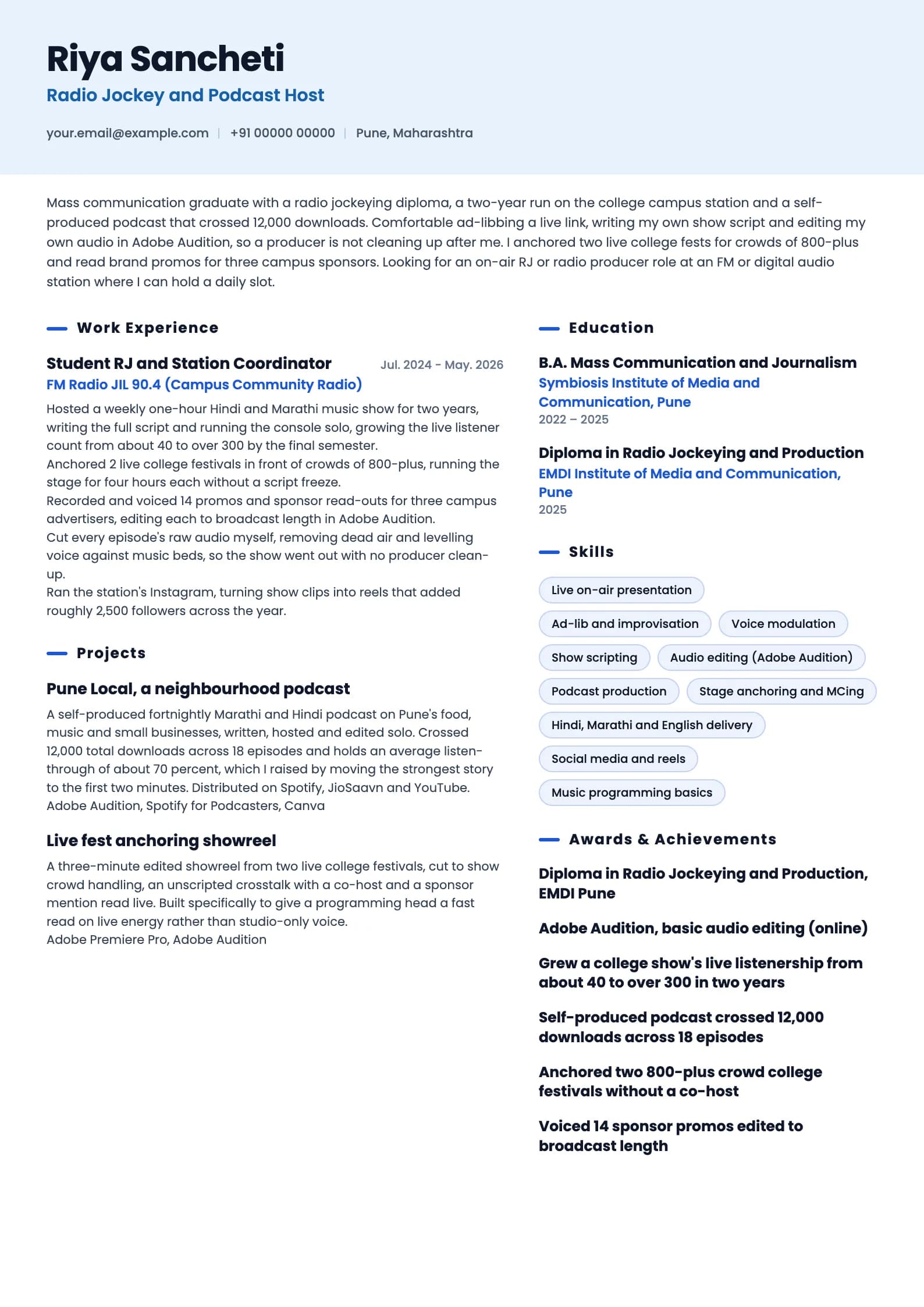
Radio Jockey Resume Format, with 3 Full Samples
A radio jockey is hired on proof of an audience that stays through the ad break, a show that holds its slot and a voice a brand is willing to pay to sit next to. Most RJ resumes list "good communication skills" and a warm personality and forget the numbers that a programming head actually reads. Below are three complete resumes, one for a fresher out of a radio course with a college station and a podcast, one for a station RJ running a daily two-hour band, and one for a senior prime-time host who carries a station's morning drive-time. After the samples come the format rules, the difference between claiming a good voice and proving a following, the terms a station HR parser matches, and the mistakes that keep a demo from ever being requested.
Build my resumeRadio Jockey resume example, Fresher (0 to 1 year)
ai-era templateIs your resume good enough?
Upload the resume you have now and see what an applicant tracking system reads before a radio jockey recruiter ever does.
Free to run. Sign in with your mobile number to see your score.
Radio Jockey resume example, Station RJ (5 years)
modern template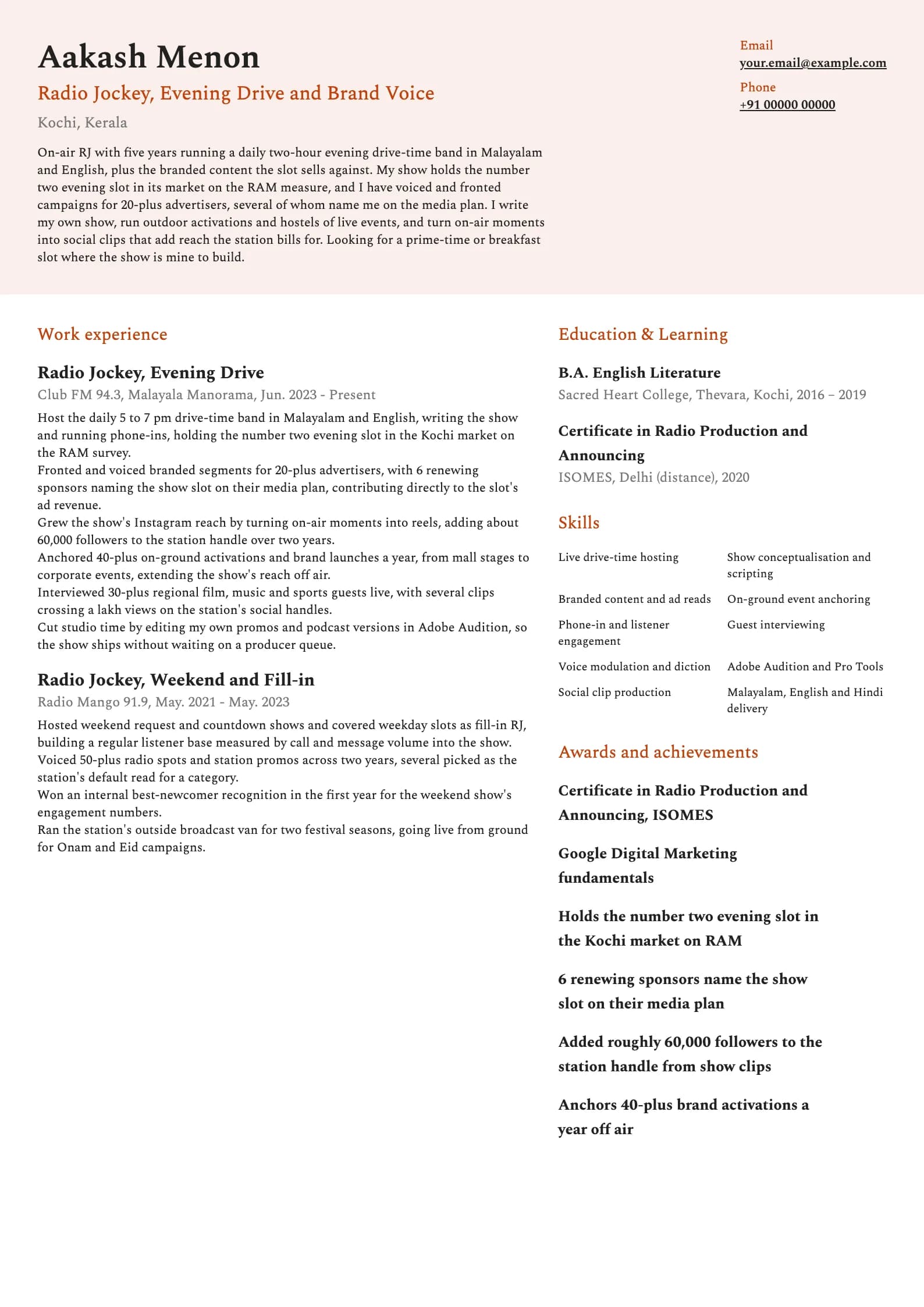
Want this structure with your own details? Build it in the resume builder.
Radio Jockey resume example, Senior host (10 years)
header-band template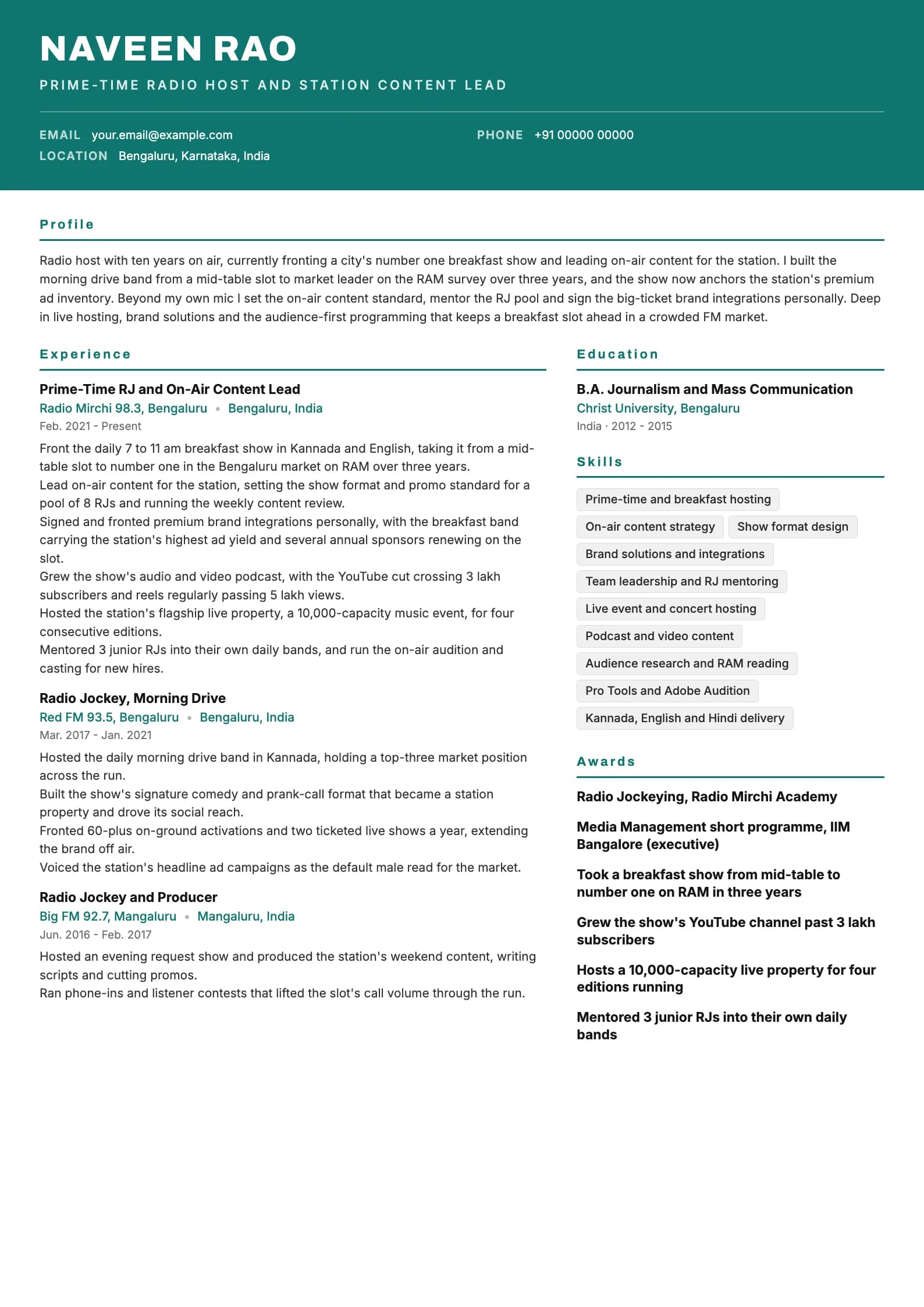
The format that works for a radio jockey resume in India
Reverse chronological is the layout to use. Most recent show or station first, then work backwards, dates on plain view. The one thing that makes an RJ resume different from an office resume is that the audio matters more than the page, so the single most important line on the whole document is a working link to a demo reel. Put it in the header, next to your name, where a programming head cannot miss it. A resume with no reel link is a resume a station has to chase, and many will not. Length is one page for almost everyone. RJs work in shows and stations, not multi-year project epics, so even a ten-year host fits a page if the older stations are trimmed to a line each. What earns space is a slot held, a rating, an audience grown and a brand fronted, not a paragraph about your passion for music. Four things do not belong on it: a full-length glamour photo, date of birth, marital status and father's name. A small professional headshot is acceptable in on-air media and sometimes expected, since presentation is part of the job, but it should look like a media headshot, not a wedding portrait, and it never replaces the demo link. Send a PDF named with your own name and "RJ" or "radio", not resume_final.pdf, so it survives a crowded inbox. Keep it single column. The table below sets out the section order that a station HR and a programming head both read cleanly.
| Section | Where it goes | Why |
|---|---|---|
| Name, headline and demo link | Top, above everything | The demo reel link is the most important item on the page. A programming head clicks it before reading a word. |
| Profile summary | Directly under the header | Three or four lines: languages, years on air, current slot and the single strongest number. |
| On-air experience | Next | Station, slot, language and show. Current show gets the most bullets. |
| Shows, events and brands | Below or inside experience | Live properties hosted, brands voiced, activations anchored. This is where reach lives. |
| Skills | Below experience | Grouped: on-air, production, languages, software. Not a wall of adjectives. |
| Education and training | Bottom, higher for a fresher | Degree, RJ course, institution, years. |
| Languages | Near skills | A casting fact in Indian radio, not a soft skill. List the ones you can host in. |
The demo reel does the hiring, the resume gets you the click
No station casts an RJ off a resume alone. The page exists to make a programming head want to press play, and once they play the reel it decides the outcome. So the two must work together: the resume promises a specific strength, and the reel delivers it in the first thirty seconds. Keep the reel short and front-loaded. Two to three minutes, best moment first. A live crosstalk that lands, an ad-lib recovery, a warm listener call, a brand read that does not sound like a brand read. Do not open with a slow music intro and your smoothest studio voice, because a station has heard a thousand smooth studio voices and is listening for the thing they cannot coach, which is live instinct. Match the reel to the slot. A breakfast-show application wants energy and banter in the sample. A late-night or storytelling slot wants a different reel entirely. Sending one generic reel to every station is the audio version of a generic objective line, and it reads the same way. Host the reel where it opens on one tap, a clean YouTube, Google Drive or SoundCloud link, and test it from a phone before you send it. A dead link or a file that asks for access permission is a rejection you handed the station yourself. Name the resume's link plainly, for example "Demo reel (2 min)", so nobody has to guess what they are clicking.
Before you send anything, open your own demo link on a phone you are not signed into. If it does not play in one tap for a stranger, the strongest applicant in the pile just filtered themselves out.
Writing a profile summary a programming head actually reads
The block under your name is the part that gets read while the reel is loading, so it should carry four facts fast: the languages you host in, how long you have been on air, your current or best slot, and the single strongest number you own. Three or four lines, no adjectives a station cannot check. The common failure is the personality paragraph: energetic, bubbly, people-person, passionate about music and connecting with the audience. Every RJ resume in the pile says this, so it carries no information and no station believes it until the reel proves it. Replace it with evidence. "Number two evening slot in the Kochi market on RAM" tells a programming head more in eight words than a paragraph of adjectives. Freshers think they have nothing to summarise. Look at the fresher sample: it names the languages, the training, a campus show that grew a real audience and a podcast with real download numbers. That is a genuine summary built from a college station and a side project, and it avoids "passionate RJ", the phrase that instantly marks a resume as a beginner's. A practical test: read your summary and ask whether a batchmate from the same RJ course could paste it onto their resume unchanged. If they could, it describes the course, not you. Add the specific slot, the specific rating or download count, and the specific brand until it only fits you.
Profile summary, station RJ
Weak
Energetic and passionate radio jockey with excellent communication skills and a bubbly personality, looking to entertain audiences and connect with listeners at a reputed FM station.
Strong
On-air RJ with five years hosting a daily Malayalam and English drive-time band, currently number two in the Kochi evening slot on RAM. Fronts branded content for 20-plus advertisers, six of whom name the show on their media plan.
The rewrite trades a personality description every applicant writes for a slot, a rating and a revenue fact a programming head and a sales head can both use.
On-air experience: slot, audience, consequence
Every strong bullet in the samples has the same shape. It names the show or slot, describes what you did on air or off it, and closes with the audience or business result. The slot tells a programming head the level. The action shows the craft. The number does the persuading, and radio has good numbers if you go and find them. Start with the outcome. RJs tend to write the task first, which produces "hosted an evening show and interacted with listeners". Instead ask what changed because of your show: the slot's rating moved, the call volume rose, a sponsor renewed on your band, the social clips added reach, an event sold out. Then write the bullet that ends in that fact. Radio gives you more metrics than people use. RAM or market rank, listener call and message volume, social followers and views added, sponsors renewing on your slot, activations anchored, spots voiced, guests interviewed, live-event crowd size. Vary them, because five "grew engagement" lines in a row read as one vague claim repeated. Where a hard rating is not yours to quote, use scope: how many hours a day the band runs, how many brands fronted, how many events a year, how many languages. "Anchored 40-plus on-ground activations a year" carries weight without a rating number. Allocate bullets by recency. Current show gets five or six, the previous station four or five, older stints one or two lines each.
| Level | What bullets must prove | Typical metric |
|---|---|---|
| Fresher | You can hold a live mic and finish a show alone | Campus listeners grown, podcast downloads, events anchored, promos voiced |
| 1 to 3 years | You run a slot and pull an audience | Call and message volume, social reach added, spots voiced, fill-in range |
| 4 to 7 years | Your slot rates and sells against brands | RAM rank, sponsors renewing on the slot, activations a year, social growth |
| 8 years and up | You set content standards and carry premium inventory | Market rank, ad yield, RJs mentored, live-property scale, podcast subs |
Experience bullet, on-air role
Weak
Hosted a daily radio show and interacted with the audience through calls and songs to keep them entertained.
Strong
Host the daily 5 to 7 pm drive-time band in Malayalam and English, holding the number two evening slot in the Kochi market on the RAM survey.
The vague version describes the job any RJ has; the rewrite names the slot, the languages and the ranking a programming head is hired to improve.
Experience bullet, brand work
Weak
Did various brand promotions and read advertisements on air for the station's clients.
Strong
Fronted and voiced branded segments for 20-plus advertisers, with 6 renewing sponsors naming the show slot on their media plan.
Turns a duty into a revenue fact, which is the language the station's sales side uses to justify keeping a show on air.
If a bullet would read identically on every other RJ's resume, it is describing radio, not you. Rewrite it until it names the slot you held and the number you moved.
The skills section: on-air craft, production and languages
An RJ resume's skills section has two jobs. It gives a station HR the literal terms their sheet or ATS scans for, and it shows a programming head what kind of host you are without a paragraph. Grouping does both. Group rather than run one long line. On-air craft, production, languages and software is a grouping that fits almost every RJ. On-air covers live presentation, ad-lib, interviewing, phone-ins, event anchoring. Production covers scripting, audio editing, podcast production. Languages is its own group because in Indian radio it is a casting decision, not a nice-to-have, and a Kannada breakfast slot will not shortlist a resume that does not name Kannada. Software is where you put the tools a station assumes: Adobe Audition, Pro Tools, and increasingly the video and reel editing a show now needs. Do not fill the section with adjectives. "Confident, energetic, creative, friendly, hardworking" are not skills, they are the demo reel's job to prove, and listing them wastes the space a real capability like "outside broadcast van operation" or "live event anchoring" should occupy. Ten to fourteen grouped, concrete skills is the working range. Name the software the way the industry writes it. Adobe Audition, not Audition; Pro Tools, not protools. A station HR sheet matches on the string, and a producer reading it forms a first impression from whether you spelled the tool of your trade correctly.
Skills section
Weak
Skills: Confident, Energetic, Good communication, Creative, Multitasking, Team player, Passionate, Hardworking, Good voice, Punctual, Friendly nature, Quick learner
Strong
On-air: live hosting, ad-lib, phone-ins, guest interviewing, event anchoring. Production: show scripting, Adobe Audition editing, podcast production. Languages: Malayalam, English, Hindi. Software: Adobe Audition, Pro Tools, Premiere Pro.
Swaps a list of personality adjectives, which the reel proves anyway, for concrete on-air and production capabilities and the languages that decide casting.
Shows, events and brands: the reach a station bills for
A modern RJ is not only a voice in a studio. Stations sell on-ground activations, brand integrations, live properties and social reach, and a host who drives those is worth more than one who only reads a shift. So a dedicated block for shows hosted, events anchored and brands fronted is not padding, it is the part of the resume the sales side reads. Name the properties and the scale. "Hosted the station's flagship 10,000-capacity music event for four editions" is a concrete, checkable line that tells a programming head you can carry a stage, not just a console. "Anchored 40-plus brand activations a year" tells them you extend the show off air, which is revenue. Brands are evidence, so name them where you can and quantify the relationship. "Fronted campaigns for 20-plus advertisers, six renewing on the slot" is far stronger than "did brand promotions", because a sponsor who renews on your specific band is voting with a budget. If a brand named you personally on a media plan, that is one of the strongest lines an RJ can write, so write it. Social reach counts now and is often undersold. A show whose clips add followers and views to the station handle is generating inventory the station sells. State it as a number: followers added, views a reel routinely crosses, subscribers on the show's podcast. Vague "managed social media" hides the one thing that makes it matter, which is the size of the audience you moved.
Where training, courses and certifications belong
Education and training go near the top for a fresher, who leads with the RJ course and the degree because there is nothing stronger yet, and drop to the bottom once you have a slot to point at. Degree, RJ course or diploma, institution, years. That is the whole block for most people. Radio jockeying is not a licensed profession in India, so there is no single certificate a station requires. A diploma from Radio Mirchi Academy, EMDI, ISOMES or a mass-communication programme signals training and helps a fresher who has no on-air history, but a station casts on the demo reel, not the certificate. Once you have hosted a rated slot, the course is a footnote and the reel is the qualification. A mass communication or journalism degree is common and worth naming, but it is not required, and plenty of successful RJs came through auditions and internships instead. If that is your path, lead with the campus station, the internship and the reel, and do not apologise for the missing formal course, because the audience does not know or care where you trained. List a course by its real name and issuing institute, with the year. Do not inflate a two-day workshop into a diploma, because the radio industry in a given city is small and a programming head will often know exactly what a named course is and how long it runs.
Getting past the station HR sheet and the ATS
Big radio networks and their parent media companies do screen applications through an applicant tracking system or an HR shortlisting sheet before a programming head ever hears your reel. It is a parser and a filter, not a judge of talent, and almost every problem it causes is a formatting problem, not a talent problem. Keep the layout parseable. One column. Standard headings, so use "On-Air Experience" or "Work Experience", not "My Radio Journey". No text baked into an image, because a poster-style header with your details inside a graphic reads as blank to a parser. Do not bury your name, current station or demo link in a header or footer region that some parsers drop. Mirror the posting's language where it is honest. If the role says "RJ", write RJ and radio jockey both, at least once each, since a recruiter may search either. If it names a language, a slot type like "breakfast" or "drive-time", or a software like Adobe Audition, and you have it, use the same word. Spell out an abbreviation once, for example "RJ (radio jockey)" and "OB van (outside broadcast van)", so both searches match. Do not stuff. A hidden block of every FM station in the country or a wall of "RJ, anchor, host, presenter, voice artist, VJ, MC, compere" repeated does not fool a recruiter and reads worse than an honest page. Write real bullets that naturally contain the terms, because a bullet describing your drive-time slot already contains "drive-time" in a form that survives human review too. Save as a text-based PDF and confirm you can select and copy a sentence from it. If the demo link is not selectable text, a recruiter who wants to click it cannot, and a parser cannot read it either.
Section heading
Weak
My Journey Behind the Mic
Strong
On-Air Experience
A parser and a busy recruiter both look for a standard heading; a creative one can drop the whole block into an unread bucket while you think you listed everything.
Copy the text out of your PDF into a plain notes app. Whatever reads cleanly there, including your demo link, is roughly what the station's system and its recruiter see. Anything scrambled is a real risk.
What gets a radio jockey resume passed over
Most RJ resumes that never lead to a demo request fail for a small set of recurring reasons, and every one is fixable in an evening. The list below is what programming heads and station HR teams in India see most often, in rough order of how much damage each does.
- No demo reel link, or a dead one. The audio is the interview, and a resume without a working link is one a station will not chase.
- A personality paragraph instead of a summary. "Energetic, bubbly, passionate" says what every applicant says and proves nothing.
- No numbers anywhere. Ratings, call volume, social reach, sponsors renewing, events anchored. Radio has metrics if you go and find them.
- One generic reel and resume sent to every slot. A breakfast show and a late-night storytelling slot want different samples, and a station can tell.
- A glamour or full-length photo instead of a clean media headshot, or no photo at all where the network's form asked for one.
- Languages left off or buried, when the slot is cast on language. A Kannada breakfast slot will not shortlist a resume that never names Kannada.
- Adjectives listed as skills. Confident, creative and friendly are the reel's job, not the skills line's.
- Brand and event work described as a duty, not a revenue fact. "Did brand promotions" hides that sponsors renewed on your slot.
- Inflating a workshop into a diploma or a fill-in week into a resident slot. Radio in a city is a small industry and it gets checked.
- Typos in the software or the station names you claim to know. "Adobe Audation" on the page of someone who edits audio for a living undoes a strong reel.
Send your resume and reel to one honest RJ friend before a station sees them. If they cannot tell your slot, your languages and your best number in fifteen seconds, a busy programming head never will.
Skills to put on a radio jockey resume
Technical
- Live on-air presentation
- Ad-lib and improvisation
- Voice modulation and diction
- Show conceptualisation and scripting
- Phone-in and listener engagement
- Guest interviewing
- Branded content and ad reads
- Stage and event anchoring
- Podcast production
- Music programming
- Outside broadcast (OB) hosting
- Audience research and RAM reading
Tools and platforms
- Adobe Audition
- Pro Tools
- Audacity
- Adobe Premiere Pro
- GarageBand
- Spotify for Podcasters
- Canva
- Instagram and YouTube Studio
- Zetta or automation console
Working skills
- Live energy and stage presence
- Quick thinking under pressure
- Audience empathy
- Storytelling
- Time and slot discipline
- Collaboration with producers
- Brand sensitivity
- Multilingual delivery
Certifications worth listing as a radio jockey
| Certification | Full name | Worth it for |
|---|---|---|
| Radio Mirchi Academy | Radio Jockeying and Anchoring Programme, Radio Mirchi Academy | The best-known station-run RJ course in India, worth it for a fresher who wants training plus a foot in the door of one of the largest networks. Least useful once you have hosted a rated slot, since stations cast on the demo reel by then. Treat it as an entry signal, not a lifelong credential. |
| EMDI RJ Diploma | Diploma in Radio Jockeying and Production, EMDI Institute of Media | A structured entry diploma covering announcing and basic production, useful for a fresher with no on-air history who needs training and a reel to show. Its value is the reel and the practice, not the paper, so pick a course with real studio time over a cheaper certificate-only one. |
| ISOMES Radio | Certificate in Radio Production and Announcing, ISOMES | A recognised radio and announcing certificate worth it for a fresher or a career switcher moving into audio. Once you have a slot and a reel, it becomes a footnote. Choose it for the hands-on production module rather than the certificate line. |
| Audio editing (Audition) | Adobe Audition audio editing course (any recognised provider) | Worth it for any RJ, because a host who edits their own promos and podcast in Audition saves a station producer time and can ship a reel without help. Especially valuable for a fresher, since self-sufficiency in production is a genuine hiring edge on a crowded shortlist. |
Keywords an ATS scans for in a radio jockey resume
These are the literal terms a parser matches against the job description. Use the ones that are true of you, in the sentences where you did the work, not as a list at the bottom.
- radio jockey
- RJ
- on-air presenter
- drive-time
- breakfast show
- live hosting
- voice modulation
- show scripting
- phone-in
- audio editing
- adobe audition
- pro tools
- podcast
- event anchoring
- branded content
- ad reads
- guest interview
- listener engagement
- RAM
- outside broadcast
Radio Jockey resume FAQ
What salary can a radio jockey expect in India?
A fresher RJ or radio producer typically starts around 2.5 to 4.5 LPA at a station, often on a probationary or contract basis. A station RJ with four to seven years holding a daily slot usually sits in the 6 to 14 LPA band, with brand voice-overs and event anchoring adding meaningful income on top. Senior prime-time hosts fronting a market-leading breakfast or drive-time show, plus their off-air brand and event fees, commonly earn 18 to 40 LPA and more at the top metros and networks. In radio, the on-air salary is only part of the picture, since voice-overs, live-event hosting and brand appearances often match or exceed the base for an established RJ.
How long should a radio jockey resume be?
One page for almost everyone. RJs work in shows and stations rather than long multi-year projects, so even a ten-year host fits a page if the older stations are trimmed to a line each. What earns space is a slot held, a rating, an audience grown and a brand fronted, not a paragraph about loving music. If you are struggling to fit one page, cut the oldest station to a single line and remove any personality adjectives, since the reel proves those anyway.
Do I need a demo reel, and does it go on the resume?
Yes, and it is the single most important thing you send. No station casts an RJ off a resume alone, so the page exists to make a programming head want to press play. Put a working demo link, labelled plainly like "Demo reel (2 min)", in the header next to your name. Keep the reel two to three minutes, lead with your strongest live moment, and match it to the slot you are applying for. A dead or access-locked link is a rejection you handed the station yourself.
Can a fresher become an RJ without a media degree?
Yes. Radio jockeying is not a licensed profession, and many working RJs came through auditions, campus stations and internships rather than a formal degree. A mass communication degree or an RJ diploma from Radio Mirchi Academy, EMDI or ISOMES helps a fresher who has no on-air history, mainly because it comes with studio practice and a reel. But a strong two-minute demo, a college show that grew a real audience and a podcast with genuine download numbers can outweigh a degree, because a station casts on the audio.
What numbers should a radio jockey put on a resume?
Whatever is honest for your work: your slot's RAM or market rank, listener call and message volume, social followers and views your show clips added, sponsors who renewed on your band, activations anchored a year, spots voiced, guests interviewed, and live-event crowd size. Radio has more metrics than most RJs use. Vary them across your bullets, because five "grew engagement" lines read as one vague claim repeated, while a rating, a sponsor renewal and a social number together read as range.
Should I put a photo on an RJ resume?
A small, clean professional headshot is acceptable and sometimes expected in on-air media, because presentation is part of the job, but it should look like a media headshot and not a full-length glamour or wedding-style photo. It never replaces the demo link, which does the real work. Skip date of birth, marital status and father's name entirely. If the network's application form specifically asks for a photo, follow the form, otherwise keep the headshot professional and let the reel and the numbers lead.
Which software should an RJ list on a resume?
List the ones you actually use, spelled the way the industry writes them: Adobe Audition and Pro Tools for audio, Audacity or GarageBand if that is your setup, and Premiere Pro or a mobile editor if you cut your own social reels, which shows now expect. Naming your editing tools matters because an RJ who edits their own promos and podcast saves a station producer time and can ship a reel without help, which is a real edge for a fresher on a crowded shortlist.
How do I show languages on a radio jockey resume?
Put them in the summary and again in a dedicated skills group, and list only the languages you can actually host in, not ones you merely speak at home. In Indian radio, language is a casting decision, so a Kannada breakfast slot will not shortlist a resume that never names Kannada, however good the English is. Naming the exact mix, for example Malayalam and English drive-time, tells a programming head immediately which slots you fit.
Do brand voice-overs and event hosting belong on an RJ resume?
Yes, and they belong prominently, because a modern station sells activations, brand integrations, live properties and social reach, not just studio shifts. A dedicated block for brands fronted, events anchored and live properties hosted is the part the station's sales side reads. Name the properties and quantify the relationship: "campaigns for 20-plus advertisers, six renewing on the slot" is far stronger than "did brand promotions", because a sponsor who renews on your specific band is voting with a budget.
Related resume examples and guides
Build your RJ resume in any of these formats
Start from a blank resume or upload the one you have. Goodspace renders it in 24 templates, keeps your demo link where a programming head will click it, and flags the on-air, production and brand keywords a station's HR sheet scans for, and the personality adjectives it will not credit.
Build my resume