Voice Over Artist Resume Format, with 3 Full Samples
A voice over artist is booked on the strength of a demo reel, a broadcast-ready home studio and a track record of jobs delivered on time, yet most voice-over resumes read like an actor's bio and forget the two things a casting director actually checks: what you sound like and whether you can deliver clean audio to spec without hand-holding. Below are three complete resumes, one for a fresher with a home booth, a demo reel and early e-learning and IVR work, one for a full-time voice artist across ads, corporate and e-learning, and one for a senior narration and dubbing specialist who voices films, audiobooks and national campaigns. After the samples come the format rules, why the reel and the gear list decide the shortlist, the terms a studio or agency parser matches, and the mistakes that keep a voice off the booking list.
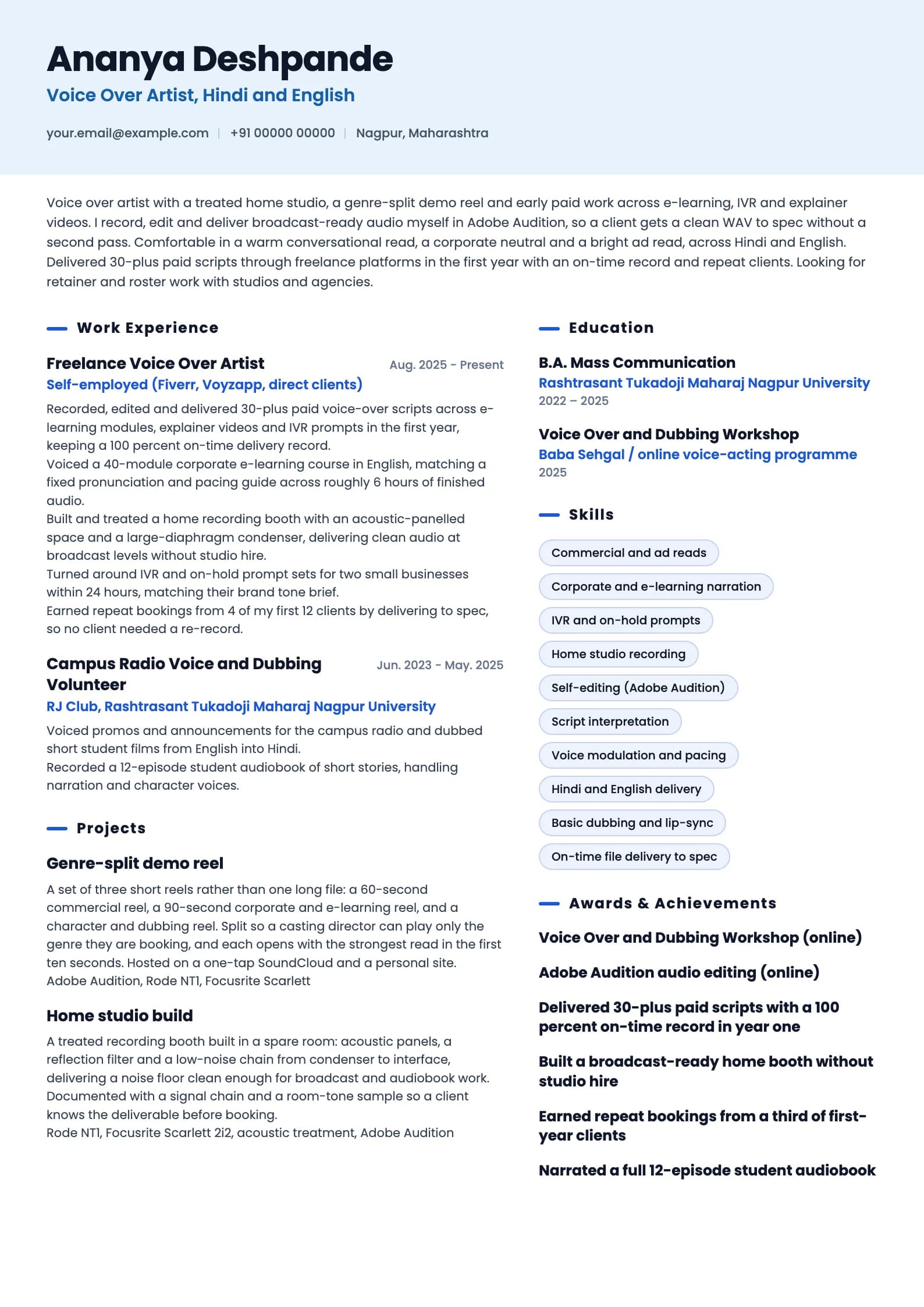
Build my resumeVoice Over Artist resume example, Fresher (0 to 1 year)
ai-era templateIs your resume good enough?
Upload the resume you have now and see what an applicant tracking system reads before a voice over artist recruiter ever does.
Free to run. Sign in with your mobile number to see your score.
Voice Over Artist resume example, Full-time voice artist (6 years)
modern template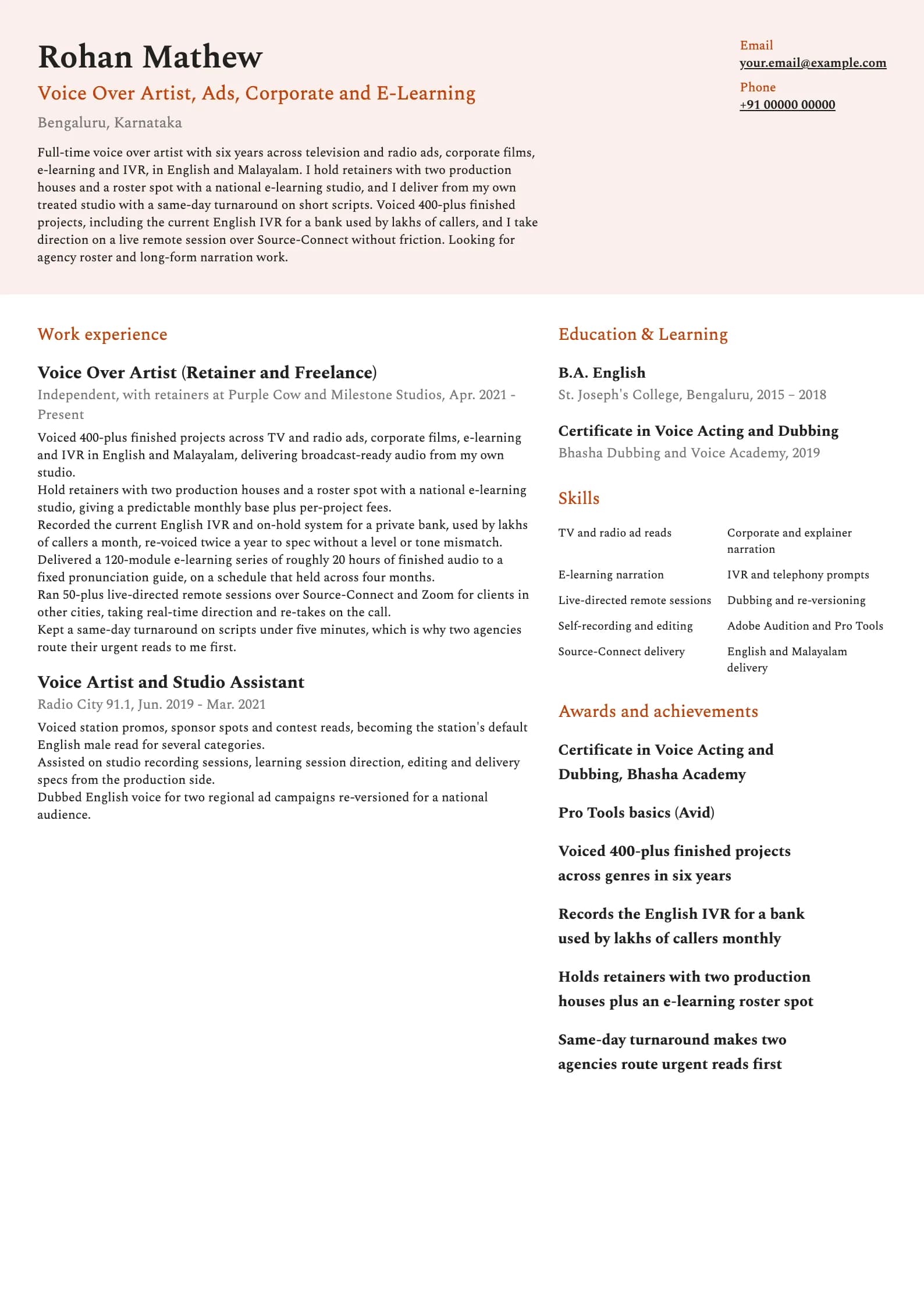
Want this structure with your own details? Build it in the resume builder.
Voice Over Artist resume example, Senior narration and dubbing (12 years)
header-band template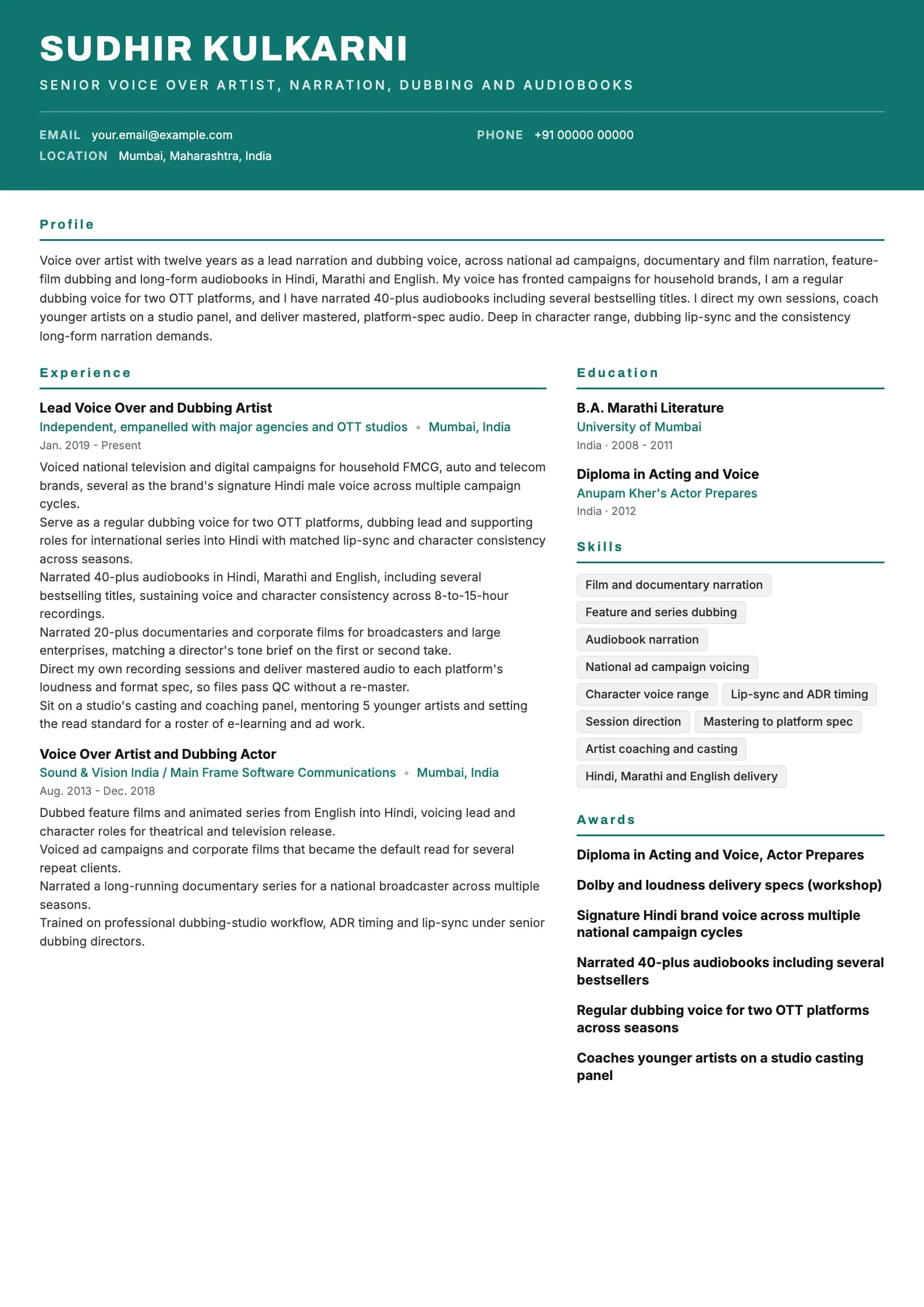
The format that works for a voice over artist resume in India
Reverse chronological is the layout to use, but a voice-over resume carries two things an ordinary resume does not, and both belong in the header next to your name: a working demo reel link and a one-line home-studio spec. A casting director shortlists on the reel and needs to know you can deliver broadcast-ready audio, so putting both up top answers the two questions that decide the booking before they read a bullet. Length is one page for almost everyone. Voice artists work in jobs and clients, not multi-year projects, so a page holds a fresher and a twelve-year narrator alike once the older work is grouped. What earns space is genres voiced, volume delivered, named clients and platforms, and the gear that proves your audio is broadcast-ready, not a paragraph about your love of storytelling. Four things do not belong: a full-length or glamour photo, date of birth, marital status and father's name. Voice-over is one of the few performing fields where looks are genuinely irrelevant, so a photo adds nothing and can distract from the only thing that matters, which is the sound. Send a PDF named with your name and "voice over", keep it single column, and make sure every link is a live, one-tap URL rather than an attachment a busy studio will not download. The table below sets out the section order.
| Section | Where it goes | Why |
|---|---|---|
| Name, demo reel and studio spec | Top, above everything | The reel link and "broadcast-ready home studio" answer the two questions that decide a booking. |
| Profile summary | Directly under the header | Languages, years, genres and the strongest volume or named credit. |
| Voice-over experience | Next | Genres and clients, most recent first. Group early freelance rather than listing every gig. |
| Genres and specialities | Below or inside experience | Ads, corporate, e-learning, IVR, dubbing, audiobooks, gaming. Say which are your core. |
| Home studio and gear | Its own short block | Mic, interface, treatment, editing software, remote-session capability. This is a hire signal. |
| Skills | Below experience | Grouped: voicing, production, languages, delivery. Not a list of adjectives. |
| Languages | Near skills | A casting fact. List the languages you can voice to broadcast standard, not just speak. |
The demo reel and the home studio decide the shortlist
No voice artist is booked off a resume alone. The page exists to make a casting director play your reel and trust your audio, so the reel link and the studio spec do most of the work and the rest of the resume supports them. Split the reel by genre rather than sending one long file. A commercial reel, a corporate and e-learning reel, and a character or dubbing reel let a casting director play only the one they are booking. Keep each short, sixty to ninety seconds, and lead with your strongest read in the first ten seconds, because a casting director listening to fifty voices in a session decides fast. The fresher sample lists exactly this genre split as a project, which is the right instinct. The home studio is half the pitch now, because most voice-over work is delivered remotely from the artist's own booth. State the chain in one line: microphone, interface, acoustic treatment and editing software, and whether you can take a live-directed session over Source-Connect, ipDTL or Zoom. A studio reading "treated booth, Rode NT1, Focusrite, Source-Connect capable" knows it can book you without hiring a room, and that makes you cheaper and easier to use than a better voice with no booth. Host everything on one-tap links and test them from a phone you are not signed into. A demo that asks for access permission or a WAV attachment a studio has to download is a booking you lost to a link that just played.
State your studio in one line and your reel as a genre split. A casting director who can hear the right genre in ten seconds and see you deliver broadcast audio from your own booth has both reasons to book you before they read a single bullet.
Writing a profile summary a casting director actually reads
The block under your name is read while the reel loads, so it should carry four facts fast: the languages you voice in, how long you have worked, your core genres, and the strongest single credit or volume you own. Three or four lines, no adjectives a client cannot verify. The common failure is the actor's-bio paragraph: a versatile and passionate voice artist with a unique voice and a love for storytelling, blessed with the ability to bring any script to life. Every voice-over resume says a version of this, so it carries no information, and a casting director skips straight to the reel to find out if it is true. Replace it with evidence: "400-plus finished projects, retainers with two production houses, records the English IVR for a bank used by lakhs of callers" tells a studio in one line that you are a working professional. Freshers think they have nothing to summarise. The fresher sample names the studio setup, the genre-split reel, 30-plus paid deliveries and an on-time record. That is a real summary built from freelance work and a home booth, and it avoids "passionate voice artist with a unique voice", the phrase that instantly marks a beginner. A practical test: read your summary and ask whether any voice artist could paste it onto their resume unchanged. If they could, it describes voice-over, not you. Add the specific genres, the specific volume and the specific named client until it only fits your reel.
Profile summary, full-time voice artist
Weak
A versatile and passionate voice over artist with a unique voice and a love for bringing scripts to life across all genres, seeking opportunities to lend my voice to exciting projects.
Strong
Full-time voice over artist with six years across ads, corporate, e-learning and IVR in English and Malayalam. Records the English IVR for a bank used by lakhs of callers, holds retainers with two production houses, and takes live-directed remote sessions over Source-Connect.
The rewrite trades an actor's-bio line every artist writes for genres, a named credit, retainer status and a concrete delivery capability a studio can act on.
Voice-over experience: genre, client, delivery
A voice-over resume is really a credits and reliability record, so each entry should say what genre you voiced, for whom, and the volume or delivery fact that proves you can be booked without risk. The genre tells a casting director whether you fit the job. The client, where you can name it, is the credibility. The volume and the delivery record are what say you will not miss a deadline or need three re-records. Group early freelance rather than listing every gig. "Delivered 30-plus paid scripts across e-learning, explainer and IVR" is stronger and cleaner than fifteen one-line entries for individual Fiverr jobs. As you grow, name the marquee work individually: the bank IVR, the OTT dubbing, the bestselling audiobook. Use the numbers voice-over actually gives you. Finished projects delivered, hours of finished audio, on-time delivery rate, re-record rate, retainer and roster spots, live-directed sessions run, audiobooks narrated, campaigns voiced, callers or learners the audio reaches. Vary them, because five "delivered high-quality audio" lines read as one claim repeated. Name clients only where you are allowed to. Much voice work is under NDA or white-labelled, so "a private bank" or "a national FMCG brand" is honest and still credible, while inventing a named client is a background-check risk in a small industry. Where a platform or a brand is public, name it. Allocate space by recency and prestige. Current retainers and marquee credits get the most lines, early freelance gets a grouped summary.
| Level | What bullets must prove | Typical metric |
|---|---|---|
| Fresher | You deliver clean audio to spec, on time, alone | Scripts delivered, on-time rate, repeat clients, studio built |
| 1 to 4 years | You work across genres and take direction | Finished projects, genres voiced, hours delivered, remote sessions |
| 5 to 8 years | You are a reliable roster voice with named credits | Project volume, retainers, marquee credit, turnaround, reach |
| 9 years and up | You are a lead narration or dubbing voice, and direct | Campaigns, audiobooks, dubbing seasons, artists coached, platform credits |
Experience bullet, voice-over delivery
Weak
Provided high-quality voice over services to various clients and delivered good audio for their projects on time.
Strong
Voiced 400-plus finished projects across TV and radio ads, corporate films, e-learning and IVR in English and Malayalam, delivering broadcast-ready audio from my own studio.
The vague version could belong to anyone; the rewrite names the volume, the genres, the languages and the fact that the audio ships broadcast-ready without a studio.
Experience bullet, dubbing work
Weak
Worked on dubbing projects for various films and shows and did the voices for different characters.
Strong
Serve as a regular dubbing voice for two OTT platforms, dubbing lead and supporting roles into Hindi with matched lip-sync and character consistency across seasons.
Turns a generic claim into a named format, a hard skill (lip-sync and consistency across seasons) and an ongoing relationship a casting director can weigh.
If a bullet would fit any voice artist's resume, it is describing the craft, not your record. Rewrite it until it names the genre, the client type and the volume or delivery fact that is yours.
The home studio block: the gear that makes you bookable
Voice-over is now a remote-first business. Most e-learning, corporate, IVR and even ad and dubbing work is recorded by the artist in their own booth and delivered as a file, so a broadcast-ready home studio is not a hobby detail, it is the thing that decides whether a studio can use you at all. Give it its own short block. State the signal chain in plain terms: the microphone, the audio interface, the acoustic treatment, and the editing and delivery software. "Treated booth, Rode NT1 into a Focusrite Scarlett, Adobe Audition" tells a studio the noise floor and the format will be right. If you own a higher-end chain, a Neumann or a Sennheiser into a good preamp in a proper vocal booth, say so, because for audiobook and premium ad work it matters. Name your remote-session capability explicitly. Whether you can take a live-directed session over Source-Connect, ipDTL or Zoom is a real filter, because a client in another city who needs to direct the read live will only book a booth that supports it. "Source-Connect capable" is a phrase worth its space. State your delivery specs and turnaround. Whether you deliver mastered audio to a platform's loudness spec, the formats you provide (WAV, MP3, split files, with or without breaths), and your typical turnaround on a short script. A studio reading "delivers to platform loudness spec, same-day on scripts under five minutes" knows exactly what it is getting, and that certainty is what gets the booking over an artist who leaves it vague.
The skills section: voicing, production and languages
A voice-over skills section has two audiences. A studio or agency's shortlisting sheet wants literal terms it can match, dubbing and IVR and e-learning. A casting director wants a fast read of what kind of voice and what kind of professional you are. Grouping serves both. Group rather than run one line. Voicing genres, production and delivery, and languages is a grouping that fits almost every voice artist. Voicing covers the read types: commercial, corporate, e-learning, IVR, dubbing, audiobook, character, promo. Production and delivery covers self-recording, editing, mastering to spec and remote-session tools. Languages is its own group and a casting decision, because a Hindi audiobook casting will not shortlist a resume that never names Hindi to a broadcast standard. Do not fill the section with adjectives. "Versatile, unique voice, expressive, dedicated, hardworking" are not skills, they are what the reel proves, and they waste the space a real capability like "lip-sync and ADR timing" or "mastering to loudness spec" should hold. Ten to fourteen grouped, concrete items is the working range. Write the tools and terms the way the industry does. Adobe Audition, Pro Tools, Source-Connect, ADR, IVR, loudness spec. A studio's sheet matches on the string, and a producer forms a first impression from whether you named the tools of the trade correctly.
Skills section
Weak
Skills: Unique voice, Versatile, Expressive, Good pronunciation, Hardworking, Dedicated, Creative, Team player, Passionate about voice acting, Good communication
Strong
Voicing: commercial, corporate, e-learning, IVR, dubbing, audiobook narration. Production: self-recording, Adobe Audition and Pro Tools editing, mastering to loudness spec, Source-Connect sessions. Languages: Hindi, English, Marathi (broadcast standard).
Swaps adjectives the reel already proves for the read types, the production and delivery capabilities and the broadcast-standard languages a casting director actually filters on.
Where training, courses and certifications belong
Voice-over is not a licensed profession, and there is no certificate a studio requires, so training goes near the top only for a fresher who has little else to show and drops to the bottom once you have a reel and credits. A voice or acting course, a dubbing workshop, the institution and the year is the whole block for most people. A voice-acting or dubbing course from a recognised academy, or an acting programme like Actor Prepares or the National School of Drama, signals training and gives a fresher a reel and technique. But casting is on the demo, so once you have delivered real work the course becomes a footnote. Do not lead a twelve-year narrator's resume with the workshop they took in year one. A degree is not required and often unrelated. Many strong voice artists came through theatre, radio or dubbing studios rather than a media degree, so if that is your path, lead with the studio work and the reel and do not treat the missing degree as a gap, because a listener cannot hear a degree. List a course by its real name, institute and year, and do not inflate a weekend workshop into a diploma. The dubbing and voice industry in a city is small and interconnected, so a named training claim is easy to check, and a senior dubbing director may know the exact course you listed.
Getting past the studio or agency screening
Large agencies, dubbing studios and e-learning companies do run applications through an applicant tracking system or a roster-management sheet before a casting director hears your reel. It is a parser and a filter, not a judge of your voice, and almost every problem it causes is a formatting problem rather than a talent problem. Keep the layout parseable. One column. Standard headings, so "Voice Over Experience" or "Work Experience", not "My Sound Journey". No text baked into an image, because a stylised header graphic reads as empty. Do not hide your name, languages or reel link in a header or footer that a parser may drop, and make the reel link real selectable text, not an image of a URL. Mirror the posting's language where it is honest. If the brief says "voice over artist", write both voice over artist and voice artist at least once, since a recruiter may search either. If it names a genre like e-learning or IVR, a language, or a tool like Source-Connect, and you have it, use the same word. Spell out an abbreviation once, for example "IVR (interactive voice response)" and "ADR (automated dialogue replacement)", so both searches match. Do not stuff. A hidden block of every language, accent and genre you can imagine does not fool an agency and reads worse than an honest page, and inventing named brand credits is a real risk in a small industry that checks. Write real entries that naturally contain the terms, because a bullet about the e-learning series you voiced already contains "e-learning" in a form that survives human review. Save a text-based PDF and confirm you can select and copy a sentence, including your reel link. If the link is not selectable, a recruiter who wants to play it cannot, and neither can the parser index it.
Section heading
Weak
The Voice Behind It All
Strong
Voice Over Experience
A parser and a busy casting assistant both scan for a standard heading; a creative one can push your whole credit list into a bucket nobody searches.
Copy the text out of your PDF into a plain notes app. Whatever reads cleanly there, including your reel and studio links, is roughly what an agency's system and its casting assistant see. Anything scrambled is a booking you may never hear about.
What keeps a voice over artist off the booking list
Most voice-over resumes that never lead to a booking fail for a small set of recurring reasons, and each is fixable in an evening. The list below is what casting directors, agencies and dubbing studios in India see most often, in rough order of how much damage each does.
- No demo reel link, or a dead or access-locked one. The reel is the booking, and a resume without a working link is one a studio will not chase.
- One long generic reel instead of a genre split. A casting director booking an ad will not sit through your audiobook reel to find the ad read.
- No home-studio spec. Most work is delivered remotely, so a studio needs to know your chain and whether you can take a live session, or it cannot book you.
- An actor's-bio summary. "Versatile, unique voice, passionate about storytelling" says what every artist says and proves nothing until the reel does.
- Adjectives listed as skills instead of genres, production capability and broadcast-standard languages.
- No numbers. Projects delivered, hours of audio, on-time rate, retainers, sessions run. Voice-over has volume and reliability metrics if you use them.
- Inventing named brand or platform credits under NDA. A small, connected industry checks, and a false credit ends the relationship.
- A photo. Voice-over is one of the few fields where looks are irrelevant, and a glamour shot only distracts from the sound.
- Languages listed loosely, mixing ones you can voice to broadcast standard with ones you merely speak, which fails you at the audition.
- Typos in the tools of the trade. "Adobe Audation" or "Source Connect" spelled wrong on an audio professional's page undoes a strong reel.
Send your resume and reel to one working voice artist before a studio sees them. If they cannot tell your core genres, your languages and whether they could book your booth for a remote session in fifteen seconds, a casting director never will.
Skills to put on a voice over artist resume
Technical
- Commercial and ad reads
- Corporate and explainer narration
- E-learning narration
- IVR and telephony prompts
- Dubbing and re-versioning
- Audiobook narration
- Character voice range
- Lip-sync and ADR timing
- Documentary and film narration
- Script interpretation and pacing
- Voice modulation and breath control
- Live-directed remote sessions
Tools and platforms
- Adobe Audition
- Pro Tools
- Audacity
- Reaper
- Source-Connect
- ipDTL
- Focusrite Scarlett interface
- Rode / Neumann / Sennheiser microphones
- Acoustic treatment and vocal booth
Working skills
- Takes direction cleanly
- On-time, to-spec delivery
- Reliability under deadline
- Script and brand sensitivity
- Consistency across long form
- Client communication
- Self-direction
- Multilingual delivery
Certifications worth listing as a voice over artist
| Certification | Full name | Worth it for |
|---|---|---|
| Voice Acting Course | Certificate in Voice Acting and Dubbing (recognised academy) | Worth it for a fresher or a career switcher who needs technique and a first reel, since a good course comes with studio practice and direction. Once you have delivered real work and built a reel, casting is on the audio and the course becomes a footnote, so do not lead an experienced resume with it. |
| Acting Diploma | Diploma in Acting and Voice (e.g. Actor Prepares, NSD, Whistling Woods) | Useful for voice artists moving into dubbing and character work, where acting range and emotional delivery matter as much as the voice. Valuable early and for a dubbing career specifically. For pure corporate, e-learning and IVR work it is less relevant than a clean read and a good booth. |
| Audition / Pro Tools | Adobe Audition or Avid Pro Tools editing certification | Worth it for any voice artist, because self-recording and editing to spec is now expected and a client wants a clean, mastered file, not raw audio. Especially valuable for a fresher, since a booth that delivers broadcast-ready audio without a studio is more bookable than a better voice that cannot self-edit. |
| Loudness / delivery spec | Broadcast loudness and delivery-spec workshop (e.g. EBU R128, platform specs) | A practical, niche credential for artists doing broadcast, OTT and audiobook work, where files must pass a platform's loudness and format QC. Worth it once you deliver mastered audio yourself, since passing QC on the first submission is a concrete reliability signal studios book on. Skip it if a studio always masters your raw takes. |
Keywords an ATS scans for in a voice over artist resume
These are the literal terms a parser matches against the job description. Use the ones that are true of you, in the sentences where you did the work, not as a list at the bottom.
- voice over artist
- voice artist
- dubbing artist
- narration
- e-learning voice over
- corporate voice over
- IVR
- ad read
- commercial voice over
- audiobook narration
- adobe audition
- pro tools
- source-connect
- ADR
- lip-sync
- home studio
- broadcast-ready audio
- voice modulation
- remote session
- script interpretation
Voice Over Artist resume FAQ
What can a voice over artist earn in India?
Income is usually per project rather than a fixed salary, which makes ranges wide. A fresher building a client base might make 1.5 to 4 LPA equivalent in the first year or two, mostly from e-learning, IVR and small ad work. A full-time voice artist with five to eight years, retainers and a steady roster commonly earns the equivalent of 8 to 20 LPA across all clients. A senior narration and dubbing voice with national campaigns, OTT dubbing and audiobooks can earn 25 to 60 LPA and more, since marquee ad campaigns and long audiobooks pay well and the best voices are booked constantly. Because it is project-based, reliability, turnaround and a broadcast-ready booth affect earnings as much as the voice itself.
How long should a voice over artist resume be?
One page for almost everyone. Voice artists work in jobs and clients, not multi-year projects, so a page holds a fresher and a twelve-year narrator alike once older work is grouped rather than listed gig by gig. What earns space is genres voiced, volume delivered, named clients and platforms, and the home-studio spec, not a paragraph about loving storytelling. The demo reel and the studio line do the heavy lifting, so the page just has to support them cleanly.
Do I need a demo reel, and how should it be structured?
Yes, the reel is what you are actually booked on. Structure it as a genre split rather than one long file: a short commercial reel, a corporate and e-learning reel, and a character or dubbing reel, each sixty to ninety seconds and leading with your strongest read in the first ten seconds. That lets a casting director play only the genre they are booking. Put a working, one-tap link in the header of the resume, labelled by genre, and test each from a phone you are not signed into so it plays for a stranger.
How important is a home studio for voice-over work?
It is now half the job. Most e-learning, corporate, IVR, and much ad and dubbing work is recorded by the artist in their own booth and delivered as a file, so a broadcast-ready home studio decides whether a studio can use you at all. State your signal chain in one line, microphone, interface, acoustic treatment and editing software, and say whether you can take a live-directed session over Source-Connect or ipDTL. A booth that can do this gets booked over a better voice that cannot.
Can I list clients that were under an NDA?
Not by name if you signed an NDA, but you can and should describe them credibly: "a private bank", "a national FMCG brand", "a leading OTT platform". That is honest and still carries weight, while inventing or naming a protected client is a real risk in a small, connected industry that checks credits. Where a brand, platform or title is public, name it, since a verifiable marquee credit is one of the strongest lines on a voice-over resume.
What numbers should a voice over artist put on a resume?
Use the ones voice-over actually gives you: finished projects delivered, hours of finished audio, on-time delivery rate, re-record rate, retainers and roster spots held, live-directed sessions run, audiobooks narrated, campaigns voiced, and how many callers or learners your audio reaches. Vary them across bullets, because five "delivered high-quality audio" lines read as one claim repeated, while a volume, a turnaround and a named credit together read as a working professional.
Do I need an acting or voice-over course to get work?
No course is required, since voice-over is not a licensed profession and casting is on the demo. A voice-acting or dubbing course, or an acting programme, helps a fresher because it comes with technique, direction and a first reel, and it is worth listing early. Once you have delivered real work, the course becomes a footnote and the reel and credits are the qualification. Many strong voice artists came through theatre, radio and dubbing studios rather than a formal course.
Should a voice over artist put a photo on the resume?
No. Voice-over is one of the few performing fields where looks are genuinely irrelevant, so a photo adds nothing and can distract from the only thing that matters, which is the sound. Skip date of birth, marital status and father's name too. Use the space a photo would take for the home-studio spec and a clean genre list instead, since those are what actually make a casting director book you.
How does a fresher voice artist get on studio rosters?
Lead with a genre-split demo reel and a broadcast-ready home booth, then build a delivery record you can quantify: scripts delivered, on-time rate, repeat clients. Take early e-learning, IVR and explainer work through platforms and direct outreach to prove you deliver clean audio to spec without hand-holding, since reliability is what turns a one-off client into a roster spot. On the resume, group that early freelance into a strong summary line rather than listing every small gig, and make the reel and studio line impossible to miss in the header.
Related resume examples and guides
Build your voice over resume in any of these formats
Start from a blank resume or upload the one you have. Goodspace renders it in 24 templates, keeps your demo reel and home-studio spec where a casting director will see them first, and flags the genre, production and language keywords a studio's roster sheet scans for, and the actor's-bio adjectives it will not credit.
Build my resume