Professor Resume Format, with 3 Full Samples
A professor is appointed on a research and leadership record that a committee scores against a hard rubric, funded projects, indexed publications, scholars guided to a PhD, and the institution-building that comes with the rank, yet many senior academic resumes still read like a longer version of an assistant professor's. Below are three complete resumes, one for an associate professor building the case for promotion, one for a full professor with a mature research group, and one for a senior professor and dean running an entire faculty. After the samples come the academic CV rules at this level, where the research score and grants belong, the difference between a long publication list and a scored one, the terms a selection committee and a parser both look for, and the mistakes that cost a senior candidate the shortlist.
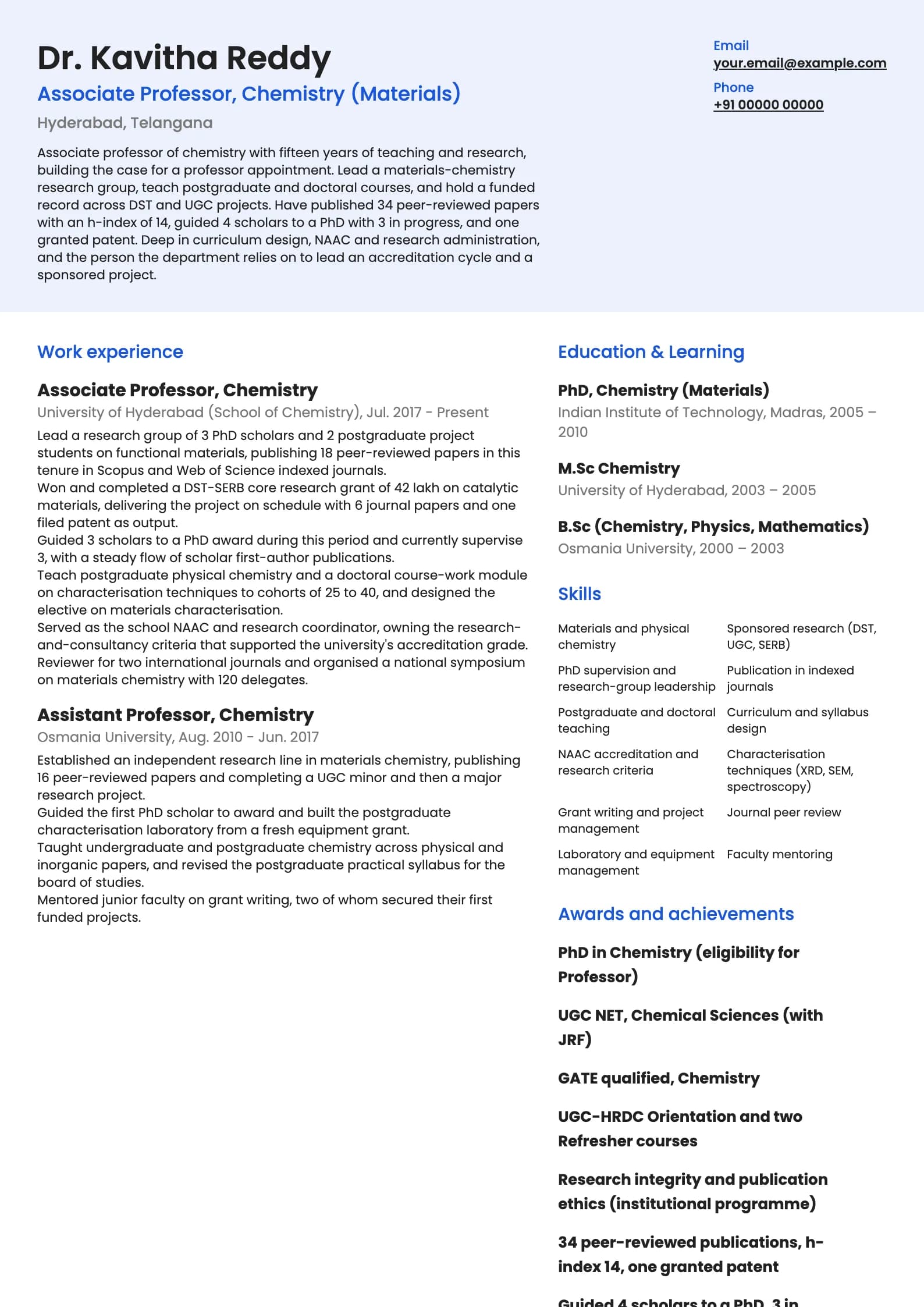
Build my resumeProfessor resume example, Associate Professor, case for promotion (15 years)
modern templateIs your resume good enough?
Upload the resume you have now and see what an applicant tracking system reads before a professor recruiter ever does.
Free to run. Sign in with your mobile number to see your score.
Professor resume example, Professor (20 years)
professional template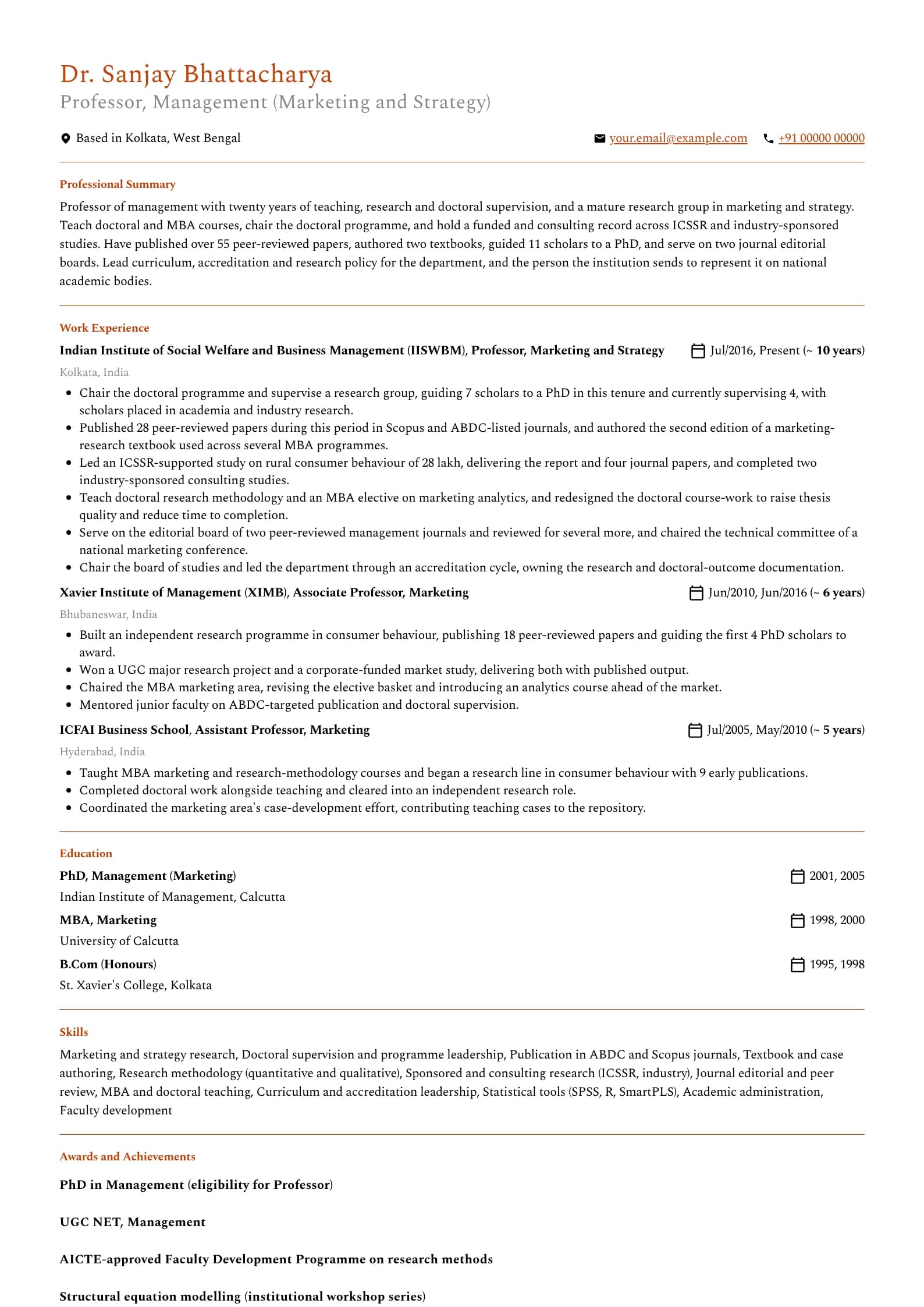
Want this structure with your own details? Build it in the resume builder.
Professor resume example, Senior Professor and Dean (26 years)
header-band template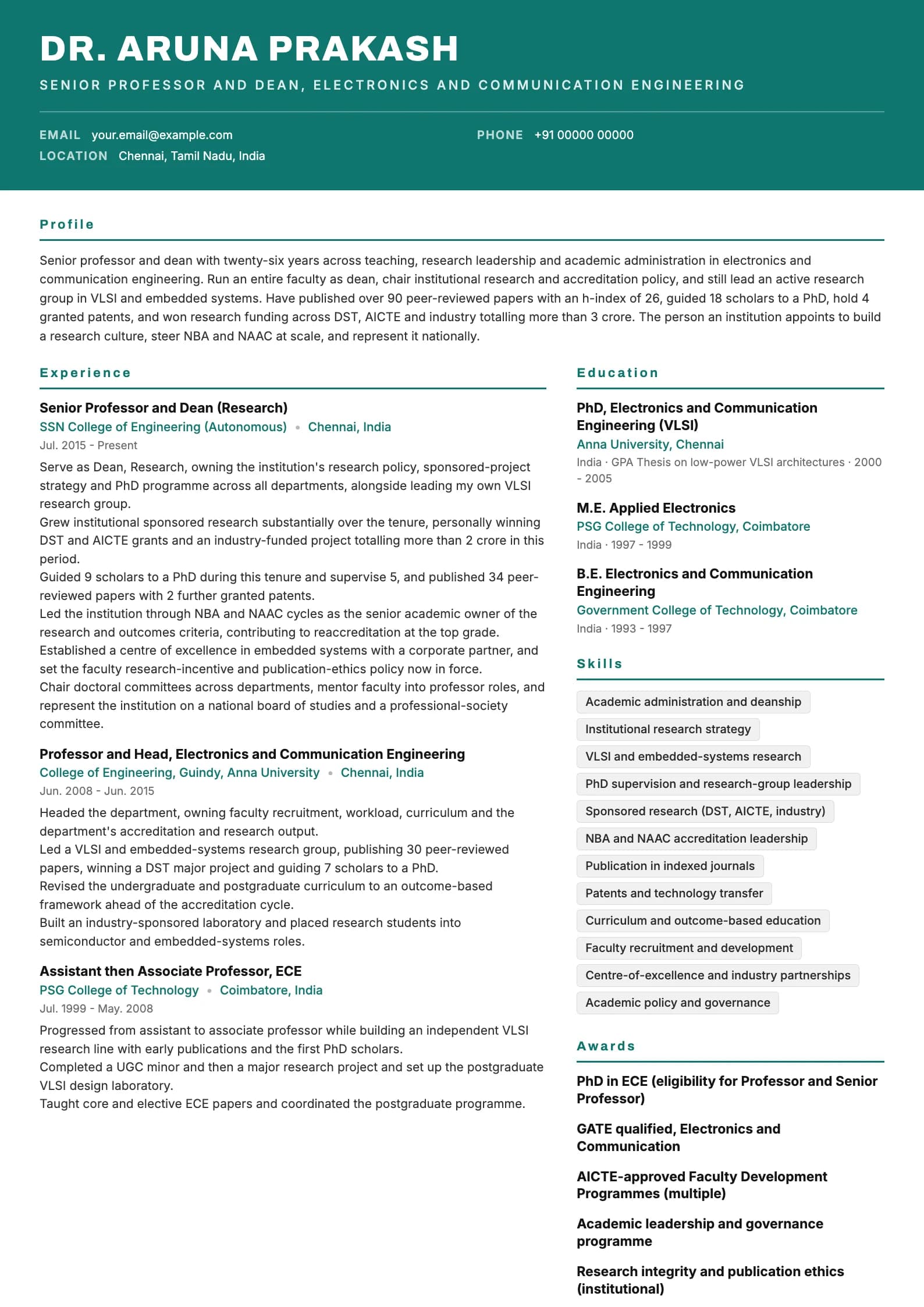
The professor-level academic CV format
A professor's resume is an academic CV, and at this level the research record leads the entire document. Reverse chronological within each block, most recent first, dates in plain view, because a selection committee scores every year, publication, grant and guided scholar against a rubric and cross-checks them against your certificates and appointment orders. Nothing is hidden and nothing is rounded up. Length is expected to be substantial. A professor with two decades of output, funded projects and a group of guided scholars will run to several pages, and a short CV at this level reads as a thin record rather than a tidy one. The discipline is not brevity but order: the reader should reach your research score, grants, publications and supervision quickly, then find teaching, administration and service in a predictable sequence. Eligibility at this level is not NET, it is the research-and-experience threshold: a PhD, the years as assistant and associate professor, the minimum research score, the scholars guided and the publications the UGC regulations require for a professor appointment. Put a compact eligibility-and-research-summary block near the top so a committee can confirm you clear the bar before it reads on. Send a PDF, name the file with your name and the post, and keep a clean single-column layout that prints and parses reliably for a committee that often receives applications by email or portal. The table below sets out the block order at professor level.
| Block | Where it goes | Why |
|---|---|---|
| Name and academic headline | Top | Rank and discipline, e.g. Professor, Physics. Committees shortlist by field and level. |
| Research summary and eligibility | Very near the top | Publications, h-index, PhDs guided, grants, years. The scored threshold for the post. |
| Funded projects and grants | High | Agency, amount, duration, output. The hardest research signal at this level. |
| Publications, books and patents | High, grouped by type | Indexed papers, authored books, patents. Counted by category. |
| Research supervision | With research | PhDs awarded and in progress. A core scored measure of research maturity. |
| Teaching and administration | Next | Courses, headship, deanship, board of studies. Leadership and institution-building. |
| Academic service and honours | Below | Editorial boards, keynotes, memberships, awards. Standing in the field. |
A long publication list is not the same as a scored one
The most common senior-academic-resume failure is a wall of publications with no structure and no metrics, so a committee cannot quickly read the research score it must assign. At professor level the committee is scoring indexed papers, h-index, citations, funded projects, PhDs guided, books and patents against a threshold, so the resume has to present exactly those, cleanly and countably. Lead with a research summary that states the totals: number of peer-reviewed papers, h-index and citation count, PhDs guided to award and in progress, funded projects with total value, books and patents. This is the block a committee reads first, and a candidate who states it plainly is easier to score than one whose numbers are buried in a fifteen-page list. List publications properly and grouped: authors in order, title, journal, year, indexing, Scopus, Web of Science, ABDC, UGC-CARE, and DOI. Separate journal papers, book chapters, conference papers, authored and edited books, and patents, because they are counted in different categories. Do not inflate, since a committee of subject experts recognises the venues and a padded list at this level damages credibility badly. Grants are the hardest signal, so give each its own line: agency, DST, ICSSR, AICTE, SERB or industry, sanctioned amount, duration, your role as principal or co-investigator, and the output. And treat scholars guided to a PhD as a headline number, because it is a core scored measure of whether you can run research, not only do it.
Research record, professor candidate
Weak
Has published numerous research papers in reputed national and international journals and guided many research scholars, with several projects and a keen interest in emerging areas.
Strong
34 peer-reviewed papers (Scopus and Web of Science), h-index 14, guided 4 scholars to a PhD with 3 in progress, one granted patent, and completed a 42 lakh DST-SERB core research grant with 6 papers as output.
The rewrite replaces numerous and many with counted, indexed, verifiable figures a committee can score directly against its rubric.
Put a research summary at the top: papers, h-index, citations, PhDs guided, grants with total value, books, patents. A committee scores against a rubric, so hand it the scored numbers rather than making it hunt.
Writing a professor-level profile a committee reads first
The block under your name should carry, in three or four lines, what a committee needs to decide whether to read on: your rank and discipline, the shape of your research record, and the leadership you hold. It is a research-and-leadership profile, not an objective, and every figure in it should be checkable. The old line, a seasoned academician with vast experience seeking a challenging position to contribute to research and education, is empty at any level and especially at this one. Replace it with a profile that states years, publication and PhD counts, funded record and current role, so a committee sees the scored threshold in the first glance. A senior candidate sometimes under-states, assuming the long CV will speak for itself. It will be scored, but the profile is what earns the close read, so it should front-load the strongest numbers: the h-index, the scholars guided, the grant total, the books and patents. The professor and dean samples both open by naming these, because at this level they are the whole case. A practical test: read your profile and ask whether it could belong to any professor in your field, or only to you. If it names your research area, your specific counts and your specific leadership role, it is yours. If it reads as a generic tribute to a long career, rebuild it around the numbers.
Academic profile, full professor
Weak
A highly experienced and dedicated academician with a passion for teaching and research and a long career in higher education, seeking a senior position in a reputed institution.
Strong
Professor of management with twenty years of teaching and doctoral supervision, 55-plus peer-reviewed papers, two authored textbooks and 11 scholars guided to a PhD, chairing the doctoral programme and serving on two journal editorial boards.
The rewrite trades a career tribute for the discipline, the counted research output and the leadership roles a committee scores.
Experience and leadership bullets at professor level
At this level the bullets carry research leadership, teaching and administration, and each should open with what you led or did, name the specific group, grant, programme or committee, and close with the countable output or outcome. The activity shows the scope of the role. The number, papers, scholars, grant value, accreditation grade, does the scoring. Do not reduce a senior career to teaching subjects. "Taught postgraduate courses and guided research scholars" wastes the strongest lines you have. Name the research group and its output, the grants with agency and amount, the scholars guided to award, the programme or department you chaired, the accreditation you owned. These are the items a committee counts, and they belong in the bullets, not implied by a job title. Make administration visible and specific, because at professor level institution-building is scored. Headship, deanship, board of studies, doctoral-committee chairing, accreditation ownership, centre-of-excellence and industry partnerships, editorial roles: name the role, the scale and the result. Owning the research criteria that lifted a NAAC grade, or setting the research policy for a faculty, is exactly the leadership a professor post is filling. Allocate bullets by recency and seniority of the work. The current professor or dean role gets the most, earlier roles fewer, and the oldest condensed to the research and leadership highlights rather than a full duty list.
| Level | What bullets must prove | Typical evidence |
|---|---|---|
| Associate Professor (promotion case) | You now lead research, not only do it | Group led, grants won, scholars guided to award, papers, accreditation criteria |
| Professor | You have scholarly standing and shape a programme | Books, editorial boards, PhD cohort, chaired programme, consulting |
| Head of Department | You run a department and its research output | Faculty and curriculum owned, department funding, PhDs, accreditation |
| Senior Professor / Dean | You set research and academic policy at scale | Institutional strategy, career funding total, h-index, centres, national roles |
Leadership bullet, senior professor
Weak
Held various administrative responsibilities in the institution and contributed to its overall academic and research development over the years.
Strong
Serve as Dean, Research, owning the institution's research policy, sponsored-project strategy and PhD programme across all departments, and grew sponsored research substantially while winning grants totalling more than 2 crore.
"Various administrative responsibilities" hides the role; the rewrite names the deanship, its scope and the funding it moved.
The skills and expertise block, grouped for a senior CV
A professor's skills block is less a checklist than a map of expertise, but it still serves two readers. A committee wants to see research areas, methods and the leadership and accreditation you can operate. An applicant tracking system, used by private universities and academic portals, wants literal terms it can match, PhD supervision, Scopus, NAAC, VLSI, ABDC. Grouping serves both. Group by function: research areas, research methods and tools, academic leadership, and teaching areas is a grouping that works across disciplines at this level. Write the terms as the field writes them, Web of Science, h-index, DST-SERB, NBA, so a parser and a committee both recognise them. The block should read as the profile of a leader in the field, not a junior candidate's tool list. Keep it defensible and senior. Twelve to eighteen items across the groups is a reasonable range, weighted toward research leadership, supervision, funding and accreditation rather than software. A professor listing basic office tools as headline skills undersells the role; the tools that belong are the ones a senior researcher genuinely operates, statistical or domain software, and the research-administration capabilities the post needs. Do not use a proficiency bar or list soft virtues as skills. At this level the publications, the scholars guided and the funded projects are the proof of capability, and a star rating or a line of adjectives beside them only weakens the page.
Skills block, senior academic
Weak
Skills: Teaching, Research, Leadership, Communication, Hardworking, MS Office, Dedication, Team Management, Discipline, Guidance, Motivation, Internet
Strong
Research areas: VLSI, embedded systems. Methods and tools: low-power design, EDA tools, statistical analysis. Leadership: research strategy, PhD supervision, NBA and NAAC. Teaching: digital systems, VLSI design.
Replaces generic virtues and basic tools with the research areas, methods, leadership and accreditation expertise a senior post and a parser actually search for.
Eligibility, qualifications and the research threshold
A professor appointment has a hard eligibility bar, and stating it clearly near the top saves a committee the work of assembling it from a long CV. The threshold is not a single test but a combination: a PhD in the discipline, the required years of experience as assistant and associate professor, a minimum research score, a required number of publications in indexed journals, and evidence of research supervision, typically scholars guided to a PhD, under the applicable UGC or AICTE regulations. Present a compact eligibility-and-research-summary block that lets a committee tick the bar quickly: PhD with year and institution, total years of teaching and research, publication count with indexing, h-index and citations, PhDs guided and in progress, and funded projects. This is the fastest way to signal that you clear the threshold before the detailed scoring begins. List degrees with the awarding institution and the year, in reverse order, and keep the doctoral thesis title, because at this level the research trajectory it started matters. Early distinctions like a university rank matter far less now than the research record, so keep them brief and let the publications and grants lead. Include the professional development that the career advancement scheme and accreditation value: UGC-HRDC courses, faculty development programmes, research-integrity and publication-ethics training, and leadership or governance programmes for those moving into deanship. Name the body and year, and as always keep the list honest, because a scrutiny committee at this level verifies every claim against the record.
Getting past the parser and the selection committee
Senior academic hiring runs two filters. Government and university recruitment uses an expert selection committee that scores your CV against a research-and-experience rubric, item by item, and cross-checks it against your certificates, sanction letters and appointment orders. Private universities and academic portals parse the file first with an applicant tracking system. A professor-level CV has to satisfy both without diluting either. For the parser, the rules are unchanged by seniority. One column. Standard headings, Research and Publications, Funded Projects, Teaching Experience, not decorative ones. Real selectable text, never a scan. Keep the name and contact block out of a header or footer some parsers drop, and mirror the advertisement's wording, professor, the discipline, PhD supervision, so the file surfaces in a search. For the selection committee, completeness and verifiability decide the score. Every scored item, each paper, grant, patent and guided scholar, should carry enough detail to be checked: journal and indexing, DOI, agency and sanction amount, patent number and status, thesis titles of scholars where relevant. A committee scores only what it can verify, so a complete, consistent record outscores a polished but vague one every time. At this level, present the research summary and totals up front so a committee can locate the threshold numbers immediately, then let the detailed lists support them. Save the PDF with real text, open it and confirm a citation copies cleanly, because the same file has to parse for the portal and read cleanly for the human who scores it.
Section heading
Weak
A Lifetime of Scholarly Pursuit
Strong
Research and Publications
A selection committee scoring against a rubric, and a parser indexing the file, both look for the standard heading; a decorative one hides the most-scored block from both.
Lead with a research summary of your totals, then verify every detailed line against its proof: DOI, sanction letter, patent number, scholar award date. At professor level the committee scores what it can check, so completeness beats polish.
What costs senior candidates the professor shortlist
Most rejections at the resume stage of a senior academic search are not close calls. They come from a small set of recurring problems, and all are fixable before submission. The list below covers what selection and scrutiny committees, and private-university recruiters, see most often on professor-level CVs, in rough order of how much damage each one does.
- No research summary, so a committee has to assemble the scored totals, papers, h-index, PhDs, grants, from a long list, and scores a lower, cautious estimate.
- "Numerous publications" and "guided many scholars" instead of counted, indexed, verifiable figures a rubric can score.
- An inflated or padded list, weak venues dressed as reputed journals, that a committee of subject experts recognises and distrusts across the whole CV.
- Grants stated without agency, amount, duration or role, when funded research is the hardest signal at this level.
- Administration reduced to "various responsibilities", hiding the headship, deanship or accreditation leadership that a professor post is filling.
- A career reduced to teaching subjects, wasting the research-leadership and institution-building lines that should lead.
- Incomplete citations, missing DOIs, years or indexing, that a scrutiny committee cannot verify and therefore cannot score.
- A profile that reads as a generic tribute to a long career rather than naming this candidate's specific research area, counts and leadership.
- A scanned or image-only PDF that a portal parser reads as blank, failing the first filter before any human sees the record.
- Any claim, a rank, a date, a grant, a supervision count, that will not match the certificates, sanction letters and appointment orders a committee verifies line by line.
Read your CV as the selection committee will: with the research-score rubric open and your sanction letters, patents and scholar records on the table. Anything you cannot back with a document is a line to complete or cut before it costs you the shortlist.
Skills to put on a professor resume
Technical
- Independent research and publication
- Research-group leadership
- PhD supervision to award
- Sponsored research (DST, ICSSR, AICTE, SERB)
- Publication in indexed journals (Scopus, Web of Science, ABDC)
- Books, monographs and patents
- Research methodology
- Postgraduate and doctoral teaching
- Curriculum and outcome-based education
- NAAC and NBA accreditation leadership
- Academic administration and governance
- Journal editorial and peer review
Tools and platforms
- SPSS
- R
- Domain and simulation software
- SmartPLS or AMOS (where relevant)
- LaTeX
- Reference managers (Zotero, Mendeley)
- Plagiarism and integrity tools (Turnitin)
- Learning management systems
Working skills
- Academic leadership
- Research mentorship
- Institution building
- National and international collaboration
- Committee and governance work
- Grant and policy writing
- Faculty development
- Conference and keynote delivery
- Strategic academic planning
Certifications worth listing as a professor
| Certification | Full name | Worth it for |
|---|---|---|
| PhD (UGC regulations) | Doctorate in the discipline under the applicable UGC or AICTE regulations | The non-negotiable base qualification for a professor post, expected of every candidate. Keep the thesis title and awarding institution, because the research line it began still matters at this level. It anchors the eligibility that the years, publications and supervision build on. |
| Research score threshold | Minimum research score and publication or supervision requirement (UGC) | Not a certificate but the scored bar a professor appointment is judged against: required indexed publications, PhDs guided and a minimum research score. Present your totals as a research summary so a committee can confirm you clear it. This is the real eligibility gate at this level. |
| UGC NET / JRF | National Eligibility Test, often with JRF, from early career | Usually held from the assistant-professor stage and worth retaining on the CV as part of the qualification trail, especially JRF, which signals an early research-funded start. At professor level the PhD and research record outweigh it, but it completes the eligibility history. |
| FDP / HRDC | UGC-HRDC courses and AICTE-approved Faculty Development Programmes | Professional development the career advancement scheme counts and that accreditation values. Name the body and year. For candidates moving into headship or deanship, leadership and governance programmes are worth listing alongside the discipline-specific ones. |
| Research integrity | Research integrity and publication ethics training | Increasingly expected and valued as institutions tighten on ethics and plagiarism, and a sensible line for anyone supervising scholars and running a research group. Signals that you set the standard for the students and faculty you lead, not only for your own work. |
| Academic leadership | Academic leadership or governance programme | Relevant for professors moving into HOD, dean or director roles, where a committee wants evidence of administrative and governance capability alongside the research record. A supporting credential that strengthens the institution-building case rather than the research one. |
Keywords an ATS scans for in a professor resume
These are the literal terms a parser matches against the job description. Use the ones that are true of you, in the sentences where you did the work, not as a list at the bottom.
- professor
- PhD
- research supervision
- PhD guided
- publications
- scopus
- web of science
- h-index
- funded research
- DST
- ICSSR
- AICTE
- patents
- NAAC
- NBA accreditation
- doctoral programme
- editorial board
- academic leadership
- dean
- higher education
Professor resume FAQ
What salary can a professor expect in India?
In government and aided universities and colleges a professor is appointed at Pay Level 14 of the 7th CPC, with an entry basic around 1,44,200 and a gross that commonly reaches roughly 1.8 to 2.3 lakh a month with allowances. A senior professor sits at Pay Level 15. Private universities and autonomous institutions vary widely, with the stronger ones matching or exceeding government scales, especially for research-active professors who bring funding and a publication record. Grants, an h-index and doctoral supervision lift both the placement and the negotiating position.
How long should a professor's resume be?
It is an academic CV, and at this level it is expected to be substantial, often several pages, because every publication, grant, patent and guided scholar is a scored item that belongs on the page. A short CV reads as a thin record, not a tidy one. The discipline is order rather than brevity: a research summary and eligibility block up front, then funded projects, publications, supervision, teaching, administration and service in a predictable sequence a committee can navigate quickly.
What qualifies someone to be appointed a professor?
A combination set by the UGC or AICTE regulations: a PhD in the discipline, a required number of years as an assistant and associate professor, a minimum research score, a required count of publications in indexed journals, and evidence of research supervision such as scholars guided to a PhD. Direct recruitment as a professor is judged on this whole threshold, not on teaching alone. State your totals in a research summary near the top so a committee can confirm you clear the bar before the detailed scoring.
How do I present my research record for a professor post?
Lead with a research summary of the totals a committee scores: peer-reviewed papers, h-index and citations, PhDs guided to award and in progress, funded projects with total value, books and patents. Then list publications grouped by type with authors, journal, year, indexing and DOI, and give each grant its own line with agency, amount, duration, your role and output. This lets a committee score you directly against its rubric instead of assembling the numbers from a long, unstructured list.
How important is research funding for a professor appointment?
It is one of the hardest and highest-scored signals at this level. A funded project with the agency named, DST, ICSSR, AICTE, SERB or industry, the sanctioned amount, the duration and your role as principal or co-investigator, shows external validation that publications alone do not. State the output too. For senior posts and deanships, the ability to win and deliver sponsored research, and to grow it for an institution, is often the deciding factor in the shortlist.
Does an associate professor list the same things when applying for professor?
The categories are the same but the emphasis shifts to leadership and the promotion threshold. The case is built on research you now lead rather than only do: a research group, scholars guided to award, grants won with agency and amount, and accreditation or programme leadership. The associate-professor sample above front-loads exactly these, because a professor appointment is scored on evidence that you can run research and build a department, not only publish and teach.
Should administrative roles like HOD or Dean go on the resume?
Yes, prominently, because institution-building is scored at professor level and is precisely what many senior posts are filling. Name the role, the scale and the outcome: department or faculty owned, curriculum revised, accreditation grade achieved, research policy set, a centre of excellence established. Pair the administration with a continuing research record where you have one, since a leader who still guides scholars and wins grants reads as standing on academic strength rather than a title alone.
Does a senior academic CV need to get past an ATS?
It depends on the employer. Government and university searches use an expert selection committee that scores the CV against a rubric and verifies every claim, so completeness matters most there. Private universities and academic portals parse the file first with an applicant tracking system, so a single-column layout, standard headings, real selectable text and wording that mirrors the advertisement all matter. Build the CV to be complete enough for a committee and clean enough for a parser, and confirm a citation copies out of the PDF before submitting.
How do I show scholarly standing beyond publications?
Name the roles that signal recognition in your field: editorial board memberships and journal reviewing, keynote and invited talks, professional-society and national board positions, authored or edited books, patents, and honours or awards. These show that the community relies on your judgement and builds on your work, which is part of what a professor post evaluates. Keep each entry specific and checkable, and group them in an academic-service-and-honours block rather than scattering them through the CV.
Related resume examples and guides
Build your own in any of these formats
Start from a blank resume or upload the one you have. Goodspace renders it in 24 templates and flags the research-score, grant and supervision keywords a selection committee and an applicant tracking system will look for, and the vague career language they will not score.
Build my resume