School Principal Resume Format, with 3 Full Samples
A principal is hired on a record of running a school, not on a list of subjects taught, yet most candidates submit a teacher's resume with a bigger title on top. A trust board or a CBSE affiliated management wants to see enrolment held or grown, board results improved, teachers led and retained, affiliation and safety compliance kept clean, and budgets managed. Below are three complete resumes, one for a senior coordinator or vice principal stepping up to a first headship, one for an established principal who has run a school through a full board cycle, and one for a senior head who oversees a group of schools. After the samples come the format rules, the shift from teaching to leadership language, the compliance sections a board checks, and the mistakes that keep a strong educator stuck below the top job.
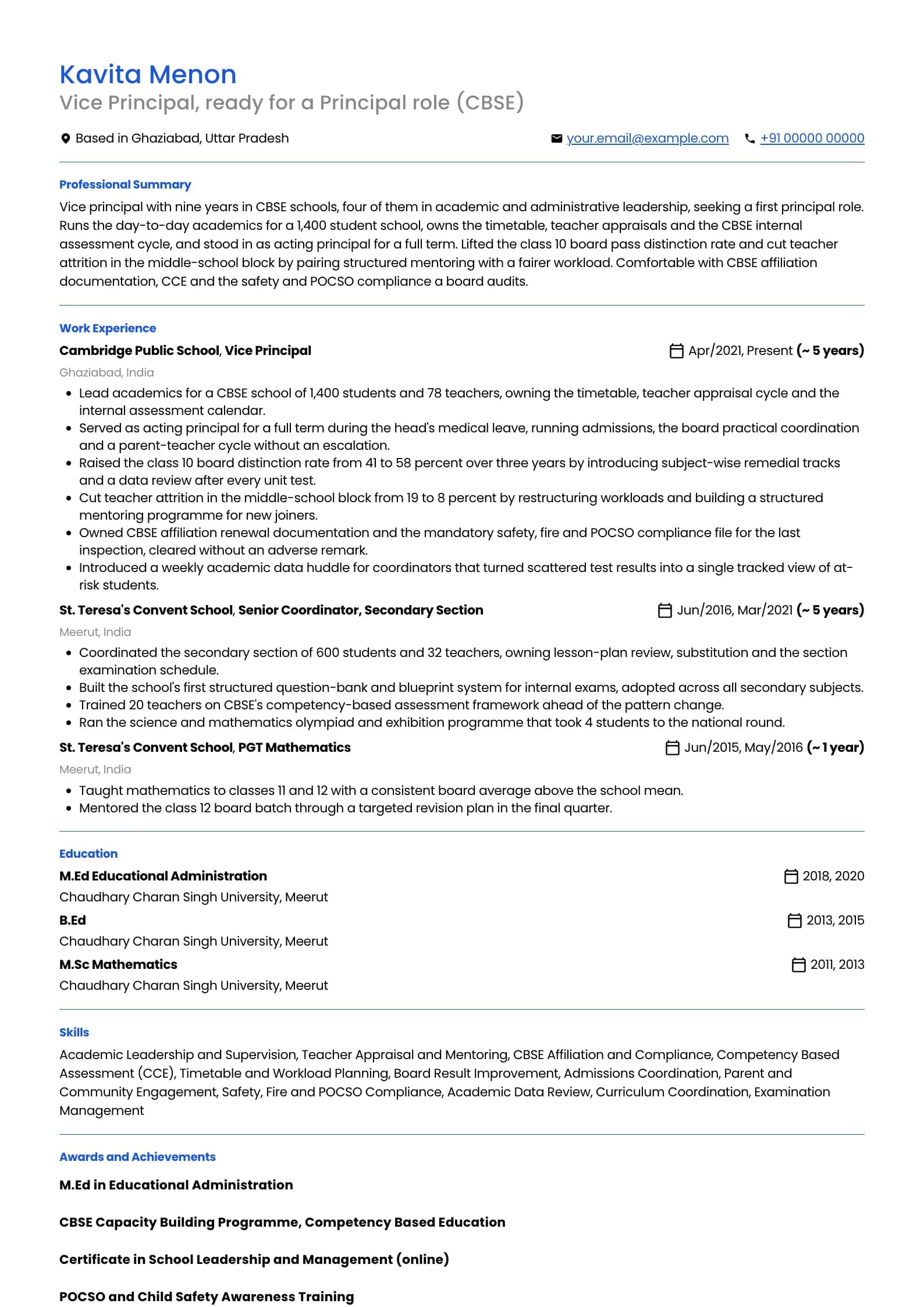
Build my resumeSchool Principal resume example, Vice Principal to first Headship (8 to 10 years)
professional templateIs your resume good enough?
Upload the resume you have now and see what an applicant tracking system reads before a school principal recruiter ever does.
Free to run. Sign in with your mobile number to see your score.
School Principal resume example, Principal (14 years)
header-band template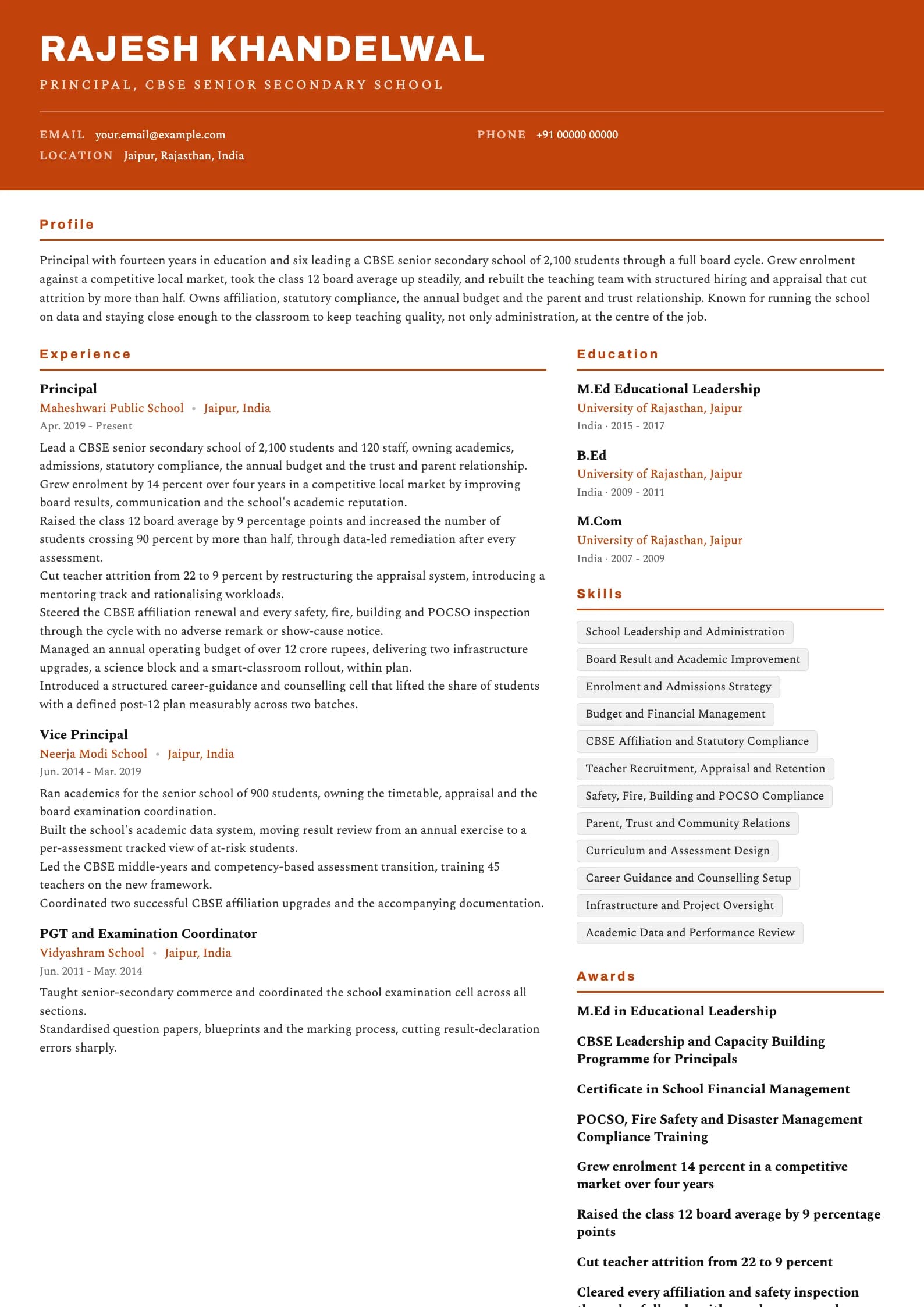
Want this structure with your own details? Build it in the resume builder.
School Principal resume example, Head of Schools and Director, Academics (20 years)
modern template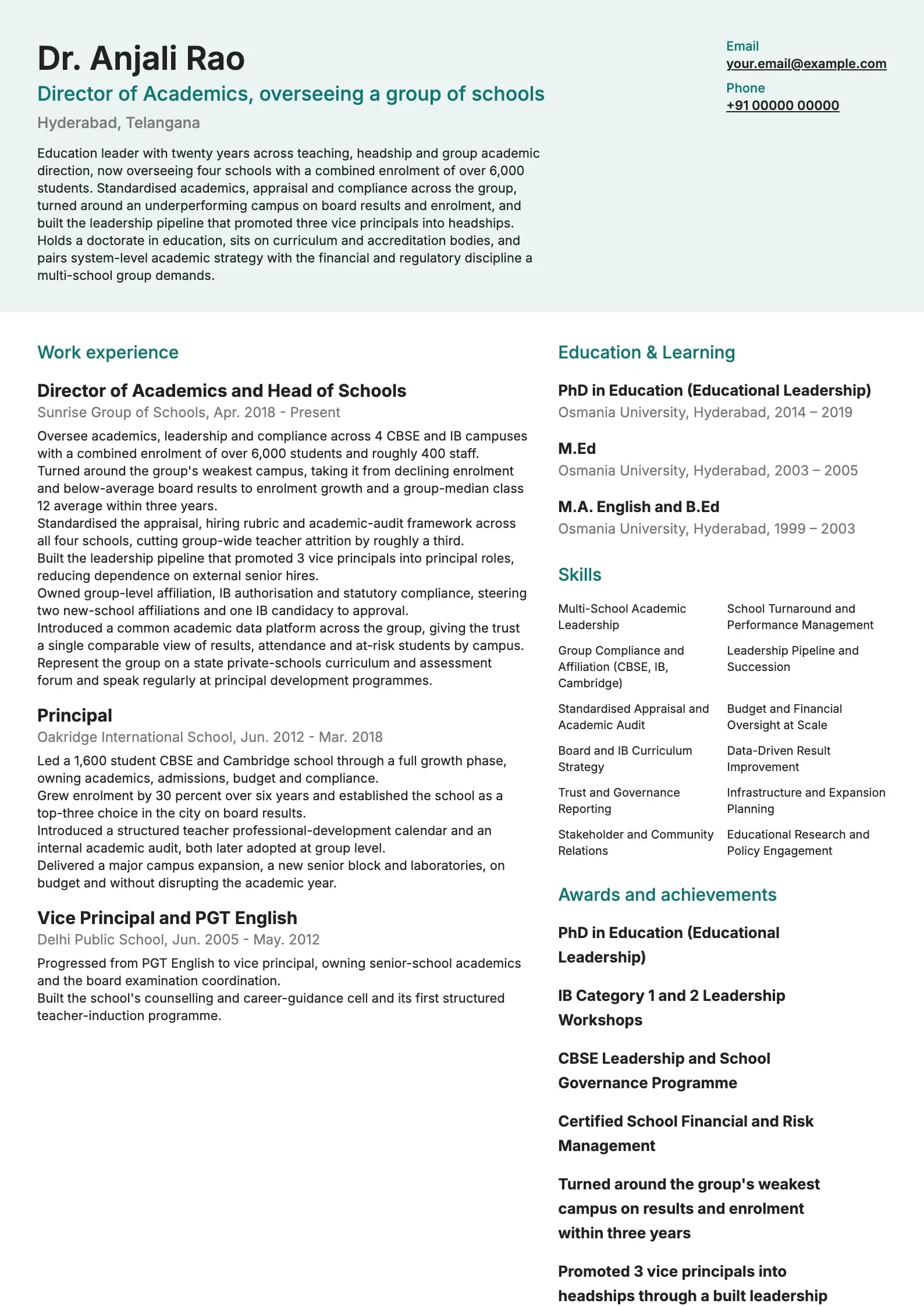
The format that works for principal resumes in India
A principal's resume is a leadership document, not a longer teacher's resume with a bigger title. A trust board, a society or a CBSE affiliated management reads it to answer a few concrete questions: can this person hold and grow enrolment, improve board results, lead and retain teachers, keep affiliation and safety compliance clean, and manage a budget. The layout should let those answers surface fast. Reverse chronological is the only sensible order, most recent role first. Two pages is the working length for a first-headship candidate; an experienced principal or a group head may run to three, because the compliance record, the budget scope and the results across a cycle are all real, verifiable content. What does not justify a longer file is a list of every workshop attended or a hobbies paragraph. The summary under the header carries four facts: the scale of the school you lead or led, how long, the results you moved, and your compliance and budget scope. Then experience, framed as leadership rather than teaching. Then education and, importantly for this role, a dedicated compliance and administration block if your inspection and affiliation record is strong, because a board weights it heavily. Keep the professional discipline of a corporate senior resume. Single column, standard headings, a PDF named with your name and the word principal. Leave off the photograph, date of birth, marital status and father's name; a governing board evaluating a school leader does not score them, and they take space a result or a compliance record should hold. The table below sets the section order.
| Section | Where it goes | Why |
|---|---|---|
| Name and headline | Top, above everything | Headline names the target role and board, e.g. Principal, CBSE Senior Secondary. |
| Leadership summary | Directly under the header | Scale of the school, years leading, the results moved, budget and compliance scope. |
| Leadership experience | Next, reverse chronological | Enrolment, results, staff led, compliance, budget. Newest role gets the most detail. |
| Compliance and administration | After experience, or woven into it | Affiliation, safety, fire, POCSO, inspections. A board weights this as risk. |
| Education and qualification | Below experience | B.Ed and M.Ed are baseline; a leadership degree or doctorate is a differentiator. |
| Professional development | After education | Leadership and governance programmes, board capacity-building courses. |
| Achievements | A short block near the top or bottom | Four to five leadership results, quantified, that summarise the record. |
From teaching language to leadership language
The most common reason a strong educator's principal application does not land is that the resume still speaks like a teacher's. It talks about lessons delivered and classes handled, when a board is looking for enrolment held, results moved, teams led and compliance kept. The record may be genuinely there, but the language hides it, and a trust reading twenty applications for a headship rewards the one that speaks its language. The shift is from I taught to I led, and from activity to institutional outcome. A teacher writes taught mathematics to classes 11 and 12. A principal candidate writes lifted the class 10 board distinction rate from 41 to 58 percent across the section. The first is a duty; the second is a school-level result the candidate owned. Every leadership bullet should name something that changed at the level of a section, a department or the school, not one classroom. This is also where scope belongs. State how many students and staff you are responsible for, because a board sizes the job by headcount. Leading academics for a 1,400 student school with 78 teachers is a scale statement a management can compare against the post it is filling. Handled academics is not. Acting-principal or officiating experience is the single most valuable thing a first-time candidate can show, because it answers the board's real fear directly: can this person actually run the school. If you have stood in as head, even for a term, state it early and state what you carried, admissions, a board cycle, a parent season, without an escalation.
Leadership summary, aspiring principal
Weak
Dedicated educator with 9 years of teaching experience, having handled various classes and administrative responsibilities, now seeking the position of Principal in a reputed school.
Strong
Vice principal with nine years in CBSE schools, running academics for a 1,400 student school and standing in as acting principal for a full term. Raised the class 10 distinction rate to 58 percent and cut middle-school teacher attrition by more than half.
The rewrite replaces teaching-and-seeking language with the scale led, the acting-principal proof and two institution-level results a board can size the candidate on.
Leadership experience: scale, result, and what you owned
A strong principal bullet names what you were responsible for, gives the scale, and closes with what measurably changed at the level of the school. The scale tells the board the size of job you can hold. The result tells it whether you improved the institution or only ran it. Both belong in almost every line. Start from the outcomes a board tracks and work backwards. Those are, roughly in order: enrolment, board results, teacher retention, compliance record, budget, and the student experience through counselling, safety and co-curriculars. For each, ask what was different after your tenure and write the sentence that lands on that fact. Grew enrolment by 14 percent in a competitive market carries more than improved the school's reputation, because it can be verified. Vary the type of result. A page of nothing but board averages reads narrowly. Across a real headship you can honestly reach for enrolment growth, board improvement, attrition cut, a clean inspection, a budget delivered, a new block built on time and a counselling cell that changed student outcomes. That range is what tells a board you can hold the whole job, not one slice of it. Where a number is not honest, give scope: how many staff, how many students, how many sections, how large a budget, how many campuses. Managed an annual budget of over 12 crore with two infrastructure upgrades within plan is a scope statement that carries real weight without inventing a percentage. Allocate detail by recency, the current or most senior role gets the most bullets.
| Level | What the resume must prove | Typical result to lead with |
|---|---|---|
| Coordinator to Vice Principal | You already run a section, and ideally the whole school in an acting capacity | Section results, attrition cut, acting-principal term, a clean inspection owned |
| Vice Principal to first Principal | You can hold the full institution, its results and its risk | Board result move, teacher retention, affiliation and safety record |
| Established Principal | You grew the school and kept it compliant and solvent | Enrolment growth, board improvement, budget delivered, clean inspections |
| Group or Director level | You set standards and build leaders across schools | Turnaround, standards set across campuses, leaders promoted, affiliations won |
If a bullet would sit unchanged on a senior teacher's resume, it has not made the jump to leadership. Add the scale you owned and the school-level result until it could only belong to someone who ran the section or the school.
The compliance record a board reads as risk
There is a section of a principal's resume that most candidates underweight and every trust board reads closely: the compliance and statutory record. A principal is the person legally accountable for the school's affiliation, its safety and fire clearances, its building and land compliance, and its child-protection obligations under POCSO. A board hiring a head is, in part, deciding who it trusts to carry that risk, so a clean, specific record is a genuine differentiator. Name the compliance you have actually owned, not the general idea of it. CBSE affiliation renewal or upgrade documentation, the mandatory safety, fire and building inspections, POCSO and child-safety committee compliance, and any board or government audit you have steered. State the outcome plainly: cleared without an adverse remark, or approved on the first submission. A board reads no adverse remark as evidence that the school will stay out of trouble under you. Be precise about which board and which framework, because CBSE, ICSE, IB, Cambridge and the various state boards have different affiliation and audit regimes, and a management wants a head who knows the one it operates under. If you have carried a school through an affiliation upgrade or an IB authorisation, that is concrete, verifiable leadership work and it belongs in the experience, not hidden in a skills line. Do not overstate. Compliance claims are the easiest thing on the resume to check, because inspection records and affiliation status are documented. A board that finds a show-cause notice you implied did not exist will end the process. Honesty here is not only ethical, it is the safe play, because the truth is verifiable either way.
Compliance bullet
Weak
Handled all administrative and compliance-related work of the school as required by the management and the board.
Strong
Steered the CBSE affiliation renewal and every safety, fire, building and POCSO inspection through the cycle with no adverse remark or show-cause notice.
Replaces a vague catch-all with the specific statutory duties owned and the clean outcome a board reads as reduced risk.
The skills and administration section: leadership, not subjects
A principal's skills section should read as a leadership and administration profile, not a subject list. The reader is a board matching you to the demands of running their school, so the section should name the leadership, financial, regulatory and academic competencies the job actually requires, grouped so a governor can scan them in one pass. Group by function: academic leadership, people and appraisal, compliance and administration, finance, and stakeholder relations is a grouping that fits almost every headship. The subject you once taught is now almost irrelevant to the section; what matters is whether you can lead a curriculum, run an appraisal system, keep an affiliation, manage a budget and hold a parent body. Name those directly. Avoid the generic-virtue trap that sinks so many education resumes. Good communication, leadership qualities, hardworking and dedicated on a principal's resume read as empty, because they are claimed by every applicant and evidenced by none. Replace each with a specific competency a board can probe: teacher appraisal and retention, CBSE affiliation and compliance, budget and financial management, board-result improvement. Twelve to sixteen items across the groups is the working range, and every one should be something your experience can back. The skills line and the experience must agree: if you list budget management, a bullet should name the budget you ran. A competency you cannot evidence in the interview costs you more than it gains you in the initial scan.
Skills section
Weak
Skills: Leadership, Communication, Team Management, Discipline, Hardworking, Dedicated, Punctual, Subject Knowledge, Computer Knowledge, Good Personality
Strong
Academic: board-result improvement, curriculum and assessment leadership. People: teacher appraisal, mentoring, retention. Compliance: CBSE affiliation, fire and POCSO. Finance: annual budget and infrastructure oversight. Stakeholders: trust and parent relations.
Swaps generic virtues every applicant claims for the grouped leadership, compliance and financial competencies a board actually hires a principal to hold.
Qualification, professional development and what a board expects
For a principal the education section confirms baseline eligibility and then, in the professional-development lines, shows that you have grown into leadership. Most managements expect a master's in the subject, a B.Ed, and increasingly an M.Ed or a leadership qualification, with a defined number of years in teaching and administration. Some boards and states publish specific eligibility norms for a principal post, so state your qualifications clearly enough for a board to check them off. List the degrees with the university and year. The M.Ed, and especially a specialisation in educational administration, leadership or management, is a real differentiator for a headship, so give it its own line. A doctorate in education is a strong signal at group and director level, where it also supports the policy and curriculum-body work senior leaders do. State a leadership degree the way it is titled, because a board reads the specialisation. Professional development is the part that separates a candidate who is still a senior teacher from one who is preparing to lead. Board capacity-building and leadership programmes, school-governance and financial-management courses, and mandatory safety and POCSO training all belong here with the year. They tell a board you have deliberately built the administrative and regulatory knowledge a head needs, rather than assuming teaching experience alone qualifies you. Drop the school-level marks and the long list of subjects you can teach once you are applying for a headship. They belong to an earlier stage of the career and compete for space with leadership results and compliance record that predict far more about how you will run a school.
Getting past the ATS and the trust's screening
Large school groups, chains and many established trusts now run applications through an HR portal or an applicant tracking system before a governor or director reads them, and even where a person opens every file, they skim for the same terms a parser would match. The rules that make a resume parse cleanly are the rules that make a busy trustee find your record fast. Use a single column and standard headings. Write Leadership Experience and Education, not My Journey in Education, because the portal and the skimming eye both look for the conventional label. Keep the facts a board searches on, principal, vice principal, CBSE, board results, affiliation, in the body of the page, not in a header or footer strip a parser can drop. Mirror the advertisement honestly. If the post is Principal, CBSE Senior Secondary, those exact words should appear in your file. Spell out an acronym alongside its short form once, for example POCSO (Protection of Children from Sexual Offences) and CBSE (Central Board of Secondary Education), so a search on either finds you. Name the board and the framework precisely, because a group running IB or Cambridge alongside CBSE screens for the specific experience. Do not stuff. A hidden line of every education buzzword, or a claim of experience you cannot support, is caught quickly and read as dishonesty, which is a worse outcome than being filtered out. Write real leadership bullets that naturally carry the right terms, because a line describing a board-result improvement contains the words board result in a context that survives a governor's reading too. Save a PDF that embeds real text and confirm you can select and copy a sentence from it. If the text will not select, a parser cannot read it, and neither can the portal that shortlists you.
Before you send it, copy the text out of your PDF into a plain editor. Whatever reads cleanly there is roughly what a portal parses and what a busy trustee skims. If your headship results and compliance record scramble, fix the layout first.
What keeps strong educators out of the principal shortlist
Most principal rejections at the file stage are not judgements that the candidate is a weak educator. They come from a resume that fails to make the case for leadership, and from a short list of recurring, fixable problems. The list below covers what trust boards and school managements see most often on Indian principal applications, in rough order of how much damage each one does.
- A teacher's resume with a principal's title on top. Lessons and classes handled, where a board wants enrolment, results, staff led and compliance owned.
- No scale anywhere. A board sizes the job by student and staff headcount, so a resume that never states them is hard to place.
- Acting-principal or officiating experience left out or buried, when it is the single strongest proof a first-time candidate can offer.
- The compliance record missing or vague, so the board cannot tell whether affiliation, safety and POCSO risk are safe in your hands.
- No budget or financial responsibility shown, leaving a management unsure you can be trusted with the money side of the job.
- Generic virtues, dedicated, hardworking, good leader, standing in for evidence a board can actually probe.
- Results stated only as reputation or improvement, with no verifiable number a trust can check against records.
- A photo, date of birth, marital status or father's name from an old template, taking space a leadership result should hold.
- Board and framework left ambiguous, so a CBSE or IB group cannot tell whether your experience fits its regime.
- Inflated titles or a compliance claim that the documented inspection and affiliation record contradicts, which ends the process at verification.
Read your resume as a trustee will, asking one question at a time: can this person grow the school, hold the results, lead the staff, and keep us compliant and solvent. Any section that does not answer one of those is a section to rewrite.
Skills to put on a school principal resume
Technical
- School Leadership and Administration
- Board Result and Academic Improvement
- Curriculum and Assessment Leadership
- Teacher Recruitment, Appraisal and Retention
- Affiliation and Statutory Compliance (CBSE, ICSE, IB, State)
- Safety, Fire, Building and POCSO Compliance
- Budget and Financial Management
- Enrolment and Admissions Strategy
- Academic Data and Performance Review
- Infrastructure and Project Oversight
- Timetable and Workload Planning
- Examination and Assessment Management
Tools and platforms
- School ERP and management systems
- Student information systems
- Academic data dashboards
- MS Excel and PowerPoint
- Online examination platforms
- Learning management systems
- Attendance and biometric systems
- Fee and finance management software
Working skills
- Team leadership and delegation
- Stakeholder and parent communication
- Conflict resolution and mediation
- Decision making under pressure
- Mentoring and succession building
- Crisis and safety management
- Negotiation with vendors and boards
- Community and trust relations
Certifications worth listing as a school principal
| Certification | Full name | Worth it for |
|---|---|---|
| M.Ed (Leadership) | Master of Education, with a specialisation in Educational Administration or Leadership | The core qualification differentiator for a principal candidate. Worth doing for any senior teacher or coordinator aiming for a headship, because most managements now expect an M.Ed and a leadership specialisation reads directly onto the job. |
| B.Ed | Bachelor of Education | The baseline teaching qualification behind every school leadership role, assumed for a principal but still stated. If you moved into leadership without it, expect a compliance gap, since many boards require it for the post. |
| CBSE Leadership Programme | CBSE Capacity Building and Leadership Programme for School Heads | Board-run leadership and governance training aimed at principals and senior leaders. Worth doing for anyone in or targeting a CBSE headship, because it signals familiarity with the board's expectations of a head and its affiliation and compliance regime. |
| PhD in Education | Doctor of Philosophy in Education or Educational Leadership | A strong signal at group, director and academic-head level, where it also supports policy, curriculum-body and research work. Not necessary for a first single-school headship, where leadership record and compliance experience matter more. |
| POCSO and Safety | POCSO, Child Safety, Fire and Disaster Management Compliance Training | Mandatory-knowledge training for the statutory duties a principal personally owns. Worth completing and stating for every candidate, because a board reads it as evidence you understand the legal risk a head carries. |
Keywords an ATS scans for in a school principal resume
These are the literal terms a parser matches against the job description. Use the ones that are true of you, in the sentences where you did the work, not as a list at the bottom.
- school principal
- vice principal
- academic leadership
- CBSE affiliation
- board results
- teacher appraisal
- school administration
- budget management
- POCSO compliance
- safety and fire compliance
- enrolment growth
- curriculum leadership
- staff management
- admissions
- M.Ed
- educational leadership
- parent engagement
- accreditation
- school management
- student outcomes
School Principal resume FAQ
What salary can a school principal expect in India?
It varies widely by school type and city. A principal at a small or mid private CBSE school in a tier-two city often earns 6 to 12 LPA. An established metro CBSE or ICSE senior secondary school typically pays a principal 12 to 25 LPA, and premium international and IB schools pay 25 to 45 LPA and higher for a proven head. Group academic directors and heads of schools at large chains sit at the top of that range and beyond. A leadership qualification, a clean compliance record and a track record of enrolment growth and board results all push the band upward.
How long should a principal resume be?
Two pages for a first-headship candidate, and up to three for an experienced principal or a group head, because the compliance record, the budget scope and the results across a full board cycle are all real, verifiable content that justifies the space. The test is whether every line is a leadership fact a board can check. Padding with workshop lists, a hobbies paragraph or a declaration is what makes a resume too long, not genuine leadership evidence.
How is a principal resume different from a teacher resume?
A teacher resume proves you can teach; a principal resume proves you can run a school. The language shifts from lessons delivered to enrolment held, results moved, teachers led and compliance kept. State the scale you are responsible for in students and staff, lead with institution-level results rather than classroom ones, and add the sections a board weights for a head: a compliance and affiliation record, budget responsibility, and leadership development. The subject you once taught becomes almost irrelevant to the decision.
What qualifications do I need to become a principal?
Most managements expect a master's in a subject, a B.Ed, and increasingly an M.Ed or a leadership qualification, along with a defined minimum of teaching and administrative experience, often around ten to fifteen years with several in a leadership role. Specific boards and states publish their own eligibility norms, so check the advertisement. Beyond the paper qualification, acting-principal or vice-principal experience and a clean affiliation and safety record are what actually move a candidate onto the shortlist.
I am a vice principal. How do I show I am ready to be a principal?
Lead with any experience running the whole school, especially an acting-principal or officiating term, and state exactly what you carried: admissions, a board cycle, a parent season, an inspection, without an escalation. Then show institution-level results you owned, board improvement, teacher retention, a clean compliance file, and any budget or infrastructure responsibility. The board's real question is whether you can hold the full job, and proof that you already have, even briefly, answers it more powerfully than years as a deputy.
Should the resume mention affiliation and safety compliance?
Yes, prominently. A principal is legally accountable for affiliation, safety, fire, building and POCSO compliance, and a board hiring a head is deciding who it trusts with that risk. Name the specific compliance you have owned and the outcome, for example cleared the CBSE affiliation renewal and every safety and POCSO inspection with no adverse remark. It is one of the strongest differentiators on the page, and because inspection records are documented, an honest, specific claim is also the safe one.
Do school groups use an ATS for principal hiring?
Large school groups, chains and many established trusts run applications through an HR portal or applicant tracking system before a governor reads them, and even manual screeners skim for the same terms. Use a single column, standard headings, and keep the facts a board searches on, principal, CBSE, board results, affiliation, in the body rather than a header strip. Name the board and framework precisely, because a group running IB or Cambridge alongside CBSE screens for the specific experience. Test the file by copying its text into a plain editor.
Should I list the subjects I used to teach?
Only briefly, and lower down. Your subject and teaching years establish where you came from, but for a headship the decision turns on leadership, results, compliance and finance, not on which subject you taught. Keep a short line acknowledging your teaching background and specialisation, then give the space to what a board actually scores a principal on. Once you are applying for a head role, a long subject list and school-level marks read as a resume that has not made the jump to leadership.
Do I need a photo on a principal resume in India?
No. A governing board evaluates leadership record, results and compliance, none of which a photograph informs. The same goes for date of birth, marital status, father's name and a declaration paragraph, which come from an older template and take space a leadership result should hold. If a specific school's application portal has its own photo field, use that, but keep the resume itself a clean professional leadership document.
Related resume examples and guides
Build your own in any of these formats
Start from a blank resume or upload the one you have. Goodspace renders it in 24 templates and flags the leadership, compliance and result keywords a trust board will look for, and the teaching-resume filler it will not credit for a headship.
Build my resume