Assistant Professor Resume Format, with 3 Full Samples
An assistant professor is selected on eligibility that is non-negotiable, UGC NET or a PhD under the current regulations, and then on the depth of teaching and research behind it, yet most academic resumes bury the eligibility and pad the rest with a page of soft phrases. Below are three complete resumes, one for a freshly NET-qualified fresher moving from ad-hoc teaching, one for a mid-career assistant professor with a PhD and a steady publication record, and one for a senior-scale assistant professor with funded projects and research supervision. After the samples come the academic format rules, where publications and eligibility actually belong, the difference between listing research and proving it, the terms a selection committee and a parser both look for, and the mistakes that get a resume screened out before the interview call.
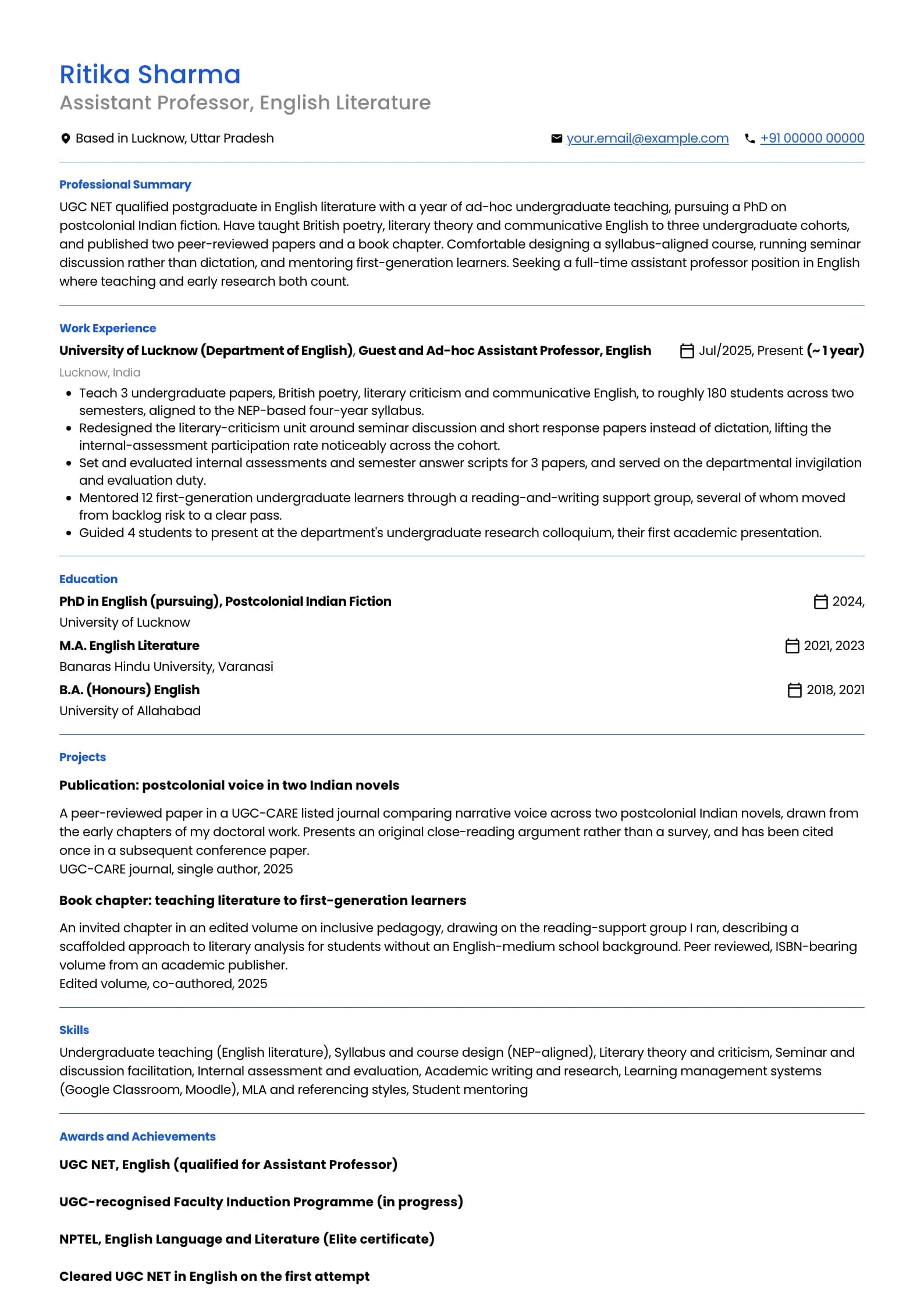
Build my resumeAssistant Professor resume example, Fresher (NET-qualified, 1 year ad-hoc)
minimalist templateIs your resume good enough?
Upload the resume you have now and see what an applicant tracking system reads before a assistant professor recruiter ever does.
Free to run. Sign in with your mobile number to see your score.
Assistant Professor resume example, Mid-career (6 years, PhD)
professional template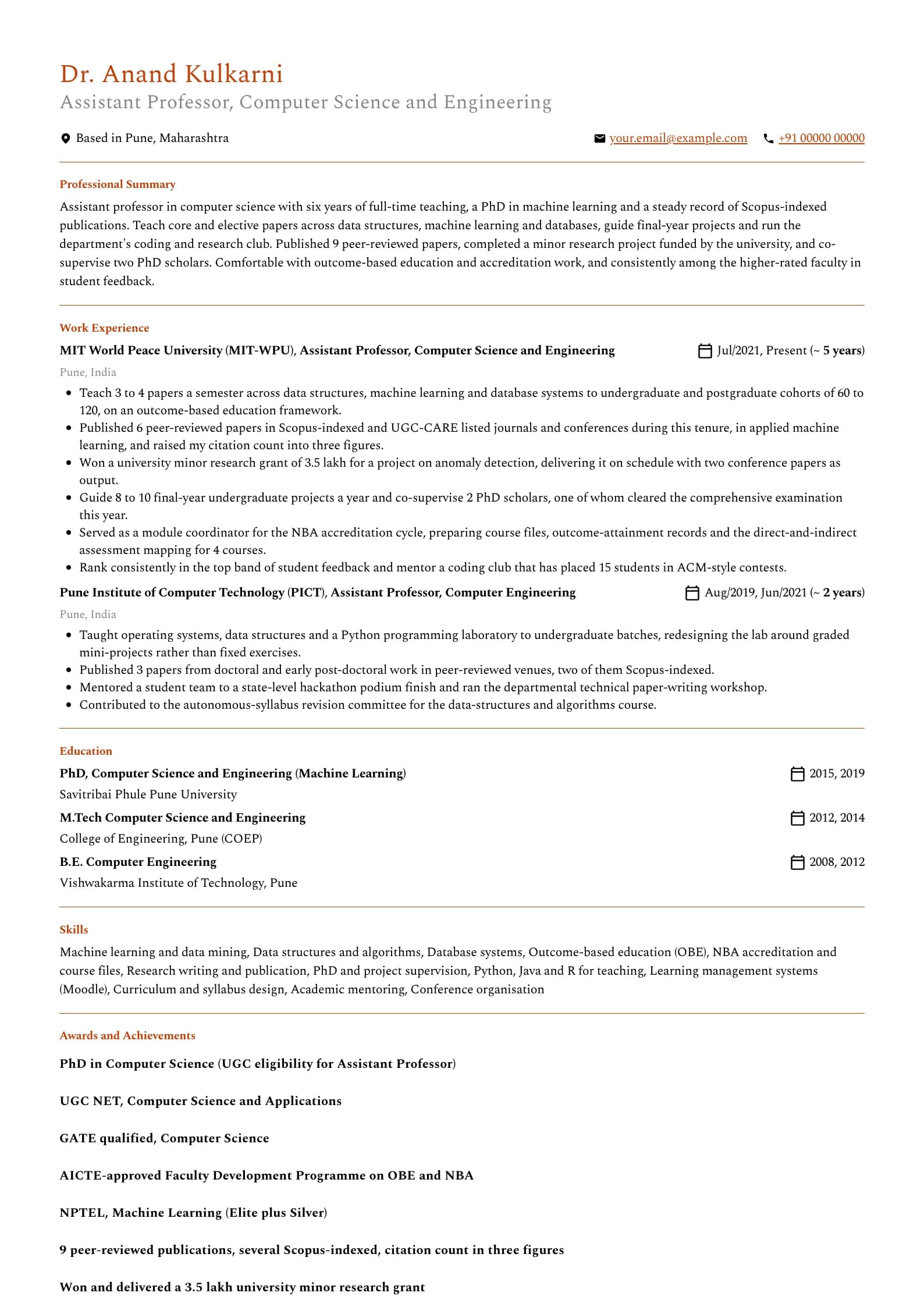
Want this structure with your own details? Build it in the resume builder.
Assistant Professor resume example, Senior scale (12 years, PhD, funded projects)
header-band template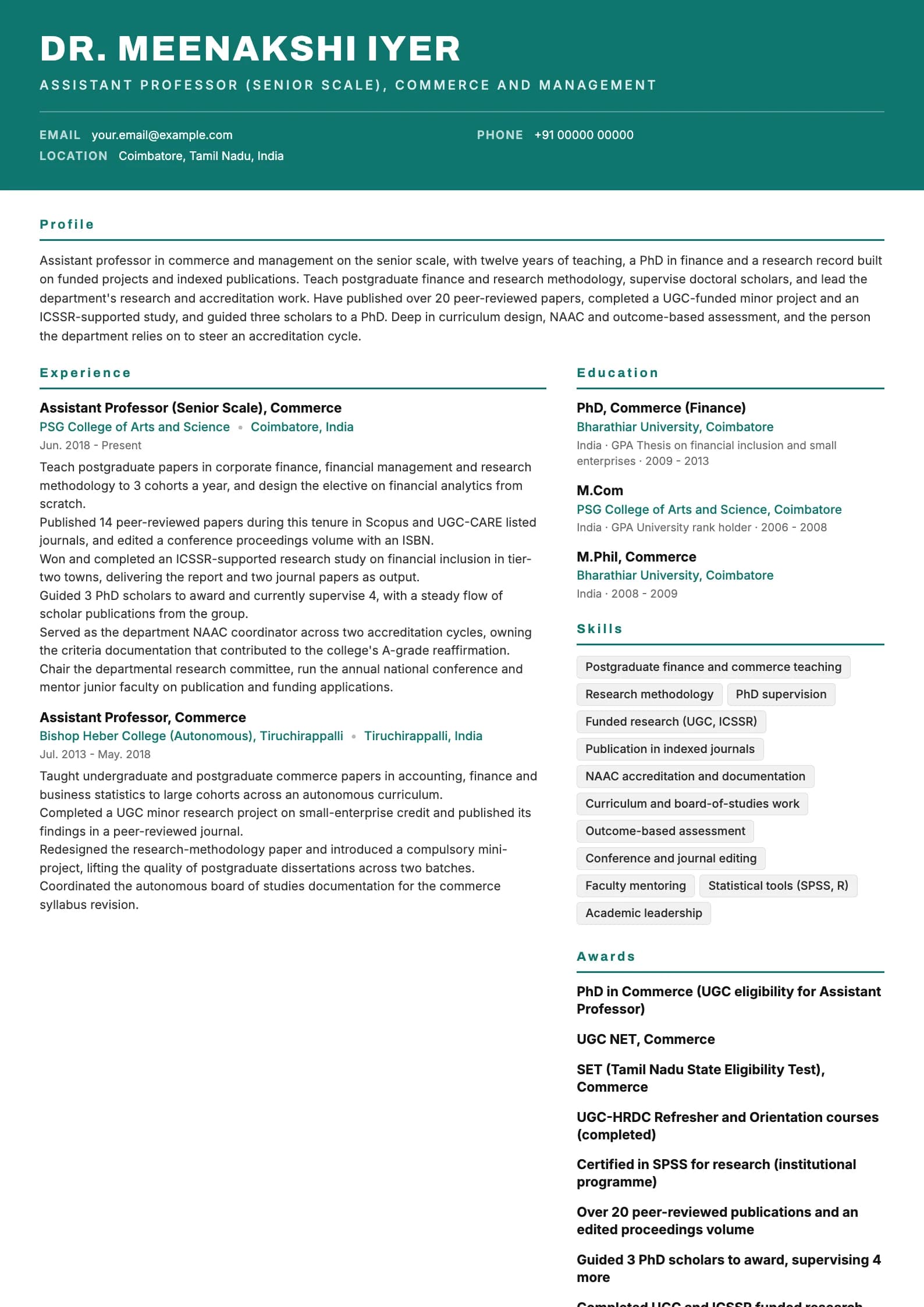
The academic resume format that works in India
An assistant professor resume is really an academic CV, and it is ordered differently from a corporate one. Eligibility and research lead, because a selection committee filters on them first. Reverse chronological within each block, most recent first, dates in plain view. Never hide dates, because in academia every year, publication and funded project is a scored item and a committee cross-checks them against your certificates and the API-style record. Length works the opposite way to a corporate resume. A fresher can hold to two pages, but an established academic with a long publication list and funded projects is expected to run longer, and a padded-out two pages will look thin next to peers who list real output. What matters is that the length is filled with checkable research, teaching and service, not soft description. Eligibility is not a footnote. UGC NET, SET or SLET, or a PhD under the current UGC regulations, is the gate for the post, so it belongs near the top where a committee sees it in the first glance, alongside your subject. Burying NET on the last line under hobbies is a common and costly mistake. Send a PDF, name the file with your name and the post, and keep a clean single-column layout so it parses and prints cleanly for a committee that may receive it by email. The table below sets out the section order for an academic resume.
| Section | Where it goes | Why |
|---|---|---|
| Name and academic headline | Top | Subject and post, e.g. Assistant Professor, Economics. Committees shortlist by discipline. |
| Eligibility and qualifications | Very near the top | UGC NET or SET, PhD status. The gate for the post, so make it the first thing read. |
| Research and publications | High, above or beside teaching | Indexed papers, books, chapters, projects. The single most scored block. |
| Teaching experience | Next | Institution, papers taught, cohorts, most recent first. |
| Funded projects and supervision | After research or merged into it | Grants with agency and amount, scholars guided. A hard research signal. |
| Academic service | Below teaching | Accreditation, board of studies, committees, conference organisation. |
| Education | Lower down | Degrees with class and university. Eligibility already sits at the top. |
Listing research is not the same as proving it
The most common academic-resume failure is a paragraph that says has a keen interest in research and several publications in reputed journals, with no list a committee can check. Selection committees score publications by title, journal, indexing and year, so a vague claim scores nothing. A named list scores. List each publication properly: authors in order, title, journal or venue, year, and the indexing that matters, Scopus, Web of Science, UGC-CARE listed, along with a DOI or ISBN where it exists. Group them by type, journal papers, book chapters, conference papers, edited volumes, because a committee counts them by category. Do not inflate a departmental newsletter into a journal or a local seminar into an international conference, since committees know the venues in their own field and a padded list damages more than a short honest one. Separate the funded work and make it prominent. A project with the funding agency named, UGC, ICSSR, DST, AICTE, and the amount and duration, is one of the strongest signals on an academic resume, because it shows external validation of your research. State the output too, the report submitted and the papers it produced. Supervision is research evidence. Name how many PhD scholars you have guided to award and how many you currently supervise, and how many postgraduate dissertations or projects you mentor. For a mid-career or senior candidate this is a scored measure of research maturity, not an afterthought.
For every research claim, ask: can a committee find and count it. A named paper with a journal, an index and a year is a scored item. "Several publications in reputed journals" is not.
Writing an academic summary a committee actually reads
The block under your name should carry three facts a committee wants immediately: your eligibility and highest qualification, what and how long you have taught, and the shape of your research record. Three or four lines, specific, no unverifiable adjectives. The old objective line, seeking a challenging teaching position in a reputed institution to impart quality education, tells a committee nothing. Replace it with a profile that states NET or PhD, the subject, the years, and the count of publications and funded projects. An objective describes what you want; an academic profile describes what you have already qualified for and produced, and only one is scored. Freshers often feel they have nothing to summarise. The fresher sample shows otherwise: it names UGC NET, the doctoral topic, the papers taught and two real publications. That is a genuine early-career profile. What it avoids is "a passionate educator dedicated to shaping young minds", a line so common on teaching resumes that it now signals nothing. A practical test: read your profile and ask whether any NET-qualified peer in your subject could paste it onto their resume unchanged. If they could, it describes the qualification, not you. Add the specific research area, the specific publication count and the specific funded project until it is yours alone.
Academic profile, mid-career faculty
Weak
A passionate and dedicated educator with several years of teaching experience and a keen interest in research, seeking a challenging position in a reputed institution to impart quality education.
Strong
Assistant professor in computer science with six years of teaching, a PhD in machine learning and 9 peer-reviewed publications, several Scopus-indexed. Won a university research grant and co-supervise two PhD scholars.
The rewrite trades passion and reputation language for eligibility, a discipline, a publication count and funded, verifiable research.
Teaching and service bullets: what you taught, and what changed
Academic experience bullets have a shape too, though it differs from a corporate one. Open with what you did, name the specific papers, cohorts or committee, and where you can, close with a checkable result: a redesigned course, a lifted feedback score, mentored students who progressed, an accreditation delivered. The activity shows the range of your role. The evidence separates you from a resume that only lists subjects. Do not reduce teaching to a subject list. "Taught various subjects to undergraduate and postgraduate students" is the weakest common line on an academic resume. Name the papers, the level, the cohort size, and where you shaped the course, say so: designed the elective, revised the syllabus, moved a lab to graded projects, introduced a compulsory mini-project. Make academic service visible and specific. Board of studies work, NBA or NAAC coordination, syllabus revision, conference organisation and committee roles are scored and are exactly what a hiring department needs done. Name the accreditation body and your role, because owning course files or NAAC criteria documentation makes you a lower-risk appointment. Where numbers are honest, use them: cohort sizes, papers taught, students mentored to a result, grants with amounts, feedback bands, scholars guided. Where a number would be forced, state scope instead, how many papers, which committees, how many accreditation cycles, and let the specificity carry the weight.
| Career stage | What bullets must prove | Typical evidence |
|---|---|---|
| Fresher / ad-hoc | You have run a real classroom and started research | Papers taught, cohort size, first publications, students mentored |
| Assistant Professor (early) | You teach independently and publish steadily | Indexed papers, courses designed, project guidance, feedback band |
| Mid-career (PhD) | You publish, supervise and support accreditation | Scopus papers, funded minor project, PhD co-supervision, NBA course files |
| Senior scale (12+) | You lead research and build the department | Funded projects, scholars guided to award, NAAC leadership, conferences |
Teaching bullet
Weak
Responsible for teaching various subjects of the department to undergraduate and postgraduate students as per the university syllabus.
Strong
Teach postgraduate corporate finance, financial management and research methodology to 3 cohorts a year, and designed the elective on financial analytics from scratch.
"Various subjects" hides the discipline; the rewrite names the papers, the level, the cohort load and a course the candidate actually built.
The skills and research-tools section, grouped and honest
An academic resume's skills block has two readers. A committee wants to see teaching areas, research methods and the accreditation and tools you can operate. An applicant tracking system, used by many private universities and by aggregator job portals, wants literal terms it can match, UGC NET, Scopus, NAAC, SPSS. Grouping serves both. Group by function rather than one long line. Teaching areas, research and methods, tools and software, and academic service is a grouping that works for almost every discipline. Write the terms the way academia writes them: UGC-CARE not ugc care, Scopus not scopus, SPSS and R named plainly. A parser matches strings, and a committee skims for the exact method or tool it needs. Keep it defensible. Ten to sixteen items across the groups is the working range. Every research method or tool you list is something a committee may ask you to demonstrate in the interview, so list the statistical package you actually run and the method you actually use, not a wish-list. Academic resumes are prone to a different padding than corporate ones: listing every soft virtue, dedicated, punctual, disciplined, as skills. Cut those and let teaching feedback and publications carry the character claim. Do not use a proficiency bar. A star rating on research methodology invites exactly the argument you cannot win in front of subject experts. Let the publications and the supervised scholars prove the depth.
Skills section
Weak
Skills: Teaching, Research, Hardworking, Punctual, Dedicated, Good Communication, Discipline, Leadership, Time Management, Subject Knowledge, MS Office, Team Player
Strong
Teaching areas: machine learning, data structures, databases. Research and methods: applied ML, experimental design, publication. Tools: Python, R, SPSS, Moodle. Service: OBE, NBA accreditation, curriculum design.
Replaces a list of interchangeable virtues with the disciplines, methods, tools and accreditation work a selection committee and a parser actually search for.
Eligibility, qualifications and certifications: the non-negotiable block
For most jobs a certification is a bonus. For an assistant professor post it is the gate, so this block is the most important one on the page and belongs near the top, not at the bottom under hobbies. State your eligibility clearly: UGC NET, or a State Eligibility Test, SET or SLET, or a PhD awarded under the applicable UGC regulations, with the subject named. If you hold JRF, say so, because it is a stronger signal than NET alone. If your PhD is your route to eligibility, make its status unambiguous: awarded, thesis submitted, or pursuing, with the year, because committees treat these very differently. List your degrees with class or division and the university, in reverse order, and keep the university-rank or gold-medal distinctions that early-career candidates rightly lead with. For a fresher these carry real weight; for a senior candidate the funded projects and publications matter more, but the degrees still anchor the eligibility. Add the professional development that academia values: UGC-HRDC orientation and refresher courses, faculty induction and development programmes, and AICTE-approved FDPs on outcome-based education and accreditation, since promotion under the career advancement scheme counts them. Name the body and the year. Do not, however, dress a two-day webinar up as a refresher course, because these are exactly the items a scrutiny committee verifies line by line.
Getting past the parser and the scrutiny committee
Academic hiring runs two very different filters. Government college and university recruitment uses a manual scrutiny committee that scores your resume against an API-style rubric, publication by publication and project by project. Many private universities and every academic job aggregator use an applicant tracking system that parses your file first. A good academic resume clears both. For the parser, the layout rules are the same as anywhere. One column. Standard headings, so Research and Publications rather than My Scholarly Contributions, and Teaching Experience rather than My Journey in Academia. Real selectable text in the PDF, not a scanned image. Keep the eligibility and contact block out of a header or footer region some parsers drop. Mirror the advertisement's wording where honest, assistant professor, UGC NET, the exact discipline, so both a recruiter and a parser find you. For the scrutiny committee the priority is verifiability and completeness. Every scored item, each publication, each funded project, each qualification, should carry enough detail to be checked and matched to a certificate: journal name and indexing, DOI or ISBN, agency and sanction amount, NET roll and year. A committee that cannot verify a claim scores it zero, so completeness is worth more than polish. One academic-specific caution: keep a clean, consistent publication format throughout, because an inconsistent or inflated list is the fastest way to lose a scrutiny committee's trust in the whole document. Save the PDF with real text and open it to confirm you can select a citation, because if you cannot, neither can the portal that screens you first.
Section heading
Weak
My Scholarly Voyage and Contributions
Strong
Research and Publications
A scrutiny committee and a parser both look for the standard heading; a decorative one can push the most-scored block into a section neither reads properly.
Before you submit, check every scored line against the certificate that proves it: NET year, PhD award date, journal and DOI, grant sanction letter. A committee scores only what it can verify, so anything unverifiable is wasted space or a red flag.
What gets assistant professor resumes screened out
Most academic rejections at the resume stage are not close calls. They come from a small set of recurring problems, and all of them are fixable before you submit. The list below covers what selection and scrutiny committees, and private-university recruiters, see most often, in rough order of how much damage each one does.
- Eligibility hidden or unclear. UGC NET, SET or PhD status must sit near the top, with the subject and year, because it is the gate for the post.
- "Several publications in reputed journals" instead of a named, checkable list with journal, indexing and year. A committee scores only what it can count.
- An inflated publication list, a newsletter dressed as a journal or a local seminar as an international conference, which a subject committee spots and distrusts.
- Teaching reduced to "various subjects", so a committee cannot see the discipline, the level or the cohort.
- Funded projects and supervision left out or buried, when they are among the highest-scored items on an academic resume.
- A page of soft virtues, dedicated, passionate, disciplined, standing in for evidence a classroom and a publication record should carry.
- A scanned or image-only PDF that a portal parser reads as blank, quietly failing the first online filter.
- Inconsistent or incomplete citations, missing years, DOIs or agency names, that a scrutiny committee cannot verify and therefore cannot score.
- A generic objective line instead of a profile that states eligibility, discipline, years and research output.
- Dates and claims that will not match your certificates, appointment orders and sanction letters, in a process built around line-by-line verification.
Read your resume as the scrutiny committee will: with the API-style rubric open and your certificates on the table. Anything you cannot back with a document is a line to complete or remove before it costs you the shortlist.
Skills to put on a assistant professor resume
Technical
- Undergraduate and postgraduate teaching
- Curriculum and syllabus design
- Research methodology
- Publication in indexed journals
- Funded research (UGC, ICSSR, DST, AICTE)
- PhD and project supervision
- Outcome-based education (OBE)
- NAAC and NBA accreditation
- Internal and semester assessment design
- Statistical analysis (SPSS, R)
- Academic writing and referencing
- Board of studies and syllabus revision
Tools and platforms
- SPSS
- R
- Python (for teaching and research)
- Moodle and Google Classroom
- Turnitin and plagiarism tools
- LaTeX
- Zotero or Mendeley
- MS Office
Working skills
- Classroom facilitation
- Student mentoring
- Academic leadership
- Research collaboration
- Conference organisation
- Committee and service work
- Faculty mentoring
- Clear academic communication
- Institution building
Certifications worth listing as a assistant professor
| Certification | Full name | Worth it for |
|---|---|---|
| UGC NET | University Grants Commission National Eligibility Test | The core eligibility for an assistant professor post across most disciplines, and non-negotiable for government and aided colleges. Essential for freshers and anyone without a PhD under the current regulations. State the subject and year, and mention JRF if you hold it, since it is a stronger signal than NET alone. |
| SET / SLET | State Eligibility Test / State Level Eligibility Test | The state-level equivalent of NET, valid for assistant professor posts within that state and often accepted more widely. Worth holding alongside NET for candidates targeting state universities and colleges, especially where a state-specific quota or language requirement applies. |
| PhD (UGC regulations) | Doctorate awarded under the applicable UGC regulations | An alternative route to eligibility and, at mid-career and beyond, the expectation rather than the exception. Make the status unambiguous, awarded, submitted or pursuing, with the year, because committees treat these very differently and a submitted thesis is not an awarded degree. |
| GATE | Graduate Aptitude Test in Engineering | Relevant for engineering and technical faculty, sometimes accepted toward eligibility or valued alongside it, and useful for M.Tech-qualified candidates in AICTE institutions. A supporting credential rather than a stand-alone gate for an assistant professor post. |
| FDP / Orientation | UGC-HRDC Orientation and Refresher, or AICTE-approved Faculty Development Programme | Professional development that the career advancement scheme counts toward promotion, and that hiring departments read as commitment to teaching quality. Name the body and year. Especially worth listing FDPs on outcome-based education and accreditation for technical and professional institutions. |
| MOOC / NPTEL | NPTEL or SWAYAM certified course in the discipline | A useful supporting credential, particularly an Elite or topper certificate in your subject, that signals subject currency for freshers and career switchers. Not a substitute for NET or a PhD, but a genuine add-on that fills out an early-career resume. |
Keywords an ATS scans for in a assistant professor resume
These are the literal terms a parser matches against the job description. Use the ones that are true of you, in the sentences where you did the work, not as a list at the bottom.
- assistant professor
- UGC NET
- PhD
- SET
- JRF
- publications
- scopus
- UGC-CARE
- research methodology
- teaching experience
- curriculum design
- outcome-based education
- NAAC
- NBA accreditation
- PhD supervision
- funded research
- conference
- academic
- higher education
- faculty
Assistant Professor resume FAQ
What salary can an assistant professor expect in India?
In government and aided colleges and universities, an assistant professor is appointed at Pay Level 10 of the 7th CPC, with an entry basic around 57,700 and a gross that commonly works out to roughly 70,000 to 1,00,000 a month with allowances, rising through the career advancement scheme. Private colleges and universities vary widely, from about 30,000 to 70,000 a month depending on the institution, discipline and NAAC standing, with the better private universities matching or exceeding government scales. A PhD, funded projects and a strong publication record lift both the band and the promotion pace.
How long should an assistant professor resume be?
This is the one role where longer is expected, because it is an academic CV. A fresher can hold to about two pages, but an established academic with a real publication list, funded projects and supervision will and should run longer, since every scored item belongs on the page. What matters is that the length is filled with checkable research, teaching and service, not soft description. A padded two-pager will read as thinner than a five-page CV full of verifiable output.
Where do I put UGC NET on my resume?
Near the top, not the bottom. Eligibility is the gate for the post, so a selection committee checks it in the first glance. State UGC NET with the subject and year in your summary and again in a clear eligibility and qualifications block high on the page. If you hold JRF, say so, since it is a stronger signal than NET alone, and if a PhD is your route to eligibility, make its status, awarded, submitted or pursuing, unambiguous.
How should I list publications on an academic resume?
As a named, grouped list a committee can count and verify: authors in order, title, journal or venue, year, and the indexing that matters, Scopus, Web of Science or UGC-CARE listed, with a DOI or ISBN where it exists. Group by type, journal papers, book chapters, conference papers, edited volumes. Do not inflate a newsletter into a journal or a local seminar into an international conference, because subject committees know the venues in their field and a padded list costs you trust in the whole document.
Can I become an assistant professor without a PhD?
Yes, in many disciplines UGC NET or a State Eligibility Test is sufficient to be appointed as an assistant professor, and a PhD is not always mandatory at entry, though norms are tightening and vary by institution and subject. A PhD becomes effectively expected for university posts, for career progression and for research-active departments. If you are NET-qualified and pursuing a PhD, state both clearly, because together they read as a stronger early-career profile than either alone.
How does a fresher write an assistant professor resume?
Lead with eligibility, UGC NET or SET and your PhD status, then research and any publications, then teaching, including ad-hoc, guest or teaching-assistant work. Name the papers you taught, the cohort sizes, the courses or units you shaped and the students you mentored to a result. List every real publication with its journal and year even as a scholar, and keep the university-rank or gold-medal distinctions that genuinely help early on. Verifiable facts outweigh phrases like passionate educator every time.
Do funded research projects matter on the resume?
Very much, and they are among the highest-scored items on an academic resume. A project with the funding agency named, UGC, ICSSR, DST, AICTE, the sanctioned amount and the duration, shows external validation of your research that a self-declared interest cannot. State the output too, the report submitted and the papers it produced. For mid-career and senior candidates a completed funded project can be the single line that moves the resume from experienced teacher to research-active faculty.
Does an academic resume need to get past an ATS?
It depends on where you apply. Government and aided institutions use a manual scrutiny committee that scores your resume line by line against an API-style rubric, so verifiability and completeness matter most there. Many private universities and every academic job aggregator parse your file with an applicant tracking system first, so a single-column layout, standard headings, real selectable text and wording that mirrors the advertisement all matter. Build for both: complete enough for a committee, clean enough for a parser.
Should I include teaching feedback scores or student results?
Yes, where they are honest and checkable. A consistent top-band position in student feedback, a redesigned course that lifted assessment outcomes, or students you mentored from backlog risk to a clear pass are exactly the kind of teaching evidence that separates a real classroom record from a subject list. Keep the claims specific and defensible, since a committee may ask about them, and pair them with the harder research and service metrics rather than relying on them alone.
Related resume examples and guides
Build your own in any of these formats
Start from a blank resume or upload the one you have. Goodspace renders it in 24 templates and flags the eligibility, publication and accreditation keywords a selection committee and an applicant tracking system will look for, and the soft description they will not score.
Build my resume