Lecturer Resume Format, with 3 Full Samples
A lecturer is shortlisted on eligibility first and evidence second: NET or a PhD decides whether the file is even read, and then teaching load, results, publications and funded work decide the interview. Most academic resumes get the order wrong, burying the UGC eligibility line under a hobbies paragraph. Below are three complete resumes, one for a NET qualified fresher applying to a degree college, one for an assistant professor with five years and a growing publication list, and one for senior faculty who leads a department. After the samples come the format rules, the way an academic CV differs from a corporate resume, the sections a recruitment cell checks against UGC norms, and the mistakes that cost an otherwise eligible candidate the shortlist.
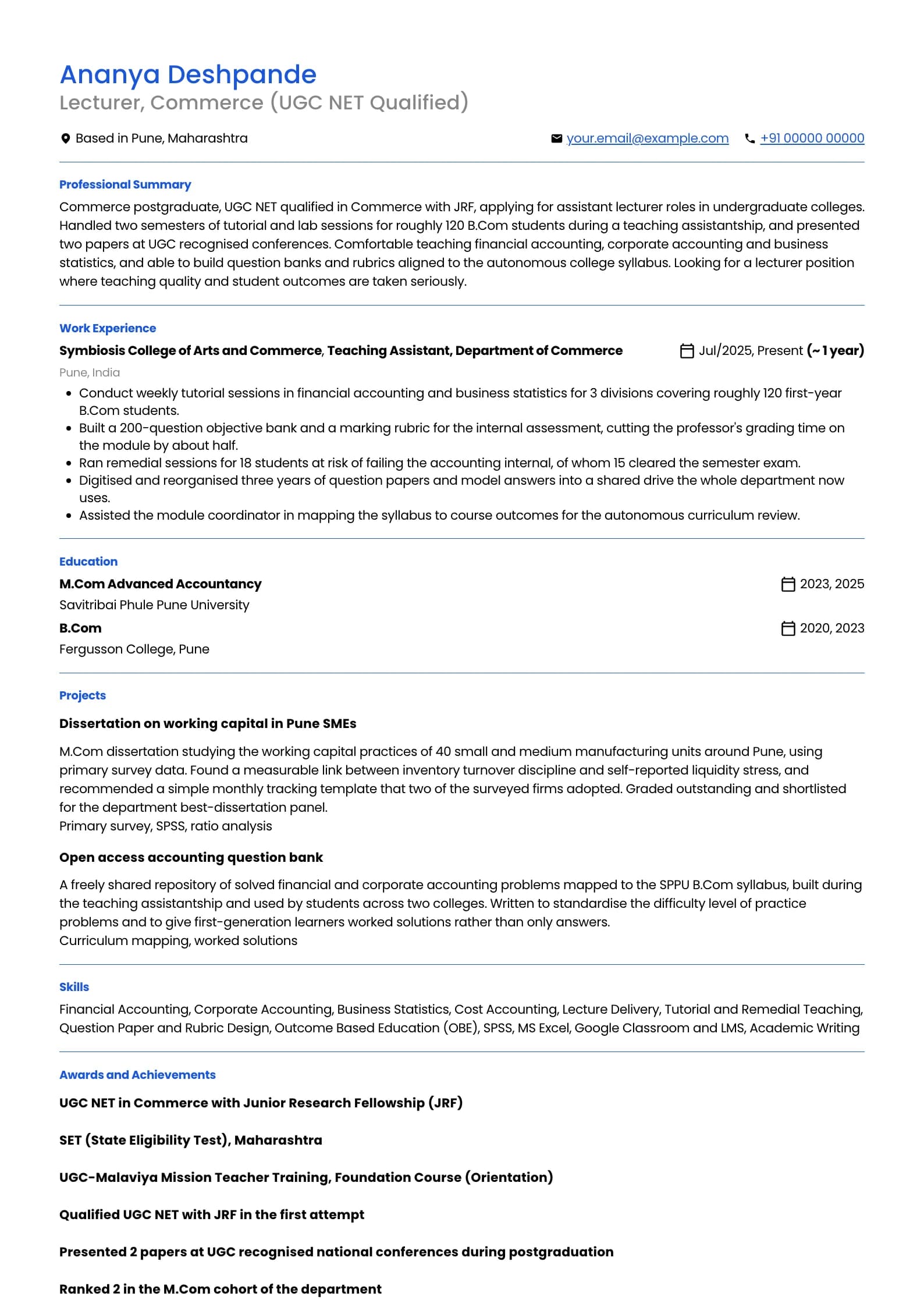
Build my resumeLecturer resume example, NET Qualified Fresher (0 to 1 year)
professional templateIs your resume good enough?
Upload the resume you have now and see what an applicant tracking system reads before a lecturer recruiter ever does.
Free to run. Sign in with your mobile number to see your score.
Lecturer resume example, Assistant Professor (5 years)
header-band template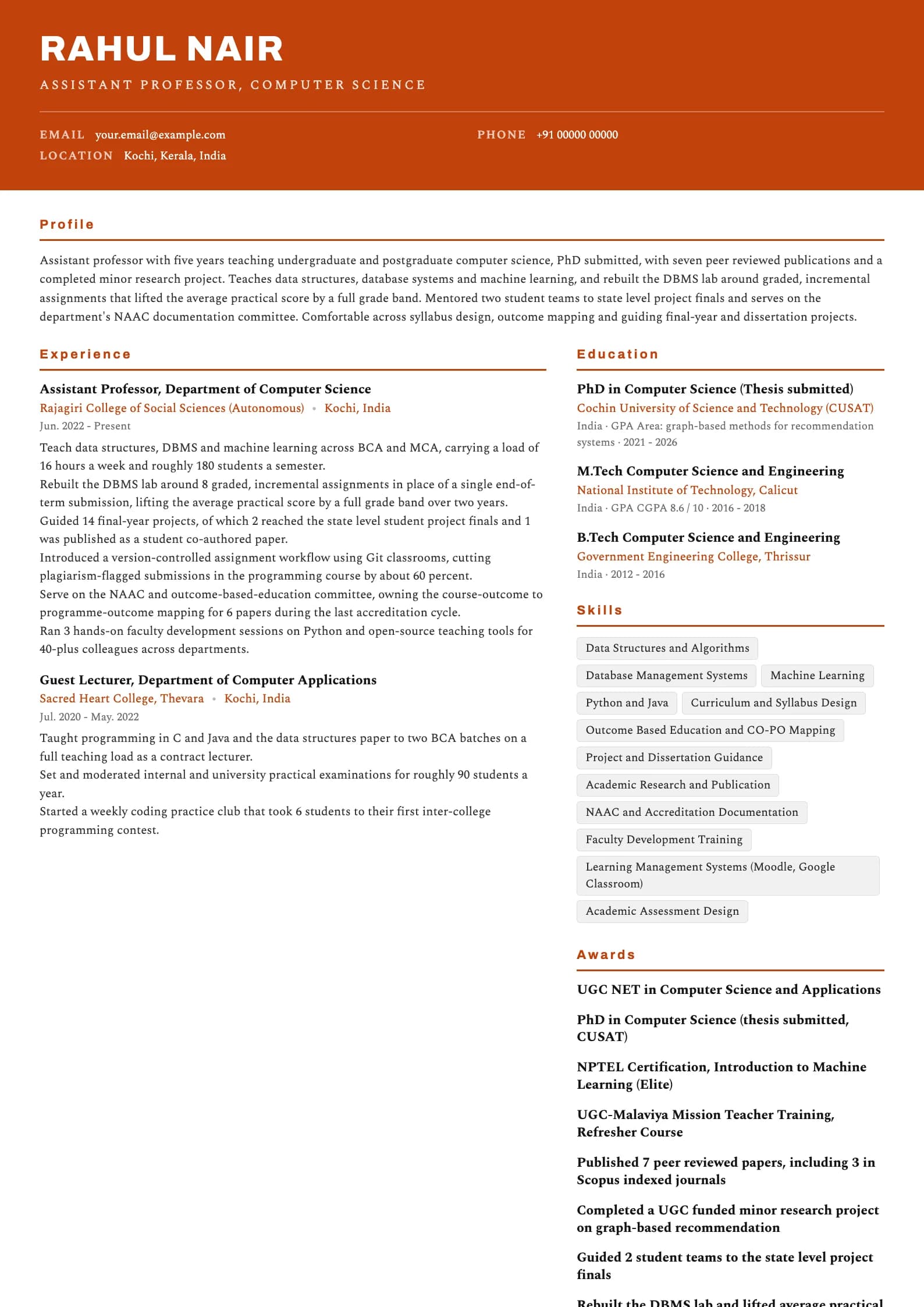
Want this structure with your own details? Build it in the resume builder.
Lecturer resume example, Associate Professor and Head (12 years)
modern template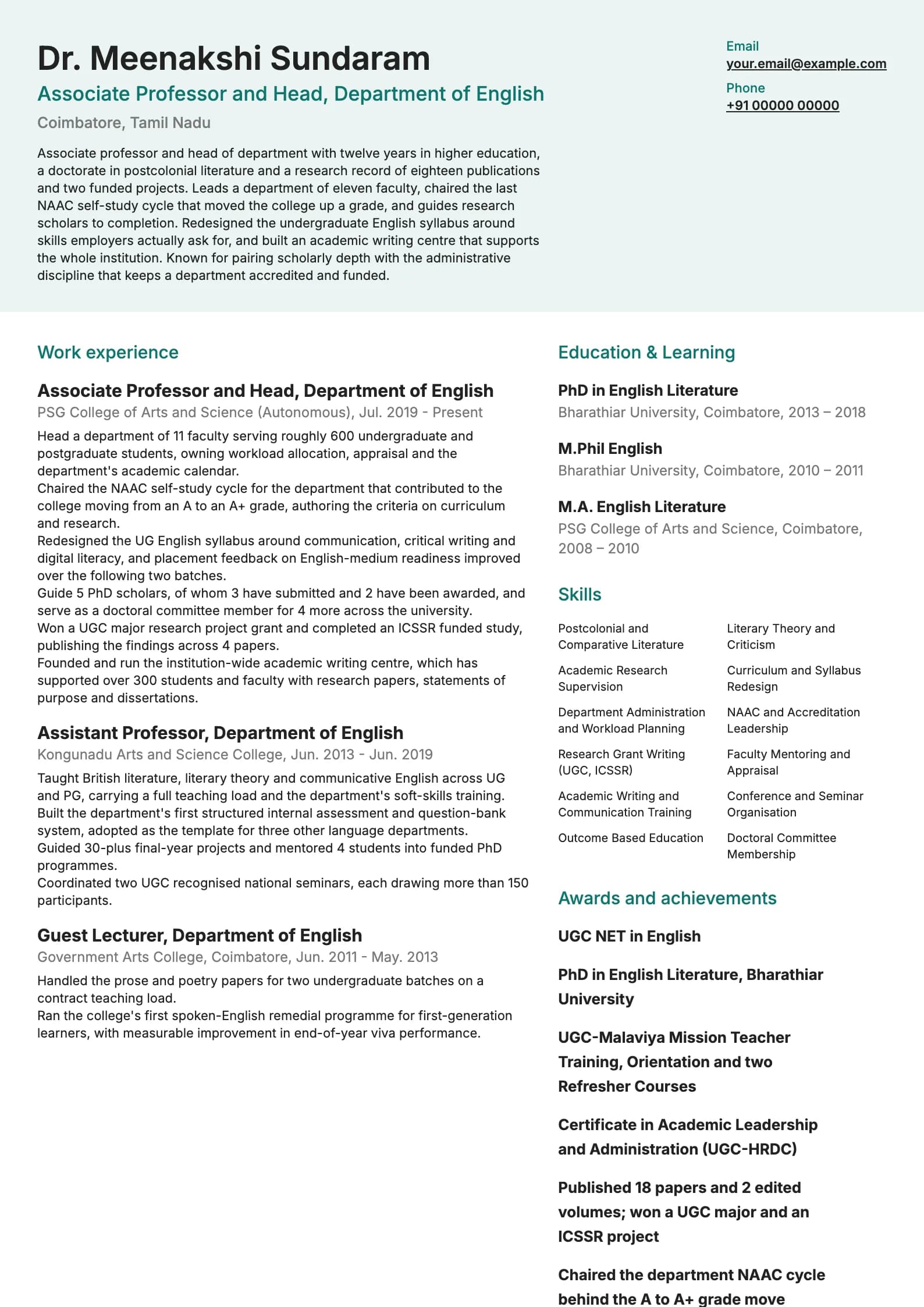
The format that works for lecturer resumes in India
An academic resume is not a one-page corporate CV, and it is not the twenty-page research CV a foreign postdoc submits either. For an Indian college or university lecturer post it sits in between: two to four pages, reverse chronological, with eligibility and teaching foremost and research listed in full. The recruitment cell reads it against UGC norms, so the file has to make those norms easy to verify. Eligibility comes first because it is the first filter. NET, SET or SLET, a PhD, or the exemption route all decide whether the application is even considered under UGC regulations. State the qualification, the subject and the year in the header and again under certifications. A committee that cannot find your NET line in the first ten seconds may set the file aside as ineligible. Teaching experience is the second pillar. State the institutions, the papers taught, the level, the years and the teaching load in hours. Research is the third: publications with journal names and indexing, funded projects with the agency and amount, conferences, and scholars guided. For a senior candidate these become their own numbered sections rather than a paragraph. Length follows evidence. A NET qualified fresher fits two pages. An assistant professor with a publication list runs to three. A head of department with funded projects and scholars guided may reach four, and that is acceptable in academia as long as every line is a verifiable fact. Send a PDF, use a single column, and keep photographs, date of birth, marital status and father's name off the file: they belong to an older template and add nothing a selection committee scores. The table below sets out the order.
| Section | Where it goes | Why |
|---|---|---|
| Name, prefix and headline | Top, above everything | Dr. if you hold a doctorate. Headline names the post and subject, e.g. Assistant Professor, Physics. |
| Eligibility (NET/SET/PhD) | Immediately under the header | The first filter a recruitment cell applies. Subject and year stated plainly. |
| Academic summary | Under eligibility | Three to four lines: subjects, years, teaching load and the strongest research or teaching result. |
| Teaching experience | Next, reverse chronological | Institution, papers, level, load in hours, years. Newest role gets the most detail. |
| Research and publications | After teaching, as its own block | Journal name, year and indexing (Scopus, UGC-CARE). Projects with agency and amount. |
| Education | After research, or near top for a fresher | Degree, university, year, class. Rank and marks kept while early-career. |
| Certifications and FDPs | Below education | Orientation and refresher courses, NPTEL, workshops. UGC training carries weight. |
Eligibility first: NET, SET, PhD and why the order matters
Almost every lecturer rejection at the file stage is an eligibility problem the candidate made hard to see. Under UGC regulations the assistant professor post requires NET, SET or SLET, or a PhD awarded under the relevant regulations. The recruitment cell has to record which route applies to you, so the resume that states it first and clearly moves faster than the one that hides it. Write the qualification in full, with the subject and year: UGC NET in Commerce, June 2024, not just NET qualified. If you cleared NET with JRF, say so, because JRF is a distinct and stronger signal that carries research funding. If you qualified through the State Eligibility Test, name the state, since SET is valid for posts in that state. A PhD awarded under the 2009 or later regulations can exempt you from NET for direct recruitment, so state the awarding university and the year of the notification, not just the thesis title. Do not conflate submitted with awarded. A submitted thesis is a real milestone and worth stating, but a committee treats submitted and awarded differently for eligibility, so be precise. The same honesty applies to a NET result awaited: if you have appeared but not cleared, do not imply otherwise, because the certificate is checked at the interview. Subject match matters as much as the qualification. NET in Management does not make you eligible for a Commerce post at many institutions, and a committee reads the subject line carefully. State the exact NET subject as printed on your certificate so there is no ambiguity for the screener.
A selection committee spends its first pass deciding who is eligible, not who is best. Make your NET, SET or PhD line the easiest fact to find on the page, stated with subject and year, or a strong candidate gets set aside as ineligible.
Writing an academic summary a selection committee reads
The block under your eligibility line is the part a committee reads before deciding whether to open the publication list, so it should carry four facts: the subjects you teach, how long you have taught them, your teaching load or scale, and your strongest research or teaching result. Three to four lines, no adjectives a viva could not verify. The old objective line, seeking a challenging teaching position in a reputed institution to impart quality education, describes every applicant and distinguishes none. Replace it with a summary of what you have already done. An objective states an aspiration; a summary states a record, and only the record is scored. Freshers often feel they have nothing to summarise. Look at the fresher sample: it names the subjects, states the teaching assistantship and its student count, and points at a JRF and two conference papers. That is a genuine academic summary built from a postgraduation, one assistantship and real eligibility. What it avoids is passionate about teaching, a phrase so common it now carries no information for a committee. A practical test: read your summary and ask whether a batchmate with the same NET could paste it onto their file unchanged. If they could, it describes the qualification, not you. Add the specific subject, the specific number of students, the specific publication until it stops being transferable.
Academic summary, assistant professor
Weak
Passionate and dedicated educator with 5+ years of teaching experience seeking a challenging position in a reputed institution to impart quality education and contribute to the growth of students.
Strong
Assistant professor with five years teaching data structures, DBMS and machine learning across BCA and MCA, PhD submitted, with seven peer reviewed papers. Rebuilt the DBMS lab and lifted average practical scores by a full grade band.
The rewrite trades self-description for the subjects taught, the eligibility route, a countable publication record and one verifiable teaching result.
Research and publications: list them the way a committee scores them
For any post above entry level, research is scored, often literally on an academic performance indicator or a college's own point sheet. That means the format of your publication list is not cosmetic: a committee has to be able to read the journal, the year and the indexing off the page and add it up. Vague lines like published several papers in reputed journals score nothing because they can be verified as nothing. List each publication in a consistent citation style with the authors, title, journal, year, volume and, critically, the indexing: Scopus, Web of Science, UGC-CARE listed, or peer reviewed. A committee weights a Scopus indexed paper differently from a conference proceeding, so hiding the distinction hurts you. Number the list so a reader can cite it back to you in the interview. Funded projects are worth more than most candidates realise, so give the agency, the title, the amount and the status. A completed UGC minor project or an ICSSR study is concrete evidence of research capacity that a committee scores highly. Distinguish completed from ongoing honestly, because the sanction letter is checked. Scholars guided is the senior researcher's strongest currency. State how many PhD or MPhil scholars you have guided, how many have submitted and how many have been awarded, because a professor promotion board reads exactly this line. Do not inflate: awarded means the degree was conferred, and the university record settles any dispute. Finally, separate your best work from the long tail. A committee reading a list of thirty publications skims. Consider a short selected publications block of your five strongest, indexed pieces, with the full list following, so your best work is not lost in the volume.
| Research item | What to state | Why it matters |
|---|---|---|
| Journal paper | Authors, title, journal, year, indexing (Scopus / UGC-CARE) | The indexing is what a committee weights and scores. |
| Conference paper | Title, conference, level (national / international), year | Counts, but weighted below indexed journal work. |
| Funded project | Agency, title, amount, status (completed / ongoing) | Concrete evidence of research capacity, scored highly. |
| Book or chapter | Title, publisher, ISBN, year, sole or edited | ISBN and a recognised publisher separate it from self-published. |
| Scholars guided | Number registered, submitted and awarded | The core metric a professor promotion board reads. |
| Patent or copyright | Title, number, status (filed / granted) | A growing item on Indian academic scorecards; state status honestly. |
Teaching experience: institution, papers, load, result
A strong teaching bullet does more than say you taught. It names the institution and level, states the papers, gives the teaching load, and where it can, closes with what measurably improved: a result, a pass rate, a lab redesigned, a project that reached a final. The load and the numbers are what let a committee judge scale, the way industry judges throughput. State the teaching load in hours a week and the student headcount, because a committee that hires on workload norms reads exactly that. Sixteen hours a week and 180 students a semester is a concrete picture; taught various subjects is not. Name the papers as they appear in the syllabus, both because it is honest and because a recruitment cell searches on paper titles. Where you improved something, say so with a number. A lab rebuilt around graded assignments that lifted the average practical score, a remedial programme that moved fifteen of eighteen students across the line, a plagiarism workflow that cut flagged submissions: these are teaching results, and they are rarer and more persuasive on an academic resume than the subjects list. Most lecturer resumes have none, so even one sets you apart. Include guest and contract lecturing honestly, with the arrangement named, because early teaching experience is real experience and a committee counts it. Do not inflate a guest stint into a permanent post; the appointment letter is verified. Allocate detail by recency: the current role carries the most bullets, older contract roles two or three.
Teaching experience bullet
Weak
Responsible for teaching various subjects to undergraduate and postgraduate students and maintaining discipline in the classroom.
Strong
Rebuilt the DBMS lab around 8 graded, incremental assignments in place of a single end-of-term submission, lifting the average practical score by a full grade band over two years.
"Responsible for teaching various subjects" describes a job title; the rewrite names a change made to a specific course and the outcome it produced.
Teaching experience bullet
Weak
Handled classes and helped weak students improve their performance in examinations.
Strong
Ran remedial sessions for 18 students at risk of failing the accounting internal, of whom 15 cleared the semester exam.
Replaces a vague claim of helping weak students with the exact cohort and the exact outcome a committee can verify.
If a teaching bullet would read identically on every other lecturer's resume, it describes the profession, not you. Add the paper, the load or the result until it fits only the classroom you actually ran.
Skills and specialisation: grouped, honest, and syllabus-aligned
A lecturer's skills section has two readers. The parser wants literal terms it can match against the advertisement, the subject, the specialisation, the software. A selection committee wants to see whether your specialisation fits the papers the department needs taught. Grouping serves both. Group by function rather than one long line: subject areas, teaching and assessment, research, and tools. The subject areas should match the papers in the target syllabus, because a department advertising for a specialisation in machine learning is scanning for it. Write the specialisation the way the discipline writes it, since a committee reads the exact term. Do not pad with generic classroom phrases. Good communication skills and knowledge of MS Office on an academic resume read as filler, because they are assumed of anyone with a postgraduate degree. What earns space is a specific teaching or assessment competence: outcome-based education and CO-PO mapping, rubric design, LMS platforms you actually run, statistical or lab software your discipline uses. Ten to sixteen items across the groups is the working range. The list is a contract: every specialisation is a paper you have agreed to teach and every research method is one a viva can probe. Do not claim a specialisation you cannot deliver a full semester on, because the demonstration lecture at the interview settles it quickly.
Skills section
Weak
Skills: Teaching, Communication, MS Office, Internet, Hardworking, Time Management, Leadership, Team Player, Good Command of English, Subject Knowledge
Strong
Subjects: Data Structures, DBMS, Machine Learning. Teaching: OBE and CO-PO mapping, rubric design, project guidance. Research: academic writing, Scopus publication, minor project execution. Tools: Python, Moodle, SPSS.
Cuts the generic self-praise, names the actual papers taught and research methods used, and groups the rest so a committee reads the specialisation match in one pass.
Education, doctoral work and academic development
For a lecturer the education section is heavier than on a corporate resume, because the degrees are part of the eligibility a committee checks. List every degree from bachelor upward with the university, the year and the class or CGPA, and for a fresher keep the rank or percentage, since early-career academic screening still filters on it. Drop the school details once you hold a postgraduate degree. The doctorate carries the most weight and deserves its own line with the university, the year and the thesis area. State the status precisely: awarded with the year of the degree, submitted with the date, or pursuing with the registration year and expected submission. A committee treats these differently for eligibility and for the academic score, so precision is not optional. An MPhil, where you hold one, sits between the master's and the PhD. Academic development is the academic version of professional certification and it is scored in promotion cycles, so give it a place. The UGC-Malaviya Mission Teacher Training courses, the orientation and refresher programmes, faculty development programmes, and NPTEL certifications all belong here with the year. Naming them signals that you keep up with the training the system expects, which a permanent post rewards. Do not list coursework or your class-ten and class-twelve marks once you have a master's. They compete for space with publications and teaching results that are far more predictive of how you will perform in the role, and a committee scanning for research will skim past them.
Getting past the recruitment portal and the ATS
Many colleges and almost all universities now accept applications through an online recruitment portal that parses your file into fields before a human sees it, and central and state university portals in particular structure the application around your degrees, NET, publications and experience. The same rules that help a corporate ATS help here, and the failures are the same: they come from layout, not from the strength of your record. Use a single column and standard section headings. Write Teaching Experience, not My Academic Journey, and Publications, not My Research Contributions, because the portal and any parser look for the conventional label. Keep the critical facts, your NET and your PhD, in the body of the page rather than in a header or footer strip, which some parsers drop. Mirror the language of the advertisement where it is honest. If the post is for an assistant professor in Commerce, the words assistant professor and Commerce should appear in your file exactly as written. Spell out an acronym alongside its short form at least once, for example NET (National Eligibility Test) and OBE (outcome based education), so both searches find you. Do not stuff. A hidden block of every subject in the discipline, or a wall of journal names you never published in, is caught quickly and read as dishonesty, which is worse than being filtered. Write real teaching and research lines that naturally contain the right terms, because a bullet describing a paper you published in a Scopus journal contains the word Scopus in a context that also survives a human committee. Save as a PDF that embeds real text, then open it and confirm you can select and copy a sentence. If the text will not select, a parser cannot read it, and neither can the portal that shortlists you.
Before you upload, copy the text out of your PDF into a plain editor. Whatever reads cleanly there is roughly what the recruitment portal parses. If your NET line or your publications scramble, fix the layout before a screener ever sees the file.
What gets lecturer resumes rejected
Most lecturer rejections at the file stage are not close judgements about quality. They come from a small set of recurring problems, and every one of them is fixable in an afternoon. The list below covers what recruitment cells and selection committees see most often on Indian academic resumes, in rough order of how much damage each one does.
- Eligibility hidden or vague. NET, SET or PhD not stated with subject and year near the top is the fastest way to be set aside as ineligible.
- Subject mismatch left unclear. A NET subject that does not obviously match the advertised post, with no line resolving it, invites a rejection the candidate could have prevented.
- Publications listed without journal names or indexing, so a committee that scores research can score none of it.
- Submitted and awarded used interchangeably for the PhD, which reads as either careless or misleading once the certificate is checked.
- An objective paragraph instead of a summary, telling a committee what you want rather than what you have done.
- A wall of generic skills, communication, MS Office, hardworking, that every postgraduate could claim and none can be scored on.
- A photo, date of birth, marital status or father's name carried over from an old template, taking space a publication or a result could use.
- No teaching load or student numbers anywhere, so a committee cannot judge the scale of the work.
- Guest or contract work inflated into permanent posts, a mismatch the appointment letters expose at verification.
- Typos in the very subjects and journals you claim, for example Scopus written as Scoups, which undermines an otherwise eligible file.
Read your file as a selection committee will: eligibility, then teaching, then research, each a fact to verify. Anything that cannot be checked against a certificate, a payslip or a journal is a line to make precise or cut.
Skills to put on a lecturer resume
Technical
- Subject Expertise and Specialisation
- Lecture Delivery and Pedagogy
- Curriculum and Syllabus Design
- Outcome Based Education and CO-PO Mapping
- Academic Assessment and Rubric Design
- Research Methodology
- Academic Writing and Publication
- Project and Dissertation Guidance
- Research Supervision
- NAAC and Accreditation Documentation
- Grant and Project Proposal Writing
- Statistical and Data Analysis
Tools and platforms
- Learning Management Systems (Moodle, Google Classroom)
- MS Excel and PowerPoint
- SPSS
- Zotero or Mendeley
- Turnitin or plagiarism tools
- NPTEL and SWAYAM
- Online examination platforms
- LaTeX
- Google Scholar and ORCID
Working skills
- Mentoring and student guidance
- Committee and department collaboration
- Academic communication
- Time and workload management
- Public speaking and seminar delivery
- Conflict resolution in the classroom
- Continuous professional development
- Institutional service
Certifications worth listing as a lecturer
| Certification | Full name | Worth it for |
|---|---|---|
| UGC NET | University Grants Commission National Eligibility Test | The core eligibility qualification for an assistant professor post across Indian universities and colleges. Essential for anyone entering higher education teaching who does not hold a qualifying PhD. Clearing it with JRF is a materially stronger signal because it carries a research fellowship and stipend. |
| SET / SLET | State Eligibility Test / State Level Eligibility Test | The state-level equivalent of NET, valid for posts within the state that conducts it. Worth holding for candidates targeting colleges in a specific state, and often held alongside NET. Check the state's validity rules, since a SET is not automatically transferable across states. |
| PhD | Doctor of Philosophy in the subject | The strongest academic credential and, when awarded under the relevant UGC regulations, an eligibility route in its own right that can exempt direct recruits from NET. Increasingly expected for permanent posts in universities and autonomous colleges, and required for associate and full professor grades. |
| MMTTP | UGC-Malaviya Mission Teacher Training (Orientation and Refresher courses) | The teacher training and professional development programmes run through UGC-HRDCs, formerly the orientation and refresher courses. Scored in promotion cycles under the career advancement scheme, so worth completing for anyone in or entering a permanent post. |
| NPTEL / SWAYAM | NPTEL and SWAYAM online certification courses | MOOC certifications from the national platforms, useful for demonstrating subject currency and, for a fresher or a career switcher, for signalling depth in a specialisation. An Elite or top-percentile result carries more weight than a plain completion. |
Keywords an ATS scans for in a lecturer resume
These are the literal terms a parser matches against the job description. Use the ones that are true of you, in the sentences where you did the work, not as a list at the bottom.
- lecturer
- assistant professor
- UGC NET
- SET
- PhD
- teaching experience
- curriculum design
- outcome based education
- CO-PO mapping
- research publication
- Scopus
- UGC-CARE
- NAAC
- project guidance
- syllabus
- academic writing
- faculty development programme
- research supervision
- higher education
- pedagogy
Lecturer resume FAQ
What salary can a lecturer expect in India?
In a government or aided college or university under the UGC pay scales, an assistant professor starts on academic level 10 with a basic of around 57,700 rupees, so a gross of roughly 8 to 11 LPA depending on the city and allowances. An associate professor sits on level 13A and a professor on level 14, taking gross pay well past 20 LPA. Private colleges vary far more widely, from 3 to 7 LPA for a fresh lecturer at a small college to competitive UGC-linked pay at established institutions. A PhD, funded projects and a strong publication record raise both the grade you are eligible for and the pace of career advancement.
How long should a lecturer resume be?
Two to four pages, decided by your record rather than a fixed rule. A NET qualified fresher fits two pages. An assistant professor with a publication list runs to three. A head of department with funded projects and scholars guided may reach four, and that length is normal in academia as long as every line is a verifiable fact. What is not acceptable is padding two pages of real content into four with coursework, declarations and hobbies.
Do I need NET or a PhD to apply for a lecturer post?
For an assistant professor post at a college or university under UGC regulations, yes: you need NET, SET or SLET, or a PhD awarded under the relevant regulations, and a qualifying master's. The PhD route can exempt direct recruits from NET for the entry grade. State your exact qualification with the subject and year at the top of the resume, because a recruitment cell records which route makes you eligible before it assesses anything else. Guest, contract and private-tuition roles may have looser requirements, but the permanent path runs through this eligibility.
How should I list my publications on the resume?
In a consistent citation style with authors, title, journal, year and, critically, the indexing: Scopus, Web of Science, UGC-CARE listed or peer reviewed. A committee weights an indexed journal paper differently from a conference proceeding, so make the distinction visible and number the list. If you have many papers, add a short selected publications block of your five strongest ahead of the full list, so your best work is not lost in the volume. State funded projects with the agency, amount and status, since these score highly.
How does a fresher write a lecturer resume with no permanent post?
Lead with eligibility, then education, then whatever teaching you have done as a teaching assistant, guest lecturer or during a fellowship. Treat each teaching stint as real experience: name the subjects, the student count and any result, such as a remedial cohort that improved. Add conference papers, a strong dissertation and your JRF if you hold one. A NET with JRF, two conference papers and a real assistantship with numbers is a genuine early-career record that a committee can score.
Should I mention my API or academic score on the resume?
You do not need to compute and print a single score, because different institutions use different point sheets and yours may not match theirs. What you should do is present the underlying evidence, publications with indexing, funded projects with amounts, teaching load, scholars guided, so the committee can compute its own score from your page. Make each scorable item easy to find and verify, and let the committee add it up in the format it uses.
Do college recruitment portals use an ATS?
Central and state university portals, and many college portals, parse your application into structured fields before a human reads it, which is effectively an ATS. Use a single column, standard headings like Teaching Experience and Publications, and keep your NET and PhD in the body rather than a header strip that a parser may drop. Test your file by copying its text into a plain editor: if your eligibility and publications read cleanly there, the portal will most likely parse them correctly.
Should I include faculty development and orientation courses?
Yes. The UGC-Malaviya Mission Teacher Training courses, formerly the orientation and refresher programmes, and faculty development programmes are scored in the career advancement scheme, so they belong in the resume with the year completed. For a fresher they signal that you are entering the system's expected training track; for someone in a permanent post they are part of the promotion record. NPTEL and SWAYAM certifications also help demonstrate subject currency.
Do I need a photo on a lecturer resume in India?
No. A selection committee scores eligibility, teaching and research, and a photograph adds nothing to any of those. The same goes for date of birth, marital status, father's name, nationality and a declaration paragraph. These come from an older campus template and take space a publication or a teaching result should occupy. If a specific university application form requires a photograph in its own portal fields, provide it there, not on the resume body.
Related resume examples and guides
Build your own in any of these formats
Start from a blank resume or upload the one you have. Goodspace renders it in 24 templates and flags the eligibility, teaching and publication keywords a college recruitment portal will look for, and the filler it will not credit.
Build my resume