Police Officer Resume Format, with 3 Full Samples
A police officer's worth on paper is measured in cases closed, incidents prevented, teams led and law upheld under pressure, yet most resumes read like a duty roster and prove none of it. Below are three complete resumes: one for a graduate preparing for constable and sub-inspector recruitment who needs a resume for physical-standard drives, verification and any allied role; one for a serving sub-inspector documenting a policing career; and one for a senior officer moving into corporate or industrial security after retirement, which is where a strong resume matters most. After the samples come the format rules, the difference between a duty list and proof of judgment, the terms an applicant tracking system matches, and the mistakes that get an officer's resume filtered before a human reads it.
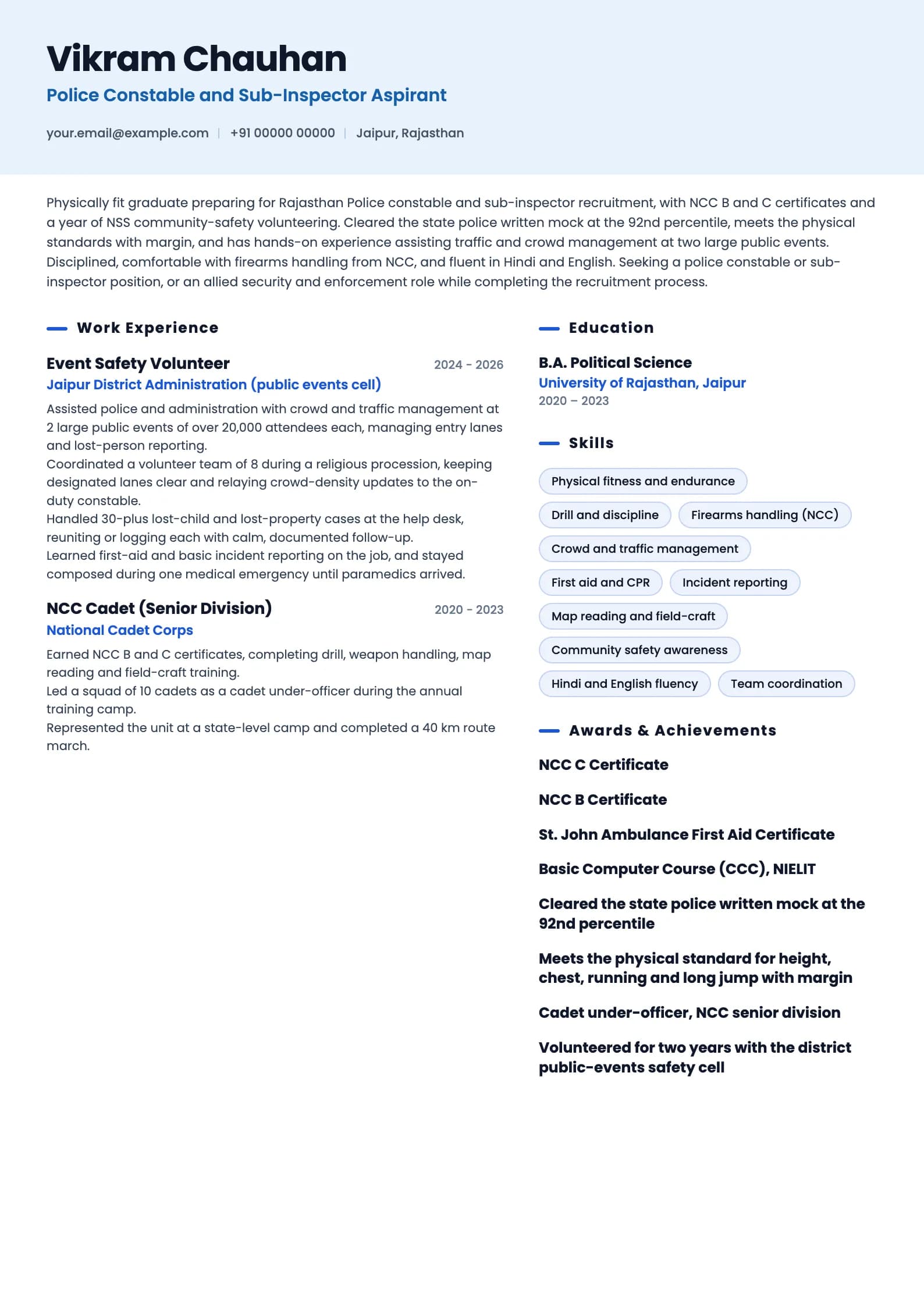
Build my resumePolice Officer resume example, Aspirant and fresher (0 years)
ai-era templateIs your resume good enough?
Upload the resume you have now and see what an applicant tracking system reads before a police officer recruiter ever does.
Free to run. Sign in with your mobile number to see your score.
Police Officer resume example, Serving Sub-Inspector (8 years)
professional template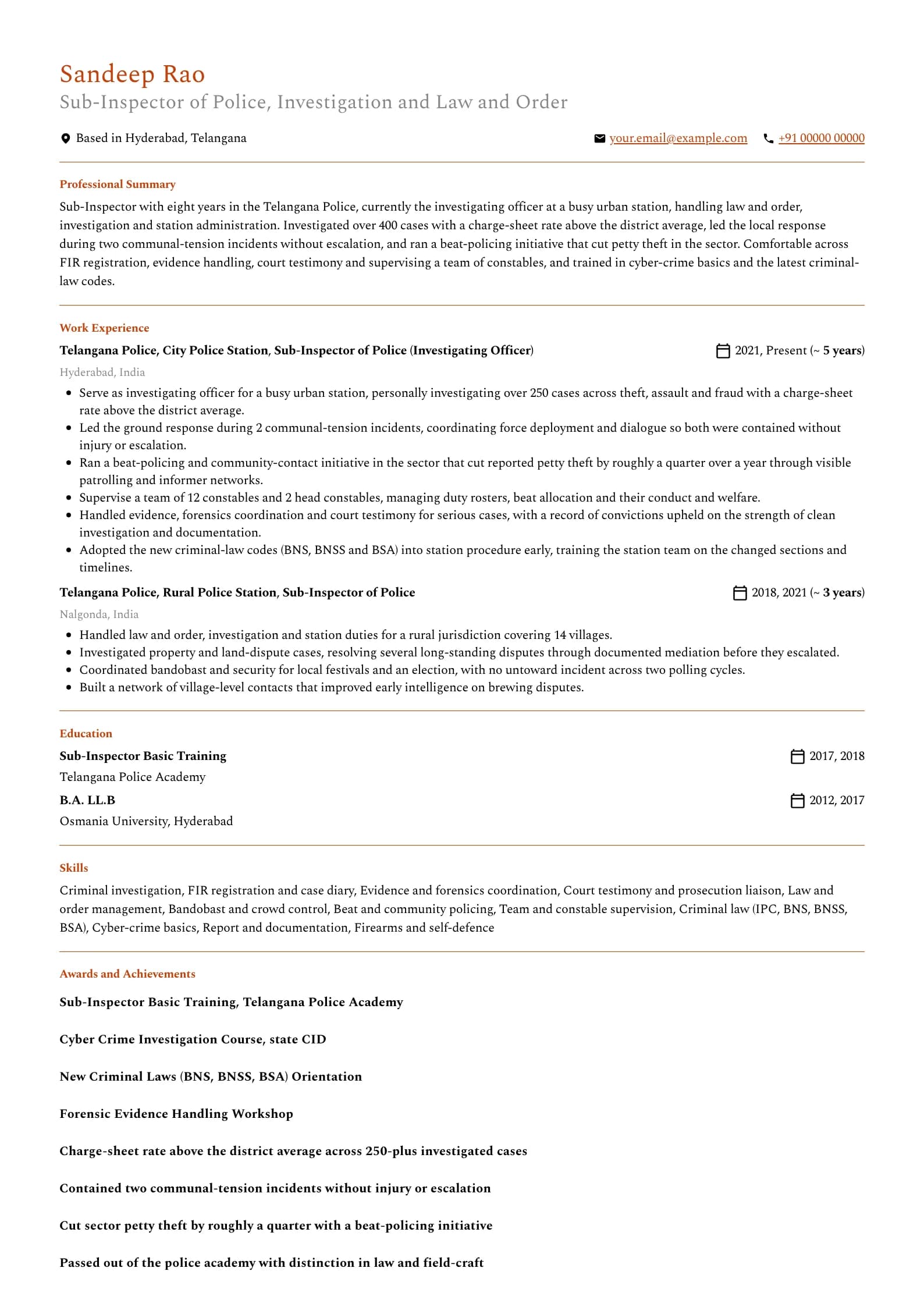
Want this structure with your own details? Build it in the resume builder.
Police Officer resume example, Senior officer to corporate security (25 years)
header-band template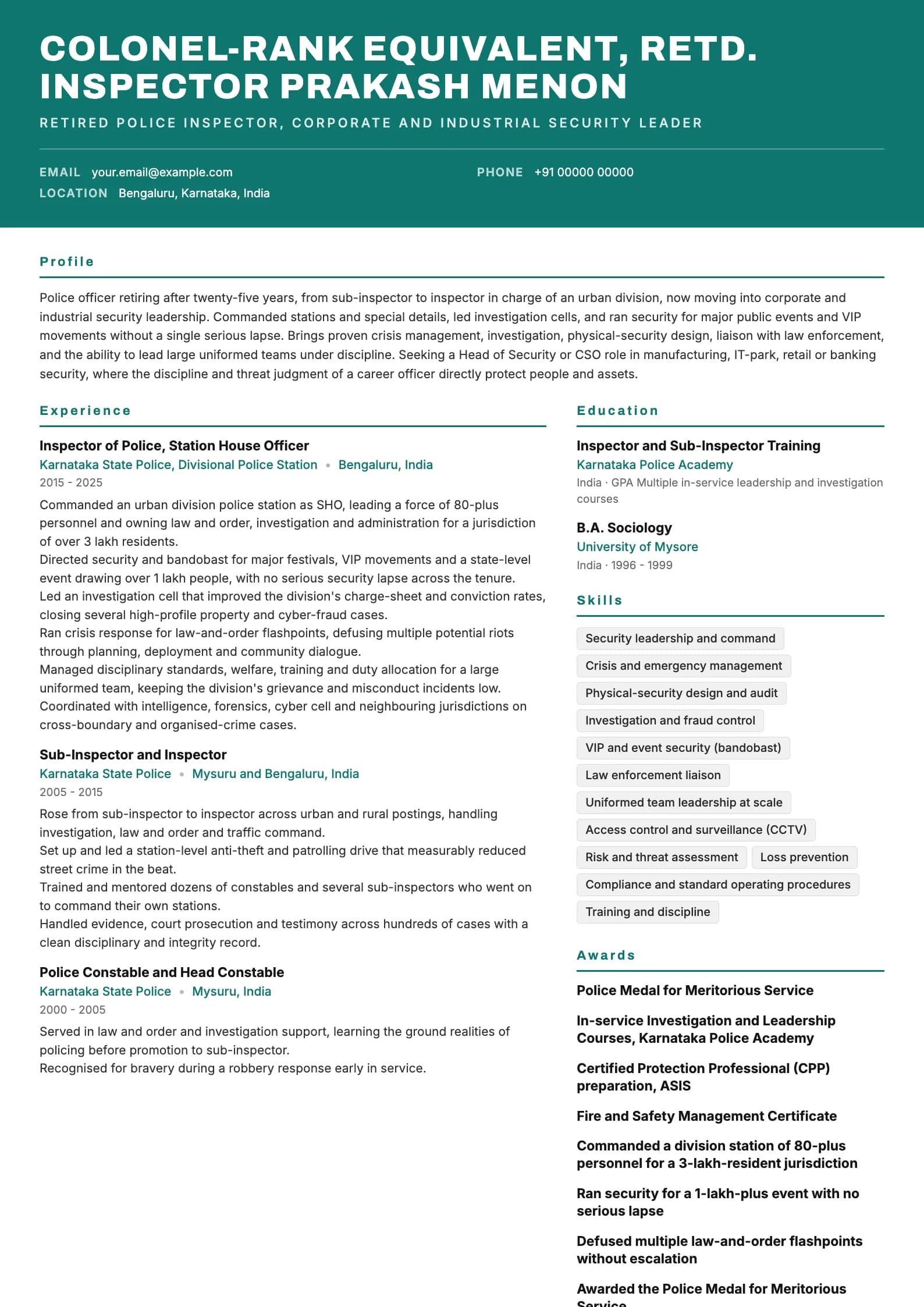
The format that works for police officer resumes in India
A police resume is used in three very different situations, and the format bends to which one you are in. An aspirant needs a clean, verification-ready resume for recruitment drives, physical-standard tests and any allied job while they clear the process. A serving officer occasionally needs one for deputations, allied postings or a documented service record. A retiring or ex-officer needs the most polished resume of all, because they are competing in the open corporate-security market against civilians. All three use reverse chronological order, most recent role first, dates in plain view. Length follows evidence. One page for an aspirant with limited experience. One to two pages for a serving or retired officer with a full service history, where the second page is justified only if it carries commands, cases and outcomes rather than a list of every posting town. Some details that a technical resume drops are handled differently here. Contact information and personal identifiers still do not belong on the page, and the type deliberately omits them. But a physically-demanding uniformed role does turn on eligibility, so an aspirant should state that they meet the physical standards, and a serving officer their rank and force. What still adds nothing is a photograph pasted into the corner, a father's name, marital status and a declaration paragraph. Send a PDF unless the posting asks otherwise, and name the file with your name and target role. Use a single column, because security-firm and corporate recruiters increasingly run resumes through an applicant tracking system that parses two-column layouts unreliably. The table below sets the section order.
| Section | Where it goes | Why |
|---|---|---|
| Name and headline | Top, above everything | Headline is the target: police aspirant, sub-inspector, or head of security for an ex-officer. |
| Professional summary | Directly under the header | Three lines. Role or rank, years, and the strongest outcome: cases, incidents contained, command held. |
| Eligibility or rank line | Under the summary for aspirants | For an aspirant, that physical standards are met. For a serving officer, the rank and force. |
| Service or work experience | Next | Most recent posting first. Cases, law-and-order outcomes and team led, not a duty list. |
| Skills | Below experience, grouped | Investigation, law-and-order, security, leadership grouped for humans and parsers. |
| Training and education | Below skills | Academy training, degree, in-service courses. Degree matters for SI and IPS aspirants. |
| Awards and certifications | After education | Medals, commendations, NCC certificates and security certifications carry real weight. |
A duty list is not the same as proof of judgment
The most common police-resume failure is a page of duties that could describe any officer of that rank: maintained law and order, registered FIRs, conducted patrolling, performed bandobast duty, ensured peace in the jurisdiction. Every officer does these. Listing them proves you held the post, not that you were good in it. The reviewer, whether a departmental board or a corporate security head, already assumes the duties. What they cannot tell from a duty list is your judgment, your record and your outcomes. The fix is to attach an outcome to the policing. How many cases investigated and at what charge-sheet or conviction rate, how a tense situation was contained without escalation, how a crime type fell in your sector, how large a team you led, how clean your integrity and disciplinary record is. The serving-officer sample states 250-plus cases at an above-average charge-sheet rate and two communal incidents contained without injury, which is far stronger than maintained law and order, because it shows the judgment behind the duty. For an aspirant, the equivalent is showing temperament and eligibility with small, concrete proof: physical standards met, NCC leadership, a lost-child desk handled calmly, an emergency held together until help arrived. These are the seeds of the judgment a policing career is built on, and they beat a paragraph of ambition. Where a hard number is unavailable, give scope: jurisdiction population, villages covered, team size, events secured. Scope establishes the weight of the responsibility without inventing a statistic.
For every duty on your resume, ask what your judgment changed: a case closed, an escalation avoided, a crime type reduced, a team kept disciplined. A police resume that shows outcomes and a clean record beats one that recites the constable's manual.
Writing a summary that works for a board and for a corporate reader
The block under your name is the part most likely to be read, so it should carry three facts: your role or rank and force, how long you have served, and the single strongest outcome of your service, whether that is a case record, an incident contained or a command held. Three or four lines, no adjectives that cannot be checked. The old objective line, seeking a challenging and responsible position where I can serve the nation and utilise my abilities, tells the reader nothing they had not assumed. Replace it with a summary of what you have actually done. An objective states a wish; a summary states a record, and only one is evidence. The summary does the heaviest lifting for a retiring officer entering corporate security, because the reader may not know what a station house officer does. The senior sample translates rank into value a company can price: commanded stations, ran security for large events without a lapse, led investigation cells, and now targets a head-of-security role. It reaches toward the new job rather than only describing the old one, which is the difference between a service record and a job application. An aspirant's summary should state fitness, any NCC or allied experience, and a genuine readiness for disciplined work, without the passionate-about-serving-the-nation line that appears on nearly every recruitment resume and therefore carries no information.
Professional summary, serving officer
Weak
Sincere and dedicated police officer with 8 years of experience in maintaining law and order and serving the public, seeking a challenging role to serve the nation and utilise my skills and abilities.
Strong
Sub-Inspector with eight years in the Telangana Police, currently investigating officer at a busy urban station. Investigated 250-plus cases at an above-average charge-sheet rate and contained two communal-tension incidents without injury or escalation.
The rewrite trades duty language and a patriotic wish for a rank, a case record and a judgment outcome a board or an employer can verify.
Experience bullets: action, situation, outcome
Every strong bullet in the samples follows the same shape. It opens with an action verb, names the specific policing situation you handled, and closes with what resulted. The verb shows you acted. The situation tells the reader the nature and difficulty of the work. The outcome, whether a number or a contained incident, does the persuading. Start from the outcome and work backwards. Officers usually write the duty first, then leave it there, which produces bullets like handled law and order duties and conducted investigation of cases. Instead, ask what resulted from your handling: a case charge-sheeted, a riot defused, a crime type reduced, a team kept disciplined, an event secured cleanly. Then write the sentence that ends in that fact. Vary the evidence. Not everything is a case count. A police career offers charge-sheet and conviction rates, incidents contained, crime reduction in a beat, team size led, jurisdiction scope, events secured, personnel trained, and a clean integrity and disciplinary record. The senior sample moves across command scope, event security, investigation and crisis response, which reads as a rounded leader rather than one type of officer. For a corporate-bound resume, phrase each bullet in language a civilian security manager understands. Bandobast becomes large-scale event security. SHO becomes commanding a unit of 80-plus. Case work becomes investigation and fraud control. Keep the substance, translate the vocabulary. Allocate bullets by recency: the current or last posting gets five or six, earlier postings three or four, the earliest one or two.
| Situation | What the bullet must prove | Typical evidence |
|---|---|---|
| Aspirant | Eligibility, discipline and temperament | Physical standards met, NCC leadership, calm handling of an incident |
| Investigation | You close cases that stand up | Cases investigated, charge-sheet or conviction rate, evidence and court record |
| Law and order | You manage crowds and tension safely | Incidents contained without escalation, events secured, crime reduced in a beat |
| Command and corporate move | You lead disciplined teams and can protect assets | Team size, jurisdiction scope, clean record, security-design language |
Experience bullet, law and order
Weak
Maintained law and order in the jurisdiction and performed bandobast duty during festivals and public events.
Strong
Led the ground response during 2 communal-tension incidents, coordinating force deployment and dialogue so both were contained without injury or escalation.
"Maintained law and order" is a duty any officer could claim; the rewrite names the difficult situation and the judgment outcome that resolved it.
Experience bullet, ex-officer to corporate security
Weak
Worked as Station House Officer and handled all police duties of the station including bandobast and VIP duty.
Strong
Commanded a division station as SHO, leading 80-plus personnel and directing security for a 1-lakh-plus event with no serious lapse across the tenure.
Translates rank into civilian security-leadership terms, states team scale and event security, and closes on a clean-record outcome a company can price.
If a bullet would fit any officer of your rank, it describes the post, not you. Rewrite it until it proves a case you closed, an escalation you prevented or a team you commanded, in language the reader of that resume understands.
The skills section: grouped, honest, and matched to the reader
A police officer's skills section has different readers depending on the target. A recruitment or departmental reader wants policing terms: investigation, FIR, law and order, bandobast. A corporate-security employer wants the civilian equivalents: risk assessment, physical-security design, loss prevention, access control. A strong resume for the corporate move carries both, because the security terms make you searchable and the policing terms prove you earned the skill. Group by function rather than one long line. Investigation, law and order and security, leadership and discipline, and tools and knowledge is a grouping that works for most officers. The exact headings matter less than the presence of structure. Write names the way the field writes them: FIR, BNS, BNSS and BSA for the new criminal codes, CCTV rather than seesteevee. For a corporate reader spell out the security terms fully, because that is what their applicant tracking system searches. Ten to fifteen grouped skills is the working range. Below eight it looks thin. Above twenty it stops being a signal, and police resumes tend to pad with generic traits: honest, disciplined, hardworking, punctual, loyal. Integrity matters enormously in this field, but stated as an unproven adjective it carries no weight; a clean disciplinary record and a meritorious-service medal in the awards section prove it far better. Name your firearms and self-defence competence honestly, and any specialist training such as cyber-crime, forensics or bomb-disposal, because these are genuine differentiators. Do not add a star-rating bar; nobody agrees what four stars in investigation means.
| Group | What goes in it | How many |
|---|---|---|
| Investigation | Criminal investigation, FIR and case diary, evidence handling, court testimony | 3 to 4 |
| Law and order and security | Crowd control, bandobast, beat policing, VIP and event security, risk assessment | 3 to 5 |
| Leadership and discipline | Team supervision, training, crisis management, standard operating procedures | 2 to 4 |
| Knowledge and tools | Criminal law (IPC, BNS, BNSS, BSA), cyber-crime basics, CCTV and access control, firearms | 2 to 4 |
| Languages | The languages you police and testify in | 2 to 4 |
Skills section, ex-officer targeting corporate security
Weak
Skills: Honest, Disciplined, Hardworking, Loyal, Punctual, Brave, Physically fit, Good leadership, Public dealing, Law and order, Bandobast, Duty-minded
Strong
Investigation: criminal investigation, evidence handling, fraud control. Security: physical-security design, VIP and event security, access control and CCTV, risk assessment. Leadership: uniformed team command, crisis management, SOPs. Knowledge: criminal law, loss prevention.
Replaces unprovable traits with investigation and corporate-security terms an employer and an ATS can both search, and lets the awards section carry the integrity claim.
Training, awards and certifications, and where they belong
Training and education go below skills for a serving or retired officer, and near the top for an aspirant whose degree and NCC certificates are among their strongest cards. Academy basic training, a law or other degree, and in-service courses in investigation, cyber-crime or leadership all belong here, named with the institution. For sub-inspector and IPS aspirants the degree is an eligibility fact, so make it clear. Awards and medals are the single most persuasive block on a police resume and are routinely undersold. A Police Medal for Meritorious Service, a gallantry award, a director-general's or superintendent's commendation, or a distinction at the academy are checkable proof of exactly what employers and boards want: competence and integrity. Give them their own lines with the awarding authority and, where you can, the reason. They carry the integrity claim that an adjective in the skills section cannot. Certifications matter most for the move into corporate security. A civilian security qualification such as the ASIS Certified Protection Professional or Physical Security Professional, a fire-and-safety certificate, or an industrial-security course tells a company you have translated your policing into their framework rather than expecting them to. For an aspirant, NCC B and C certificates and a first-aid certificate carry direct recruitment value, and some forces award bonus marks for NCC. List real, named credentials with the issuing body and year. Do not pad with a string of one-day seminar participation lines, which read as attendance and quietly stretch a clean resume into a padded one.
Getting through the applicant tracking system
This matters most for the officer moving into corporate or industrial security, because private security firms, manufacturers, IT parks, banks and retail chains screen resumes through an applicant tracking system, which is a parser and a search index, not a judge. Departmental recruitment runs on application forms and physical tests instead, so the ATS advice is aimed squarely at the civilian job market a retiring officer enters. The layout rules are short. One column. Standard section headings, so Work Experience rather than My Service Journey and Skills rather than My Strengths. No text inside images, because a department-logo strip reads as empty space. No critical information in the header or footer band, which some parsers drop. Avoid text boxes and nested tables in the body. On wording, mirror the language of the security job description where it is honest. If the posting says physical security, loss prevention, access control or risk assessment, and your policing genuinely gave you that skill, write those exact civilian terms, then let a bullet prove them with the policing story behind them. Spell out an acronym once alongside its short form, for example station house officer (SHO), so a reader who does not know the term still understands, and both searches match. Keyword stuffing does not work. A hidden block of security, police, investigation, bandobast repeated in white text is found quickly, and the outcome is worse than being filtered. Write real bullets that carry the terms naturally, because a bullet describing the CCTV-and-access-control setup you ran contains those words in a context that survives human review. Save as PDF from a tool that embeds real text, then open the file and confirm you can select and copy a sentence. If you cannot select the text, neither can the parser.
Section heading
Weak
My Service to the Nation
Strong
Work Experience
Parsers look for standard headings; a creative one can push the whole service record into an unclassified bucket a corporate recruiter never searches.
What gets police officer resumes rejected
Most rejections at the resume stage are not close calls, and this is truest for the ex-officer competing in the open corporate market. The problems below are the ones recruiters and security heads see most often on Indian police and ex-police resumes, in rough order of how much damage each does.
- A duty list that fits any officer of the rank: maintained law and order, registered FIRs, did bandobast, with no case record, incident contained or team scale.
- For an ex-officer, keeping the resume in pure police language, so a corporate reader cannot translate SHO or bandobast into the security value they are buying.
- Integrity claimed as an adjective, honest and loyal, instead of proved by a clean disciplinary record and a named service medal in the awards section.
- Awards, medals and commendations buried or left off entirely, when they are the most persuasive and checkable evidence you have.
- For an aspirant, no statement that the physical standards are met, when eligibility is the first gate the reviewer checks.
- A patriotic objective line, serving the nation and utilising my abilities, in place of a summary that states rank, years and a real outcome.
- Outdated law references only, with no sign you have adopted the new BNS, BNSS and BSA codes, dating your training.
- A photograph, father's name, marital status or declaration paragraph, none of which belongs on the page and each of which takes an outcome's space.
- Inflated rank or postings that will not survive verification, which is exceptionally thorough in police and security hiring and ends the process outright.
- A wall of one-day seminar participation certificates padding the page in place of two or three real, named credentials.
Read your resume as the person hiring will. A departmental board wants outcomes and a clean record; a corporate security head wants your policing translated into their language. If the page does not speak to that specific reader, rewrite it until it does.
Skills to put on a police officer resume
Technical
- Criminal investigation
- FIR registration and case diary
- Evidence and forensics handling
- Court testimony and prosecution liaison
- Law and order management
- Crowd control and bandobast
- Beat and community policing
- VIP and event security
- Criminal law (IPC, BNS, BNSS, BSA)
- Cyber-crime basics
- Physical-security design
- Risk and threat assessment
Tools and platforms
- CCTV and surveillance systems
- Access-control systems
- Police wireless and communication
- Firearms and self-defence
- CCTNS and case-management systems
- MS Office
- Metal detectors and screening
- First aid
Working skills
- Leadership under pressure
- Discipline and integrity
- Crisis decision-making
- Team and personnel management
- Community and stakeholder liaison
- Report and documentation
- Composure in emergencies
- Training and mentoring
- Multilingual communication
Certifications worth listing as a police officer
| Certification | Full name | Worth it for |
|---|---|---|
| NCC C Certificate | National Cadet Corps C Certificate | One of the strongest cards for a police aspirant, since some state forces and paramilitary recruitments award bonus marks for it and it proves drill, weapon handling and leadership. Most valuable at the recruitment stage; it stops mattering once you have years of service behind you. |
| SI Basic Training | Sub-Inspector or Inspector Basic Training, State Police Academy | The foundational in-service qualification for a serving officer, worth naming with any distinction earned. It confirms formal training in law, investigation and field-craft. On a corporate-security resume it signals structured, disciplined training rather than only field experience. |
| Cyber Crime Course | Cyber Crime Investigation Course, State CID or specialised agency | A genuine differentiator for a serving officer, since cyber-crime is a growing share of casework and few officers have formal training in it. Also valuable for the move into corporate security, where fraud and information-security exposure is prized. |
| CPP / PSP | ASIS Certified Protection Professional or Physical Security Professional | The most recognised civilian security certifications, worth it for an officer targeting a corporate or industrial Head of Security or CSO role. It translates policing experience into the framework private employers use, and makes an ex-officer resume searchable and credible in the corporate market. |
| Police Medal | Police Medal for Meritorious or Gallantry Service, or departmental commendation | Not a certification but the most persuasive credential a police resume can carry, since it is checkable proof of competence and integrity from the force itself. Always name the award, the authority and, where possible, the reason, for both departmental and corporate readers. |
Keywords an ATS scans for in a police officer resume
These are the literal terms a parser matches against the job description. Use the ones that are true of you, in the sentences where you did the work, not as a list at the bottom.
- police officer
- sub inspector
- investigation
- FIR
- law and order
- bandobast
- crowd control
- criminal law
- evidence handling
- court testimony
- beat policing
- VIP security
- physical security
- loss prevention
- access control
- CCTV
- risk assessment
- crisis management
- security operations
- NCC
Police Officer resume FAQ
What salary can a police officer expect in India?
Government police pay follows the pay commission and varies by state and rank. A constable typically starts around 3 to 5 LPA in total emoluments, a sub-inspector roughly 5 to 9 LPA, and an inspector higher, with allowances, quarters and pension adding substantial value beyond the basic figure. For an ex-officer moving into corporate or industrial security, a security officer or manager role commonly pays 4 to 10 LPA, and a Head of Security or Chief Security Officer role at a large company 12 to 30 LPA and above, where a strong command record and a security certification push the top of the band upward.
How long should a police officer resume be?
One page for an aspirant, and one to two pages for a serving or retired officer with a full service history. A second page is justified only if it carries commands, cases and outcomes rather than a list of every posting town. An ex-officer entering the corporate-security market should keep it tight and outcome-focused, because they are competing against civilian security professionals who write concise, results-led resumes.
How does a fresher or aspirant write a police resume with no service?
Lead with eligibility and evidence of temperament. State that you meet the physical standards, then put NCC certificates, any NSS or volunteering, first-aid training and your degree forward as real cards. Show small, concrete instances of judgment: managing a crowd, handling a lost-child desk calmly, staying composed in an emergency. These carry more weight than a patriotic objective line, and NCC in particular earns bonus marks in some recruitments, so give it prominence.
How does a retiring police officer move into corporate security on a resume?
Translate rank and duties into civilian security language while keeping the substance. SHO becomes commanding a unit of a stated size, bandobast becomes large-scale event security, casework becomes investigation and fraud control. Lead the summary and skills with terms a company searches for, such as physical-security design, loss prevention, access control and risk assessment, and let each policing bullet prove the skill behind the term. A recognised security certification like the ASIS CPP makes the transition credible and the resume searchable.
Which achievements matter most on a police officer resume?
Outcomes that show judgment and a clean record: cases investigated with a charge-sheet or conviction rate, tense situations contained without escalation, a crime type reduced in your beat, the size of the team you commanded, events secured without a lapse, and above all medals, commendations and a spotless disciplinary and integrity record. These are checkable and are exactly what both departmental boards and corporate security heads are trying to verify.
Should integrity and discipline be listed as skills?
Not as bare adjectives. Integrity and discipline matter enormously in policing and security, but honest and loyal typed into a skills list carry no weight because anyone can type them. Prove them instead: a clean disciplinary record, a named service medal, a meritorious-service commendation, a distinction at the academy. Let the awards and record section carry the integrity claim, and keep the skills section for capabilities a reader can test.
Do certifications like NCC, cyber-crime or ASIS CPP help?
Yes, and which one depends on your stage. NCC B and C certificates carry direct recruitment value and can earn bonus marks for an aspirant. A cyber-crime or forensics course differentiates a serving officer as casework digitises. For the move into corporate security, a civilian certification such as the ASIS Certified Protection Professional translates your experience into the employer's framework and makes the resume both credible and searchable. Name the issuing body and year in each case.
Does an applicant tracking system affect police officer resumes?
It matters for the corporate and private-security job market that a retiring or ex-officer enters, where firms parse resumes through an applicant tracking system. Departmental recruitment runs on application forms and physical tests instead, so the ATS rules do not apply there. For the corporate move, use a single column, standard headings, and the civilian security terms the employer searches for, and test your file by copying the text out of the PDF into a plain editor to confirm it parses in order.
Is a photo needed on a police officer resume in India?
No. A pasted photograph adds nothing to a departmental board or a corporate security recruiter, and it takes space an outcome or an award should occupy. The same goes for father's name, marital status and a declaration paragraph, which come from an older template. Eligibility facts such as meeting the physical standard for an aspirant, or your rank and force for a serving officer, do belong, but a photo does not.
Related resume examples and guides
Build your own in any of these formats
Start from a blank resume or upload the one you have. Goodspace renders it in 24 templates and flags the investigation, law-and-order and security keywords a recruiter or an applicant tracking system will look for, and the duty-list padding it will not credit.
Build my resume