Government Clerk Resume Format, with 3 Full Samples
A clerk keeps an office moving, files that never go missing, dak that reaches the right desk, bills that clear on time, registers that reconcile. Yet most clerk resumes read as a list of duties copied from a recruitment notification, with no typing speed, no software named and no result. Below are three complete resumes, one for a commerce graduate with a CCC certificate and a typing test behind them, one for a lower division clerk with five years in a government department, and one for a head clerk who runs a section and supervises staff. After the samples come the format rules, the typing and software proof that separates a real clerk from a form-filler, the terms an office parser matches, and the mistakes that get a clerical resume set aside.
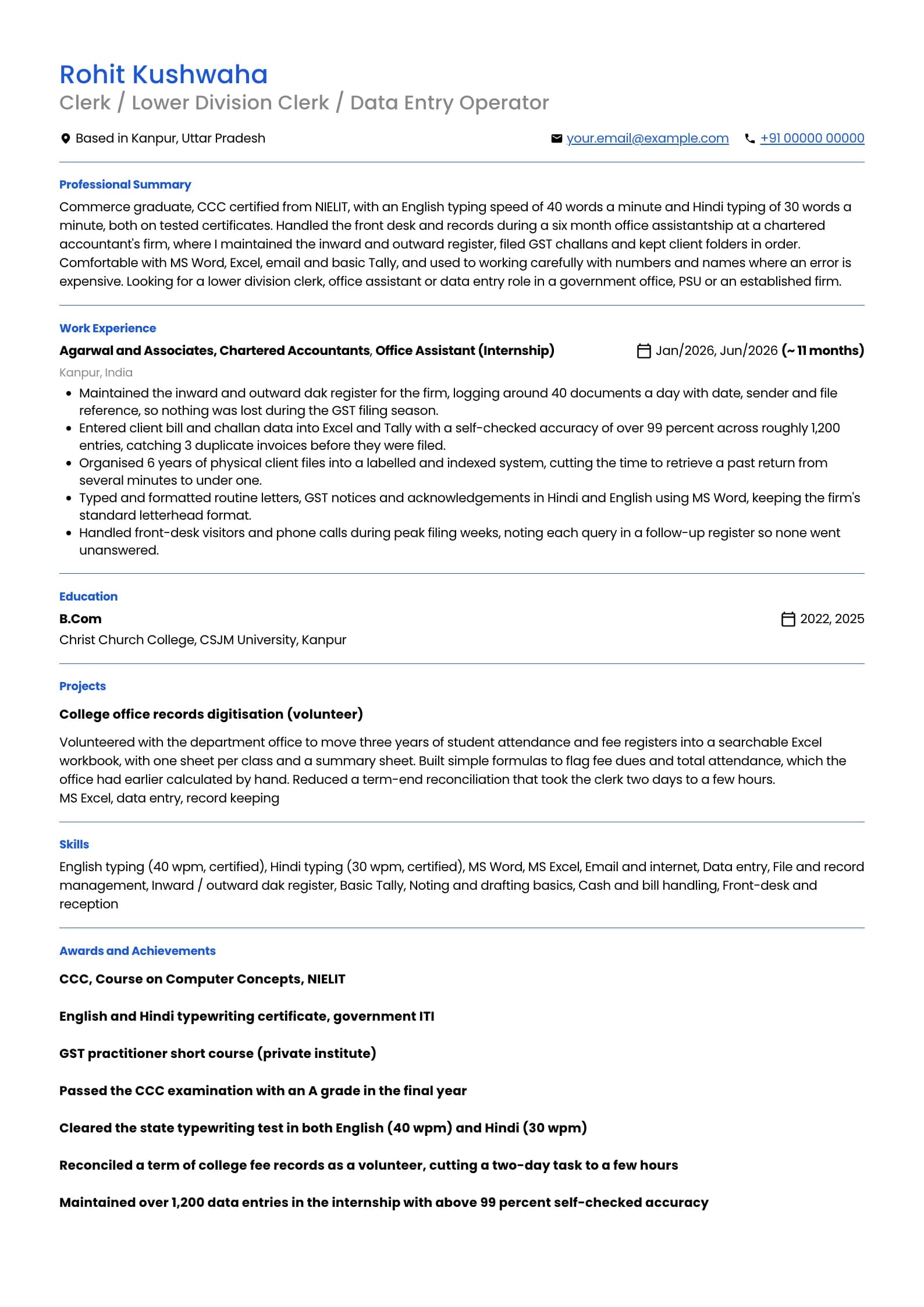
Build my resumeGovernment Clerk resume example, Fresher (0 years)
professional templateIs your resume good enough?
Upload the resume you have now and see what an applicant tracking system reads before a government clerk recruiter ever does.
Free to run. Sign in with your mobile number to see your score.
Government Clerk resume example, Experienced (5 years)
minimalist template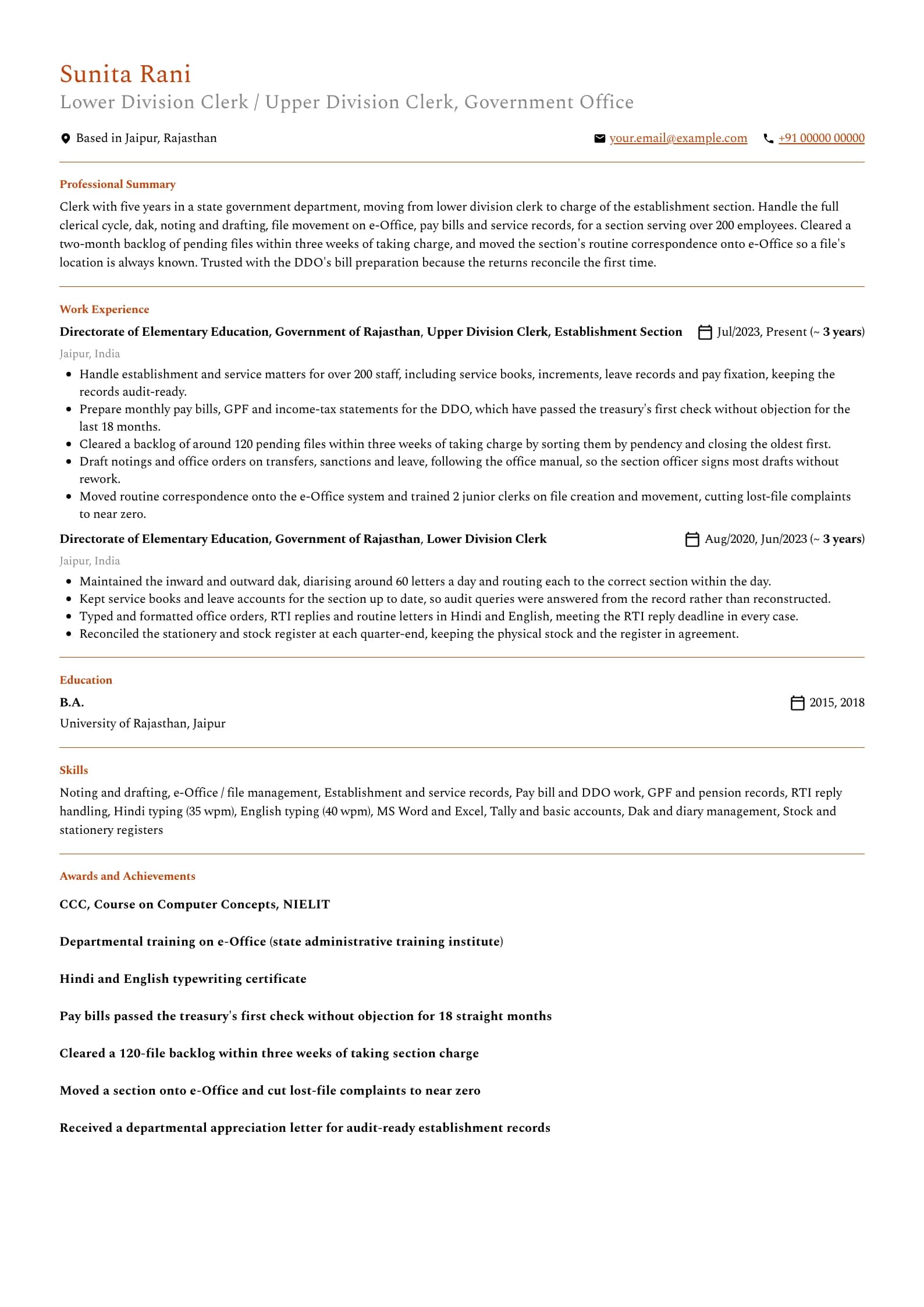
Want this structure with your own details? Build it in the resume builder.
Government Clerk resume example, Head Clerk (12 years)
header-band template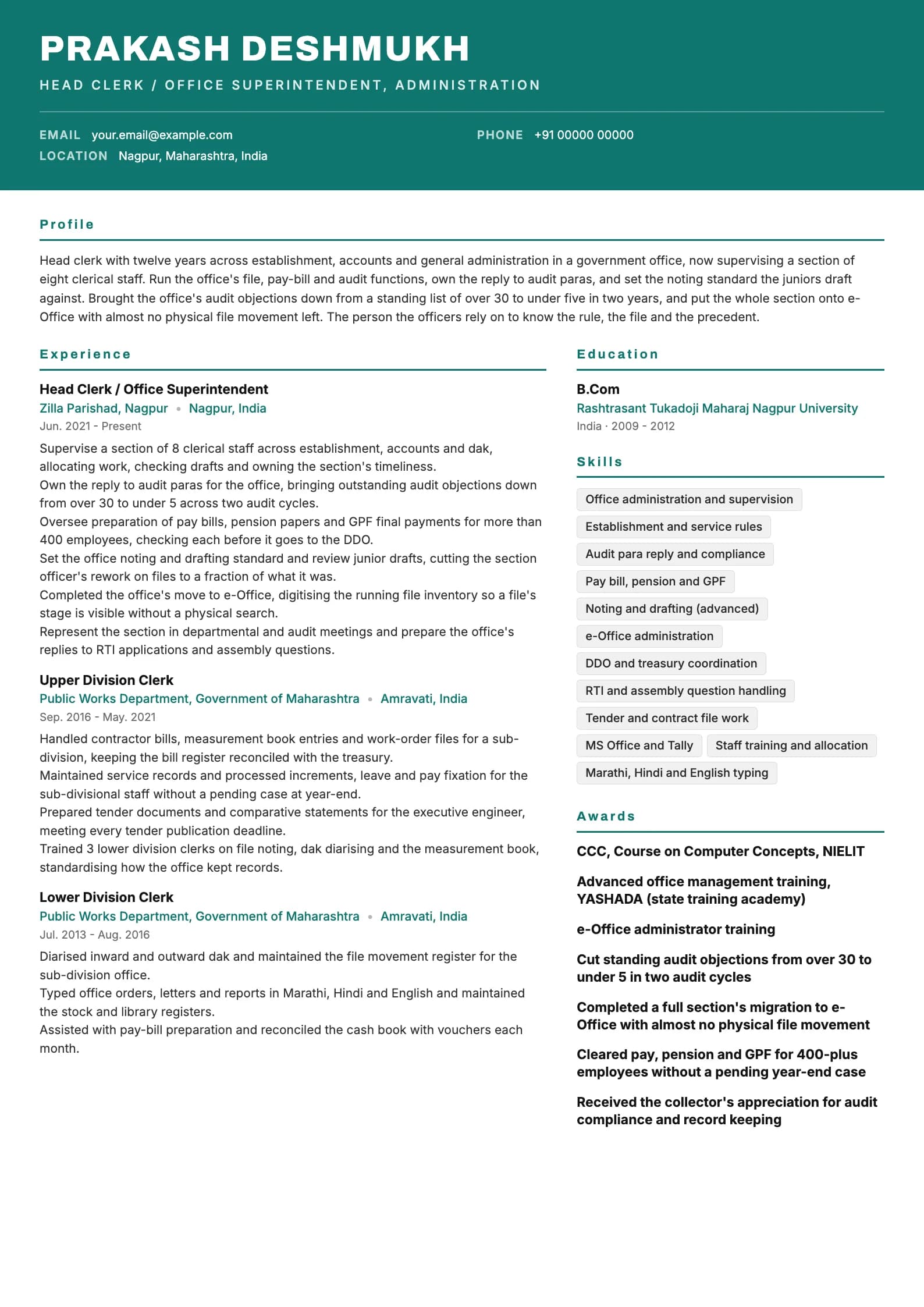
The format that works for a government clerk resume in India
Use a reverse chronological layout, most recent post first, with the dates in plain view. A clerk's whole value is orderly, verifiable records, so a resume that hides its own timeline works against the very trait the job tests. If there is a gap, state it in one honest line rather than disguising it with a functional layout. Keep it to one page for a fresher and for most clerks up to about eight years. A head clerk or office superintendent with a supervisory record and a long service history can run to two pages, but only if the second page carries real charge and audit work, not a longer hobbies list. Four things do not belong on a clerical resume even though old templates still carry them: a photograph unless the notification asks for one, marital status, and religion or caste, and a long declaration paragraph. Father's name, date of birth and address are personal contact details that a private application does not need up front, and this page's samples deliberately leave them out. Every line they take is a line a certificate or a result could have used. Name the software and the systems plainly, e-Office, Tally, the treasury or DDO system your office uses, because a recruiter searches for exactly those words. Send a PDF unless the posting asks for something else, name the file with your own name and the post, and keep to a single column so the layout parses cleanly. The table below sets the section order.
| Section | Where it goes | Why |
|---|---|---|
| Name and headline | Top, above everything | The headline names the post you want, clerk, LDC, UDC or DEO, so a recruiter matches on it. |
| Professional summary | Directly under the header | Three or four lines. Years, typing speed, main software and the single strongest result. |
| Typing and computer skills | High, near the summary | Certified words per minute in each language, and CCC. The most searched clerical proof. |
| Work experience | Next, for anyone with a job | Most recent first. Current post gets the most bullets. |
| Skills | Below experience | Grouped: clerical work, software, accounts. Not a 30-item wall. |
| Education | Bottom, near the top only for a fresher | Degree, institution, years. Keep the division while it is fresh. |
| Certifications | After education, or beside skills | CCC, typewriting certificate, Tally. Name the issuing body and year. |
Typing speed and computer skills: the proof, not the claim
For a clerk, the two facts a recruiter looks for first are your typing speed and your computer literacy, and both must be stated as evidence, not adjectives. Write the speed as a number with the language and the source: English typing 40 words a minute on a tested certificate, Hindi typing 30 words a minute. A line that says only "good typing skills" tells a recruiter nothing and reads as a claim you would rather not put a number on. Many government clerical posts carry a minimum speed, often around 35 words a minute in English or 30 in Hindi and Devanagari, tested on a skill test. If you hold a state typewriting certificate or an ITI certificate at those speeds, name it, because it is a document the office can verify. If your speed is below the usual bar, practise before you apply rather than rounding it up on paper, since the skill test will catch an inflated number and end the process. Computer literacy for a government office means the CCC certificate from NIELIT at the least, and O Level if you have it. Name the certificate with its issuing body. Then list the software you actually use: MS Word and Excel for almost every clerk, Tally for accounts work, and the department systems, e-Office for file movement, the treasury or DDO software for bills, IFMS or the state's financial system where it applies. These are the exact terms a government screening searches. Do not pad the computer list with things a clerk does not use on the job. Photoshop, video editing or a coding language on a clerk's resume reads as filler and distracts from the Excel, Tally and e-Office that the post actually needs.
State every typing speed as a number, with the language and the certificate behind it. "Good typing" is invisible to a search and unconvincing to a reviewer; "English 40 wpm, certified" is both searchable and checkable.
Writing a clerk summary that is read
The block under your name is the part most likely to be read in full, so it should carry four facts: how long you have worked as a clerk, your typing speed, the main software or systems you use, and the strongest thing that came out of your work. Three or four lines, no unverifiable praise. The old objective, seeking a clerical post in a reputed organisation where I can use my skills and grow, tells the reader nothing they did not already assume. Replace it with a summary. An objective says what you want, a summary says what you have already done, and only the second is evidence a recruiter can act on. Freshers often think they have nothing to summarise. Look at the fresher sample: it states the degree, the CCC certificate, both typing speeds, and an internship where real registers were kept accurately. That is a genuine summary built from a commerce degree, a computer certificate and six months of careful office work. What it avoids is "hardworking and sincere", a phrase so common on clerical resumes that it now carries no information at all. A practical test: read your summary and ask whether any other clerk with the same certificate could paste it onto their resume unchanged. If they could, it describes the qualification, not you. Add the specific section you handled, the specific volume, and the specific result until it stops being transferable.
Professional summary, experienced clerk
Weak
Hardworking and sincere clerk with experience in office work, typing and computer, seeking a suitable clerical post in a reputed government organisation where I can utilise my skills.
Strong
Upper division clerk with five years in a state government establishment section, handling service records, pay bills and e-Office for over 200 staff. English typing 40 wpm. Pay bills cleared the treasury's first check without objection for 18 months.
The rewrite trades self-praise and a vague wish for a section handled, a scope, a typing number and one verifiable result.
Experience bullets: task, volume, result
A clerk's work is often described as though it cannot be measured, which is why so many clerical resumes read as a copied list of duties. It can be measured. Every strong bullet in the samples names what you did, how much of it you handled, and what came out right because of it. The task shows relevance, the volume shows scale, and the result shows care. Start from what was different in the office because you did the work. A backlog cleared, a register that reconciled, a bill that passed audit the first time, a file that was never lost, a deadline that was always met. These are a clerk's outcomes, and they persuade far more than "maintained files and registers". Use the numbers a clerk actually has: documents diarised a day, files handled, entries made and their accuracy, staff whose records you kept, audit objections closed, deadlines met. "Diarised around 60 letters a day and routed each to the correct section within the day" carries weight without inventing anything. Where there is no number, give scope, how many staff a section serves, how many years of records you keep, how many bills you prepare a month. Reconciliation and audit are the clerk's strongest signals, because they say the record was right when someone checked. Allocate bullets by recency: the current post gets four to six, older posts three to four.
| Level | What bullets must prove | Typical metric |
|---|---|---|
| Fresher | You are accurate and orderly with records | Entries made and accuracy, documents logged a day, files organised |
| 1 to 4 years | You run a clerk's cycle without supervision | Dak a day, files handled, deadlines met, backlog cleared |
| 5 to 8 years | You own a section's records and bills | Staff served, bills reconciled, audit queries answered, RTI met |
| 9 years and up | You supervise staff and own compliance | Staff supervised, audit objections closed, sections run, drafts reviewed |
Experience bullet, government clerk
Weak
Responsible for maintaining files, registers and doing typing work and other duties as assigned by the officer.
Strong
Diarised around 60 letters of dak a day and routed each to the correct section within the day, so no inward document went untraced.
"Responsible for" and "other duties" describe the recruitment notice; the rewrite names the daily volume and the result it protected.
Experience bullet, accounts work
Weak
Prepared pay bills and other financial statements as required and submitted to the concerned officer.
Strong
Prepared monthly pay bills, GPF and income-tax statements that passed the treasury's first check without objection for 18 straight months.
Turns a duty into a track record by naming the exact statements and the audit result that proves they were right.
If a bullet would read identically on any clerk's resume, it is describing the post, not you. Add the section you handled, the volume you carried and the reconciliation or deadline you met until it only fits your desk.
The skills section: grouped, real, and easy to check
A clerk's skills section has two readers. An office recruiter, sometimes an ATS, wants literal terms it can match, e-Office, Tally, MS Excel, noting and drafting. A human wants a short, ordered list that says what kind of clerk you are, establishment, accounts or general administration. Grouping serves both. Group by function rather than one long line. Clerical work, computer and software, accounts, and languages and typing is a grouping that fits almost every clerk. Put the certified typing speeds in the list, with the number, because it is the most searched clerical skill. Write software the way it is written on the job: MS Excel not "excel sheet", e-Office not "e office", Tally not "tally erp" unless that is the exact version you used. Twelve to sixteen skills is the working range. Below eight the section looks thin. Above twenty it stops being a signal and starts to look padded, and a clerk's resume is prone to listing every small task as a separate skill. Keep the ones a recruiter screens on, and let the experience carry the rest. Do not add star ratings or proficiency bars. Nobody agrees what four stars in Excel means, and it invites a test you would rather take on the job. State the typing speed as a number and let the experience prove the depth of everything else.
Skills section
Weak
Skills: Typing, Computer, MS Office, Internet, Email, Filing, Registers, Communication, Team work, Hard working, Punctual, Honest, Dedicated, Sincere, Good handwriting
Strong
Typing: English 40 wpm and Hindi 35 wpm, both certified. Computer: MS Word, MS Excel, e-Office, Tally. Clerical: noting and drafting, dak and diary, service records, pay bill and DDO work, RTI replies.
Replaces personality words and a vague "typing" with certified speeds, named software and the actual clerical functions an office searches for.
Government exams, contractual posts and the private route
A regular government clerk post, an LDC or UDC under the SSC or a state public service commission, is filled through a written examination and a skill test, not by a resume. So it is worth being clear about where a clerk's resume actually earns its keep, because that decides what to put on it. A strong resume matters for the interview and document verification stage of an exam, for contractual and outsourced clerical posts in government offices and PSUs that hire on application, for university, court and autonomous-body clerical jobs, and for moving from a government or contractual post into a private office, an accounts firm or a company's administration team. All of these read a resume, and all of them screen on typing speed, software and reliability. If you are preparing for or have cleared a stage of an exam, name it plainly: appeared for SSC CHSL, qualified the state PSC LDC written examination, cleared the typing skill test. These are checkable facts that show seriousness. Do not claim a selection you have not received, because verification is thorough and a false claim ends everything. If you are applying to a private employer after government service, translate the experience into their language. "Establishment section" becomes HR and records, "DDO bill work" becomes payroll and accounts support, "e-Office" becomes document and workflow management. The underlying skill is the same; the words on the page should match the reader.
| Where the resume is used | Who reads it | What they screen on |
|---|---|---|
| Exam interview and document verification | Selection board | Genuine certificates, typing speed, consistent record |
| Contractual / outsourced government and PSU posts | Agency or office HR | Typing, CCC, relevant clerical experience, availability |
| University, court and autonomous body clerk | Institutional HR | Typing, software, record-keeping experience, languages |
| Private office, accounts firm, company admin | Company HR | Excel and Tally, accuracy, payroll or accounts exposure |
Where education and certifications belong
Education sits at the bottom for anyone with a clerical job and near the top for a fresher, who has nothing stronger to lead with. Degree, institution, years. For most clerical posts a graduate degree, often in commerce or arts, is the requirement, so name it plainly with the division. Keep the division or percentage while you are a fresher and while it is good, because early screening still filters on it. Once you have a few years of clerical work behind you, the division from years ago competes for space with a reconciliation record and an audit result that predict your work far better, so it can shrink to a line. Certifications carry real weight for a clerk, so give them their own place just below education, or beside skills if you hold only one or two. The CCC from NIELIT is the standard computer-literacy proof for government clerical work, O Level is a step above it, a state or ITI typewriting certificate proves your speed, and a Tally or GST course helps for accounts-heavy posts. Write the full name, the issuing body and the year for each. An expired or unverifiable certificate is a small dishonesty that is easy to catch at document verification, so list only what you can produce. If your CCC is under process, say "appeared" rather than "certified".
Getting a clerk resume through the screening
Many private and PSU employers now run applications through an applicant tracking system, which is a parser and a search index, not a judge. It reads your file, tries to split it into name, dates, employers, posts and skills, and stores the result so a recruiter can search across applicants. Most screening failures are parsing failures, and parsing failures come from layout, not from the words. The layout rules are short. Use one column. Use standard headings, Work Experience rather than "My Career Journey", and Skills rather than "What I Can Do". Keep no critical information inside an image or a logo, because a parser reads a picture as blank space. Keep your name and dates in the body, not only in a header or footer that some parsers drop. Avoid text boxes and nested tables in the resume body. On wording, mirror the language of the notification or the job post where it is honest. If it says "data entry operator", write data entry operator. If it says "noting and drafting", use those words. Include the expansion beside an abbreviation once, for example "CCC (Course on Computer Concepts)" and "DDO (drawing and disbursing officer)", so both a keyword and an expanded search find you. Do not stuff keywords, and do not paste a hidden white-text block of every clerical term. Recruiters find it, and the result is worse than being filtered. Write real bullets that naturally carry the terms, because a bullet about pay bills you prepared on the treasury system carries "pay bill" and "treasury" in a form that survives a human read too. Save as a PDF that holds real text, then open it and check that you can select and copy a sentence. If you cannot select the text, neither can the parser.
Section heading
Weak
My Duties and Responsibilities
Strong
Work Experience
A parser looks for standard headings; a non-standard one can push the whole block into an unclassified bucket the recruiter never searches.
Test your own file before you send it. Copy the text out of the PDF into a plain text editor. Whatever reads cleanly there is roughly what the parser sees, and anything scrambled is a real risk.
What gets a government clerk resume set aside
Most rejections at the resume stage are not close calls. They come from a small set of recurring problems, and each is fixable in an afternoon. The list below is what reviewers of Indian clerical resumes see most often, in rough order of the damage each one does.
- No typing speed, or a vague "good typing skills" with no number and no certificate. It is the first thing a clerical recruiter looks for.
- A copied list of duties from the recruitment notification instead of what you actually handled. "Responsible for" and "other duties as assigned" are the tells.
- No software named. MS Excel, Tally, e-Office, the treasury system. A clerk who names no software reads as untrained on a computer.
- No numbers anywhere. Dak a day, files handled, entries and accuracy, staff served, audit objections closed. Pick whichever is honest.
- Personality words as skills, sincere, hardworking, honest, punctual. They fill space and prove nothing a reference cannot.
- A photo, marital status, religion or a declaration paragraph carried over from an old template. None of it belongs on a clerical resume.
- Claiming a selection or an exam result you have not received. Document verification is thorough and a false claim ends the process.
- Certificates listed without the issuing body or year, so a verifier cannot confirm them. Name NIELIT, the ITI, the year.
- One resume for both government and private applications. Translate "establishment" and "DDO work" into HR and payroll when the reader is a company.
- Spelling errors in the very software and terms you claim, "Tallay" for Tally or "Excell" for Excel, which undoes an otherwise careful page.
Read your resume aloud once before sending it. Anything you would hesitate to state to a selection board's face, an unproven speed, a duty you never did, is a line to cut or fix.
Skills to put on a government clerk resume
Technical
- Noting and drafting
- e-Office / file management
- Establishment and service records
- Pay bill and DDO work
- GPF and pension processing
- Dak and diary management
- RTI reply handling
- Data entry and record keeping
- Cash book and reconciliation
- Stock and stationery registers
- Audit para compliance
- Tender and contract file work
Tools and platforms
- MS Word
- MS Excel
- Tally
- e-Office
- Treasury / DDO system
- IFMS / state financial system
- Email and internet
- PDF and scanning tools
- Google Sheets
Working skills
- Accuracy and attention to detail
- Confidentiality
- Time management and deadlines
- Coordination between sections
- Front-desk and public dealing
- Following office rules and manuals
- Staff supervision
- Written communication
Certifications worth listing as a government clerk
| Certification | Full name | Worth it for |
|---|---|---|
| CCC | Course on Computer Concepts, NIELIT | The standard computer-literacy certificate for government and PSU clerical posts, and often a mandatory qualification in the recruitment notification. Worth it for every clerk and aspirant, and named with the NIELIT issuing body so a verifier can confirm it. |
| O Level | O Level, NIELIT (DOEACC) | A step above CCC, a foundation-level IT certificate worth it for a clerk who wants a stronger computer credential or is aiming at data entry and IT-adjacent office roles. Useful early; less decisive once you have years of departmental software experience to point at. |
| Typewriting certificate | State or ITI English and Hindi typewriting certificate | The document that proves your typing speed for a clerical post, since many notifications set a minimum words-per-minute bar tested at a skill test. Essential for a fresher clerk and worth naming with the exact certified speeds in each language. |
| Tally / GST course | Tally with GST, private institute or NIELIT | Worth it for clerks aiming at accounts, billing or DDO-heavy posts, and for those moving from a government office to a private accounts or company administration role, where Tally and GST are the day-to-day tools. Less relevant for a purely establishment or dak-focused post. |
| SSC CHSL / state PSC | Staff Selection Commission CHSL or state public service commission clerical exam | Not a certificate but the examination route into regular LDC, UDC and DEO posts. Name the stage you have honestly reached, appeared, qualified written, cleared skill test, on a resume used for interview or document verification, since it shows a serious, checkable candidacy. |
Keywords an ATS scans for in a government clerk resume
These are the literal terms a parser matches against the job description. Use the ones that are true of you, in the sentences where you did the work, not as a list at the bottom.
- clerk
- lower division clerk
- upper division clerk
- data entry operator
- typing speed
- CCC
- MS Office
- Excel
- Tally
- e-Office
- noting and drafting
- dak
- pay bill
- DDO
- establishment
- service records
- RTI
- audit
- record keeping
- office administration
Government Clerk resume FAQ
What salary can a government clerk expect in India?
A regular lower division clerk usually starts on Pay Level 2 of the seventh pay matrix, with a basic around 19,900 rupees and a gross of roughly 25,000 to 35,000 a month after allowances, varying by city and department. An upper division clerk on Level 4 earns more, and a head clerk or office superintendent on higher levels can reach a gross of 50,000 to 70,000 with experience. PSU and bank clerical posts often pay more than a state clerical post, while contractual and outsourced clerk jobs pay less and without the same benefits. A private office clerk's pay depends on the employer and on Tally and accounts skill.
How long should a government clerk resume be?
One page for a fresher and for most clerks up to about eight years. A head clerk or office superintendent with a supervisory record and long service can use two pages, but only if the second page carries real charge, audit and staff-supervision work rather than a longer hobbies list. Nobody has been rejected for a resume that was easy to read. If you are struggling to fit one page, cut the oldest post to a single line and remove personality words like sincere and hardworking.
Do I really need a typing speed on a clerk resume?
Yes, and stated as a number with the language and a certificate behind it, for example English 40 words a minute and Hindi 30 words a minute, both certified. Typing speed is the first thing a clerical recruiter looks for, many posts set a minimum tested at a skill test, and a vague "good typing skills" reads as a claim you would rather not put a number on. If your speed is below the usual bar of around 35 in English or 30 in Hindi, practise before applying rather than inflating it, because the skill test will catch it.
Is a resume even used for a government clerk post?
A regular LDC or UDC post through the SSC or a state commission is filled by a written exam and a skill test, not a resume. But a resume matters at the interview and document-verification stage, for contractual and outsourced clerical posts in offices and PSUs that hire on application, for university and court clerk jobs, and for moving from a government or contractual post into a private office or accounts firm. All of those read a resume and screen on typing, software and reliability.
Which certifications help a government clerk?
The CCC from NIELIT is the standard computer-literacy proof and is often mandatory in the notification, O Level is a step above it, and a state or ITI typewriting certificate proves your speed. For accounts-heavy or private-office roles, a Tally with GST course helps. Name each with its issuing body and year so a verifier can confirm it, and list only what you can actually produce at document verification.
How do I write a clerk resume as a fresher?
Lead with your typing speeds and CCC certificate, then education, then any internship or volunteer office work, then skills. Treat an internship or a volunteer records task as real experience: state the volume you handled, the accuracy you kept and what you organised. A commerce degree, a computer certificate, a certified typing speed and six months of careful register work make a genuine fresher resume. Add anything checkable, such as your CCC grade and your tested words per minute, since verifiable facts carry more weight than words like sincere.
Should I put a photo and personal details on the resume?
No, unless the notification specifically asks for a photograph. Marital status, religion, caste and a long declaration paragraph come from an old template that spread through employment exchanges and add nothing to a clerical screen. Personal contact details are not needed high on the page. Use the space for your typing speeds, software and results instead, which is what actually gets a clerk shortlisted.
How do I move from a government clerk post to a private job?
Translate the experience into the private employer's language. "Establishment section" becomes HR and records, "DDO and pay bill work" becomes payroll and accounts support, and "e-Office" becomes document and workflow management. Lead with Excel, Tally and accuracy, since a private office screens on those. Keep the numbers, staff served, bills reconciled, audit results, because a clean record under audit reassures a private employer just as much as a government one.
Does an ATS reject a two-column clerk resume?
Not outright, but some parsers read a two-column layout out of order and interleave your sidebar with your experience, which produces nonsense in the recruiter's view. A single-column layout removes the risk, which is why the samples above use one. Test your own file by copying the text out of the PDF into a plain text editor, and if it reads in order there it will most likely parse correctly for a PSU or private employer's system.
Related resume examples and guides
Build your clerk resume in any of these formats
Start from a blank resume or upload the one you have. Goodspace renders it in 24 templates and flags the typing speed, e-Office, Tally and record-keeping keywords an office recruiter will look for, and the filler it will not credit.
Build my resume