IBPS Clerk Resume Format, with 3 Full Samples
A bank clerk is trusted with cash, customers and a clean audit trail, so a clerk resume is really a statement of accuracy and volume handled, not a list of the counters someone once staffed. Below are three complete resumes, one for a fresh graduate who has just cleared IBPS Clerk, one for a single-window operator with five years at the counter, and one for a senior clerk who has grown into a special assistant and cleared JAIIB. After the samples come the format rules, the difference between listing counter duties and proving reliability with numbers, the exact terms a parser and an interview panel look for, and the mistakes that quietly cost a shortlist.
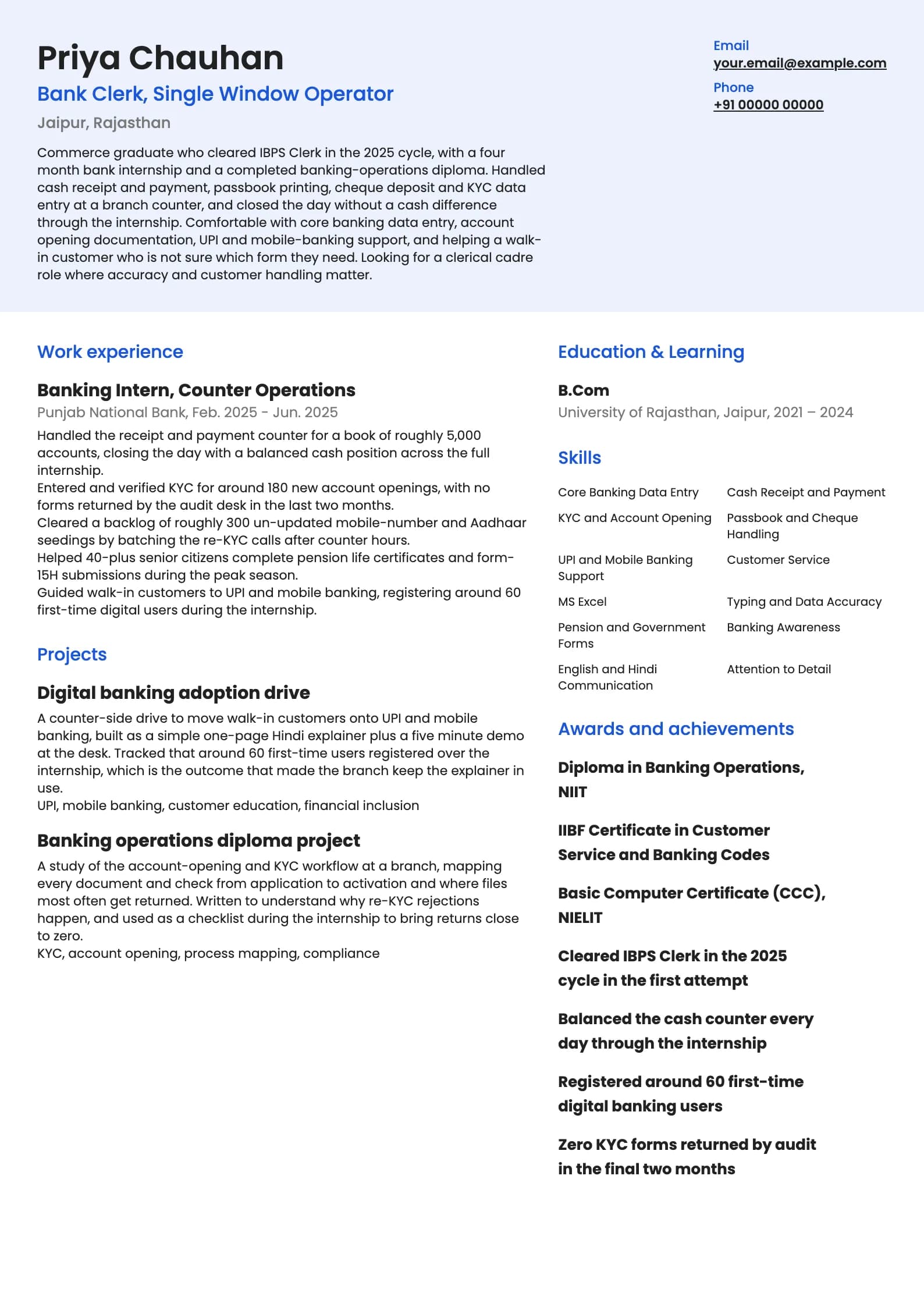
Build my resumeIBPS Clerk resume example, Fresher (0 years)
modern templateIs your resume good enough?
Upload the resume you have now and see what an applicant tracking system reads before a ibps clerk recruiter ever does.
Free to run. Sign in with your mobile number to see your score.
IBPS Clerk resume example, Experienced Clerk (5 years)
professional template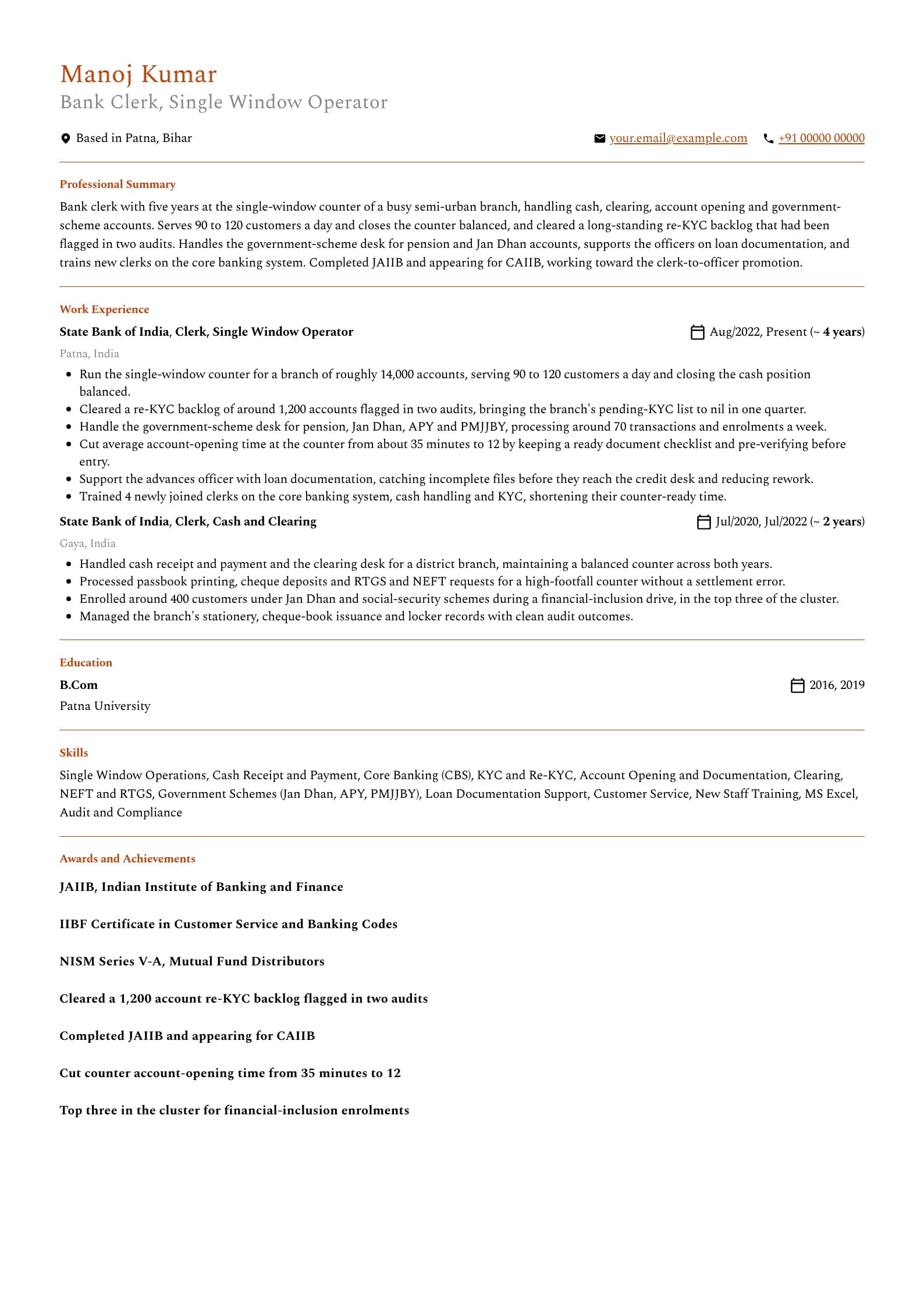
Want this structure with your own details? Build it in the resume builder.
IBPS Clerk resume example, Special Assistant (9 years)
header-band template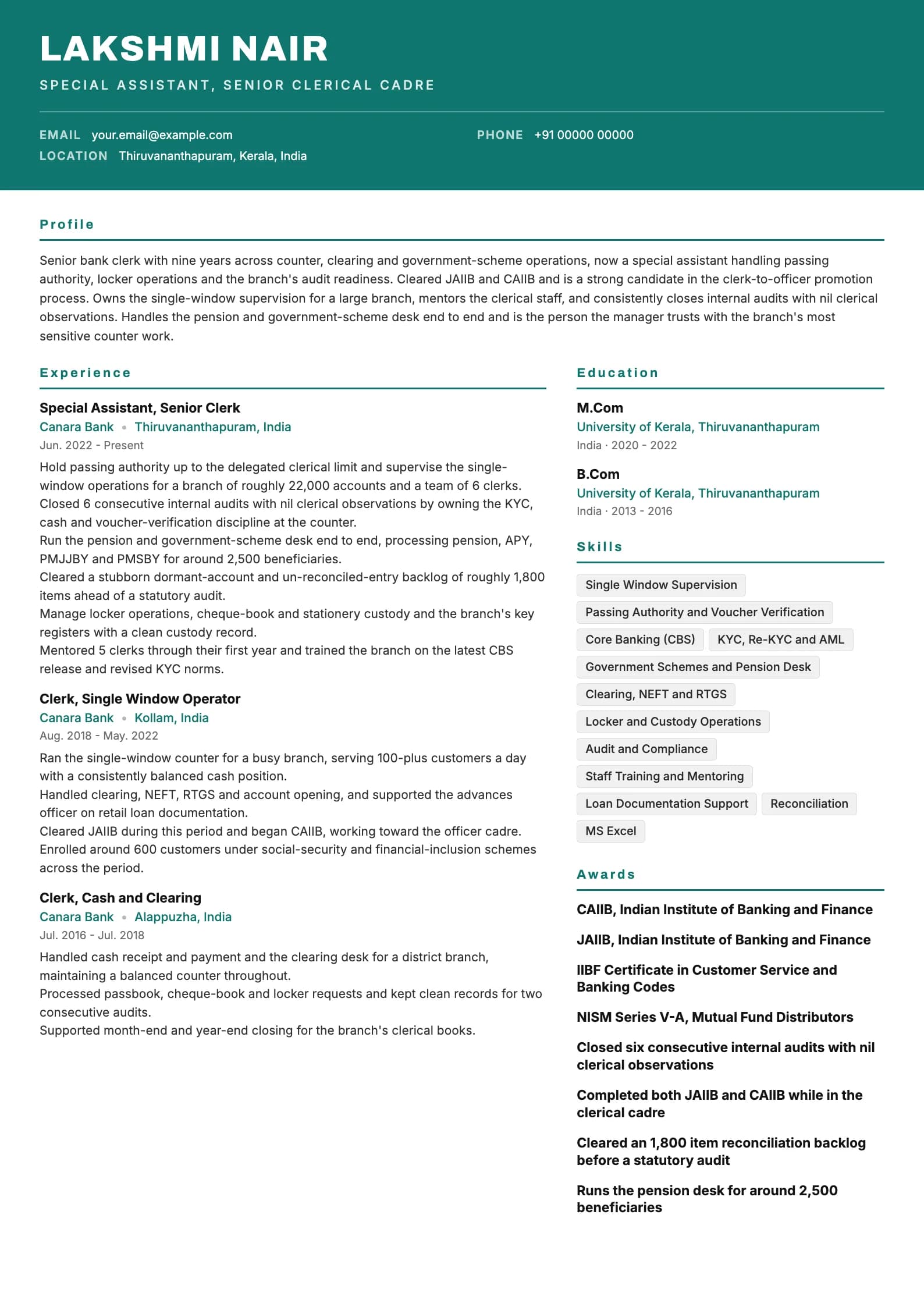
The format that works for IBPS clerk resumes in India
Reverse chronological is the layout to use. Put the most recent role first, work backwards, and keep the dates in plain view. A functional resume that groups everything under Banking Skills and hides the timeline reads as an attempt to cover a gap or a short stint, and recruiters treat it that way. One honest line about a gap beats a layout built to disguise it. Length is decided by what you have done. One page holds everything a fresh clerk and most operators up to roughly six years need. A special assistant with supervisory work can use a second page when it carries real audit and desk-ownership evidence, not a longer list of counters. A second page built from a hobbies line and a declaration is a padded one-page resume. Remember what an IBPS clerk resume is for. If you have already cleared the exam, the written result gets you to the interview, and the resume plus biodata is what the panel reads and questions. For a private bank teller or back-office role, or a clerk-to-officer promotion process, the resume is the whole first filter. Either way it is a document about accuracy and volume, so it should show accounts handled, cash balanced, KYC done and audits closed, not a description of counter work everyone already knows. Four things belong nowhere on it: a photograph unless the posting asks, date of birth beyond what a government form separately needs, marital status and father's name. They survive from an older template. Send a PDF unless the posting asks for DOCX, name the file with your name and the role, and keep to a single column so a parser reads it in order. The table below sets out the section order.
| Section | Where it goes | Why |
|---|---|---|
| Name and headline | Top, above everything | The headline is the post you want: bank clerk, single window operator, special assistant. Panels and parsers match on it. |
| Professional summary | Directly under the header | Three lines. Years at the counter, the desk you handle and the strongest accuracy or volume fact. |
| Work experience | Next, for anyone with a job | Most recent role first. Current counter gets the most bullets. |
| Projects or drives | Above experience for freshers, below it after that | For a fresh clerk a digital-adoption drive or a KYC project is the evidence of counter sense. |
| Skills | Below experience | Grouped: operations, compliance, systems, service. Not a 30-item wall. |
| Education | Bottom, unless you are a fresher | Degree, institution, years. Keep the percentage only while it helps a fresher. |
| Certifications | After education, or beside skills if only one or two | Name, issuing body, year. JAIIB and CAIIB from IIBF earn their place. |
Listing counter duties is not the same as proving reliability
The most common clerk resume failure is a duty list: handled cash, did account opening, maintained records, provided customer service. A panel reads that and learns nothing, because it describes the counter, not the clerk. Every operator in the branch could write those exact lines. The fix is to attach a reliability or volume number to the duty. Not handled cash, but served 90 to 120 customers a day and closed balanced every day. Not did account opening, but entered KYC for 180 accounts with zero returned by audit. Not maintained records, but cleared a 1,200 account re-KYC backlog flagged in two audits. The experienced sample never says maintained good customer service, it says the daily footfall and the clean cash position that prove it. A clerk's job gives honest numbers everywhere, so use them: accounts on the counter, customers a day, cash balanced, KYC or account-opening volume, re-KYC or reconciliation backlogs cleared, scheme enrolments, audit observations, turnaround at the counter, staff trained. A resume that quantifies even three of these reads as an accurate, high-volume operator, which is exactly what a bank counter needs. Do not confuse activity with impact. Participated in the financial-inclusion drive is activity. Enrolled around 400 customers under Jan Dhan, top three in the cluster is impact. The panel is looking for the second kind.
For every counter duty on your resume, ask: how many, how accurate, how clean the audit. If there is no number, either find the honest one or cut the line. A duty list gets you screened out against candidates who quantified.
Writing a summary an interview panel actually reads
The block under your name is the part you can be sure gets read, especially by a panel skimming just before your slot. It should carry three facts: how long you have worked the counter, the desk you handle, and the strongest accuracy or volume fact behind you. Three or four lines, no adjectives a panel cannot check. The old objective line, seeking a stable and respectable clerical position in a reputed bank to serve customers with dedication, tells the panel nothing new. Replace it with a summary. An objective says what you want, a summary says what you have already handled, and only one survives a follow-up question. Freshers often think they have nothing to summarise. Look at the fresher sample: it names the exam cleared, the internship length, and points at a balanced cash counter and a digital-adoption drive with a real number. That is a genuine summary built from a degree, one internship and a diploma. What it avoids is honest, sincere and hardworking with good communication skills, a phrase so common on clerk resumes it now reads as blank space. A practical test: read your summary and ask whether any other clerk from your branch could paste it unchanged. If they could, it describes the counter, not you. Add the specific branch size, the specific volume and the specific clean-audit fact until it stops being transferable.
Professional summary, experienced clerk
Weak
Sincere and hardworking bank clerk with 5 years of experience in cash handling, account opening and customer service, seeking a stable clerical position in a reputed bank.
Strong
Bank clerk with five years at a busy single-window counter serving 90 to 120 customers a day and closing balanced, cleared a 1,200 account re-KYC backlog flagged in two audits. Completed JAIIB.
The rewrite trades a duty list and self-praise for the daily volume, a concrete backlog cleared and a credential.
Experience bullets: action, volume, clean outcome
Every strong bullet in the samples follows the same shape. It opens with an action, names the specific counter or desk you handled, and closes with the volume or the clean outcome. The action shows you did it. The desk tells the panel the work is real. The number does the persuading. Start with the outcome and work backwards. Clerks usually write the duty first, then cannot attach a number, which produces lines like handled cash operations and maintained good service. Instead ask what was true about your counter: how many accounts, how many customers a day, whether it balanced, what backlog you cleared, what audit came back clean. Then write the sentence that ends in that fact. Vary the number. Five cash lines in a row read as one duty repeated. Across a real clerical role you can honestly reach for accounts on the counter, customers a day, KYC and account-opening volume, backlogs cleared, scheme enrolments, turnaround, audit observations and staff trained. The experienced sample uses several of these, which reads as someone who runs a whole counter. Where you lack a clean number, give scope: how large the branch book, how many schemes on your desk, how many clerks you trained. Trained 4 newly joined clerks on the core banking system carries weight without inventing a percentage. Allocate bullets by recency. Current role gets five or six, the previous role four or five, anything older two or three.
| Level | What bullets must prove | Typical metric |
|---|---|---|
| Fresher or fresh clerk | You can be trusted at a counter and are accurate | Accounts on the counter, KYC done, cash balanced, digital users |
| 1 to 4 years | You run a counter at volume without errors | Customers a day, backlogs cleared, scheme enrolments, turnaround |
| 5 to 8 years | You own a desk and keep it audit-ready | Audit observations, reconciliation, staff trained, book size |
| Special assistant, 8 and up | You supervise, hold passing authority and set the discipline | Passing authority, nil-observation audits, team supervised |
Experience bullet, counter operations
Weak
Responsible for cash handling, account opening, passbook printing and providing good customer service at the branch counter.
Strong
Run the single-window counter for a branch of roughly 14,000 accounts, serving 90 to 120 customers a day and closing the cash position balanced.
"Responsible for" describes the counter; the rewrite names the book size, the daily volume and the clean cash outcome.
Experience bullet, KYC and compliance
Weak
Handled KYC updation work and cleared the pending accounts as instructed by the branch manager from time to time.
Strong
Cleared a re-KYC backlog of around 1,200 accounts flagged in two audits, bringing the branch's pending-KYC list to nil in one quarter.
Names the size of the backlog, that audit had flagged it, and the clean result, so the panel can ask a real follow-up.
If a bullet would read identically on another clerk's resume from your branch, it is describing the counter, not you. Rewrite it until it only fits the volume and the clean outcome you actually delivered.
The skills section: grouped, honest, and short enough to defend
A clerk resume's skills section has two audiences. A private bank's parser wants literal terms it can match, CBS, KYC, cash handling, NEFT. A human panel wants a short, organised list that signals what kind of operator you are. Grouping serves both. Group by function rather than one long line. Operations, compliance, systems and service is a grouping that works for almost every bank clerk. The exact headings matter less than the fact that structure exists. Write the terms the way banking writes them: CBS, KYC, NEFT and RTGS in capitals, Finacle or the system in use spelled correctly, because a parser matches on strings and a panel notices a misspelt term. Ten to sixteen skills is the working range. Below eight the section looks thin. Above twenty it stops being a signal, and it invites the panel to quiz you on the one you cannot defend. The list is a contract: every item is a question you have agreed to answer, so do not put loan appraisal on a clerk's resume, that is an officer's line. Support of loan documentation is honest, appraisal is not. Do not include a proficiency bar or a star rating. Nobody agrees what four stars in cash handling means. Let the volume you handled prove the depth instead.
| Group | What goes in it | How many |
|---|---|---|
| Operations | Cash, single window, clearing, account opening, NEFT and RTGS | 3 to 5 |
| Compliance | KYC, re-KYC, AML, audit, documentation | 2 to 4 |
| Systems | Core banking (CBS or Finacle), MS Excel, typing accuracy | 2 to 3 |
| Service | Customer service, government schemes, digital banking support | 2 to 3 |
| Supervision (seniors) | Passing authority, staff training, reconciliation, custody | 1 to 3 |
Skills section
Weak
Skills: Banking, Cash, Computer, Communication, Hard Working, Sincere, Honest, Team Work, Customer Handling, MS Office, Typing, Fast Learner, Punctual, Dedicated
Strong
Operations: single window, cash receipt and payment, clearing, NEFT and RTGS. Compliance: KYC, re-KYC, audit. Systems: core banking (CBS), MS Excel. Service: customer service, government schemes.
Cuts the personality traits masquerading as skills, keeps the banking terms a parser and a panel actually search, and groups them so a human reads it in one pass.
Drives and internships: what a fresher shows instead of experience
For a fresh clerk, an internship or a counter-side drive is the resume. It sits above experience, gets the most space, and is where a panel decides whether you have counter sense or only cleared an aptitude paper. For an experienced clerk these move below experience and shrink to nothing, because the counter work speaks louder. The common fresher failure is describing the internship as attendance: worked at the branch and observed how banking operations are done. That tells a panel nothing. Describe what you actually handled and what came of it. The digital-adoption drive in the fresher sample is a stronger entry than a longer duty list, because it shows initiative and a countable outcome: around 60 first-time users registered. Pick evidence that shows range rather than three versions of watching the counter. One that shows accuracy, such as a KYC or process project that brought returns close to zero, and one that shows customer or field ability, such as a digital or financial-inclusion drive with a number, is a stronger pair than a list of everything you observed. If you handled real volume during an internship, state it. A panel treats a fresher who balanced the cash counter every day and entered KYC for 180 accounts very differently from one who assisted in daily branch activities, because one carries a verifiable outcome and the other carries none.
Internship description, fresher resume
Weak
Bank Internship: worked at the branch for four months and observed cash handling, account opening and other banking activities under the staff.
Strong
Handled the receipt and payment counter for a book of roughly 5,000 accounts, closing the day balanced across the internship, and entered KYC for around 180 new accounts with zero returned by audit.
Swaps observed for the volume actually handled and the clean-audit quality signal that a counter role is judged on.
Where education and certifications belong
Education goes at the bottom for anyone with a banking job, and near the top for a fresher, who has nothing stronger to lead with. Degree, institution, years. That is the whole entry for most people. Percentage or CGPA is worth keeping while you are a fresher and it is decent, because early-career screening still filters on it and public sector banks record it separately anyway. Once you have a counter and a clean audit record to point at, drop the school and college percentages. A number from years ago competes for space with cash balanced and backlogs cleared, which predict far more. Coursework and subjects are for freshers only, and only when relevant. Banking, accountancy and business law are worth naming for a clerk role. Foundational mathematics is not. Certifications sit just below education, or beside skills if you hold only one or two. Write the full name, the issuing body and the year. For clerks, JAIIB and CAIIB from the Indian Institute of Banking and Finance carry genuine weight, because they gate increments and are central to the clerk-to-officer promotion process. A basic computer certificate helps a fresher show typing and CBS readiness. NISM matters if your counter also handles third-party products. An expired or half-completed certification listed as done is easy to catch, so state the real status: cleared, appearing, or the papers pending.
Getting through the applicant tracking system and the panel
For a private bank teller or back-office application, an applicant tracking system reads your file first. It is a parser and a search index, not a judge. It breaks your resume into name, dates, employers, titles and skills, and stores the result so a recruiter can search across candidates. Almost every ATS problem is a parsing problem, and parsing problems come from layout, not wording. The layout rules are short. One column. Standard section headings, so Work Experience rather than My Banking Story, and Skills rather than My Strengths. No text inside images, because a bank-logo strip reads as empty space. Nothing critical in the header or footer region, which some parsers drop. Avoid text boxes and nested tables in the body. On wording, mirror the posting where it is honest. If it says single window operator, write single window operator. If it says CBS, write CBS rather than only computer. Include the expansion alongside an acronym once, for example CBS (core banking solution), so both searches find you. For a public sector clerk role reached through IBPS, there is no ATS at the resume stage, the exam did the filtering, but the same discipline helps the interview biodata form the panel reads. Keyword stuffing does not work either way. A hidden block of banking terms is spotted fast, and the outcome is worse than being filtered. Write real bullets that naturally contain KYC, clearing, cash and audit, because a bullet about clearing a re-KYC backlog contains the word in a context that survives the panel too. Save as PDF from a tool that embeds real text, then open the file and confirm you can select and copy a sentence. If you cannot select the text, neither can the parser.
Section heading
Weak
My Banking Story
Strong
Work Experience
Parsers look for standard headings; a creative one can push the whole block into an unclassified bucket the recruiter never searches.
For a private bank, copy the text out of your PDF into a plain text editor before sending. Whatever reads in order there is roughly what the parser sees, and anything scrambled is a real risk.
What gets IBPS clerk resumes rejected
Most rejections at the resume and biodata stage are not close calls. They come from a small set of recurring problems, and all of them are fixable in an afternoon. The list below covers what banking recruiters and interview panels in India see most often on clerk resumes, in rough order of how much damage each one does.
- A duty list instead of results: handled cash, did account opening, provided service. Every clerk can write it, so it says nothing about you.
- No numbers anywhere. Customers a day, accounts on the counter, cash balanced, backlogs cleared. Pick whichever is honest for your desk.
- Leading with the exam result as if it were the resume. Clearing IBPS Clerk is one achievement line; the panel wants what you did after.
- Personality traits listed as skills: sincere, honest, hardworking. These belong nowhere on a document about accuracy and volume.
- Claiming officer-level work like loan appraisal or credit sanction that a clerk does not do. The panel catches it and it reads as overstatement.
- A photo, date of birth, marital status or father's name copied from an old template, taking space a real number should have.
- A generic objective line. Replace it with a summary that states years at the counter, the desk you handle and one clean-outcome fact.
- Vague audit and compliance lines: did KYC work, maintained records. Name the volume and the audit outcome instead.
- Claiming a completed JAIIB or CAIIB you are still appearing for. It is verifiable, so state the real status honestly.
- Misspelt banking terms: CBS, NEFT, RTGS, Finacle written wrong. On a clerk's resume it undercuts the accuracy the job is about.
Read your resume as though you are the panel with your file open and you in front of them. Any line you could not defend under one follow-up question is a line to fix or cut.
Skills to put on a ibps clerk resume
Technical
- Single Window Operations
- Cash Receipt and Payment
- Core Banking (CBS and Finacle)
- KYC, Re-KYC and AML
- Account Opening and Documentation
- Clearing, NEFT and RTGS
- Government Schemes (Jan Dhan, APY, PMJJBY)
- Reconciliation
- Loan Documentation Support
- Pension and Locker Operations
- Audit and Compliance
- Passing Authority (senior cadre)
Tools and platforms
- Finacle Core Banking
- Flexcube
- MS Excel
- MS Word
- Cheque Truncation System
- UPI and Mobile Banking Ops
- CRM Systems
- Data Entry and Typing Tools
Working skills
- Accuracy and attention to detail
- Customer service in local language
- Integrity and discretion
- Working at high volume
- Patience with walk-in customers
- Teamwork at the counter
- New staff training
- Time management at closing
- Calm under counter pressure
Certifications worth listing as a ibps clerk
| Certification | Full name | Worth it for |
|---|---|---|
| JAIIB | Junior Associate of the Indian Institute of Banking and Finance | The first banking qualification a clerk clears, worth it for anyone in the clerical cadre since it gates increments and is central to the clerk-to-officer promotion process. Clearing it early signals officer ambition and knowledge of banking beyond the counter; it is expected on the resume of any clerk aiming to move up. |
| CAIIB | Certified Associate of the Indian Institute of Banking and Finance | The advanced banking qualification, worth it for experienced clerks and special assistants targeting the officer cadre, since it carries increments and real weight in the promotion process. Most valuable once you have a few years at the counter and want to prove you are ready for a lending or supervisory role. |
| Customer Service, IIBF | IIBF Certificate in Customer Service and Banking Codes | A focused, cheap credential for clerks and freshers, since customer handling and BCSBI codes are the daily reality of the counter. Worth it for a fresher who wants a banking-specific certificate on an otherwise thin resume, and a small plus for anyone whose desk is customer-facing. |
| CCC or Computer Certificate | Course on Computer Concepts, NIELIT | A basic computer literacy certificate worth it mainly for a fresher, since it signals typing speed and CBS readiness for a clerical role that is data-entry heavy. Once you have counter experience on a core banking system, the experience proves it and the certificate becomes redundant. |
| NISM V-A | NISM Series V-A, Mutual Fund Distributors Certification | Worth it for clerks and special assistants at a branch that cross-sells mutual funds and where the counter supports third-party products. A useful extra keyword for a private-bank application, and optional for a pure operations desk that does not touch investments. |
Keywords an ATS scans for in a ibps clerk resume
These are the literal terms a parser matches against the job description. Use the ones that are true of you, in the sentences where you did the work, not as a list at the bottom.
- ibps clerk
- bank clerk
- single window operator
- cash handling
- core banking
- CBS
- KYC
- account opening
- NEFT
- RTGS
- clearing
- customer service
- government schemes
- reconciliation
- audit compliance
- JAIIB
- CAIIB
- special assistant
- data entry
- passing authority
IBPS Clerk resume FAQ
What salary can an IBPS clerk expect in India?
A fresh clerk in a public sector bank starts at roughly 3.5 to 4.8 LPA CTC on the current pay scale, with basic pay around 24,000 to 30,000 a month plus allowances that vary by city. An experienced clerk of five to eight years usually sits around 5 to 7 LPA as increments and stagnation increments accrue. A special assistant or a senior clerk with nine years and above can reach roughly 7 to 9 LPA, and clearing JAIIB and CAIIB adds increments and opens the clerk-to-officer route, which lifts pay substantially once promoted.
How long should an IBPS clerk resume be?
One page up to about six years, two pages after that only if the second page carries real supervisory and audit work rather than a longer duty list. Nobody has been rejected for a resume that was easy to read. If you are struggling to fit one page, cut the oldest role to a single line, drop coursework and college percentages, and remove any counter duty a panel would find obvious for the job.
Do I even need a resume if I cleared IBPS Clerk?
Yes. The written exam and the biodata form get you to the interview, but the panel reads and questions your background, and a clear summary of your internship, volume handled and any prior work shapes what they ask. For a private bank teller or back-office role, or a promotion process, the resume is the whole first filter. Treat it as a document about accuracy and volume that shows accounts handled, cash balanced and audits closed, not a copy of your scorecard.
Should a fresher put internships and drives above work experience?
Yes. With no confirmed clerical role, an internship and a real counter-side drive are the strongest evidence you can offer, so they sit directly under the summary. State what you handled and what came of it, not that you observed operations. Pick evidence that shows range: one that shows accuracy like a KYC project that brought returns near zero, and one that shows customer or field ability like a digital-adoption drive with a real number of users.
Do certifications like JAIIB and CAIIB help a clerk?
They help a great deal. JAIIB and CAIIB from IIBF affect increments and are central to the clerk-to-officer promotion process, so they are among the most valuable things a clerk can add. Clear JAIIB early and pursue CAIIB as you gain experience. A basic computer certificate helps a fresher show typing and CBS readiness, and NISM matters if your counter cross-sells investments. Keep the list to certifications that carry real banking weight.
What skills should an IBPS clerk put on a resume?
Group them by function: operations such as cash, single window, clearing and account opening, compliance such as KYC, re-KYC and audit, systems such as the core banking system and MS Excel, and service such as customer handling and government schemes. Only list what you can defend, and do not claim officer-level work like loan appraisal that a clerk does not do. Avoid personality traits like sincere and hardworking, which are not skills and read as filler.
Does an ATS reject clerk resumes with two columns?
For private banks that use one, it does not reject outright, but some parsers read multi-column layouts out of order and interleave your sidebar with your experience, producing nonsense in the recruiter's view. A single-column layout removes the risk, which is why all three samples above use one. Public sector clerk selection has no ATS at the resume stage, but the same clean, single-column layout still makes your interview biodata easier for the panel to read.
How do I write a bank clerk resume with no experience?
Lead with your internship and drives, then education, then skills. Treat the internship as a job: what you handled, how many accounts or customers, and whether your counter balanced. A digital-adoption drive, a KYC process project and a financial-inclusion enrolment all count. Add anything checkable, such as the IBPS Clerk result and year, a diploma and a computer certificate, because verifiable facts carry far more weight than adjectives like sincere and hardworking.
Can this resume help with the clerk-to-officer promotion?
Yes, and a promotion-focused resume should make your officer readiness obvious. Lead with supervisory or passing-authority work if you have it, put JAIIB and CAIIB high, and quantify audit outcomes, backlogs cleared and staff trained. The senior sample above is written exactly this way: nil-observation audits, both banking qualifications completed, and a pension desk owned end to end, which is the profile a clerk-to-officer panel is looking for.
Related resume examples and guides
Build your own in any of these formats
Start from a blank resume or upload the one you have. Goodspace renders it in 24 templates and flags the KYC, single-window and audit keywords a bank recruiter and an interview panel will look for, and the duty-list filler they will not credit.
Build my resume