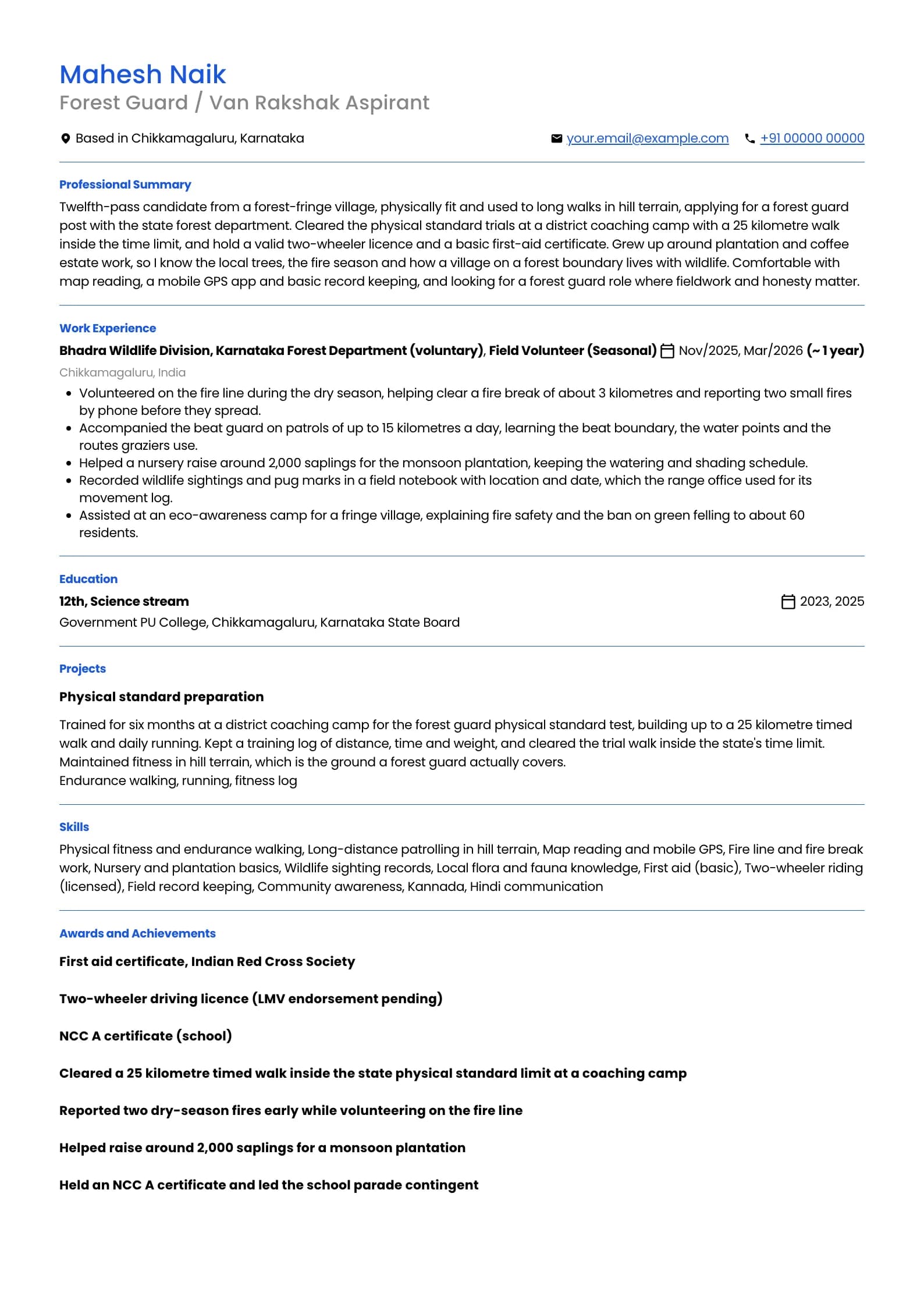
Forest Guard Resume Format, with 3 Full Samples
A forest guard is the department's eyes on the ground, walking a beat that others only see on a map, stopping a fire before it spreads and an axe before it falls. Yet most forest guard resumes read as a copied duty list with no beat area, no patrol distance, no seizure and no proof of the physical fitness the post is built on. Below are three complete resumes, one for a fit twelfth-pass aspirant applying to a state forest department, one for a serving forest guard, or van rakshak, with six years on a beat, and one for a forester who supervises guards across a range. After the samples come the format rules, the fitness and fieldcraft proof that separates a real guard from a form-filler, the terms a recruiter searches, and the mistakes that get a forestry resume set aside.
Build my resumeForest Guard resume example, Fresher (0 years)
professional templateIs your resume good enough?
Upload the resume you have now and see what an applicant tracking system reads before a forest guard recruiter ever does.
Free to run. Sign in with your mobile number to see your score.
Forest Guard resume example, Experienced (6 years)
minimalist template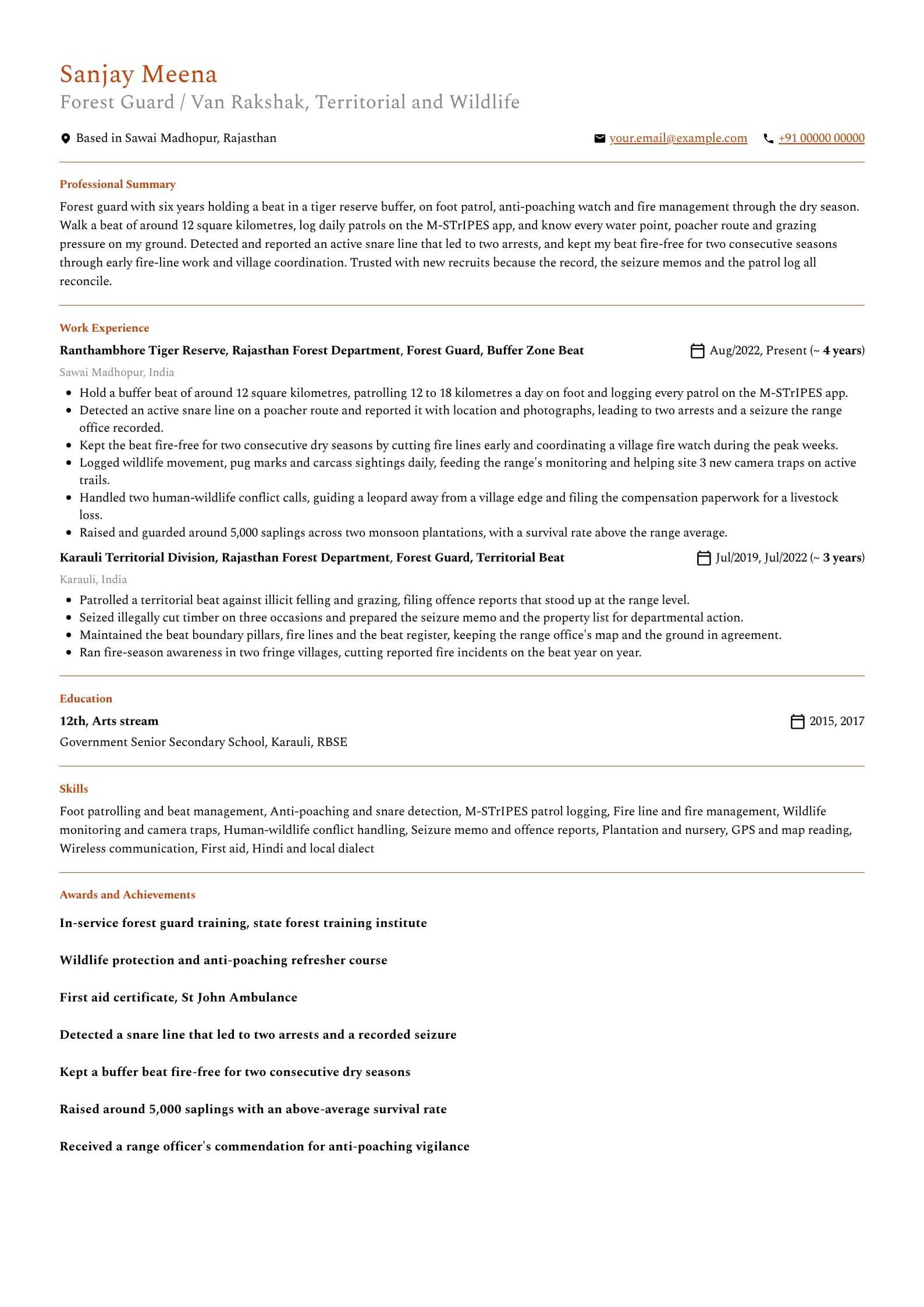
Want this structure with your own details? Build it in the resume builder.
Forest Guard resume example, Forester (12 years)
header-band template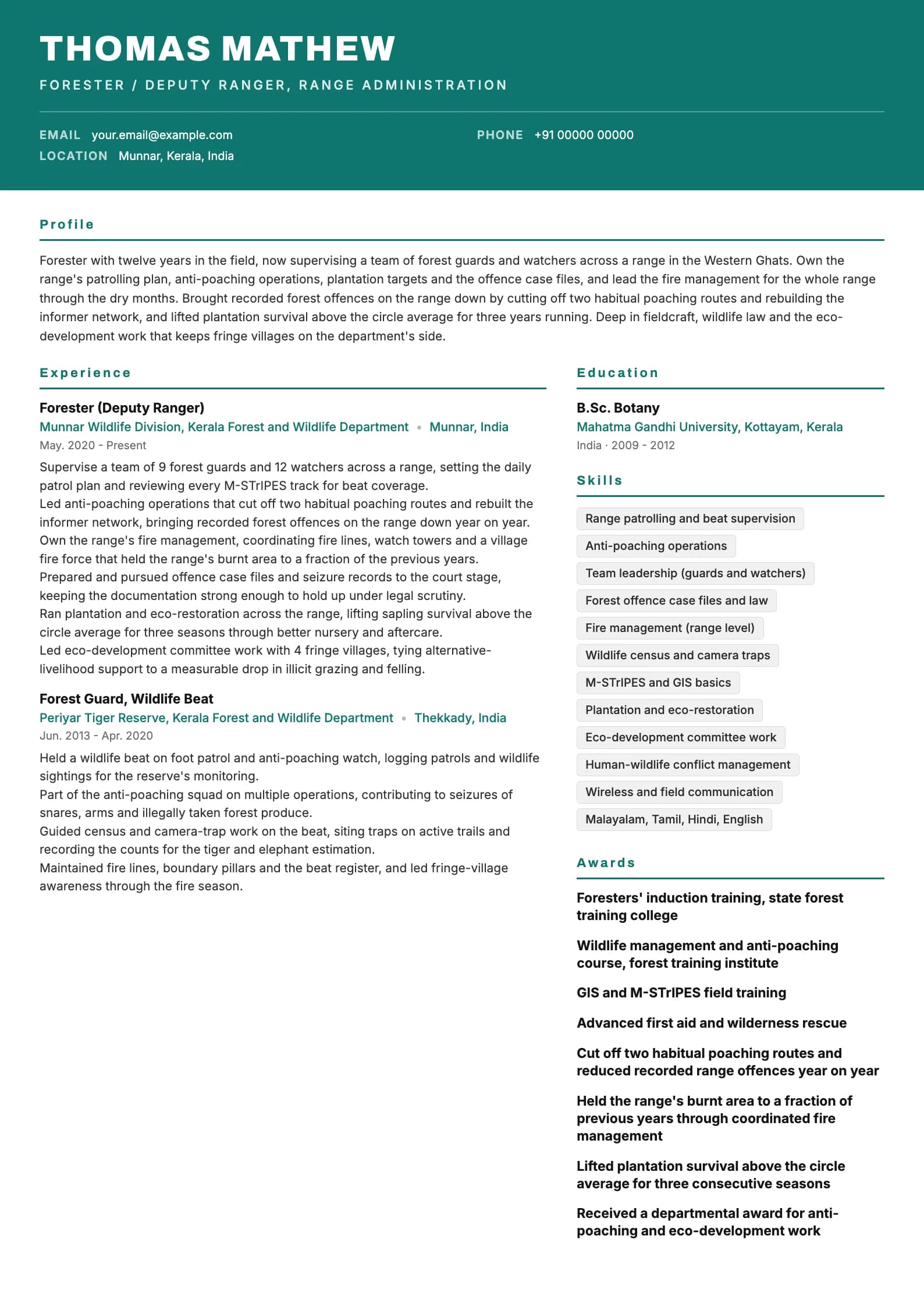
The format that works for a forest guard resume in India
Use a reverse chronological layout, most recent posting first, with the dates in plain view. A forest guard's credibility rests on a clean, checkable record, so a resume that hides its own timeline works against the trait the post depends on. If there is a gap, state it in one honest line rather than disguising it. Keep it to one page for a fresher and for most guards up to about eight years. A forester or deputy ranger with a supervisory record and a long field history can run to two pages, but only if the second page carries real range, operations and case work rather than a longer hobbies list. Some things do not belong on a forestry resume even though old templates carry them: a photograph unless the notification asks for one, marital status, religion or caste, and a long declaration paragraph. Personal contact details such as father's name, date of birth and full address are not needed high on the page, and these samples deliberately leave them out. A physical-standards line, on the other hand, does belong, because this post is built on it, so state your fitness and any cleared physical test plainly. Name the beat, the terrain, the app and the operations plainly, M-STrIPES, anti-poaching, fire line, plantation, because a recruiter and a screening system search for exactly those words. Send a PDF unless the posting asks otherwise, name the file with your name and the post, and keep to a single column so it parses cleanly. The table below sets the section order.
| Section | Where it goes | Why |
|---|---|---|
| Name and headline | Top, above everything | The headline names the post, forest guard or van rakshak, so a recruiter matches on it. |
| Professional summary | Directly under the header | Three or four lines. Years, beat or terrain, fitness, and the strongest field result. |
| Physical and field fitness | High, near the summary | Cleared physical test, endurance, terrain. The post is built on it. |
| Work experience | Next, for anyone in service | Most recent posting first. Current beat gets the most bullets. |
| Skills | Below experience | Grouped: patrolling, enforcement, fieldcraft, tools. Not a 30-item wall. |
| Education | Bottom, near the top only for a fresher | Qualification, institution, years. Keep the class while it is fresh. |
| Certifications | After education, or beside skills | In-service training, first aid, driving licence, NCC. Name the body and year. |
Physical fitness and fieldcraft: the proof, not the claim
The forest guard post is built on a physical standard, a walk of a fixed distance inside a time limit, height and chest measurements, sometimes a run. So the first thing a recruiter and a selection board want to see is proof that you can do the physical job, and it must be stated as evidence, not as "physically fit". If you have cleared a physical standard test, a departmental trial, or a documented endurance walk, name it with the distance and the time: cleared a 25 kilometre walk inside the state time limit, ran the required distance in the trial. If you are an aspirant, state your training, the distance you can cover and the terrain you cover it in. Hill and forest terrain matters, because a guard walks ground, not a track. Fieldcraft is the second layer. Name the concrete skills a guard actually uses: foot patrolling and beat coverage, map reading and mobile GPS, the M-STrIPES patrol app used across Indian tiger reserves, fire-line cutting and fire management, snare and trap detection, wildlife sighting and pug-mark recording, nursery and plantation work, and wireless communication. These are the terms a forest recruiter searches, and each is checkable in service records. Do not pad the list with skills a guard does not use. Office software beyond basic record keeping, or an unrelated technical course, distracts from the patrolling, fire and enforcement work the post is really about. A driving licence, a first-aid certificate and swimming, on the other hand, are genuinely useful field credentials worth naming.
State your fitness as a fact with a number, cleared a 25 km walk inside the time limit, not "physically fit and active". The post is a physical one, and a number is the only version of fitness a selection board can act on.
Writing a forest guard summary that is read
The block under your name is the part most likely to be read in full, so it should carry four facts: how long you have served, the beat or terrain you work, your physical fitness, and the strongest field result you can point to. Three or four lines, no unverifiable praise. The old objective, seeking a challenging post in the forest department to serve nature and the nation, tells the reader nothing they did not assume. Replace it with a summary. An objective says what you want, a summary says what you have already done in the field, and only the second is evidence. Freshers often think they have nothing to summarise. Look at the fresher sample: it states the fitness cleared at a coaching camp, the volunteer fire-line and patrol work, and the local terrain knowledge from a forest-fringe upbringing. That is a genuine summary built from real preparation and field exposure, not just a claim of love for nature. What it avoids is "passionate about wildlife and environment", a line so common on forestry resumes it now carries no information. A practical test: read your summary and ask whether any other aspirant with the same twelfth-pass certificate could paste it onto their resume unchanged. If they could, it describes the eligibility, not you. Add the beat you held, the distance you patrol, the seizure you made, until it stops being transferable.
Professional summary, experienced forest guard
Weak
Sincere and physically fit person passionate about wildlife and forest protection, seeking a challenging post in the forest department to serve nature and gain experience.
Strong
Forest guard with six years on a tiger reserve buffer beat of around 12 square kilometres, on foot patrol, anti-poaching and fire management. Patrols logged daily on M-STrIPES. Detected a snare line that led to two arrests and kept the beat fire-free for two seasons.
The rewrite trades self-praise and a vague wish for a beat size, the systems used and two verifiable field results.
Experience bullets: patrol, action, result
A forest guard's work is often described as though it cannot be measured, which is why so many forestry resumes read as a copied duty list. It can be measured. Every strong bullet in the samples names what you patrolled or acted on, how much ground or how many operations it covered, and what came out of it, a seizure, a fire prevented, a plantation that survived. Start from what was different on your beat because you were on it. A snare line detected, a fire that never spread, an offender arrested, a plantation that took, a poaching route shut down. These are a guard's outcomes, and they persuade far more than "performed patrolling and other duties". Use the numbers a guard actually has: beat area in square kilometres, patrol distance a day, seizures and arrests, saplings raised and their survival, fires prevented or fought, conflict calls handled, camera traps sited. "Hold a buffer beat of around 12 square kilometres, patrolling 12 to 18 kilometres a day" carries weight without inventing anything. Where there is no number, give scope, how large the beat, how many seasons fire-free, how many villages you coordinate. Enforcement and fire prevention are the guard's strongest signals, because they are the outcomes the post exists for. Allocate bullets by recency: the current posting gets four to six, older postings three to four.
| Level | What bullets must prove | Typical metric |
|---|---|---|
| Fresher / aspirant | You are fit and have real field exposure | Physical test cleared, patrol distance walked, saplings raised, fires reported |
| 1 to 5 years | You hold a beat and enforce on it | Beat area, daily patrol distance, seizures, offence reports, fire lines |
| 6 to 10 years | You deliver enforcement and prevention outcomes | Arrests, snare lines detected, fire-free seasons, plantation survival |
| 10 years and up | You supervise guards and run a range | Guards supervised, offences reduced, operations led, case files pursued |
Experience bullet, forest guard
Weak
Responsible for patrolling the forest area and protecting it from illegal activities and other duties assigned by seniors.
Strong
Hold a buffer beat of around 12 square kilometres, patrolling 12 to 18 kilometres a day on foot and logging every patrol on the M-STrIPES app.
"Responsible for" and "other duties" describe the recruitment notice; the rewrite names the beat size, the daily distance and the logging system.
Experience bullet, anti-poaching
Weak
Worked in anti-poaching activities and helped in catching poachers whenever required in the reserve.
Strong
Detected an active snare line on a poacher route and reported it with location and photographs, leading to two arrests and a recorded seizure.
Turns a vague activity into a specific enforcement outcome with a detection, a report and a countable result.
If a bullet would read identically on any guard's resume, it is describing the post, not you. Add the beat you held, the distance you cover and the seizure or fire-free season you delivered until it only fits your ground.
The skills section: grouped, real, and field-tested
A forest guard's skills section has two readers. A recruiter, sometimes a screening system, wants literal terms it can match, patrolling, anti-poaching, M-STrIPES, fire management. A human wants a short, ordered list that says what kind of guard you are, territorial, wildlife or a fire and plantation hand. Grouping serves both. Group by function rather than one long line. Patrolling and enforcement, fieldcraft and monitoring, fire and plantation, and tools and communication is a grouping that fits almost every guard. Put your physical fitness and any cleared test in there, because it is the post's foundation. Write the systems the way the department writes them: M-STrIPES not "mstripes", GPS, wireless, and the local names for terrain and produce where they help. Twelve to sixteen skills is the working range. Below eight the section looks thin. Above twenty it stops being a signal and starts to look padded, and a forestry resume is prone to listing every routine duty as a separate skill. Keep the ones a recruiter screens on, and let the field record carry the rest. Do not add star ratings or proficiency bars. Nobody agrees what four stars in patrolling means, and the physical trial and service record already prove your depth. List the concrete skills and let the beat and the seizures speak for how good you are at them.
Skills section
Weak
Skills: Hard working, Physically fit, Honest, Nature lover, Patrolling, Duty, Discipline, Team work, Punctual, Dedicated, Brave, Loyal
Strong
Fitness: cleared 25 km timed walk, endurance in hill terrain. Patrolling: foot patrol, beat management, anti-poaching, snare detection. Fieldcraft: M-STrIPES, GPS and map reading, wildlife monitoring. Fire and plantation: fire lines, nursery, eco-restoration.
Replaces personality and virtue words with a cleared fitness figure, named enforcement and fieldcraft skills, and the fire and plantation work a forest recruiter searches for.
Recruitment, physical standards and the conservation route
A regular forest guard, or van rakshak, post is filled by a state forest department through a written examination, a physical standard test and a physical efficiency test, then document verification, not by a resume alone. So it is worth being clear where a forest guard's resume actually earns its keep, because that decides what to put on it. A strong resume matters at the interview and document-verification stage of departmental recruitment, for contractual and daily-wage forest watcher and fire-watcher posts that hire on application, for anti-poaching camp and eco-development roles, and for jobs with conservation NGOs, tiger reserves, biosphere projects, eco-tourism operators and estate or plantation protection outfits. All of these read a resume and screen on fitness, fieldcraft and a clean enforcement record. If you are preparing for or have cleared a stage of recruitment, name it plainly: appeared for the state forest guard written exam, cleared the physical standard test at the district trial, qualified the physical efficiency test. These are checkable facts that show a serious candidacy. Do not claim a selection you have not received, because forest-department verification is thorough and a false claim ends everything. If you are applying to an NGO, a reserve or an eco-tourism employer after departmental service, keep the field language but add the outcomes they care about, wildlife monitoring data collected, community relations built, restoration survival rates, since conservation employers screen on evidence of protection and restoration, not only enforcement.
| Where the resume is used | Who reads it | What they screen on |
|---|---|---|
| Departmental recruitment interview and verification | Selection board | Cleared physical test, genuine certificates, clean record |
| Contractual watcher and fire-watcher posts | Division or agency | Fitness, local terrain knowledge, availability, references |
| Anti-poaching camp and eco-development roles | Division or project | Patrolling, enforcement exposure, community work |
| Conservation NGO, reserve, eco-tourism | Project or company | Fieldcraft, monitoring data, wildlife and restoration record |
Where education, training and certifications belong
Education sits at the bottom for anyone in service and near the top for a fresher, who has nothing stronger to lead with. Qualification, institution, years. Many forest guard posts require a pass at the tenth or twelfth standard, so name it plainly with the class or percentage. Keep the class or percentage while you are a fresher and while it is decent, because early screening still looks at it. Once you have field service behind you, the mark from years ago matters far less than a beat held and a seizure made, so it can shrink to a line. A graduate degree, especially in botany, zoology, forestry or environmental science, is worth keeping longer because it helps for promotion and for conservation roles. Training and certifications carry real weight for a guard, so give them their own place just below education, or beside skills if you hold only one or two. In-service forest guard and forester training, a wildlife-protection or anti-poaching course, a first-aid or wilderness-rescue certificate, a driving licence, swimming, and an NCC certificate all speak to a field post. Write the full name, the issuing body and the year. List only what you can produce at verification. A first-aid certificate that has lapsed, or a training you did not complete, is easy to catch and costs you more than the line was worth, so renew it or leave it off.
Getting a forest guard resume through the screening
NGOs, reserves, eco-tourism operators and agency contractors increasingly run applications through an applicant tracking system, which is a parser and a search index, not a judge. It reads your file, tries to split it into name, dates, employers, posts and skills, and stores the result so a recruiter can search across applicants. Most screening failures are parsing failures, and parsing failures come from layout, not from the words. The layout rules are short. Use one column. Use standard headings, Work Experience rather than "My Service in the Jungle", and Skills rather than "My Abilities". Keep no critical information inside an image, because a parser reads a photo as blank space. Keep your name and dates in the body, not only in a header or footer some parsers drop. Avoid text boxes and nested tables in the body. On wording, mirror the language of the post where it is honest. If it asks for anti-poaching experience, write anti-poaching. If it names M-STrIPES or GPS monitoring, use those words. Include the expansion beside an abbreviation once, for example "M-STrIPES (monitoring system for tigers, intensive protection and ecological status)", so both searches find you. Do not stuff keywords or paste a hidden block of every forestry term. Recruiters find it, and the result is worse than being filtered. Write real bullets that carry the terms naturally, because a bullet about a snare line you detected on patrol carries "anti-poaching" and "patrol" in a form that survives a human read too. Save as a PDF that holds real text, then open it and check you can select and copy a sentence. If you cannot select the text, neither can the parser.
Section heading
Weak
My Journey in the Forest
Strong
Work Experience
A parser looks for standard headings; a non-standard one can push the whole block into an unclassified bucket the recruiter never searches.
Test your own file before you send it. Copy the text out of the PDF into a plain text editor. Whatever reads cleanly there is roughly what the parser sees, and anything scrambled is a real risk.
What gets a forest guard resume set aside
Most rejections at the resume stage are not close calls. They come from a small set of recurring problems, and each is fixable in an afternoon. The list below is what reviewers of Indian forestry and forest guard resumes see most often, in rough order of the damage each one does.
- No physical fitness stated, or a vague "physically fit" with no cleared test and no distance. The post is built on a physical standard.
- A copied duty list from the recruitment notification instead of what you did on your beat. "Responsible for patrolling and other duties" is the tell.
- No beat, terrain or numbers. Beat area, patrol distance, seizures, saplings, fire-free seasons. Pick whichever is honest.
- Personality and virtue words as skills, brave, loyal, nature lover, honest. They fill space and prove nothing a reference cannot.
- No enforcement or field outcome, so the resume reads as attendance rather than protection. Name a seizure, an arrest, a fire prevented.
- A photo, marital status, religion or a declaration paragraph carried over from an old template. None of it belongs on a field-post resume.
- Claiming a selection or a cleared physical test you have not passed. Forest-department verification is thorough and a false claim ends everything.
- Certificates and training listed without the issuing body or year, so a verifier cannot confirm them.
- Ignoring language and terrain skills that are a genuine edge for a local recruit, the dialects and the ground knowledge a range officer values.
- Spelling errors in the terms you claim, "M-Stripes" mangled or "plantation" misspelt, which undoes an otherwise strong field record.
Read your resume aloud once before sending it. Anything you would hesitate to state to a selection board's face, an unproven fitness claim or a duty you never did, is a line to cut or fix.
Skills to put on a forest guard resume
Technical
- Foot patrolling and beat management
- Anti-poaching and snare detection
- Fire line and fire management
- Wildlife monitoring and census
- Nursery and plantation
- Human-wildlife conflict handling
- Forest offence and seizure reports
- Boundary and fire-line maintenance
- Map reading and navigation
- Eco-restoration and aftercare
- Community and eco-development work
- First aid and field safety
Tools and platforms
- M-STrIPES app
- Handheld and mobile GPS
- Wireless / VHF communication
- Camera traps
- Compass and maps
- Fire-line tools
- Two-wheeler and jeep (licensed)
- Basic GIS
- Field notebook and registers
Working skills
- Physical fitness and endurance
- Alertness and vigilance
- Discipline and reliability
- Local terrain knowledge
- Community relations
- Teamwork on operations
- Honesty and integrity
- Multilingual communication
Certifications worth listing as a forest guard
| Certification | Full name | Worth it for |
|---|---|---|
| Forest guard training | In-service forest guard induction training, state forest training institute | The departmental training every serving forest guard completes, worth naming with the institute and year because it proves formal induction into fieldcraft, law and drill. Central for a serving guard's resume; an aspirant names any pre-recruitment coaching instead. |
| Wildlife / anti-poaching course | Wildlife management and anti-poaching course, forest training institute | A refresher or specialist course worth it for guards and foresters on wildlife and reserve beats, since it strengthens the enforcement and monitoring side. Useful for conservation NGO and reserve roles too, where anti-poaching experience is screened directly. |
| First aid | First aid certificate, Indian Red Cross or St John Ambulance | A genuinely useful field credential for a post that works far from a hospital, worth it for every guard and aspirant. Pair it with wilderness or rescue training for wildlife and hill postings, and keep it current because a lapsed certificate is easy to catch at verification. |
| Driving licence | Two-wheeler and LMV driving licence | A practical field credential, since a guard often rides to the beat and a forester drives a department vehicle. Worth naming with the class of licence, and an added edge for anti-poaching and patrol roles that need mobility across the range. |
| NCC certificate | National Cadet Corps A, B or C certificate | A useful discipline-and-drill credential for a forest guard aspirant, valued at recruitment for the physical and organisational grounding it shows. Most relevant early, as an entry signal, and less decisive once you have years of field service to point at. |
Keywords an ATS scans for in a forest guard resume
These are the literal terms a parser matches against the job description. Use the ones that are true of you, in the sentences where you did the work, not as a list at the bottom.
- forest guard
- van rakshak
- patrolling
- anti-poaching
- beat
- M-STrIPES
- fire management
- plantation
- nursery
- wildlife monitoring
- seizure
- physical standard test
- GPS
- map reading
- forest protection
- human-wildlife conflict
- first aid
- eco-development
- forestry
- conservation
Forest Guard resume FAQ
What salary can a forest guard expect in India?
A regular forest guard, or van rakshak, usually starts around Pay Level 3 of the seventh pay matrix, with a basic near 21,700 rupees and a gross of roughly 28,000 to 40,000 a month after allowances, varying by state and posting, with field and hardship allowances in remote beats. A forester or deputy ranger earns more on a higher level, and a range forest officer more again. Contractual forest watcher and fire-watcher posts pay less and without the same benefits, often on a daily wage. Conservation NGO and eco-tourism field pay varies widely with the employer and the project.
How long should a forest guard resume be?
One page for a fresher and for most guards up to about eight years. A forester or deputy ranger with a supervisory record and long field service can use two pages, but only if the second page carries real range, operations and case work rather than a longer hobbies list. Nobody has been rejected for a resume that was easy to read. If you are struggling to fit one page, cut the oldest posting to a line and remove virtue words like brave and loyal.
Do I put physical fitness on a forest guard resume?
Yes, and stated as a fact with a number, because the post is built on a physical standard. Name a cleared physical test or a documented endurance walk with the distance and the time, for example cleared a 25 kilometre walk inside the state time limit, and mention the terrain you cover it in. "Physically fit and active" is invisible to a search and unconvincing to a selection board, while a cleared distance is both checkable and exactly what the post screens for.
Is a resume used to become a forest guard?
The regular post is filled by a written examination, a physical standard test and a physical efficiency test, then document verification, not by a resume alone. But a resume matters at the interview and verification stage, for contractual watcher and fire-watcher posts that hire on application, for anti-poaching camp and eco-development roles, and for jobs with conservation NGOs, reserves and eco-tourism operators. All of those read a resume and screen on fitness, fieldcraft and a clean record.
What skills matter most on a forest guard resume?
Physical fitness first, then the concrete fieldcraft a guard uses: foot patrolling and beat management, anti-poaching and snare detection, the M-STrIPES patrol app, fire-line and fire management, wildlife monitoring, nursery and plantation work, map reading and GPS, and wireless communication. A driving licence, first aid and local terrain and language knowledge are genuine additions. Name the systems the way the department writes them, because a recruiter searches for exactly those terms.
How do I write a forest guard resume as a fresher?
Lead with your fitness and any cleared physical trial, then education, then any volunteer or seasonal field work, then skills. Treat volunteer fire-line, patrol or nursery work as real experience: state the distance walked, the saplings raised, the fires reported. Local terrain and language knowledge from a forest-fringe upbringing is a genuine edge, so state it plainly. Add anything checkable, such as a cleared timed walk, an NCC certificate or a first-aid certificate, since verifiable facts carry more weight than a claim of love for nature.
Should I put a photo and personal details on the resume?
No, unless the notification specifically asks for a photograph. Marital status, religion, caste and a long declaration paragraph come from an old template and add nothing to a field-post screen. Personal contact details are not needed high on the page. Use the space for your fitness, fieldcraft and enforcement results instead, which is what actually gets a guard shortlisted at the interview and verification stage.
How do I move into a conservation NGO from the forest department?
Keep the field language but add the outcomes an NGO cares about. Alongside enforcement, name the wildlife-monitoring data you collected, the camera-trap and census work, the plantation and eco-restoration survival rates, and the fringe-village and eco-development relations you built. Conservation employers screen on evidence of protection and restoration, not only arrests and seizures, so present both sides of the field record and keep the numbers on each.
Related resume examples and guides
Build your forest guard resume in any of these formats
Start from a blank resume or upload the one you have. Goodspace renders it in 24 templates and flags the fitness, patrolling, anti-poaching and fieldcraft keywords a forest department or conservation recruiter will look for, and the filler it will not credit.
Build my resume