Petroleum Engineer Resume Format, with 3 Full Samples
A petroleum engineer is hired on evidence of barrels added, drilling days cut, wells that came in on plan, and an HSE record that stayed clean, yet most resumes list Petrel and Eclipse and forget the production result. Below are three complete resumes, one for a fresher out of a B.Tech in Petroleum Engineering, one for a drilling engineer with five years across onshore and offshore rigs, and one for a senior reservoir engineer leading a field-development team. After the samples come the format rules, the split between drilling, reservoir and production careers, the software and standards a parser matches literally, and the mistakes that end a screening before a human reads the page.
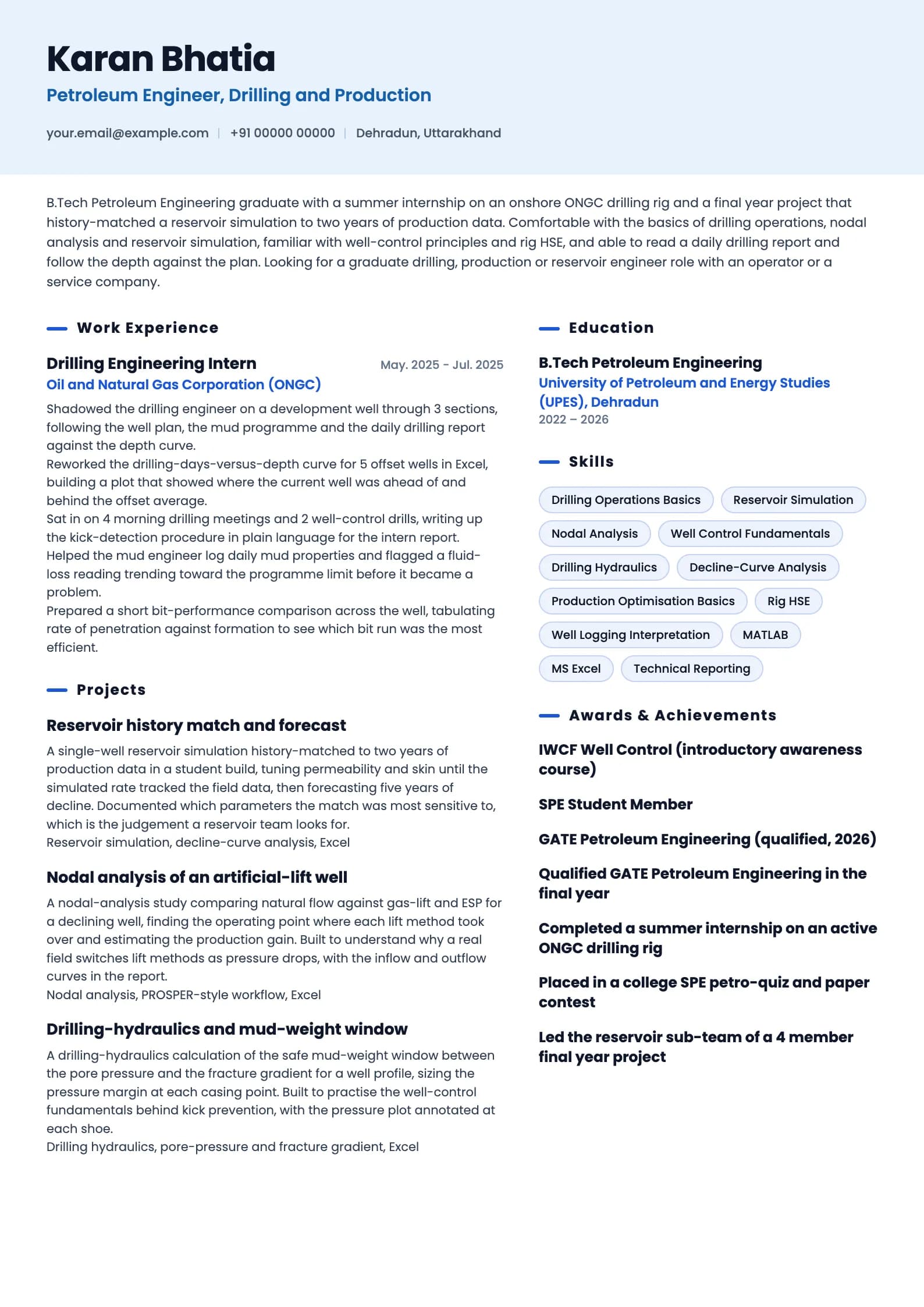
Build my resumePetroleum Engineer resume example, Fresher (0 years)
ai-era templateIs your resume good enough?
Upload the resume you have now and see what an applicant tracking system reads before a petroleum engineer recruiter ever does.
Free to run. Sign in with your mobile number to see your score.
Petroleum Engineer resume example, Drilling engineer (5 years)
professional template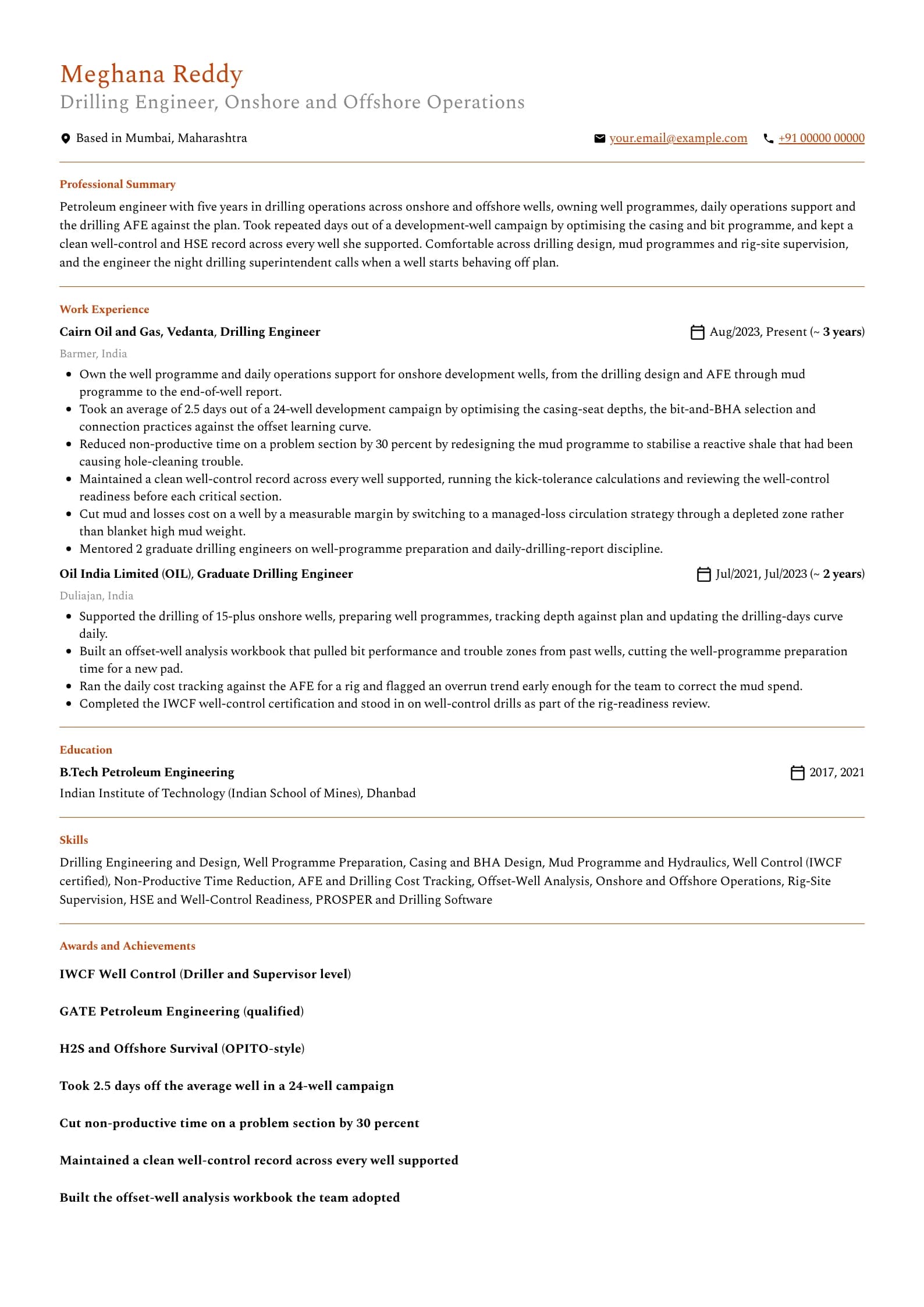
Want this structure with your own details? Build it in the resume builder.
Petroleum Engineer resume example, Reservoir lead (12 years)
header-band template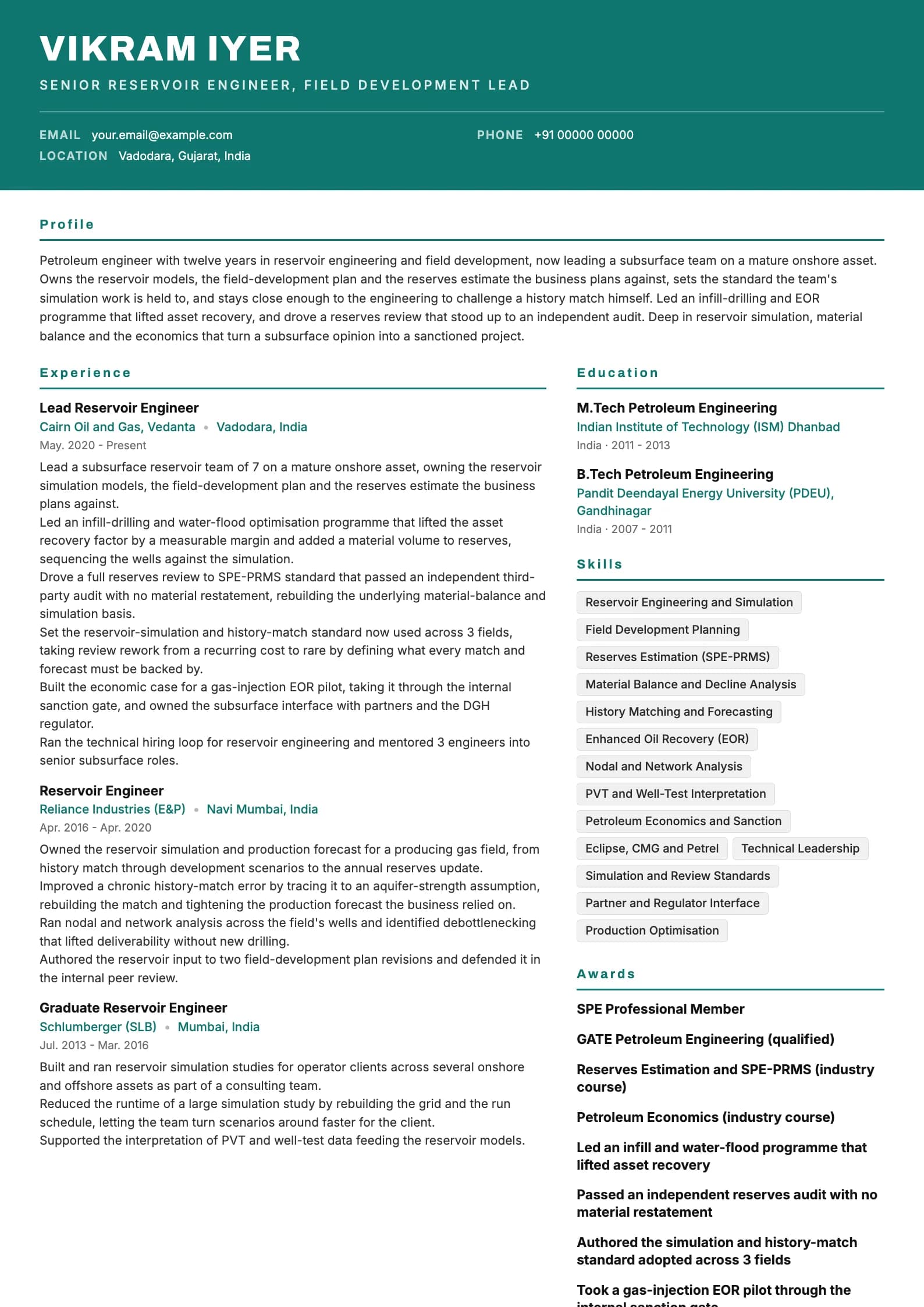
The format that works for petroleum engineer resumes in India
Reverse chronological is the only layout worth using. Put the most recent role first, work backwards, and let the dates sit in plain view. Functional resumes that group everything under Skills and quietly drop the dates read as an attempt to hide a gap, and an industry with cyclical hiring and rotational postings is one where reviewers look hard at continuity. A gap explained in one honest line, including an industry downturn, is better than one buried. Length is decided by evidence. One page holds everything a fresher and most engineers up to roughly six years have to say. Past that a second page is fine when it carries real field, well and project work rather than a longer software list. A page two built from a declaration paragraph and a hobbies line is a padded one-page resume. Four things belong nowhere on a technical resume here: a photograph, date of birth, marital status and father's name. They survive from an older template that circulated through campus placement cells. Nobody screening a drilling or reservoir engineer is looking for them, and every line they occupy is a line a result could have used. Name your file with your own name and the target role rather than resume_final_v4, and send a PDF unless the posting asks for DOCX. Use a single column all the way down, because two-column layouts parse unpredictably when a sidebar sits beside the experience. The table below sets out the section order.
| Section | Where it goes | Why |
|---|---|---|
| Name and headline | Top, above everything | The headline is the role you want: drilling, reservoir or production engineer. Recruiters match on it. |
| Professional summary | Directly under the header | Three lines. Discipline, years, and the single strongest days, barrels or recovery result. |
| Work experience | Next, for anyone with a job | Most recent first. Newest role gets the most bullets. |
| Projects | Above experience for freshers, below it after that | For a fresher the simulation or drilling project is the evidence. For an experienced engineer it is supporting material. |
| Skills | Below experience | Grouped: discipline, software, methods, HSE and well control. Not a 30-item wall. |
| Education | Bottom, unless you are a fresher | Degree, institution, years. GATE score near the top while it is fresh. |
| Certifications | After education, or beside skills if only one or two | IWCF well control, GATE, SPE, HSE tickets. Name, body, year. |
Drilling, reservoir or production: name the discipline before you write
Petroleum engineering splits into distinct disciplines, and a resume that reads as generic across all of them convinces a specialist reviewer of none. Decide which discipline the posting is for and lead with the evidence that discipline values. Drilling and completions, at operators and service companies, is about wells delivered safely and fast. It wants well programmes, casing and BHA design, mud programmes, non-productive time, drilling days and the well-control record. The bullets are about days off the well and NPT cut, as in the drilling engineer sample. Well control and HSE are first-order, not soft skills. Reservoir engineering wants simulation, material balance, history matching, reserves and field development. The bullets are about recovery factor, reserves added, forecasts tightened and models that survived an audit, as in the senior sample. This is the most analytical track and the one where an M.Tech and SPE-PRMS knowledge pay off. Production engineering wants nodal analysis, artificial lift, well intervention, production optimisation and facilities interface. The bullets are about deliverability lifted, downtime cut and lift methods optimised. Service-company roles such as mud engineer, wireline, cementing or well-testing are their own world again, leading with the service line, the runs delivered and the operational track record. A drilling resume sent to a reservoir opening, or vice versa, reads as the wrong specialist. Pick the discipline, reorder the page, and lead with what that discipline cares about.
Decide first: drilling, reservoir, production or a service line. Then reorder your resume so the first thing a reviewer sees is the evidence that discipline values. Same degree, different specialist front pages.
Writing a summary a hiring manager actually reads
The block under your name is the part you can be reasonably sure gets read, so it should carry three facts: what you drill, model or produce, how long you have been doing it, and the strongest thing that happened because of your work. Three or four lines, no adjectives that cannot be checked. The old objective line, seeking a challenging position in the oil and gas industry to utilise my petroleum engineering skills, tells the reader nothing they did not assume from the application. Replace it with a summary. An objective describes what you want, a summary describes what you have already done, and only one is evidence. Freshers often believe they have nothing to summarise. Look at the fresher sample: it names the rig internship, states the discipline, and points at a history-match project with a defended result. That is a genuine summary built from coursework, one internship and real projects. What it avoids is "passionate about the energy sector", a phrase so common on petroleum graduate resumes it now carries no information. A practical test: read your summary and ask whether a classmate with the same degree could paste it onto their resume unchanged. If they could, it describes the syllabus, not you. Add the specific field, the specific number and the specific ownership until it stops being transferable.
Professional summary, drilling engineer
Weak
Passionate petroleum engineer with 5+ years of experience in drilling operations and oil and gas seeking a challenging role in a reputed organisation.
Strong
Petroleum engineer with five years in drilling operations across onshore and offshore wells, owning well programmes and daily operations support. Took 2.5 days off the average well in a 24-well campaign and kept a clean well-control record.
The rewrite trades self-description for an ownership scope, a verifiable time-and-cost result and the safety record the discipline is judged on.
Experience bullets: verb, well or field, consequence
Every strong bullet in the samples follows the same shape. It opens with an action verb, names the specific well, field or study you worked on, and closes with what measurably moved. The verb establishes you did it. The well or the field tells a technical reviewer whether the work is relevant. The number does the persuading. Start with the outcome and work backwards. Engineers usually write the task first, then struggle to attach a number, which produces bullets like "worked on drilling operations and supported the rig team". Instead ask what was different after you finished: days came off the well, NPT dropped, recovery went up, reserves were added, a forecast tightened, a cost overrun was caught. Then write the sentence that ends in that fact. Vary the metric. Petroleum work has a rich language of numbers depending on discipline: drilling days and non-productive time, cost against AFE, rate of penetration, recovery factor, reserves and production added, deliverability, and above all the HSE and well-control record. Money and time lead in drilling; recovery and reserves lead in reservoir; deliverability leads in production. Where you lack a number, give scope: how many wells supported, how many fields modelled, how many well programmes prepared, how long a campaign ran. "Supported the drilling of 15-plus onshore wells" carries weight without inventing a percentage. Allocate bullets by recency. Current role gets five or six, the previous role four or five, anything older two or three.
| Level | What bullets must prove | Typical metric |
|---|---|---|
| Fresher | You have seen operations and can run a real study | Wells shadowed, offset analysis, project match, HSE exposure |
| 1 to 4 years | You own well programmes or studies without supervision | Wells supported, NPT, cost vs AFE, forecasts run |
| 5 to 8 years | You own wells or a reservoir model end to end | Drilling days cut, recovery, reserves added, well-control record |
| 8 years and up | You set method and shape the field-development plan | Asset recovery, reserves audited, standards set, projects sanctioned |
Experience bullet, drilling role
Weak
Responsible for drilling operations of oil wells and coordinating with the rig team and service companies.
Strong
Took an average of 2.5 days out of a 24-well development campaign by optimising the casing-seat depths, bit-and-BHA selection and connection practices against the offset learning curve.
"Responsible for" describes a job description; the rewrite names the change made, the campaign and the days it saved.
Experience bullet, reservoir role
Weak
Worked on reservoir simulation and reserves estimation for the field and prepared reports.
Strong
Drove a full reserves review to SPE-PRMS standard that passed an independent third-party audit with no material restatement, rebuilding the underlying material-balance and simulation basis.
Names the standard, the audit and the outcome, so a reviewer can trust a number that outsiders already checked instead of nodding at a vague claim.
If a bullet would read identically on a teammate's resume, it is describing the asset team, not you. Rewrite it until it only fits the wells or the model you actually owned.
The skills section: grouped, honest, and short enough to defend
A petroleum resume's skills section has two audiences with opposite preferences. The parser wants literal terms it can match, Petrel and Eclipse and IWCF. A human wants a short, organised list that signals what kind of engineer you are. Grouping satisfies both. Group by function rather than one long line. The grouping depends on discipline: a drilling engineer groups design, operations, software and well-control-HSE, while a reservoir engineer groups simulation, methods, economics and software. Write names the way the industry writes them: Eclipse and CMG for simulators, Petrel for the geoscience platform, PROSPER and GAP for the production-network tools, IWCF for well control. A knowing reviewer notices a tool listed in the wrong category. Twelve to sixteen skills is the working range. Below eight the section looks thin. Above twenty it stops being a signal. The list is a contract: every item is a question you have agreed to answer in the interview, and claiming a simulator or a well-control level you have never used is caught quickly in a specialist field. Separate the tool from the method. Listing Eclipse proves you opened a simulator. Listing material balance, history matching or nodal analysis proves you understand the engineering the simulator runs, and that is what separates an engineer from an operator of software. Include the methods, and for drilling include the well-control level explicitly, because IWCF or IADC certification is a hard requirement for many roles. Do not include a proficiency bar. Star ratings invite an argument you cannot win, and nobody agrees on what four stars in Petrel means. Let the experience prove the depth instead.
| Group | What goes in it | How many |
|---|---|---|
| Discipline | Drilling design, reservoir simulation, production optimisation, completions | 2 to 4 |
| Methods | Material balance, history matching, nodal analysis, well-control calculations | 3 to 5 |
| Software | Petrel, Eclipse, CMG, PROSPER, PIPESIM, OLGA | 2 to 4 |
| Well control and HSE | IWCF or IADC level, H2S, offshore survival, HSE process | 1 to 3 |
| Economics and data | Petroleum economics, PVT and well-test interpretation, Excel | 1 to 3 |
Skills section
Weak
Skills: Petrel, Eclipse, CMG, PROSPER, PIPESIM, OLGA, GAP, Techlog, Drilling, Reservoir, Production, Well Control, MS Office, Communication, Teamwork, Leadership, Oil and Gas, HSE, MATLAB, AutoCAD
Strong
Discipline: drilling design, well programme preparation. Methods: casing and BHA design, mud hydraulics, well-control calculations. Software: PROSPER, drilling suite. Well control: IWCF Driller and Supervisor. HSE: H2S, offshore survival.
Cuts the every-tool wall and the empty soft skills, states the well-control level explicitly because roles require it, and groups the rest so a human reads it in one pass.
Projects and academic work: what to include and how to describe it
For a fresher, projects are the resume. They sit above experience, they get the most space, and they are where a reviewer decides whether you can actually reason about a well or a reservoir or only pass exams about it. For an experienced engineer they move below experience and shrink to one or two entries, kept only if they show something the day job does not. The common failure is describing the software instead of the engineering. "A reservoir study done using Eclipse" tells a reviewer nothing, because thousands of petroleum resumes carry that line. Describe what the study asked, what you tuned or decided, and what the judgement required. The history-match project in the fresher sample is a stronger entry than a flashier one, because it names the parameters the match was sensitive to, which is the exact judgement a reservoir team looks for. Pick projects that show range across the discipline you are chasing rather than three of the same. For reservoir, a history match, a nodal analysis and a drilling-hydraulics calculation cover simulation, production and drilling fundamentals and show breadth. For a drilling-focused fresher, a well-plan or a mud-weight-window study is worth more than a generic simulation. An active rig or field internship is worth a great deal and is often undersold. A summer on an operating drilling rig, following the plan and sitting well-control drills, tells a recruiter you have seen operations, not only slides, and that is exactly what separates a petroleum fresher from a classmate who only did coursework. Name the asset, what you followed and what you produced.
Project description, fresher resume
Weak
Reservoir Project: performed reservoir simulation using Eclipse to study the production of an oil reservoir.
Strong
Reservoir history match and forecast: history-matched a single-well simulation to two years of production data by tuning permeability and skin, then forecast five years of decline, documenting which parameters the match was most sensitive to.
Swaps a software name for the actual engineering judgement, tuning and sensitivity, which is what a reservoir reviewer wants to see a fresher understand.
Where education, GATE and certifications belong
Education goes at the bottom for anyone with a full-time job, and near the top for a fresher, who has nothing stronger to lead with. Degree, institution, years. That is the whole entry for most people, and a petroleum degree from IIT ISM Dhanbad, PDEU, UPES or RGIPT carries recognition worth naming clearly. CGPA or percentage is worth keeping while you are a fresher and it is good, roughly 7.5 out of 10 and above, because campus and PSU screening still filters on it. Once you have your first full-time role, drop it. A number from four years ago competes for space with real wells and fields that are far more predictive. A GATE Petroleum score is different. It is the gate to ONGC and OIL recruitment and to M.Tech admission, so while you are a fresher or early-career it earns a prominent line, often near education. Once you have several years of shipped drilling or reservoir work, it fades to a single line and eventually drops off. Certifications sit just below education, or beside skills if you hold only one or two. Write the full name, the issuing body and the year. For drilling and any rig-based role, an IWCF or IADC well-control certification is often a hard requirement, so state the level clearly and keep it current, because an expired well-control ticket is a genuine problem, not a cosmetic one. HSE tickets such as H2S and offshore survival matter for offshore postings. SPE membership and reserves or economics courses strengthen a reservoir resume.
Getting through the applicant tracking system
An applicant tracking system is a parser and a search index, not a judge. It reads your file, tries to break it into name, dates, employers, titles and skills, and stores the result so a recruiter can search across candidates. Almost every ATS problem is a parsing problem, and parsing problems come from layout, not wording. The layout rules are short. One column. Standard section headings, so use Work Experience rather than My Journey, and Skills rather than My Toolbox. No text inside images, because a strip of operator and service-company logos reads as empty space. No critical information in the header or footer region, which some parsers drop. Avoid text boxes and nested tables in the resume body. On wording, mirror the language of the job description where it is honest. If the posting says reservoir simulation, write reservoir simulation. If it says well control, write well control and name the IWCF level. Include the expansion alongside an acronym at least once, for example "NPT (non-productive time)" and "EOR (enhanced oil recovery)", so both searches find you. Keyword stuffing does not work. A hidden block of every simulator and service line in white text is found quickly, and the outcome is worse than being filtered. Write real bullets that naturally contain the right terms, because a bullet describing a history match contains the words reservoir simulation in a context that survives human review too. Save as PDF from a tool that embeds real text, then open the file and confirm you can select and copy a sentence. If you cannot select the text, neither can the parser.
Test your own file before you send it. Copy the text out of the PDF into a plain text editor. Whatever you can read there is roughly what the parser sees, and anything scrambled is a real risk.
What gets petroleum engineer resumes rejected
Most rejections at the resume stage are not close calls. They come from a small set of recurring problems, and all of them are fixable in an afternoon. The list below covers what reviewers of Indian petroleum engineer resumes see most often, in rough order of how much damage each one does.
- Wrong discipline. A drilling resume sent to a reservoir opening, or vice versa, reads as the wrong specialist no matter how good the underlying work is.
- No days, barrels or recovery. Petroleum is judged in drilling days, NPT, recovery factor and reserves, so a resume with none of these has not spoken the language.
- Well control and HSE treated as a soft footnote. In drilling and rig roles they are first-order hiring criteria, and an unstated or expired well-control level is a real problem.
- A software wall listing every simulator with no study proving any of it. Claiming Eclipse, CMG and Petrel with no reservoir work invites the question you cannot answer.
- Software instead of method. Naming a simulator but never material balance, history matching or nodal analysis reads as an operator, not an engineer.
- A photo, date of birth, marital status or father's name. None of it belongs on a technical resume, and it takes a result's space.
- A generic objective line. Replace it with a summary that states discipline, years and one days, recovery or reserves result.
- Hiding an industry-downturn gap instead of naming it in one honest line. Oil and gas hiring is cyclical and reviewers understand a downturn.
- Inflated titles or dates that do not match your payslips and offer letters. Verification is standard and a mismatch ends the process.
- Typos in the tools and terms you claim. Writing "resorvoir" or the wrong simulator name undoes an otherwise strong page in a specialist field.
Read your resume aloud once before sending it. Anything you would be embarrassed to defend on a rig floor or in a subsurface review is a line to cut or rewrite.
Skills to put on a petroleum engineer resume
Technical
- Drilling Engineering and Design
- Reservoir Engineering and Simulation
- Production Engineering and Optimisation
- Well Completion and Intervention
- Nodal and Network Analysis
- Material Balance and History Matching
- Reserves Estimation (SPE-PRMS)
- Enhanced Oil Recovery (EOR)
- Artificial Lift (Gas Lift, ESP)
- Well Control and Kick Tolerance
- Drilling Hydraulics and Mud Programme
- Petroleum Economics
- PVT and Well-Test Interpretation
- Field Development Planning
Tools and platforms
- Petrel
- Eclipse
- CMG
- PROSPER and GAP
- PIPESIM
- OLGA
- Techlog
- WellCAD
- Landmark
- MATLAB
- MS Excel
- Python
Working skills
- HSE leadership
- Rig-site and field communication
- Cross-functional collaboration
- Partner and regulator interface
- Technical reporting
- Mentoring
- Decision-making under uncertainty
- Cost and AFE discipline
- Working across rotational shifts
Certifications worth listing as a petroleum engineer
| Certification | Full name | Worth it for |
|---|---|---|
| IWCF Well Control | International Well Control Forum, Well Control Certification | Often a hard requirement for drilling and any rig-based petroleum role, certified at Driller or Supervisor level. It proves you can prevent and manage a well-control event, so for drilling engineers it is the most load-bearing certification on the page and must be kept current. The IADC WellSharp scheme is the equivalent many operators accept. Not needed for pure office-based reservoir or economics work. |
| GATE Petroleum | Graduate Aptitude Test in Engineering, Petroleum Engineering | The single most useful qualification for a petroleum fresher in India. A good GATE Petroleum score is the route into ONGC and OIL recruitment and into M.Tech admission at the IITs and ISM Dhanbad. Worth a prominent line while you are early-career, and it fades once you have several years of shipped drilling or reservoir work to point at. |
| SPE Membership | Society of Petroleum Engineers, Professional Membership | The professional body of the industry. Student membership is a reasonable line for a fresher showing engagement, and professional membership signals continued involvement for experienced engineers. It is not a competence certification, so treat it as a supporting credential rather than a headline, most useful alongside SPE-PRMS reserves knowledge on a reservoir resume. |
| H2S and Offshore Survival | H2S Awareness and Offshore Survival (BOSIET or OPITO-style) | Mandatory HSE tickets for offshore and sour-service postings, covering hydrogen-sulphide safety and offshore escape and survival. Essential to state clearly for any offshore drilling, production or service role, because you cannot mobilise to a rig without them. Not required for onshore-only or purely office-based positions. |
| SPE-PRMS | SPE Petroleum Resources Management System, reserves estimation training | The standard framework for classifying and estimating reserves, worth it for reservoir engineers whose work feeds the reserves and field-development plan. Signals you can produce reserves numbers to an auditable standard, which is exactly what a subsurface or reserves role needs. Most valuable mid-career as you take ownership of reserves. |
| NEBOSH | National Examination Board in Occupational Safety and Health | A recognised HSE qualification, worth it for petroleum engineers moving toward drilling supervision, operations leadership or dedicated HSE roles, where safety accountability grows with seniority. Signals formal safety-management competence beyond the basic rig tickets. Optional for early-career technical roles but valued as you take on operational responsibility. |
Keywords an ATS scans for in a petroleum engineer resume
These are the literal terms a parser matches against the job description. Use the ones that are true of you, in the sentences where you did the work, not as a list at the bottom.
- petroleum engineer
- drilling engineer
- reservoir engineer
- production engineer
- reservoir simulation
- well control
- IWCF
- nodal analysis
- non-productive time
- drilling operations
- reserves estimation
- enhanced oil recovery
- history matching
- material balance
- Petrel
- Eclipse
- PROSPER
- well completion
- HSE
- field development
Petroleum Engineer resume FAQ
What salary can a petroleum engineer expect in India?
Petroleum engineering pays well relative to most branches. A fresher joining ONGC or OIL through GATE lands a structured public-sector package that is among the higher graduate scales, while private operators and service companies vary more. Freshers broadly sit around 4 to 10 LPA depending on employer. A drilling or reservoir engineer with four to six years usually reaches 10 to 20 LPA, and offshore and service-company roles pay a premium for the rotation. Senior reservoir leads and drilling superintendents with ten years and above commonly earn 25 to 50 LPA and more, with international and offshore postings higher still. Hiring is cyclical with oil prices, which affects the top of every band.
How long should a petroleum engineer resume be?
One page up to about six years of experience, two pages after that only if the second page carries real well, field and project work rather than a longer software list. Nobody has been rejected for a resume that was too easy to read. If you are struggling to fit one page, cut the oldest role to a single line, remove coursework, and delete any software or well-control claim you would not want to be interviewed on.
Should I tailor my resume to drilling, reservoir or production?
Yes, and it matters more here than in many fields. Petroleum engineering splits into distinct disciplines, and a specialist reviewer can tell within seconds whether a resume is aimed at their world. A drilling resume leads with days, non-productive time and the well-control record; a reservoir resume leads with recovery, reserves and history matching; a production resume leads with deliverability and artificial lift. Reorder the page so the first thing the reviewer sees is the evidence their discipline values, rather than sending one generic resume everywhere.
Should a fresher put projects above work experience?
Yes. With no full-time roles, projects and any internship are the strongest evidence you can offer, so projects sit directly under the summary. Describe what each study asked, what you tuned or decided, and the judgement it required, not just the software. A rig or field internship is worth a great deal because it shows you have seen operations. Pick projects that cover the discipline you are chasing: for reservoir, a history match and a nodal analysis; for drilling, a well-plan or a mud-weight-window study.
How important is well-control certification on the resume?
For drilling and any rig-based role it is often a hard requirement, not a nice-to-have. An IWCF or IADC WellSharp certification proves you can prevent and manage a kick, so state the level, Driller or Supervisor, clearly and keep it current. An expired well-control ticket is a genuine problem that can stop you mobilising to a rig, so renew it before you apply. For purely office-based reservoir or economics roles it matters far less, and you should lead with simulation and reserves instead.
Does the oil and gas downturn hurt my resume if I have a gap?
Industry hiring is cyclical with oil prices, and reviewers in this sector understand that layoffs and hiring freezes follow a downturn. A gap explained honestly in one line, noting an industry downturn or a project completion, is far better than a gap left blank or hidden behind a functional layout. What reviewers penalise is the appearance of concealment, not the fact of a cyclical gap, so name it plainly and move on to the work.
Does an ATS reject resumes with two columns?
It does not reject them outright, but some parsers read multi-column layouts out of order, which interleaves your sidebar with your experience and produces nonsense in the recruiter's view. A single-column layout removes the risk, which is why all three samples above use one. Test your own file by copying the text out of the PDF into a plain text editor, and if it reads in order there it will most likely parse correctly.
How do I write a petroleum resume with no work experience?
Lead with any internship and your projects, then education and GATE, then skills. Treat each project as a job: what the study asked, what you decided, what you owned and the judgement it required. A rig or field internship is the strongest thing a petroleum fresher can carry, so describe the asset, what you followed and what you produced. Add anything checkable, such as a GATE score, an SPE contest placing or a well-control awareness course, since verifiable facts carry more weight than adjectives like passionate about energy.
Do I need a photo on a petroleum engineer resume in India?
No. Operators and service companies do not expect one, and it takes space a result should occupy. The same goes for date of birth, marital status, father's name, nationality and a declaration paragraph. These come from an older template that spread through campus placement cells and add nothing to a technical screen. The only exception is a role that explicitly asks for a photograph in the posting.
Related resume examples and guides
Build your own in any of these formats
Start from a blank resume or upload the one you have. Goodspace renders it in 24 templates and flags the reservoir, drilling and well-control keywords an applicant tracking system will look for, and the software padding it will not credit.
Build my resume