Mining Engineer Resume Format, with 3 Full Samples
A mining engineer is hired on production moved, cost per tonne, and a safety record clean enough to satisfy the DGMS, yet most resumes list mine software and forget the tonnes. Below are three complete resumes, one for a fresher out of a mining degree with a GATE score and a First Class training stint, one for a mine planning engineer with five years across opencast and underground, and one for a mine manager holding a First Class Manager's Certificate of Competency and running a full section. After the samples come the format rules, why a DGMS certificate belongs above every skill line, the terms a parser matches literally, and the mistakes that end a screening before a human sees the page.
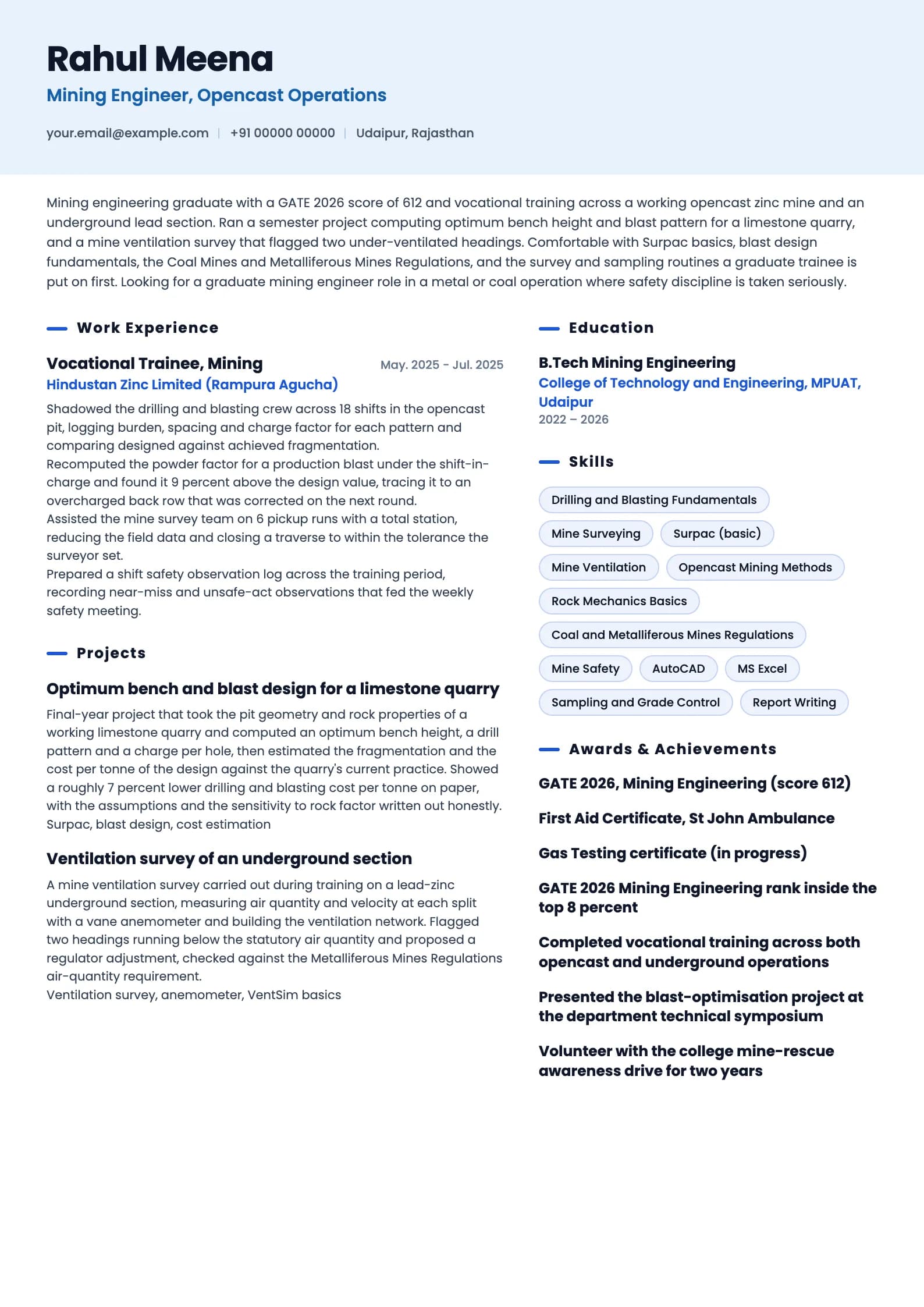
Build my resumeMining Engineer resume example, Fresher (0 years)
ai-era templateIs your resume good enough?
Upload the resume you have now and see what an applicant tracking system reads before a mining engineer recruiter ever does.
Free to run. Sign in with your mobile number to see your score.
Mining Engineer resume example, Mid-level (5 years)
professional template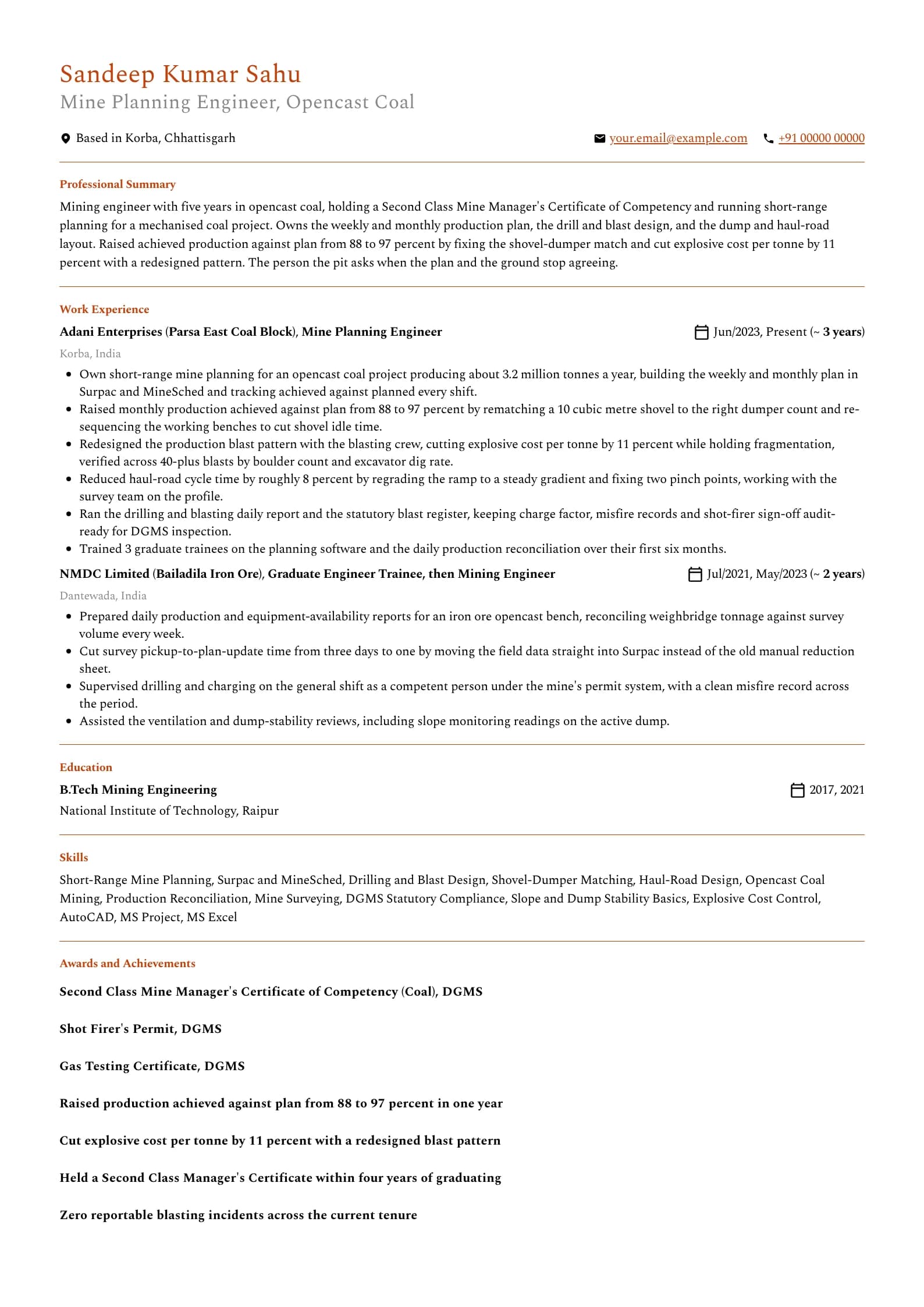
Want this structure with your own details? Build it in the resume builder.
Mining Engineer resume example, Senior (12 years)
header-band template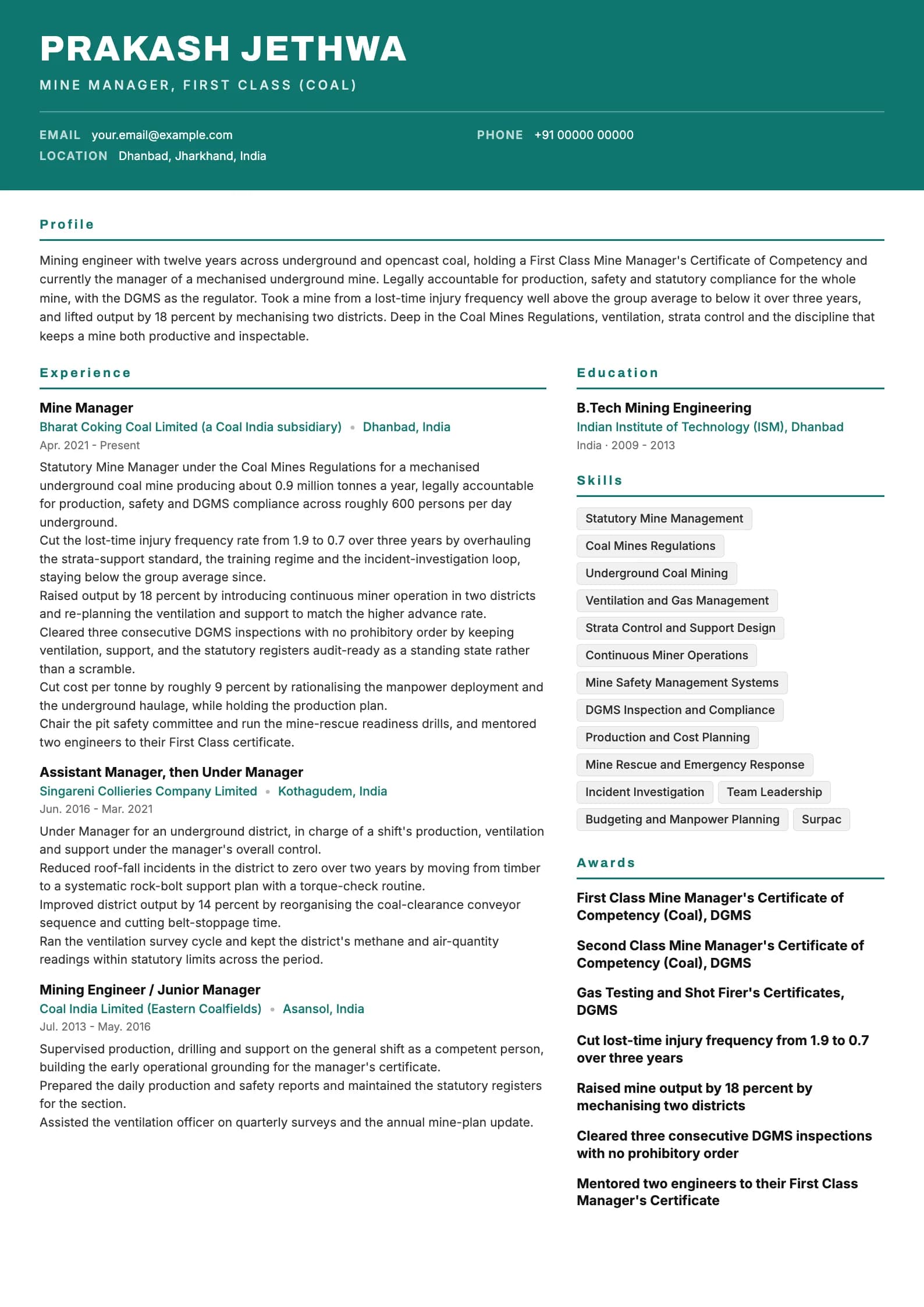
The format that works for mining engineer resumes in India
Reverse chronological is the only layout worth using. Put the most recent role first, work backwards, and keep the dates in plain view. Functional resumes that group everything under a Skills heading and drop the dates read as an attempt to hide a gap, and mine recruiters, who care about continuous statutory experience, treat them that way. A gap between projects is normal in mining and better explained in one honest line than buried. One thing sets a mining resume apart from most engineering resumes: the DGMS Certificate of Competency, where you hold one, belongs near the top, not down with education. A First or Second Class Manager's Certificate is a statutory qualification that legally gates the roles you can hold, so a recruiter reads for it before anything else. State the class, the mineral (coal or metalliferous), and that it is a DGMS certificate. Length follows evidence. One page holds everything a fresher and most engineers up to roughly six years have to say. A mine manager with a decade of statutory experience can run to two pages, provided page two carries real production, safety and compliance work rather than a longer software list. Four things belong nowhere on a technical mining resume: a photograph, date of birth, marital status and father's name. They survive from an older campus template and take space a production number or a safety record should hold. Send a PDF unless the posting asks otherwise, name the file with your own name and the target role, and use a single column all the way down. The table below sets out the section order.
| Section | Where it goes | Why |
|---|---|---|
| Name and headline | Top, above everything | Headline states the role and mine type, e.g. mine planning engineer, opencast coal. |
| DGMS certificate | Right under the header, if you hold one | A statutory qualification that gates the role. Recruiters read for it first. |
| Professional summary | Below the certificate line | Three lines. Mineral, years, and the single strongest production or safety result. |
| Work experience | Next, for anyone with a job | Most recent first. Newest role gets the most bullets. |
| Projects | Above experience for freshers, below it after that | For a fresher, blast, survey and ventilation projects are the evidence. |
| Skills | Below experience | Grouped: methods, software, regulations, safety. Not a 40-item wall. |
| Education and certifications | Bottom for the experienced, near top for freshers | Degree, institution, years, plus GATE and any DGMS or gas-testing certificates. |
The DGMS Certificate of Competency is the line recruiters read first
In most engineering fields a certificate is a nice-to-have. In mining it is often a legal precondition. Under the Mines Act and the Coal Mines and Metalliferous Mines Regulations, certain positions, the Mine Manager above all, can only be held by a person holding a valid DGMS Certificate of Competency of the right class and mineral. That makes the certificate the single most load-bearing line on the page for anyone applying to a role that requires it. State it precisely. "First Class Mine Manager's Certificate of Competency (Coal), DGMS" tells a recruiter exactly what you can legally be appointed to. "Manager certificate" does not, because class (First or Second) and mineral (coal or metalliferous) both change which roles the certificate covers. A First Class Coal certificate does not qualify you to manage a metal mine, and a screener knows it. Supporting statutory certificates matter too and are often left off. The Gas Testing certificate, the Shot Firer's or blaster's permit, the Overman or Sirdar competency, and the Surveyor's certificate each unlock specific duties, and naming the ones you hold tells a recruiter which parts of the operation you can be put in charge of on day one. If you are working towards a certificate, say so honestly with the stage. "Second Class Manager's Certificate, DGMS (viva pending)" is a real and useful signal. Claiming a certificate you do not yet hold is a fast way to be caught, because these are verifiable against the DGMS record and the appointment is a legal matter.
Class and mineral both change what a DGMS certificate legally covers. Always write both: First or Second Class, coal or metalliferous. A vague 'manager certificate' line makes a recruiter guess, and they will guess low.
Writing a summary a mine recruiter actually reads
The block under your name and certificate line is the part you can be reasonably sure gets read, so it should carry four facts: the mineral and mine type you work, how long you have worked it, the certificate you hold, and the strongest thing that happened because of your work. Three or four lines, no adjectives that cannot be checked against a production log. The old objective line, seeking a challenging position in a reputed mining organisation to utilise your technical skills, tells the reader nothing they did not assume from the application. Replace it with a summary. An objective describes what you want, a summary describes what you have already moved, in tonnes, in cost, or in the injury frequency rate, and only one is evidence. Freshers often believe they have nothing to summarise. Look at the fresher sample: it names the GATE score, states training across both mine types, and points at a blast-optimisation project with a real cost number. That is a genuine summary built from a degree, one training stint and two projects. What it avoids is "hardworking and dedicated engineer", a phrase so common on graduate resumes it now carries no information. A practical test: read your summary and ask whether a classmate with the same degree and GATE score could paste it onto their resume unchanged. If they could, it describes the course, not you. Add the specific mine, the specific tonnage and the specific certificate until it stops being transferable.
Professional summary, mid-level mining engineer
Weak
Hardworking and dedicated mining engineer with 5+ years of experience in mining operations seeking a challenging and growth-oriented role in a reputed organisation.
Strong
Mining engineer with five years in opencast coal, holding a Second Class Manager's Certificate, running short-range planning for a 3.2 million tonne project. Raised production achieved against plan from 88 to 97 percent and cut explosive cost per tonne by 11 percent.
The rewrite trades a self-description for the mineral, the certificate, the scope in tonnes and two verifiable results.
Experience bullets: verb, operation, consequence
Every strong bullet in the samples follows the same shape. It opens with an action verb, names the specific operation or change you made, and closes with what measurably moved. The verb establishes that you did it. The operation tells a technical reviewer whether the work is relevant. The number does the persuading. Start with the outcome and work backwards. Engineers usually write the task first, then struggle to attach a number, which produces bullets like "handled drilling and blasting operations at the mine". Instead ask what was different after you shipped the change: production against plan rose, cost per tonne fell, cycle time dropped, a misfire count went to zero, an injury frequency rate improved. Then write the sentence that ends in that fact. Vary the metric. In mining you can honestly reach for tonnes produced, production achieved against plan, powder factor, cost per tonne, cycle time, equipment availability, LTIFR and reportable-incident count. A page of nothing but tonnage reads as one dimension. A mine planning engineer who also cut misfires and improved availability reads as an all-round operator. Where you lack a number, give scope: how many benches, how many blasts, how many persons underground, how many tonnes a year the operation runs. "Own short-range planning for a project producing 3.2 million tonnes a year" carries weight without inventing a percentage. And be careful with safety claims: a reviewer trusts "zero reportable blasting incidents across the tenure" far more than "maintained excellent safety standards", because one is a fact and the other is a hope.
| Level | What bullets must prove | Typical metric |
|---|---|---|
| Fresher | You have seen a real operation and can compute the basics | Blast patterns logged, powder factor checked, survey runs, project cost per tonne |
| 1 to 3 years | You run a shift task without supervision | Production reported, cycle time, equipment availability, misfire record |
| 4 to 6 years | You own planning or a district and hit the plan | Production vs plan, cost per tonne, blast redesign, LTIFR |
| 7 years and up | You are statutorily accountable and set the standard | LTIFR, output growth, clean DGMS inspections, cost per tonne, manpower |
Experience bullet, opencast planning role
Weak
Responsible for drilling and blasting operations and preparation of daily production reports at the opencast mine.
Strong
Redesigned the production blast pattern with the crew, cutting explosive cost per tonne by 11 percent while holding fragmentation, verified across 40-plus blasts by boulder count and dig rate.
"Responsible for" reads like a job description; the rewrite names the change, the cost moved and how the result was checked.
Experience bullet, safety work
Weak
Maintained high safety standards and ensured compliance with all mining regulations at all times.
Strong
Cut the lost-time injury frequency rate from 1.9 to 0.7 over three years by overhauling the strata-support standard, the training regime and the incident-investigation loop.
Swaps a claim nobody can verify for a measured safety metric and the three specific changes that moved it.
If a safety bullet cannot survive a DGMS auditor asking 'show me the register', rewrite it. 'Zero reportable incidents across the tenure' invites that question and answers it. 'Maintained excellent safety' does not.
The skills section: grouped, honest, and short enough to defend
A mining resume's skills section has two audiences with opposite preferences. The parser wants literal terms it can match, Surpac and drilling and blasting and ventilation. A human wants a short, organised list that signals what kind of mining engineer you are, opencast or underground, coal or metal, planning or operations. Grouping satisfies both. Group by function rather than one long line. Mining methods, software, regulations and statutory, and safety is a grouping that works for almost every mining engineer. The exact headings matter less than the fact that structure exists. Write names the way the industry writes them: Surpac not surpac, DGMS not dgms, LTIFR spelled out at least once. A parser matches on strings. Twelve to sixteen skills is the working range. Below eight the section looks thin. Above twenty it stops being a signal. Be honest about the software: listing Surpac, Datamine, Deswik, MineSched, VentSim and Micromine when you have only ever used Surpac is padding an interviewer will expose with one question about a Deswik workflow. List the two or three you can actually open and drive. Do not include a proficiency bar. Star ratings invite an argument you cannot win, and nobody agrees on what four stars in Surpac means. Let the experience prove the depth instead.
| Group | What goes in it | How many |
|---|---|---|
| Methods | Opencast or underground, drilling and blasting, haul-road design, strata control | 3 to 5 |
| Software | Surpac, Datamine, Deswik, MineSched, VentSim, AutoCAD | 2 to 4 |
| Statutory | DGMS compliance, Coal or Metalliferous Mines Regulations, mine plans | 2 to 3 |
| Safety | Risk assessment, incident investigation, ventilation and gas management | 2 to 4 |
| Planning | Short-range planning, production reconciliation, cost per tonne, budgeting | 2 to 4 |
Skills section
Weak
Skills: Mining, Surpac, Datamine, Deswik, MineSched, VentSim, Micromine, Whittle, AutoCAD, MS Office, Blasting, Drilling, Ventilation, Surveying, Safety, Leadership, Communication, Teamwork, Hard-working
Strong
Methods: opencast coal, drilling and blast design, haul-road design. Software: Surpac, MineSched, AutoCAD. Statutory: DGMS compliance, Coal Mines Regulations. Safety: risk assessment, incident investigation, ventilation management. Planning: short-range planning, cost per tonne.
Cuts the software you cannot drive and the generic traits, then groups the rest so a human reads your specialism in one pass.
Projects and training: what to include and how to describe it
For a fresher, projects and vocational training are the resume. They sit above any short experience, they get the most space, and they are where a reviewer decides whether you have seen a real mine or only passed exams about one. For an experienced engineer they move below experience and shrink to one entry, kept only if it shows something the day job does not, such as a research project or a reserve-estimation study. The common failure is describing the software instead of the work. "A project on mine planning using Surpac software" tells a reviewer nothing, because hundreds of resumes carry that line. Describe what the project computed, on what kind of deposit, and what the result was. The blast-optimisation project in the fresher sample is strong because it names the rock type, the design output and a cost-per-tonne comparison, and it is honest about the assumptions. Vocational and summer training at a working mine is worth real space for a fresher, because it is the closest thing to experience you have. Name the mine, the section, what you were put on, and one concrete thing you observed or computed. "Shadowed the blasting crew across 18 shifts and recomputed a powder factor 9 percent above design" is far stronger than "underwent training in mining operations". Pick projects that show range: one on drilling and blasting, one on ventilation or strata, one on planning or economics. Two well-described projects beat five listed by name.
Training description, fresher resume
Weak
Vocational Training at Hindustan Zinc: underwent one month of training and gained knowledge about various mining operations and equipment.
Strong
Vocational trainee at Rampura Agucha opencast: shadowed the drilling and blasting crew across 18 shifts, and recomputed the powder factor for a production blast to find it 9 percent above design, traced to an overcharged back row.
Swaps 'gained knowledge' for the exact section, what you were on, and one real thing you computed and found.
Where education, GATE and certifications belong
Education goes at the bottom for anyone with a full-time job, and near the top for a fresher, who has nothing stronger to lead with. Degree, institution, years. That is the whole entry for most people. A diploma in mining plus a route to the degree is worth stating clearly, since the mining workforce has both diploma and degree engineers and the roles differ. A GATE score is worth keeping prominently while you are a fresher or early-career, because PSU recruitment, Coal India, NMDC, SCCL, MECL, filters on it and it also gates M.Tech admission. State the score or rank and the year. Once you have a few years and a DGMS certificate, GATE matters less and can move down. CGPA or percentage is worth keeping while it is good and you are early-career, roughly 7 out of 10 and above. After your first mine role, the production and safety record is far more predictive, so let CGPA drop. Certifications are different in mining from most fields, because the DGMS Certificate of Competency belongs at the top, not the bottom, as covered above. What sits with education is the supporting set: gas testing, first aid, mine-rescue training, a mine-surveyor certificate, and any software certification. Write the full name, the issuing body and the year, and never list a lapsed statutory certificate as current, because it is verifiable and the appointment is a legal matter.
Getting through the applicant tracking system
Large mining employers, the Coal India subsidiaries, Vedanta, Tata Steel, Adani and the recruitment consultancies that staff them, run resumes through an applicant tracking system before a human sees them. An ATS is a parser and a search index, not a judge. It reads your file, tries to break it into name, dates, employers, titles and skills, and stores the result so a recruiter can search across candidates. Almost every ATS problem is a parsing problem, and parsing problems come from layout, not wording. The layout rules are short. One column. Standard section headings, so use Work Experience rather than My Mining Journey, and Skills rather than My Expertise. No text inside images, because a mine-equipment photo strip reads as empty space. No critical information in the header or footer region, which some parsers drop. Avoid text boxes and nested tables in the resume body. On wording, mirror the language of the job description where it is honest. If the posting says opencast, write opencast, not open-cast or surface unless those are the exact words used. If it asks for a Second Class certificate, write Second Class Manager's Certificate of Competency in full. Include the expansion alongside an acronym at least once, for example "DGMS (Directorate General of Mines Safety)" and "LTIFR (lost-time injury frequency rate)", so both searches find you. Keyword stuffing does not work. Recruiters find a hidden block of mine software in white text quickly, and the outcome is worse than being filtered. Write real bullets that naturally contain the right terms, because a bullet describing a blast you redesigned contains the word blasting in a context that survives human review too. Save as a PDF that embeds real text, then open it and confirm you can select and copy a sentence. If you cannot select the text, neither can the parser.
Section heading
Weak
My Journey in the Mines
Strong
Work Experience
Parsers look for standard headings; a creative one can push the whole block into an unclassified bucket the recruiter never searches.
Test your own file before you send it. Copy the text out of the PDF into a plain text editor. Whatever you can read there is roughly what the parser sees, and anything scrambled, especially your certificate line, is a real risk.
What gets mining engineer resumes rejected
Most rejections at the resume stage are not close calls. They come from a small set of recurring problems, and all of them are fixable in an afternoon. The list below covers what reviewers of Indian mining engineer resumes see most often, in rough order of how much damage each one does.
- Burying or omitting the DGMS certificate. For a role that legally requires one, it is the first line a recruiter reads. State class and mineral clearly, or be filtered out for candidates who did.
- Safety written as a feeling instead of a number. "Maintained excellent safety standards" carries no weight; "cut LTIFR from 1.9 to 0.7" does.
- Software lists you cannot drive. Six mine-planning packages when you know one is padding an interviewer exposes with a single workflow question.
- No tonnes, no cost, no production-against-plan. Mining is a numbers business and a resume with no production number reads as junior regardless of years.
- Duties copied from the job description. "Responsible for mining operations" is the tell. Name what you actually planned, blasted or managed.
- A photo, date of birth, marital status or father's name. None belongs on a technical mining resume, and each takes a production line's space.
- Not stating opencast versus underground, or coal versus metal. A reviewer needs to place your experience, and these are the first two questions.
- A generic objective line. Replace it with a summary stating mineral, years, certificate and one result.
- Claiming a certificate or competency you do not hold, or listing a lapsed one as current. Both are verifiable against the DGMS record and end the process.
- Inflated titles or dates that do not match your appointment letters. Mining background verification is thorough because the appointment is a statutory act.
Read your resume aloud once before sending it. Anything you would be uncomfortable saying to a DGMS inspector or a mine manager's face is a line to cut or rewrite.
Skills to put on a mining engineer resume
Technical
- Opencast Mining
- Underground Mining
- Drilling and Blast Design
- Short-Range and Long-Range Planning
- Mine Surveying
- Ventilation and Gas Management
- Strata Control and Support Design
- Haul-Road and Dump Design
- Slope Stability
- Rock Mechanics
- Production Reconciliation
- Grade Control and Sampling
- Cost per Tonne Control
- Reserve Estimation
Tools and platforms
- Surpac
- Datamine
- Deswik
- MineSched
- VentSim
- Micromine
- AutoCAD
- MS Project
- MS Excel
- Total Station and GPS Survey
- Anemometer and Gas Detectors
Working skills
- Safety leadership
- Statutory compliance discipline
- Incident investigation
- Shift and crew supervision
- Cross-functional coordination
- Emergency response
- Report writing
- Training and mentoring
- Decision-making under pressure
Certifications worth listing as a mining engineer
| Certification | Full name | Worth it for |
|---|---|---|
| First Class Manager's Certificate | First Class Mine Manager's Certificate of Competency (Coal or Metalliferous), DGMS | The senior statutory qualification. Legally required to be appointed Mine Manager of a large or gassy mine. Worth everything for anyone targeting a manager or agent role, and the single line a senior recruiter reads first. State the mineral, because the coal and metalliferous certificates are separate. |
| Second Class Manager's Certificate | Second Class Mine Manager's Certificate of Competency (Coal or Metalliferous), DGMS | The mid-career statutory certificate, qualifying you to manage smaller mines and to hold under-manager and assistant-manager roles. The strongest single credential for an engineer in the three-to-seven-year band, and a prerequisite step towards the First Class. |
| Gas Testing Certificate | Gas Testing Certificate, DGMS | A supporting statutory certificate needed for many underground supervisory duties, especially in gassy coal mines. Worth holding and naming for any underground role, because it unlocks specific competent-person duties on the shift. |
| Shot Firer's Permit | Shot Firer's or Blaster's Permit, DGMS | Authorises you to charge and fire shots. Valuable for opencast and underground production roles where you supervise blasting, and a clean signal that you have hands-on blasting competency, not only design knowledge. |
| GATE (Mining) | Graduate Aptitude Test in Engineering, Mining Engineering | Not a mining certificate but the key that opens PSU recruitment (Coal India, NMDC, SCCL, MECL) and M.Tech admission. Worth stating prominently with the score for freshers and early-career engineers, and less relevant once you hold a DGMS certificate and a production record. |
| Mine Surveyor's Certificate | Mine Surveyor's Certificate of Competency, DGMS | For engineers who specialise in mine survey and want to legally sign off statutory plans and sections. Worth it if you are on the survey and planning track rather than production management, since it is a distinct competency with its own duties. |
Keywords an ATS scans for in a mining engineer resume
These are the literal terms a parser matches against the job description. Use the ones that are true of you, in the sentences where you did the work, not as a list at the bottom.
- mining engineer
- mine planning engineer
- opencast mining
- underground mining
- drilling and blasting
- mine surveying
- ventilation
- strata control
- DGMS
- certificate of competency
- mine manager
- Surpac
- production planning
- cost per tonne
- mine safety
- LTIFR
- shot firer
- gas testing
- coal mining
- metalliferous
Mining Engineer resume FAQ
What salary can a mining engineer expect in India?
A fresher in a private mine typically starts around 4 to 8 LPA, while PSU graduate engineer trainee roles at Coal India, NMDC or SCCL start higher on the fixed pay scales with strong allowances and benefits. A mine planning engineer with five to seven years and a Second Class certificate usually sits in the 10 to 20 LPA band. A mine manager holding a First Class certificate commonly earns 24 to 45 LPA and more at large private operators, with underground, gassy and remote postings paying above surface ones. The DGMS certificate class you hold moves you between bands more than years alone do.
How long should a mining engineer resume be?
One page up to about six years of experience, two pages after that only if the second page carries real production, safety and compliance work rather than a longer software list. A mine manager with a First Class certificate and a decade of statutory experience earns a second page. If you are struggling to fit one page, cut the oldest role to a single line, remove coursework, and drop any software you would not want to be interviewed on.
Where should I put my DGMS Certificate of Competency?
Near the top, right under your header, not down with education. For any role that legally requires it, the certificate is the first thing a recruiter reads, because it gates which positions you can be appointed to. State the class (First or Second), the mineral (coal or metalliferous), and that it is a DGMS certificate. Supporting statutory certificates like gas testing and the shot firer's permit can sit with education, but the manager's certificate belongs high.
How does a mining fresher write a resume with no job?
Lead with projects and vocational training, then education with your GATE score, then skills. Treat each project as evidence: what it computed, on what deposit, and the result, as with the blast-optimisation and ventilation projects in the fresher sample. Vocational training at a working mine is the closest thing to experience you have, so name the mine, the section and one concrete thing you observed or computed. A GATE score and any statutory certificate in progress are checkable facts that carry more weight than adjectives.
Does a GATE score help on a mining engineer resume?
Yes, especially early. A GATE score is the entry route into PSU recruitment at Coal India, NMDC, SCCL and MECL, and into M.Tech admission, so freshers and early-career engineers should state the score and year prominently. Once you hold a DGMS certificate and have a production and safety record to point at, GATE matters less and can move down the page, since the mines you have run become the stronger evidence.
Should I say whether my experience is opencast or underground?
Always. Opencast and underground are genuinely different operations, and coal and metal differ again, so a reviewer needs to place your experience before anything else on the page makes sense. State it in your headline and summary, and if you have worked more than one, say so, because a mine that runs both values an engineer who has seen both. It also determines which DGMS certificate class and mineral your experience counts towards.
Do mining companies really use ATS software?
The large employers and their recruitment consultancies do, so the layout rules apply: one column, standard headings, real selectable text, and the certificate line where a parser can read it. Smaller mines and contractors may screen by hand, but a single-column, clean-text PDF is safe for both. Test your own file by copying the text out of the PDF into a plain text editor, and if your certificate line and dates read in order there, they will most likely parse correctly.
Do I need a photo on a mining engineer resume in India?
No. A photo adds nothing to a technical mining screen and takes space a production or safety number should hold. The same goes for date of birth, marital status, father's name, nationality and a declaration paragraph, all of which come from an older campus template. Recruiters at Coal India subsidiaries and private operators screen on your certificate, your production record and your safety record, not a photograph.
How important is the safety record on a mining resume?
Very, and it must be stated as evidence, not sentiment. Mining is a safety-regulated industry with the DGMS as the regulator, and a manager is legally accountable for safety, so a measured record carries real weight. Write it as a number a reviewer could verify: a lost-time injury frequency rate you improved, a run of clean DGMS inspections, a count of reportable incidents that went to zero. "Maintained excellent safety standards" is a hope; "cut LTIFR from 1.9 to 0.7 over three years" is a fact.
Related resume examples and guides
Build your own in any of these formats
Start from a blank resume or upload the one you have. Goodspace renders it in 24 templates and flags the DGMS, production and safety keywords a mining recruiter's applicant tracking system will look for, and the padding it will not credit.
Build my resume