Paralegal Resume Format, with 3 Full Samples
A paralegal is hired on evidence of documents drafted cleanly, research that held up and matters kept on track, yet most resumes list the Bare Acts and a legal database and forget what they supported. Below are three complete resumes, one for an LLB fresher on litigation support, one for a paralegal with five years in a corporate legal team doing contracts and due diligence, and one for a senior paralegal or legal executive running document review and process for a law firm or an LPO. After the samples come the format rules, the difference between naming SCC Online and proving you researched with it, the terms a parser matches literally, and the mistakes that end a screening before a lawyer sees the page.
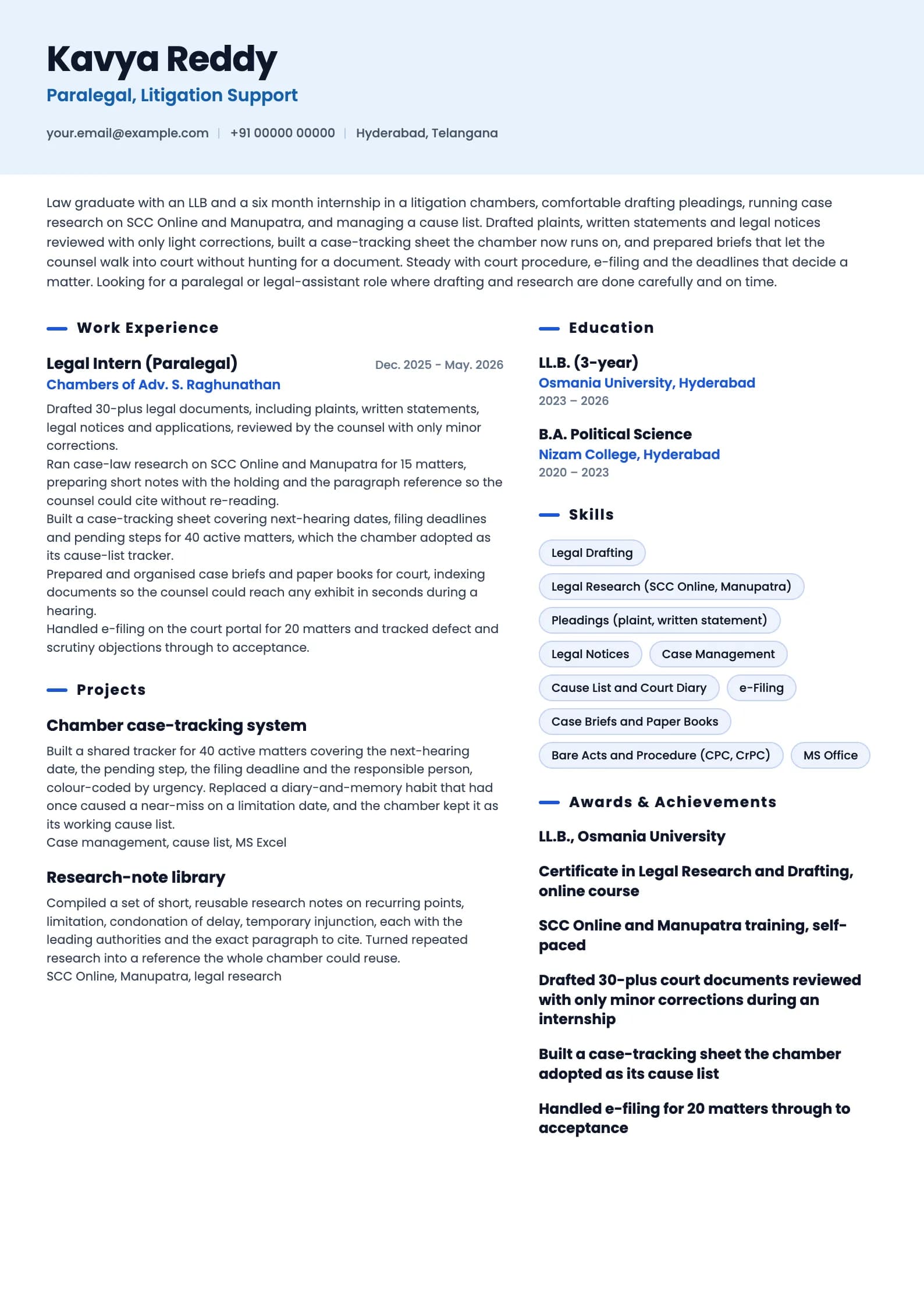
Build my resumeParalegal resume example, Fresher (0 years)
ai-era templateIs your resume good enough?
Upload the resume you have now and see what an applicant tracking system reads before a paralegal recruiter ever does.
Free to run. Sign in with your mobile number to see your score.
Paralegal resume example, Corporate Paralegal (5 years)
professional template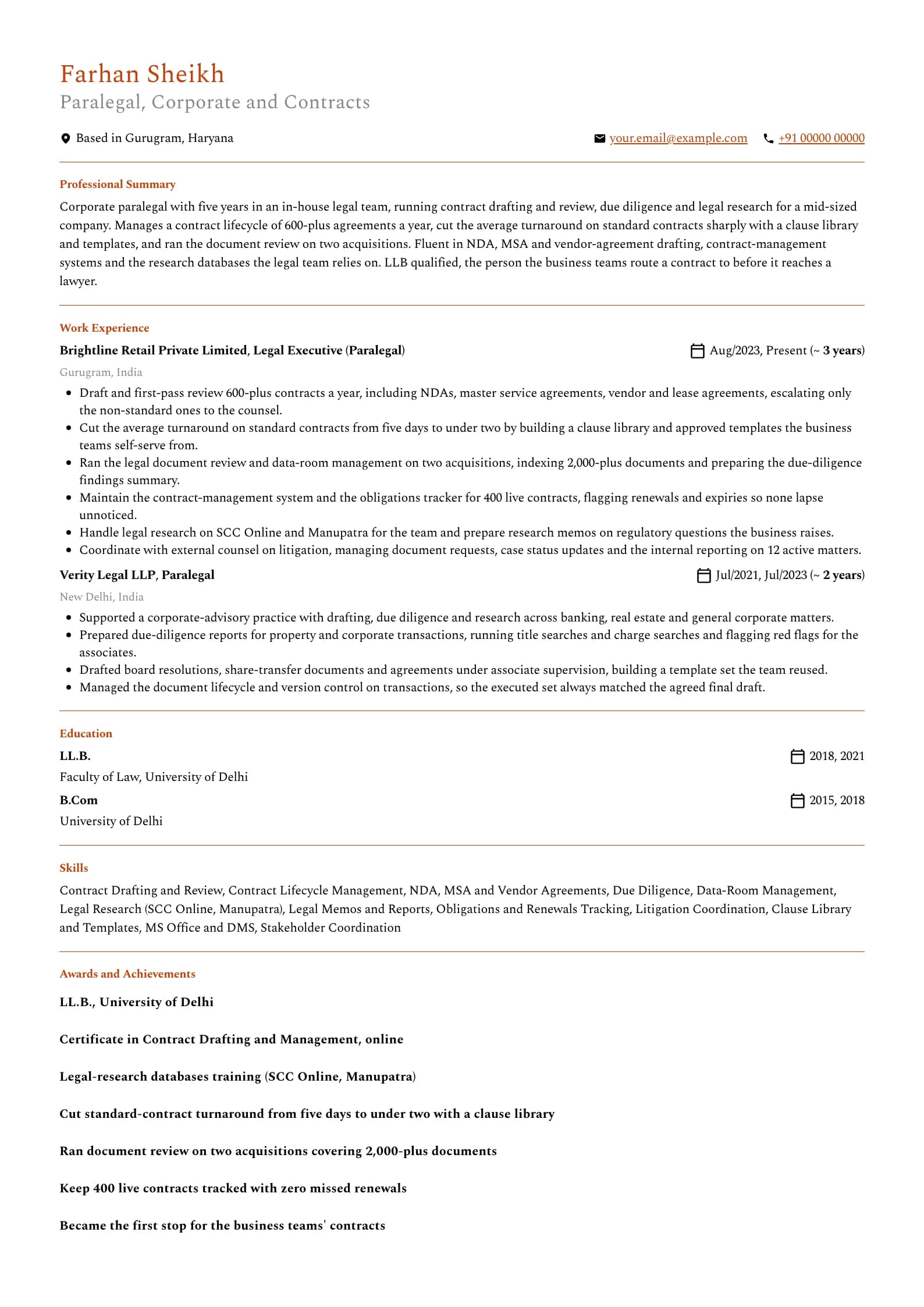
Want this structure with your own details? Build it in the resume builder.
Paralegal resume example, Senior Paralegal / Legal Team Lead (10 years)
header-band template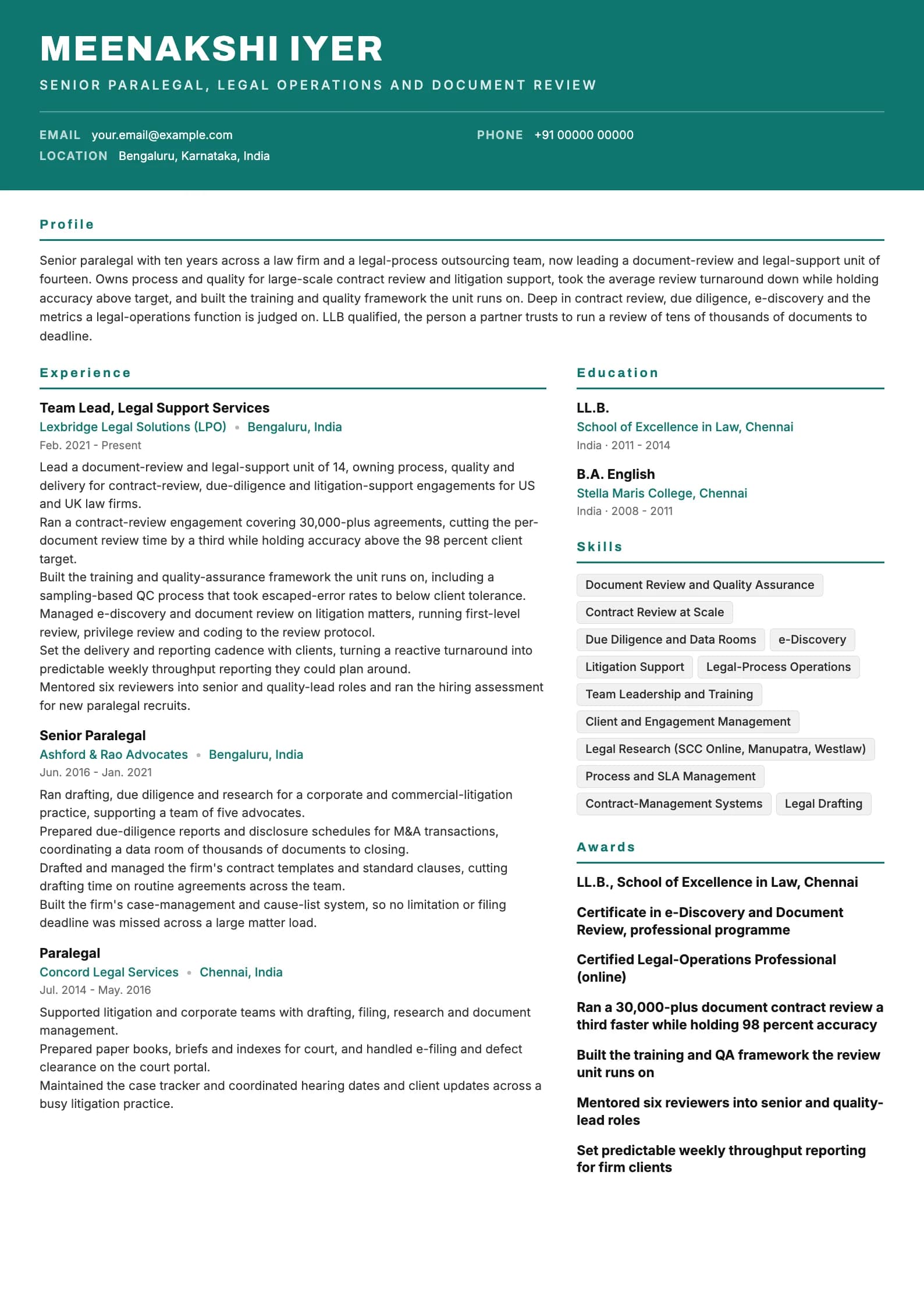
The format that works for paralegal resumes in India
Reverse chronological is the layout to use. Put the most recent legal role first, work backwards, and let the dates show. Functional resumes that group everything under Legal Skills and drop the dates read as an attempt to hide a gap or a short stint, and lawyers and legal-operations managers, who read documents for a living, treat them that way. Length is decided by evidence. One page holds everything a fresher and most paralegals up to roughly six years have to say. A senior paralegal or team lead with real process, scale and leadership work earns a second page. A page two padded with a list of every act you studied is a one-page resume in disguise. Be clear early about the kind of legal work you support, because paralegal covers very different jobs: litigation support in a chambers, contract and corporate work in-house, and large-scale review in an LPO are not interchangeable. A litigation firm wants to see pleadings, cause lists and e-filing; an in-house team wants contracts and due diligence; an LPO wants review throughput and quality. Signal your track in the headline and summary so the reviewer is not guessing. Four things belong nowhere on the resume: a photograph, date of birth, marital status and father's name. They survive from an older template. A legal hiring manager is not screening for them, and every line they occupy is a line a drafting or review result could have used. Send a PDF unless the posting asks for DOCX, keep to a single column, and name the file with your own name and the role. The table below sets out the section order.
| Section | Where it goes | Why |
|---|---|---|
| Name and headline | Top, above everything | The headline names your track: paralegal (litigation), corporate paralegal, or legal support. |
| Professional summary | Directly under the header | Three lines. Track, years, and the single strongest drafting or review result. |
| Work experience | Next, for anyone with a role | Most recent first. Newest role gets the most bullets. |
| Projects / key matters | Above experience for freshers, below it after that | For a fresher, a tracker or research library is the evidence; for others it is supporting. |
| Skills | Below experience | Grouped: drafting, research, contracts or litigation, tools. Not a 30-item wall. |
| Education | Bottom, unless a fresher | LLB or law diploma, institution, years. A fresher keeps the division. |
| Certifications | After education | Drafting, e-discovery, database or legal-ops courses that match the track. |
Naming SCC Online is not the same as proving you researched with it
The most common paralegal resume failure is a skills line that reads SCC Online, Manupatra, Westlaw, LexisNexis, CPC, CrPC, IPC, Contract Act, Companies Act, drafting, research, due diligence with no bullet anywhere that shows any of it applied to a real matter. A parser matches those terms, but a lawyer reads the wall and assumes it is a syllabus, then goes looking for the one thing you can actually do. The fix is to let the experience prove the tools. If you write SCC Online, a bullet should say what you researched with it and what the note was for. If you write due diligence, a bullet should name the transaction, the volume of documents and what you found. The corporate sample lists contract lifecycle management and due diligence precisely because the bullets show 600 contracts, a clause library and two acquisition reviews. The skills line and the work agree, which is what makes both believable. Be specific about the kind of drafting and research you have actually done, because it signals your track. Pleadings, legal notices and e-filing say litigation. NDAs, MSAs, due-diligence reports and data rooms say corporate. First-level review, privilege review and coding say LPO. Naming the right cluster tells a reviewer you will fit their work, not that you memorised the whole field. Do not claim a database or a document type you touched once. If you opened Westlaw twice in college, do not list it as a core research tool, because an interviewer who asks how you would pull US case law will find out quickly. List what you actually use, and let a bullet back it.
For every tool and document type on your skills line, ask: is there a bullet that shows me using it on a real matter. If not, either add the bullet or cut it. A wall of unproven databases and acts helps the parser and hurts the interview.
Writing a summary a lawyer actually reads
The block under your name is the part you can be reasonably sure gets read, so it should carry three facts: the kind of legal work you support, how long you have been doing it, and the strongest thing that happened because of your work. Three or four lines, no adjectives a reference check cannot confirm. The old objective line, seeking a challenging position in a reputed law firm to utilise my legal knowledge and drafting skills, tells a lawyer nothing new. Replace it with a summary. An objective describes what you want, a summary describes what you have already done, and only one is evidence. Freshers often think they have nothing to summarise. Look at the fresher sample: it names the litigation track, the internship length, and points at documents drafted with light corrections and a tracker the chamber adopted. That is a genuine summary built from an LLB and one internship. What it avoids is "a hardworking law graduate with a passion for the law", a phrase so common on legal resumes it now carries no information. A practical test: read your summary and ask whether any other LLB graduate could paste it onto their resume unchanged. If they could, it describes the degree, not you. Add the specific track, the specific number and the specific ownership until it stops being transferable.
Professional summary, corporate paralegal
Weak
A hardworking and detail-oriented law graduate with good knowledge of drafting, legal research and due diligence, seeking a challenging paralegal role in a reputed organisation.
Strong
Corporate paralegal with five years drafting and reviewing contracts and running due diligence in-house. Cut standard-contract turnaround from five days to under two with a clause library, and ran document review on two acquisitions covering 2,000-plus documents.
The rewrite trades a skills list and self-description for a track, an ownership scope and two verifiable results.
Experience bullets: verb, matter, consequence
Every strong bullet in the samples follows the same shape. It opens with an action verb, names the specific document, matter or process you handled, and closes with what measurably changed. The verb establishes that you did it. The matter tells a reviewer whether the work fits their practice. The number does the persuading. Start with the outcome and work backwards. Paralegals usually write the duty first, then leave it vague, which produces bullets like "handled drafting and research and other legal work". Instead ask what was different after your work: a document went out with light corrections, a turnaround dropped, a data room was ready for closing, a deadline was never missed. Then write the sentence that ends in that fact. Legal support has honest numbers, so use them: documents drafted, matters tracked, contracts a year, turnaround, documents reviewed, accuracy held, deadlines met, transactions supported. The samples vary these across bullets, which reads as range rather than one trick repeated. Where a number does not fit, give scope: how many matters, how many contracts live, how large a data room, how many active litigations coordinated. "Ran the document review on two acquisitions, indexing 2,000-plus documents" carries weight without inventing a percentage. Allocate bullets by recency. Current role gets five or six, the previous one four, anything older two or three.
| Level | What bullets must prove | Typical metric |
|---|---|---|
| Fresher | You can draft and research under supervision, and it holds | Documents drafted, matters tracked, e-filings, research notes |
| 1 to 4 years | You run drafting and support for a caseload unsupervised | Contracts a year, turnaround, due-diligence reports, deadlines met |
| 5 to 8 years | You own a workflow and improve how the team works | Volume reviewed, turnaround cut, transactions, contracts tracked |
| 8 years and up | You lead a unit, its process and its quality | Throughput, accuracy held, team led, engagements delivered |
Experience bullet, litigation support
Weak
Responsible for drafting of legal documents and doing research work and maintaining the case files of the office.
Strong
Drafted 30-plus plaints, written statements and legal notices reviewed by the counsel with only minor corrections, and built a tracker covering next-hearing dates for 40 active matters.
"Responsible for" describes a job description; the rewrite names the documents, the review outcome and the caseload tracked.
Experience bullet, document review at scale
Weak
Worked on a large document review project and completed the review within the given timelines.
Strong
Ran a contract-review engagement of 30,000-plus agreements, cutting per-document review time by a third while holding accuracy above the 98 percent client target.
Names the volume, the speed gain and the quality bar held, so a reviewer can see both throughput and accuracy rather than a vague completion claim.
If a bullet would read identically on any other LLB graduate's resume, it is describing the degree, not you. Rewrite it until it only fits the matters and documents you actually handled.
The skills section: grouped, honest, and short enough to defend
A paralegal's skills section has two audiences with opposite preferences. The parser wants literal terms it can match, drafting, due diligence, SCC Online, contract review. A human wants a short, organised list that signals what kind of legal support you provide and on what track. Grouping satisfies both. Group by function rather than one long line. Drafting, legal research, the substantive area (contracts or litigation), and tools is a grouping that works for almost every paralegal. The exact headings matter less than the fact that structure exists. Write names the way the field writes them: SCC Online not Scc, Manupatra not Manupathra, CPC not C.P.C. inconsistently. A parser matches on strings. Twelve to sixteen skills is the working range. Below eight the section looks thin. Above twenty it stops being a signal, and legal resumes are especially prone to listing every act and every database ever encountered as though breadth of exposure were depth of use. The list is a contract: every item is a question an interviewer can ask you to demonstrate. Do not include a proficiency bar. Star ratings invite an argument you cannot win, and nobody agrees what four stars in drafting means. Let the experience prove the depth, and pitch the list to the target: a litigation role wants pleadings and cause lists, a corporate role wants contracts and due diligence, an LPO wants review and QC.
| Group | What goes in it | How many |
|---|---|---|
| Drafting | Pleadings, notices, contracts, agreements (per your track) | 3 to 4 |
| Legal research | SCC Online, Manupatra, Westlaw, legal memos | 2 to 3 |
| Substantive area | Contracts and due diligence, or litigation and procedure | 3 to 4 |
| Process and tools | Case management, CLM, e-filing, data rooms, e-discovery | 2 to 4 |
| Support skills | Document management, coordination, deadline tracking | 2 to 3 |
Skills section
Weak
Skills: drafting, legal research, SCC Online, Manupatra, Westlaw, LexisNexis, CPC, CrPC, IPC, Contract Act, Companies Act, Transfer of Property Act, Evidence Act, Arbitration, due diligence, litigation, MS Office, communication, teamwork, hardworking, time management
Strong
Drafting: contracts, NDAs, MSAs, legal notices. Research: SCC Online, Manupatra, legal memos. Corporate: due diligence, data-room management, CLM. Process: contract tracking, version control, deadline management.
Cuts the every-act-and-database wall to the track the candidate actually works, and groups it so a lawyer reads the level in one pass.
Key matters and initiatives: what to include and how to describe it
For a fresher, internship matters and self-built tools are the resume: a case tracker, a research-note library, a bundle of documents you drafted. This is where a reviewer decides whether you can actually support legal work or only recite procedure. For an experienced paralegal, the standout items are the transactions and process improvements that go beyond routine: an acquisition data room, a clause library, a review framework you built. The common failure is describing the activity instead of the result. "Did legal research and drafting" tells a reviewer nothing, because every paralegal resume carries that line. Describe what you produced, for what matter, and what it enabled. The case-tracking system in the fresher sample is a stronger entry than a vague drafting claim, because it names the caseload, the near-miss it prevented and the adoption that followed. Pick work that shows range rather than three drafting tasks. One drafting piece, one research or due-diligence piece, and one process improvement is a stronger set than three variations of the same duty. Two well-described matters beat five listed by name. Be honest and precise about your role. "Prepared the due-diligence findings summary" is credible; claiming you led the transaction when you managed the data room is the kind of overstatement a reference call from the associate exposes at once. Client confidentiality matters too: describe the type of matter and your contribution, not names and figures you should not disclose.
Matter description, corporate paralegal
Weak
Assisted in due diligence for an M&A deal and helped in reviewing the documents in the data room.
Strong
Ran the document review and data-room management on two acquisitions, indexing 2,000-plus documents and preparing the due-diligence findings summary.
Swaps a vague assist claim for the specific scope owned and the deliverable produced, without disclosing confidential deal details.
Where the LLB, diploma and certifications belong
Education goes near the top for a fresher, who has nothing stronger to lead with, and lower for anyone with real legal support experience behind them. State the LLB or law degree, institution and years. Where your route is a diploma in paralegal studies rather than an LLB, name it clearly, because employers differ on what they require and honesty about your qualification avoids a wasted interview. A point on enrolment: a paralegal is a legal-support professional, not an enrolled advocate, and you should not imply otherwise. If you hold an LLB but are not enrolled with a Bar Council or do not practise, that is entirely normal for the role, but do not describe yourself as an advocate or lawyer on a paralegal resume, because it is easy to check and reads as a misrepresentation. Division or percentage is worth keeping while you are a fresher and it is reasonable, because early-career screening still uses it. Once you have supported real matters for a few years, the marks matter far less than the drafting and review you can point to, so let them recede. Certifications sit below education. Short courses in contract drafting, e-discovery, legal-research databases or legal operations are worth naming with the year when they match your track. A contract-drafting certificate helps a corporate paralegal, an e-discovery certificate helps an LPO reviewer, and neither helps much on the wrong track, so include what fits the target and skip the rest.
Getting through the applicant tracking system
Law firms, corporate legal teams and especially LPOs run applications through an applicant tracking system before a human sees them. It reads your file, tries to break it into name, dates, employers, titles and skills, and stores the result so a recruiter can search. Almost every ATS problem is a parsing problem, and parsing problems come from layout, not wording. The layout rules are short. One column. Standard section headings, so use Work Experience rather than My Legal Journey, and Skills rather than My Competencies. No text inside images, because a scanned certificate reads as empty space. No critical information in the header or footer region, which some parsers drop. Avoid text boxes and nested tables in the resume body. On wording, mirror the advertisement where it is honest. If the post says legal executive or paralegal, use that title. If it names contract review, due diligence or SCC Online and you have done that work, write the term exactly. Spell out an acronym alongside itself at least once, for example "CLM (contract lifecycle management)", so both searches find you. For an LPO role, terms like document review, e-discovery, privilege review and QC are the ones the parser is set to match. Keyword stuffing does not work. A hidden block of every act in white text is found quickly, and the outcome is worse than being filtered. Write real bullets that naturally contain the right terms. Save as PDF from a tool that embeds real text, then open the file and confirm you can select and copy a sentence. If you cannot select the text, neither can the parser.
Section heading
Weak
My Path in the Legal World
Strong
Work Experience
Parsers look for standard headings; a creative one can push the entire block into an unclassified bucket the recruiter never searches.
Test your own file before you send it. Copy the text out of the PDF into a plain text editor. Whatever you can read there is roughly what the parser sees, and anything scrambled is a real risk.
What gets paralegal resumes rejected
Most rejections at the resume stage are not close calls. They come from a small set of recurring problems, and all of them are fixable in an afternoon. The list below covers what legal hiring managers reviewing Indian paralegal resumes see most often, in rough order of how much damage each one does.
- Every act and database from the syllabus listed as a skill, with no bullet showing any of it used on a matter. Breadth of exposure is not depth of use.
- No track signalled, so the reviewer cannot tell whether you do litigation, corporate or LPO work. Say it in the headline and summary.
- Duties copied from the job description instead of what you produced. "Responsible for drafting and research" is the tell.
- No numbers anywhere. Documents drafted, contracts a year, matters tracked, documents reviewed, turnaround. Pick whichever is honest.
- Implying you are an advocate or practising lawyer when you are a paralegal. It is easy to check and reads as a misrepresentation.
- A photo, date of birth, marital status or father's name. None of it belongs on the resume and it takes a result's space.
- "Passion for the law" as the summary. Passion is assumed; state the track, the years and one result.
- Overstating a role in a transaction, which a reference call to the associate or partner catches quickly.
- Disclosing confidential client names, figures or deal terms to look impressive, which reads as a discretion risk to any legal employer.
- Typos in the tools and acts you claim, such as writing Manupatra as "Manupathra" or CrPC as "CRPC" inconsistently, which undoes an otherwise careful page.
Read your resume aloud once before sending it. Anything you would hesitate to defend to a supervising lawyer's face is a line to cut or rewrite.
Skills to put on a paralegal resume
Technical
- Legal Drafting
- Contract Drafting and Review
- Legal Research
- Due Diligence
- Document Review
- Pleadings and Legal Notices
- e-Discovery
- Contract Lifecycle Management
- Case Management
- Data-Room Management
- Legal Memos and Reports
- Court Procedure (CPC, CrPC)
Tools and platforms
- SCC Online
- Manupatra
- Westlaw
- LexisNexis
- e-Filing portals
- Contract-management systems
- Document-management systems
- e-Discovery platforms
- MS Word and Excel
Working skills
- Attention to detail
- Deadline discipline
- Confidentiality and discretion
- Written communication
- Coordination with counsel
- Organisation and tracking
- Judgement on escalation
- Client and stakeholder liaison
- Working under pressure
Certifications worth listing as a paralegal
| Certification | Full name | Worth it for |
|---|---|---|
| LL.B. | Bachelor of Laws | The most common qualifying degree for a paralegal in India and expected for most corporate and litigation-support roles. Name the institution and year. Note that holding an LLB does not make you an enrolled advocate; describe yourself as a paralegal or legal executive, not a lawyer, unless you are actually enrolled and practising. |
| Paralegal Diploma | Diploma or certificate in paralegal studies | An alternative route into the profession for those without a full LLB. Worth naming clearly, since employers differ on whether they require an LLB or accept a diploma; honesty about your qualification saves everyone a wasted interview. |
| Contract Drafting | Certificate in contract drafting and management | A practical credential for corporate and in-house paralegals whose day job is contracts. Most useful in the entry-to-mid range to signal drafting depth; back it with bullets showing the contracts and clause work you have actually done. |
| e-Discovery / Document Review | Certificate in e-discovery and document review | Valuable for paralegals working in an LPO or legal-support operation, where review, coding and privilege work are the core of the job. Signals familiarity with the review workflow and platforms; less relevant for a pure litigation-chambers role. |
| Legal Operations | Certified Legal-Operations Professional | Worth it for senior paralegals and team leads moving into legal-operations and process-management roles, where SLAs, quality frameworks and delivery metrics matter. Pair it with leadership and process bullets; it adds little for an early-career drafting role. |
Keywords an ATS scans for in a paralegal resume
These are the literal terms a parser matches against the job description. Use the ones that are true of you, in the sentences where you did the work, not as a list at the bottom.
- paralegal
- legal executive
- legal assistant
- legal drafting
- legal research
- contract drafting
- contract review
- due diligence
- document review
- e-discovery
- SCC Online
- manupatra
- litigation support
- case management
- e-filing
- pleadings
- legal notice
- data room
- LLB
- legal memo
Paralegal resume FAQ
What salary can a paralegal expect in India?
A fresher paralegal typically starts around 2.5 to 4.5 LPA, higher in corporate legal teams and large law firms than in small chambers. A paralegal with four to six years in contracts, due diligence or litigation support usually sits in the 5 to 10 LPA band. Senior paralegals and team leads, especially in legal-process outsourcing serving international firms, commonly earn 10 to 18 LPA and above. The LPO segment and in-house corporate teams generally pay more than traditional litigation chambers for the same experience.
How long should a paralegal resume be?
One page up to about six years of experience, two pages after that only if the second page carries real scale, transaction or leadership work rather than a longer list of acts. Nobody has been rejected for a resume that was easy to read. If you are struggling to fit one page, cut the oldest role to a single line, remove the recited statute list, and drop any tool or area you would not want to be tested on.
How does a fresher write a paralegal resume with no full-time job?
Lead with your LLB or paralegal diploma, then internship and project work, then skills. Treat internship tasks as evidence: documents you drafted and how lightly they were corrected, research notes you prepared, a case tracker you built, e-filings you handled. Name the tools you actually used, SCC Online, Manupatra, the court portal, and put numbers on the work even when small. A tracker the chamber adopted or documents drafted with light corrections carry more weight than "good drafting skills".
Should I list every act and legal database I have studied?
No. Listing SCC Online, Manupatra, Westlaw, LexisNexis and a dozen acts as separate skills is padding an interviewer sees through quickly, because they will ask you to demonstrate one. List the databases and areas you have actually worked in, and let a bullet prove each. Pitch the list to the role: a litigation role wants pleadings and cause lists, a corporate role wants contracts and due diligence, an LPO wants review and QC. Depth on a few beats a recited syllabus.
Is a paralegal the same as an advocate or lawyer?
No. A paralegal is a legal-support professional who drafts, researches and manages documents and matters, but does not appear in court or give legal advice as an enrolled advocate. You may hold an LLB, but unless you are enrolled with a Bar Council and practising, describe yourself as a paralegal or legal executive, not a lawyer. Overstating this is easy for an employer to check and reads as a misrepresentation, so be accurate about your qualification and role.
What is the difference between a litigation and a corporate paralegal resume?
They emphasise different work. A litigation paralegal resume shows pleadings, legal notices, cause-list and case management, e-filing, paper books and court procedure. A corporate paralegal resume shows contract drafting and review, due diligence, data-room management, obligations tracking and contract-management systems. An LPO resume shows document review, e-discovery, privilege review and quality metrics. Signal your track in the headline and summary, and pick the skills and bullets that match it, so the reviewer sees a fit rather than a general legal graduate.
Does an ATS reject two-column paralegal resumes?
It does not reject them outright, but many firm and LPO parsers read multi-column layouts out of order, which interleaves your sidebar with your experience and can produce nonsense in the recruiter's view. A single-column layout removes the risk, which is why all three samples above use one. Test your own file by copying the text out of the PDF into a plain text editor; if it reads in order there, it will most likely parse correctly.
What certifications help a paralegal's resume?
The ones that match your track. A contract-drafting or contract-management certificate helps a corporate paralegal, an e-discovery or document-review certificate helps an LPO reviewer, and a legal-operations certificate helps a team lead. A course in legal-research databases signals familiarity with SCC Online or Manupatra for any track. Name the issuing body and year, back the certificate with a bullet showing the work, and skip certificates unrelated to the role you are applying for.
Related resume examples and guides
Build your own in any of these formats
Start from a blank resume or upload the one you have. Goodspace renders it in 24 templates and flags the drafting, due-diligence and document-review keywords an applicant tracking system will look for, and the recited acts it will not credit.
Build my resume