3 Lawyer Resume Examples, Format and Guide
A lawyer's resume is judged on practice area, the quality of the matters you have handled, and whether you are actually enrolled to practise. Most resumes in India list did legal research, drafted documents and appeared in court without naming the forum, the type of matter, or the outcome. Below are three complete resumes, one each for a fresh law graduate, a mid-level advocate and a senior counsel, followed by the format rules and the exact keywords a legal recruiter or an applicant tracking system scans for. Each sample is a full document, not a fragment: summary, experience with real matters, skills, enrolment and education, in the order a legal hiring manager expects.
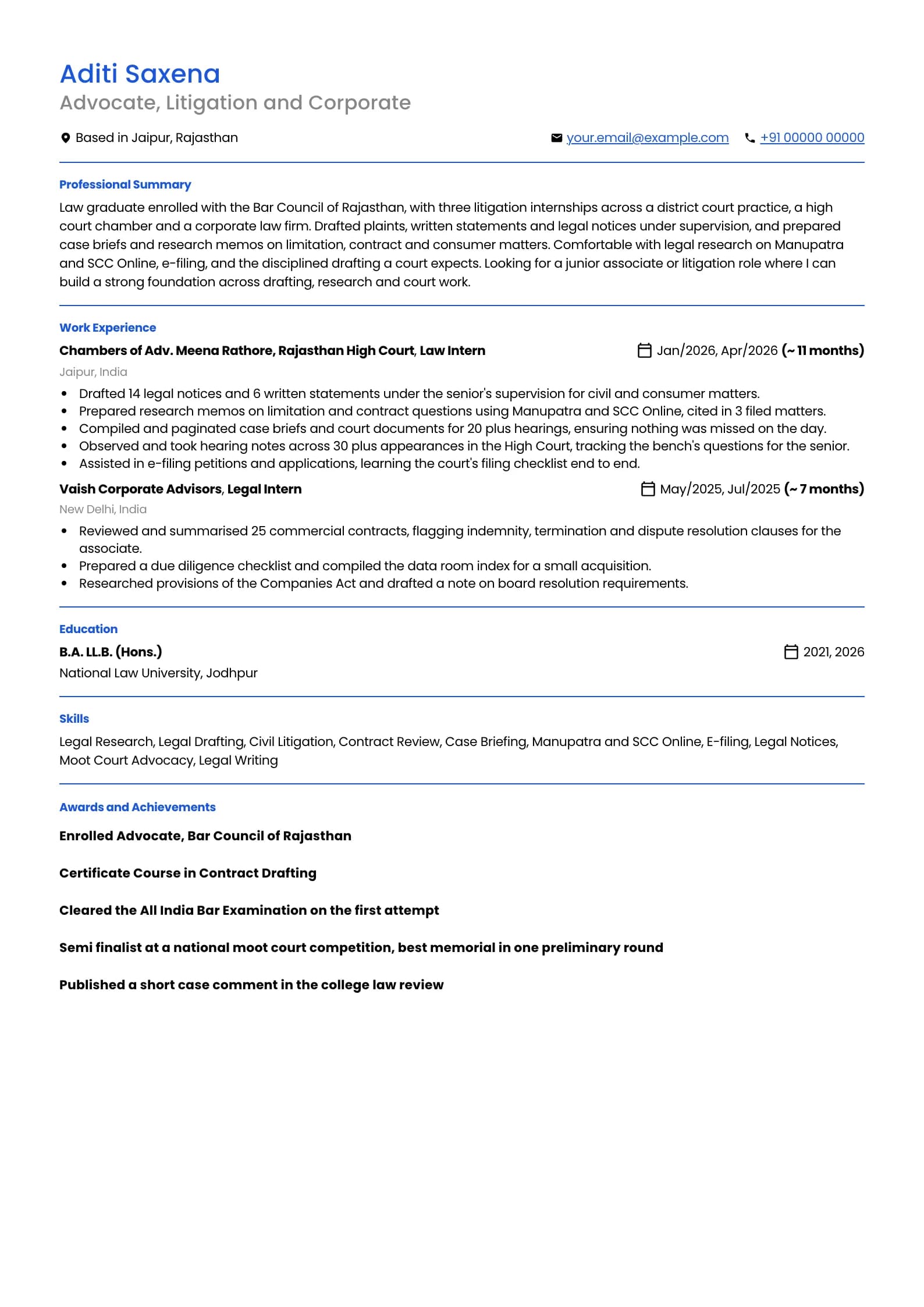
Build my resumeLawyer resume example, Fresh graduate (0 years)
minimalist templateIs your resume good enough?
Upload the resume you have now and see what an applicant tracking system reads before a lawyer recruiter ever does.
Free to run. Sign in with your mobile number to see your score.
Lawyer resume example, Mid-level (5 years)
professional template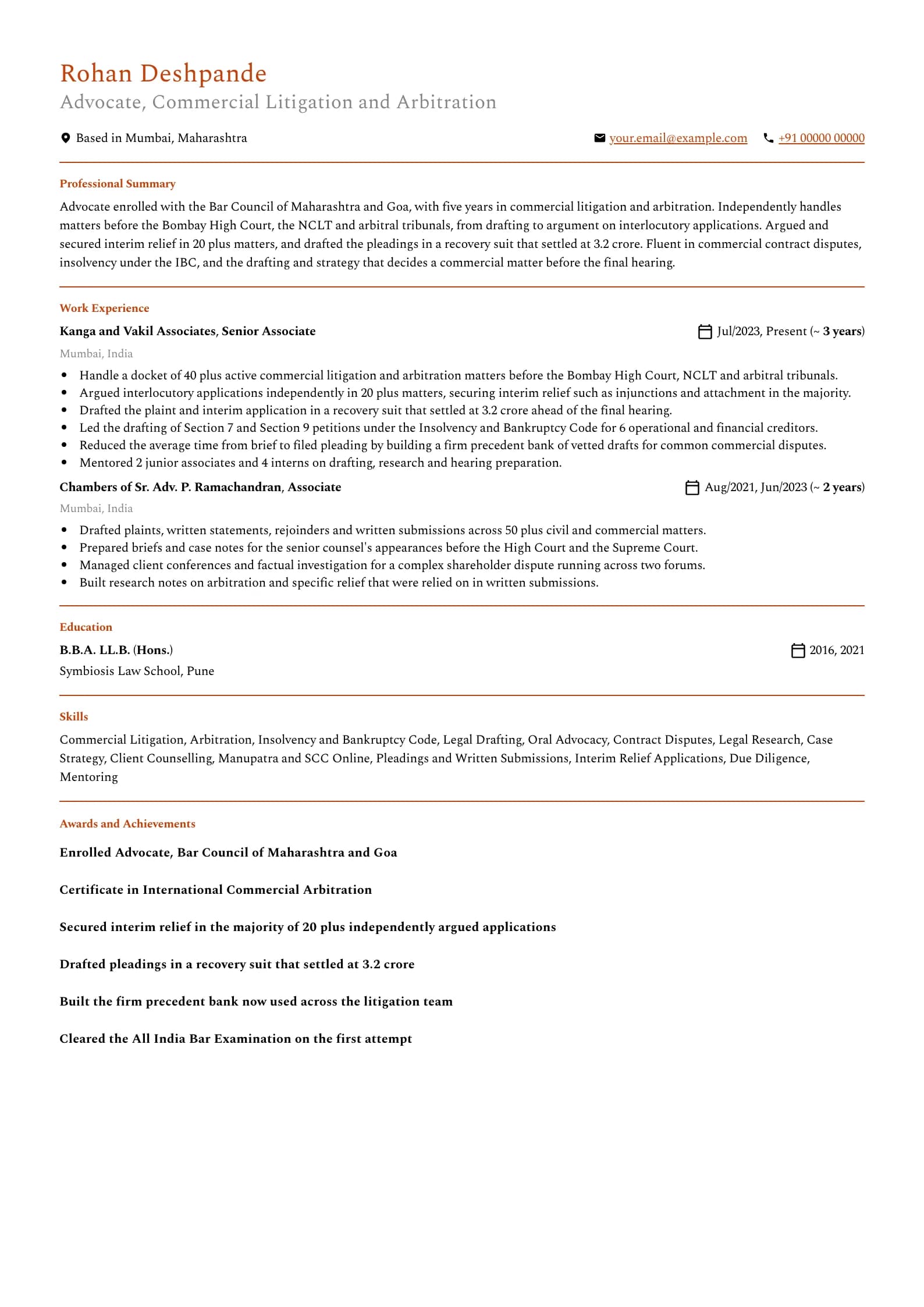
Want this structure with your own details? Build it in the resume builder.
Lawyer resume example, Senior (11 years)
header-band template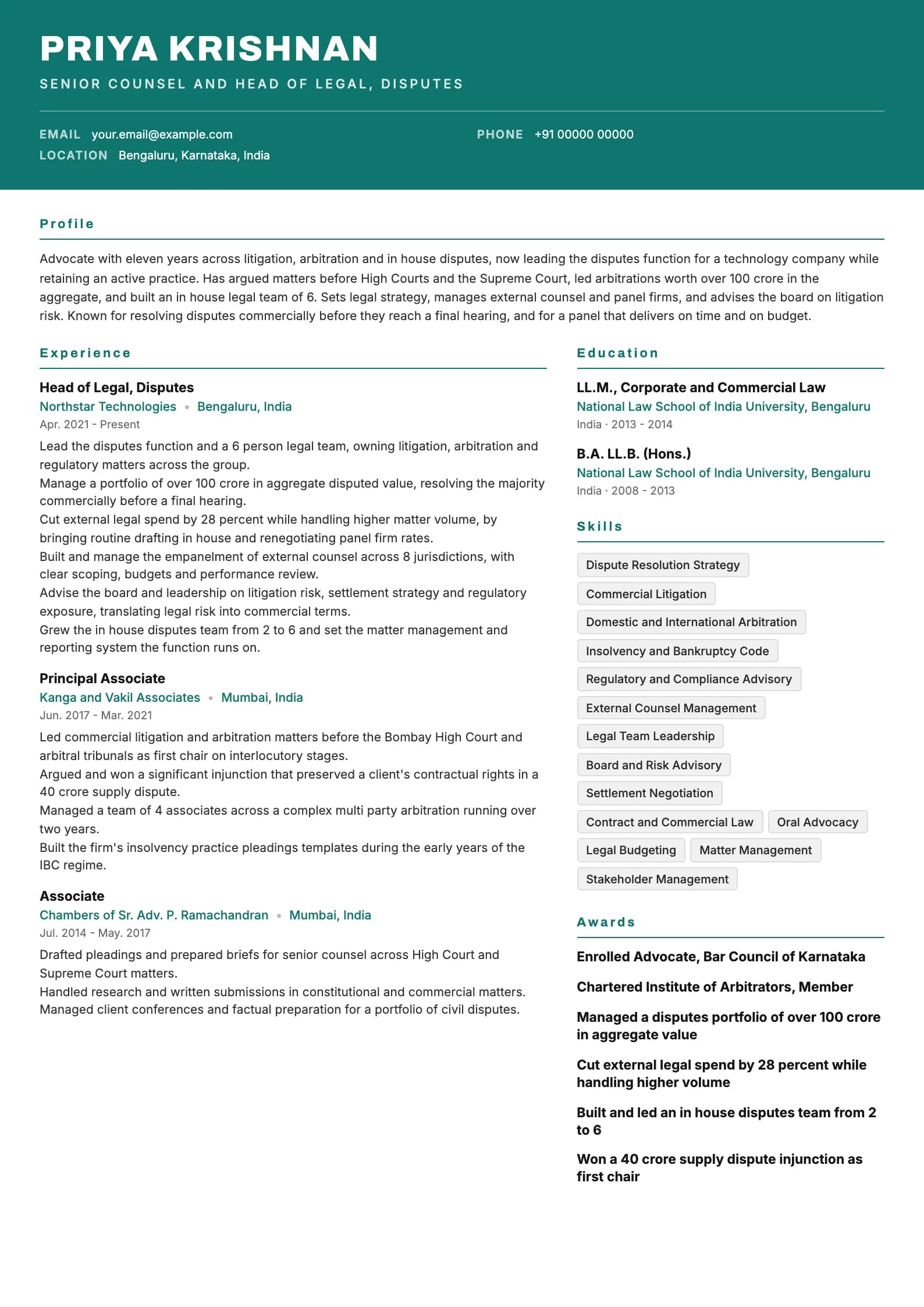
The format that works for lawyer resumes in India
Reverse chronological is the only layout worth using. Most recent role first, work backwards, dates in plain view. Functional resumes that hide dates read, in a profession built on precision and candour, as an attempt to obscure something, and that is a poor signal for a lawyer. What a lawyer's resume must do that others need not is state your Bar Council enrolment and your practice area clearly, and describe matters with the forum and the type named. Did legal research is a duty. Drafted Section 7 IBC petitions for 6 creditors and argued interim relief before the Bombay High Court is a resume. Name the forum, the statute or matter type, and the outcome where you may state it, because a legal employer screens on exactly where you can appear and on what. One page is right for a fresh graduate and most advocates up to roughly five years. Senior counsel and in house heads can run to two, if the second page carries substantial matters and leadership rather than a longer skills list. Send a PDF unless the posting asks for DOCX, name the file with your name and target role, and use a single column so an applicant tracking system reads it in order. Four things belong nowhere on the resume: a photograph, date of birth, marital status and father's name. They add nothing to a legal screen. The table below sets the section order.
| Section | Where it goes | Why |
|---|---|---|
| Name and headline | Top, above everything | The headline names your practice area: litigation, corporate, arbitration. |
| Bar enrolment | In the summary, and a clear line near the top | The threshold question for any practising role. State the Bar Council and year. |
| Professional summary | Directly under the header | Three lines. Years, practice area, forums, and a signature matter. |
| Work experience | Next, for anyone with a role | Most recent first, matters described with forum, matter type and outcome. |
| Practice areas and skills | Below experience | The areas of law you actually work in, plus drafting and research tools. |
| Education | Near top for a fresher, lower once practising | LL.B. or integrated LL.B., the law school, and an LL.M. if held. |
| Publications and moots | For students and juniors, as evidence | Moot record, published notes and internships stand in for practice. |
Writing a summary a legal recruiter actually reads
The block under your name is the only part a hiring partner is guaranteed to read, so it must carry three facts: your enrolment and practice area, how long you have practised, and a signature matter or forum. Three or four lines, no adjectives that cannot be checked. The old objective line, a dedicated and hardworking law graduate seeking a challenging position in a reputed law firm, tells a recruiter nothing and, for a lawyer, leaves out the two things that matter first: whether you are enrolled and what you practise. Replace it with a summary that names your Bar Council, your area and the forums you appear in. A legal summary without a practice area is unreadable to a hiring partner. Fresh graduates often think they have nothing to summarise. Look at the fresher sample: it states enrolment, names three internships across litigation and corporate, and lists the specific documents drafted. That is a real summary from internships and moots. What it avoids is passionate about justice and quick learner, phrases that carry no information in a profession that runs on specifics. Rewrite the summary for each meaningfully different role. A litigation chamber and an in house corporate role want different emphasis in those three lines. Two minutes of editing, and it is the highest leverage change you can make.
Professional summary, mid-level advocate
Weak
A dedicated and hardworking advocate with 5 years of experience seeking a challenging position in a reputed law firm to utilise my legal knowledge and skills.
Strong
Advocate enrolled with the Bar Council of Maharashtra and Goa, with five years in commercial litigation and arbitration, independently handling matters before the Bombay High Court, NCLT and arbitral tribunals from drafting to argument on interim relief.
The rewrite replaces self description with enrolment, the practice area, the specific forums and the level of independent work, which is what a legal recruiter screens on.
Experience bullets: forum, matter, and what you did
Every strong bullet in the samples follows one shape. It opens with an action verb, names the matter or document and the forum, and where permissible states the outcome. Drafted, argued, appeared, advised, negotiated. The specificity does the persuading: a legal reviewer wants to know exactly where you have appeared and on what kind of matter, because that is what tells them whether you can do their work. The common failure is the duty bullet. Responsible for drafting and legal research and appearing in court describes the job posting, not your practice. Name the document, the statute and the forum: drafted Section 9 petitions under the IBC, argued interlocutory applications before the Bombay High Court, reviewed commercial contracts flagging indemnity and termination. Then, where you properly may, state the outcome. Be careful and honest with outcomes. You may state that a suit settled at a figure, that interim relief was secured, or that an injunction was won, because these are matters of record. Do not overclaim sole credit for a team win, and respect client confidentiality by describing the matter type and value rather than naming the client where that is not public. In law, an overstated claim is not just weak, it is a professional risk. Where a matter has no stated outcome, give scope: the number of matters on your docket, the forums you appear before, the value of a dispute, the size of a team you led. Scope tells a recruiter the weight of your practice without breaching confidence.
| Level | What bullets must prove | Typical signal |
|---|---|---|
| Fresh graduate | You can research, draft and support a matter | Documents drafted, memos on named issues, internships, moot record |
| 1 to 3 years | You draft independently and appear on routine matters | Pleadings drafted, forums appeared, matter types, research relied on |
| 4 to 6 years | You run matters and argue interim stages | Docket size, interim relief, signature matters, IBC or arbitration work |
| 7 years and up | You set strategy and lead a team or function | Portfolio value, external counsel managed, spend, team, board advisory |
Experience bullet, litigation role
Weak
Responsible for legal research, drafting of documents and appearing in court for various matters as assigned by the senior.
Strong
Argued interlocutory applications independently in 20 plus matters before the Bombay High Court and arbitral tribunals, securing interim relief in the majority.
The duty version fits any junior; the rewrite names the stage of work, the forums, the volume and the outcome, all of which a hiring partner can weigh.
Experience bullet, drafting work
Weak
Drafted various legal documents and petitions for the firm's litigation matters over the year.
Strong
Led the drafting of Section 7 and Section 9 petitions under the Insolvency and Bankruptcy Code for 6 operational and financial creditors.
Names the exact provisions, the statute and the client type, so a legal reviewer knows precisely what you have drafted and under which regime.
Name the forum and the statute in every matter bullet you can. Appeared in court is a duty; argued a Section 9 application before the NCLT is a practice a recruiter can place.
The skills section: practice areas, drafting and research
A lawyer's skills section serves two audiences. The applicant tracking system, increasingly used by large firms and in house legal teams, wants literal terms it can match, so arbitration, commercial litigation, insolvency, contract drafting and legal research must appear as written. A hiring partner wants to see your genuine practice areas, not a list of every subject you studied. Group the list so both are served. Lead with practice areas, then drafting and advocacy, then research tools. Practice areas are the heart of a legal skills section: commercial litigation, arbitration, insolvency, corporate advisory, whatever you actually work in. Be honest here, because a partner will interview on any area you list, and a claimed expertise you cannot sustain is quickly exposed. Drafting and advocacy covers pleadings, contracts, written submissions and oral advocacy. Research tools covers the databases you use, Manupatra, SCC Online, and legal writing. Twelve to sixteen skills is the working range. Every skill is a claim a hiring partner can and will test. Put the practice areas you are strongest in first, since a litigation firm and a corporate team are screening for different things. Skip star ratings entirely, they read as unserious in a legal document. And do not pad the list with every subject from the LL.B., because a wall of subjects signals a student, while a focused set of practice areas signals a lawyer.
| Group | What goes in it | How many |
|---|---|---|
| Practice areas | Commercial litigation, arbitration, insolvency, corporate advisory | 3 to 5 |
| Drafting and advocacy | Pleadings, contracts, written submissions, oral advocacy | 3 to 5 |
| Research | Legal research, Manupatra, SCC Online, legal writing | 2 to 4 |
| Advisory | Client counselling, due diligence, negotiation, compliance | 2 to 4 |
Skills section
Weak
Skills: Law, Hardworking, Legal Knowledge, Constitutional Law, Criminal Law, Contract Law, Tort, IPR, Communication, Sincere, Property Law, Family Law, Company Law
Strong
Practice areas: commercial litigation, arbitration, insolvency (IBC). Drafting: pleadings, written submissions, commercial contracts. Advocacy: interim relief applications, oral advocacy. Research: Manupatra, SCC Online.
Cuts the wall of LL.B. subjects that signals a student, keeps the actual practice areas and drafting a firm searches for, and removes unprovable traits like sincere.
Getting through the applicant tracking system and the recruiter
Large law firms and corporate legal teams increasingly run resumes through an applicant tracking system before a human reads them. It is a parser and a search index, not a judge: it breaks your file into name, dates, employers, titles and skills, and stores it so a recruiter can search across candidates. Almost every ATS problem is a layout problem, not a wording one. The layout rules are short. One column. Standard section headings, so Work Experience and Skills rather than My Legal Journey and Areas of Expertise written creatively. No text inside images, since a chamber crest or a photo reads as empty space. Keep nothing critical in the header or footer region, which some parsers drop. Avoid text boxes and nested tables for the body. On wording, mirror the posting where honest. If it says commercial litigation, use commercial litigation. If it names arbitration or the IBC, name the same, and spell out an acronym once, for example IBC (Insolvency and Bankruptcy Code), so both searches find you. Your matter descriptions naturally contain the statutes and forums a legal recruiter searches, which is another reason to name them. Keyword stuffing does not work, and in a profession that prizes precision it reads especially badly. Write real matter bullets that contain the right terms because you did the work. Finally, export a real text PDF, open it, and confirm you can select and copy a sentence. If you cannot select the text, neither can the parser.
Section heading
Weak
My Journey Through the Law
Strong
Work Experience
Parsers look for standard headings; a creative one can drop the whole block into an unclassified bucket, and it reads as unserious to a partner too.
Test your own file before sending it. Copy the text out of the PDF into a plain text editor. Whatever you can read there is roughly what the parser sees.
What gets lawyer resumes rejected
Most rejections at the resume stage are not close calls. They come from a small set of recurring problems, all fixable in an afternoon. The list below covers what legal recruiters in India see most often, in rough order of how much damage each one does.
- No Bar Council enrolment stated. For any practising role this is the threshold question, so state your Bar Council and year clearly.
- Matters described without forum or statute. Appeared in court tells a partner nothing about where you can actually appear or on what.
- A wall of LL.B. subjects listed as skills, which signals a student rather than a lawyer with a focused practice.
- Overclaimed outcomes or sole credit for team wins. In law an exaggeration is a professional risk, not just a weak line.
- Breaching confidentiality by naming clients or matters that are not public. Describe the matter type and value instead.
- A generic objective instead of a summary that leads with enrolment, practice area and forums.
- The same resume sent to a litigation chamber and an in house corporate role without changing the practice emphasis up top.
- A photo, date of birth, marital status or father's name, none of which belongs on a legal resume.
- A wall of dense text with no whitespace, which for a profession judged on clear drafting is a poor sample of your writing.
- Typos and inconsistent citation, which on a lawyer's resume, whose stock in trade is precise drafting, undermine the entire application.
Your resume is a writing sample. For a profession judged on drafting, a page with a typo, a loose citation or a muddled sentence argues against you before the interview.
Skills to put on a lawyer resume
Technical
- Legal Drafting
- Commercial Litigation
- Civil Litigation
- Arbitration
- Insolvency and Bankruptcy Code
- Contract Drafting and Review
- Legal Research
- Pleadings and Written Submissions
- Oral Advocacy
- Due Diligence
- Corporate Advisory
- Regulatory Compliance
- Case Strategy
- Legal Writing
Tools and platforms
- Manupatra
- SCC Online
- Westlaw India
- E-filing Portals
- MS Office
- Legal Matter Management Systems
- Case Management Software
Working skills
- Client Counselling
- Negotiation
- Analytical Reasoning
- Attention to Detail
- Court Craft
- Confidentiality and Ethics
- Time and Deadline Management
- Stakeholder Communication
Certifications worth listing as a lawyer
| Certification | Full name | Worth it for |
|---|---|---|
| Bar Enrolment | Enrolment with a State Bar Council and the All India Bar Examination | Not a certification so much as the licence to practise, and the single most important line for any litigation or court facing role. State the Bar Council and year of enrolment, and that you have cleared the All India Bar Examination. Essential for anyone appearing before a court; less critical for purely advisory in house or research roles, though still worth stating. |
| LL.M. | Master of Laws in a specialisation | A genuine differentiator for corporate, tax, IPR and international law roles, and for those aiming at academia or policy. Most valuable when the specialisation matches the target practice, for example a corporate LL.M. for a transactional role. Litigation practice usually values court experience over an LL.M., so weigh the time against a few years at the Bar. |
| Arbitration Cert | Certificate or membership in arbitration, such as CIArb | Worth it for advocates building an arbitration practice, and membership of a body like the Chartered Institute of Arbitrators is a recognised signal for domestic and international arbitration work. Best for mid to senior lawyers with real arbitration matters to point at, rather than as an early career badge. |
| Company Secretary | Company Secretary, ICSI | A strong complementary credential for corporate, compliance and secretarial legal roles, valued by in house teams and law firms with a corporate practice. Most useful for lawyers on the transactional and advisory side rather than pure litigators. |
| Contract Drafting | Certificate Course in Contract or Commercial Drafting | A useful, accessible signal for law students and fresh graduates who want to show drafting readiness before they have firm experience. Assumed rather than listed once you have years of real drafting behind you, so treat it as an early career credential. |
Keywords an ATS scans for in a lawyer resume
These are the literal terms a parser matches against the job description. Use the ones that are true of you, in the sentences where you did the work, not as a list at the bottom.
- advocate
- lawyer
- legal counsel
- commercial litigation
- civil litigation
- arbitration
- legal drafting
- legal research
- insolvency and bankruptcy code
- contract drafting
- due diligence
- corporate law
- pleadings
- Bar Council enrolment
- Manupatra
- SCC Online
- client counselling
- dispute resolution
- regulatory compliance
- written submissions
Lawyer resume FAQ
How much do lawyers earn in India, and should compensation go on the resume?
It varies widely. Litigation juniors in a chamber often start at 20,000 to 45,000 rupees a month, tier one law firm associates at 12 to 18 LPA, and senior in house counsel and firm partners well above that, with practice area and city driving large differences. Do not put your current or expected compensation on the resume. It anchors the conversation before you have shown your practice and belongs in the recruiter discussion, not the document.
Should I put my Bar Council enrolment on the resume?
Yes, prominently, for any role that involves practising or appearing before a court or tribunal. State the State Bar Council you are enrolled with, the year, and that you have cleared the All India Bar Examination, because this is the threshold question a litigation employer checks first. For purely advisory or in house research roles it is slightly less critical but still worth stating, since it signals you are qualified to practise.
How long should a lawyer's resume be?
One page for a fresh graduate and most advocates up to about five years, two pages for senior counsel or in house heads only if the second page carries substantial matters and leadership rather than a longer list of subjects. A hiring partner screens for practice area and signature matters quickly, so a focused, well drafted page beats a long one. For a profession judged on drafting, concision itself is a favourable signal.
How does a fresh law graduate write a resume with no practice experience?
Lead with your enrolment and internships, then education, then moots and publications. Treat each internship as evidence: the documents you drafted, the research memos on named issues, the forums you observed, the type of matters you supported. A strong moot court record, a published case comment, and internships across litigation and corporate all count, because each shows real legal work and advocacy rather than only the degree.
How should I describe matters without breaching client confidentiality?
Describe the matter type, the forum and the value rather than naming the client, unless the matter is a matter of public record. You may write drafted pleadings in a recovery suit that settled at 3.2 crore or argued an injunction in a supply dispute without identifying the parties. This respects confidentiality while still conveying the weight of your practice, and it reflects the discretion a legal employer expects. Never state an outcome or figure you cannot support.
Do certifications help a lawyer get hired?
The one that matters most is not a certification at all but your Bar enrolment and the All India Bar Examination. Beyond that, an LL.M. helps for corporate, tax and IPR roles, an arbitration credential like CIArb helps for arbitration practice, and a Company Secretary qualification complements corporate and compliance work. For litigators, real court and drafting experience outweighs most certificates, so invest in matters and mentorship over badges once you are practising.
Does an applicant tracking system affect legal hiring in India?
Increasingly yes, especially at large law firms and corporate in house teams that receive high applicant volume and screen resumes through a parser before a human reads them. Use a single column, standard headings, and name your practice areas, statutes and forums as literal terms, because those are what a legal recruiter searches. A well drafted, clearly structured resume serves both the parser and the partner, which is convenient, since clear structure is what the profession values anyway.
Related resume examples and guides
Build your own in any of these formats
Start from a blank resume or upload the one you have. The builder renders it in 24 templates and flags what an applicant tracking system will miss.
Build my resume