Legal Advisor Resume Format, with 3 Full Samples
A legal advisor is hired on judgement, on the deals closed cleanly and the risks caught before they became disputes, yet most legal resumes read like a list of statutes memorised for an exam. Below are three complete resumes, one for an LLB fresher with a strong internship record, one for a corporate legal counsel with five years across contracts and compliance, and one for a head of legal owning risk for a company. After the samples come the format rules, the difference between naming a law and showing you applied it, the terms an applicant tracking system matches literally, and the mistakes that get a legal resume set aside before a partner or general counsel reads it.
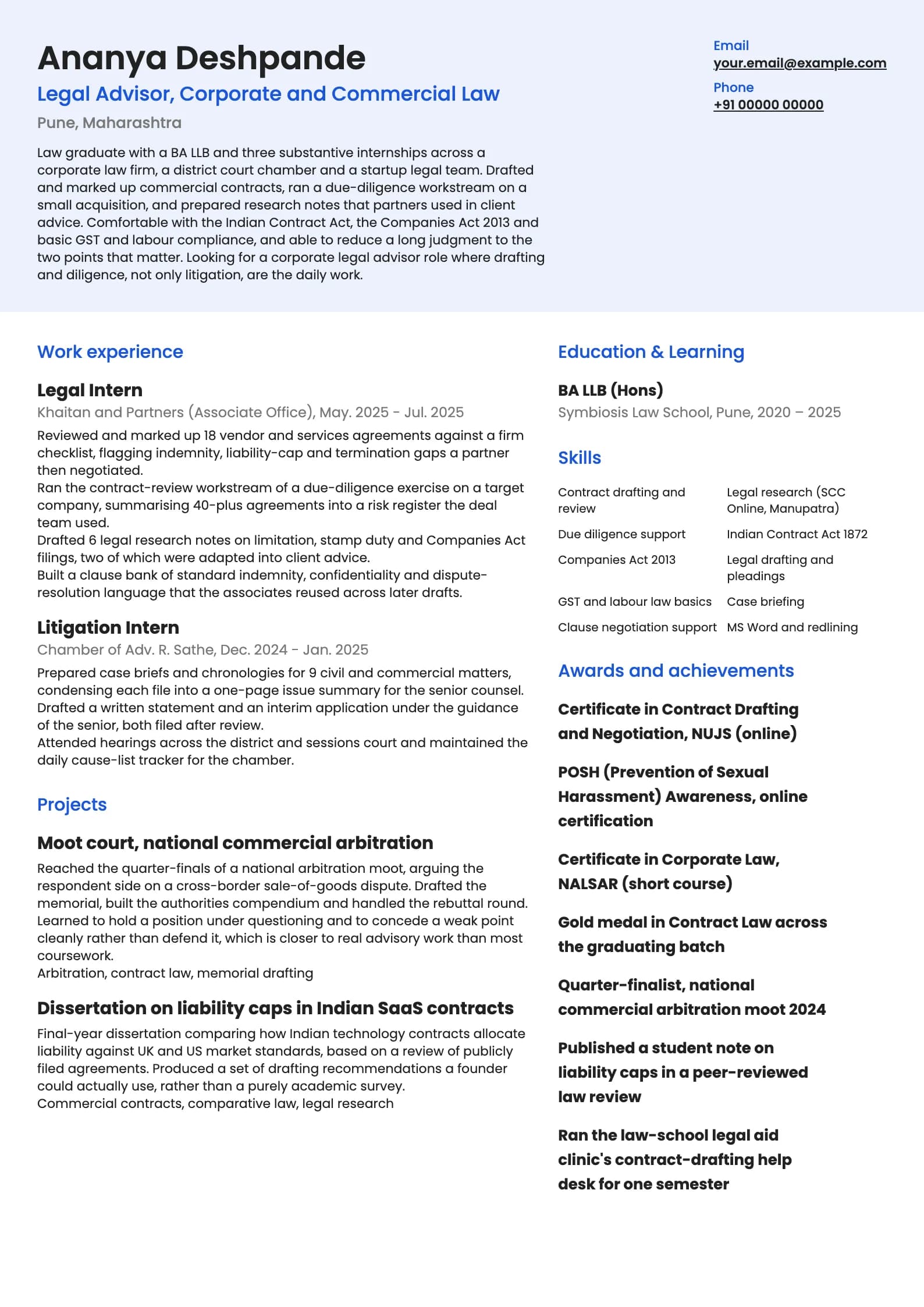
Build my resumeLegal Advisor resume example, Fresher (0 years)
modern templateIs your resume good enough?
Upload the resume you have now and see what an applicant tracking system reads before a legal advisor recruiter ever does.
Free to run. Sign in with your mobile number to see your score.
Legal Advisor resume example, Mid-level (5 years)
professional template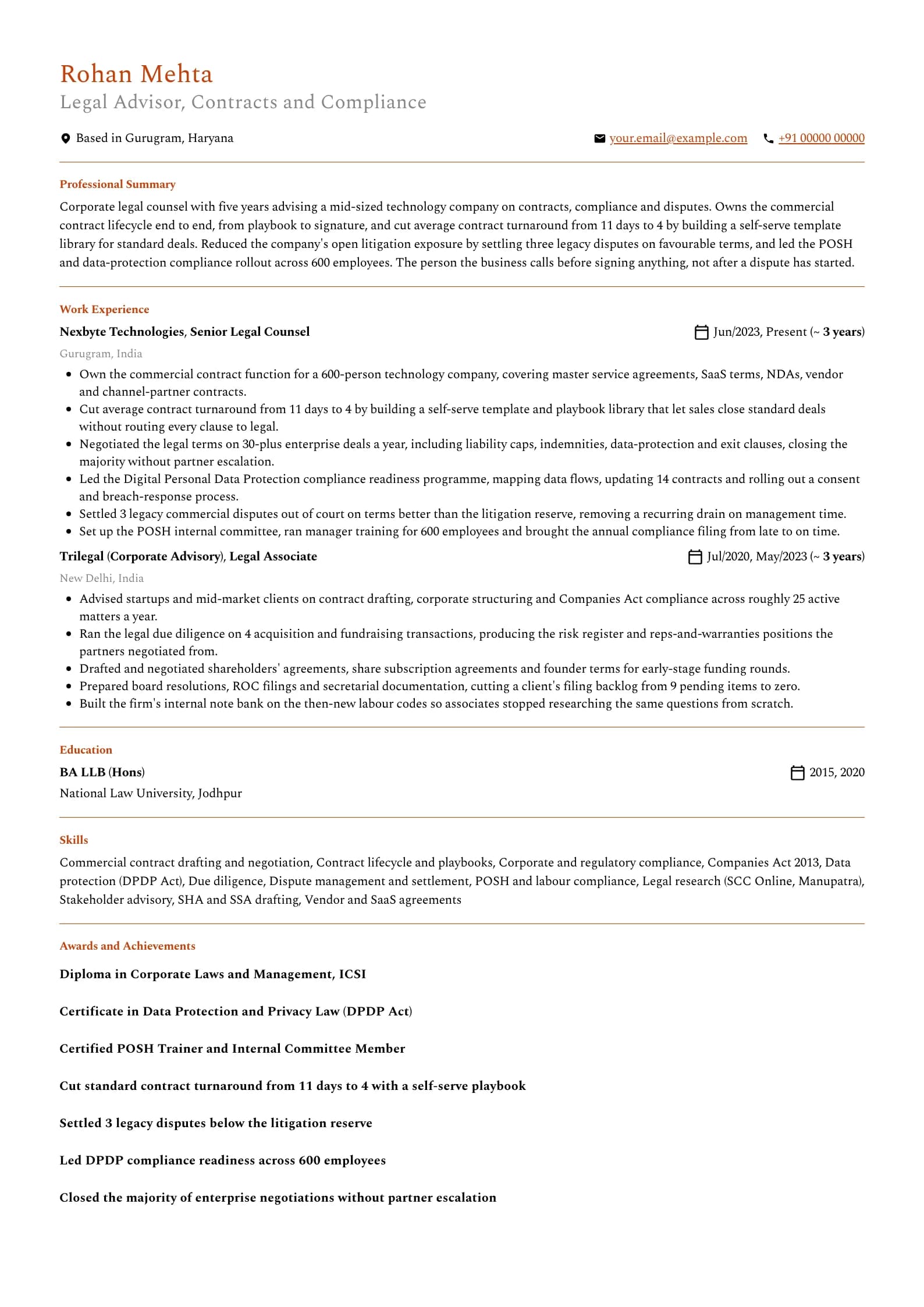
Want this structure with your own details? Build it in the resume builder.
Legal Advisor resume example, Senior (12 years)
header-band template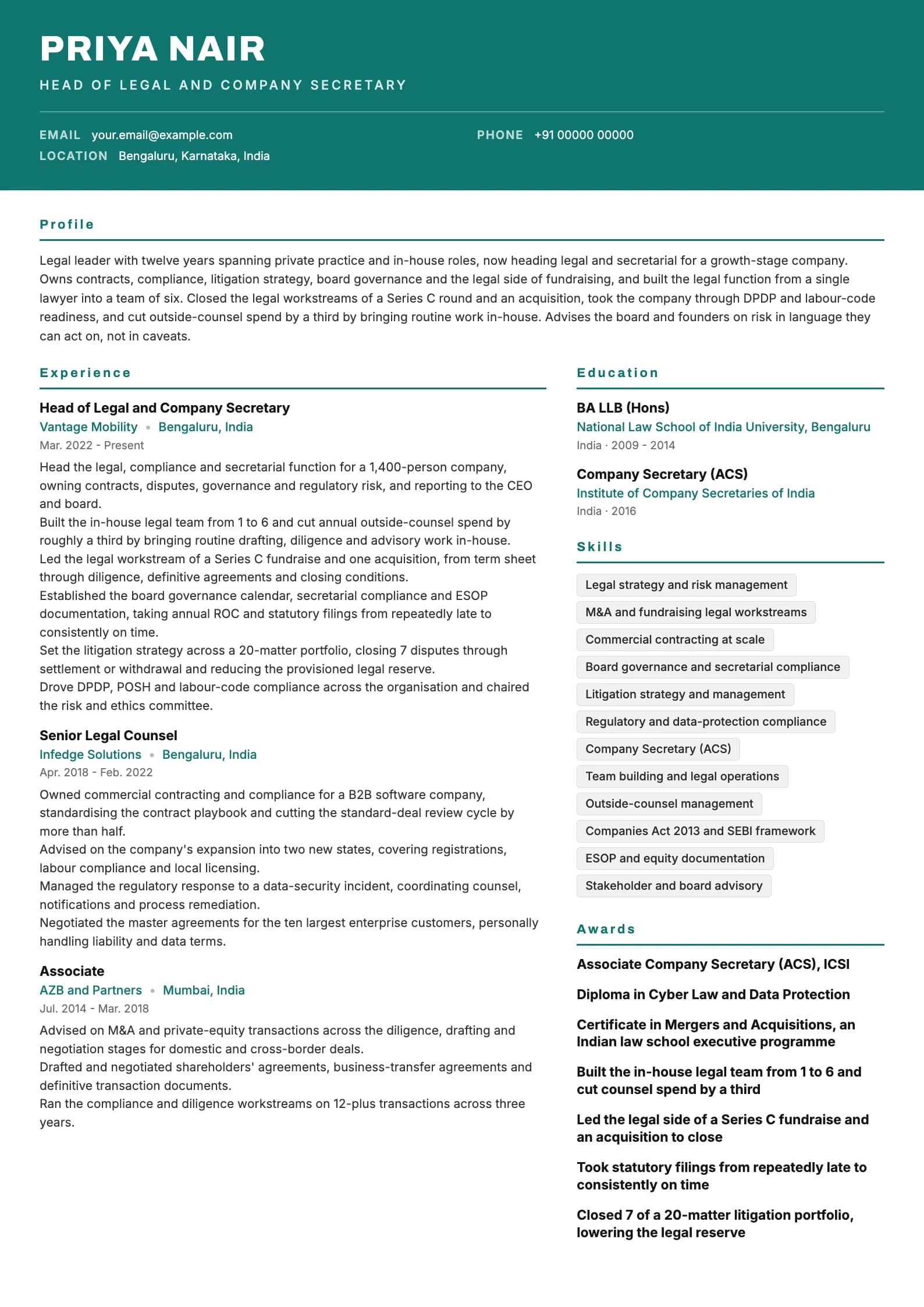
The format that works for legal advisor resumes in India
Reverse chronological is the layout to use. Most recent role first, work backwards, dates in plain view. Legal reviewers, whether a hiring partner or a general counsel, read a lot of resumes and treat a functional layout that hides dates the way they treat a contract with a missing date, as something to be suspicious of. A career gap is better explained in one honest line than concealed by structure. Length follows evidence. One page holds everything a fresher and most lawyers up to roughly six years have to say. A senior advisor or general counsel with a decade of transactions, disputes and governance work can run to two pages, provided the second page carries real matters and not a longer list of Acts. A page two built from a list of statutes read in college is a padded one-page resume. Four things do not belong on a professional legal resume in India: a photograph, date of birth, marital status and father's name. They survive from an older campus template, and no one screening a legal advisor is looking for them. Every line they take is a line a matter or a result could have used. Your enrolment with a State Bar Council, however, is worth stating, because it is a genuine credential a reviewer looks for. Send a PDF unless the posting asks for DOCX, and name the file with your own name and the target role rather than resume_final. Use a single column all the way down, because a two-column legal resume tends to interleave a sidebar of Acts with the experience when a parser reads it. The table below sets out the section order.
| Section | Where it goes | Why |
|---|---|---|
| Name and headline | Top, above everything | The headline is the role you want: legal advisor, legal counsel, corporate legal. Add Bar Council enrolment if you have it. |
| Professional summary | Directly under the header | Three or four lines. Practice area, years, and the single strongest outcome. |
| Work experience | Next, for anyone practising | Most recent first. Newest role gets the most bullets. |
| Internships and moots | Above experience for freshers, dropped after that | For a law fresher this is the evidence. It disappears once you have a full-time role. |
| Skills | Below experience | Grouped: drafting, compliance, litigation, statutes, research tools. Not a wall of Act names. |
| Education | Bottom, unless you are a fresher | Degree, university, years. Add CS or LLM if held. Bar enrolment stated once. |
| Certifications and Bar | After education, or beside skills if few | State Bar enrolment, ACS, and named diplomas earn their place. |
Naming a statute is not the same as showing you applied it
The single most common legal-resume failure is a skills block that reads Indian Contract Act, Companies Act, SEBI, FEMA, Arbitration Act, IBC, GST, Labour Codes, IPC, CrPC, CPC with no bullet anywhere that shows any of them used in a real matter. A parser matches the names, but a partner or general counsel reads the wall and assumes it is the syllabus, then probes the one Act you can actually reason about. The fix is to let the experience carry the statute. If you write Companies Act, at least one bullet should describe a filing, a resolution or a compliance issue you handled under it. If you write DPDP or data protection, a bullet should name the mapping or the contracts you updated. The mid-level sample lists the DPDP Act and the Companies Act precisely because its bullets show a data-protection rollout and ROC filings cleared. The skills block and the experience agree, which is what makes both believable. Be specific about the kind of law you practise. Corporate advisory, litigation, compliance and secretarial work are different jobs, and a resume that claims all of them equally reads as claiming none. A legal advisor role usually means contracts, compliance and risk rather than courtroom litigation, so lead with drafting, negotiation and diligence and keep litigation in proportion to what you actually did. Do not pad with the entire bare-act index. Listing IPC, CrPC and CPC on a corporate-advisory resume when your day job is SaaS contracts reads as filler. Name the four or five areas the target role uses and prove each one.
For every Act on your skills block, ask: is there a bullet that shows I applied it. If not, either add the bullet or cut the Act. A wall of statute names helps the parser and hurts the interview.
Writing a summary a hiring partner actually reads
The block under your name is the part you can be reasonably sure gets read, so it should carry three facts: what kind of law you practise, how long you have practised it, and the strongest thing that happened because of your advice. Three or four lines, no adjectives a reviewer cannot check. The old objective line, seeking a challenging position in a reputed organisation to apply your legal knowledge, tells the reader nothing the application did not already say. Replace it with a summary. An objective describes what you want, a summary describes what you have already done, and only one is evidence in a profession built on evidence. Freshers often believe they have nothing to summarise. Look at the fresher sample: it names the degree, the three internships, and the fact that partners used the research and that a diligence workstream was owned. That is a genuine summary built from internships and moots, not from adjectives. What it avoids is "a dedicated law graduate with excellent communication skills", a phrase so common it now carries no information. A practical test: read your summary and ask whether a classmate with the same degree could paste it onto their resume unchanged. If they could, it describes the LLB, not you. Add the specific practice area, the specific matter and the specific outcome until it stops being transferable.
Professional summary, mid-level legal counsel
Weak
A dynamic and result-oriented legal professional with 5+ years of experience in corporate law, contracts and compliance, seeking a challenging role in a reputed organisation to utilise my legal skills.
Strong
Corporate legal counsel with five years advising a technology company on contracts, compliance and disputes. Cut standard contract turnaround from 11 days to 4 with a self-serve playbook and settled three legacy disputes below the litigation reserve.
The rewrite trades a keyword list and self-description for a practice area, a scope and two verifiable outcomes a reviewer can ask about.
Experience bullets: action, matter, consequence
Every strong bullet in the samples follows the same shape. It opens with an action verb, names the specific matter or document you handled, and closes with what measurably changed. The verb establishes that you did it. The matter tells a legal reviewer whether the work is relevant. The outcome does the persuading. Start with the result and work backwards. Lawyers usually write the task first, which produces bullets like "handled various contracts and compliance matters for the company". Instead ask what was different after your work: a deal closed, a dispute settled below reserve, a turnaround time dropped, a filing backlog cleared, a compliance programme rolled out, a liability position won in negotiation. Then write the sentence that ends in that fact. Vary the evidence. Not every legal outcome is a number, but many are: contract turnaround, deals negotiated, disputes settled, filings cleared, counsel spend cut, employees trained, matters in a portfolio. Where a number would be dishonest, give scope instead: how many agreements, which type of transaction, how many jurisdictions, the size of the round. "Ran the legal due diligence on 4 acquisition and fundraising transactions" carries weight without inventing a percentage. Be careful with confidentiality. You can describe the type of deal, your role and the outcome without naming a client or breaching privilege. "Led the legal workstream of a Series C fundraise to close" says everything a reviewer needs without disclosing anything you should not. Allocate bullets by recency. Current role gets five or six, the previous role four or five, anything older two or three.
| Level | What bullets must prove | Typical evidence |
|---|---|---|
| Fresher | You can draft, research and support a matter | Contracts reviewed, notes drafted, diligence workstreams, moots |
| 1 to 3 years | You handle a matter with light supervision | Agreements negotiated, filings cleared, transactions supported |
| 4 to 6 years | You own the legal side of the business function | Contract turnaround, deals closed, disputes settled, compliance rollouts |
| 7 years and up | You set legal strategy and run a function | Fundraises and M&A closed, team built, counsel spend, governance |
Experience bullet, in-house counsel
Weak
Responsible for handling all legal matters of the company including contracts, compliance and coordination with external lawyers.
Strong
Cut average contract turnaround from 11 days to 4 by building a self-serve template and playbook library that let sales close standard deals without routing every clause to legal.
"Responsible for handling all legal matters" is a job description; the rewrite names the change made and what it did for the business.
Experience bullet, disputes
Weak
Managed various litigation matters and disputes of the organisation and attended court proceedings as required.
Strong
Settled 3 legacy commercial disputes out of court on terms better than the litigation reserve, removing a recurring drain on management time.
Names the number of matters, the outcome relative to the reserve and the business effect, so a reviewer can ask a real follow-up.
If a bullet would read identically on a classmate's resume, it is describing the profession, not you. Rewrite it until it only fits the matter you actually worked.
The skills section: grouped, honest, and short enough to defend
A legal resume's skills section has two audiences with opposite preferences. The parser wants literal terms it can match, such as contract drafting, due diligence and Companies Act. A human wants a short, organised list that signals what kind of lawyer you are. Grouping satisfies both. Group by function rather than one long line. Drafting, compliance, litigation, statutes and tools is a grouping that works for almost every legal advisor. The exact headings matter less than the fact that structure exists. Write names the way the profession writes them: DPDP Act not data act, Companies Act 2013 with the year, SCC Online and Manupatra as the research tools a reviewer recognises. Twelve to sixteen skills is the working range. Below eight the section looks thin. Above twenty it stops being a signal, and a legal resume is especially prone to Act-name padding: listing eight statutes as eight skills when the role wants to know which two you have actually worked under. The list is a contract: every item is a question you have agreed to answer. Do not include a proficiency bar. Star ratings invite an argument you cannot win, and no one agrees on what four stars in arbitration means. Let the experience prove the depth instead.
| Group | What goes in it | How many |
|---|---|---|
| Drafting and negotiation | Contract drafting, redlining, SHA and SSA, playbooks | 3 to 5 |
| Compliance and regulatory | Corporate compliance, DPDP, POSH, labour, secretarial | 2 to 4 |
| Disputes and diligence | Litigation management, settlement, due diligence, risk | 2 to 3 |
| Statutes | Companies Act 2013, Contract Act, the Acts you have applied | 2 to 4 |
| Tools and research | SCC Online, Manupatra, CLM tools, MS Word redlining | 2 to 3 |
Skills section
Weak
Skills: Indian Contract Act, Companies Act, SEBI, FEMA, IBC, GST, Arbitration Act, IPC, CrPC, CPC, Labour Laws, Constitution, Property Law, Family Law, Cyber Law, Drafting, Research, Communication, MS Office
Strong
Drafting: commercial contracts, SHA and SSA, redlining, playbooks. Compliance: Companies Act 2013, DPDP Act, POSH, labour. Disputes: settlement, due diligence, risk. Research: SCC Online, Manupatra.
Cuts the bare-act index down to the areas you have actually worked, groups the rest so a partner reads it in one pass, and drops the padding like Constitution and MS Office.
Bar enrolment, certifications and where they belong
Enrolment with a State Bar Council is a genuine credential and worth stating once, near your name or in education, because a reviewer looks for it and its absence raises a question. If you have cleared the All India Bar Examination, say so. These are the legal equivalents of a licence, and unlike most certifications they are not optional signals. Beyond the Bar, the certifications that carry weight for a legal advisor in India are the practical ones. The Company Secretary qualification is directly load-bearing for anyone who touches governance and secretarial work, as the senior sample shows. A specialised diploma in corporate law, data protection or arbitration is worth listing when it maps to the target role. A generic online certificate in "business law" is not, and a wall of them reads as compensating for thin experience. An LLM is worth its line, especially early in a career or when it is in the area you want to practise. Once you have five years of transactions behind you, it matters less than the matters. Write the full name, the institution and the year. An expired or lapsed enrolment listed as current is exactly the kind of small dishonesty a legal reviewer is trained to catch, and it costs more than the credential was worth. Keep it current or leave it off.
Getting through the applicant tracking system
Larger firms and in-house legal teams increasingly screen with an applicant tracking system, which is a parser and a search index, not a judge. It reads your file, tries to break it into name, dates, employers, titles and skills, and stores the result so a recruiter can search across candidates. Almost every ATS problem is a parsing problem, and parsing problems come from layout, not wording. The layout rules are short. One column. Standard section headings, so use Work Experience rather than My Legal Journey, and Skills rather than My Areas of Expertise dressed up. No text inside images. No critical information in the header or footer region, which some parsers drop. Avoid text boxes and nested tables in the resume body. On wording, mirror the language of the job description where it is honest. If the posting says commercial contracts, write commercial contracts. If it says compliance, write compliance rather than only listing Acts. Include the expansion alongside an acronym at least once, for example "SHA (shareholders' agreement)" and "DPDP (Digital Personal Data Protection) Act", so both searches find you. Keyword stuffing does not work, and legal resumes offend by pasting a hidden block of every statute in white text. Recruiters find it, and the outcome is worse than being filtered. Write real bullets that naturally contain the right terms, because a bullet describing a data-protection rollout contains the words data protection in a context that survives human review too. Save as PDF from a tool that embeds real text, then open the file and confirm you can select and copy a sentence. If you cannot select the text, neither can the parser.
Section heading
Weak
My Journey in Law
Strong
Work Experience
Parsers look for standard headings; a creative one can push the entire block into an unclassified bucket the recruiter never searches.
Test your own file before you send it. Copy the text out of the PDF into a plain text editor. Whatever you can read there is roughly what the parser sees, and anything scrambled is a real risk.
What gets legal advisor resumes rejected
Most rejections at the resume stage are not close calls. They come from a small set of recurring problems, and all of them are fixable in an afternoon. The list below covers what reviewers of Indian legal resumes see most often, in rough order of how much damage each one does.
- A wall of statute names with no bullet showing any applied. Every Act is a question you have agreed to answer.
- Job duties copied from the job description instead of matters you actually handled. "Responsible for all legal matters" is the tell.
- No outcomes anywhere. Deals closed, disputes settled, turnaround cut, filings cleared. Pick whichever is honest for the work.
- Claiming litigation, corporate, compliance and secretarial equally, which reads as claiming none of them at real depth.
- A photo, date of birth, marital status or father's name. None of it belongs on a professional legal resume and it takes a matter's space.
- No mention of Bar Council enrolment where you hold it, leaving a reviewer to wonder whether you are qualified to practise.
- A generic objective line. Replace it with a summary that states practice area, years and one outcome.
- Breaching client confidentiality by naming parties or deal details you should not. Describe the type of matter and your role instead.
- Inflated titles or dates that do not match your enrolment record or offer letters. Background checks are standard and a mismatch ends the process.
- Typos in the statutes or terms you claim to know. Writing "Arbitration and Concilliation Act" or a misspelt case name undoes an otherwise strong page.
Read your resume aloud once before sending it. Anything you would be uncomfortable defending to a general counsel's face is a line to cut or rewrite.
Skills to put on a legal advisor resume
Technical
- Commercial contract drafting
- Contract negotiation and redlining
- Corporate and regulatory compliance
- Companies Act 2013
- Due diligence
- Litigation strategy and management
- Dispute settlement
- Data protection (DPDP Act)
- POSH and labour compliance
- SHA, SSA and transaction documents
- Legal research and drafting
- Board governance and secretarial
- Arbitration
- Risk assessment
Tools and platforms
- SCC Online
- Manupatra
- MS Word redlining and track changes
- Contract lifecycle management tools
- DocuSign and e-signature
- Legal matter management software
- MCA and ROC portal filings
- Excel risk registers
Working skills
- Legal advisory and judgement
- Negotiation
- Stakeholder communication
- Clear written advice
- Risk communication to non-lawyers
- Confidentiality and ethics
- Attention to detail
- Cross-functional collaboration
- Working under deadline pressure
Certifications worth listing as a legal advisor
| Certification | Full name | Worth it for |
|---|---|---|
| Bar Council enrolment | Enrolment with a State Bar Council of India (advocate) | Not optional. Any lawyer who wants to practise or hold themselves out as an advocate should state their Bar Council enrolment, and clearing the All India Bar Examination alongside it. Its absence is the first thing a legal reviewer notices, so it earns a line near the name or in education. |
| ACS (CS) | Associate Company Secretary, ICSI | Directly load-bearing for a legal advisor whose role touches board governance, ROC filings and secretarial compliance, which most in-house roles do. Strongest for anyone heading legal in a company that needs both a lawyer and a secretary. Less relevant for a pure litigation track. |
| DPDP and privacy | Certificate in Data Protection and Privacy Law (DPDP Act) | Worth it for legal advisors in technology, SaaS and data-heavy companies now that the Digital Personal Data Protection Act is live. It puts a current, in-demand keyword on the page and signals you can run a compliance programme, not just cite the Act. |
| Corporate law diploma | Diploma in Corporate Laws and Management, ICSI or a law school | A practical credential for a lawyer moving into or deepening corporate advisory work. Most useful in the one-to-five-year range when you are building an in-house or transactional profile. Beyond that, closed deals and shipped compliance programmes outrank the diploma. |
| LLM | Master of Laws, in a relevant specialisation | Worth its line early in a career or when it is in the area you want to practise, such as corporate, IP or arbitration law. It signals depth to a reviewer who has only your degree to go on. Once you have five years of matters behind you, the matters matter more. |
| Arbitration certificate | Certificate or diploma in arbitration and dispute resolution | Useful for a legal advisor who genuinely handles arbitration and commercial disputes, since it maps to a specific and growing area of Indian practice. Skip it if your work is purely transactional and you never touch a dispute, where it reads as padding. |
Keywords an ATS scans for in a legal advisor resume
These are the literal terms a parser matches against the job description. Use the ones that are true of you, in the sentences where you did the work, not as a list at the bottom.
- legal advisor
- legal counsel
- corporate law
- commercial contracts
- contract drafting
- compliance
- companies act 2013
- due diligence
- litigation management
- data protection
- DPDP act
- POSH
- arbitration
- shareholders agreement
- regulatory compliance
- legal research
- company secretary
- risk management
- negotiation
- bar council enrolment
Legal Advisor resume FAQ
What salary can a legal advisor expect in India?
A law fresher joining an in-house legal team or a mid-tier firm typically starts around 4 to 8 LPA, with top-tier law firms paying considerably more for a strong NLU graduate. A legal advisor or counsel with four to six years across contracts and compliance usually sits in the 12 to 25 LPA band. A head of legal or general counsel with a decade and above commonly earns 30 to 60 LPA and more at a growth-stage or listed company. A Company Secretary qualification, transactional experience and a data-protection specialism push the top of every band upward.
How long should a legal advisor resume be?
One page up to about six years of experience, two pages after that only if the second page carries real matters, transactions and governance work rather than a longer list of statutes. A reviewer values a resume that is easy to read. If you are struggling to fit one page, cut the oldest role to a single line, remove college moots once you have work experience, and delete any Act you would not want to be interviewed on.
Should I list every statute I studied as a skill?
No. Listing eight or ten Acts as eight or ten skills is padding that a partner or general counsel sees through in seconds. List the four or five areas the target role uses, and let a bullet prove each one. The skills block and the experience should agree, because a statute you cannot back with a real matter costs you more in the interview than it gains in the search index.
How does a law fresher write a resume with no full-time experience?
Lead with internships and moots, then education, then skills. Treat each internship as a job: what you drafted, what you researched, what you owned and what the partner or senior did with your work. A diligence workstream you ran, a clause bank you built and a memorial you drafted for a moot all count. Add anything checkable, such as a gold medal, a published note or a Bar exam result, since verifiable facts carry more weight than adjectives.
Do certifications like the CS qualification or a corporate law diploma help?
They help most when they map to the role. The Company Secretary qualification is directly useful for in-house roles that involve governance and secretarial work. A corporate law or data-protection diploma helps when the job wants that specialism. A wall of generic online certificates does not, and can read as compensating for thin experience. Keep the list short and relevant, and always state your Bar Council enrolment separately, since that is a licence rather than a certificate.
Should I put my Bar Council enrolment on the resume?
Yes. Enrolment with a State Bar Council, and clearing the All India Bar Examination, is a genuine credential a reviewer looks for, and its absence raises a question about whether you are qualified to practise. State it once, near your name or in the education section, with the council and year. It is one of the few credentials on a legal resume that is closer to a licence than an optional signal.
How do I show experience without breaching client confidentiality?
Describe the type of matter, your role and the outcome without naming the client or disclosing privileged detail. "Led the legal workstream of a Series C fundraise to close" and "settled a legacy commercial dispute below the litigation reserve" say everything a reviewer needs while protecting privilege. Naming parties or leaking deal specifics does the opposite of impressing a legal hiring manager, who reads it as a discretion risk.
Is a photo needed on a legal resume in India?
No. Legal recruiters do not expect one, and it takes space a matter or an outcome should occupy. The same goes for date of birth, marital status, father's name, nationality and a declaration paragraph. These come from an older campus template and add nothing to a legal screen. What does belong, and is often left off, is your Bar Council enrolment, which is worth far more than a photograph.
What is the difference between a legal advisor resume and a litigation resume?
A legal advisor or in-house counsel role is mostly about contracts, compliance, diligence and risk, so the resume should lead with drafting, negotiation and business outcomes like contract turnaround and deals closed. A litigation-focused resume leads with matters argued, courts appeared before and outcomes won or settled. Many lawyers do both, but a resume that claims equal depth in both usually convinces a reviewer of neither, so weight it toward the work the target role actually does.
Related resume examples and guides
Build your own in any of these formats
Start from a blank resume or upload the one you have. Goodspace renders it in 24 templates and flags the contract, compliance and statutory keywords an applicant tracking system will look for, and the wall of Act names it will not credit.
Build my resume