Advocate Resume Format, with 3 Full Samples
An advocate is hired on evidence of matters argued, drafts that hold and clients kept, yet most advocate resumes list every practice area at once and prove none. Below are three complete resumes, one for a fresh law graduate enrolled with the Bar Council and qualified in the All India Bar Examination, one for a litigation associate with five years across civil and criminal matters, and one for a senior advocate with fifteen years, a reported judgment and a chamber of juniors. After the samples come the format rules, the difference between listing litigation and proving it, the terms a law firm's screening matches, and the mistakes that end a shortlisting before a partner reads the page.
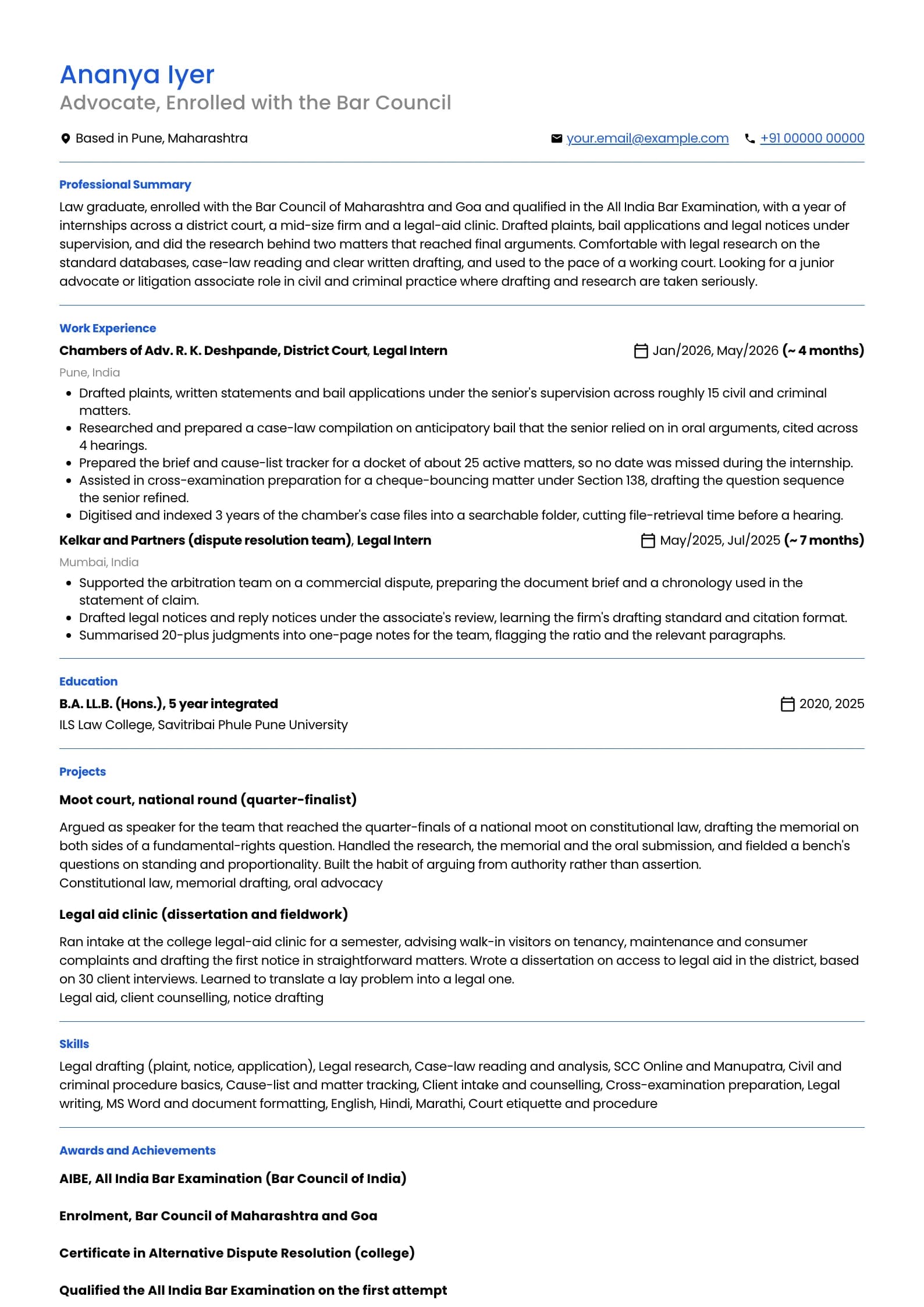
Build my resumeAdvocate resume example, Fresher (0 years)
professional templateIs your resume good enough?
Upload the resume you have now and see what an applicant tracking system reads before a advocate recruiter ever does.
Free to run. Sign in with your mobile number to see your score.
Advocate resume example, Litigation Associate (5 years)
minimalist template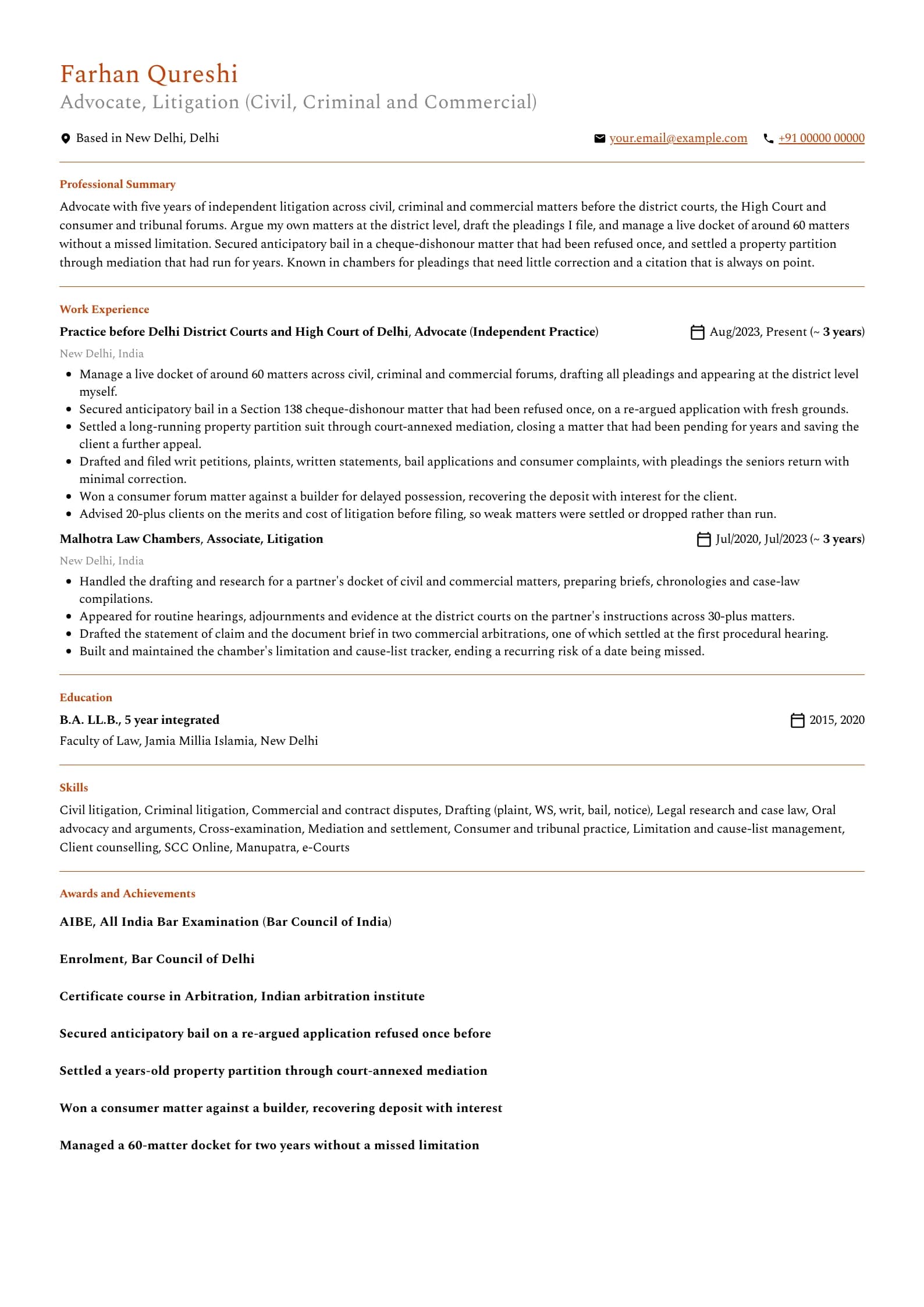
Want this structure with your own details? Build it in the resume builder.
Advocate resume example, Senior Advocate (15 years)
header-band template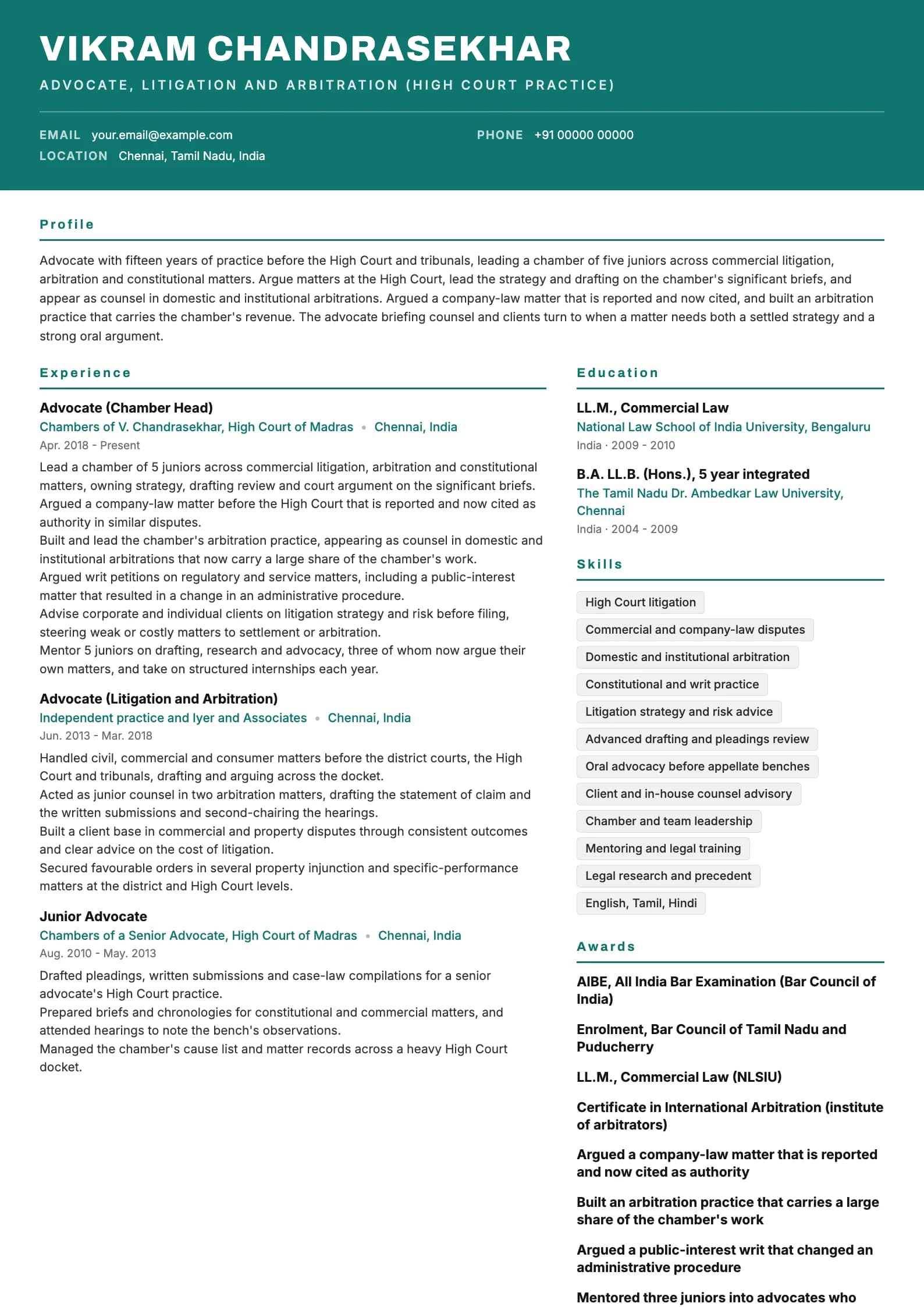
The format that works for an advocate resume in India
Use a reverse chronological layout, most recent practice first, with the dates in plain view. A chamber or a firm reads a career the way it reads a case history, in order, so a resume that hides its timeline reads as an attempt to obscure a gap or a short stint. If there is a gap, a preparation year or a career break, state it in one honest line rather than disguising it with a functional layout. Length follows evidence. One page holds everything a fresher and most advocates up to roughly six or seven years have to say. A senior advocate with reported matters, arbitration work and a chamber can use a second page, but only if it carries real matters and outcomes rather than a longer list of seminars attended. A few things do not belong on an advocate's resume even though old templates carry them: a photograph unless asked for, marital status, religion or caste, and a long declaration paragraph. Personal contact details such as father's name, date of birth and full address are not needed high on the page, and these samples deliberately leave them out. What does belong, and is often missing, is your Bar Council enrolment and AIBE status, because without them no litigation role reads further. Name the practice areas, the forums and the drafting plainly, civil, criminal, commercial, arbitration, High Court, tribunal, because a firm's screening searches for exactly those words. Send a PDF unless the posting asks otherwise, name the file with your name and "advocate", and keep to a single column so it parses cleanly. The table below sets the section order.
| Section | Where it goes | Why |
|---|---|---|
| Name and headline | Top, above everything | The headline names the role and practice, advocate, litigation or corporate. A firm matches on it. |
| Enrolment and AIBE | In the header or summary | Bar Council enrolment and AIBE are the gate to any litigation role. State them early. |
| Professional summary | Directly under the header | Three or four lines. Years, practice areas, forums, and the strongest matter or outcome. |
| Practice / work experience | Next, for anyone practising | Most recent first. Current practice gets the most detail. |
| Skills | Below experience | Grouped: practice areas, drafting, research, forums. Not a 30-item wall. |
| Education | Bottom, near the top for a fresher | LL.B. and any LL.M., institution, years. Keep CGPA while it is fresh. |
| Publications and moots | For freshers and academics | Reported matters for seniors; moots, publications and internships for freshers. |
Listing litigation is not the same as proving it
The most common advocate resume failure is a line that reads civil, criminal, corporate, family, property, labour, taxation, constitutional, cyber, IPR, with no matter anywhere that shows any of it. A firm reads that wall and assumes you have brushed against everything and command nothing, then looks for the one area you can actually defend in an interview. The fix is to let the experience prove the practice. If you claim criminal litigation, at least one line should name a bail or a trial matter you handled, without breaching client confidence. If you claim arbitration, a line should describe the statement of claim you drafted or the hearing you second-chaired. The mid-level sample lists civil, criminal and commercial precisely because the matters, a Section 138 bail, a partition settled, a consumer matter won, back each one. Pick a focus. A litigation chamber hiring a junior wants an advocate who is becoming good at something, not one who lists ten areas equally. Two practice areas argued well read as stronger than ten claimed flatly. If you genuinely practise broadly, group by the forum you appear in, district court, High Court, consumer forum, tribunal, and let that show range without diluting each claim. Name forums and outcomes carefully, and never breach confidentiality. You can describe the nature of a matter, the forum and the result without naming a client or revealing privileged facts. "Secured anticipatory bail in a cheque-dishonour matter refused once before" is specific and proper; a client's name and the sordid facts are neither needed nor allowed.
For every practice area on your resume, ask: is there a matter that proves I have done it. If not, either add the matter, described within confidentiality, or cut the area. A wall of ten practice areas helps no one and invites the one question you cannot answer.
Writing a summary a hiring partner actually reads
The block under your name is the part you can be reasonably sure gets read, so it should carry four facts: your years at the Bar, the practice areas and forums you work, and the single strongest matter or outcome you can point to. Three or four lines, no adjectives a partner cannot check. The old objective, seeking a challenging position in a reputed law firm to enhance my legal knowledge and skills, tells the reader nothing they did not assume from the application. Replace it with a summary. An objective describes what you want, a summary describes what you have already argued and drafted, and only the second is evidence. Freshers often believe they have nothing to summarise. Look at the fresher sample: it states enrolment and AIBE, the courts and firms interned at, the pleadings drafted and a compilation the senior actually used. That is a genuine summary built from a degree, enrolment and a year of real internships. What it avoids is "a passionate and dedicated law graduate eager to learn", a phrase so common it now carries no information. A practical test: read your summary and ask whether any other graduate from your college could paste it onto their resume unchanged. If they could, it describes the degree, not you. Add the specific forum, the specific matter and the specific outcome until it stops being transferable.
Professional summary, litigation associate
Weak
A dedicated and passionate advocate with 5+ years of experience in various fields of law including civil, criminal, corporate, family and property matters, seeking a challenging role in a reputed law firm.
Strong
Advocate with five years of independent litigation across civil, criminal and commercial matters before the Delhi district courts and High Court, managing a 60-matter docket. Secured anticipatory bail on a re-argued application and settled a years-old property partition through mediation.
The rewrite trades a flat list of practice areas and self-praise for the forums worked, the docket managed and two verifiable outcomes.
Experience: matter, action, outcome, within confidentiality
Every strong line in the samples names the nature of a matter, what you did on it, and how it resolved, all without breaching confidence. The matter shows the practice is real, the action shows what you personally did rather than what the chamber did, and the outcome does the persuading. Start from the outcome and work back. Advocates often write the task first, "handled various civil matters", then cannot attach a result. Instead ask what happened because of the work: bail granted, a suit settled, an injunction secured, an arbitration won, a limitation never missed. Then write the line that ends in that fact. Separate what you did from what the chamber did. "Assisted in" and "was part of" are honest for a junior, but as you gain years the resume should show matters you drafted, argued and owned. "Argue my own matters at the district level and draft all pleadings I file" is a stronger claim than "worked under a senior on litigation", when it is true. Use the proof an advocate has: matters on the docket, forums appeared before, drafts filed, matters settled or won, a reported judgment, a limitation record. Where a number would breach confidence or overstate, give scope instead, the forum, the nature of the matter, the stage it reached. Allocate detail by recency: current practice gets the most, older roles less.
| Level | What the experience must prove | Typical proof |
|---|---|---|
| Fresher | You can research and draft under supervision | Pleadings drafted, compilations used, moots, internships, publications |
| 1 to 3 years | You draft and appear on your own matters | Drafts filed, routine hearings argued, matters assisted, docket handled |
| 4 to 7 years | You argue and own matters end to end | Matters argued, outcomes secured, docket managed, limitation record |
| 8 years and up | You lead strategy and a chamber or practice | Reported matters, arbitration practice built, juniors led, clients advised |
Experience line, litigation
Weak
Handled various civil and criminal matters and appeared in court on behalf of clients as required.
Strong
Secured anticipatory bail in a Section 138 cheque-dishonour matter that had been refused once, on a re-argued application with fresh grounds.
"Various matters as required" describes attendance; the rewrite names one matter, what was hard about it and the outcome, without naming the client.
Experience line, drafting
Weak
Did drafting work like plaints, applications and notices for the senior in various matters.
Strong
Drafted the statement of claim and the document brief in two commercial arbitrations, one of which settled at the first procedural hearing.
Turns generic drafting into a specific, checkable contribution with the document, the forum and the result.
Describe matters by their nature, forum and outcome, never by client name or privileged fact. A resume that respects confidentiality tells a partner you can be trusted with theirs.
The skills section: grouped, honest, and defensible
An advocate's skills section has two readers. A firm's screening, sometimes an ATS, wants literal terms it can match, arbitration, drafting, civil litigation, SCC Online. A partner wants a short, organised list that says what kind of advocate you are, a litigator, a drafter, a corporate adviser. Grouping serves both. Group by function rather than one long line. Practice areas, drafting, research and forums is a grouping that fits almost every advocate. Name the research tools the profession actually uses, SCC Online, Manupatra, the e-Courts services and case-status portals, because a firm searches for them. Write drafting as the documents you produce, plaint, written statement, writ petition, bail application, legal notice, statement of claim, not just "drafting". Twelve to sixteen skills is the working range. Below eight the section looks thin. Above twenty it stops being a signal, and an advocate's resume is especially prone to practice-area padding, listing ten areas of law as ten skills. Keep the areas you can defend and the concrete drafting and research skills, and let the experience carry the rest. Every item is a question you have agreed to answer in the interview. Do not add proficiency bars. Nobody agrees what four stars in criminal law means, and it invites a question you would rather answer from a matter. Let the practice prove the depth.
Skills section
Weak
Skills: Civil law, Criminal law, Corporate law, Family law, Property law, Labour law, Tax law, Constitutional law, Cyber law, IPR, Banking law, Consumer law, Hardworking, Good communication, Confident
Strong
Practice: civil and criminal litigation, commercial disputes, arbitration. Drafting: plaint, written statement, writ, bail application, legal notice. Research: SCC Online, Manupatra, e-Courts. Forums: district courts, High Court, consumer and tribunal.
Cuts the ten-area wall and the personality words, keeps the areas you can defend, and names the drafting, research tools and forums a firm actually searches for.
Practice areas, forums and the corporate versus litigation split
Where an advocate resume goes depends on which of two very different readers it is for, and the same page rarely serves both well. Tailor it to the reader. A litigation chamber or a disputes team reads for forums and matters. It wants to know which courts you appear before, which matters you have argued or drafted, and whether your docket runs clean. Lead with the practice areas you litigate, the forums, and the outcomes, and keep the drafting concrete. A reported judgment, a bail secured, an arbitration second-chaired are the currency here. A corporate or in-house team reads for transactions and advisory. It wants drafting and review of contracts, due diligence, compliance, and the ability to advise a business on risk. If you are aiming there, lead with contract drafting, due diligence, regulatory and compliance work, and any company-secretary or corporate-law exposure, and translate litigation experience into risk judgement. A litigator's docket matters less to an in-house team than a clean piece of contract drafting and a sense of commercial risk. Do not send a single resume to both. An advocate who lists heavy trial-court litigation to a corporate team, or contract review to a litigation chamber, reads as a poor fit even when genuinely capable of both. Keep a litigation version and a corporate version, each leading with what that reader screens on, and let the other side sit as supporting depth.
| Reader | Leads with | Proof they screen on |
|---|---|---|
| Litigation chamber | Forums, practice areas, matters argued | Bail and trial outcomes, reported matters, docket, drafting |
| Corporate / in-house team | Contracts, advisory, compliance | Drafting and review, due diligence, risk judgement, transactions |
| Law firm disputes team | Arbitration, commercial litigation | Statements of claim, second-chair hearings, research depth |
| Legal-aid / NGO | Client counselling, public-interest work | Intake and advice, notices, community and rights matters |
Where education, enrolment and certifications belong
Education sits at the bottom for a practising advocate and near the top for a fresher, who leads with the degree and enrolment. Name the LL.B. or the integrated five-year degree, the university, and any LL.M., with the years. For a fresher, keep the CGPA or percentage while it is good, because early-career and campus screening still filter on it. Once you have practice behind you, the mark from years ago matters far less than a matter argued. Enrolment and AIBE are not ordinary certificates, they are the licence to practise, so state them clearly and early. Name the State Bar Council you are enrolled with and the year, and state that you have qualified the All India Bar Examination. An advocate resume that leaves these out forces a firm to ask the first, most basic question, and many will not bother. Certifications and further study sit just below education, or beside skills if only one or two. An LL.M., a diploma or certificate in arbitration, taxation, IPR, cyber law, corporate law or alternative dispute resolution, and a company-secretary qualification all earn their place when they match the practice you are aiming at. Write the full name, the institute and the year. For a fresher, moots, publications, a law-review case comment and internships carry real weight and belong high, because they are the closest thing to practice a graduate has. For a senior, a reported judgment does the same work, so name the matter and where it is reported, within what confidentiality allows.
Getting an advocate resume through the screening
Law firms, legal process outsourcing units and in-house teams increasingly run applications through an applicant tracking system, which is a parser and a search index, not a judge. It reads your file, tries to split it into name, dates, employers, roles and skills, and stores the result so a recruiter can search across applicants. Most screening failures are parsing failures, and parsing failures come from layout, not from the words. The layout rules are short. Use one column. Use standard headings, Work Experience or Professional Experience rather than "My Legal Journey", and Skills rather than "My Expertise". Keep no critical information inside an image, because a parser reads a photo or a logo as blank space. Keep your name and dates in the body, not only in a header or footer some parsers drop. Avoid text boxes and nested tables in the body. On wording, mirror the language of the job post where it is honest. If it asks for arbitration experience, write arbitration. If it names commercial litigation or contract drafting, use those words. Include the expansion beside an abbreviation once, for example "AIBE (All India Bar Examination)" and "WS (written statement)", so both a keyword and an expanded search find you. Do not stuff keywords or paste a hidden white-text block of every area of law. Recruiters find it, and for a profession built on candour it is a worse look than being filtered. Write real experience lines that carry the terms naturally, because a line about a writ petition you drafted contains "writ" and "drafting" in a form that survives a partner's read too. Save as a PDF that holds real text, then open it and check you can select and copy a sentence. If you cannot select the text, neither can the parser.
Section heading
Weak
My Legal Journey and Milestones
Strong
Professional Experience
A parser looks for standard headings; a creative one can push the entire block into an unclassified bucket the recruiter never searches.
Test your own file before you send it. Copy the text out of the PDF into a plain text editor. Whatever reads cleanly there is roughly what the parser sees, and anything scrambled is a real risk.
What gets an advocate resume rejected
Most rejections at the resume stage are not close calls. They come from a small set of recurring problems, and each is fixable in an afternoon. The list below is what reviewers of Indian advocate resumes see most often, in rough order of the damage each one does.
- No Bar Council enrolment or AIBE status stated. Without them a firm cannot tell whether you can appear at all, and many will not ask.
- A wall of ten practice areas with no matter proving any of them. Every area is a question you have agreed to answer in the interview.
- "Handled various matters as required" instead of specific matters, forums and outcomes. It describes attendance, not advocacy.
- No outcome anywhere. Bail, settlement, injunction, an arbitration, a reported judgment, a clean limitation record. Name what actually resolved.
- Breaching confidentiality by naming clients or privileged facts to sound impressive, which tells a partner you would do the same to them.
- One resume sent to both a litigation chamber and a corporate team, so it fits neither. Keep a litigation and a corporate version.
- A generic objective line. Replace it with a summary that states years, practice areas, forums and one outcome.
- A photo, marital status, religion or a declaration paragraph carried over from an old template. None of it belongs on a professional legal resume.
- Inflated titles or claimed matters that a reference or a reported record would contradict. Verification in law is easy and a mismatch ends it.
- Typos and citation errors, a mis-cited section or a misspelt "plaintiff", which for a drafting profession undoes an otherwise strong page.
Read your resume aloud once before sending it. Anything you would be reluctant to stand behind before a bench, an overstated matter or a breach of confidence, is a line to cut or rewrite.
Skills to put on a advocate resume
Technical
- Civil litigation
- Criminal litigation
- Commercial and contract disputes
- Arbitration and ADR
- Constitutional and writ practice
- Legal drafting (pleadings and notices)
- Legal research and precedent
- Cross-examination
- Contract drafting and review
- Due diligence and compliance
- Client counselling and advisory
- Limitation and docket management
Tools and platforms
- SCC Online
- Manupatra
- e-Courts services
- Case-status and cause-list portals
- National Judicial Data Grid
- MS Word and document formatting
- e-filing systems
- Legal citation formats
- Case-management spreadsheets
Working skills
- Oral advocacy
- Persuasive legal writing
- Confidentiality and ethics
- Attention to detail
- Composure under a bench
- Client relationship handling
- Negotiation and settlement
- Mentoring juniors
Certifications worth listing as a advocate
| Certification | Full name | Worth it for |
|---|---|---|
| AIBE | All India Bar Examination, Bar Council of India | The examination every law graduate must clear to hold a certificate of practice and appear in court, so it is essential for any litigation or advocate role and stated early on the resume. Not optional and not a bonus, it is the licence, so a firm reads its absence as a reason to stop. |
| Bar enrolment | Enrolment with a State Bar Council | Registration with a State Bar Council is what makes you an advocate rather than a law graduate, and lets you appear before courts. Name the State Bar Council and year. Central for every litigation resume, and the first thing a chamber or firm checks. |
| LL.M. | Master of Laws | A postgraduate law degree worth it for advocates aiming at specialisation, academia or a policy and corporate track, and a genuine signal for firms in the specialised area. Less decisive for pure trial-court litigation, where matters argued outweigh the degree, so weigh it against the years you would spend. |
| Arbitration certificate | Certificate or diploma in arbitration and ADR | Worth it for advocates building a disputes or arbitration practice, which is among the faster-growing areas of Indian legal work. Pairs well with commercial litigation experience and signals to a firm that you can handle the statement of claim and the procedural side, not just court appearances. |
| Corporate / tax diploma | Diploma in corporate law, taxation, IPR or cyber law | A specialist diploma worth it for advocates moving towards a corporate, in-house or transactional practice, or a niche like intellectual property or tax. Most valuable when it matches the exact team you are applying to, and best paired with real drafting or advisory work in that area rather than listed alone. |
Keywords an ATS scans for in a advocate resume
These are the literal terms a parser matches against the job description. Use the ones that are true of you, in the sentences where you did the work, not as a list at the bottom.
- advocate
- litigation
- Bar Council enrolment
- AIBE
- civil litigation
- criminal litigation
- arbitration
- drafting
- pleadings
- writ petition
- bail application
- legal research
- SCC Online
- Manupatra
- High Court
- district court
- consumer forum
- contract drafting
- due diligence
- client counselling
Advocate resume FAQ
What salary can an advocate expect in India?
It varies more than almost any profession. A fresh advocate in independent litigation often earns little in the first year or two, sometimes a stipend of 10,000 to 30,000 rupees a month under a senior, before a practice builds. A litigation associate at a firm typically starts around 4 to 8 LPA in tier-two firms and higher at top firms, while a corporate associate at a leading firm can start well above that. With five to seven years, a firm associate commonly sits in the 12 to 25 LPA band, and a successful independent advocate's income depends entirely on the practice. Senior advocates and partners with a strong litigation or arbitration practice earn far more, but the range is wide and driven by reputation and matters.
How long should an advocate resume be?
One page up to about six or seven years of practice, two pages after that only if the second page carries real matters, arbitration work and a chamber rather than a list of seminars. Nobody has been rejected for a resume that was easy to read. If you are struggling to fit one page, cut the oldest internship to a line, remove personality words, and drop any practice area you would not want to be questioned on.
Do I need Bar Council enrolment and AIBE on my resume?
Yes, and stated early, because they are the licence to practise, not ordinary certificates. Name the State Bar Council you are enrolled with and the year, and state that you have qualified the All India Bar Examination. A litigation role cannot use you without them, so a resume that leaves them out forces a firm to ask the most basic question first, and many will simply move to the next candidate.
How do I write an advocate resume as a fresher?
Lead with enrolment and AIBE, then education, then internships, moots and publications, then skills. Treat each internship as real experience: state the pleadings you drafted, the research you did and any compilation the senior actually used, all within confidentiality. A national moot, a law-review case comment and a legal-aid clinic all carry weight because they are the closest thing to practice a graduate has. Add anything checkable, such as clearing the AIBE on the first attempt, since verifiable facts outweigh "passionate and eager to learn".
Should I list every area of law I know?
No. A line reading civil, criminal, corporate, family, property, labour, tax, constitutional, cyber and IPR reads as brushing against everything and commanding nothing, and it invites the one area you cannot defend. List the two or three you actually practise, back each with a matter described within confidentiality, and if you genuinely work broadly, group by the forums you appear before instead. Two areas argued well beat ten claimed flatly.
How do I show experience without breaching client confidentiality?
Describe a matter by its nature, its forum and its outcome, never by the client's name or any privileged fact. "Secured anticipatory bail in a cheque-dishonour matter refused once before" is specific and proper, while a client's name and the underlying facts are neither needed nor allowed. A resume that respects confidentiality is itself a signal to a partner that you can be trusted with theirs, so keep every line on the right side of that line.
Should I have different resumes for litigation and corporate roles?
Yes. A litigation chamber reads for forums, matters and outcomes, while a corporate or in-house team reads for contract drafting, due diligence, compliance and commercial risk judgement. A single resume that leads with trial-court litigation reads as a poor fit to a corporate team, and one that leads with contract review reads as a poor fit to a litigation chamber. Keep a litigation version and a corporate version, each leading with what that reader screens on.
Do certifications like an LL.M. or an arbitration course help?
They help most when they match the practice you are aiming at and least when they sit unconnected to any real work. An LL.M. signals specialisation for firms in that area and matters for academia and policy tracks, while an arbitration or ADR certificate suits an advocate building a disputes practice, and a corporate or tax diploma suits a move in-house. For pure trial-court litigation, matters argued outweigh any diploma, so keep the list short and let the practice be the credential.
Related resume examples and guides
Build your advocate resume in any of these formats
Start from a blank resume or upload the one you have. Goodspace renders it in 24 templates and flags the enrolment, practice-area, drafting and arbitration keywords a law firm or chamber will look for, and the padding it will not credit.
Build my resume