Junior Engineer Resume Format, with 3 Full Samples
A junior engineer is hired on evidence of work executed on site, quantities measured and quality passed, yet most JE resumes list software they once opened and forget the structures they helped build. Below are three complete resumes, one for a fresh diploma or B.Tech candidate targeting SSC JE, RRB JE or a PSU, one for a civil JE with four years of site execution, and one for a senior JE stepping up toward assistant engineer. After the samples come the format rules, the difference between listing AutoCAD and proving site delivery, the exact terms a parser and a technical interview board look for, and the mistakes that quietly cost a shortlist.
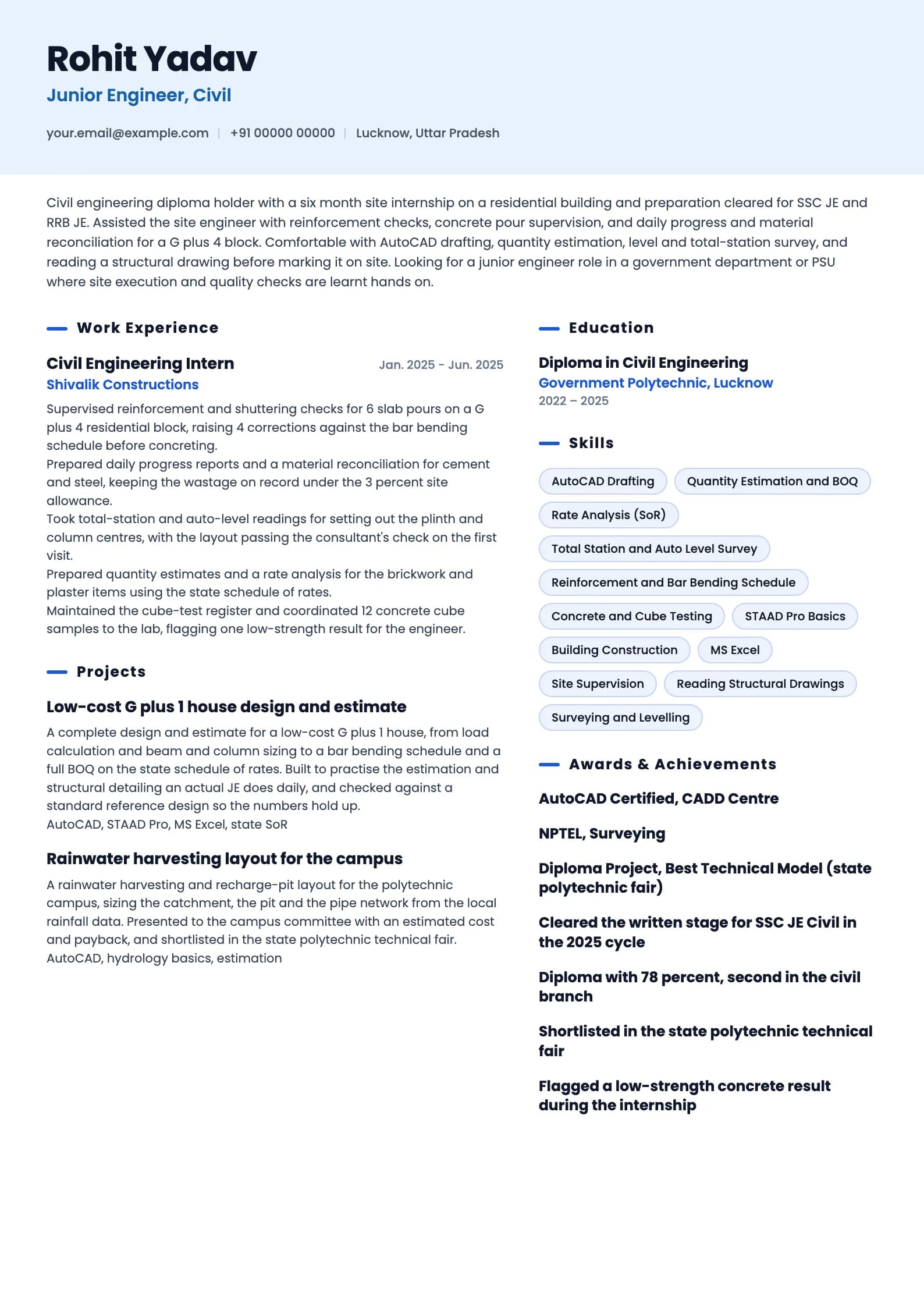
Build my resumeJunior Engineer resume example, Fresher (0 years)
ai-era templateIs your resume good enough?
Upload the resume you have now and see what an applicant tracking system reads before a junior engineer recruiter ever does.
Free to run. Sign in with your mobile number to see your score.
Junior Engineer resume example, Junior Engineer (4 years)
professional template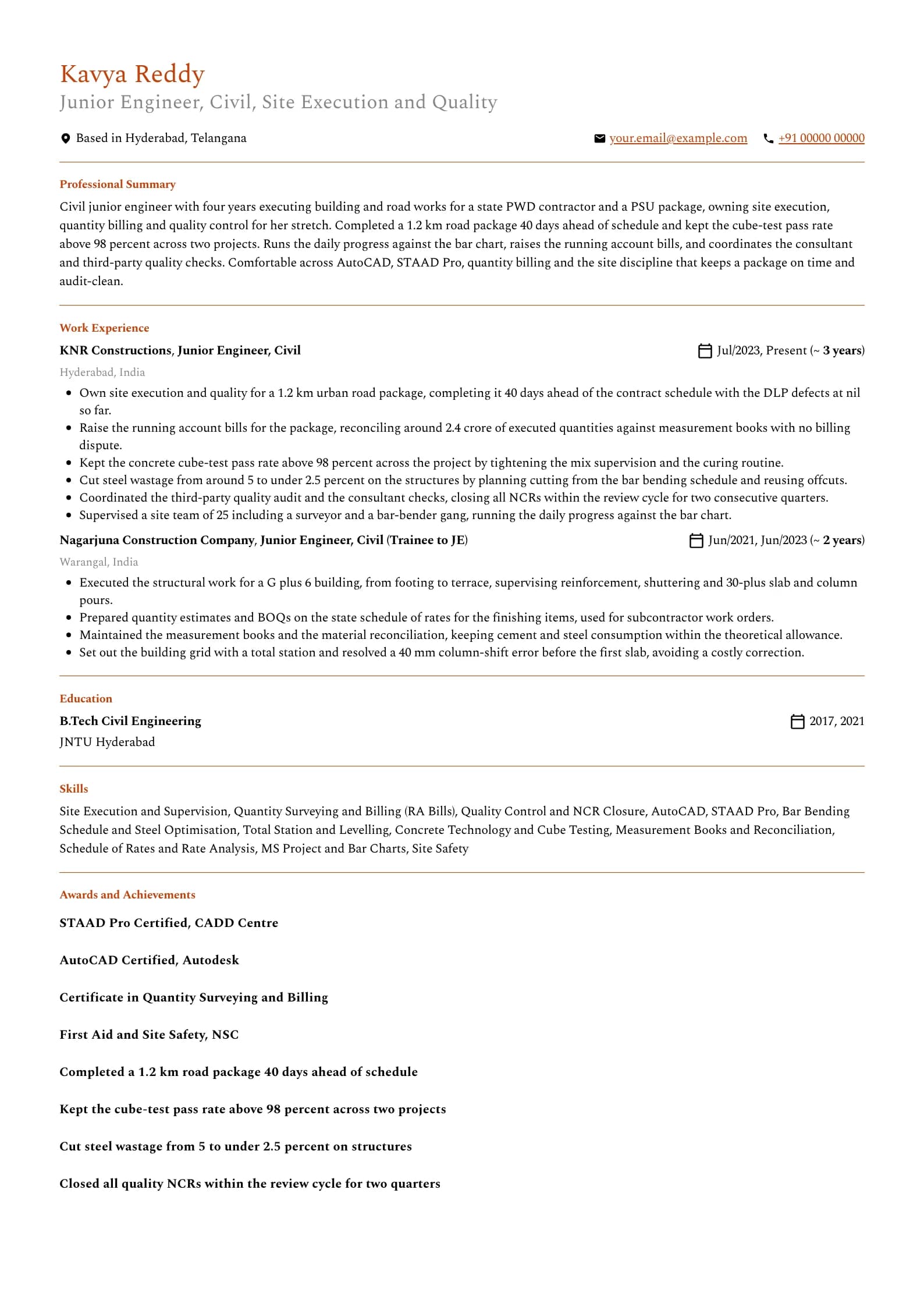
Want this structure with your own details? Build it in the resume builder.
Junior Engineer resume example, Senior JE to AE (9 years)
header-band template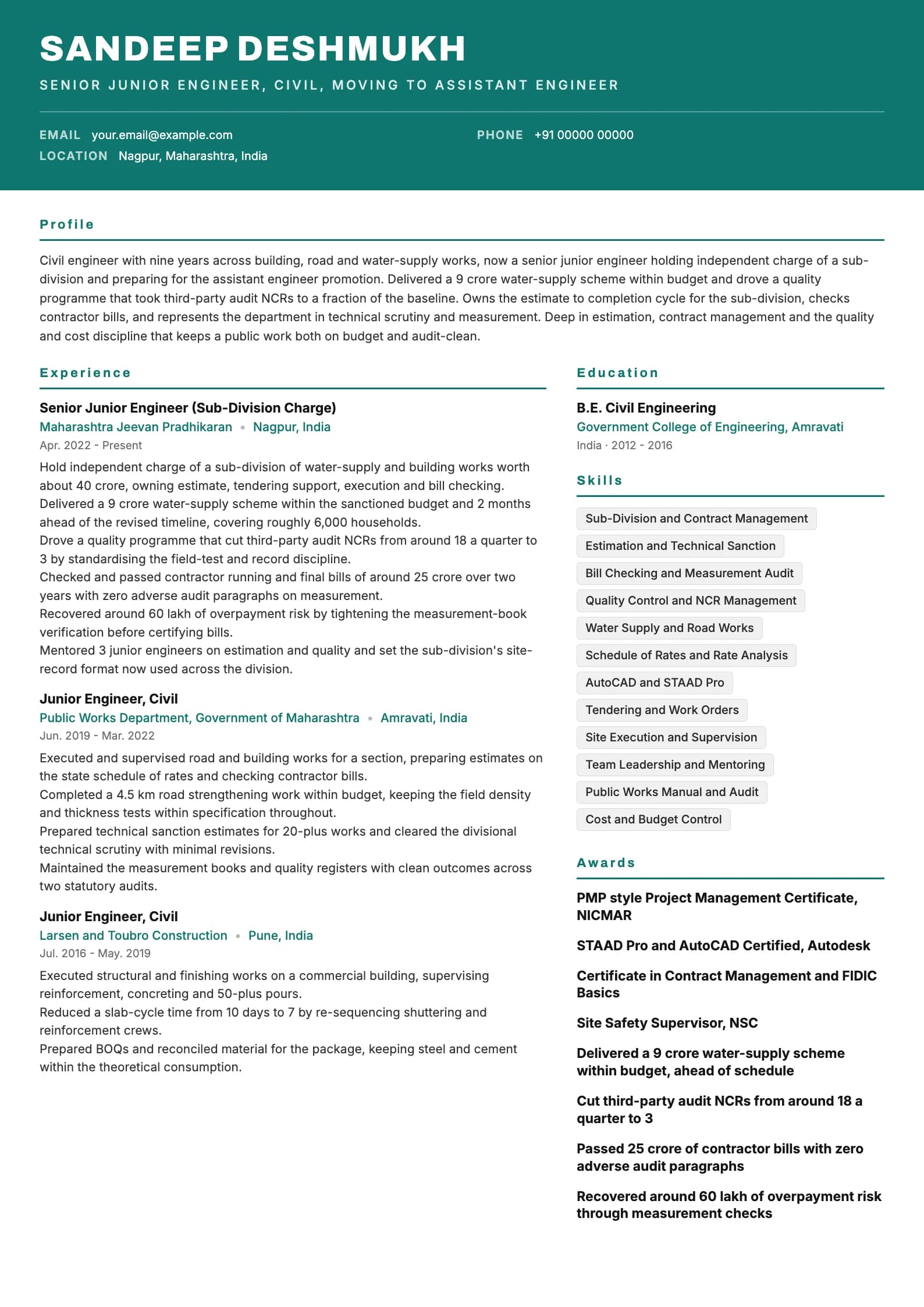
The format that works for junior engineer resumes in India
Reverse chronological is the layout to use. Put the most recent role first, work backwards, and keep the dates in plain view. A functional resume that groups everything under Technical Skills and hides the timeline reads as an attempt to cover a gap or a short stint, and recruiters treat it that way. One honest line about a gap beats a layout built to disguise it. Length is decided by evidence. One page holds everything a fresher and most junior engineers up to roughly six years have to say. A senior JE with sub-division charge can use a second page when it carries real project, billing and audit work, not a longer software list. A second page built from a hobbies line and a declaration is a padded one-page resume. Remember what a JE resume is for. If you are targeting SSC JE, RRB JE or a state PSU, the written exam gets you to document verification and any interview, and the resume plus biodata is what a board reads and questions. For a private construction or MEP contractor, the resume is the whole first filter. Either way it is an execution document, so it should show works delivered, quantities billed, quality passed and audits cleared, not a description of site routine everyone already knows. Four things belong nowhere on a technical resume here: a photograph unless the posting asks, date of birth beyond what a government form separately needs, marital status and father's name. They survive from an older campus template. Send a PDF unless the posting asks for DOCX, name the file with your name and the discipline, and keep to a single column so a parser reads it in order. The table below sets out the section order.
| Section | Where it goes | Why |
|---|---|---|
| Name and headline | Top, above everything | The headline is the post and discipline: junior engineer, civil or electrical. Boards and parsers match on it. |
| Professional summary | Directly under the header | Three lines. Discipline, years and the single strongest delivery result. |
| Work experience | Next, for anyone with a job | Most recent first. Current site or charge gets the most bullets. |
| Projects | Above experience for freshers, below it after that | For a fresher a design and estimate or a survey project is the evidence of engineering sense. |
| Skills | Below experience | Grouped: execution, estimation, software, survey. Not a 30-item wall. |
| Education | Bottom, unless you are a fresher | Diploma or degree, institution, years. Keep the percentage only while it helps a fresher. |
| Certifications | After education, or beside skills if only one or two | Name, issuing body, year. AutoCAD, STAAD and a safety certificate earn their place. |
Listing AutoCAD is not the same as proving site delivery
The single most common JE resume failure is a software line that reads AutoCAD, STAAD Pro, Revit, MS Project, Primavera, ETABS, SketchUp, 3ds Max with no bullet anywhere that shows any of it producing real work. A parser matches those terms, but a technical interviewer reads the wall and assumes it is padded, then asks which load case you actually ran in STAAD and watches the answer. The fix is to let the experience prove the tool. If you write STAAD Pro, a bullet should describe a structure you analysed or checked with it. If you write MS Project, a bullet should mention the schedule you tracked against a bar chart. The mid-level sample lists AutoCAD, STAAD and billing precisely because the bullets show a road package delivered, quantities reconciled and steel optimised from a bar bending schedule. The skills line and the site work agree, which is what makes both believable. A JE is judged on execution, so lead with what you built and measured, not what you drew. Works completed, quantities billed against measurement books, cube-test pass rate, wastage cut, NCRs closed, days ahead or behind schedule, budget position. These are the numbers a contractor and a government board both understand, and they are what separate an engineer who ran a package from one who watched it. Do not list Primavera, Revit and ETABS unless you have genuinely used them on a project. On a site-execution resume for a road or building JE they read as padding, and a board will spend the interview exposing the ones you cannot defend.
For every software on your skills line, ask: is there a bullet that proves I produced real work with it. If not, either add the bullet or cut the tool. A wall of unused software helps the parser and hurts the interview.
Writing a summary a technical board actually reads
The block under your name is the part you can be sure gets read, especially by a board skimming just before your slot. It should carry three facts: your discipline and years, the kind of work or charge you own, and the strongest delivery result behind you. Three or four lines, no adjectives a board cannot check. The old objective line, seeking a challenging position in a reputed organisation to utilise my engineering knowledge and skills, tells a board nothing it did not already assume. Replace it with a summary. An objective says what you want, a summary says what you have already delivered, and only one survives a follow-up question. Freshers often think they have nothing to summarise. Look at the fresher sample: it names the discipline, the internship length, and points at real site work, slab pours checked and cube samples handled, plus a design-and-estimate project. That is a genuine summary built from a diploma, one internship and projects. What it avoids is hardworking fresher with good technical knowledge and a passion for construction, a phrase so common on graduate resumes it now reads as blank space. A practical test: read your summary and ask whether a classmate with the same diploma could paste it onto their resume unchanged. If they could, it describes the course, not you. Add the specific package, the specific quantity and the specific quality number until it stops being transferable.
Professional summary, civil JE with four years
Weak
Hardworking and dedicated civil engineer with 4+ years of experience in construction, site work and AutoCAD, seeking a challenging junior engineer position in a reputed organisation.
Strong
Civil junior engineer with four years of site execution and quantity billing, completed a 1.2 km road package 40 days ahead of schedule and kept the cube-test pass rate above 98 percent across two projects.
The rewrite trades a software list and self-praise for owned execution, a delivery result and a quality number a board can probe.
Experience bullets: action, work, measured result
Every strong bullet in the samples follows the same shape. It opens with an action, names the specific work or package you executed, and closes with what measurably moved. The action shows you did it. The work tells a technical board the experience is relevant. The number does the persuading. Start with the outcome and work backwards. Engineers usually write the task first, then cannot attach a number, which produces lines like handled site work and completed the project successfully. Instead ask what was true when your package finished: it was ahead or behind schedule, quantities billed clean, cube tests passed, wastage cut, NCRs closed, a budget held. Then write the sentence that ends in that fact. Vary the metric. Five schedule numbers in a row read as one trick. Across a real JE role you can honestly reach for days ahead or behind, quantity value billed, cube-test pass rate, wastage percentage, NCRs closed, budget position, team size and a slab-cycle time. The mid-level sample uses several of these, which reads as an engineer who runs a whole package. Where you lack a clean number, give scope: how long the road, how many pours, how large the bill, how many households a scheme serves. Executed the structural work for a G plus 6 building, footing to terrace carries weight without inventing a percentage. Allocate bullets by recency. Current role gets five or six, the previous role four or five, anything older two or three.
| Level | What bullets must prove | Typical metric |
|---|---|---|
| Fresher | You understand site work and can be trusted on it | Pours supervised, cube samples, corrections raised, layout passed |
| 1 to 3 years | You execute a section without close supervision | Length of work, pours, quantities estimated, wastage |
| 4 to 6 years | You own execution, billing and quality for a package | Days ahead, RA bill value, cube pass rate, NCRs closed, team |
| 7 years and up | You hold charge, check bills and set the standard | Budget delivered, audit paragraphs, bill value passed, recovery |
Experience bullet, site execution
Weak
Responsible for site supervision, checking of work and completing the construction project as per the drawings and instructions.
Strong
Own site execution and quality for a 1.2 km urban road package, completing it 40 days ahead of the contract schedule with the DLP defects at nil so far.
"Responsible for" describes the job; the rewrite names the package, the schedule position and the defect outcome.
Experience bullet, quality work
Weak
Ensured quality of concrete and other materials was maintained at the site as per standards during the work.
Strong
Kept the concrete cube-test pass rate above 98 percent across the project by tightening the mix supervision and the curing routine.
Names the exact quality number and the two things that produced it, so a board can ask a real follow-up instead of nodding at ensured quality.
If a bullet would read identically on a classmate's resume, it is describing the site, not you. Rewrite it until it only fits the package you actually executed.
The skills section: grouped, honest, and short enough to defend
A JE resume's skills section has two audiences with opposite preferences. A private contractor's parser wants literal terms it can match, AutoCAD, STAAD Pro, quantity surveying. A human board wants a short, organised list that signals what kind of engineer you are. Grouping satisfies both. Group by function rather than one long line. Execution, estimation and billing, software, and survey and quality is a grouping that works for almost every civil JE, with the equivalent for electrical or mechanical. The exact headings matter less than the fact that structure exists. Write names the way the industry writes them: AutoCAD not Auto Cad, STAAD Pro not Staad, BOQ and SoR in capitals, because a parser matches on strings and a board notices a misspelt tool. Twelve to sixteen skills is the working range. Below eight the section looks thin. Above twenty it stops being a signal, and a JE resume is especially prone to software padding: listing eight design packages when the role wants to know which two you have actually produced work in. The list is a contract: every item is a question you have agreed to answer. Do not include a proficiency bar. Star ratings invite an argument you cannot win, and nobody agrees what four stars in STAAD means. Let the experience prove the depth instead.
| Group | What goes in it | How many |
|---|---|---|
| Execution | Site supervision, reinforcement, concreting, bar bending schedule | 3 to 5 |
| Estimation and billing | Quantity surveying, BOQ, rate analysis, RA bills, measurement books | 2 to 4 |
| Software | AutoCAD, STAAD Pro, MS Project, ETABS if genuinely used | 2 to 4 |
| Survey and quality | Total station, levelling, cube and field testing, NCR closure | 2 to 4 |
| Site management | Safety, scheduling, contract and material management | 1 to 3 |
Skills section
Weak
Skills: AutoCAD, STAAD Pro, ETABS, Revit, Primavera, MS Project, SketchUp, 3ds Max, SAP2000, MS Office, Estimation, Surveying, Construction, Quality, Management, Leadership, Hard Working
Strong
Execution: site supervision, reinforcement, concreting, bar bending schedule. Estimation: quantity surveying, BOQ, RA bills. Software: AutoCAD, STAAD Pro, MS Project. Survey and quality: total station, cube testing, NCR closure.
Cuts the unused design packages and personality traits, keeps the tools and skills you can defend, and groups them so a board reads it in one pass.
Projects and internships: what a fresher shows instead of experience
For a fresher, projects and an internship are the resume. They sit above experience, get the most space, and are where a board decides whether you can actually execute engineering work or only pass exams about it. For an experienced JE they move below experience and shrink to nothing, because the site work speaks louder. The common failure is describing the software instead of the engineering. A building designed using AutoCAD and STAAD Pro tells a board nothing, because thousands of resumes carry that exact line. Describe what you designed or executed, what you calculated, and what check it passed. The G plus 1 house design in the fresher sample is a stronger entry than a fancier title, because it names the load calculation, the bar bending schedule, the full BOQ and that it was checked against a reference design. Pick projects that show range rather than three drafting exercises. One that shows design and estimation, such as a house design with a full BOQ, and one that shows a systems or field skill, such as a survey or a rainwater harvesting layout with real rainfall data, is a stronger pair than three variations of the same drawing. If you interned on a live site, treat it as the strongest evidence you have and quantify it. A board treats a fresher who supervised 6 slab pours and handled 12 cube samples very differently from one who visited the site and observed construction work, because one carries verifiable engineering exposure and the other carries none.
Project description, fresher resume
Weak
Building Design: designed a residential building using AutoCAD and STAAD Pro with structural analysis and drawings as part of the diploma project.
Strong
Low-cost G plus 1 house: full design and estimate from load calculation and beam and column sizing to a bar bending schedule and a BOQ on the state schedule of rates, checked against a standard reference design.
Swaps a software list for the actual engineering done, the deliverables produced and the check that proves the numbers hold.
Where education and certifications belong
Education goes at the bottom for anyone with a full-time engineering job, and near the top for a fresher, who has nothing stronger to lead with. Diploma or degree, institution, years. That is the whole entry for most people. Percentage or CGPA is worth keeping while you are a fresher and it is good, because campus, PSU and early-career screening still filters on it, and government forms record it anyway. Once you have your first site role and works to point at, drop the school and diploma percentages. A number from years ago competes for space with a package delivered and quantities billed, which predict far more. Coursework lines are for freshers only, and only when directly relevant. Structural analysis, concrete technology, surveying and estimation are worth naming for a civil JE role. Engineering mathematics is not. Certifications sit just below education, or beside skills if you hold only one or two. Write the full name, the issuing body and the year. For a JE, AutoCAD and STAAD Pro certifications, a quantity-surveying or billing certificate, and a site-safety credential carry real weight with contractors and signal readiness for site. For government roles, the technical qualification matters more than the badge, so keep the list short. An expired safety certificate listed as current is easy to catch on a site that checks, so renew it or remove it.
Getting through the applicant tracking system and the board
For a private construction, infrastructure or MEP contractor, an applicant tracking system reads your file first. It is a parser and a search index, not a judge. It breaks your resume into name, dates, employers, titles and skills, and stores the result so a recruiter can search across candidates. Almost every ATS problem is a parsing problem, and parsing problems come from layout, not wording. The layout rules are short. One column. Standard section headings, so Work Experience rather than My Site Journey, and Skills rather than My Toolbox. No text inside images, because a software-logo strip reads as empty space. Nothing critical in the header or footer region, which some parsers drop. Avoid text boxes and nested tables in the body. On wording, mirror the posting where it is honest. If it says quantity surveying, write quantity surveying. If it says RA bills, write RA bills rather than only billing. Include the expansion alongside an acronym once, for example BOQ (bill of quantities), so both searches find you. For SSC JE, RRB JE or a state PSU, there is no ATS at the resume stage, the exam did the filtering, but the same discipline helps the biodata a board reads at document verification and interview. Keyword stuffing does not work either way. A hidden block of software names is spotted fast, and the outcome is worse than being filtered. Write real bullets that naturally contain AutoCAD, STAAD, cube test and measurement book, because a bullet about reconciling quantities in the measurement book contains the term in a context that survives a board too. Save as PDF from a tool that embeds real text, then open the file and confirm you can select and copy a sentence. If you cannot select the text, neither can the parser.
Section heading
Weak
My Engineering Journey
Strong
Work Experience
Parsers look for standard headings; a creative one can push the whole block into an unclassified bucket the recruiter never searches.
For a private contractor, copy the text out of your PDF into a plain text editor before sending. Whatever reads in order there is roughly what the parser sees, and anything scrambled is a real risk.
What gets junior engineer resumes rejected
Most rejections at the resume stage are not close calls. They come from a small set of recurring problems, and all of them are fixable in an afternoon. The list below covers what recruiters and technical boards reviewing Indian JE resumes see most often, in rough order of how much damage each one does.
- A software wall on the skills line with no bullet proving any of it. Every tool is a question you have agreed to answer in the interview.
- A task list instead of delivery: handled site work, completed the project. Every JE can write it, so it says nothing about you.
- No numbers anywhere. Days ahead, quantities billed, cube pass rate, wastage, NCRs. Pick whichever is honest for the work.
- Listing design packages like Revit, Primavera and ETABS you have never actually used on a project, which a board exposes quickly.
- No billing or measurement line at all. Quantity billing against measurement books is core JE work and a resume that omits it looks like a drafter's.
- A photo, date of birth, marital status or father's name copied from an old campus template, taking space a delivery number should have.
- A generic objective line. Replace it with a summary that states discipline, years and one delivery result.
- Vague quality lines: ensured quality, maintained standards. Name the cube-test pass rate, the field-test result, the NCRs closed.
- Inflated titles or overstating charge you did not hold. Government verification and reference checks catch it and it ends the process.
- Misspelt technical terms: STAAD, bar bending schedule, bituminous written wrong, which on an engineer's resume reads as not knowing the work.
Read your resume as though you are the board with the drawing and the measurement book in front of you. Any line you could not defend under one technical follow-up is a line to fix or cut.
Skills to put on a junior engineer resume
Technical
- Site Execution and Supervision
- Quantity Surveying and Billing (RA Bills)
- Estimation, BOQ and Rate Analysis
- Bar Bending Schedule and Steel Optimisation
- Concrete Technology and Cube Testing
- Quality Control and NCR Closure
- Total Station and Levelling Survey
- Structural Detailing
- Measurement Books and Reconciliation
- Contract and Tender Management
- Schedule of Rates (SoR)
- Site Safety
Tools and platforms
- AutoCAD
- STAAD Pro
- ETABS
- MS Project
- Primavera
- Revit
- MS Excel
- Total Station
- Auto Level
- Concrete and Field Test Kits
Working skills
- Site coordination
- Labour and gang supervision
- Reading and marking drawings
- Problem solving on site
- Coordination with consultants
- Documentation discipline
- Working to deadline
- Team leadership
- Communication with contractors
Certifications worth listing as a junior engineer
| Certification | Full name | Worth it for |
|---|---|---|
| AutoCAD | Autodesk AutoCAD Certified User or Professional | The baseline drafting credential worth it for almost every civil, electrical and mechanical JE, since drawings are the language of the work. Most useful for a fresher who needs to prove drafting on paper; once you have shipped drawings and executed from them on site, the experience carries it and the badge is a small plus. |
| STAAD Pro | Bentley STAAD Pro Structural Analysis Certification | A structural analysis credential worth it for civil JEs whose work touches design or checking of structures. Genuinely valuable only if a bullet shows you analysed or verified a real structure with it; listing it without that invites a load-case question in the interview you need to be able to answer. |
| Quantity Surveying | Certificate in Quantity Surveying, Estimation and Billing | A high-value, often underrated credential for a JE, since billing accuracy against measurement books is what a contractor actually pays for. Worth it for anyone who owns or wants to own the RA-bill and measurement side, and a strong differentiator on a resume that would otherwise read like a drafter's. |
| Site Safety | Site Safety Supervisor Certificate, National Safety Council | A practical safety credential worth it for any JE on a live construction site, since safety compliance is now a hard requirement on organised projects. Especially useful for larger contractors and infrastructure work, and a sensible add for anyone supervising labour gangs directly. |
| MS Project or Primavera | Project Planning Certification in MS Project or Primavera P6 | A planning and scheduling credential worth it for JEs moving toward planning or a package-lead role on larger projects. Most valuable when a bullet shows you actually tracked a schedule against a bar chart; on a pure execution resume it is optional and should not crowd out the site and billing evidence. |
| Contract Management | Certificate in Contract Management and FIDIC Basics | A credential worth it for senior JEs and those preparing for assistant engineer, since bill checking, tendering and contract conditions become central at that level. Pairs naturally with sub-division or charge experience, and is unnecessary early on when the work is pure site execution. |
Keywords an ATS scans for in a junior engineer resume
These are the literal terms a parser matches against the job description. Use the ones that are true of you, in the sentences where you did the work, not as a list at the bottom.
- junior engineer
- civil engineer
- site engineer
- site execution
- quantity surveying
- RA bills
- estimation
- BOQ
- rate analysis
- AutoCAD
- STAAD Pro
- bar bending schedule
- cube test
- quality control
- total station
- measurement book
- schedule of rates
- SSC JE
- site supervision
- contract management
Junior Engineer resume FAQ
What salary can a junior engineer expect in India?
A government JE selected through SSC JE or RRB JE starts on pay level 6, roughly 5.5 to 7 LPA CTC with a basic around 35,000 to 44,000 a month plus allowances, and a PSU JE often a little higher at around 7 to 10 LPA. A JE in a private construction or infrastructure firm typically starts around 3 to 5 LPA and rises with site delivery. A JE with four to six years usually sits around 5 to 9 LPA private and higher in a PSU, and a senior JE moving to assistant engineer with nine years and above commonly earns 9 to 15 LPA depending on the department or company. Strong billing, quality and estimation skill pushes the top of every band upward.
How long should a junior engineer resume be?
One page up to about six years, two pages after that only if the second page carries real project, billing and audit work rather than a longer software list. Nobody has been rejected for a resume that was easy to read. If you are struggling to fit one page, cut the oldest role to a single line, drop coursework and diploma percentages, and remove any software you have not actually produced work in.
Do I need a resume if I am appearing for SSC JE or RRB JE?
Yes. The written exam gets you to document verification and, for some posts, an interview, and a clear biodata and resume shape how a board reads your background. For a private construction, infrastructure or MEP contractor the resume is the whole first filter. Treat it as an execution document that shows works delivered, quantities billed and quality passed, not a copy of your exam scorecard, and it will serve both the government track and any private application.
Should a fresher put projects above work experience?
Yes. With no full-time role, projects and any site internship are the strongest evidence you can offer, so they sit directly under the summary. Describe what you designed or executed, what you calculated and what check it passed, not just the software. Pick projects that show range: one with design and a full estimate, and one with a field or systems skill like a survey or a harvesting layout. If you interned on a live site, quantify it, because slab pours supervised and cube samples handled outweigh a longer drawing list.
Do certifications like AutoCAD and STAAD Pro help?
They help most when you have little site experience or are a fresher proving skills on paper, and least once you have executed works to point at. AutoCAD is a sensible baseline, STAAD Pro helps only if a bullet shows you actually analysed a structure with it, and a quantity-surveying or billing certificate is often the highest-value one because billing accuracy is core JE work. For government roles the technical qualification matters more than any badge, so keep the list short and let the site work be the credential.
What skills should a junior engineer put on a resume?
Group them by function: execution such as site supervision, reinforcement and concreting, estimation and billing such as BOQ, rate analysis and RA bills, software such as AutoCAD and STAAD Pro, and survey and quality such as total station, cube testing and NCR closure. Only list what you can defend, because a technical board probes the ones you claim. Lead with execution and billing rather than software, since a JE is hired to run and measure work, not only to draw it.
Does an ATS reject resumes with two columns?
For private contractors that use one, it does not reject outright, but some parsers read multi-column layouts out of order and interleave your sidebar with your experience, producing nonsense in the recruiter's view. A single-column layout removes the risk, which is why all three samples above use one. Government JE selection has no ATS at the resume stage, but the same clean, single-column layout still makes your biodata easier for a board to read at verification and interview.
How do I write a junior engineer resume with no experience?
Lead with projects and any site internship, then education, then skills. Treat each project as a job: what you designed or executed, what you calculated, and what check it passed. A design-and-estimate project counts, a survey or harvesting layout counts, and a live-site internship counts most, so quantify the pours supervised and the samples handled. Add anything checkable, such as an AutoCAD certificate, your diploma or degree percentage and your SSC JE or RRB JE stage, because verifiable facts carry more weight than adjectives like hardworking.
Should electrical and mechanical JEs use the same format?
Yes, the structure is identical, only the content changes. An electrical JE swaps site execution for panel, cabling, LT and HT work, testing and commissioning, load calculation and the relevant IS codes, and software like AutoCAD Electrical or ETAP. A mechanical JE leads with maintenance, erection, HVAC or plant work, preventive maintenance schedules and downtime reduction. The same rules hold: prove the tool with a bullet, quantify the delivery, and lead with execution and measured results rather than a software list.
Related resume examples and guides
Build your own in any of these formats
Start from a blank resume or upload the one you have. Goodspace renders it in 24 templates and flags the execution, billing and quality keywords a construction recruiter and a technical board will look for, and the software-list padding they will not credit.
Build my resume