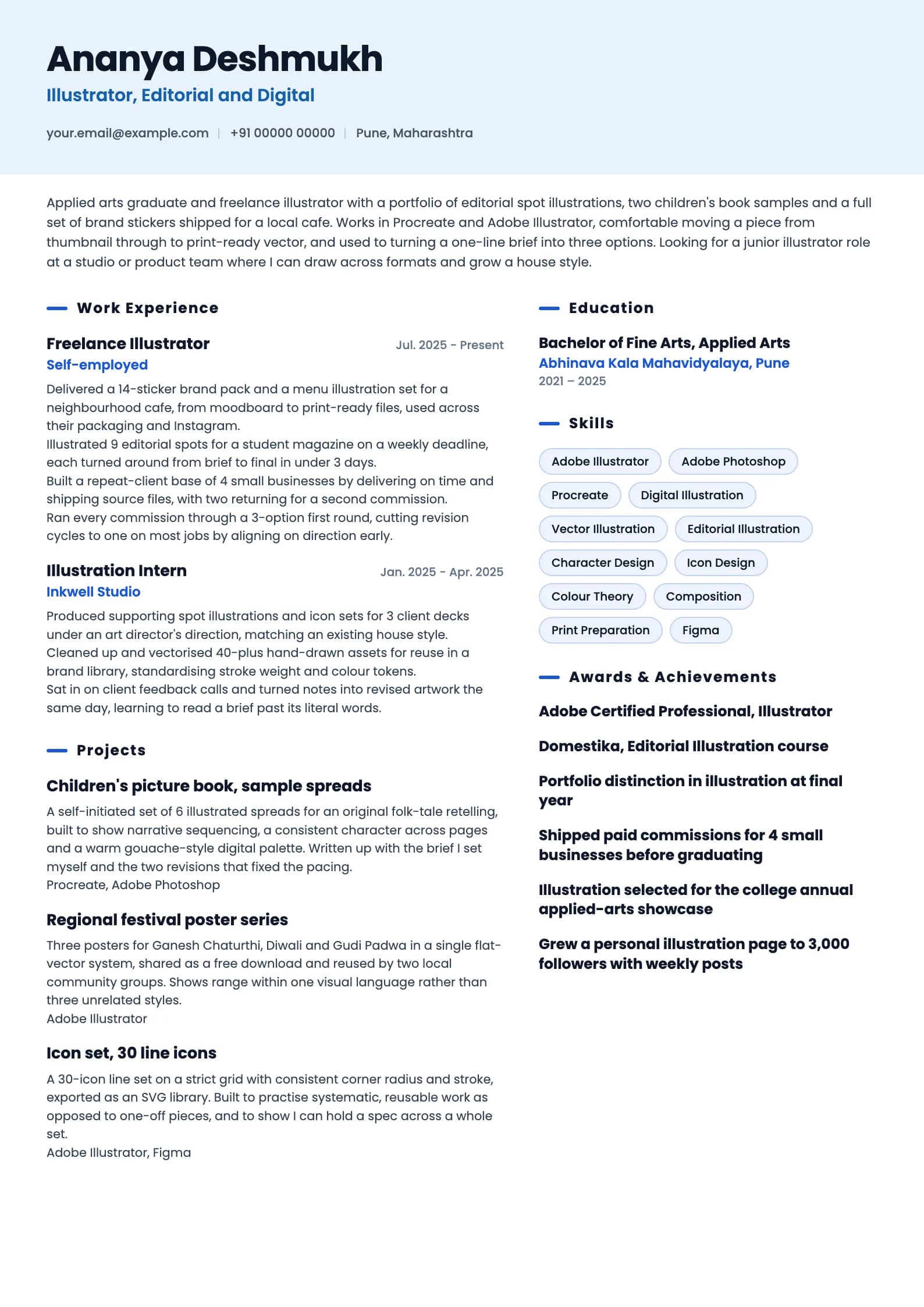
Illustrator Resume Format, with 3 Full Samples
An illustrator is hired on the strength of a portfolio, but the resume is what decides whether that portfolio ever gets opened. It has to place your style, prove you can take a brief to a finished asset that shipped, and make your software and delivery habits legible to an art director skimming forty applications. Below are three complete resumes, one for a design graduate breaking in with freelance and student work, one for a mid-level illustrator four years into agency and product work, and one for a senior illustrator leading style and mentoring a small team. After the samples come the format rules, why a portfolio link at the top is non-negotiable, the terms a parser matches literally, and the mistakes that leave strong artwork unseen.
Build my resumeIllustrator resume example, Fresher (0 to 1 years)
ai-era templateIs your resume good enough?
Upload the resume you have now and see what an applicant tracking system reads before a illustrator recruiter ever does.
Free to run. Sign in with your mobile number to see your score.
Illustrator resume example, Mid-level (4 years)
professional template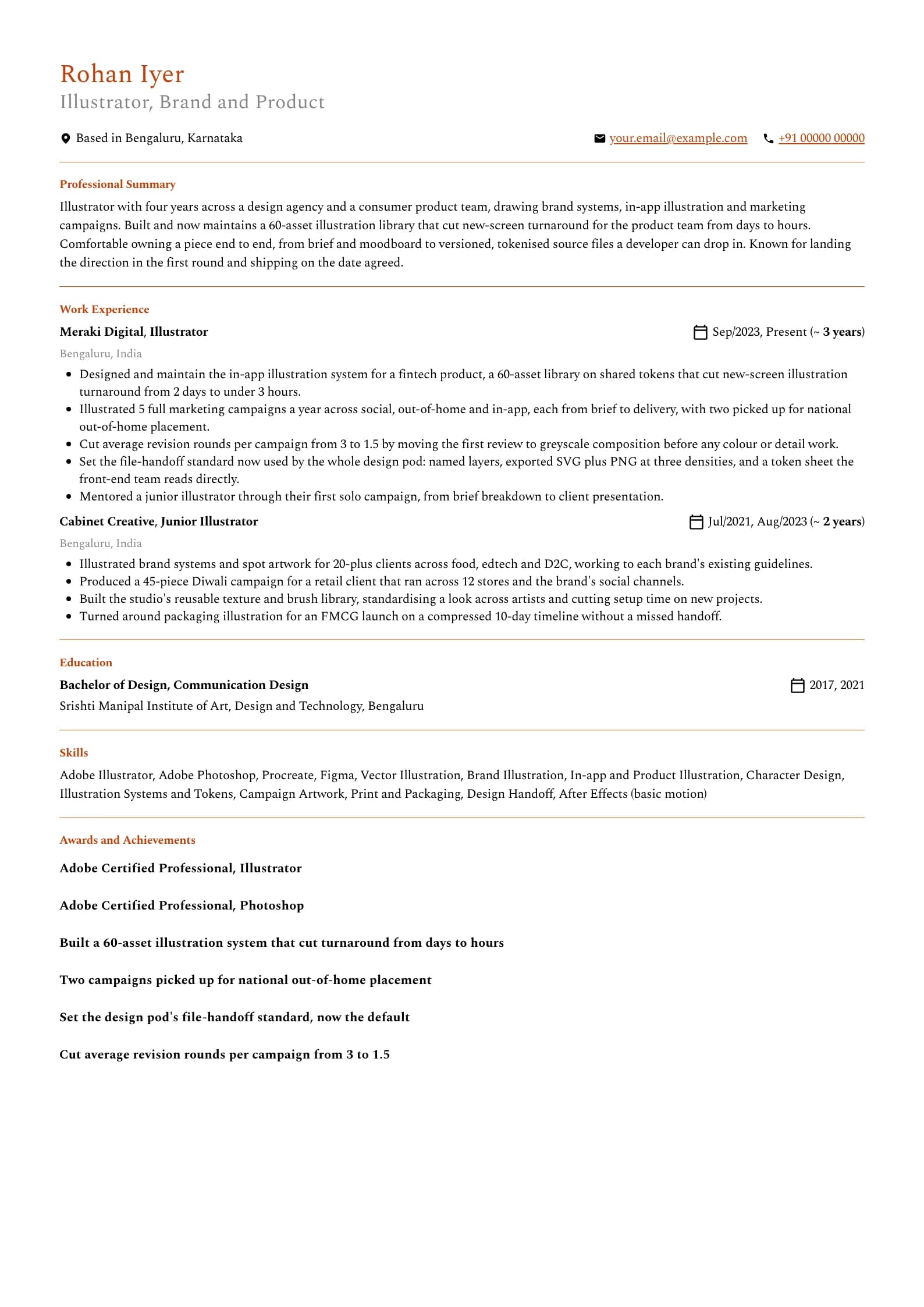
Want this structure with your own details? Build it in the resume builder.
Illustrator resume example, Senior (9 years)
header-band template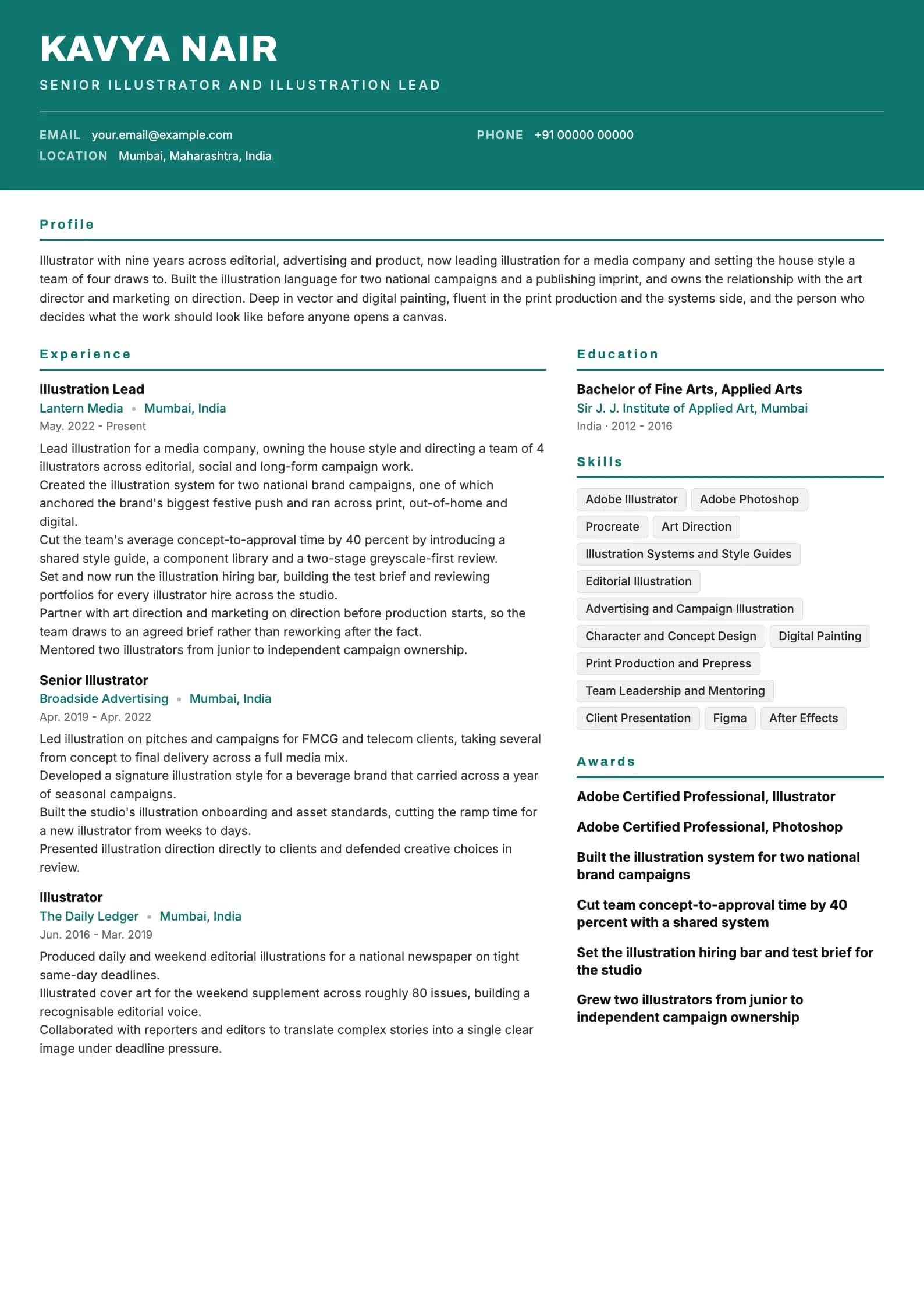
The format that works for illustrator resumes in India
Reverse chronological, one page, portfolio link in the header. Those three decisions cover most of what an illustrator resume needs to get right. Put your most recent role or your freelance practice first, work backwards, and keep the whole thing to a single page, because an illustrator's real work lives in the portfolio and the resume only has to route the reviewer there. The portfolio link is not optional and it is not a footnote. It goes in the header, right under your name and headline, in plain readable text. An illustrator resume with no link, or a link buried at the bottom, fails at its one job. Make sure the link works, opens to curated work rather than a raw drive folder, and shows your strongest six to twelve pieces first. Length is one page for almost everyone up to senior, and a second page only if you are a lead with campaigns and team work that genuinely will not compress. Nobody in a creative team wants to read three pages of an artist describing themselves when the artwork is one click away. Cut the oldest freelance gigs to a line before you spill onto a second page. Three things belong nowhere on a creative resume here: a self-portrait photo, date of birth and a declaration paragraph. They come from an old campus template and they push down the link and the work that actually matter. Send a PDF unless a studio's form asks otherwise, keep the layout to a single clean column so the file parses, and name it with your name and the word illustrator, not portfolio_final_v3. The table below sets the section order.
| Section | Where it goes | Why |
|---|---|---|
| Name, headline and portfolio link | Top, above everything | The link is why the resume exists. The headline names your lane: editorial, brand, character, product. |
| Summary | Directly under the header | Three lines: what you draw, how long, and the strongest thing you have shipped. |
| Experience or freelance practice | Next, for anyone with work | Studio, agency or freelance, most recent first. Freelance counts as experience. |
| Selected projects | Above experience for freshers, below it after that | For a fresher this is the evidence. Each entry points at a piece in the portfolio. |
| Skills and software | Below experience | Grouped: mediums, software, illustration types. Not a 30-tool wall. |
| Education | Bottom, unless you are a fresher | Degree, institution, years. A BFA or B.Des is relevant, so keep it. |
| Certifications and recognition | After education | Adobe Certified Professional, awards, published or selected work. |
The portfolio link is the resume's real job
For most roles the resume is the artefact a decision rests on. For an illustrator it is a routing slip. An art director decides in seconds whether to open your link, and everything on the page either earns that click or wastes the space that could have. This changes how you write every line. Put the link where the eye lands first, under your name, as clean readable text and not a raw shortened URL that a reviewer cannot trust. Never send a link to an unfiltered cloud folder with 200 files and three false starts. Curate. The first six to twelve pieces should be your strongest and should match the kind of work the role wants: apply to a children's-book studio with character and narrative work up top, apply to a product team with system and in-app work up top. A single portfolio reordered per application beats one generic wall. Name your pieces the way the resume names them, so a reviewer moving from resume to portfolio finds the campaign or the book you referenced without hunting. If your project line says "the fintech in-app illustration system", the portfolio should have a case for exactly that, ideally with the brief, the range and one or two process frames, because process is what separates a hireable illustrator from a lucky one. If you keep an Instagram or Behance as your public work, link the one that is curated, not the one that is a diary. Followers are a weak signal and reviewers know it. What they are actually checking is consistency, range within a language, and whether the finished work matches the thumbnails.
Before you send the resume, open your own portfolio link on a phone as if you were the art director. If the first screen does not make you want to keep scrolling, reorder it until it does.
Writing a summary an art director actually reads
The lines under your name should carry three facts: what you draw, how long you have been doing it, and the strongest thing that shipped because of your work. Three or four lines, concrete, no adjectives a reviewer cannot check against the portfolio. The old objective line, a creative and passionate illustrator seeking a challenging role in a reputed organisation to showcase my artistic skills, tells the reader nothing the application did not already imply. Replace it with a summary. An objective describes what you want, a summary describes what you have already made, and only one of them survives a skim. Name your lane. Editorial, brand, character, children's book, product, concept: an art director is hiring for a specific kind of illustration, and a summary that could belong to any illustrator gets read as any illustrator. The mid-level sample says brand and product and names an in-app system, which places the artist immediately. Freshers often think they have nothing to summarise. Look at the fresher sample: it names the software, states the freelance practice, and points at shipped packaging and book samples. That is a genuine summary built from commissions and student work. What it avoids is passionate about art, a phrase so common it now reads as blank.
Summary, mid-level illustrator
Weak
Creative and passionate illustrator with 4+ years of experience in Adobe Illustrator and Photoshop, looking for a challenging opportunity to showcase my artistic skills in a reputed organisation.
Strong
Illustrator with four years across agency and product work, drawing brand systems and in-app illustration. Built a 60-asset library that cut new-screen turnaround from days to hours, and I land the direction in the first round.
The rewrite trades a software list and self-description for a lane, a shipped system and a habit a hiring team actually values.
Experience bullets: brief, work, result
A strong illustrator bullet names the work you took on, what you actually made, and what came of it. The brief tells a reviewer the kind of problem you handle, the work tells them the medium and scale, and the result, wherever one honestly exists, does the persuading. Illustration has real results once you stop reaching only for likes: turnaround time, revision rounds, campaign reach, assets shipped, a style adopted, a piece published or placed. Start from what changed after the work shipped. Artists tend to write the task first, which produces bullets like "created illustrations for various clients using Adobe Illustrator". Instead ask what was different because you did it: a campaign ran across twelve stores, a library cut turnaround, a revision cycle dropped, a style got adopted across a team. Then write the sentence that ends in that fact. Vary what you count. Ten follower numbers in a row read as one weak metric repeated. Across a real practice you can honestly reach for turnaround, revision rounds, number of assets, campaign placements, stores or issues a piece ran in, and clients retained. Where you have no number, give scale: how many pieces, how many spreads, how long a deadline, how many stores. Freelance is experience. A returning client, packaging that shipped, a campaign that ran, are all evidence, and the resume should treat a serious freelance practice as a role with bullets, not a single throwaway line.
| Level | What bullets must prove | Typical metric |
|---|---|---|
| Fresher | You can take a brief to a finished, shipped piece | Commissions delivered, revision rounds, clients retained, pieces published |
| 1 to 3 years | You work to a brand and hit deadlines reliably | Assets shipped, campaigns worked, turnaround, on-time handoffs |
| 4 to 6 years | You own pieces end to end and build reusable systems | Library size, turnaround cut, revision rounds cut, placements |
| 7 years and up | You set the style and direct other illustrators | House style set, team speed, campaigns owned, illustrators grown |
Experience bullet, agency illustrator
Weak
Created various illustrations and artwork for different clients using Adobe Illustrator and Photoshop as per requirements.
Strong
Produced a 45-piece Diwali campaign for a retail client that ran across 12 stores and the brand's social channels, delivered on a compressed timeline with no missed handoff.
"As per requirements" describes a job posting; the rewrite names the campaign, the volume, the reach and the reliability.
Experience bullet, product illustration
Weak
Worked on illustrations for the app which improved the overall look and feel of the product.
Strong
Designed and maintain a 60-asset in-app illustration system on shared tokens that cut new-screen illustration turnaround from 2 days to under 3 hours.
Swaps a vague look-and-feel claim for a system, a token approach and a turnaround number a product manager understands.
If a bullet would read the same on any illustrator's resume, it is describing the software, not you. Rewrite it until it only fits the piece you actually made.
Skills and software: grouped, current, and honest
An illustrator's skills section has two readers. A parser wants literal software names it can match, Adobe Illustrator and Procreate and Figma. A human art director wants to see, in one glance, your mediums and the kind of illustration you do. Grouping serves both. Split software from craft. Software is Adobe Illustrator, Photoshop, Procreate, Figma, After Effects. Craft is vector illustration, editorial illustration, character design, illustration systems, print production. Mixing them into one line of twenty items hides both. Write the tool names the way the industry writes them, Adobe Illustrator not Adobe Illustration, Procreate not ProCreate, because a parser matches strings. Twelve to sixteen items across the groups is the working range. A shorter list looks thin, a longer one stops signalling anything. Do not pad with tangential tools: listing Microsoft Office, CorelDRAW you last touched in college, and every Adobe app whether or not you use it, weakens the two or three that matter. The list is a contract, and every item is something a reviewer may ask you to open a file and show. Skip star ratings and skill bars. Nobody agrees what four stars in Photoshop means, and a bar invites an argument you cannot win. Let the portfolio prove the depth. Do add a light motion skill honestly if you have it, because an illustrator who can hand off a simple animated version of a static asset is more useful to a modern content team.
| Group | What goes in it | How many |
|---|---|---|
| Core software | Adobe Illustrator, Photoshop, Procreate | 2 to 4 |
| Supporting tools | Figma, After Effects, InDesign, Blender (if real) | 2 to 4 |
| Illustration types | Editorial, brand, character, product, concept, packaging | 2 to 4 |
| Craft and fundamentals | Vector, digital painting, colour, composition, typography basics | 2 to 4 |
| Production and delivery | Print prep, prepress, illustration systems, design handoff | 1 to 3 |
Skills section
Weak
Skills: Adobe Illustrator, Photoshop, Procreate, CorelDRAW, InDesign, After Effects, Premiere, Blender, Figma, Canva, MS Word, MS PowerPoint, Painting, Sketching, Drawing, Creativity, Hard-working, Team player
Strong
Software: Adobe Illustrator, Photoshop, Procreate, Figma. Types: editorial, brand and character illustration. Craft: vector illustration, digital painting, colour and composition. Delivery: print prep, illustration systems, design handoff.
Cuts the tools you do not use and the personality words, then groups the rest so an art director reads your range in one pass.
Projects: the fresher's whole case
For a fresher, projects are the resume. They sit above experience, get the most space, and are where a reviewer decides whether you can take a brief to a finished piece or only fill sketchbooks. For an experienced illustrator they move below experience and shrink to one or two, kept only when they show something the studio work does not. The common failure is naming the software instead of the work. "A poster designed using Adobe Illustrator" tells a reviewer nothing, because every applicant wrote that line. Describe what the piece is, who it was for, and what was actually hard about it. The children's-book spreads in the fresher sample are a stronger entry than a flashier one-off, because they name the constraint that makes illustration hard: holding one character consistent across six pages. Pick projects that show range inside a controllable language, not three unrelated experiments. One narrative piece, one system or set showing you can hold a spec, and one that solves a real brief for a real, even tiny, client is a stronger trio than three moodboards. Two well-described pieces with a brief and a process note beat five titles in a list. Every project line should point at something a reviewer can open. A project you describe but cannot show reads as a claim. If the piece is in your portfolio, make the names match so the reviewer lands on it without searching, and include one process frame, a thumbnail or a greyscale stage, because process is what proves the finished piece was yours.
Project description, fresher resume
Weak
Poster Series: a set of festival posters designed using Adobe Illustrator with bright colours and Indian themes.
Strong
Regional festival poster series: three posters for Ganesh Chaturthi, Diwali and Gudi Padwa in one flat-vector system, shared as a free download and reused by two local community groups.
Swaps a software note and a colour adjective for a single visual system, real subjects and evidence the work got used.
Where education, certifications and recognition belong
Education goes at the bottom for anyone with a working practice, and near the top for a fresher, who has little else to lead with. A BFA in Applied Arts or a B.Des in Communication Design is directly relevant to illustration, so name the degree, institution and years, and keep it. Unlike some fields, the art-school credential still reads as a real signal early on. Keep a distinction, a portfolio award or a first class while you are a fresher and it helps, because early screening and campus hiring still look at it. Once you have shipped commissioned work, the work outranks the mark and the grade can go. Coursework lines are for freshers only, and only when relevant: illustration, typography and print production are worth naming, general art history is not. Certifications sit below education. For illustration the Adobe Certified Professional in Illustrator or Photoshop is a modest but real signal, most useful for a fresher or a self-taught artist who wants a checkable credential next to a strong portfolio. It does not substitute for the work and it fades in value once you have shipped campaigns. Recognition is worth a short line when it is real and checkable: a published cover, a piece selected for a showcase, a design award, an illustration featured by a brand. Name the outlet and the year. Vague claims like award-winning without the award named read as padding, so either name it or drop it.
Getting an illustrator resume through the ATS
Studios and agencies increasingly post through job platforms with an applicant tracking system behind them, and larger in-house creative teams almost always do. An ATS is a parser and a search index, not a judge. It reads your file, tries to split it into name, dates, employers, titles and skills, and stores the result so a recruiter can search. Almost every ATS problem is a parsing problem, and parsing problems come from layout, not wording. The layout rules are short and they matter more for creative resumes, which are the ones most tempted to break them. One column. Standard headings, so Work Experience rather than My Creative Journey, and Skills rather than My Toolkit. No text baked into an image or a decorative banner, because a parser reads a picture of your name as empty space. No critical information in the header or footer region some parsers drop, which unfortunately includes the portfolio link, so put the link in the body of the header text, not in a page footer. On wording, mirror the posting where it is honest. If the role says vector illustration, write vector illustration. If it names a tool, name the same tool. Spell software fully at least once, Adobe Illustrator rather than just Ai, so both the tool search and the human find it. The creative-resume temptation is to submit a beautifully laid out two-column PDF with the name set in a display face as outlines. It parses as nothing. Keep the submitted resume clean and single-column, and let the beauty live in the portfolio where it belongs. Save as PDF with real selectable text, then open the file and confirm you can select and copy your name and a skill line. If you cannot select it, neither can the parser.
Portfolio link placement
Weak
Portfolio link set as an icon in a page footer, next to social icons, as an image.
Strong
Portfolio: your-portfolio-site (as plain, selectable text directly under the name and headline)
Footer regions and image icons are exactly what parsers drop; the one link that must survive parsing has to be selectable text high in the body.
Keep two files: a clean single-column PDF you submit through forms, and a designed leave-behind you send directly to a human when there is no parser in the way. Do not try to make one file do both jobs.
What gets illustrator resumes rejected
Most rejections at the resume stage are not close calls, and for illustrators they usually come from a small set of avoidable problems, all fixable in an afternoon. The list below is what reviewers of Indian illustrator resumes see most often, in rough order of how much damage each one does.
- No portfolio link, or a broken one, or one buried in a footer. This is the single fastest rejection, because the resume cannot do its one job.
- A link to an unfiltered drive folder with 200 files and false starts instead of a curated set of your strongest work.
- Software listed as the achievement. "Proficient in Adobe Illustrator" is table stakes, not a differentiator. Show what you made with it.
- No lane. A summary that could belong to any illustrator gets read as any illustrator. Name editorial, brand, character or product.
- Three unrelated styles presented as range, which reads as still searching for a voice rather than commanding several.
- A beautiful two-column, outlined-type PDF that parses as blank when submitted through an ATS.
- Follower counts as the only metric. Reach, turnaround, revision rounds, assets shipped and placements are stronger and harder to fake.
- A self-portrait photo, date of birth and a declaration paragraph pushing the portfolio link down the page.
- "Award-winning" with no award named, or "published" with no outlet. Name it or cut it, because a reviewer assumes the worst.
- Project lines a reviewer cannot verify in the portfolio, which read as claims rather than work.
Send the resume to one illustrator friend and ask them to open only the portfolio link, then tell you what kind of illustrator they think you are. If it does not match the role, reorder before you apply.
Skills to put on a illustrator resume
Technical
- Digital Illustration
- Vector Illustration
- Editorial Illustration
- Brand and Campaign Illustration
- Character Design
- Concept Art
- In-app and Product Illustration
- Icon and Pictogram Design
- Illustration Systems and Style Guides
- Digital Painting
- Colour Theory and Composition
- Print Production and Prepress
- Storyboarding
- Basic Motion and Animation
Tools and platforms
- Adobe Illustrator
- Adobe Photoshop
- Procreate
- Adobe After Effects
- Adobe InDesign
- Figma
- Adobe Fresco
- Blender
- Clip Studio Paint
- Wacom and iPad Pro
Working skills
- Taking and interpreting a brief
- Working to a deadline
- Client presentation
- Receiving and acting on feedback
- Art direction and creative judgement
- Collaboration with designers and marketers
- Design handoff discipline
- Mentoring junior artists
- Visual storytelling
Certifications worth listing as a illustrator
| Certification | Full name | Worth it for |
|---|---|---|
| ACP Illustrator | Adobe Certified Professional, Illustrator | A checkable software credential worth most to a fresher or self-taught illustrator who wants proof of tool fluency next to a strong portfolio. It signals you know the vector tool properly rather than fighting it. Experienced illustrators can drop it, since shipped campaigns outweigh a tool badge. |
| ACP Photoshop | Adobe Certified Professional, Photoshop | Useful alongside the Illustrator credential for illustrators who work in raster and digital painting as much as vector. Best for early-career artists and career switchers proving fundamentals. Once your portfolio carries painted or textured work, the work itself is the credential. |
| Domestika courses | Domestika, illustration specialisations (editorial, character, procreate) | Course completions are not certifications in a hiring sense, but naming a specific, respected specialisation you finished can signal focus for a fresher building a lane. Name the specialisation, not a generic online course, and only if the resulting work is in your portfolio. |
| NID or design school | Formal design or fine-arts degree (BFA Applied Arts, B.Des Communication Design) | A formal art or design degree from a recognised institution still carries real weight in Indian creative hiring, especially early on and for studio roles. It is education rather than a certification, but for illustration it functions as the strongest paper credential you can hold. |
Keywords an ATS scans for in a illustrator resume
These are the literal terms a parser matches against the job description. Use the ones that are true of you, in the sentences where you did the work, not as a list at the bottom.
- illustrator
- digital illustration
- vector illustration
- adobe illustrator
- adobe photoshop
- procreate
- character design
- editorial illustration
- brand illustration
- concept art
- icon design
- storyboarding
- figma
- after effects
- print production
- illustration systems
- portfolio
- art direction
- packaging
- campaign
Illustrator resume FAQ
What salary can an illustrator expect in India?
A fresher illustrator at a studio or agency typically starts around 2.5 to 5 LPA, with freelance rates varying widely by client and format. A mid-level illustrator with four to six years across brand and product work usually sits in the 6 to 14 LPA band, higher at product companies that value in-house illustration. Senior illustrators and illustration leads with nine years and above commonly earn 15 to 30 LPA and more at large media or product firms. Strong freelancers with a premium client base can exceed salaried bands, but income is less predictable.
How long should an illustrator resume be?
One page for almost everyone up to senior, and a second page only if you lead a team and have campaign and hiring work that genuinely will not compress. The resume is a routing slip to the portfolio, not the work itself, so it should be quick to skim. If you are spilling onto a second page, cut the oldest freelance gigs to a single line and trim project descriptions before you add the page.
Do I need a portfolio link on my resume?
Yes, and it is the single most important element. Put it in the header as plain selectable text, right under your name, and make sure it opens to a curated set of your strongest six to twelve pieces rather than a raw drive folder. An illustrator resume without a working, curated link fails at its one job, because the artwork is what the hire actually rests on and the resume exists to get it opened.
Does freelance work count as experience?
Yes. A serious freelance practice is experience and should be written as a role with real bullets, not a throwaway line. Returning clients, packaging that shipped, a campaign that ran and pieces published are all evidence an art director values. Treat it exactly like a studio job: what the brief was, what you made, and what came of it, with turnaround, revision rounds or reach where you can honestly give a number.
Should I list every software I know?
No. List the software you actually use and can open a file in on request, and skip tools you touched once in college. Group software separately from illustration types and craft so an art director reads your range in one glance. A padded list of every Adobe app and CorelDRAW weakens the two or three tools that matter. Every item is something a reviewer may ask you to demonstrate, so treat the list as a contract.
How do I write an illustrator resume with no experience?
Lead with projects and freelance commissions, then education, then skills. Treat each project as a job: what it is, who it was for, and what was hard about it, with a link to the finished piece. Student work, a paid sticker pack for a local cafe, a poster series that got reused, all count. Pick pieces that show range inside one controllable style, and make the project names match your portfolio so a reviewer lands on the work without hunting.
Will a designed two-column resume get parsed by an ATS?
Often not. Multi-column layouts and type set as outlines parse badly or as blank, which is a real risk when studios post through job platforms. Keep the submitted resume clean and single-column with selectable text, and let the beautiful layout live in your portfolio where no parser sits between you and the reviewer. Test your file by copying the text out of the PDF into a plain editor, and if your name and skills come out readable it will most likely parse.
Do certifications like Adobe Certified Professional help illustrators?
They help most for a fresher or self-taught illustrator who wants a checkable credential next to a strong portfolio, and least once you have shipped commissioned work. An Adobe Certified Professional in Illustrator or Photoshop signals real tool fluency, but it never substitutes for the artwork. A recognised design or fine-arts degree carries more weight in Indian creative hiring than any online certificate, especially early in a career and for studio roles.
Should I put a photo on an illustrator resume in India?
No. A self-portrait photo, date of birth, marital status and a declaration paragraph come from an old campus template and only push down the portfolio link and the work that decide the hire. Creative recruiters do not expect a photo, and the space is far better spent on the link and one more project line. The only exception is a role that explicitly asks for a headshot in its application form.
Related resume examples and guides
Build your own illustrator resume
Start from a blank resume or upload the one you have. Goodspace renders it in 24 templates, keeps your portfolio link where a parser can read it, and flags the illustration and software keywords a studio's applicant tracking system looks for, plus the padding it will not credit.
Build my resume