Motion Graphics Designer Resume Format, with 3 Full Samples
A motion graphics designer is hired on a reel and the brand work behind it, not on a list of plugins. Yet most resumes read like a script folder, every expression and effect named, with nothing about what the motion was for, who briefed it, or what it moved. Below are three complete resumes, one for a design-graduate fresher with a kinetic-typography and explainer reel, one for a motion designer with five years across brand campaigns and product UI, and one for a senior motion designer leading the motion language for an agency and a small team. After the samples come the format rules, why the reel and the design sense matter more than a plugin list, the terms a parser matches literally, and the mistakes that get a creative resume set aside before anyone opens the reel.
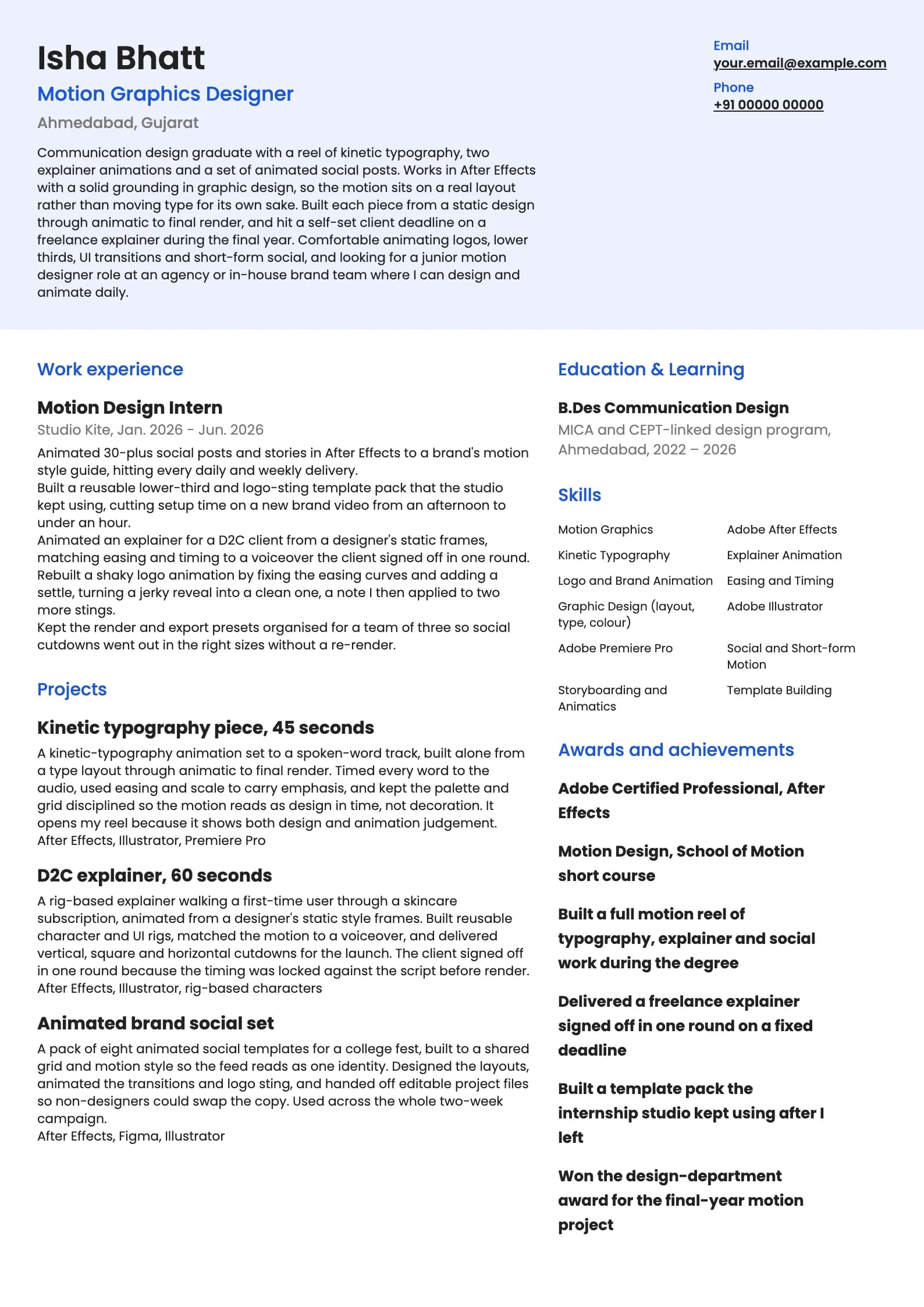
Build my resumeMotion Graphics Designer resume example, Fresher (0 to 1 year)
modern templateIs your resume good enough?
Upload the resume you have now and see what an applicant tracking system reads before a motion graphics designer recruiter ever does.
Free to run. Sign in with your mobile number to see your score.
Motion Graphics Designer resume example, Mid-level (5 years)
professional template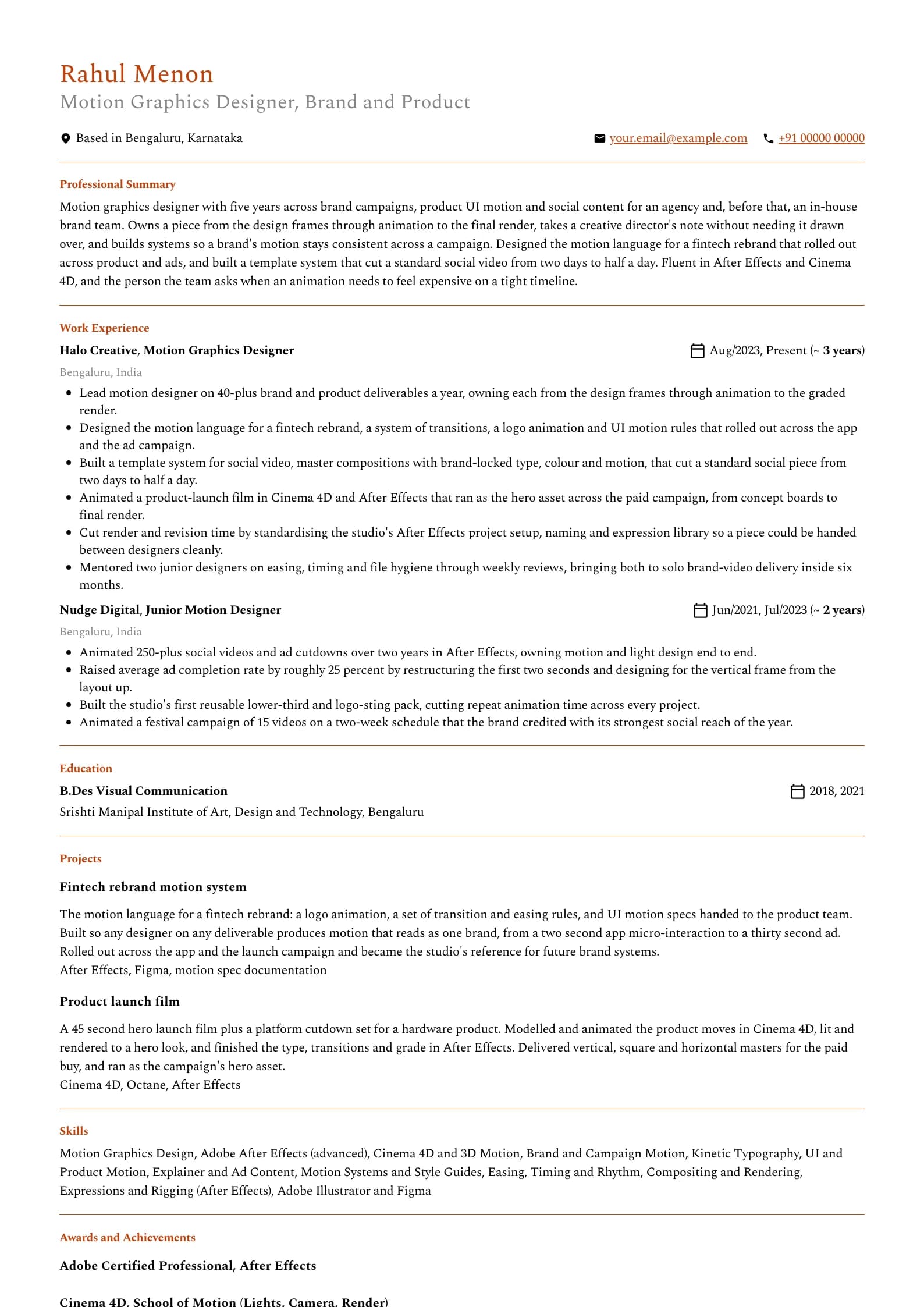
Want this structure with your own details? Build it in the resume builder.
Motion Graphics Designer resume example, Senior (10 years)
header-band template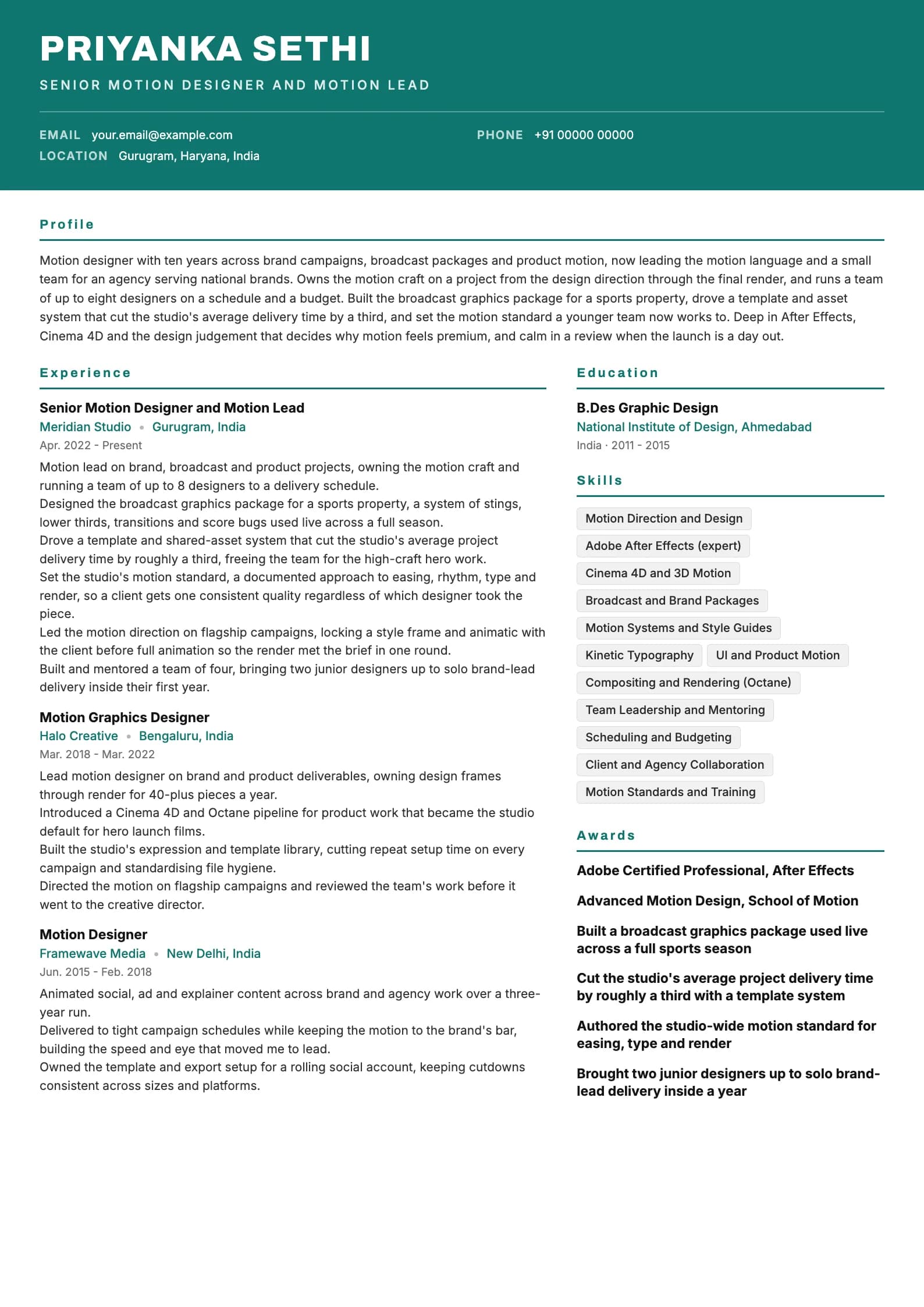
The format that works for motion graphics designer resumes in India
A motion designer resume has one job the reel cannot do for it: get a busy creative director or recruiter to press play on the reel. So the top of the page carries your name, the role you want, your city, and a working link to your motion reel. That reel link is the single most important line on the page. If a reviewer has to hunt for it, or it opens to a Drive folder that asks for access, the rest of the resume barely matters. Reverse chronological is still the layout to use. Most recent work first, dates in plain view. A motion designer's history often mixes agency and in-house roles with short freelance stretches, and that is fine: label a freelance period honestly with its own dates rather than hiding a gap, because a reviewer reads a hidden gap as a problem and an owned one as a working designer. Length is decided by evidence. One page holds a fresher and most motion designers up to six or seven years. A senior motion lead with a decade of campaigns can run to a second page when it carries real work, but a page built from a longer plugin list is just a padded one-pager. The reel proves the craft. The resume proves the career. Four things belong nowhere on a creative resume here: a photograph, date of birth, marital status and father's name. They come from an older campus template and add nothing to a screening for motion work. Send a PDF unless the posting asks otherwise, name the file with your own name and the role, use a single column all the way down, and put the reel link somewhere it survives a copy-paste. The table below sets the section order.
| Section | Where it goes | Why |
|---|---|---|
| Name, headline and reel link | Top, above everything | The reel URL is the point of the page. Make it impossible to miss. |
| Professional summary | Directly under the header | Three lines. What you animate, how long, and the one strongest campaign or result. |
| Work experience | Next, for anyone with agency or in-house work | Most recent first. Include freelance as a labelled, dated block. |
| Projects or select work | Above experience for freshers, below it after that | Named pieces with the client, the format and your role, not just the plugins. |
| Skills and software | Below experience | Grouped: craft, motion type, software. Not one long plugin list. |
| Education | Bottom, unless you are a fresher | Design degree or diploma, institution, years. |
| Certifications and software badges | After education, or beside skills if only one or two | An After Effects or School of Motion line can earn a spot. A weekend workshop rarely does. |
The reel is the resume, so treat the link like the headline
For a motion designer, the reel is the interview. A creative director decides in the first few seconds whether to keep watching, and the resume exists mostly to get them to press play and to explain what they are seeing. This changes how you build the page. The link is not a footnote under references. It sits with your name at the top, written as plain text so it survives a PDF copy-paste, and it points somewhere that opens instantly, a Vimeo or YouTube reel or a clean portfolio, not a folder that asks for access. Cut the reel for the job you want. A designer applying to a brand agency should lead with brand and campaign motion, not a personal abstract loop. Sixty to ninety seconds of your strongest, most relevant work beats a three minute everything-reel, because the reviewer stops watching long before the good piece you buried at the end. Put the strongest brand shot first, and keep the edit tight, because pacing on the reel itself is a sample of your motion sense. Show the design under the motion. Motion graphics is design in time, so a reel of slick animation on weak layouts reads as an operator, while clean type, grid and colour that then move well reads as a designer. Where you can, note your exact role on a piece, motion only, full design and motion, or a template built for a team, so a reviewer knows what you actually did. One broken link undoes the whole application. Before you send it, open the resume as the recipient will, click the reel link, and confirm it plays without a login. A dead reel link on a motion designer resume is the equivalent of a developer's code that does not compile.
Put the reel URL at the top as plain text, cut it to your strongest 60 to 90 seconds for this specific role, lead with the design-strong brand work, and test the link from a logged-out browser before you send. A reel a director cannot open is a resume with no evidence.
Writing a summary a creative director actually reads
The block under your name is the part you can be reasonably sure gets read on the way to the reel, so it should carry three facts: what you animate, how long you have been doing it, and the single strongest thing you have made. Three or four lines, no adjectives a reviewer cannot check. The old objective line, a passionate and creative motion designer seeking a challenging role to utilise my skills, tells a director nothing they did not assume from the application. Replace it with a summary. An objective describes what you want; a summary describes what you have already animated, and only one of those is evidence. Name your lane. An agency hiring for brand campaigns wants to know you do brand motion, and a product team wants to know you can do UI motion to spec. Passionate about bringing designs to life fits everyone and therefore no one. The mid-level sample says brand campaigns, product UI motion and social in the first line, so a reviewer knows in one read whether to keep going. A practical test: read your summary and ask whether a classmate from the same design course could paste it onto their resume unchanged. If they could, it describes the course, not you. Add the specific campaign, the specific system you built and the specific result until it only fits you.
Professional summary, mid-level motion designer
Weak
Passionate and creative motion graphics designer with 5+ years of experience in After Effects and video, seeking a challenging role in a reputed organisation to utilise my creative skills.
Strong
Motion designer with five years across brand campaigns, product UI motion and social, owning a piece from design frames to final render. Designed the motion language for a fintech rebrand that rolled out across product and ads.
The rewrite trades self-description for a lane, an ownership scope and one verifiable, named result.
Experience bullets: verb, deliverable, consequence
Every strong bullet in the samples follows the same shape. It opens with an action verb, names the specific piece, campaign or system you built, and closes with what measurably happened. The verb establishes that you did it, not the team. The deliverable tells a director whether the work is relevant. The number does the persuading. Start with the outcome and work backwards. Motion designers usually write the task first, which produces bullets like worked on various motion graphics projects and handled animation and editing. Instead ask what was different after your work: a campaign shipped, a delivery time dropped, an ad's completion rate rose, a motion system rolled out, a junior reached solo delivery. Then write the sentence that ends in that fact. Vary the metric. A column of view counts reads as one trick repeated. Across real work you can honestly reach for reach and completion rate, turnaround days, deliverables a year, revision rounds, template time saved and mentees brought to solo delivery. The mid-level sample deliberately mixes these so the resume reads as range, not one viral clip. Claim your exact role. On an agency piece, be honest about whether you designed and animated it, animated a designer's frames, or built the template a team then used. Directors cross-check, and a hero campaign you templated but claim as your design is the fastest way to lose an interview. Where you lack a number, give scope: how many deliverables, how many formats, how big the team, what schedule. Allocate bullets by recency: current role five or six, previous four or five, older two or three.
| Level | What bullets must prove | Typical metric |
|---|---|---|
| Fresher | You can design and animate a piece on your own | Pieces delivered, reel views, one-round sign-off, turnaround |
| 1 to 3 years | You deliver brand work to spec without hand-holding | Videos shipped, completion rate, delivery days, template time saved |
| 4 to 6 years | You own the craft and build motion systems | Deliverables a year, turnaround cut, campaigns, mentees |
| 7 years and up | You set the motion language and lead a team | Team size, packages built, delivery time cut, standards set |
Experience bullet, brand motion designer
Weak
Responsible for creating motion graphics and social media videos for various clients as per requirement.
Strong
Built a template system for social video, master compositions with brand-locked type and motion, that cut a standard social piece from two days to half a day.
"Responsible for" describes a job posting; the rewrite names the system built and the before-and-after time it saved.
Experience bullet, campaign work
Weak
Worked on a big rebrand project for a client and made various motion assets for it.
Strong
Designed the motion language for a fintech rebrand, a system of transitions, a logo animation and UI motion rules that rolled out across the app and the ad campaign.
Claims an exact contribution and names what shipped and where it ran, so a director can ask a real follow-up instead of nodding at a vague credit.
If a bullet would read identically on the whole team's resumes, it is describing the campaign, not your part in it. Rewrite it until it names the deliverable and the role you actually owned.
Skills and software: grouped, honest, and matched to the role
A motion designer's skills section has two audiences with opposite preferences. A parser and a keyword search want literal terms, After Effects and Cinema 4D and Illustrator. A human director wants a short, organised read that tells them what kind of designer you are. Grouping satisfies both. Group by function, not one long line. Craft, motion type, software, and production is a grouping that fits almost any motion designer. Craft is the part that travels: design sense, easing, timing, rhythm and typography do not go obsolete when a plugin does, so lead with them. Software proves you can sit at a studio's machine, but a plugin-and-effect list with no craft above it reads as a script folder. Name the software the way the industry writes it, because a search matches on strings: After Effects not AE on first mention, Cinema 4D not C4D on first mention, Adobe Illustrator not Ai. Ten to sixteen skills is the working range. Below eight it looks thin; above twenty the plugin list has taken over. You do not need every expression preset and effect you have used. List what you can walk in and build with. Do not add a proficiency bar. Star ratings invite an argument nobody wins, and no director agrees on what four stars in easing means. Let the reel prove the depth. And match the software to the posting: a studio that renders 3D in Cinema 4D wants to see it, and a heavy list of a tool the role never touches is wasted space.
| Group | What goes in it | How many |
|---|---|---|
| Craft | Design sense, easing, timing and rhythm, typography, colour | 3 to 5 |
| Motion type | Kinetic typography, explainer, brand, UI motion, 3D motion | 2 to 4 |
| Software | After Effects, Cinema 4D, Illustrator, Figma, Premiere Pro | 2 to 4 |
| Production | Compositing, rendering, expressions, template building, delivery | 2 to 4 |
| Supporting | Storyboarding, animatics, sound sync, motion systems | 1 to 3 |
Skills and software section
Weak
Skills: After Effects, Premiere, Photoshop, Illustrator, Cinema 4D, Blender, Element 3D, Trapcode, Saber, Optical Flares, DaVinci, Figma, XD, MS Office, teamwork, hardworking, creative, punctual
Strong
Craft: design sense, easing and timing, typography, colour. Motion type: brand, kinetic typography, UI motion, 3D. Software: After Effects, Cinema 4D, Illustrator, Figma. Production: compositing, rendering, template building.
Leads with the craft that survives a plugin change, cuts the effect-list padding and soft-skill filler, and groups the rest so a director reads it in one pass.
Select work: name the piece, not the plugin
For a fresher, select projects are the resume. They sit above experience, they get the most space, and they are where a reviewer decides whether you can actually design and animate or only run software. For an experienced motion designer they move below experience and shrink to two or three flagship pieces, kept because they show something the day-job line cannot. The common failure is describing the software instead of the motion. A promo video made in After Effects with cool effects tells a director nothing, because thousands of resumes carry that line. Describe what you made, who it was for, your role on it, and what happened: the campaign it ran in, the completion rate it lifted, the system it became. The kinetic-typography piece in the fresher sample is a stronger entry than a flashier loop would be, because it names a craft goal, design and animation together, and shows the discipline behind it. Pick work that shows range rather than three of the same thing. One brand or campaign piece, one explainer or UI-motion job, and one type or design-led piece is a stronger set than three near-identical logo stings. Two well-described pieces beat five listed by title. Be honest about your role, and link the specific piece rather than only the full reel. A director who can jump straight to the piece you are describing trusts the claim more than one who has to take your word across a three minute montage.
Project description, fresher resume
Weak
Explainer Video: an explainer animation made in After Effects with characters, icons and transitions.
Strong
D2C explainer, 60 seconds: animated from a designer's static style frames, built reusable character and UI rigs, and locked the timing against the voiceover so the client signed off in one round.
Swaps a plugin list for the scope, the craft it proves and a real client outcome a reviewer can check.
Where education and certifications belong
Education goes at the bottom for anyone with agency or in-house work, and near the top for a fresher, who has less shipped work to lead with. Design degree or diploma, institution, years. That is the whole entry for most people. A design or visual-communication background helps a fresher; for an experienced motion designer the reel has long since taken over as the credential. Marks are worth keeping only while you are a fresher and they are strong. Once you have shipped brand work, a percentage from three years ago competes for space with pieces that are far more predictive of how you design and animate. Drop it. Motion design is a field where self-taught designers are common and respected, so do not pad a thin formal education. A strong reel from a self-taught designer outshoots a weak reel from a top-institute graduate every time, and a director knows it. If your route in was online courses and freelance rather than a design degree, own that in the work, not in an invented qualification. Certifications sit below education, or beside skills if you hold only one or two. An Adobe After Effects certification names the core tool and can earn a line early on, and a well-known course such as School of Motion carries some signal for a fresher because the industry knows its standard. A generic two-day workshop certificate does not, and listing it can read as thin. Name the issuing body and, for a certification, the year, and never list an expired credential as current.
Getting through the applicant tracking system
Larger agencies, in-house brand teams and product companies route applications through an applicant tracking system before a human sees them. It is a parser and a search index, not a judge. It reads your file, tries to break it into name, dates, employers, titles and skills, and stores that so a recruiter can search across candidates. Almost every ATS problem is a parsing problem, and parsing problems come from layout, not wording. The layout rules are short. One column, because a two-column creative layout with a sidebar can be read out of order and turn your experience into nonsense. Standard section headings, so Work Experience rather than My Journey, and Skills rather than My Toolkit. No text baked into an image or a graphic banner, because a parser reads it as blank space, which is a real risk for a motion designer tempted to make the resume itself a design piece. Keep the reel URL as selectable text, not hidden behind an icon. Avoid text boxes and nested tables in the body. On wording, mirror the posting where it is honest. If it says motion graphics designer, write motion graphics designer, not motion artist. If it names After Effects, write After Effects. Spell out a tool alongside its short form once, for example After Effects (AE) or Cinema 4D (C4D), so both searches find you. The software names are the literal terms a recruiter searches, which is exactly why the skills section should carry the real ones you can defend. Save as a PDF that embeds real text, then open it and confirm you can select and copy a sentence and click the reel link. If you cannot select the text, neither can the parser, and a beautifully designed image-only resume is invisible to the search that decides whether a human ever sees it.
Section heading
Weak
My Creative Reel Journey
Strong
Work Experience
Parsers look for standard headings; a creative one can push the whole block into an unclassified bucket the recruiter never searches.
Test your own file before you send it. Copy the text out of the PDF into a plain editor and click the reel link from a logged-out browser. Whatever you can read and open there is roughly what a recruiter and their parser get.
What gets motion graphics designer resumes set aside
Most rejections at the resume stage are not close calls. They come from a small set of recurring problems, and all of them are fixable in an afternoon. The list below covers what directors and creative recruiters reviewing Indian motion designer resumes see most often, in rough order of how much damage each one does.
- No reel link, or a link that opens to an access-request screen. Without a working reel there is nothing to hire on, so this is the fastest reject.
- A plugin and effect list where the craft and design should be. Every tool named, nothing about the layout, easing or campaigns you actually made.
- A three minute everything-reel with the best piece buried at the end, so the director stops watching before it.
- Slick motion sitting on weak design. It reads as an operator, not a designer, which is what a motion role actually screens for.
- Job duties copied from a posting instead of what you made. "Responsible for creating motion graphics" is the tell.
- Claiming an agency campaign you only templated or animated from someone's frames as your own design. Directors cross-check.
- No numbers anywhere. Completion rate, turnaround, deliverables a year, template time saved. Pick whichever is honest for the work.
- A photo, date of birth, marital status or father's name, carried over from an old campus template, taking a piece's space.
- A resume built as an image or single graphic with no selectable text, invisible to the parser and to a copy-paste of the reel link.
- Typos in the tools you claim, writing "After Effect" or "Cinema4d", which undoes an otherwise strong page for a tool you say you know.
Before you send it, watch your own reel to the end as a stranger would and click every link in the resume. Any piece that makes you reach for the skip button is a cut to make first.
Skills to put on a motion graphics designer resume
Technical
- Motion Graphics Design
- Design Sense (layout, type, colour)
- Easing, Timing and Rhythm
- Kinetic Typography
- Brand and Campaign Motion
- Explainer and Ad Animation
- UI and Product Motion
- 3D Motion (Cinema 4D)
- Compositing and Rendering
- Expressions and Rigging
- Motion Systems and Style Guides
- Storyboarding and Animatics
Tools and platforms
- Adobe After Effects
- Cinema 4D
- Adobe Illustrator
- Adobe Photoshop
- Figma
- Adobe Premiere Pro
- Octane and Redshift (render)
- Blender
- DaVinci Resolve
- Adobe Audition
Working skills
- Taking creative direction and notes
- Working to a schedule and budget
- Brief interpretation
- Presenting and defending motion choices
- Collaboration with designers and editors
- Mentoring junior designers
- File hygiene and handoff discipline
- Calm under deadline pressure
Certifications worth listing as a motion graphics designer
| Certification | Full name | Worth it for |
|---|---|---|
| After Effects Certified | Adobe Certified Professional, After Effects | Worth it for a motion designer early in their career, since After Effects is the core tool at almost every Indian agency and brand team and the badge substitutes for a thin work history. Once you have brand work on a reel to point at, the reel outweighs the certificate. |
| School of Motion | School of Motion courses (Animation Bootcamp, Design Bootcamp, C4D) | Not a formal certification so much as a recognised set of courses, and it carries real signal for a fresher because the industry knows the standard the work is held to. Worth naming early, especially the animation and design bootcamps that build a strong reel. The reel it produces matters more than the completion itself. |
| Maxon C4D | Maxon Cinema 4D training or certification | A useful line for motion designers who do 3D product and hero work, since Cinema 4D is the standard 3D motion tool at Indian studios that render in 3D. Most valuable for mid-level designers moving into 3D-heavy campaigns. Beyond that, rendered work on a reel carries it. |
| Illustrator Certified | Adobe Certified Professional, Illustrator | Worth it for motion designers who design their own assets rather than only animating a designer's frames, which most in-house and small-agency roles expect. Signals the design half of the craft, not just the animation, and pairs naturally with the After Effects credential. |
| UX Motion (course) | UI and UX motion design course (for example Interaction Design Foundation) | Niche but valuable for designers targeting product and app teams, where motion means micro-interactions and UI transitions to spec rather than campaign video. Worth it if you want to move from ad and social motion into product design. Skip it if your lane is purely brand and broadcast. |
Keywords an ATS scans for in a motion graphics designer resume
These are the literal terms a parser matches against the job description. Use the ones that are true of you, in the sentences where you did the work, not as a list at the bottom.
- motion graphics designer
- motion designer
- motion graphics
- after effects
- cinema 4d
- kinetic typography
- explainer video
- brand motion
- ui motion
- compositing
- rendering
- illustrator
- figma
- 2d animation
- 3d motion
- video editing
- storyboarding
- demo reel
- visual effects
- graphic design
Motion Graphics Designer resume FAQ
What salary can a motion graphics designer expect in India?
A fresher typically starts around 3 to 5 LPA at an agency or content studio, with product and tech companies paying a little more. A motion designer with four to six years across brand and campaign work usually sits in the 7 to 15 LPA band, and strong 3D and product-motion designers command the higher end. Senior motion designers and motion leads with a decade of work commonly earn 16 to 32 LPA in an agency or in-house role, and experienced freelancers charge premium project and day rates. A design-strong reel and 3D or product-motion skill push the top of every band upward.
How long should a motion graphics designer resume be?
One page up to about six or seven years, and a second page after that only if it carries real campaigns and a leadership record rather than a longer plugin list. The reel does the heavy lifting, so the resume can stay tight. If you are struggling to fit one page, cut the oldest role to a single line, drop the software you rarely open, and remember a director skims the resume on the way to pressing play.
Do I really need a reel link on my resume?
Yes, and it is the most important line on the page. A motion designer is hired off the reel, so the URL belongs at the top with your name, written as plain text that survives a PDF copy-paste and pointing to a reel that opens instantly without a login. Cut the reel to your strongest 60 to 90 seconds for the specific role, lead with design-strong brand work, keep the edit tight because pacing is itself a sample, and test the link from a logged-out browser. A resume with no reel, or a broken reel link, has no evidence behind it.
How does a fresher write a motion designer resume with no job?
Lead with select work and projects, then education, then skills, and put the reel link at the top. Treat each piece as a job: what you designed and animated, what you ran solo and what was hard, whether that was the type, the easing or the brand consistency. Freelance explainers count, a kinetic-typography piece counts, and college campaign work counts. Pick work that shows range, one brand piece, one explainer or UI-motion job and one design-led type piece, rather than three logo stings. Show the design under the motion, because that is what a reviewer is screening for.
Should I list every plugin and effect I know?
List the tools you can walk in and build with, grouped and matched to the role, not every plugin and preset you have used. Lead the skills section with craft such as design sense, easing, timing and typography, because that survives a plugin change, then name the software under it. A studio that renders in Cinema 4D does not care about a long list of effects the role never touches, and a resume that is mostly a plugin list reads as a script folder rather than a portfolio.
Do certifications like After Effects or School of Motion help?
They help most when your work history is thin or you are self-taught, and least once you have brand work on a reel to show. An Adobe After Effects certification names the core tool and can earn a line early on, and a recognised course such as School of Motion carries signal for a fresher because the industry knows its standard. For senior roles, the reel and your campaign record matter far more than any certificate, so keep the list short.
What is the difference between a motion designer and an animator?
The lines overlap, but on a resume it helps to be clear about your lane. Motion graphics design is design in time, brand systems, kinetic typography, explainer content, UI motion and broadcast graphics, and it leans heavily on graphic-design judgement. Character animation is about performance, acting and body mechanics for film, OTT and games. Many designers do both, but a reel that commits to a lane reads stronger than one that mixes a little of each. Match the resume and reel to the role you are applying for.
How do I show my exact role on an agency campaign?
Name it plainly in the bullet and the reel breakdown: full design and animation, animation from a designer's frames, or a template you built for the team. On a big campaign, several people could otherwise claim the same hero piece, so state what you actually did and, where you can, link the specific piece rather than only the full reel. Directors cross-check credits, and one overclaim caught in an interview costs more than an honest smaller role ever would.
Do I need a photo or personal details on a motion designer resume?
No. Agencies and brand teams do not expect a photograph, and it takes space a piece or a credit should occupy. The same goes for date of birth, marital status, father's name, nationality and a declaration paragraph. These come from an older campus template that spread through placement cells and add nothing to a creative screen. Put that space toward your select work and your strongest campaigns instead.
Related resume examples and guides
Build your own in any of these formats
Start from a blank resume or upload the one you have. Goodspace renders it in 24 templates, keeps the reel link selectable and parseable, and flags the motion, design and software keywords an agency's applicant tracking system will look for, and the padding it will not credit.
Build my resume