3D Artist Resume Format, with 3 Full Samples
A 3D artist is hired on a portfolio and a reel, so the resume's real job is to make an art director open the link and then confirm you can work inside a studio's pipeline, not just make one pretty render. Most 3D resumes list every software ever touched and forget to say what the artist actually shipped, at what polycount budget, under whose direction. Below are three complete resumes, one for a fresher out of an animation course with a strong portfolio, one for a mid-level artist across game assets and product visualisation, and one for a senior 3D artist leading a small team and owning look development. After the samples come the format rules, why the reel decides the shortlist, the pipeline terms a recruiter's parser matches, and the mistakes that keep a reel from being opened.
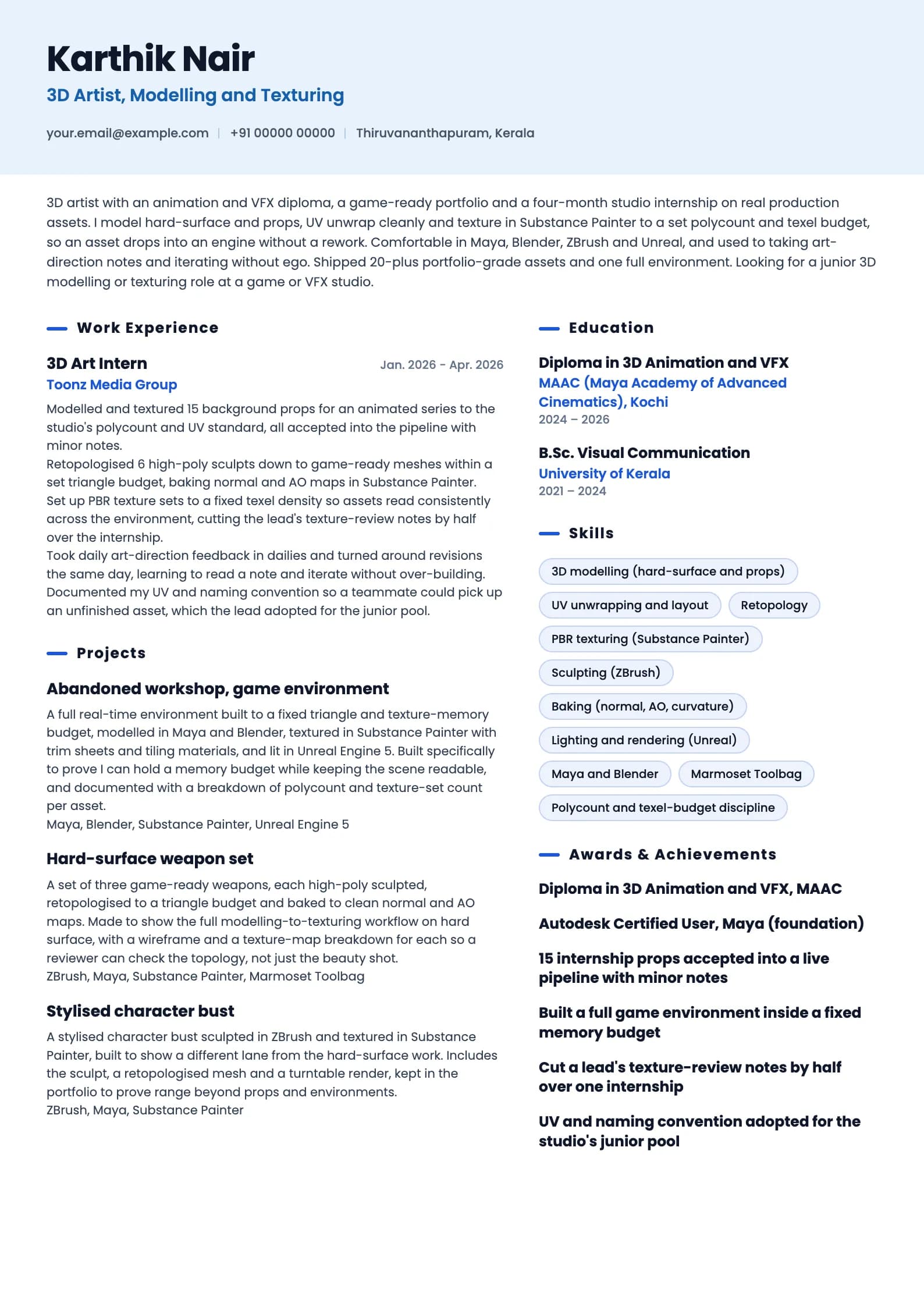
Build my resume3D Artist resume example, Fresher (0 to 1 year)
ai-era templateIs your resume good enough?
Upload the resume you have now and see what an applicant tracking system reads before a 3d artist recruiter ever does.
Free to run. Sign in with your mobile number to see your score.
3D Artist resume example, Mid-level (4 years)
modern template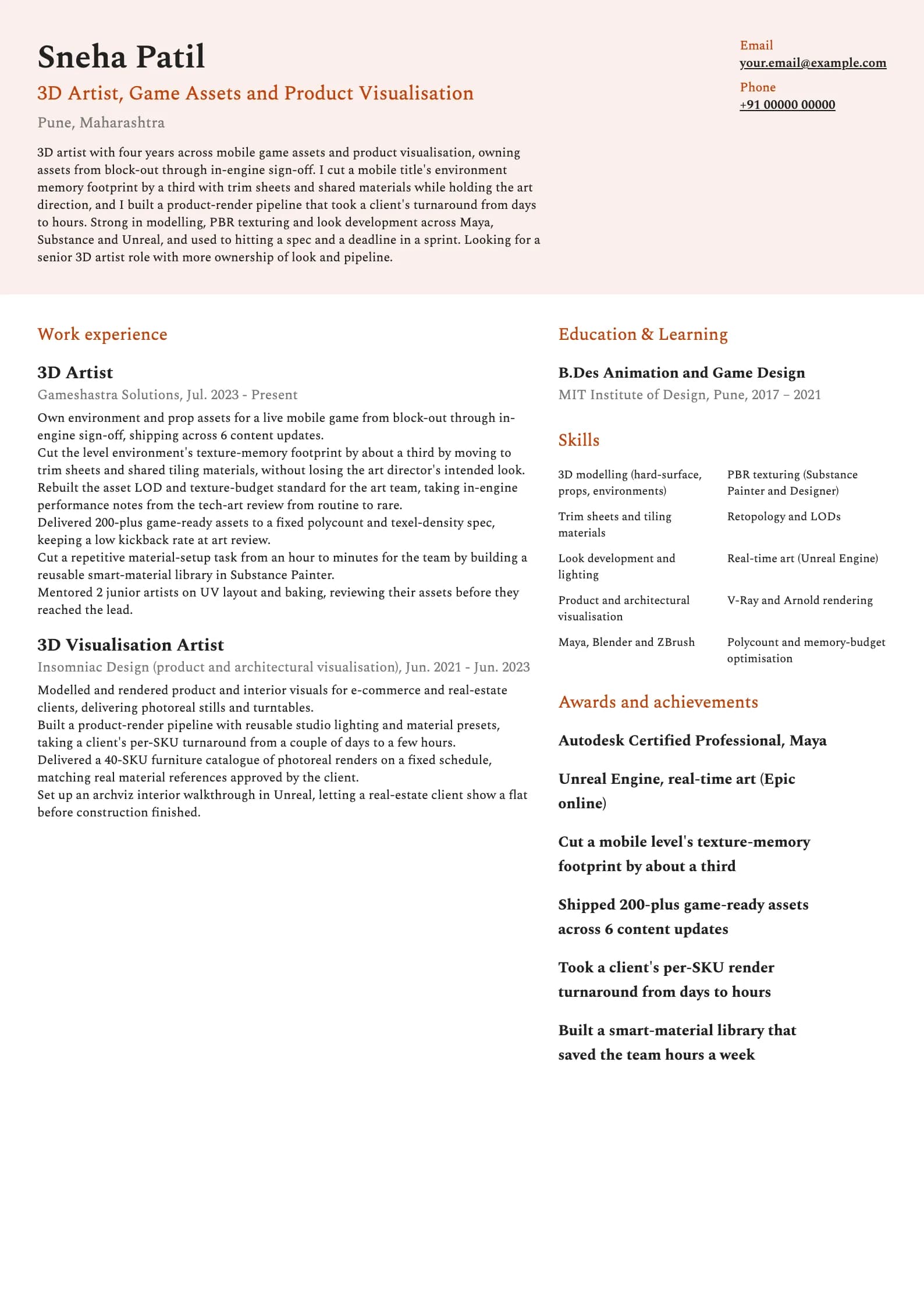
Want this structure with your own details? Build it in the resume builder.
3D Artist resume example, Senior (9 years)
header-band template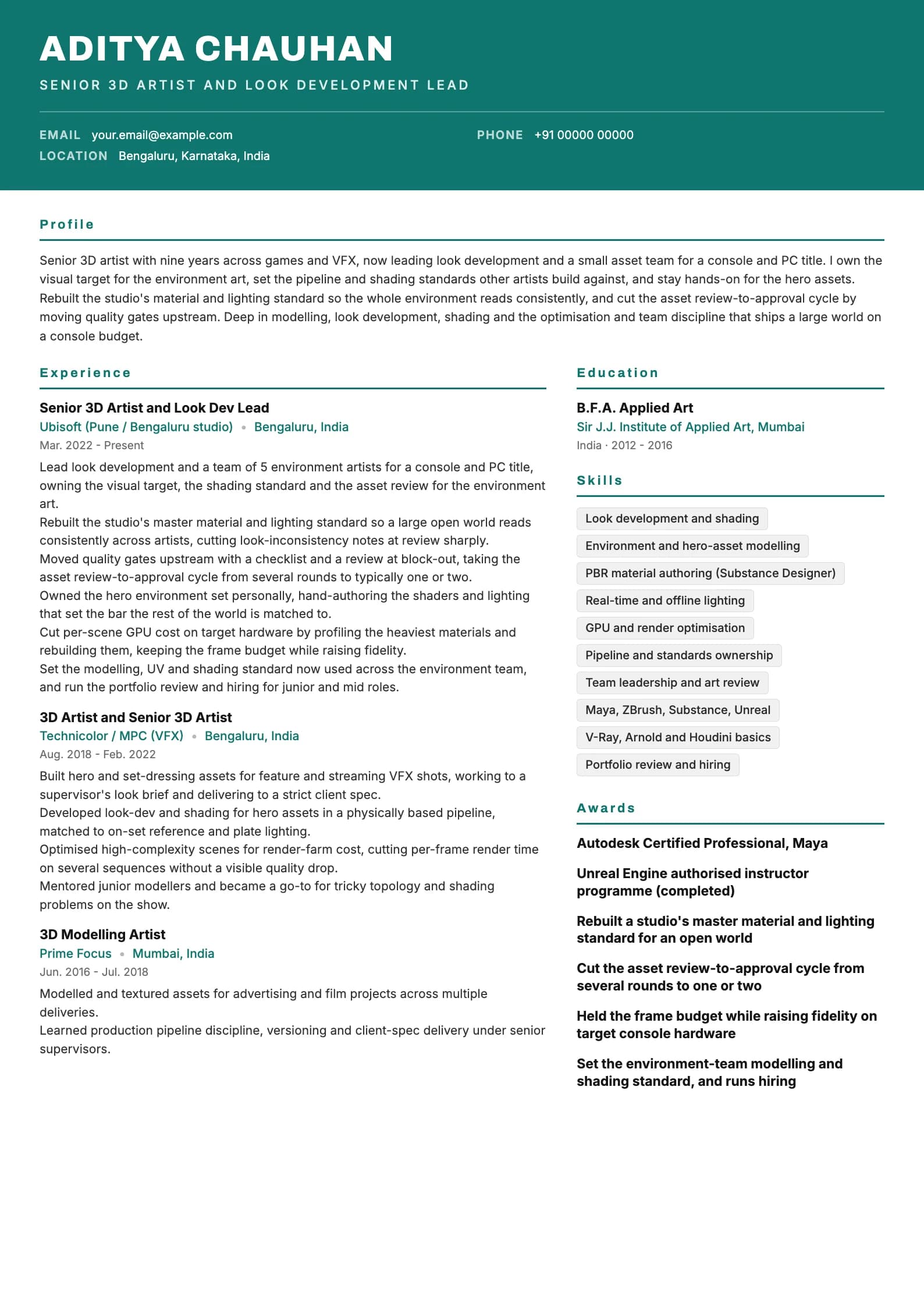
The format that works for a 3D artist resume in India
Reverse chronological is the layout to use, but a 3D artist's resume has one non-negotiable that an ordinary resume does not: a working portfolio or demo-reel link in the header, next to your name. An art director hires from the reel and uses the resume to confirm you can work in a pipeline, so the link is the most important item on the page and it goes where it cannot be missed. Length is one page for almost everyone. 3D artists work in shots, assets and projects, so a page holds a fresher and a nine-year lead alike once older studios are trimmed to a line each. What earns space is what you shipped, the budgets you held, the software pipeline you own and the direction you worked under, not a paragraph about your passion for art. Four things do not belong: a photo, date of birth, marital status and father's name. A studio judges a modeller by the mesh, not the face, and every line these take is a line a shipped asset or a budget number could have used. Send a PDF named with your name and "3D artist", keep it single column, and make every link live, one-tap and public rather than an attachment or an access-locked drive. The table below sets out the section order that a recruiter and an art director both read cleanly.
| Section | Where it goes | Why |
|---|---|---|
| Name, headline and portfolio link | Top, above everything | The reel or portfolio link is the most important item. An art director opens it before reading a word. |
| Profile summary | Directly under the header | Discipline, years, pipeline and the single strongest shipped result. |
| Experience | Next | Studio, role, project. What you shipped and to what budget, most recent first. |
| Projects and showreel breakdown | Above experience for freshers, below it after | For a fresher this is the evidence. Name each with what it proves and link breakdowns. |
| Software and pipeline | Its own grouped block | DCC, sculpting, texturing, engine, render. Say which you are strong in, not a 30-tool wall. |
| Skills | Below experience | Modelling, texturing, look dev, optimisation. Grouped, not a flat list. |
| Education and training | Bottom, higher for a fresher | Degree or animation diploma, institution, years. |
The portfolio decides the shortlist, the resume gets it opened
No 3D artist is hired off a resume alone. The page exists to make an art director open your portfolio and then trust that you can work inside a production pipeline. So the link does the casting, and the resume's job is to get it clicked and to answer the pipeline questions the images cannot. Curate hard. A portfolio is judged by its weakest piece, not its best, because a strong reel with three weak assets reads as an artist who cannot tell good from bad. Ten excellent assets beat thirty mixed ones. Show the discipline you are applying for: an environment role wants environments, a character role wants characters, and a portfolio that is all over the place reads as undecided. Show the work, not just the beauty shot. For modelling roles, include wireframes and clean topology. For texturing, show the material breakdown and the maps. For real-time work, state the polycount and texture-memory budget the asset holds, because a gorgeous render that no engine can run is the single most common junior mistake. A breakdown that proves you held a budget is worth more than one more hero render. Host it where it opens in one tap, an ArtStation or a personal site, and test the link and any embedded reel from a device you are not signed into. An ArtStation link is close to expected in this field, so put it in the header. A dead link or a login-walled drive is a rejection you handed the studio yourself.
An art director judges your portfolio by its weakest asset. Cut anything you are not proud of, show wireframes and budgets alongside the beauty shots, and match the pieces to the exact role you are applying for.
Writing a profile summary an art director actually reads
The block under your name is read while your portfolio loads, so it should carry four facts fast: your discipline, how long you have worked, the pipeline you own, and the single strongest thing you shipped. Three or four lines, no adjectives a studio cannot check against the reel. The common failure is the passion paragraph: a passionate and creative 3D artist with an eye for detail and a love for bringing imagination to life across all kinds of projects. Every 3D resume says a version of this, so it carries no information, and an art director skips to the reel to find out if it is true. Replace it with evidence: "cut a mobile level's texture-memory footprint by a third while holding the art direction" says more than any adjective. Freshers think they have nothing to summarise. The fresher sample names the pipeline, the internship on real production assets, the budgets held and the volume shipped. That is a genuine summary built from a course, an internship and a curated portfolio, and it avoids "passionate about 3D", the phrase that instantly marks a beginner. A practical test: read your summary and ask whether any 3D artist from your course could paste it unchanged. If they could, it describes the software, not you. Add the specific discipline, the specific budget or shipped number, and the specific project until it only fits your reel.
Profile summary, mid-level 3D artist
Weak
A passionate and creative 3D artist with an eye for detail and strong knowledge of Maya, ZBrush, Substance Painter and Unreal, looking for a challenging role to grow my skills.
Strong
3D artist with four years across mobile game assets and product visualisation, owning assets from block-out to in-engine sign-off. Cut a level's texture-memory footprint by a third while holding the art direction, and shipped 200-plus game-ready assets to spec.
The rewrite trades a passion line and a software list, both of which the reel already shows, for a discipline, an ownership scope and two shipped, budget-aware results.
Experience: shipped asset, budget, direction
Every strong bullet in the samples has the same shape. It names what you built, the constraint you built it under, and what shipped or improved. The asset tells an art director the discipline. The constraint, a polycount, a texture-memory budget, a render-farm cost, a deadline, tells them you can work in production, not just in a personal project with no limits. The result does the persuading. Start with the outcome. 3D artists tend to write the task first, which produces "worked on 3D models and textures for the project using Maya and Substance". Instead ask what shipped and what got better: an asset accepted at review, a memory footprint cut, a render-time reduced, a review cycle shortened, a reusable material library built. Then write the bullet that ends in that fact. Use the numbers 3D work actually gives you. Assets shipped, polycount and triangle budgets held, texture-memory footprint cut, texel density hit, render-time or GPU cost reduced, review kickback rate, content updates shipped into, artists mentored. Vary them, because five "created high-quality assets" lines read as one claim repeated. Where you cannot quote a number, give scope: how many assets, how many shots, how many content updates, what part of the pipeline you owned end to end. "Own environment and prop assets from block-out through in-engine sign-off" carries weight without a percentage. Allocate bullets by recency. Current role gets five or six, the previous studio four or five, older stints one or two lines.
| Level | What bullets must prove | Typical metric |
|---|---|---|
| Fresher | You can build a production-ready asset to a budget | Assets accepted at review, budgets held, revision speed, portfolio range |
| 1 to 3 years | You own an asset from block-out to sign-off | Assets shipped, polycount and texel budgets, kickback rate, content updates |
| 4 to 6 years | You optimise and improve the pipeline, not just deliver | Memory or render cost cut, reusable tools built, spec hit at scale, mentoring |
| 7 years and up | You own look development and set the standard | Standards set, review cycle cut, frame budget held at fidelity, team led |
Experience bullet, game asset work
Weak
Worked on creating 3D models and textures for the game project using Maya, ZBrush and Substance Painter as per requirements.
Strong
Cut the level environment's texture-memory footprint by about a third by moving to trim sheets and shared tiling materials, without losing the art director's intended look.
The vague version describes any 3D job; the rewrite names the constraint met, the technique used and the fact that the art direction survived the optimisation.
Experience bullet, VFX optimisation
Weak
Was responsible for optimising scenes and reducing render times for various shots in the pipeline.
Strong
Optimised high-complexity scenes for render-farm cost, cutting per-frame render time on several sequences without a visible quality drop.
Swaps "responsible for" for the specific outcome, render cost cut with no quality loss, which an art director can ask a real follow-up about.
If a bullet would read the same on any 3D artist's resume, it is describing the software, not your work. Rewrite it until it names the asset you shipped and the budget or constraint you held it inside.
The software and pipeline block: strong in a few, not touched thirty
A 3D artist's software list is where the parser looks and where a human decides whether you fit the pipeline. It has two failure modes: too thin, which reads as untrained, and a thirty-tool wall, which reads as an artist who has opened everything and mastered nothing. Grouping by pipeline stage fixes both. Group by stage rather than one long line. Modelling and DCC (Maya, Blender, 3ds Max), sculpting (ZBrush), texturing (Substance Painter and Designer, Mari), engine and real-time (Unreal, Unity), rendering (V-Ray, Arnold, Marmoset), and any pipeline or scatter tools (Houdini, SpeedTree). This tells an art director exactly where you sit in a pipeline in one glance. Be honest about depth, because a 3D interview is a portfolio review and the software claims get tested asset by asset. Mark the tools you are genuinely strong in and do not list a package you opened once for a college assignment, since an interviewer will open your ZBrush sculpt and ask about it. A short list you can defend beats a long one you cannot. Match the list to the studio. A game studio wants to see Unreal or Unity, trim sheets and LODs. A VFX house wants Maya, Houdini basics and a physically based shading pipeline. An archviz or product studio wants V-Ray or Corona and real material work. Reorder the block so the tools that matter to the specific opening sit first, and name them the way the industry writes them: Substance Painter, not substance; ZBrush, not zbrush; Unreal Engine, not unreal.
The skills section: grouped by what you actually do
A 3D resume's skills section, separate from the software list, should describe the craft you bring rather than repeat the tool names. The parser wants the discipline terms, modelling and texturing and look development. A human wants a fast read of what kind of artist you are. Grouping serves both. Group by capability rather than a flat wall. Modelling (hard-surface, organic, environment, props), surfacing (UV, PBR texturing, material authoring, baking), look and lighting (look development, shading, lighting, rendering), and technical (retopology, LODs, optimisation, polycount and memory budgets). The exact headings matter less than that structure exists and a reviewer can find their discipline fast. Be specific about your lane. "3D artist" is broad, and studios hire for a slot: a hard-surface modeller, an environment artist, a character artist, a look-dev artist, a product-viz artist. Let the skills and the portfolio agree on which one you are, because a resume that claims all of them and a portfolio that shows one reads as unfocused. Do not include a star-rating bar. Nobody agrees on what four stars in ZBrush means, and it invites an argument the portfolio should settle instead. Ten to fourteen grouped, concrete skills is the working range, and every one should be something an interviewer could open your reel and see.
Skills section
Weak
Skills: Maya, 3ds Max, Blender, Cinema 4D, ZBrush, Mudbox, Substance Painter, Substance Designer, Mari, Photoshop, Unreal, Unity, V-Ray, Arnold, Redshift, Marmoset, Houdini, Nuke, After Effects, Premiere, Illustrator, Creativity, Hard work, Team spirit
Strong
Modelling: hard-surface, props, environments. Surfacing: UV layout, PBR texturing (Substance Painter and Designer), baking. Look and lighting: look development, shading, real-time lighting (Unreal). Technical: retopology, LODs, polycount and memory-budget optimisation.
Cuts the everything-tool wall and the personality words, and reorganises into the capabilities an art director hires for, each one visible in the portfolio.
Where education, courses and certifications belong
Education and training go near the top for a fresher, who leads with the animation or design diploma because the portfolio is still young, and drop to the bottom once you have shipped work to point at. Degree or diploma, institution, years. That is the whole block for most people. 3D art is a portfolio field, not a licensed one, so no degree is required and none guarantees a job. A diploma from MAAC, Arena, Whistling Woods or a design degree signals training and gives a fresher a structured path and a first reel, but a self-taught artist with a strong ArtStation is hired over a certificate-holder with a weak one every time. The reel is the qualification. Software certifications, an Autodesk Certified Professional in Maya or an Epic Unreal credential, are a minor plus for a fresher and near-invisible once you have production credits. They are worth listing early because they confirm baseline tool fluency, but they never substitute for the portfolio, and an experienced artist should not lead with them. List a course or certificate by its real name, institute and year, and do not inflate a short workshop into a diploma. The Indian animation and games industry is well networked, so a named training claim is easy to place, and an art director often knows exactly what a given course covers and how long it runs.
Getting past the studio recruiter and the ATS
Large game studios, VFX houses and their outsourcing partners do screen applications through an applicant tracking system before an art director opens your reel. It is a parser and a filter, not a judge of art, and almost every problem it causes is a formatting problem, not a talent problem. Keep the layout parseable. One column. Standard headings, so "Experience" and "Skills", not "My Creative Path". No text baked into a graphic, because a portfolio-style header with your details inside an image reads as blank. Do not hide your name, discipline or portfolio link in a header or footer region that a parser may drop, and make the ArtStation and reel links real selectable text, not an image of a URL. Mirror the posting's language where it is honest. If the role says "environment artist", write both 3D artist and environment artist at least once. If it names a tool like Substance Painter, an engine like Unreal, or a technique like retopology or PBR, and you have it, use the same word. Spell out an abbreviation once, for example "PBR (physically based rendering)" and "LOD (level of detail)", so both searches match. Do not stuff. A hidden wall of every 3D tool and technique in white text does not fool a recruiter and reads worse than an honest page, and a claim your portfolio does not back gets caught in the first review anyway. Write real bullets that naturally carry the terms, because a bullet about the trim sheets you used already contains "trim sheets" in a form that survives human review. Save a text-based PDF and confirm you can select and copy a sentence, including your portfolio link. If the link is not selectable, a recruiter who wants to open it cannot, and a parser cannot index it either.
Section heading
Weak
My Artistic Journey
Strong
Experience
A parser and a busy studio recruiter both scan for a standard heading; a creative one can drop your whole shipped-work history into a bucket that never gets searched.
Copy the text out of your PDF into a plain notes app. Whatever reads cleanly there, including your ArtStation and reel links, is roughly what a studio's ATS and its recruiter see. Anything scrambled is a risk you can fix before you send it.
What keeps a 3D artist resume from getting the reel opened
Most 3D resumes that never lead to a portfolio review fail for a small set of recurring reasons, and each is fixable in an evening. The list below is what art directors and studio recruiters in India see most often, in rough order of how much damage each does.
- No portfolio or ArtStation link, or a dead or login-walled one. The reel is the hire, and a resume without a working link is one a studio will not chase.
- A padded portfolio. It is judged by its weakest asset, so three weak pieces sink seven strong ones. Ten excellent beat thirty mixed.
- Beauty shots with no wireframes, breakdowns or budgets, so a studio cannot tell if the topology and the memory footprint are production-ready.
- A thirty-tool software wall. Listing every package ever opened reads as mastering none, and each claim gets tested in the review.
- A passion-paragraph summary. "Passionate, creative, eye for detail" says what every resume says and proves nothing until the reel does.
- No mention of budgets or constraints. A gorgeous render no engine can run is the classic junior tell; studios hire for work that ships.
- A portfolio that does not match the role. An environment opening wants environments, and an all-over-the-place reel reads as undecided.
- Duties copied instead of shipped work. "Responsible for creating 3D models" hides what you actually delivered and to what spec.
- A photo, date of birth or father's name on a page where the mesh is the only thing being judged.
- Typos in the tools of the trade. "Substance Painter" as "Substance Paintter" or "ZBrush" as "Z-Brush" on an artist's page undermines an otherwise strong reel.
Show your portfolio and resume to one working 3D artist before a studio sees them. If they cannot tell your discipline, your strongest asset and whether your work is production-ready in fifteen seconds, an art director never will.
Skills to put on a 3d artist resume
Technical
- 3D modelling (hard-surface, props, environments)
- Organic and character sculpting
- UV unwrapping and layout
- Retopology and LODs
- PBR texturing and material authoring
- Baking (normal, AO, curvature)
- Look development and shading
- Lighting and rendering
- Real-time art (Unreal, Unity)
- Trim sheets and tiling materials
- Polycount and memory-budget optimisation
- Product and architectural visualisation
Tools and platforms
- Autodesk Maya
- Blender
- 3ds Max
- ZBrush
- Substance Painter
- Substance Designer
- Marmoset Toolbag
- Unreal Engine 5
- Unity
- V-Ray and Arnold
- Houdini (basics)
- Adobe Photoshop
Working skills
- Takes art direction cleanly
- Iterates without ego
- Deadline and sprint discipline
- Attention to reference and detail
- Collaboration with tech art
- Mentoring and art review
- Problem-solving on topology and shading
- Communication in dailies
Certifications worth listing as a 3d artist
| Certification | Full name | Worth it for |
|---|---|---|
| Autodesk Maya (ACP) | Autodesk Certified Professional, Maya | A minor plus for a fresher, since it confirms baseline fluency in the DCC most Indian studios use. Near-invisible once you have production credits, because the portfolio proves tool depth far better than a certificate. List it early, drop it down the page once you have shipped work. |
| Unreal Engine | Unreal Engine real-time art / authorised programme (Epic Games) | Worth it for artists targeting games and real-time visualisation, where Unreal fluency is increasingly assumed. Useful for a fresher or an artist moving from offline rendering into real-time, since it signals you understand engine budgets and lighting. Redundant once your reel clearly shows in-engine work. |
| Substance suite | Adobe Substance 3D (Painter and Designer) course | Practical for any modern 3D artist, because PBR texturing and material authoring in Substance is standard across games, VFX and archviz. Most valuable for freshers and self-taught artists who want structured coverage of the surfacing pipeline. The maps in your portfolio matter more than the certificate. |
| MAAC / Arena diploma | Diploma in 3D Animation and VFX (MAAC, Arena Animation and similar) | A structured entry path for a fresher with no portfolio, giving software training, a mentored reel and often a first internship. Its real value is the portfolio and the practice, not the certificate, so choose a centre with strong placement and industry mentors. A self-taught artist with a great ArtStation can skip it entirely. |
Keywords an ATS scans for in a 3d artist resume
These are the literal terms a parser matches against the job description. Use the ones that are true of you, in the sentences where you did the work, not as a list at the bottom.
- 3d artist
- 3d modeler
- environment artist
- character artist
- texturing artist
- look development
- maya
- zbrush
- substance painter
- unreal engine
- PBR
- retopology
- UV unwrapping
- LOD
- lighting
- rendering
- hard-surface modelling
- polycount optimization
- game assets
- product visualization
3D Artist resume FAQ
What salary can a 3D artist expect in India?
A fresher 3D artist typically starts around 2.5 to 5 LPA at a studio or outsourcing house, with strong game and VFX studios paying more for a standout portfolio. A mid-level artist with four to six years across game assets, VFX or visualisation usually sits in the 7 to 16 LPA band. Senior 3D artists and look-development leads with nine years and above commonly earn 18 to 40 LPA and more at top game studios and VFX houses. Specialism matters: strong look development, character art or real-time optimisation, plus a portfolio that shows shipped titles, pushes the top of every band upward, and remote work for overseas studios can pay well above local scales.
How long should a 3D artist resume be?
One page for almost everyone. 3D artists work in assets, shots and projects rather than long multi-year epics, so a page holds a fresher and a nine-year lead alike once older studios are trimmed to a line each. What earns space is what you shipped, the budgets you held and the pipeline you own, not a paragraph about your passion for art. The portfolio link does the heavy lifting, so the resume just has to support it and answer the pipeline questions the images cannot.
Is the portfolio or the resume more important for a 3D artist?
The portfolio, without question. An art director hires from the reel and uses the resume to confirm you can work in a pipeline and meet a deadline. So put a working ArtStation or personal-site link in the header, curate the portfolio hard, since it is judged by its weakest asset, and match the pieces to the exact role. Then let the resume answer what the images cannot: the budgets you held, the direction you worked under, the software you own and the volume you shipped.
Should I show wireframes and polycounts in my portfolio?
Yes, for anything technical. For modelling roles, wireframes and clean topology prove the mesh is production-ready, not just a nice silhouette. For texturing, show the material breakdown and maps. For real-time work, state the polycount and texture-memory budget the asset holds, because a beautiful render that no engine can run is the single most common junior mistake. A breakdown that proves you held a budget is often worth more than one more hero render.
How many software packages should I list?
List the few you are genuinely strong in, grouped by pipeline stage, not every package you have ever opened. A thirty-tool wall reads as an artist who has mastered none, and every claim gets tested asset by asset in a portfolio review. Group them: DCC, sculpting, texturing, engine, render. Then reorder so the tools that matter to the specific studio sit first, since a game studio wants Unreal and trim sheets while a VFX house wants Maya, Houdini basics and a physically based pipeline.
Can I become a 3D artist without a formal degree?
Yes. 3D art is a portfolio field, not a licensed one, so no degree is required and none guarantees a job. A diploma from MAAC, Arena or a design degree gives a fresher structured training and a first reel, but a self-taught artist with a strong ArtStation is hired over a certificate-holder with a weak portfolio every time. If you are self-taught, lead with the reel and the shipped or personal projects, and do not treat the missing degree as a gap, because the mesh does not care where you learned.
What numbers should a 3D artist put on a resume?
Use the ones 3D work gives you: assets shipped, polycount and triangle budgets held, texture-memory footprint cut, texel density hit, render-time or GPU cost reduced, review kickback rate, content updates shipped into, and artists mentored. These prove you work in production, not just in an unconstrained personal project. Vary them across bullets, because five "created high-quality assets" lines read as one claim repeated, while a budget cut, a volume and a review-cycle number together show range.
Do software certifications like Autodesk or Unreal help?
They are a minor plus for a fresher, since they confirm baseline tool fluency, and near-invisible once you have production credits, because the portfolio proves depth far better than any certificate. List an Autodesk Maya or Unreal credential early to signal you know the pipeline, but never let it substitute for the reel, and do not lead an experienced resume with it. For senior roles, shipped titles, look-development depth and optimisation skill matter far more than any badge.
How does a fresher 3D artist build a hireable resume?
Lead with a tight, curated portfolio of ten strong assets that match the discipline you want, then a resume that names the pipeline you own and the budgets you can hold. Show range across a couple of lanes rather than five identical props, include wireframes and breakdowns, and if you can, do an internship on real production assets so you can write about work accepted into a live pipeline. On the page, put projects above experience, lead with the ArtStation link, and prove you can take a note and hit a spec, which is what a studio hiring a junior is really checking.
Related resume examples and guides
Build your 3D artist resume in any of these formats
Start from a blank resume or upload the one you have. Goodspace renders it in 24 templates, keeps your ArtStation and reel links where an art director will open them first, and flags the pipeline, software and shipped-work keywords a studio recruiter scans for, and the passion-paragraph filler it will not credit.
Build my resume