Game Developer Resume Format, with 3 Full Samples
A game developer is hired on evidence of shipped games and gameplay that feels right at a stable frame rate, not on a list of engines and genres. Most game resumes read like a wishlist of dream studios and forget that the job is systems that ship, run smoothly on a mid-range phone, and hold players past the first session. Below are three complete resumes, one for a fresher with a published itch.io game and a game-jam record, one for a mid-level Unity developer who has shipped a live mobile title, and one for a senior gameplay engineer owning systems and performance at scale. After the samples come the format rules, why naming an engine is not the same as shipping in it, how a portfolio changes the resume, the terms a parser matches, and the mistakes that end a studio screening early.
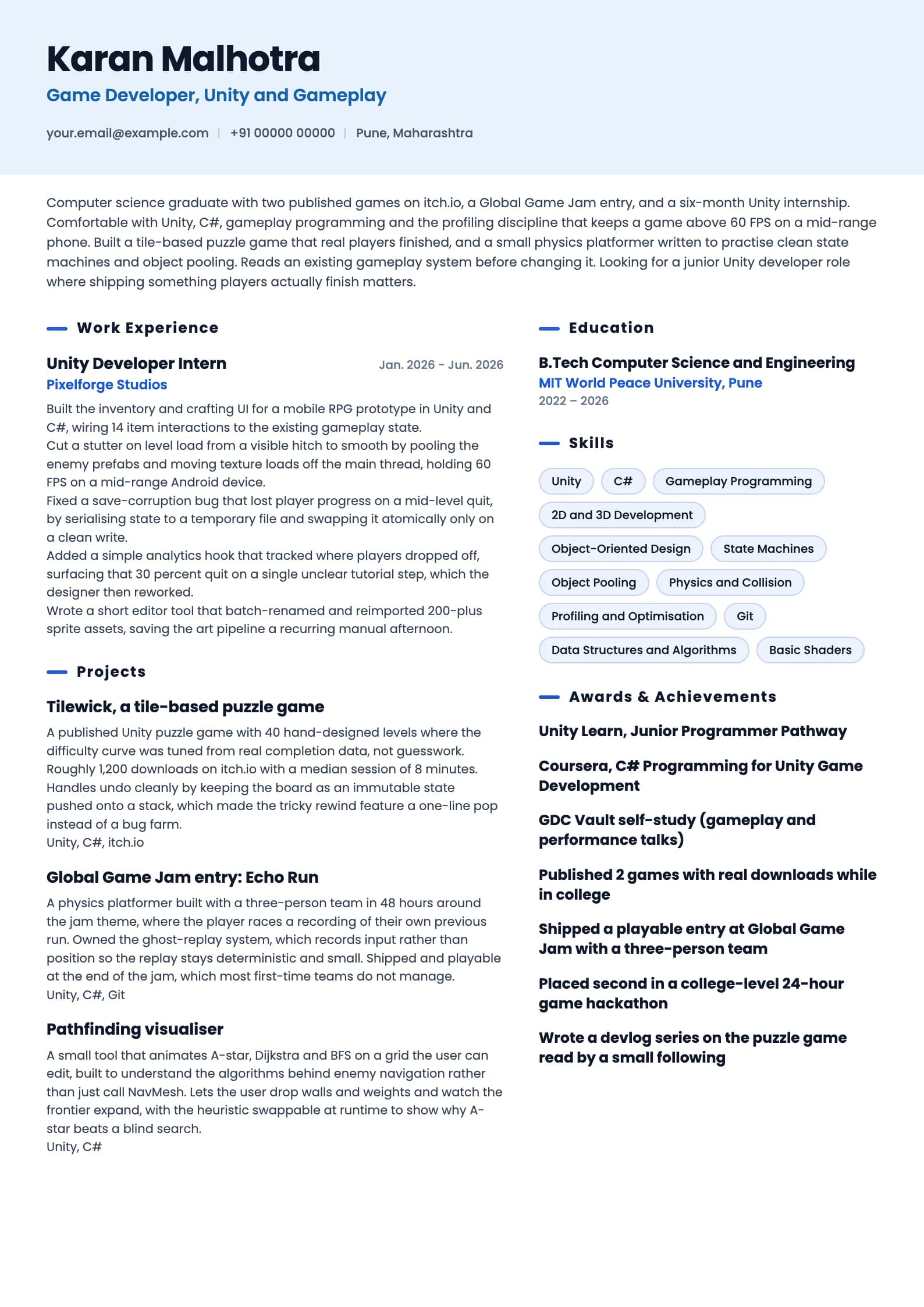
Build my resumeGame Developer resume example, Fresher (0 years)
ai-era templateIs your resume good enough?
Upload the resume you have now and see what an applicant tracking system reads before a game developer recruiter ever does.
Free to run. Sign in with your mobile number to see your score.
Game Developer resume example, Mid-level (4 years)
professional template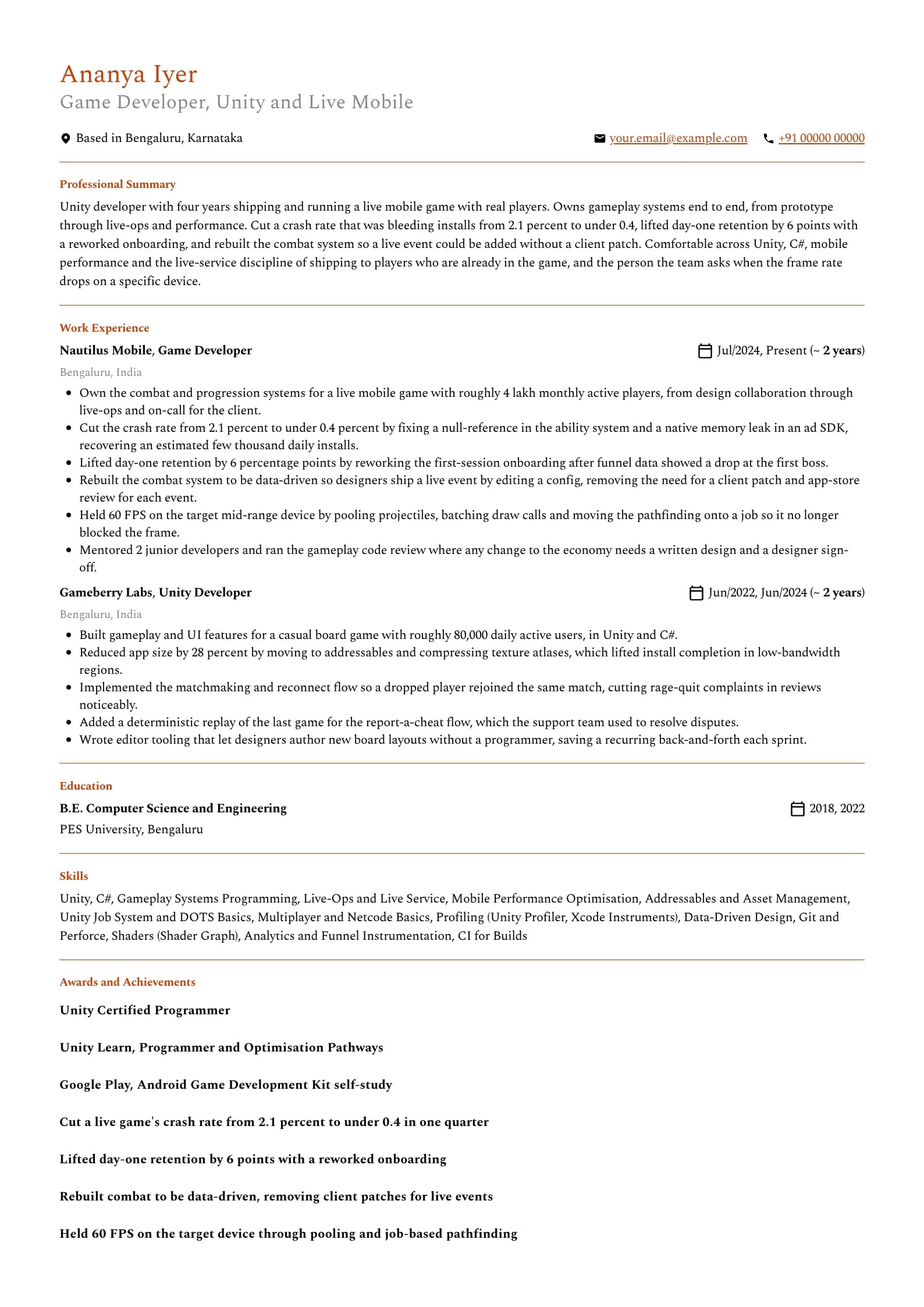
Want this structure with your own details? Build it in the resume builder.
Game Developer resume example, Senior (9 years)
header-band template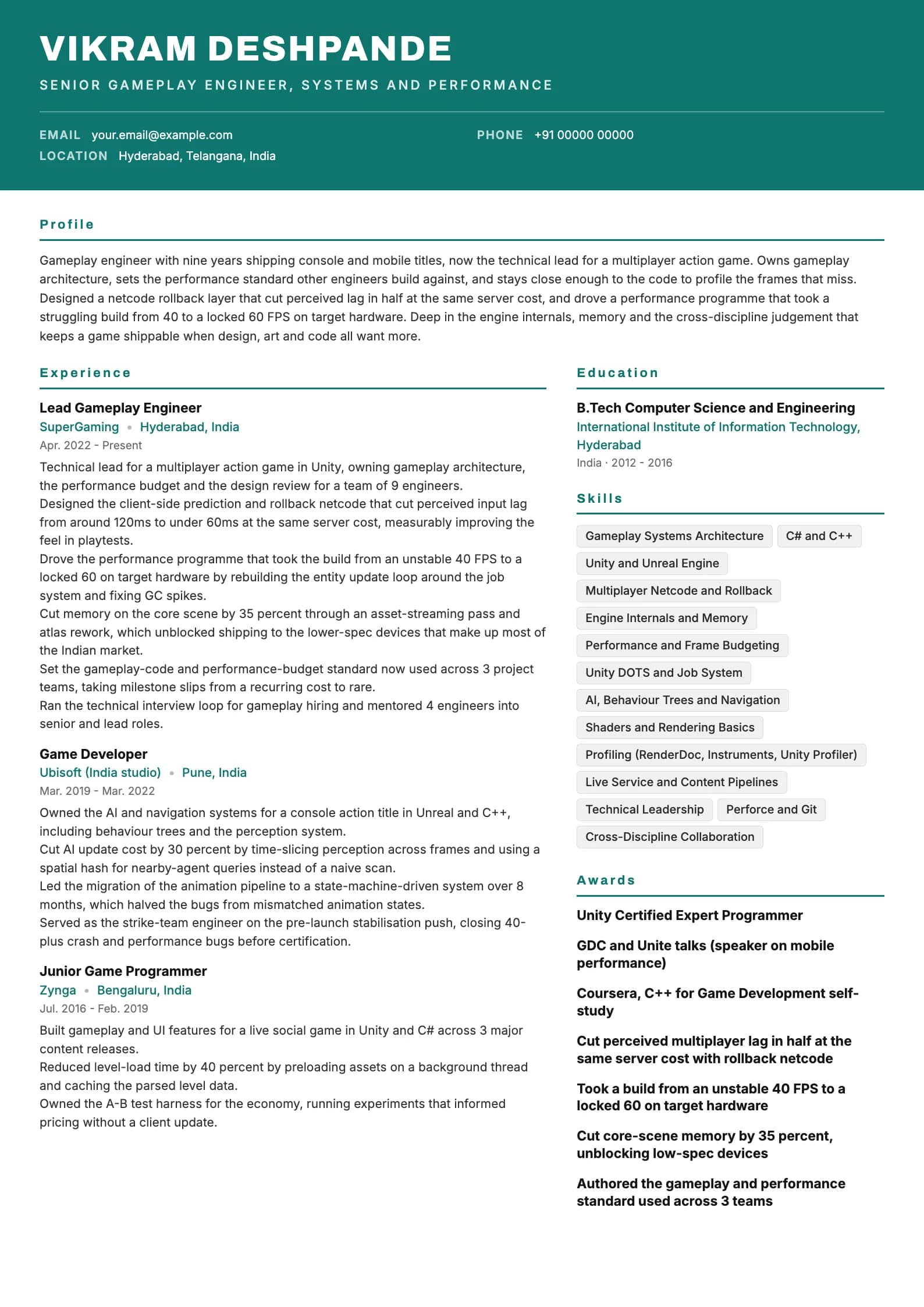
The format that works for game developer resumes in India
Reverse chronological is the layout to use. Put the most recent role first, work backwards, and keep the dates visible. Functional resumes that group everything under a skills heading and drop the dates read as an attempt to hide a gap, and game studios, which see a lot of hobbyist applications, are quick to notice. One honest line about a gap beats a hidden one. Game development is the one software field where a portfolio can outweigh the resume, so the resume's job changes slightly: it exists to get a reviewer to open your games. Put a clean, plain-text link to your portfolio, itch.io or Steam page near the top, and make sure the games behind it are playable. A resume that lists five titles with no link is weaker than one with a single link that works. Length follows evidence. One page holds everything a fresher and most developers up to roughly six years need. Past that a second page is fine when it carries real shipped-title work rather than a longer engine list. A page two of genres you have played rather than built is padding. The usual clutter still applies: a photograph, date of birth, marital status and father's name survive from older campus templates and belong nowhere on a technical resume. So does a wall of every genre and platform you have touched. Send a PDF unless asked otherwise, name the file with your own name and target role, and keep to a single column so a parser does not read a sidebar out of order. The table below sets the section order.
| Section | Where it goes | Why |
|---|---|---|
| Name, headline and portfolio link | Top, above everything | Headline is the role, game or Unity developer. The portfolio link is the point of the page. |
| Professional summary | Directly under the header | Three lines. Engine and stack, years, and the single strongest shipped result. |
| Work experience | Next, for anyone with a job | Most recent first. Newest role gets the most bullets. |
| Shipped titles and projects | Above experience for freshers, below it after that | For a fresher these are the evidence. Name the game, your role on it, and one hard system. |
| Skills | Below experience | Grouped: engine, language, systems, tools. Not a genre-and-platform wall. |
| Education | Bottom, unless you are a fresher | Degree, institution, years. Drop the percentage after your first job. |
| Certifications | After education, or beside skills if only one or two | Name, issuing body, year. Unity Certified credentials earn a line, no more. |
Naming an engine is not the same as shipping a game in it
The most common game resume failure is a skills line that reads Unity, Unreal, Godot, CryEngine, GameMaker, Cocos, C++, C#, Java, Python, Lua, HLSL with no shipped game behind most of them. A parser matches the engines, but a studio interviewer reads the wall and assumes it is a list of tutorials watched, then asks which engine you have actually shipped a finished game in. The fix is to let the experience and portfolio prove the stack. If you write Unity, a title in your portfolio should be built in it. If you write multiplayer netcode, a bullet should describe the reconnect or rollback flow you shipped. The mid-level sample lists live-ops, addressables and the job system precisely because the bullets show a data-driven live event, an app-size cut through addressables, and job-based pathfinding. The skills line and the experience agree, which is what makes both believable. Be honest about which engine is your real strength. Most Indian game roles, especially mobile, are Unity and C#. Listing Unreal and C++ because a dream studio uses them, when you have never shipped in either, invites the interview question you cannot answer. Depth in one engine with a shipped game beats a shallow list of six. Game-specific competence lives in the systems you name, not the genres. Object pooling, state machines, behaviour trees, netcode, profiling, memory budgets and frame timing tell a reviewer you understand that a game is a real-time system under a hard 16-millisecond budget. Genres such as RPG, FPS and puzzle are what the game is, not what you can do, so let them appear inside titles rather than as a skills wall.
For every engine and system on your skills line, ask: is there a shipped game or a bullet that proves it. If not, either add the evidence or cut the item. A studio would rather see one finished Unity game than six engines you have opened.
Writing a summary a studio lead actually reads
The block under your name is the part most likely to be read, so it should carry three facts: what you build and in which engine, how long you have been building it, and the strongest thing that happened because of your work. In games the strongest thing is often a shipped title, a retention lift, a crash-rate cut or a frame-rate win. Three or four lines, no adjectives that cannot be checked. The old objective line, seeking a challenging role in a reputed gaming company to pursue a passion for games, tells a studio nothing they did not assume from the fact that you applied. Everyone who applies to a game studio is passionate about games. Replace it with a summary. An objective describes what you want, a summary describes what you have already shipped, and only one gets you an interview. Freshers often believe they have nothing to summarise. Look at the fresher sample: it names two published games, a jam entry, and the profiling habit that keeps a game above 60 FPS. That is a genuine summary built from side projects and one internship. What it avoids is "lifelong gamer with a passion for creating immersive experiences", a sentence so common on game resumes it now carries no information. A practical test: read your summary and ask whether any hobbyist who plays a lot of games could paste it onto their resume unchanged. If they could, it describes a player, not a developer. Add the specific shipped title, the specific number and the specific system you owned until it stops being transferable.
Professional summary, mid-level developer
Weak
Passionate and creative game developer and lifelong gamer with 4+ years of experience in Unity, Unreal and multiple genres, seeking a challenging role at a reputed gaming studio.
Strong
Unity developer with four years shipping and running a live mobile game, owning combat and progression from prototype to live-ops. Cut the crash rate from 2.1 to under 0.4 percent and lifted day-one retention by 6 points.
The rewrite trades an engine list and self-description for a shipped live title, an ownership scope and two verifiable results.
Experience bullets: verb, system, consequence
Every strong bullet in the samples follows the same shape. It opens with an action verb, names the specific gameplay system or shipped feature you built, and closes with what measurably moved. The verb establishes that you did it. The system tells a reviewer whether the work is relevant. The number, whether frame rate, retention, crash rate or memory, does the persuading. Start with the outcome and work backwards. Developers usually write the task first, then struggle to attach a number, which produces bullets like "worked on gameplay features in Unity and improved the game". Instead ask what was different for players or on the device after you shipped: a frame rate held, a crash rate dropped, retention rose, memory fell, a load time shrank, an event could ship without a patch. Then write the sentence that ends in that fact. Vary the metric. Game work gives you a rich set of honest numbers: frame rate on a named device, day-one and day-seven retention, crash rate, app size, load time, memory, and daily or monthly active players. Six frame-rate numbers in a row read as one trick, so reach for the range the work gives you. Where you lack a number, give scope: how many systems, how many platforms, how many titles shipped, how large a migration. "Rebuilt the combat system to be data-driven so designers ship a live event without a client patch" carries weight without a percentage. Allocate bullets by recency. Current role gets five or six, the previous role four or five, anything older two or three.
| Level | What bullets must prove | Typical metric |
|---|---|---|
| Fresher | You can finish and publish a game that runs smoothly | Downloads, session length, FPS held, drop-off found |
| 1 to 3 years | You own a gameplay system on a shipped title | Load time cut, app size, features shipped, crash fixes |
| 4 to 6 years | You own systems end to end on a live game | Retention lift, crash rate, FPS on device, active players |
| 7 years and up | You set architecture and the performance standard | Frame budget locked, memory cut, netcode latency, standards set |
Experience bullet, live game role
Weak
Responsible for working on gameplay features in Unity and fixing bugs reported by the QA team.
Strong
Cut the crash rate from 2.1 percent to under 0.4 percent by fixing a null-reference in the ability system and a native memory leak in an ad SDK, recovering an estimated few thousand daily installs.
"Responsible for" describes a job description; the rewrite names the two fixes and the install impact.
Experience bullet, performance work
Weak
Worked on optimising the game which improved the frame rate and overall performance.
Strong
Held 60 FPS on the target mid-range device by pooling projectiles, batching draw calls and moving pathfinding onto a job so it no longer blocked the frame.
Names the target device, the frame rate and the three techniques, so a reviewer can ask a real follow-up instead of nodding at a vague claim.
If a bullet would read identically on any hobbyist's resume, it is describing enthusiasm, not work. Rewrite it until it only fits the system you actually shipped in a real game.
The skills section: grouped, honest, and short enough to defend
A game resume's skills section has two audiences with opposite preferences. The parser wants literal terms it can match, Unity and C# and Shader Graph. A human, usually a lead engineer, wants a short, organised list that signals what kind of developer you are and whether you understand real-time constraints. Grouping satisfies both. Group by function rather than one long line. Engine, language, systems, graphics and tools is a grouping that works for almost every game programmer. The exact headings matter less than the fact that structure exists. Write names the way the industry writes them: Unity not unity, C# not c-sharp, Unreal Engine not UE. A parser matches on strings. Twelve to sixteen skills is the working range. Below eight the section looks thin. Above twenty it stops being a signal, and game resumes are especially prone to genre and platform padding: listing every genre you have played and every console you have owned. The list is a contract: every item is a question you have agreed to answer, and a lead will pick the one you are weakest on. Keep genres out of the skills section. RPG, FPS and racing describe games, not abilities, so let them live inside your shipped titles. What belongs here is the engineering: gameplay systems, netcode, profiling, physics, AI, memory management. Do not include a proficiency bar. Star ratings invite an argument, and nobody agrees on what four stars in Unity means. Let the portfolio prove the depth.
| Group | What goes in it | How many |
|---|---|---|
| Engine | Unity, Unreal, Godot, and which you have really shipped in | 1 to 2 |
| Language | C#, C++, and the scripting you use (Lua, Python for tools) | 1 to 3 |
| Systems | Gameplay programming, netcode, AI, state machines, physics | 3 to 5 |
| Graphics | Shaders, Shader Graph, rendering basics, VFX | 1 to 3 |
| Tools and pipeline | Git, Perforce, profilers, addressables, CI, editor tooling | 3 to 5 |
Skills section
Weak
Skills: Unity, Unreal, Godot, CryEngine, GameMaker, RPG, FPS, MOBA, Racing, Puzzle, Platformer, PC, Console, Mobile, VR, AR, C#, C++, Java, Python, HTML, CSS, Photoshop, MS Office
Strong
Engine: Unity (shipped), Unreal (learning). Language: C#, C++. Systems: gameplay programming, netcode, AI behaviour trees, object pooling. Graphics: Shader Graph, VFX. Tools: Git, Perforce, Unity Profiler, addressables.
Cuts the genres, platforms and engines you have not shipped in, keeps only what you can defend, and groups the rest so a lead reads the real engineering in one pass.
Portfolio and projects: what to include and how to describe it
In game development the portfolio is not optional, and for a fresher it is the resume. Studios hire on shipped games far more than on described experience, so the resume's real job is to get someone to open your itch.io, Steam or portfolio page. Put a working link at the top and make sure the games behind it are playable on the first click. For a fresher, titles sit above experience, get the most space, and are where a reviewer decides whether you can finish a game or only start them. For an experienced developer they move below experience and shrink to one or two entries, kept only if they show something the day job does not. The common failure is describing the genre instead of the game. "A 3D action game made in Unity" tells a reviewer nothing, because thousands of resumes carry that line. Describe what the game is, what your specific role on it was, and the one system that was genuinely hard. The puzzle game in the fresher sample is a strong entry because it names a real download count and one real engineering choice, keeping the board as immutable state so undo is a one-line pop. Name your role on team projects honestly. On a game jam or a studio title, say what you owned: the combat, the UI, the netcode, the tools. A studio reads a solo project and a five-person team project very differently, so pretending a team effort was all yours is a fast way to lose trust in the interview. Finishing and publishing even a small game says more than an ambitious unfinished one, because shipping is the skill studios are actually testing for.
Project description, fresher resume
Weak
Action Game: a 3D action-adventure game made in Unity with combat, levels and enemies.
Strong
Tilewick: a published Unity puzzle game with 40 levels, roughly 1,200 downloads and an 8-minute median session, where keeping the board as immutable state made undo a one-line stack pop instead of a bug farm.
Swaps a genre label for a real download and session number, and one specific engineering decision the reviewer can ask about.
Where education and certifications belong
Education goes at the bottom for anyone with a full-time job, and near the top for a fresher, who has nothing stronger to lead with. Degree, institution, years. That is the whole entry for most people. Game studios weight a strong portfolio above the exact degree, and many good game developers come from computer science, design or self-taught routes, so do not over-invest in the education block if your games are strong. CGPA or percentage is worth keeping while you are a fresher and it is good, roughly 7.5 out of 10 and above, because campus and early-career screening still filters on it. Once you have shipped a title in a full-time role, drop it in favour of the games, which are far more predictive. Certifications sit just below education, or beside skills if you hold only one or two. Games are honest about this: certifications carry less weight here than in almost any other software field, because a shipped game is the credential. The Unity Certified Programmer and Expert badges are worth a single line if you hold them, as a small signal for a fresher or a formality some larger studios like, but no badge substitutes for a playable game. A specialised game-development degree or a well-known bootcamp is worth naming; a generic online certificate with no game behind it is not.
Getting through the applicant tracking system
An applicant tracking system is a parser and a search index, not a judge. It reads your file, tries to break it into name, dates, employers, titles and skills, and stores the result so a recruiter can search across candidates. Game studios range from indies who read every resume by hand to large publishers with a full ATS, so keeping the file cleanly parseable helps you either way, and never hurts. The layout rules are short. One column. Standard section headings, so use Work Experience rather than My Quest, and Skills rather than My Arsenal. No text inside images, so a strip of platform logos or a screenshot with your skills baked in reads as blank space. No critical information in the header or footer region, which some parsers drop. Avoid text boxes and nested tables in the resume body. Keep your portfolio link as selectable text, not hidden behind an image. On wording, mirror the language of the job description where it is honest. If the posting says Unity, write Unity. If it says gameplay programming, write gameplay programming rather than only game development. Spell out an acronym alongside its short form at least once, for example "FPS (first-person shooter)" or "FPS (frames per second)" depending on your meaning, so both searches find you. Keyword stuffing does not work. A hidden block of every engine and genre helps no one and reads as padding to the lead who eventually sees the page. Write real bullets that naturally contain the right terms, because a bullet describing the netcode you shipped contains the word netcode in a context that survives a human read. Save as PDF from a tool that embeds real text, then open the file and confirm you can select and copy a sentence, including your portfolio URL. If you cannot select it, neither can the parser, and a lead cannot click a link they have to retype.
Section heading
Weak
My Epic Quest So Far
Strong
Work Experience
Parsers look for standard headings; a themed one can push the whole block into an unclassified bucket, and a busy lead scanning fast will miss it too.
Test your own file before you send it. Copy the text out of the PDF, including your portfolio link, into a plain text editor. Whatever you can read there is roughly what the parser sees, and a link that does not copy out is a link a studio will not click.
What gets game developer resumes rejected
Most rejections at the resume stage are not close calls. They come from a small set of recurring problems, and all of them are fixable in an afternoon. The list below covers what studio reviewers of Indian game developer resumes see most often, in rough order of how much damage each one does.
- No portfolio link, or a broken one. In games this is close to fatal, because the studio hires on playable work and you have given them nothing to open.
- An engine wall with no shipped game behind most of it. Every engine you list is a question, and a lead will pick the one you cannot answer.
- A wall of genres and platforms as skills. RPG, FPS and console are what a game is, not what you can build, so they read as filler.
- No numbers anywhere. Frame rate, retention, crash rate, downloads, load time, memory. Pick whichever is honest for the work.
- Claiming a team project as solo. Studios read a five-person jam game differently from a solo build, and the truth surfaces in the interview.
- Job duties copied from the posting instead of what you shipped. "Responsible for" is the tell.
- A photo, date of birth, marital status or father's name. None of it belongs on a technical resume, and it takes a shipped title's space.
- Listing Unreal and C++ because a dream studio uses them, when you have shipped only in Unity, which invites the interview question you cannot answer.
- Unfinished projects presented as achievements. A finished small game beats an ambitious abandoned one, because shipping is the skill being tested.
- Typos in the engines and tools you claim to know. Writing "Unty" or "Unreel" undoes an otherwise strong page.
Before you send it, click your own portfolio link from the PDF as if you were the studio. A dead link or a game that will not load is worse than not having listed it at all.
Skills to put on a game developer resume
Technical
- Unity
- Unreal Engine
- C#
- C++
- Gameplay Systems Programming
- Multiplayer Netcode
- AI and Behaviour Trees
- Physics and Collision
- Performance and Frame Budgeting
- Memory Management
- Shaders and Rendering
- State Machines and Object Pooling
- Data-Driven Design
- Data Structures and Algorithms
Tools and platforms
- Unity Profiler
- Xcode Instruments
- RenderDoc
- Git
- Perforce
- Shader Graph
- Addressables
- Blender (basic)
- Visual Studio and Rider
- Jenkins or Cloud Build
- itch.io and Steam
- Unity DOTS
Working skills
- Cross-discipline collaboration
- Working with designers and artists
- Playtesting and iteration
- Code review
- Shipping under deadline
- Mentoring
- Debugging under pressure
- Technical documentation
- Scope judgement
Certifications worth listing as a game developer
| Certification | Full name | Worth it for |
|---|---|---|
| Unity Certified Programmer | Unity Certified Programmer | A modest signal for a fresher or self-taught developer who wants a structured credential and something a larger studio's screen can tick. Worth a single line if you hold it, but in games a shipped, playable title always outranks the badge, so put your effort into the portfolio first. |
| Unity Certified Expert | Unity Certified Expert Programmer | The advanced Unity certification, occasionally recognised at larger studios and useful for a mid-level developer wanting formal proof of depth. Still secondary to shipped titles and profiling evidence, so treat it as a supplement rather than a differentiator in interviews. |
| CS or Game Dev Degree | Computer Science degree or specialised game-development programme | A CS degree is a solid base for gameplay engineering, and a well-known game-development programme signals focus. Worth naming, but studios weight a strong portfolio above the exact qualification, so a self-taught developer with shipped games competes directly with a degree holder. |
| Game Jam Record | Global Game Jam, Ludum Dare and hackathon participation | Not a certification but one of the strongest signals a fresher can carry, because finishing a playable game in 48 hours proves you can ship under constraint. List the jam, your role, and the finished entry with a link. A record of shipping small games is what studios actually screen for. |
| Unreal Learning | Epic Games Unreal Engine learning tracks and certifications | Worth pursuing for developers targeting console and AAA studios where Unreal and C++ dominate. Most valuable when paired with an actual Unreal project in your portfolio, because the track alone, without a shipped Unreal game, invites the interview question you cannot answer. |
Keywords an ATS scans for in a game developer resume
These are the literal terms a parser matches against the job description. Use the ones that are true of you, in the sentences where you did the work, not as a list at the bottom.
- game developer
- unity developer
- unreal developer
- gameplay programmer
- C#
- C++
- game programming
- gameplay systems
- multiplayer
- netcode
- performance optimisation
- profiling
- shaders
- mobile game
- live-ops
- physics
- AI
- behaviour trees
- frame rate
- addressables
Game Developer resume FAQ
What salary can a game developer expect in India?
A game programmer fresher with a real portfolio typically starts around 3.5 to 7 LPA, higher at well-funded studios and lower at small mobile shops. A mid-level Unity developer with four to six years and shipped titles usually sits in the 9 to 20 LPA band, with live-service and multiplayer experience at the top. Senior gameplay and engine engineers with nine years and above commonly earn 24 to 50 LPA, and more at global studios with India offices or on remote contracts. Netcode, engine-internals and performance specialisation push the top of every band upward.
How long should a game developer resume be?
One page up to about six years of experience, two pages after that only if the second page carries real shipped-title work rather than a longer engine list. The resume is really there to get someone to open your portfolio, so keep it tight and put the link near the top. If you are struggling to fit one page, cut the oldest role to a line and drop any engine or genre you cannot back with a shipped game.
Do I need a portfolio to get a game developer job?
Effectively yes, especially as a fresher. Game studios hire on playable work more than any other software field, so a working link to your itch.io, Steam or portfolio page is the most important thing on the resume. One finished, playable game with your role clearly stated beats a list of five titles with no link. Make sure the games load on the first click, because a broken link reads worse than no link.
Unity or Unreal, which should I put on my resume?
Put whichever you have actually shipped a game in, and be honest about the other. Most Indian game roles, especially mobile and casual, are Unity and C#, so if that is your strength, lead with it. Unreal and C++ dominate console and AAA. Listing both when you have shipped only in one invites the interview question you cannot answer, so mark the second as learning if that is the truth, and back your main engine with a real title.
How does a fresher get a game developer job with no experience?
Ship a small, finished game and publish it, even to itch.io. Lead the resume with titles, then education, then skills. Treat each game as a job: what it is, what you owned, and the one system that was hard. A game jam record proves you can finish under a deadline, which is the exact skill studios screen for. A published puzzle game with real downloads and a clear engineering choice beats an ambitious unfinished 3D project every time.
Do game development certifications help?
Less than in almost any other software field, because a shipped game is the real credential. The Unity Certified Programmer and Expert badges are worth a single line as a small signal, and a specialised game-development degree or a known bootcamp is worth naming. But no certificate substitutes for a playable game in your portfolio, so put your effort into finishing and shipping something before you spend it on a badge.
Should I list every genre I have worked on?
No. Genres such as RPG, FPS and puzzle describe what a game is, not what you can build, so a skills line full of them reads as padding. Let genres appear inside your shipped titles instead, and fill the skills section with the engineering: gameplay systems, netcode, AI, profiling, physics and memory management. A lead reading your resume is looking for what you can build, not what you have played.
How do I show performance work on a game resume?
With specific, device-named numbers. Frame rate held on a named mid-range device, crash rate cut, app size reduced, load time shrunk, memory freed. "Held 60 FPS on the target mid-range Android device by pooling projectiles and moving pathfinding onto a job" tells a studio you understand the real-time budget and the Indian market's mid-range hardware. Vague claims like "optimised the game" invite scepticism, so always name the before, the after and the technique.
Does an ATS reject game resumes with two columns or screenshots?
It does not reject them outright, but some parsers read multi-column layouts out of order and read text inside images, including a skills screenshot, as blank space. A busy indie lead scanning fast can also miss information buried in a themed layout. A single-column resume with your portfolio link as selectable text removes both risks, which is why all three samples above use one. Copy the text and the link out of your PDF to check what a reviewer and a parser actually see.
Related resume examples and guides
Build your own in any of these formats
Start from a blank resume or upload the one you have. Goodspace renders it in 24 templates and flags the Unity, gameplay and performance keywords a studio and its applicant tracking system will look for, and the genre padding they will not credit.
Build my resume