Diploma Fresher Resume Format, with 2 Full Samples
A diploma fresher is hired on evidence of a machine understood, a drawing read correctly, and a shop-floor problem seen through to a fix, yet most resumes write only three-year diploma and seeking a job and forget the workshop project, the industrial training, and the one thing on the bench that actually worked. Below are two complete resumes, one for a mechanical diploma holder fresh out of polytechnic and one for an electrical diploma holder with a one-year apprenticeship behind him. After the samples come the format rules, the difference between listing subjects and proving skill, the certifications that carry weight for a diploma engineer trainee, and the mistakes that get a resume set aside before a plant call.
Build my resume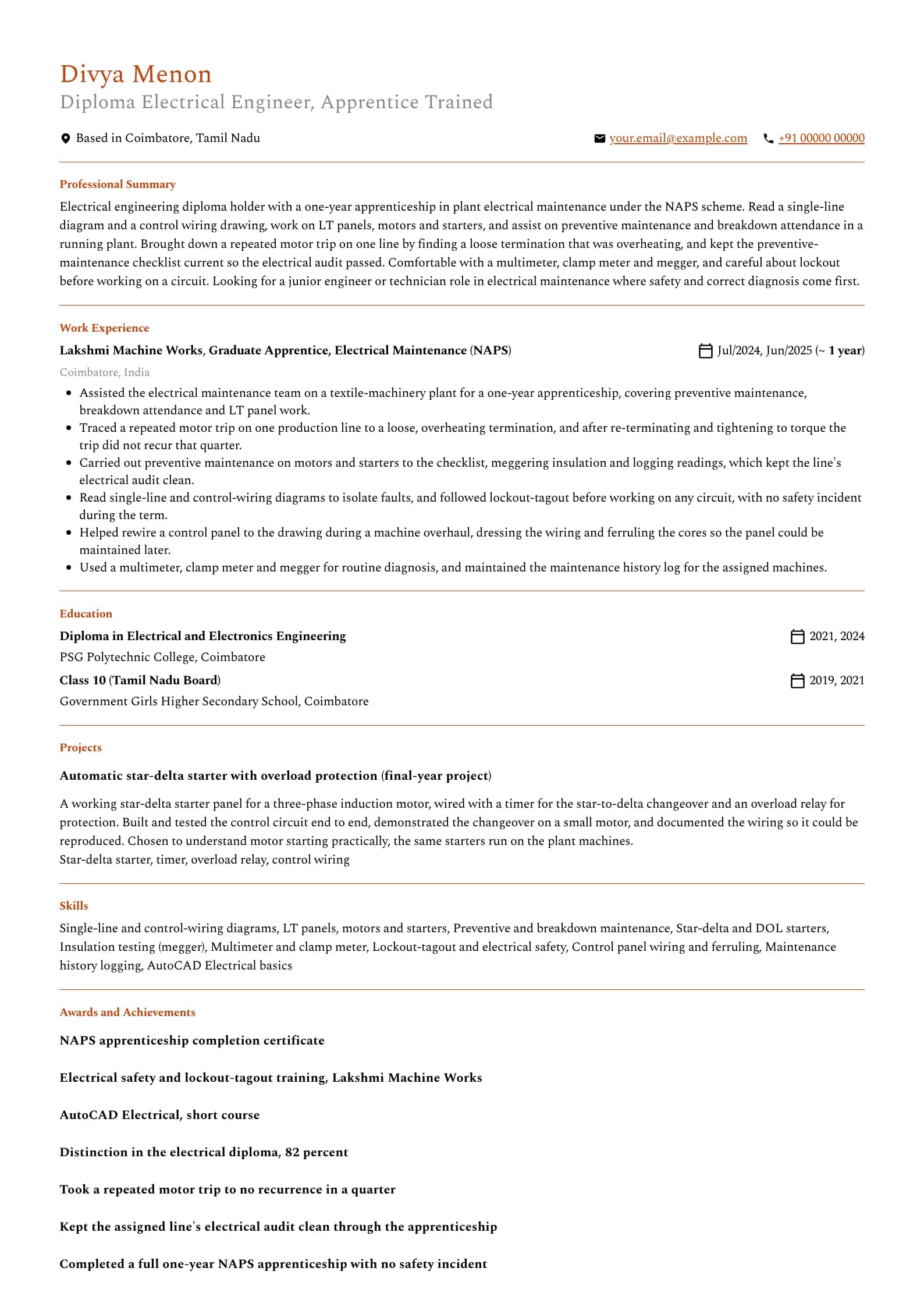
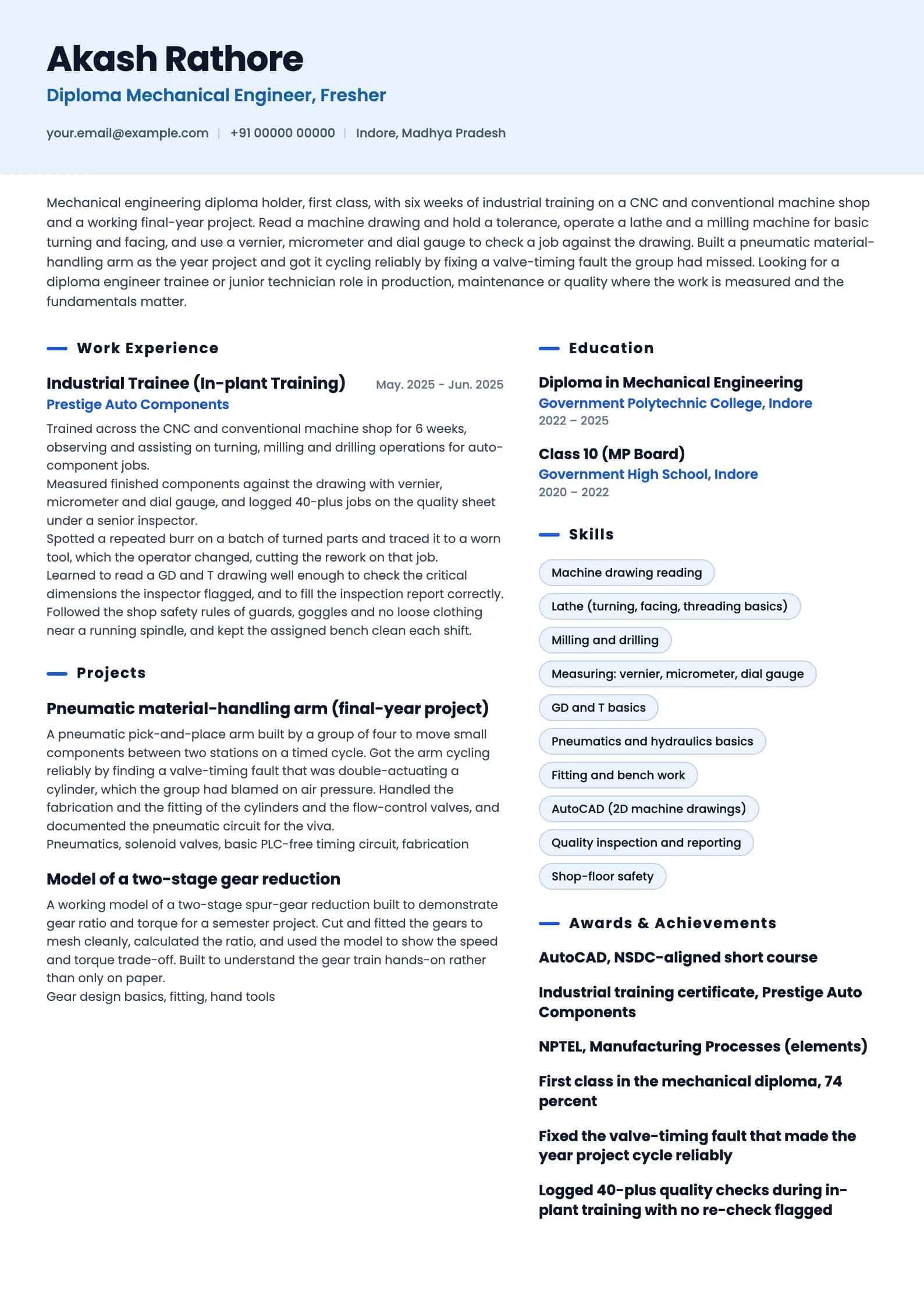
Diploma Fresher resume example, Diploma Fresher (Mechanical, 0 years)
ai-era templateIs your resume good enough?
Upload the resume you have now and see what an applicant tracking system reads before a diploma fresher recruiter ever does.
Free to run. Sign in with your mobile number to see your score.
Diploma Fresher resume example, Diploma with Apprenticeship (Electrical, 1 year)
professional templateThe format that works for a diploma fresher resume in India
Reverse chronological is the layout to use, even with little experience. Put your industrial training or apprenticeship first if you have one, then your diploma, then earlier schooling. A recruiter for a diploma engineer trainee role wants to read your history in order, so a functional layout that hides the dates works against you. One page is the right length for every diploma fresher. You do not have the history to fill two, and padding a second page with a declaration paragraph and hobbies reads as exactly that. If you are struggling to fill one page, that means your projects and training need more detail, not that you need more sections. Projects and training carry the page. With zero or one year of experience, the final-year project, the semester models and the in-plant training are the evidence a recruiter reads to decide whether you understood the diploma or only passed it. Put them above a thin experience section, describe them properly, and let them do the work. A photo, date of birth, marital status and father's name do not belong on the page, and this surface leaves the contact fields out on purpose so no sample can ship a phone number. A plant HR reads the training, the project and the marks; the personal block is space a project could have used. Send a PDF, name the file with your name and diploma trade, and keep it one column. The table below sets the section order for a fresher.
| Section | Where it goes | Why |
|---|---|---|
| Name and headline | Top, above everything | The headline is the role level, diploma engineer trainee or junior technician, and the branch. |
| Summary | Directly under the header | Three or four lines. Branch, what you can do, and the strongest project or training result. |
| Projects | Above experience for a fresher | The main evidence. Final-year project first, then a semester one. |
| Training or apprenticeship | Next, as experience | In-plant training or a NAPS apprenticeship. Treat it like a job. |
| Skills | Below training | Grouped: machines and drawing, tools, software, safety. Not one long line. |
| Education | Near the top for a fresher | Diploma with class and percentage, then Class 10. Marks still filter here. |
| Certifications | After education or beside skills | AutoCAD, an NPTEL, a safety card. Name the body and the year. |
Listing subjects is not the same as proving skill
The most common diploma fresher resume failure is a page that lists every subject from the syllabus, thermodynamics, strength of materials, fluid mechanics, machine design, as if the marksheet were the resume. A recruiter already assumes you studied the syllabus; the subject list tells him nothing about what you can do on a shop floor. The fix is to write skills, not subjects, and to prove each one. If you write lathe, a project or a training line should show a job you turned. If you write AutoCAD, a project should be the drawing you made. The mechanical sample lists measuring instruments precisely because the training bullet shows 40-plus jobs checked with a vernier, micrometer and dial gauge. The skill and the evidence agree, which is what makes both believable. Be specific about the machines and tools you have actually put your hands on. A shop wants to know whether you have run a conventional lathe, seen a CNC, wired a real panel, meggered a motor, not whether you can name them. Writing operate a lathe for turning and facing is stronger than a bare word, because it states the level honestly. Do not claim a software or a machine you saw once in a demo. A diploma fresher who lists SolidWorks, CATIA, ANSYS, PLC and SCADA together reads as padded, and a technical interviewer opens one of them in the first five minutes. List what you can actually work, keep it honest, and let the projects prove the depth.
For every machine or tool on your skills line, ask: is there a project or training line that shows me using it. If not, add the line or cut the claim. A diploma resume built on subjects instead of skills reads as a marksheet, not a candidate.
Writing a summary a plant recruiter actually reads
The block under your name is the part most likely to be read before a shortlist decision, so it should carry three things: your branch, what you can actually do, and the strongest project or training result you have. Three or four lines, in plain words, no adjectives a recruiter cannot check. The old objective, seeking a challenging position in a reputed organisation to enhance my skills and grow with the company, says nothing a recruiter did not already assume. Replace it with a summary that states the work. An objective describes what you want; a summary describes what you can already do and have already built, and only the second is evidence. Diploma freshers often think they have nothing to summarise. Look at the mechanical sample: it names the branch and class, the machines it can run, the instruments it can measure with, and the year project with the specific fault it fixed. That is a real summary built from a diploma, one training stint and a project. What it avoids is quick learner and hardworking, phrases so common on fresher pages that a recruiter's eye slides past them. A practical test: read your summary and ask whether any classmate from your batch could paste it onto their page unchanged. If they could, it describes the diploma, not you. Add the specific machine, the specific project fault and the specific measure until it only fits you.
Summary, diploma fresher
Weak
Hardworking and quick-learning diploma holder in mechanical engineering seeking a challenging position in a reputed organisation to utilise my technical skills and grow with the company.
Strong
Mechanical diploma holder, first class, able to read a machine drawing, run a lathe and mill for basic operations, and check a job with vernier, micrometer and dial gauge. Built a pneumatic handling arm and got it cycling by fixing a valve-timing fault.
The rewrite trades self-description and a wish for the branch, the machines the fresher can run, and one specific thing built and fixed.
Projects and training: what you built, found and fixed
For a diploma fresher, projects and training are the resume, and each one should read the way a good experience bullet reads. Name what the project or the training task was, what you specifically did on it, and the one thing that was genuinely hard, found or fixed. The topic tells a recruiter the area. The specific action tells him whether you did real work or watched. The find or the fix does the persuading. Start from what actually happened and work backwards. Freshers usually write the topic, made a project on pneumatic arm, and stop. Instead ask what went wrong and how it got solved, what you measured, what you fabricated with your own hands, what the viva examiner pushed on. The pneumatic-arm line is strong because it names a valve-timing fault the group had blamed on air pressure, which is a real diagnosis, not a topic. Vary what each entry proves. One project should show you can build and diagnose, another that you understand a core concept hands-on, and training should show shop-floor discipline, measurement and safety. Two well-described projects and one real training stint beat five projects listed by name only. Where there is no dramatic fix, give scope: how many jobs you checked, what you fabricated, what you wired, what you measured. Logged 40-plus jobs on the quality sheet carries weight without inventing a result. Treat an in-plant training or a NAPS apprenticeship as a job with real bullets, because to a recruiter that is the closest thing to work experience you have.
| Entry | What it should prove | Typical evidence |
|---|---|---|
| Final-year project | You can build and diagnose, not just describe | A fault found and fixed, what you fabricated, the viva point |
| Semester project or model | You understand a core concept hands-on | What you built, the calculation, what it demonstrates |
| In-plant training | You have shop-floor discipline and can measure | Jobs checked, instruments used, a defect spotted, safety |
| Apprenticeship (NAPS) | You can do real work under supervision | A breakdown attended, a fix, PM done, a clean safety record |
Project line, diploma fresher
Weak
Made a final-year project on pneumatic material handling system using pneumatic cylinders and valves which was appreciated by the faculty.
Strong
Built a pneumatic pick-and-place arm and got it cycling reliably by tracing a valve-timing fault that was double-actuating a cylinder, which the group had blamed on air pressure.
Swaps a topic and appreciated by faculty for the specific fault found and the diagnosis that fixed it, which is what an interviewer can ask about.
Training line, diploma fresher
Weak
Did industrial training in a machine shop and learned about various manufacturing processes and machines.
Strong
Measured 40-plus finished components against the drawing with vernier, micrometer and dial gauge during in-plant training, and traced a repeated burr to a worn tool the operator then changed.
Learned about is passive; the rewrite states what was actually done, how much, and a defect spotted that led to a fix.
If a project line would sit unchanged on any batchmate's page, it describes the topic, not you. Rewrite it until it names the fault you found or the part you built with your own hands.
The skills section: grouped, honest, and machine-specific
A diploma fresher's skills section has two readers. A plant HR may run the sheet past a filter and wants literal terms, lathe, AutoCAD, PLC, maintenance. A shop-floor engineer wants a short, organised list that tells him what you can be put on. Grouping serves both. Group by kind of skill rather than one long line. For a mechanical fresher, machines and drawing, measurement, software and safety works. For an electrical fresher, wiring and drawings, panels and machines, instruments and safety works. The headings matter less than the fact that structure exists. Write the terms the industry writes: GD and T not GDNT, megger not mega, AutoCAD not Autocad, because a filter matches on strings. Eight to fourteen skills is the working range for a fresher. Below eight the page looks thin, above sixteen it stops being a signal and reads as the syllabus copied out. Every skill is a promise you can answer a question on, so list what you can defend, not what you have heard of. Do not add star ratings. A four-star claim in AutoCAD invites an argument you cannot win as a fresher, and a shop-floor engineer will test it in a minute. Let the projects and training carry the depth, and keep the skills list clean and honest.
| Group | What goes in it | How many |
|---|---|---|
| Machines and work | Lathe, mill, drill, panels, motors, fitting, fabrication | 3 to 5 |
| Measurement and drawing | Vernier, micrometer, dial gauge, machine drawing, SLD | 2 to 4 |
| Software | AutoCAD, AutoCAD Electrical, basic SolidWorks if real | 1 to 3 |
| Maintenance and quality | Preventive maintenance, inspection, reporting, megger | 2 to 3 |
| Safety | Shop-floor safety, lockout-tagout, PPE discipline | 1 to 2 |
Skills section, diploma fresher
Weak
Skills: Thermodynamics, Strength of Materials, Fluid Mechanics, Machine Design, Manufacturing, AutoCAD, SolidWorks, CATIA, ANSYS, Creo, MATLAB, PLC, SCADA, C, C++, MS Office
Strong
Machines: lathe, milling, drilling, fitting. Measurement: vernier, micrometer, dial gauge, machine drawing. Software: AutoCAD (2D). Quality and safety: inspection and reporting, shop-floor safety.
Cuts the subjects and the software you only saw in a demo, keeps the machines and tools you have actually used, and groups them so an engineer reads what he can put you on.
Where education, marks and certifications belong
Education sits near the top for a diploma fresher, because it is one of your strongest signals when you have little work history. List the diploma with the branch, the polytechnic, the years, and the class or percentage, then Class 10 below it. Keep it to those lines. Marks still matter at this stage and are worth keeping while they are good, roughly first class and above, because campus and early-career screening for diploma engineer trainee roles often filters on percentage. Once you have a year or two of real plant experience, the diploma mark drops in importance and can move down or lose the percentage. A distinction stays worth showing longer than a bare pass. If you came to the diploma through an ITI, say so, because the ITI-to-diploma path is a genuine strength that shows hands-on grounding before the theory. Name the ITI trade and the diploma both; a recruiter reads that combination as a candidate who can work as well as calculate. Certifications sit just below education or beside skills. An AutoCAD or AutoCAD Electrical course, a relevant NPTEL, a NAPS apprenticeship completion, and a safety card all carry weight for a diploma fresher precisely because you have little else to point at. Write the full name, the body and the year. A course you started but did not finish is not a certification; leave it off rather than imply it is done.
Getting past the filter and the plant HR
Many diploma engineer trainee openings, especially at larger manufacturers and through campus drives, run applications through software before a human reads them, and even a plant HR reading by hand scans a fresher sheet the same rough way. Both look for the branch, the marks, the machines and the training, so the page has to make those easy to find. The layout rules are short. One column. Plain headings, so use Projects rather than My Creations, and Work Experience or Training rather than My Journey. No text inside an image or a college logo, because it reads as blank. Keep the branch and the level in the headline, diploma mechanical engineer, so the first search matches you. On wording, mirror the job posting where it is honest. If it asks for CNC, and you have seen a CNC in training, write CNC. If it asks for maintenance, and you did maintenance in an apprenticeship, write maintenance. Where a term has an acronym, put both once, for example PM (preventive maintenance), so either search finds you. Do not stuff the page with every software and machine name in small text to beat a filter. A recruiter reads it as padding and a shop engineer tests one claim, which is worse than a shorter honest list. Real project and training lines that name the machine in context carry the keyword and survive a human reading too. Save as a PDF and open it once to confirm you can select and copy a sentence. If the text does not select, a parser cannot read it either, and a diploma fresher cannot afford to be filtered out over a file that would not parse.
Section heading
Weak
My Technical Journey
Strong
Projects
A filter and a busy HR look for standard headings; a creative one can drop the whole block into a bucket nobody searches, and a fresher's projects are the block that matters most.
Copy the text out of your PDF into a plain editor before sending it. If the branch, the marks and the project titles read cleanly there, the filter will see them too. If they scramble, fix the layout, not the words.
What gets diploma fresher resumes set aside
Most diploma fresher resumes that get set aside fail for a small set of reasons, and every one is fixable in an evening. The list below covers what plant recruiters and campus screeners see most often on Indian diploma resumes, in rough order of how much damage each does.
- The syllabus copied out as skills. Subjects are assumed; a recruiter wants machines, tools and software you have actually used.
- A generic objective line. Replace it with a summary that states the branch, what you can do, and one project or training result.
- Projects listed by title only, with no fault found, part built or calculation shown. The project is the evidence, so describe it.
- Software you saw once in a demo listed as a skill. A shop engineer opens one in the interview and the page falls over.
- In-plant training reduced to one line. Treat it as a job with real bullets; it is the closest thing to experience you have.
- A photo, date of birth, marital status or father's name taking the space a project or training detail should have.
- No marks at all when they are good, or a full marksheet of every subject when a class and percentage would do.
- Claiming engineer-level skills a diploma fresher cannot back, which reads worse than an honest trainee-ready page.
- Hiding the ITI-to-diploma path, when naming both is a genuine strength that shows hands-on grounding.
- A decorated two-column template that scrambles in a parser, filtering out a candidate who would have passed a human read.
Read your resume as if you were the shop engineer about to interview you. Any skill you would not want opened in the first five minutes is a line to prove or cut.
Skills to put on a diploma fresher resume
Technical
- Machine drawing reading
- Lathe, milling and drilling
- Fitting and bench work
- Measuring instruments (vernier, micrometer, dial gauge)
- GD and T basics
- Single-line and control-wiring diagrams
- LT panels, motors and starters
- Preventive and breakdown maintenance
- Insulation testing (megger)
- Pneumatics and hydraulics basics
- Quality inspection and reporting
- Fabrication basics
Tools and platforms
- AutoCAD (2D)
- AutoCAD Electrical
- Vernier and micrometer
- Dial gauge and height gauge
- Multimeter and clamp meter
- Megger
- Basic SolidWorks
- MS Office and Excel logs
Working skills
- Following instructions on the shop floor
- Measurement discipline
- Safety awareness (PPE, lockout-tagout)
- Punctuality and attendance
- Willingness to learn on the job
- Reporting and record keeping
- Teamwork on a project
- Honesty about what you can and cannot do
Certifications worth listing as a diploma fresher
| Certification | Full name | Worth it for |
|---|---|---|
| NAPS Apprenticeship | National Apprenticeship Promotion Scheme completion certificate | Strong for any diploma fresher who has done a plant apprenticeship, because it is the closest thing to real work experience a recruiter accepts on paper. Worth naming plainly with the company and the trade; a completed NAPS year often matters more to a hiring plant than the diploma marks. |
| AutoCAD | AutoCAD 2D drafting certificate (NSDC-aligned or Autodesk) | Worth it for mechanical and civil diploma freshers, since drafting is a near-universal first-job task and the software keyword is scanned for. Most useful when a project or training line shows a drawing you actually made in it, so the certificate and the work agree. |
| AutoCAD Electrical | AutoCAD Electrical or an equivalent panel-drawing course | Useful for electrical and instrumentation diploma freshers heading into maintenance or panel work, where reading and drawing control schematics is a daily task. Pairs naturally with an apprenticeship line that shows panel wiring or fault-finding on a real machine. |
| NPTEL | NPTEL online course completion (relevant subject) | A free, verifiable credential worth it for a diploma fresher who wants to show initiative beyond the syllabus in a specific area such as manufacturing processes or basic electrical machines. Modest weight on its own, but it fills a thin certifications section honestly. |
| Safety Card | Industrial or electrical safety and lockout-tagout training | Worth it for any diploma fresher heading into a plant, especially electrical and maintenance roles, because an audited factory wants someone who will not cause a stoppage. A short but genuine signal that you take PPE and isolation seriously, which matters from day one. |
Keywords an ATS scans for in a diploma fresher resume
These are the literal terms a parser matches against the job description. Use the ones that are true of you, in the sentences where you did the work, not as a list at the bottom.
- diploma engineer trainee
- diploma mechanical
- diploma electrical
- junior engineer
- technician
- industrial training
- apprentice
- NAPS
- AutoCAD
- machine drawing
- lathe
- CNC
- preventive maintenance
- quality inspection
- GD and T
- control wiring
- megger
- safety
- final year project
- fresher
Diploma Fresher resume FAQ
What salary can a diploma fresher expect in India?
A diploma engineer trainee or junior technician in private manufacturing usually starts around 12,000 to 20,000 a month, roughly 1.5 to 2.4 LPA, more at larger organised plants and in metros. A NAPS apprentice earns a stipend, commonly 8,000 to 14,000 a month, and often converts to a trainee role afterwards. Government junior engineer posts pay more but come through separate exams. A strong diploma mark, a real apprenticeship, and a drafting or safety certificate push the top of the private band upward, and the branch matters, with core mechanical, electrical and instrumentation roles differing by plant.
How long should a diploma fresher resume be?
One page, always. A diploma fresher does not have the history to fill two, and a second page built from a declaration and hobbies reads as padding. If you are struggling to fill one page, that means your projects and training need more detail, describe the fault you found and the part you built, rather than that you need to add sections. One well-filled page beats a padded two.
I only have projects, no job. What do I put as experience?
Put your industrial or in-plant training and any apprenticeship in the experience section and treat each like a job, with real bullets: what you did, how many jobs you handled, what you measured, a defect you spotted, the safety you followed. Above that, put your projects, because for a fresher the final-year project is the strongest evidence you can offer. Describe the project by what it does, what you built with your own hands and the one thing that was hard, not just the topic.
Should I put my diploma percentage on the resume?
Yes, while you are a fresher and it is good, roughly first class and above, because early-career and campus screening for diploma engineer trainee roles filters on it. Put the diploma class and percentage near the top with Class 10 below. Once you have a year or two of real plant experience, the mark drops in importance and can move down. A distinction is worth showing longer than a bare pass.
Does an apprenticeship help a diploma fresher get hired?
A completed apprenticeship, especially under NAPS, is one of the strongest things a diploma fresher can carry, because it is the closest thing to real work experience a recruiter accepts on paper. Name the company, the trade and the year, and describe it with real bullets: a breakdown attended, a fix made, preventive maintenance done, a clean safety record. Many plants weigh a completed apprenticeship above the diploma marks when they shortlist.
Should I list all the subjects I studied in the diploma?
No. A recruiter already assumes you studied the syllabus, so a list of subjects tells him nothing about what you can do. List skills instead, the machines you have run, the instruments you can measure with, the software you can draft in, and prove each in a project or training line. If you want to signal a relevant area, name a couple of subjects in your education line at most, not a full marksheet copied out as skills.
I did an ITI before the diploma. Should I mention it?
Yes, and it is a genuine strength, not something to hide. The ITI-to-diploma path shows hands-on grounding before the theory, which many plants value. Name the ITI trade and the diploma both in your education section. A recruiter reads that combination as someone who can work on the shop floor as well as read a drawing, which is exactly what a diploma engineer trainee role wants.
Which software should a diploma fresher put on the resume?
Only what you can actually work. AutoCAD 2D is a safe and valuable one for mechanical and civil freshers because drafting is a common first task, and AutoCAD Electrical for electrical and instrumentation. If you genuinely used SolidWorks or a PLC in a project, list it and let the project prove it. Do not list CATIA, ANSYS, SCADA and MATLAB together after seeing them once in a demo, because a shop engineer opens one in the interview and a padded list costs you more than it gains.
Do I need a photo or personal details on a diploma resume?
No. A plant recruiter reads your training, project and marks, not a photo, and the photo, date of birth, marital status and father's name only take the space a project detail should occupy. These come from an older campus template and add nothing to a technical screen. Keep the page to your name and role at the top, then the summary, projects, training, skills and education that actually decide the shortlist.
Related resume examples and guides
Build your own diploma fresher resume in any of these formats
Start from a blank page or the details you already have. Goodspace puts your projects, training and diploma marks in a clean single-column format a plant recruiter and a parser both read easily, and flags the machine, drafting and maintenance keywords a diploma engineer trainee opening scans for.
Build my resume