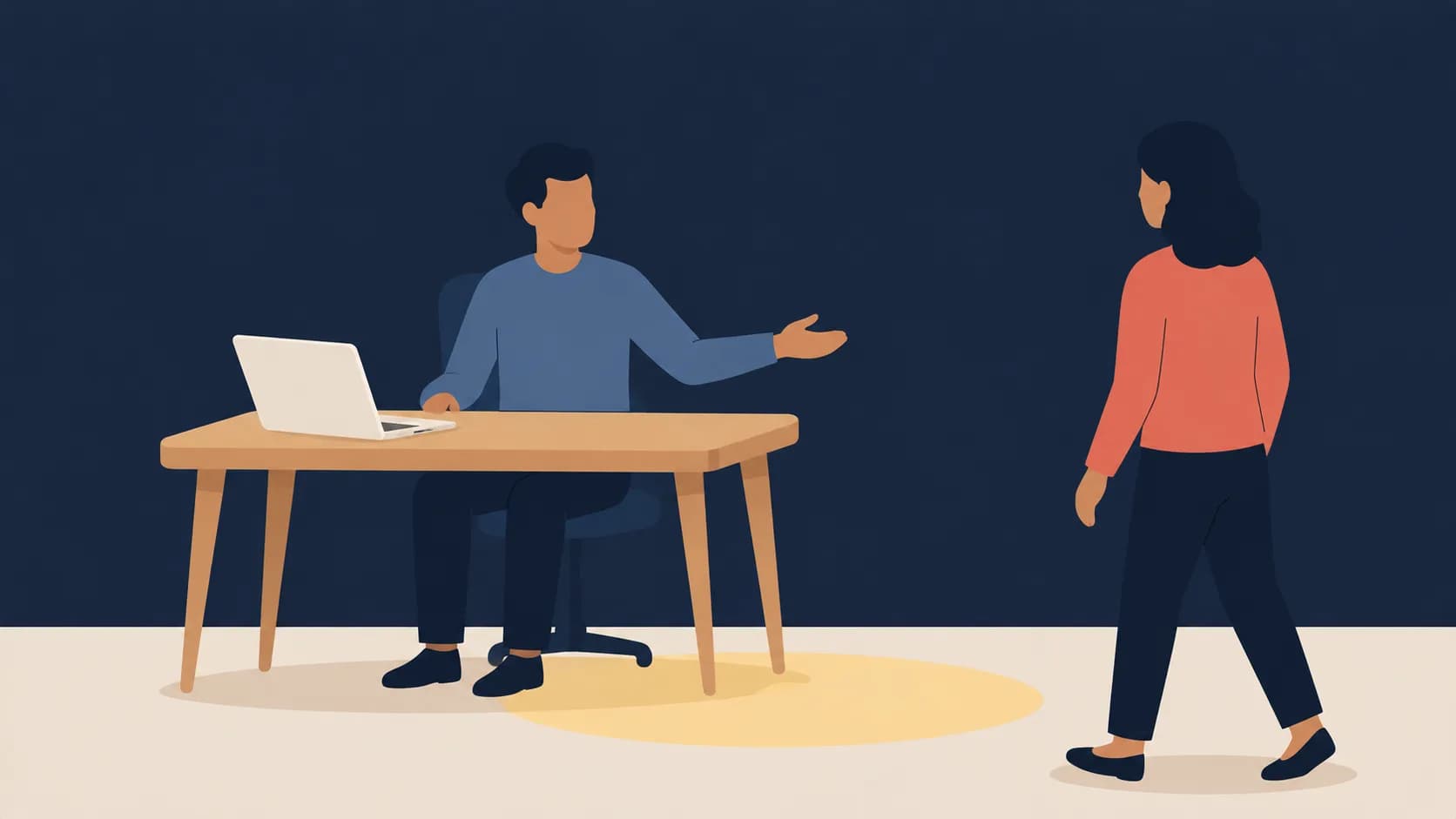
Approachability is not about being available all the time. It is about people believing that interrupting you will go well. Those are different things, and the gap between them explains why some very busy people are constantly asked useful questions while some people with open calendars are asked nothing at all.
The cost of being unapproachable is invisible to the person paying it. You do not see the question that was not asked, the problem that was solved badly by someone who did not want to bother you, or the piece of context that stopped one step short of your desk. This guide covers what makes someone approachable, the signals that quietly push people away, how workplace relationships actually get built, and what changes when the team is remote.
What does it mean to be approachable at work?
Being approachable means people expect a good outcome from initiating contact with you. They believe you will listen, that you will not make them feel stupid, that the interaction will be reasonably short, and that you will not hold it against them later. Approachability is a prediction other people make about you, based on evidence you have given them.
That reframing is useful because it makes it actionable. You cannot decide to be approachable. You can change the evidence people are working from, and the evidence is mostly:
- How you responded the last three times someone interrupted you.
- How you react when someone says something wrong in a meeting.
- Whether your response time is predictable.
- What your face does when you are concentrating.
- Whether you have ever asked anyone a question yourself.
That last one is underrated. People approach those who approach them. If you have never asked a colleague for help, they will not ask you.
What makes someone unapproachable without them realising?
The habits that make people unapproachable are almost all invisible to the person doing them, because they feel like ordinary concentration or ordinary efficiency from the inside.
Continuing to type while someone talks. The most common one. It reads as "you are less important than this message" even when it is not intended that way and even when you are genuinely still listening.
A neutral expression that reads as annoyed. Many people have a resting face that looks displeased when they are simply thinking. Nobody will ever tell you this unprompted, and it changes how often you are approached more than almost anything else.
Answering the question underneath the question, dismissively. "Why are you even doing it that way" is a reasonable technical point and a conversation ender.
Visible impatience at the wrong pace. Finishing people's sentences, sighing at a long preamble, checking the time. Each is small and each is remembered.
Unpredictable response times. Replying in four minutes on Monday and four days on Wednesday teaches people that contacting you is a gamble. Predictable slowness is far better than erratic speed.
Being permanently in meetings. A calendar that shows no gaps signals unavailability regardless of your intent, and people stop trying.
Reacting badly once. A single sharp response can end a person's willingness to approach you for months. The asymmetry is unfair and real.
Only being warm to seniors. Extremely visible to everyone below you and extremely damaging to your reputation, because it reads as character rather than as busyness.
Correcting in public what could be corrected in private. Even a mild correction in front of others teaches everyone watching that approaching you carries risk.
How do you signal that you are approachable?
You signal approachability through small, repeated, visible actions rather than through statements about your door being open. Nobody has ever been made approachable by announcing an open door policy.
The signals that work:
Stop what you are doing, briefly and visibly. Turn away from the screen. Close the laptop. Even a five second version communicates more than a distracted twenty minute conversation.
Give a real answer about timing. "I have got ten minutes now" or "I am in the middle of something, can I come to you at three?" Both are approachable. Silence or a vague "sure" while continuing to work is not.
Respond to the ask before the critique. Answer what they asked. If their approach is wrong, raise it after, and as a suggestion rather than a verdict.
Thank people for interrupting when it mattered. "Good that you flagged that early" costs one sentence and buys you the next three flags.
Ask questions yourself, visibly. Being seen to say "I do not know, can someone help me with this" makes it safe for everyone else. This is the single most effective thing a senior person can do.
React calmly to bad news, every time. Your reaction to the first bad news determines how quickly you hear the second. If it goes badly once, people will delay.
Keep some visible unbooked time. Two hours of open calendar signals availability even to people who do not use it.
Be equally warm downward. Consistency across seniority is the most watched signal in any workplace and almost nobody realises how closely it is observed.
How do workplace relationships actually get built?
Workplace relationships are built through repeated low-stakes contact, not through occasional deep conversations. The colleague you exchange thirty seconds with daily will become a stronger connection than the one you had a two hour lunch with once.
The mechanisms that actually work:
Proximity and frequency. Regular contact, however brief, builds familiarity, and familiarity builds trust in advance of any evidence for it. This is why the person sitting next to you becomes an ally by default.
Shared difficulty. Nothing builds a working relationship like getting through something hard together. A bad launch, a difficult client, a weekend outage. If you want a stronger relationship with someone, working on a genuine problem together beats any social activity.
Asking for something small. Counterintuitively, asking a colleague for a small favour increases their warmth towards you rather than depleting it. People like those they have helped, and a small ask is an invitation into a relationship.
Following up on a personal detail. Remembering that someone's parent was unwell and asking about it a week later is a very small act that lands disproportionately.
Reliability. The base layer under all of this. Warmth without follow-through produces a pleasant person nobody depends on, which is not a relationship of any value.
The important negative: relationships are not built by attending social events you find unpleasant. If team dinners are not your thing, they are not the route. Fifteen minutes of genuine help on a work problem does more than three hours of forced socialising.
How do you stay approachable when you genuinely need focus time?
Protect your attention with structure rather than with unavailability. The mistake is treating approachability and deep work as a binary. They are a scheduling problem, and a stated pattern solves it.
What works:
Publish the pattern. "I keep mornings for focused work and I am generally free after two. If something is urgent, message me and I will pick it up." Now interruption has a route and a time, and people stop guessing.
Distinguish urgent from important, out loud. Give people a way to signal urgency that you commit to honouring. If everything must wait until two, then urgent things break the system and people stop respecting it.
Batch your availability. Fixed office hours, two slots a week, work particularly well for senior people. It concentrates questions, people arrive prepared, and each one is shorter.
Close the loop when you defer. "Not now, come back at three" only works if you are actually available at three. Deferring and then being unavailable teaches people not to try.
Use physical and digital signals honestly. Headphones, a status marker, a blocked calendar. These work if they are accurate. If you use do-not-disturb permanently, it becomes noise.
The underlying principle: unpredictability is what makes people stop approaching you, not unavailability. A person who is reliably unavailable until two is easier to work with than one who might respond instantly or might not respond for two days.
How do you stay approachable when you are remote?
Remote work removes every passive signal of availability, so all of it has to be made explicit. In an office people can see you are at your desk, see you are not in a meeting, and read your expression before deciding to interrupt. Remotely they have none of that, so they default to not interrupting, and the questions simply do not get asked.
What compensates:
Predictable response windows, stated. "I check messages morning, after lunch and end of day. Tag me if it is urgent." This replaces the visual information they have lost.
Camera on for anything relationship-bearing. You do not need it for every call. You do need it for one-on-ones, for new joiners, and for any conversation where tone could be misread. Text strips warmth, and video restores most of it.
Over-communicate warmth in writing. Remote text reads colder than intended, consistently. A message that would be fine in person reads as curt on Slack. Compensate deliberately: acknowledge before disagreeing, add a line of context, use their name, and be more generous with punctuation and thanks than feels natural.
Move heat to voice quickly. Any disagreement that is escalating in text should become a call. Text escalates because it removes tone and creates time for interpretation. Voice de-escalates. This one rule prevents most remote conflict.
Create the low-stakes contact deliberately. The corridor conversation does not happen remotely and nothing replaces it accidentally. A fifteen minute non-agenda call, the first three minutes of a recurring meeting kept for anything other than work, a channel for non-work talk. These feel artificial and they work.
Be visibly human. Mentioning that you are tired, that the day has been difficult, that you got something wrong. Remote colleagues have no other evidence that you are a person rather than a role.
Reach out first, especially to new joiners. A remote new joiner will not interrupt anyone for weeks. They need to be approached, repeatedly, before they will approach. If you are a senior person on a hybrid team this is the highest-value fifteen minutes in your week.
How does approachability differ by seniority?
The more senior you are, the more effort approachability requires, because the power distance does the work of pushing people away without you doing anything at all. A director's neutral expression is read as displeasure. A director's short reply is read as a rebuke.
What changes as you get more senior:
- Your reactions get amplified. Mild irritation reads as anger two levels down.
- People stop telling you things. The filtering starts immediately and increases with every level.
- Your calendar becomes a signal. Fully booked means unavailable, regardless of intent.
- You have to initiate. Junior people will not approach you first, so if you wait, nothing happens.
- Asking for help becomes a gift. A senior person visibly saying "I do not know" gives everyone below permission.
Practical adjustments for senior people: schedule skip-level conversations rather than waiting for them, respond to bad news with visible calm every single time, ask questions in group settings so it is safe for others, and be conspicuously warm to the most junior people in any room. That last one is observed by everyone and shapes the culture more than any policy.
Frequently asked questions
How can I be more approachable at work? Stop what you are doing when someone comes to you, give a real answer about timing rather than a vague yes, answer what they asked before critiquing their approach, respond within a predictable window, and ask other people questions yourself so it is visibly normal.
What makes someone unapproachable? Continuing to work while someone talks, a resting expression that reads as annoyed, unpredictable response times, correcting people in public, reacting sharply even once, and being visibly warmer to seniors than to juniors. Most of these are invisible to the person doing them.
How do I stay approachable while protecting focus time? Publish a pattern rather than being unavailable. State when you are open and when you are heads down, give people a route for genuinely urgent things, and honour deferrals when you make them. Unpredictability stops people approaching you far more than unavailability does.
How do I build relationships with colleagues remotely? Through frequent low-stakes contact rather than occasional long conversations. Keep the first few minutes of recurring calls for non-work, keep the camera on for one-on-ones, over-compensate for the coldness of text, and move any escalating disagreement to voice.
Why do people not ask me questions? Usually because the last interaction went badly in a way you did not register, because your response times are unpredictable, or because your calendar and expression signal unavailability. Ask one trusted colleague directly how you come across. Most people are surprised by the answer.
Does being approachable mean being available all the time? No. It means people expect a good outcome from contacting you. A person who is reliably available for two hours a day is more approachable than one who might respond instantly or might disappear for a week.
How do I get people to bring me bad news earlier? Respond calmly every single time, and thank the person for raising it before addressing the content. Your reaction to the first piece of bad news determines the timing of the second. One sharp response can add weeks to future disclosure.
Is approachability different for senior people? Yes, and it takes more deliberate effort. Power distance means your neutral reads as negative and your short reply reads as a rebuke. Senior people have to initiate contact, visibly admit uncertainty, and be conspicuously warm to junior colleagues, because nobody will come to them first.
Related reading
- Friendliness at work: the interpersonal skill that pays
- Empathy and emotional intelligence at work
- Why helpfulness is important at work
Friendliness sits alongside reliability, integrity, honesty, teamwork, truthfulness, helpfulness and kindness in the Goodspace Goodness Score. Because approachability is something only other people can accurately judge, the assessment validates your answers against peer responses rather than self-report. Take it here.