Emotional intelligence has been so heavily marketed that the term has lost most of its meaning. It gets used to mean being nice, being intuitive, or having good instincts about people, none of which are quite it. The useful definition is narrower and more mechanical: emotional intelligence is the ability to notice emotional information, in yourself and others, and to use it to make better decisions about what to do next.
That definition is trainable, which is the point. This guide covers what emotional intelligence at work actually consists of, the four capabilities it breaks into, what empathy really means at work and why the popular version is wrong, how it changes feedback and conflict, and how it is assessed in interviews.
What is emotional intelligence at work?
Emotional intelligence at work is the ability to recognise emotional states, your own and other people's, understand what is driving them, and use that information to choose a more effective action. It is not about being emotional, and it is not about being agreeable. It is about treating emotional information as data rather than as noise.
The reason it matters professionally is simple: most workplace failures at senior level are not technical. They are misjudged conversations, escalations that did not need to happen, feedback that was accurate and unusable, decisions that were correct and unimplementable because nobody was brought along. All of those are emotional information problems.
Daniel Goleman popularised the framework in the mid nineties and it remains the most usable breakdown, dividing the capability into four domains along two axes: awareness versus management, and self versus others.
What are the four components of emotional intelligence?
1. Self awareness
Knowing what you are feeling while you are feeling it, and knowing how it affects your judgement. This is the foundation, because you cannot regulate a state you have not noticed.
At work this looks like: recognising that you are irritated before you reply to the message. Knowing that you argue badly when tired. Understanding which kinds of criticism land hardest for you and why. Being able to say "I am reacting to this more strongly than the situation warrants, let me come back to it."
Most people substantially overestimate their self awareness. The practical test is not whether you can describe your character but whether you can name what you are feeling in the moment, before you act on it.
2. Self regulation
Managing your reaction so that your response is chosen rather than automatic. Not suppression, which leaks out anyway, but the ability to insert a gap between the stimulus and the response.
At work: not sending the reply until the next morning. Staying level when challenged in front of others. Choosing not to correct something in a meeting that could be corrected privately. Delivering unwelcome news without defensiveness.
The mechanism people find most useful is naming the emotion internally, which reliably reduces its intensity. Labelling what you are feeling engages a more deliberative mode of thinking and takes the edge off the reactive one. It is not mystical, it just works.
3. Social awareness
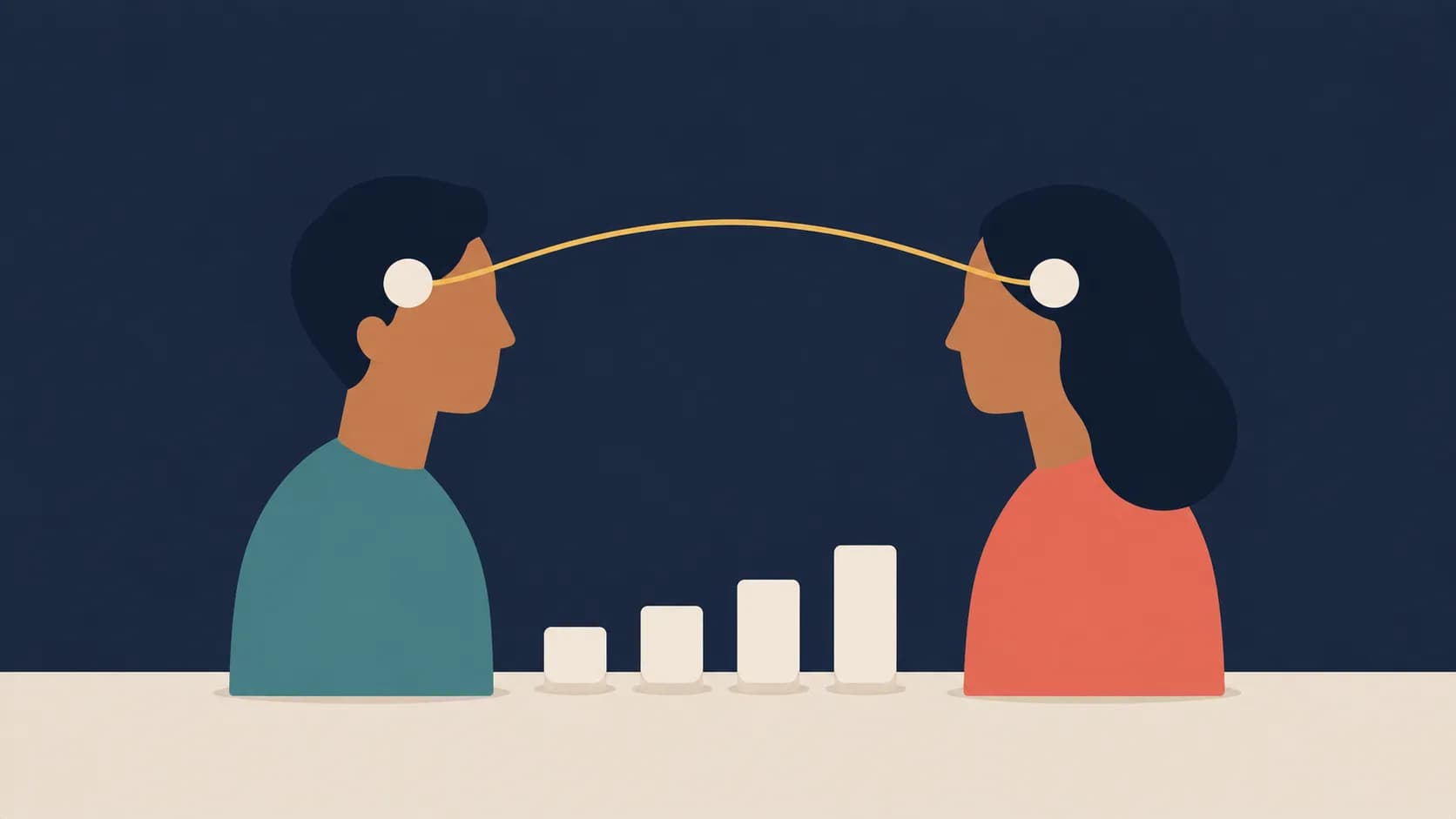
Reading what is happening for other people, including what they have not said. This is where empathy sits.
At work: noticing that the room went quiet after a particular comment. Recognising that a stakeholder's stated objection is not their real one. Reading that a colleague who is agreeing enthusiastically has actually checked out. Understanding the political constraints someone is operating under before you ask them for something.
4. Relationship management
Using all of the above to actually influence outcomes: giving feedback that lands, resolving conflict, building trust, persuading, leading through change.
This is the output of the other three. People with strong self and social awareness who cannot do anything with it are perceptive and ineffective, which is a real and frustrating combination.
What is empathy at work, and what is it not?
Empathy at work is understanding another person's position and pressures accurately enough to predict how they will react and what they need. It is primarily a cognitive skill. The popular version, feeling what someone else feels, is a different thing and is actually a poor fit for professional situations.
Psychologists distinguish three kinds, and the distinction is genuinely useful:
Cognitive empathy. Understanding another person's perspective and state. Analytical, learnable, and the most useful of the three at work.
Affective or emotional empathy. Actually feeling what they feel. Powerful for connection, and it has real costs: it does not scale, it clouds judgement in difficult decisions, and sustained exposure produces compassion fatigue.
Compassionate empathy. Understanding plus a motivation to help, without being overwhelmed. Usually the right target for professional settings.
The reason this matters: a manager who feels their team's distress fully cannot make a redundancy decision well, and will often delay it in ways that make things worse for everyone. A manager with strong cognitive and compassionate empathy can understand exactly how it will land, plan the communication properly, handle it humanely, and still make the decision. That is the more useful capability.
The other correction worth making: empathy is not agreement. You can understand precisely why someone holds a position and still think they are wrong and act against it. Conflating the two produces managers who cannot decide anything.
How does empathy change how you give feedback?
Empathy changes feedback from an accurate statement into a usable one. The content of good feedback is often obvious. What determines whether it produces change is whether the person can hear it, and that depends almost entirely on preparation you do before opening your mouth.
What empathy adds:
Understanding what they think is happening. Very often the person believes they are doing well, or believes the problem is elsewhere. Feedback that does not engage with their existing model will bounce off it.
Choosing the timing. The same feedback lands differently on the day of a failed launch versus a week later. Immediate is usually better, but not while someone is still in the middle of the crisis.
Predicting the defence. If you know the objection they will raise, you can address it before it becomes an argument.
Separating the person from the work explicitly. "This analysis does not hold up" is about the work. "You are careless" is about the person. The first is actionable and the second triggers a defence of identity.
Knowing when to stop. Once the point has landed, continuing to explain is for your benefit, not theirs. A great deal of feedback fails because it was correct and went on for ten minutes too long.
The situation-behaviour-impact structure is simple enough to actually use under pressure. Describe the situation, describe the specific behaviour, describe the effect. "In the client call yesterday, when they asked about timelines, you committed to the 15th without the dependency caveat. They have now planned a launch around a date we cannot hold." Specific, non-personal, actionable. Compare with "you need to be more careful with clients", which contains no information.
How does emotional intelligence change how you handle conflict?
It changes what you are responding to. Low emotional intelligence responds to the words. High emotional intelligence responds to what is actually driving them, which is frequently something entirely different from the stated issue.
The practical moves:
Find the real objection. The stated objection is often a proxy. "This timeline is unrealistic" can mean "I was not consulted", "I do not trust the other team", or "I am already overloaded and cannot say so". Ask: "What would need to be true for this to work for you?" The answer usually reveals the real constraint.
De-escalate before problem solving. Nobody solves a problem while they are angry. Acknowledge first: "I can see this has been frustrating, and I think that is fair." Acknowledgement is not agreement, and it is the fastest way to lower the temperature.
Move heat to voice. Text removes tone and adds interpretation time, which is why written disagreements escalate. Any conflict that is heating up in writing should become a call. This single rule prevents a large fraction of workplace conflict.
Watch for the hijack. When you feel your own reaction spike, you are temporarily worse at judgement. The response is mechanical: do not respond now, name what you are feeling, come back to it. There is no version of this where responding immediately produces a better outcome.
Separate positions from interests. Two people arguing over a deadline may have compatible underlying interests, one needs predictability and one needs flexibility. Positions conflict far more often than interests do.
Give them a way to change position without losing face. Most people will not concede if conceding is humiliating. Providing a route out, "given what you have just said about the dependency, would it make sense to...", resolves things that pure argument cannot.
Can emotional intelligence be learned?
Yes, and it is more trainable than most fixed personality traits, because the components are behaviours rather than dispositions. The evidence for the trainability of specific skills, feedback delivery, conflict handling, perspective taking, is considerably stronger than the evidence for emotional intelligence as a single measurable quantity.
Practices with the best return:
Name the feeling before acting. Internally, in words. "I am embarrassed, which is why I want to argue with this." The naming does most of the work.
Institute a delay on emotional responses. A personal rule that nothing written while irritated gets sent for at least an hour. This one rule prevents more damage than any amount of self-knowledge.
Ask about the objection rather than answering it. "Help me understand the concern" before defending. Most people skip straight to defence and never learn what the actual issue was.
Predict the reaction before difficult conversations. Two minutes beforehand: how will they take this, what will they be worried about, what will they say first. Cheap and unreasonably effective.
Get external data on how you come across. Self assessment of emotional intelligence is notoriously unreliable, and the people with the largest blind spots rate themselves highest. Ask a trusted colleague specifically: "How do I come across when I disagree with someone?"
Debrief your own bad conversations. After one that went badly, ask what you missed rather than what they did. This is uncomfortable and it is where the learning is.
How is emotional intelligence assessed in interviews?
It is assessed through behavioural questions about conflict, failure and difficult relationships, and through how you conduct yourself during the interview itself. Interviewers watch whether you listen, whether you answer what was asked, and how you describe people who are not in the room.
The most revealing single signal: how you talk about a former manager or colleague you did not get along with. Candidates who describe the other person as unreasonable, difficult or irrational without any account of their perspective are demonstrating exactly the deficit being tested.
Common questions:
- Tell me about a conflict with a colleague and how it was resolved.
- Describe a time you received difficult feedback. What did you do?
- Tell me about a time you had to work with someone whose style was very different from yours.
- Describe a situation where you had to persuade someone who disagreed with you.
- Tell me about a time you got something badly wrong.
- How do you handle a team member who is underperforming?
The strongest answers contain three things: a genuine account of the other person's point of view, an acknowledgement of your own contribution to the problem, and a specific behavioural change rather than a resolution that happened to you. The Goodspace AI Mock Interview runs these behavioural rounds and follows up on answers that externalise all the responsibility, which is the most common failure pattern.
Some employers also use structured assessments. Be aware that self-report emotional intelligence questionnaires are easy to game, which is why the better instruments include reverse-scored items, social desirability traps and peer validation. The Goodspace Goodness Score uses all three for exactly this reason.
Frequently asked questions
What is emotional intelligence at work in simple terms? The ability to notice emotional information, in yourself and in others, and use it to choose a better action. It is not about being nice or agreeable. It is about treating how people feel as useful data rather than as noise to be worked around.
What are the four components of emotional intelligence? Self awareness, knowing what you feel as you feel it. Self regulation, choosing your response rather than reacting. Social awareness, reading what is happening for others, which is where empathy sits. Relationship management, using all three to influence outcomes.
What is empathy at work? Understanding another person's position and pressures accurately enough to predict how they will react and what they need. The most useful form at work is cognitive empathy, which is analytical and learnable, rather than feeling what they feel, which does not scale and clouds difficult decisions.
Is empathy the same as agreeing with someone? No. You can understand exactly why someone holds a position, and why it is reasonable given their information and incentives, and still think they are wrong and decide against them. Conflating the two produces people who cannot make decisions.
Can emotional intelligence be learned? Yes. The components are behaviours rather than fixed traits: delaying emotional responses, naming feelings before acting, asking about an objection before defending against it, and predicting reactions before difficult conversations. All of these are trainable within weeks.
How does emotional intelligence help at work specifically? It improves the conversations that decide outcomes: feedback that produces change rather than defensiveness, conflict resolved at the real cause rather than the stated one, and decisions that people will actually implement because they were brought along.
What is compassion fatigue? The exhaustion that results from sustained affective empathy, feeling other people's distress repeatedly. It is common in management and in support-facing roles. Compassionate empathy, understanding plus a motivation to help without absorbing the emotion, is the more sustainable stance.
How do I know if I have low emotional intelligence? Self assessment is unreliable and people with the biggest blind spots rate themselves highest, so ask instead. A useful question to a trusted colleague: "How do I come across when I disagree with someone?" The answer is usually more informative than any self-rating.
Related reading
- Why kindness is important at work, and why it is not niceness
- Friendliness at work: the interpersonal skill that pays
- How to be approachable at work
Kindness and friendliness are two of the eight values assessed in the Goodspace Goodness Score, alongside reliability, integrity, honesty, teamwork, truthfulness and helpfulness. Because emotional intelligence is the area where self-perception diverges most from how others experience you, the assessment validates every self-reported answer against responses from people who have actually worked with you. Take it here.