Waiter Resume Format, with 3 Full Samples
A waiter is hired on evidence of covers turned, upsells landed and guests who came back asking for you by name, yet most resumes for the role read like a duty list copied off a training manual. Below are three complete resumes, one for a hotel-management fresher with banquet and industrial-training exposure, one for a fine-dining steward who runs a station on a busy floor, and one for a captain leading a team across a full service. After the samples come the format rules, the difference between listing food service and proving it, the POS and menu terms a parser matches, and the mistakes that get a resume dropped before a restaurant manager reads it.
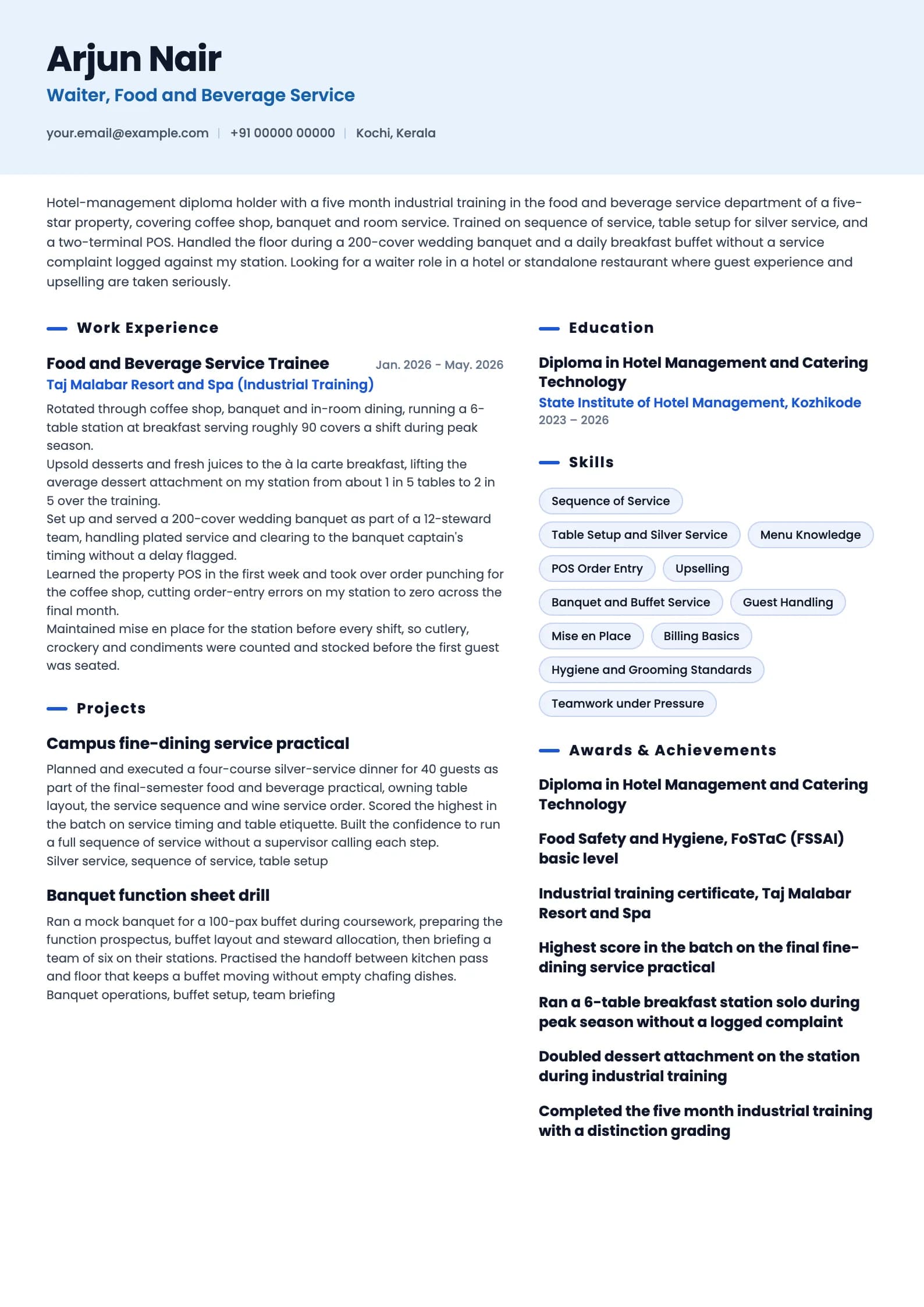
Build my resumeWaiter resume example, Fresher (0 years)
ai-era templateIs your resume good enough?
Upload the resume you have now and see what an applicant tracking system reads before a waiter recruiter ever does.
Free to run. Sign in with your mobile number to see your score.
Waiter resume example, Steward (4 years)
professional template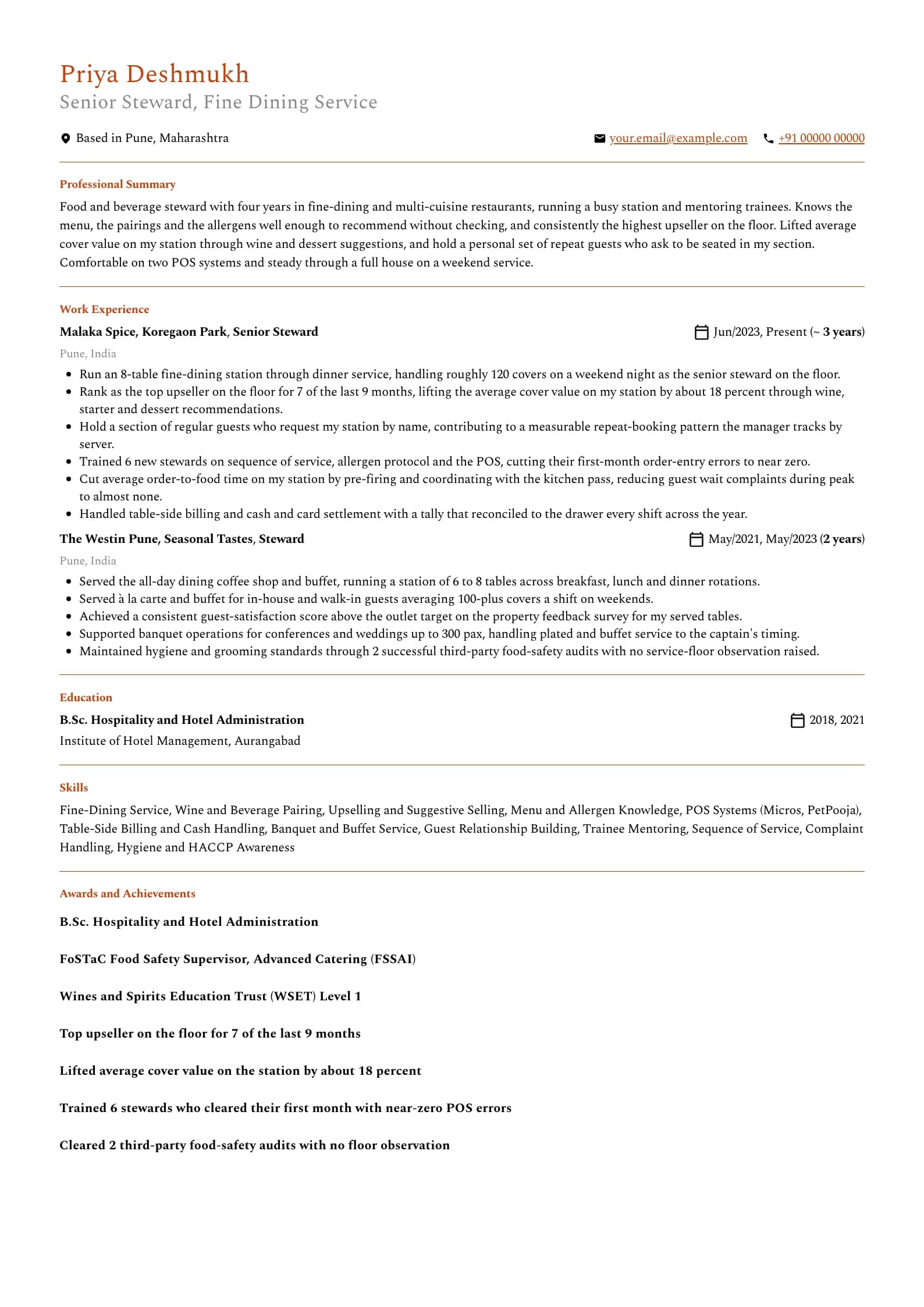
Want this structure with your own details? Build it in the resume builder.
Waiter resume example, Captain (8 years)
header-band template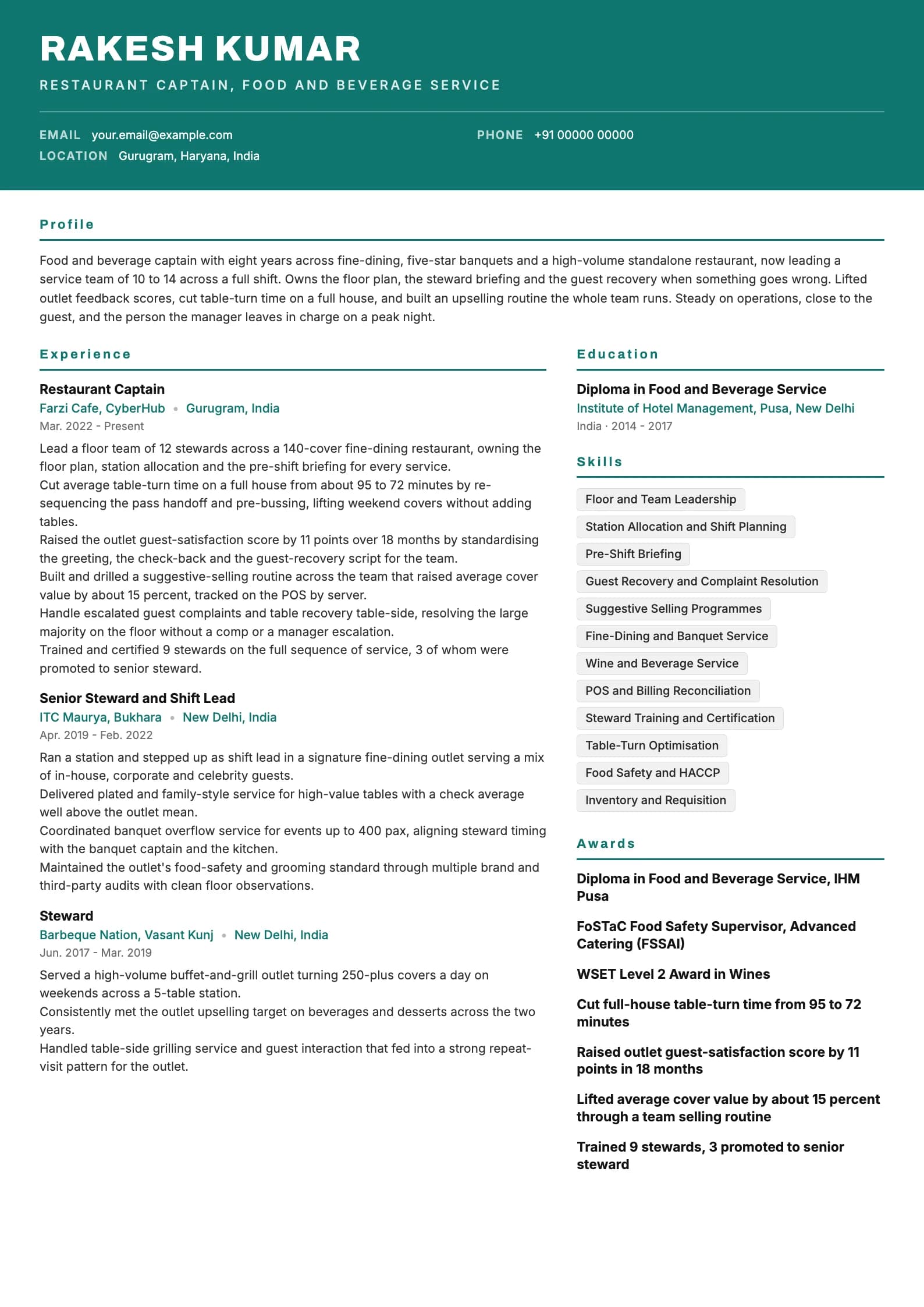
The format that works for waiter resumes in India
Reverse chronological is the layout to use. Put your most recent outlet first, work backwards, and keep the dates in plain view. Restaurant and hotel HR teams look at where you worked and how long you stayed, because a steward who job-hops every three months is a training cost they can predict. A functional resume that hides the dates under a Skills block reads as an attempt to cover a gap, and reviewers treat it that way. Length is one page for almost every waiter, including captains up to eight or nine years. Food and beverage service is judged on outlets worked, covers handled and the standard you held, none of which needs a second page. A page-two built from a hobbies line and a declaration is a padded one-page resume. Keep it to a single column and send a PDF unless the posting asks otherwise. Name the file with your own name and the role, not resume_final. A photograph is one of the few places a hospitality resume differs from a technical one: some properties do ask for a grooming photo because the job is guest-facing, so include a neat, formal one only if the posting asks. Date of birth, marital status and father's name still do not belong on the page. The headline under your name should be the role you want, steward or waiter or captain, so a recruiter matches on it in the first second. The table below sets out the section order.
| Section | Where it goes | Why |
|---|---|---|
| Name and headline | Top, above everything | The headline is the role you want, waiter, steward or captain. HR matches on it. |
| Professional summary | Directly under the header | Three lines. Outlet type, years, and the single strongest result, usually upselling or guest scores. |
| Work experience | Next, for anyone with a job or training | Most recent outlet first. Newest role gets the most bullets. |
| Skills | Below experience | Grouped: service, beverage, POS, hygiene. Not a 30-item wall. |
| Training and projects | Above experience for freshers, below for others | For a hotel-management fresher, industrial training is the evidence. |
| Education | Bottom, unless you are a fresher | Diploma or degree, institution, years. Lead with it only as a fresher. |
| Certifications | After education, or beside skills if only one or two | FoSTaC food safety, WSET wine. Name the issuing body and level. |
Listing food service is not the same as proving it
The most common waiter resume reads like a copy of the job description: takes orders, serves food and beverages, clears tables, maintains cleanliness, ensures guest satisfaction. Every waiter does all of that, so a line that only restates it tells a restaurant manager nothing and sorts you into the same undifferentiated pile as everyone else. The fix is to prove the work with a number or a scope. Instead of takes orders and serves food, write how many covers you run a shift and on which kind of station. Instead of ensures guest satisfaction, name the feedback score you held or the repeat guests who ask for your section. Instead of upsells items, name what your upselling did to the average cover value. The steward and captain samples do exactly this, which is why they read as evidence rather than a duty list. Name the outlet type and the service style, because a manager reads relevance from it. Fine dining, all-day dining, buffet, banquet and QSR are different jobs, and silver service, plated, family-style and buffet are different skills. A steward who has run silver service in a five-star coffee shop is telling a fine-dining recruiter something specific, where food service is generic. Upselling is the single most valued skill a waiter can prove, because it is the one that shows up in the outlet's revenue. If you can honestly attach a number to it, put it near the top. If you cannot measure it, describe the routine: what you suggest, when, and what changed.
For every duty on your resume, ask: could this line sit unchanged on any waiter's resume in the city. If yes, it is describing the job, not you. Add the cover count, the outlet type or the upsell number until it only fits your floor.
Writing a summary a restaurant manager actually reads
The block under your name is the part you can count on being read, so it should carry three facts: what kind of service you run, how long you have run it, and the strongest thing that happened because of your work. Three or four lines, no adjectives a manager cannot check. The old objective line, seeking a challenging position in a reputed hotel to utilise my hospitality skills, tells a reader nothing they did not already assume. Replace it with a summary. An objective describes what you want, a summary describes what you have already done on a floor, and only one of those is evidence a manager can act on. Freshers often think they have nothing to summarise. Look at the fresher sample: it names the property, the departments rotated through, the banquet size handled and a real upsell result, all built from a five month industrial training. That is a genuine summary. What it avoids is hardworking and passionate about hospitality, a phrase so common on hotel-management resumes that it now carries no information. A practical test: read your summary and ask whether a batchmate from the same institute could paste it onto their resume unchanged. If they could, it describes the diploma, not you. Add the specific outlet, the specific covers and the specific result until it stops being transferable.
Professional summary, steward
Weak
Hardworking and passionate waiter with 4+ years of experience in food service, good communication skills and the ability to work under pressure, seeking a position in a reputed restaurant.
Strong
Fine-dining steward with four years running a busy 8-table station, consistently the floor's top upseller and holding a section of repeat guests who ask for me by name. Lifted average cover value on my station by about 18 percent through wine and dessert recommendations.
The rewrite trades self-description for a service style, a scope and two results a manager can verify from the outlet's POS.
Experience bullets: verb, service, consequence
Every strong bullet in the samples follows the same shape. It opens with an action verb, names the specific service or station you worked, and closes with what measurably moved. The verb establishes that you did it. The service tells the manager whether the work is relevant. The number does the persuading. Start with the result and work backwards. Waiters usually write the task first, then cannot attach a number, which produces lines like served guests and maintained cleanliness. Instead ask what was different because of your shift: covers moved faster, cover value rose, a complaint was recovered, a trainee got up to speed, an audit passed clean. Then write the sentence that ends in that fact. Vary the metric. Five covers-per-shift numbers in a row read as one trick. Across a real career you can honestly reach for covers per shift, average cover value, upsell attachment, feedback score, table-turn time, trainees trained and audits cleared. The captain sample mixes operational, guest and people metrics, which reads as range. Where you lack a number, give scope: how many tables in your station, how large a banquet, how many stewards you briefed, which POS. Migrated is not your verb here, but ran a 6-table station serving 90 covers a shift carries weight without inventing a percentage. Allocate bullets by recency. Current outlet gets five or six, the previous one four or five, anything older two or three.
| Level | What bullets must prove | Typical metric |
|---|---|---|
| Fresher or trainee | You can run a station and follow the sequence of service | Covers a shift, banquet size, upsell attachment, POS errors |
| 1 to 3 years | You own a station without supervision | Covers, average cover value, feedback score, upsell rank |
| 4 to 6 years | You are the senior steward others learn from | Cover value lift, upsell rank, trainees trained, audits |
| 7 years and up | You lead the floor and set the service standard | Table-turn, outlet satisfaction score, team size, promotions |
Experience bullet, service work
Weak
Responsible for taking orders, serving food and beverages to guests and maintaining cleanliness of the assigned area.
Strong
Run an 8-table fine-dining station through dinner, handling roughly 120 covers on a weekend night as the senior steward on the floor.
"Responsible for" restates the job description; the rewrite names the station size, the covers and the role on the floor.
Experience bullet, upselling
Weak
Suggested additional items to customers which helped increase the sales of the restaurant.
Strong
Ranked as the floor's top upseller for 7 of the last 9 months, lifting average cover value on my station by about 18 percent through wine, starter and dessert recommendations.
Names the rank, the timeframe and the cover-value number, so a manager can check it against the POS instead of taking a vague claim.
If a bullet would read identically on a teammate's resume, it is describing the floor, not you. Rewrite it until it only fits the station you actually ran.
The skills section: grouped, honest, and short enough to defend
A waiter's skills section has two audiences. An applicant tracking system, which larger hotel groups and aggregators do use, wants literal terms it can match, POS and upselling and HACCP. A human manager wants a short, organised list that signals what kind of service you can run. Grouping satisfies both. Group by function rather than one long line. Service, beverage, systems, hygiene and people is a grouping that works for almost any waiter. The exact headings matter less than the fact that structure exists. Write names the way the industry writes them: mise en place, à la carte, HACCP, FoSTaC, the actual POS name such as Micros or PetPooja. A parser and a manager both match on the real term. Ten to fifteen skills is the working range. Below eight the section looks thin. Above twenty it stops being a signal, and a hospitality resume is prone to padding with soft phrases like teamwork, hardworking and time management that every candidate claims. Keep two or three genuine service qualities and let the rest be concrete: silver service, allergen knowledge, table-side billing, banquet operations. Name the POS systems you have actually used. A manager reads a real terminal name as a cost saved, because you can start on the floor without a week of training. Do not include a star-rating bar. Nobody agrees what four stars in wine service means, and it invites an argument you cannot win.
| Group | What goes in it | How many |
|---|---|---|
| Service | Sequence of service, silver, plated, buffet, banquet, à la carte | 3 to 5 |
| Beverage | Wine and beverage service, pairing, cocktails basics, upselling | 2 to 3 |
| Systems | POS name (Micros, PetPooja, Posist), billing, cash and card handling | 2 to 3 |
| Hygiene | Food safety, HACCP awareness, FoSTaC, grooming standards | 1 to 2 |
| People | Guest handling, complaint recovery, trainee mentoring, teamwork | 2 to 3 |
Skills section
Weak
Skills: Hardworking, Team player, Good communication, Time management, Positive attitude, Fast learner, Customer service, Multitasking, Punctual, Honest, Flexible, MS Office
Strong
Service: sequence of service, silver and plated service, banquet and buffet. Beverage: wine service, suggestive selling. Systems: Micros POS, table-side billing. Hygiene: FoSTaC food safety, HACCP awareness. People: guest recovery, trainee mentoring.
Swaps a wall of unprovable adjectives for concrete service skills, a named POS and a real food-safety credential, grouped so a manager reads it in one pass.
Training, industrial exposure and what counts as evidence
For a hotel-management fresher, the industrial training is the resume. It sits high on the page, it gets real space, and it is where a manager decides whether you have actually worked a floor or only studied one. Treat the training like a job: name the property, the departments you rotated through, the covers you handled, and the one thing you did that changed a number. The common failure is describing the syllabus instead of the shift. Completed industrial training in food and beverage service tells a reader nothing, because it is on every batchmate's resume. Instead write which outlets you ran, how many covers a shift, what you upsold, and how you did on the POS. The fresher sample names a coffee-shop station, a 200-cover wedding banquet and a doubled dessert attachment, which is far stronger than a fancier-sounding line with no detail. Campus practicals count when they show a real skill. A silver-service dinner you planned and executed for 40 guests, or a mock banquet where you briefed a team, both demonstrate something a duty list cannot. Name what you owned and what went right. Experienced waiters can drop the training and campus work once they have two or three outlets to point at. A live floor with covers and cover-value numbers is far more predictive than a coursework practical from four years ago.
Training description, fresher resume
Weak
Completed 5 months of industrial training in the food and beverage service department of a five-star hotel.
Strong
Rotated through coffee shop, banquet and in-room dining during a five month training, running a 6-table breakfast station serving roughly 90 covers a shift and doubling dessert attachment on the station.
Swaps a one-line syllabus statement for the outlets worked, the covers handled and a real result from the floor.
Where education and certifications belong
Education goes at the bottom for anyone with outlet experience, and near the top for a fresher, who has the diploma or degree as the strongest thing to lead with. Degree or diploma, institution, years. That is the whole entry for most people. Percentage or grade is worth keeping while you are a fresher and it is decent, because campus and early hospitality hiring still filters on it. Once you have your first full-time role in a restaurant or hotel, drop it. A grade from three years ago competes for space with outlets and cover numbers that predict far more. Hotel-management institutes carry weight, so name the institute clearly, whether it is an IHM, a state institute or a private college. For a fresher this is a genuine signal, since properties recruit heavily from known institutes. Certifications sit just below education, or beside skills if you hold only one or two. For a waiter, the FoSTaC food-safety training from FSSAI is the credential that matters most, because every food-service employer has to meet the hygiene standard it teaches. WSET wine certifications add value in fine dining and bar-adjacent roles. Write the full name, the issuing body and the level. An expired food-safety certificate listed as current is easy to check, so renew it or remove it.
Getting through the applicant tracking system and job portals
Large hotel groups, restaurant chains and the job portals most waiters apply through run an applicant tracking system. It is a parser and a search index, not a judge. It reads your file, tries to break it into name, outlets, dates, titles and skills, and stores the result so a recruiter can search across candidates. Almost every problem here is a parsing problem, and parsing problems come from layout, not wording. The layout rules are short. One column. Standard section headings, so use Work Experience rather than My Hospitality Journey, and Skills rather than My Strengths. No text inside images, because a hotel-logo strip reads as empty space. Keep the important facts out of the header and footer region, which some parsers drop. Avoid text boxes and nested tables in the body. On wording, mirror the posting where it is honest. If it says fine dining, write fine dining. If it says POS, write POS and name the terminal. If it says upselling, write upselling rather than only suggestive selling, and if it says steward rather than waiter, use the word the outlet uses. Include the expansion beside an acronym once, for example FoSTaC (food safety training and certification). Do not stuff keywords. A hidden block of every service term in white text is found quickly on the portals and reads worse than being filtered. Write real bullets that naturally contain the right terms, because a bullet describing a banquet you served contains the word banquet in a context that survives a human read too. Save as PDF with real text, then open it and confirm you can select and copy a sentence. If you cannot select the text, neither can the parser.
Test your own file before you send it. Copy the text out of the PDF into a plain notes app. Whatever you can read there is roughly what the parser sees, and anything scrambled is a real risk on a portal.
What gets waiter resumes rejected
Most rejections at the resume stage are not close calls. They come from a small set of recurring problems, and all of them are fixable in an afternoon. The list below covers what restaurant and hotel HR teams see most often on Indian waiter resumes, in rough order of how much damage each one does.
- Duties copied straight from the job description with no cover count, outlet type or result. Every waiter takes orders, so the line proves nothing.
- No numbers anywhere. Covers a shift, cover value, feedback score, table-turn, banquet size. Pick whichever is honest for your floor.
- No upselling result, when upselling is the one skill that shows up in the outlet's revenue and the one a manager most wants to see.
- A wall of soft-skill adjectives, hardworking, punctual, team player, standing in for concrete service skills a manager can act on.
- The outlet type and service style left out, so a fine-dining recruiter cannot tell a silver-service steward from a QSR server.
- Job-hopping across many outlets with unexplained short stints, read as a training cost. A short honest reason beats an obvious gap.
- The POS left unnamed, so a manager cannot tell whether you can start on the floor or need a week of terminal training.
- Date of birth, marital status, father's name and a declaration paragraph carried over from an old campus template.
- A generic objective line instead of a summary that states outlet type, years and one result.
- Spelling of the trade terms wrong, à la carte, mise en place, HACCP, the POS name, which undermines an otherwise decent page.
Read your resume aloud once before sending it. Anything you would be embarrassed to say to a restaurant manager's face is a line to cut or rewrite.
Skills to put on a waiter resume
Technical
- Sequence of Service
- Silver, Plated and Buffet Service
- Fine-Dining and Banquet Service
- Menu and Allergen Knowledge
- Wine and Beverage Service
- Upselling and Suggestive Selling
- Table Setup and Mise en Place
- Table-Side Billing
- Cash and Card Handling
- Food Safety and HACCP
- In-Room Dining
- Complaint Recovery
Tools and platforms
- Micros POS
- PetPooja
- Posist
- Toast POS
- KOT and Billing Systems
- Card and UPI Terminals
- Reservation and Table-Management Software
- Banquet Function Sheets
Working skills
- Guest relationship building
- Composure under pressure
- Teamwork on a busy floor
- Clear communication
- Attention to detail
- Grooming and presentation
- Trainee mentoring
- Punctuality and reliability
- Reading a table's mood
Certifications worth listing as a waiter
| Certification | Full name | Worth it for |
|---|---|---|
| FoSTaC Food Safety | Food Safety Training and Certification (FSSAI), Catering levels | The single most useful credential for a waiter, because every food-service employer has to meet the hygiene standard it teaches. Worth doing for a fresher as a clean entry signal and for a captain who supervises a floor. Take the basic catering level early and the advanced supervisor level once you lead a team. |
| Diploma in Hotel Management | Diploma or Degree in Hotel Management and Catering Technology | The core qualification that gets a fresher into a good property, since hotels recruit heavily from known institutes. Most valuable in the first few years. Once you have outlets and cover numbers to point at, the institute name matters less than the floors you have run. |
| WSET Level 1 or 2 | Wine and Spirit Education Trust Award in Wines | A genuine differentiator for waiters and stewards in fine dining and bar-adjacent roles, where wine recommendations drive cover value. Level 1 is a good entry credential, Level 2 signals real pairing knowledge. Skip it for a QSR or all-day-dining role where the beverage list is short. |
| Craftsmanship in F and B Service | Certificate or NSDC Skill India course in Food and Beverage Service | A short vocational credential worth it for a career switcher or someone without a hotel-management diploma who needs to prove trained service skills on paper. Once you have a couple of years on a real floor, the experience outranks the certificate. |
Keywords an ATS scans for in a waiter resume
These are the literal terms a parser matches against the job description. Use the ones that are true of you, in the sentences where you did the work, not as a list at the bottom.
- waiter
- steward
- food and beverage service
- fine dining
- sequence of service
- upselling
- suggestive selling
- POS
- Micros
- banquet service
- buffet service
- à la carte
- menu knowledge
- guest satisfaction
- table-side billing
- cash handling
- food safety
- HACCP
- FoSTaC
- hospitality
Waiter resume FAQ
What salary can a waiter expect in India?
A fresher or trainee steward typically starts around 1.4 to 2.4 LPA in standalone restaurants, with five-star hotels paying a slightly higher base plus service charge and tips. A steward with four to six years in fine dining usually sits in the 2.4 to 4.2 LPA band, and strong upsellers earn meaningfully more once tips and service charge are counted. Captains and senior stewards with eight years and above commonly earn 4.5 to 7.5 LPA in good properties, more in premium fine dining and on cruise lines. Fluent English, wine knowledge and a proven upselling record push the top of every band upward.
How long should a waiter resume be?
One page for almost everyone, including captains with eight or nine years. Food and beverage service is judged on outlets worked, covers handled and the standard you held, and all of that fits one page. If you are struggling to fit it, cut the oldest outlet to a single line, remove coursework, and delete any soft-skill adjective that could sit on any resume in the city.
Do I need a photo on a waiter resume in India?
This is one place a hospitality resume differs from a technical one. Because the job is guest-facing, some hotels and fine-dining restaurants do ask for a neat, formal grooming photo, so include a professional one only when the posting asks for it. Do not add date of birth, marital status, father's name or a declaration paragraph. A blurry selfie or a casual photo does more harm than no photo at all, so if in doubt leave it off.
How do I write a waiter resume with no experience?
Lead with your hotel-management training or any industrial exposure, then education, then skills. Treat the industrial training like a job: name the property, the outlets you rotated through, the covers you handled a shift, what you upsold, and how you did on the POS. Campus practicals count, a silver-service dinner you executed counts, and a part-time stint at a cafe or a family function counts. Add a FoSTaC food-safety certificate, because a verifiable credential carries more weight than adjectives.
How important is upselling on a waiter resume?
It is the most valuable thing you can prove, because it is the one waiter skill that shows up directly in the outlet's revenue. If you can honestly attach a number to it, top upseller for several months, a percentage lift in average cover value, a dessert or wine attachment rate, put it near the top of your summary and experience. If you cannot measure it, describe the routine instead: what you suggest, when in the meal, and what changed on the floor.
Should I list the POS system I have used?
Yes, and spell it correctly. Micros, PetPooja, Posist and Toast are the terminals most Indian outlets run, and naming the one you know tells a manager you can start on the floor without a week of terminal training. It is a real cost saved, which is why it reads as a genuine skill rather than filler. If you have used two, list both, since it signals you adapt across systems.
Do certifications like FoSTaC or WSET help a waiter?
FoSTaC food-safety training helps almost every waiter, because every food-service employer has to meet the FSSAI hygiene standard it covers, and it is a clean signal for a fresher. WSET wine certifications add real value in fine dining and bar-adjacent roles where beverage recommendations drive cover value, and less in a QSR with a short drinks list. Keep the list short, name the issuing body and level, and never list an expired food-safety certificate as current.
Does an ATS reject waiter resumes with two columns?
It does not reject them outright, but the parsers that larger hotel groups, restaurant chains and job portals use can read multi-column layouts out of order, which scrambles your outlets and skills in the recruiter's view. A single-column layout removes the risk, which is why all three samples above use one. Test your own file by copying the text out of the PDF into a plain notes app, and if it reads in order there it will most likely parse correctly.
How do I explain frequent job changes across restaurants?
Hospitality has genuine seasonal and contract movement, so a manager is not surprised by it, but a page full of three-month stints with no explanation reads as a risk. Keep the dates honest, group short contract or banquet-season roles under one line where that is accurate, and add a short honest reason for a move, such as an outlet closing or a seasonal contract ending, rather than leaving an unexplained gap. Stability where you have it is worth stating plainly.
Related resume examples and guides
Build your own in any of these formats
Start from a blank resume or upload the one you have. Goodspace renders it in 24 templates and flags the POS, upselling and food-safety keywords a hotel or restaurant HR team will look for, and the duty-list padding it will not credit.
Build my resume