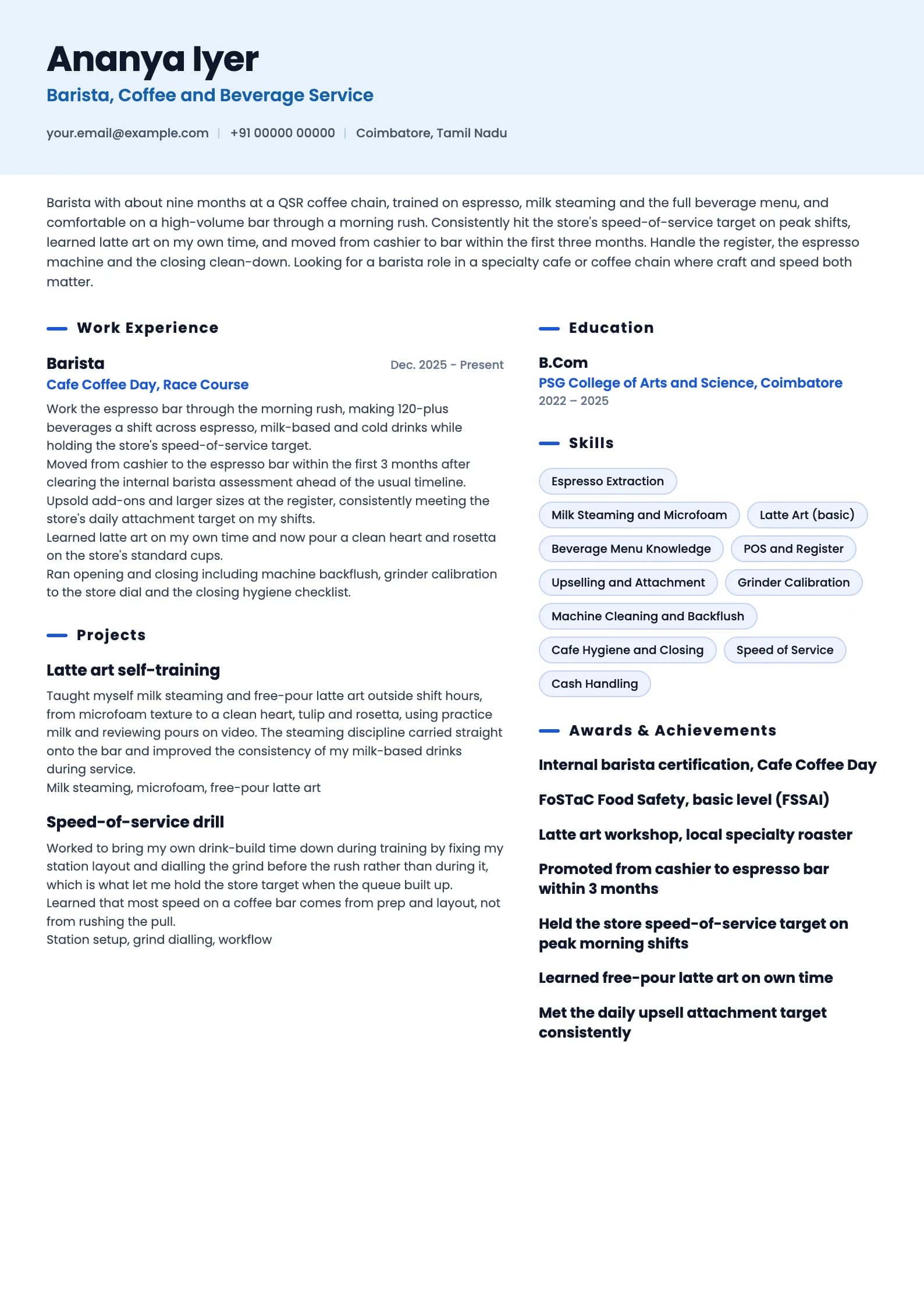
Barista Resume Format, with 3 Full Samples
A barista is hired on evidence of a dialled-in espresso, a queue kept moving, an upsell that stuck and a bar that ran clean through a morning rush, yet most resumes for the role read like a list of duties off a training card. Below are three complete resumes, one for a fresher from a QSR coffee chain, one for a specialty-coffee barista who dials in grind and pulls latte art, and one for a head barista running the bar, the training and the numbers. After the samples come the format rules, the difference between listing coffee-making and proving it, the espresso and POS terms a parser matches, and the mistakes that get a resume dropped before a cafe manager reads it.
Build my resumeBarista resume example, Fresher (0 to 1 year)
ai-era templateIs your resume good enough?
Upload the resume you have now and see what an applicant tracking system reads before a barista recruiter ever does.
Free to run. Sign in with your mobile number to see your score.
Barista resume example, Specialty Barista (4 years)
modern template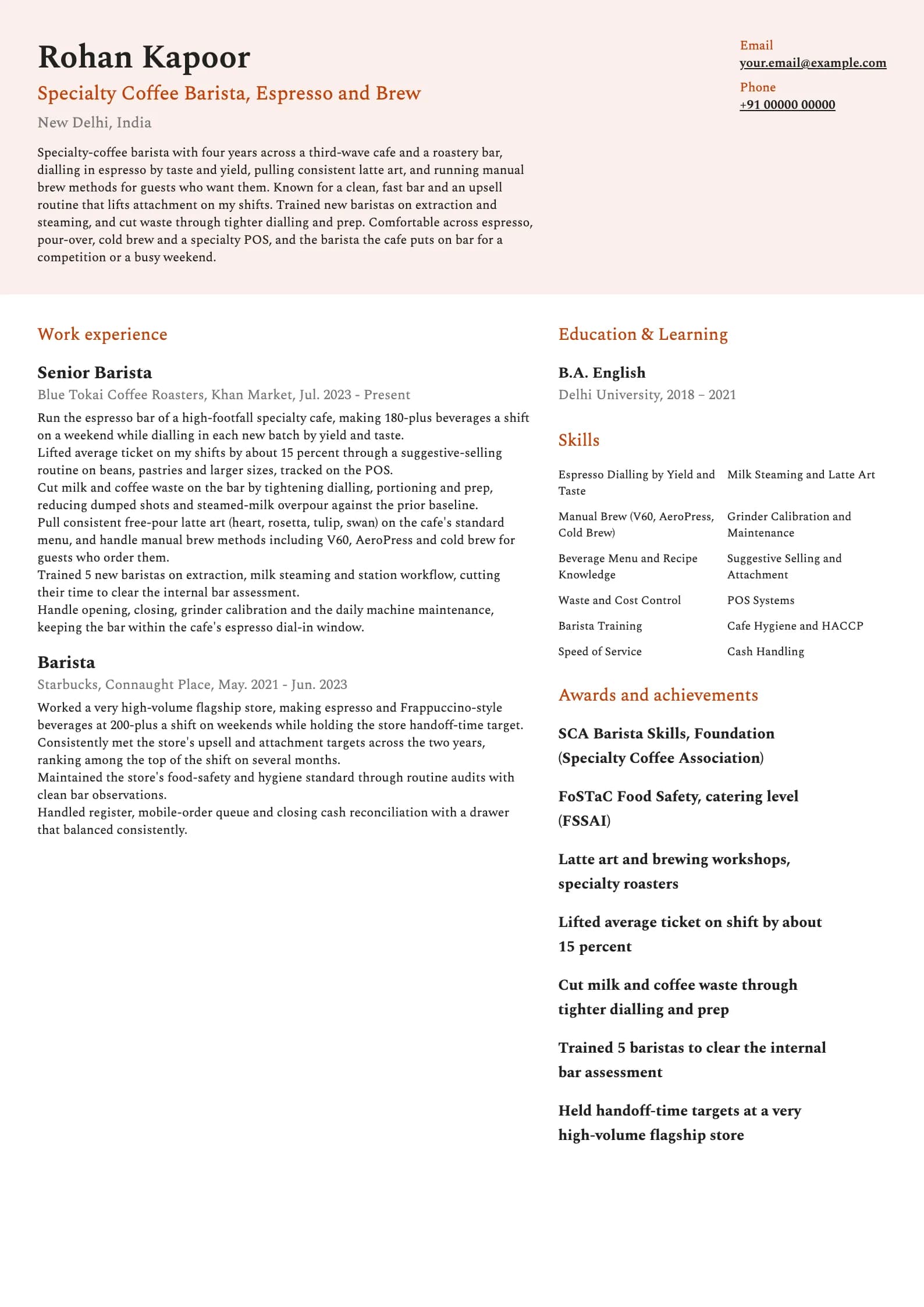
Want this structure with your own details? Build it in the resume builder.
Barista resume example, Head Barista (7 years)
header-band template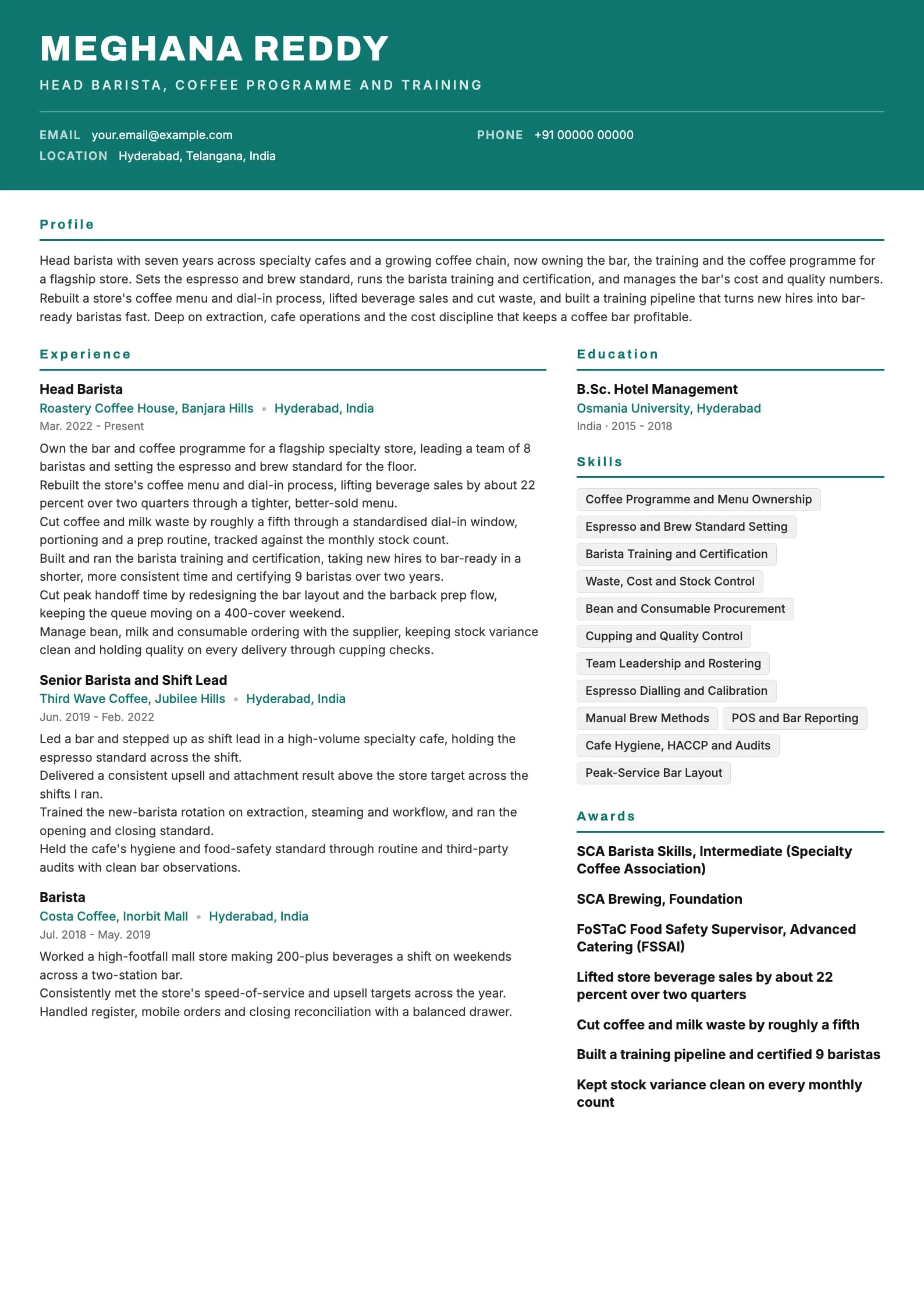
The format that works for barista resumes in India
Reverse chronological is the layout to use. Put your most recent cafe first, work backwards, and keep the dates visible. Cafes, coffee chains and QSR brands look at where you worked and how long you stayed, because a barista who moves every three months is a training cost they can predict. A functional resume that hides the dates under a Skills block reads as an attempt to cover a gap, and reviewers treat it that way. Part-time and student shifts are normal in this role, so state them honestly rather than disguising them. Length is one page for almost every barista, including head baristas up to seven or eight years. The job is judged on cafes worked, beverages handled, the craft you hold and the numbers you moved, none of which needs a second page. A page-two built from a hobbies line and a declaration is a padded one-page resume. Keep it to a single column and send a PDF unless the posting asks otherwise. Name the file with your own name and the role. A photograph is one place a cafe resume differs from a technical one: some cafes ask for a grooming photo because the role is guest-facing, so include a neat, formal one only when the posting asks. Date of birth, marital status and father's name still do not belong on the page. The headline under your name should be the role you want, barista, specialty barista or head barista, so a manager matches on it in the first second. The table below sets out the section order.
| Section | Where it goes | Why |
|---|---|---|
| Name and headline | Top, above everything | The headline is the role you want, barista or head barista. Managers match on it. |
| Professional summary | Directly under the header | Three lines. Cafe type, years, and the strongest result, usually attachment lift or a craft signal. |
| Work experience | Next, for anyone with a cafe, QSR or part-time shift | Most recent cafe first. Newest role gets the most bullets. |
| Skills | Below experience | Grouped: coffee craft, service, POS, hygiene. Not a 30-item wall. |
| Training and projects | Above experience for freshers, below for others | For a fresher, latte-art self-training and a speed drill are the evidence. |
| Education | Bottom, unless you are a fresher | Degree or course, institute, years. Lead with it only as a fresher. |
| Certifications | After education, or beside skills if only one or two | SCA barista skills, FoSTaC. Name the body and level. |
Listing coffee-making is not the same as proving it
The most common barista resume reads like a copy of the job description: prepares coffee and beverages, operates the espresso machine, maintains cleanliness, provides good customer service. Every barista does all of that, so a line that only restates it tells a cafe manager nothing and sorts you into the same undifferentiated pile as everyone else. The fix is to prove the work with a number or a scope. Instead of prepares beverages, write how many you make a shift and on which kind of bar. Instead of operates the espresso machine, name that you dial in by yield and taste or hold a store handoff target. Instead of provides customer service, name the attachment or average-ticket lift your upselling produced. The specialty and head-barista samples do exactly this, which is why they read as evidence rather than a duty list. Name the cafe type, because a manager reads relevance from it. A specialty third-wave cafe, a QSR coffee chain, a roastery bar and a hotel coffee shop are different jobs. A barista who dials in espresso by yield and runs a V60 is telling a specialty manager something specific, where a QSR barista who pushes preset buttons at volume is telling a chain manager something else. Both are valuable; say which one you are. Specialty cafes hire on craft, so if you are aiming there, prove the craft: dialling by taste, latte art you can actually pour, manual brew methods you run, waste you cut through tighter extraction. Chains hire on speed and consistency, so prove the throughput and the attachment. Match the evidence to the kind of cafe you want.
For every duty on your resume, ask: could this line sit unchanged on any barista's resume in the city. If yes, it is describing the job, not you. Add the beverages-per-shift count, the cafe type or the attachment number until it only fits your bar.
Writing a summary a cafe manager actually reads
The block under your name is the part you can count on being read, so it should carry three facts: what kind of cafe you work, how long you have worked it, and the strongest thing that happened because of your work. Three or four lines, no adjectives a manager cannot check. The old objective line, seeking a challenging barista position in a reputed cafe to utilise my skills, tells a reader nothing they did not already assume. Replace it with a summary. An objective describes what you want, a summary describes what you have already done on a bar, and only one of those is evidence a manager can act on. Freshers often think they have nothing to summarise. Look at the fresher sample: it names the chain, the beverages a shift, the fast promotion from cashier to bar, and the latte art learned on their own time. That is a genuine summary. What it avoids is passionate about coffee and hardworking team player, phrases so common on barista resumes that they now carry no information. A practical test: read your summary and ask whether another barista from the same chain could paste it onto their resume unchanged. If they could, it describes the store, not you. Add the specific cafe, the specific volume and the specific result until it stops being transferable.
Professional summary, specialty barista
Weak
Passionate and hardworking barista with 4+ years of experience in making coffee, good communication skills and a friendly attitude, seeking a position in a reputed cafe.
Strong
Specialty-coffee barista with four years across a third-wave cafe and a roastery bar, dialling in espresso by yield and taste and running manual brew methods to order. Lifted average ticket on my shifts by about 15 percent and cut milk and coffee waste through tighter dialling.
The rewrite trades self-description for a cafe type, a craft signal and two results a manager can verify from the store's numbers.
Experience bullets: verb, bar, consequence
Every strong bullet in the samples follows the same shape. It opens with an action verb, names the specific bar or cafe you worked, and closes with what measurably moved. The verb establishes that you did it. The bar tells the manager whether the work is relevant. The number does the persuading. Start with the result and work backwards. Baristas usually write the task first, then cannot attach a number, which produces lines like made coffee and served customers. Instead ask what was different because of your shift: attachment rose, waste fell, service got faster, a new hire got up to speed, an audit passed clean. Then write the sentence that ends in that fact. Vary the metric. Five beverages-per-shift numbers in a row read as one trick. Across a real career you can honestly reach for beverages per shift, average ticket or attachment, waste cut, handoff or service time, baristas trained, audits cleared and stock variance. The head-barista sample mixes sales, cost, stock and people metrics, which reads as range. Where you lack a number, give scope: how many stations, how large a store, how many baristas you trained, which brew methods you run. Run the espresso bar of a high-footfall cafe making 180-plus beverages a shift carries weight without inventing a percentage. Allocate bullets by recency. Current cafe gets five or six, the previous one four or five, anything older two or three.
| Level | What bullets must prove | Typical metric |
|---|---|---|
| Fresher | You can hold a bar and follow the craft | Beverages a shift, promotion speed, attachment, drawer balanced |
| 1 to 3 years | You run the bar without supervision | Beverages a shift, average ticket, handoff time, dialling |
| 4 to 6 years | You set the craft standard and cut waste | Average-ticket lift, waste cut, baristas trained, brew range |
| 7 years and up | You own the programme, the team and the cost | Beverage sales, waste percent, stock variance, certifications |
Experience bullet, bar work
Weak
Responsible for making coffee and other beverages for customers and keeping the counter clean.
Strong
Run the espresso bar of a high-footfall specialty cafe, making 180-plus beverages a shift on a weekend while dialling in each new batch by yield and taste.
"Responsible for" restates the job description; the rewrite names the cafe type, the volume and the extraction craft.
Experience bullet, upselling
Weak
Suggested items to customers which helped increase the sales of the cafe.
Strong
Lifted average ticket on my shifts by about 15 percent through a suggestive-selling routine on beans, pastries and larger sizes, tracked on the POS.
Names the metric, the routine and where it was tracked, so a manager can check it against the store's POS instead of taking a vague claim.
If a bullet would read identically on a teammate's resume, it is describing the cafe, not you. Rewrite it until it only fits the bar you actually ran.
The skills section: grouped, honest, and short enough to defend
A barista's skills section has two audiences. An applicant tracking system, which coffee chains and QSR brands do use, wants literal terms it can match, espresso and latte art and POS. A human manager wants a short, organised list that signals what kind of bar you can run. Grouping satisfies both. Group by function rather than one long line. Coffee craft, service and sales, systems, hygiene and people is a grouping that works for almost any barista. The exact headings matter less than the fact that structure exists. Write names the way the industry writes them: espresso, microfoam, dialling in, V60, AeroPress, SCA, FoSTaC, HACCP, the actual POS name. A parser and a manager both match on the real term. Ten to fifteen skills is the working range. Below eight the section looks thin. Above twenty it stops being a signal, and a cafe resume is prone to padding with soft phrases like friendly, energetic and team player that every candidate claims. Keep two or three genuine qualities and let the rest be concrete: espresso dialling, latte art, manual brew, waste control, grinder calibration. Match the craft depth to the cafe you want. A specialty cafe reads dialling by yield, manual brew and cupping as the signal it hires on; a QSR reads speed of service and attachment. Do not include a star-rating bar. Nobody agrees what four stars in latte art means, and it invites an argument you cannot win.
| Group | What goes in it | How many |
|---|---|---|
| Coffee craft | Espresso extraction, dialling, milk steaming, latte art, manual brew | 3 to 5 |
| Service and sales | Speed of service, upselling and attachment, menu knowledge | 2 to 3 |
| Systems | POS name, register, mobile-order handling, cash handling | 1 to 2 |
| Hygiene | Cafe hygiene, machine cleaning, food safety, HACCP, FoSTaC | 1 to 2 |
| People | Guest interaction, barista training, teamwork | 2 to 3 |
Skills section
Weak
Skills: Friendly, Hardworking, Team player, Fast learner, Good communication, Coffee, Punctual, Customer service, Multitasking, Honest, Energetic, MS Office
Strong
Craft: espresso dialling, milk steaming, latte art, V60 and AeroPress. Service: speed of service, suggestive selling, menu knowledge. Systems: POS and register. Hygiene: machine cleaning, FoSTaC food safety. People: barista training.
Swaps a wall of unprovable adjectives for concrete coffee craft, a sales skill, a named system and a food-safety credential, grouped so a manager reads it in one pass.
Training, craft practice and what counts as evidence
For a fresher, the craft you have practised and the shifts you have worked are the resume. They sit high on the page, they get real space, and they are where a cafe manager decides whether you actually care about coffee or only need a job. Treat self-taught craft like a project: name what you learned, how you practised it, and what it changed on the bar, such as latte art that improved your milk-drink consistency during service. The common failure is describing a training card instead of the craft. Trained on the espresso machine tells a reader nothing, because it is on every chain barista's resume. Instead name that you dial in the grind, pour specific latte-art patterns, or run a manual brew method. The fresher sample names self-taught latte art and a speed drill built on prep and station layout, which is far stronger than a generic training line, because it shows craft and understanding beyond the shift. Craft shown outside the shift is the single best signal for a specialty cafe, because it says you are into coffee, not just employed by a cafe. Latte art you practised, a brew method you learned, a home setup you dial in, a latte-art throwdown you entered: any of these tells a specialty manager you will care about the cup. Experienced baristas can drop the self-training once they have two or three cafes to point at. A live bar with sales, waste and training numbers is far more predictive than a practice log from years ago.
Project description, fresher resume
Weak
Learned how to make latte art during my training at the cafe.
Strong
Taught myself milk steaming and free-pour latte art outside shift hours, from microfoam texture to a clean heart, tulip and rosetta, and the steaming discipline carried onto the bar and improved my milk-drink consistency during service.
Swaps a passive training line for craft practised on your own time and the effect it had on real service, which is the specialty hiring signal.
Where education and certifications belong
Education goes at the bottom for anyone with cafe experience, and near the top for a fresher who is leaning on a recent degree. Degree or course, institute, years. That is the whole entry for most people. Being a barista does not need a specific degree, and many baristas are students or graduates from unrelated fields working part-time or full-time, which is completely normal in this role. So do not over-weight formal education. What a cafe manager wants to see is the coffee craft, the cafes you have worked and any coffee-specific training. A general degree is worth one line; it does not outrank a real bar on your record. Certifications sit just below education, or beside skills if you hold only one or two. For a barista the credential that carries the most craft weight is the SCA (Specialty Coffee Association) barista skills or brewing modules, which signal real, assessed coffee knowledge and matter especially for specialty cafes. FoSTaC food-safety training from FSSAI covers the hygiene side that every food-service employer needs. An internal chain certification, such as a barista assessment at a large coffee brand, is worth naming for a fresher. Write the full name, the issuing body and the level, and never list an expired food-safety certificate as current.
Getting through the applicant tracking system and job portals
Coffee chains, QSR brands and the job portals most baristas apply through run an applicant tracking system. It is a parser and a search index, not a judge. It reads your file, tries to break it into name, cafes, dates, titles and skills, and stores the result so a recruiter can search across candidates. Almost every problem here is a parsing problem, and parsing problems come from layout, not wording. The layout rules are short. One column. Standard section headings, so use Work Experience rather than My Coffee Journey, and Skills rather than Behind the Bar. No text inside images, because a logo strip reads as empty space. Keep the important facts out of the header and footer region, which some parsers drop. Avoid text boxes and nested tables in the body. On wording, mirror the posting where it is honest. If it says espresso, write espresso. If it says POS, name the system. If it says latte art or specialty coffee, use that exact phrase. If it says head barista rather than barista, use the title the outlet uses. Include the expansion beside an acronym once, for example SCA (specialty coffee association) or FoSTaC (food safety training and certification). Do not stuff keywords. A hidden block of every coffee term in white text is found quickly on the portals and reads worse than being filtered. Write real bullets that naturally contain the right terms, because a bullet describing the brew methods you run contains the words espresso and V60 in a context that survives a human read too. Save as PDF with real text, then open it and confirm you can select and copy a sentence. If you cannot select the text, neither can the parser.
Test your own file before you send it. Copy the text out of the PDF into a plain notes app. Whatever you can read there is roughly what the parser sees, and anything scrambled is a real risk on a portal.
What gets barista resumes rejected
Most rejections at the resume stage are not close calls. They come from a small set of recurring problems, and all of them are fixable in an afternoon. The list below covers what cafe and QSR HR teams see most often on Indian barista resumes, in rough order of how much damage each one does.
- Duties copied straight from the job description with no beverage count, cafe type or result. Every barista makes coffee, so the line proves nothing.
- No numbers anywhere. Beverages a shift, average ticket, waste cut, handoff time, baristas trained. Pick whichever is honest for your bar.
- No craft signal for a specialty role, so a third-wave cafe cannot tell someone who dials in by taste from someone who presses a preset button.
- A wall of soft-skill adjectives, friendly, energetic, team player, standing in for concrete coffee craft and sales skills a manager can act on.
- The cafe type left out, so a manager cannot tell whether your experience is QSR volume or specialty craft, which are different jobs.
- No upsell or attachment result, when it is the one barista metric that shows up directly in the store's sales.
- Unexplained short stints across many cafes, read as a training cost. State part-time and student shifts honestly rather than disguising them.
- The POS left unnamed, so a manager cannot tell whether you can run the register and mobile-order queue from the first shift.
- Date of birth, marital status, father's name and a declaration paragraph carried over from an old campus template.
- Spelling of the coffee terms wrong, espresso, microfoam, AeroPress, the POS name, which undermines an otherwise decent page.
Read your resume aloud once before sending it. Anything you would be embarrassed to say to a cafe manager's face is a line to cut or rewrite.
Skills to put on a barista resume
Technical
- Espresso Extraction and Dialling
- Milk Steaming and Microfoam
- Latte Art
- Manual Brew (V60, AeroPress, Cold Brew)
- Grinder Calibration
- Machine Cleaning and Maintenance
- Beverage and Recipe Knowledge
- Suggestive Selling and Attachment
- Waste and Cost Control
- Cafe Hygiene and HACCP
- Speed of Service
- Cash and Card Handling
Tools and platforms
- Espresso Machine (La Marzocco, Nuova Simonelli)
- Coffee Grinders
- V60, AeroPress and Brew Equipment
- POS and Register Systems
- Mobile-Order Systems
- Milk-Steaming and Bar Tools
- Card and UPI Terminals
- Stock and Inventory Sheets
Working skills
- Composure under a rush
- Guest interaction and rapport
- Upselling
- Teamwork behind the bar
- Attention to craft and detail
- Grooming and presentation
- Training new baristas
- Reliability and punctuality
- Handling busy queues
Certifications worth listing as a barista
| Certification | Full name | Worth it for |
|---|---|---|
| SCA Barista Skills | Specialty Coffee Association Barista Skills (Foundation, Intermediate, Professional) | The credential that carries the most craft weight for a barista, because it is an assessed, internationally recognised standard on espresso and milk skills. Most valuable for anyone aiming at specialty cafes and for a barista moving into a senior or training role. Foundation is a strong entry signal; the higher modules matter as you take on the coffee programme. |
| SCA Brewing | Specialty Coffee Association Brewing module | Worth it for baristas in specialty and filter-forward cafes that serve manual brew, since it certifies knowledge of extraction and brew ratios beyond espresso. Pairs naturally with the barista skills module. Less relevant for a pure QSR espresso-and-milk role where the menu does not include pour-over. |
| FoSTaC Food Safety | Food Safety Training and Certification (FSSAI), Catering levels | Useful because every cafe has to meet the FSSAI hygiene standard, and a head barista who supervises a bar benefits from the supervisor level. A clean entry signal for a fresher and a compliance signal for a lead. Never list it as current once it has expired. |
| Chain Barista Certification | Internal barista assessment or certification at a major coffee brand | Worth naming for a fresher or early-career barista, because clearing a large chain's internal bar assessment is a concrete, verifiable signal that you have been trained and tested on a real espresso bar. Once you hold an SCA credential or have several cafes on your record, it matters less. |
Keywords an ATS scans for in a barista resume
These are the literal terms a parser matches against the job description. Use the ones that are true of you, in the sentences where you did the work, not as a list at the bottom.
- barista
- coffee
- espresso
- latte art
- milk steaming
- specialty coffee
- manual brew
- beverage preparation
- speed of service
- upselling
- attachment
- POS
- grinder calibration
- cafe hygiene
- food safety
- HACCP
- FoSTaC
- cash handling
- customer service
- hospitality
Barista resume FAQ
What salary can a barista expect in India?
A fresher typically starts around 1.4 to 2.4 LPA at a coffee chain or QSR, with specialty cafes and five-star hotel coffee shops paying a somewhat higher base plus a share of tips and service charge. A specialty barista with four to six years usually sits in the 2.6 to 4.5 LPA band, and strong ones with real craft and an attachment record earn more. Head baristas and cafe leads with seven years and above commonly earn 4.5 to 8 LPA in good outlets, more in premium specialty groups and roastery-led cafes. SCA certification, latte-art skill and a proven waste and sales record push the top of every band upward.
How long should a barista resume be?
One page for almost everyone, including head baristas with seven or eight years. The job is judged on cafes worked, beverages handled, the craft you hold and the numbers you moved, and all of that fits one page. If you are struggling to fit it, cut the oldest cafe to a single line, remove course detail, and delete any soft-skill adjective that could sit on any barista's resume in the city.
How do I write a barista resume with no experience?
Lead with any coffee craft you have practised and any part-time, QSR or cafe shifts, then education, then skills. Treat self-taught craft like a project: name the latte art you can pour, the brew method you learned, or a home setup you dial in, and what it changed. Add an internal chain certification or a food-safety credential, and state your speed and upsell targets if you hit them, because a verifiable detail carries more weight than adjectives like passionate about coffee.
Does a specialty cafe want different things from a QSR chain?
Yes, and it is worth tuning your resume to the one you want. A specialty third-wave cafe hires on craft, so lead with dialling in espresso by yield and taste, latte art you can actually pour, manual brew methods you run, and waste you cut through tighter extraction. A QSR coffee chain hires on speed and consistency, so lead with beverages a shift, handoff or speed-of-service targets, and your upsell attachment. Name which kind of cafe your experience is from, because the two are genuinely different jobs.
Do certifications like SCA help a barista?
The SCA barista skills and brewing modules carry the most weight, because they are assessed, internationally recognised standards and they matter most to specialty cafes and for anyone moving into a training or lead role. For a fresher, clearing a major chain's internal barista assessment is a concrete signal too. FoSTaC food-safety training covers the hygiene side every cafe needs. Keep the list short, name the issuing body and level, and let real bar experience be the main credential once you have it.
Should I mention latte art on my resume?
Yes, especially for a specialty cafe, because it is a visible craft skill that signals you care about the cup and can steam milk to microfoam consistently. Be honest about your level: a clean heart and rosetta is worth stating, and if you can pour tulips, swans or more advanced patterns, name them. If you learned it on your own time, say so, because craft practised outside the shift is one of the strongest signals a specialty manager reads. For a pure QSR role it matters less than speed and attachment.
How do I present part-time or student cafe work?
State it honestly, because part-time and student shifts are completely normal for baristas and a manager expects them. Name the cafe, the shift pattern if it is relevant, and lead with what you did rather than how many hours it was: beverages a shift, the promotion you earned, the targets you hit. An unexplained string of short stints reads as a risk, but clearly labelled part-time work with real numbers reads as genuine experience, and it shows you can hold a bar alongside studies.
Does an ATS reject barista resumes with two columns?
It does not reject them outright, but the parsers that coffee chains, QSR brands and job portals use can read multi-column layouts out of order, which scrambles your cafes and skills in the recruiter's view. A single-column layout removes the risk, which is why all three samples above use one. Test your own file by copying the text out of the PDF into a plain notes app, and if it reads in order there it will most likely parse correctly.
Related resume examples and guides
Build your own in any of these formats
Start from a blank resume or upload the one you have. Goodspace renders it in 24 templates and flags the espresso, latte-art and POS keywords a cafe or QSR HR team will look for, and the duty-list padding it will not credit.
Build my resume