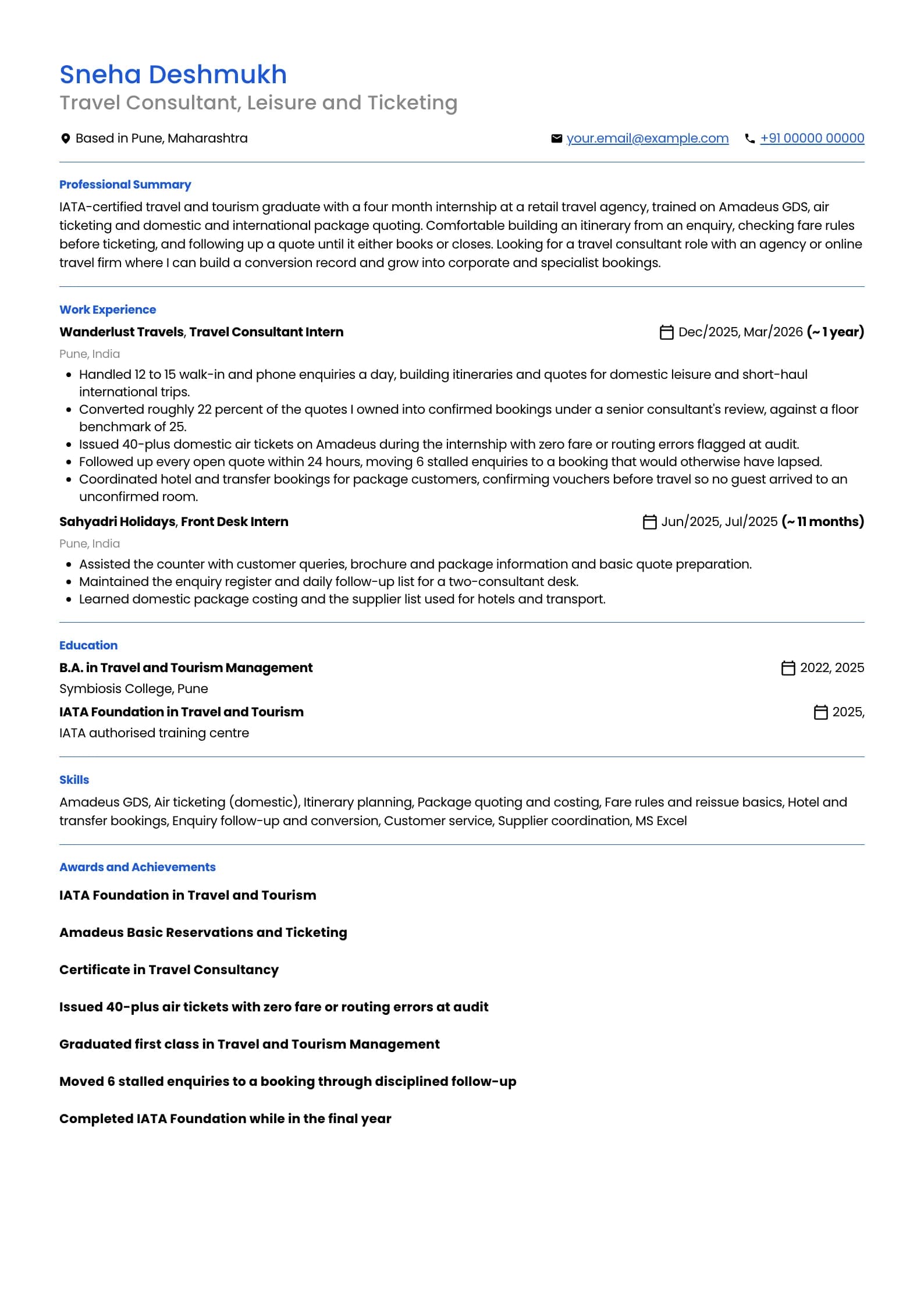
Travel Agent Resume Format, with 3 Full Samples
A travel agent is hired on evidence that enquiries turn into bookings, that customers come back for the next trip, and that a complicated multi-city itinerary gets ticketed correctly the first time whatever the fare rules throw at it, yet most travel agent resumes just list the software touched and the packages sold. The agency gets named, the duties get copied from the job description, and the conversion rate or the revenue the person actually booked goes missing. Below are three complete resumes, one for a fresher entering as a travel consultant, one for a travel consultant with five years across leisure and corporate bookings, and one for a senior travel manager owning a team and a target. After the samples come the format rules, the numbers a travel resume must carry, the GDS and booking keywords a parser matches, and the mistakes that end a screening before the interview.
Build my resumeTravel Agent resume example, Fresher (0 years)
professional templateIs your resume good enough?
Upload the resume you have now and see what an applicant tracking system reads before a travel agent recruiter ever does.
Free to run. Sign in with your mobile number to see your score.
Travel Agent resume example, Travel Consultant (5 years)
header-band template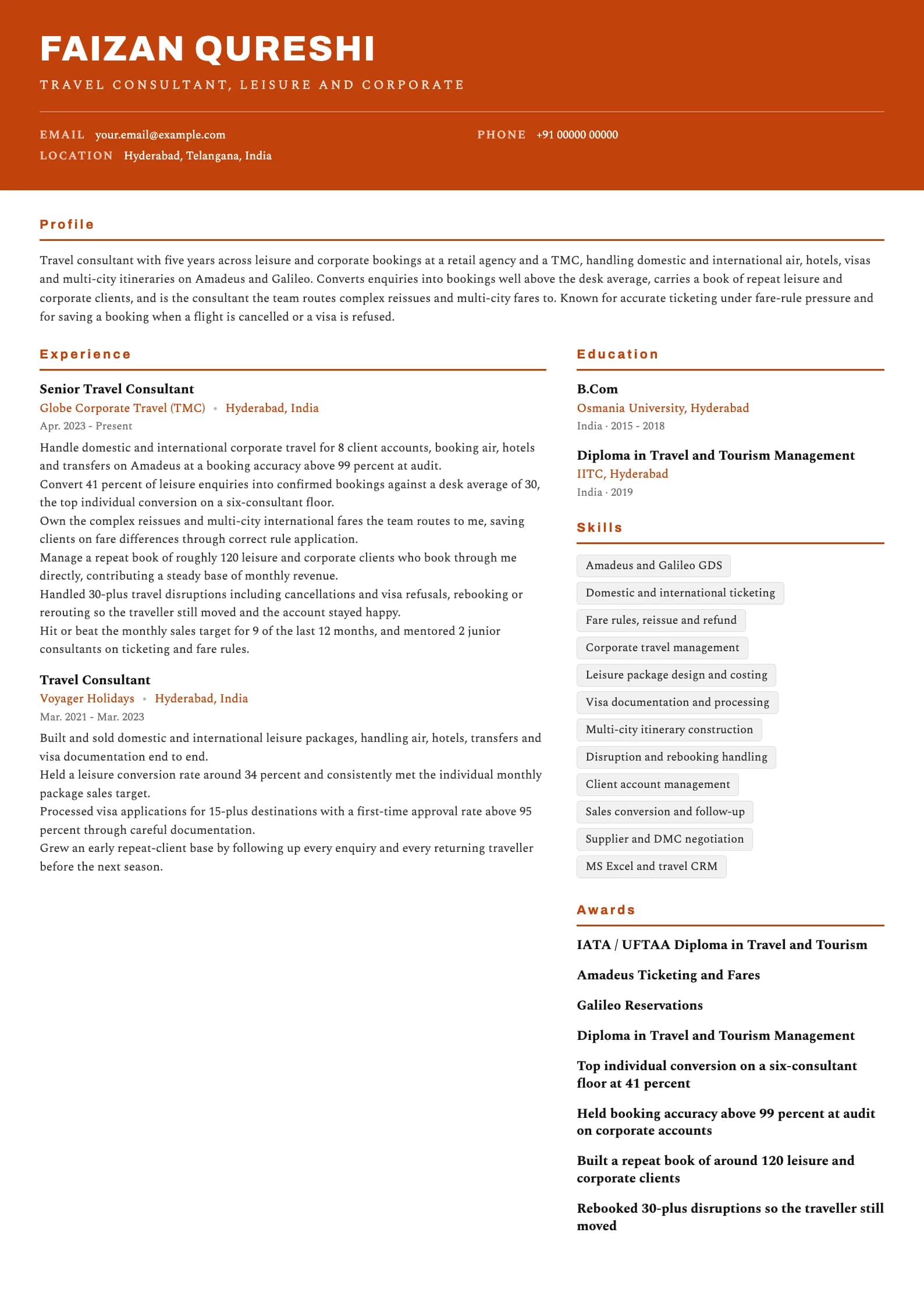
Want this structure with your own details? Build it in the resume builder.
Travel Agent resume example, Senior Travel Manager (10 years)
modern template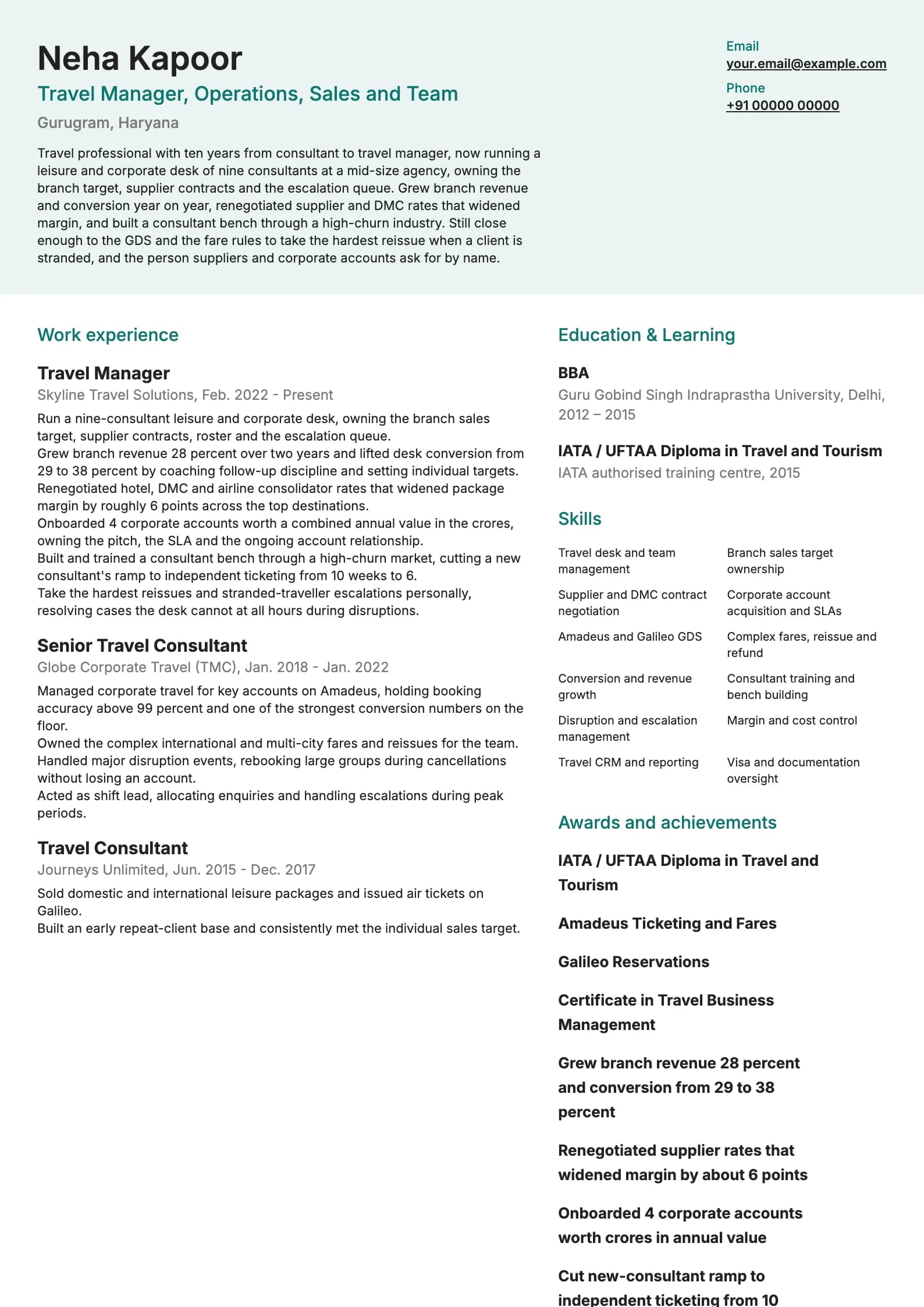
The format that works for travel agent resumes in India
Reverse chronological is the layout to use. Put the most recent agency or role first, work backwards, and let the dates sit in plain view. Travel hiring runs on references and a quick check of your booking and conversion record, so a functional resume that groups everything under skills and hides the timeline reads as an attempt to cover a gap, and an agency short a consultant will move to the next candidate. Keep it to one page. A travel agent's resume, even a senior travel manager's, fits a single page: the GDS skills, the agencies, the conversion numbers and the certifications do not need two. A second page in this trade almost always means padding, a hobbies line and a declaration paragraph, which weakens the page rather than strengthening it. Four things do not belong on it: a photograph, date of birth, marital status and father's name. They survive from an older template and add nothing to a decision about whether you can convert an enquiry and ticket it correctly. Every line they take is a line a conversion number or a GDS skill could have used. Name your GDS and certifications high, because for a travel agent the systems you can operate, Amadeus, Galileo or Sabre, and an IATA credential are among the first things an agency screens on. Send a PDF unless the posting asks otherwise, name the file with your own name and 'travel consultant', and keep a single column all the way down. The table below sets out the section order.
| Section | Where it goes | Why |
|---|---|---|
| Name and headline | Top, above everything | The headline is the role and your focus, for example 'Travel Consultant, Leisure and Corporate'. |
| Professional summary | Directly under the header | Three lines. Years, booking type, GDS and one number, the conversion rate. |
| Work experience | Next, for anyone with a job | Most recent agency first. Newest role gets the most bullets. |
| Skills | Below experience, grouped | GDS, ticketing, fares, sales, service. This is what an agency matches you on. |
| Internship or training | Above experience for a fresher | For a fresher the agency internship is the evidence, so it leads. |
| Education | Bottom, unless you are a fresher | Degree, institute, years. Keep first class or distinction while early. |
| Certifications | After education or beside skills | IATA, Amadeus and Galileo credentials earn their place here. |
The numbers a travel agent resume must carry
The single most common travel agent resume failure is a page that lists the software touched and the destinations sold, with not one number to show enquiries actually became bookings. An agency is not hiring someone who processes quotes, they are hiring someone who converts them, tickets them accurately and keeps the client coming back. Those are the numbers the resume has to reach for. Conversion rate is the number an agency reads first, because it is a travel agent's revenue expressed in one figure. Write it as a percentage and, where you can, against the desk average: '41 percent conversion against a 30 desk average' is far stronger than 'good at sales'. If you were the top-converting consultant on the floor, or hit target most months, say so and for how many. Booking accuracy is the second number, and it matters more in travel than most trades realise, because a wrong ticket is a refund, a reissue fee and an unhappy client all at once. 'Booking accuracy above 99 percent at audit' tells an agency you get the fare, the routing and the rules right the first time. Repeat clients are the third: a book of clients who come back to you by name is portable revenue, and stating its size proves you generate demand rather than only processing walk-ins. Even a fresher has numbers: enquiries a day in the internship, quotes converted under review, tickets issued without an error, stalled enquiries saved by follow-up. Reach for the honest one rather than leaving the page a bare list of tools.
Experience bullet, sales
Weak
Responsible for handling customer enquiries and making bookings for domestic and international travel packages.
Strong
Converted 41 percent of leisure enquiries into confirmed bookings against a desk average of 30, the top individual conversion on a six-consultant floor.
'Responsible for' describes the job description; the rewrite gives the conversion rate, the benchmark it beats and the rank it held.
For a travel agent the numbers that matter are conversion rate, booking accuracy and repeat clients. A resume that names software and destinations but reaches none of these describes what you touched, not the revenue you actually turned.
Writing a summary an agency owner actually reads
The block under your name is the part most likely to be read, so it should carry four facts: how long you have been booking travel, the type of travel you handle, the GDS you work on, and your strongest number, conversion or repeat clients. Three or four lines, no adjectives an owner cannot check. The old objective line, seeking a challenging position in a reputed travel company to utilise my skills, tells the reader nothing they did not assume. Replace it with a summary. An objective says what you want; a summary says what you have already booked and converted, and only one of those helps an agency decide to call you in. Freshers often feel they have nothing to summarise. Look at the fresher sample: it names the IATA credential, the internship, the GDS, and a conversion number. It avoids 'passionate about travel and helping people plan their dream trips', a phrase so common on travel resumes that it now carries no information. A practical test: read your summary and ask whether any travel-and-tourism graduate from your batch could paste it onto their resume unchanged. If they could, it describes the course, not you. Add your GDS, your booking type and your conversion number until it stops being transferable.
Professional summary, experienced consultant
Weak
Passionate and customer-focused travel agent with 5+ years of experience in the travel industry, seeking a challenging role in a reputed organisation to utilise my skills.
Strong
Travel consultant with five years across leisure and corporate bookings on Amadeus and Galileo, handling air, hotels, visas and multi-city itineraries. Convert 41 percent of enquiries against a 30 desk average and carry a repeat book of 120 clients.
The rewrite trades self-description for the GDS, the booking type, a conversion number and a repeat book an owner can verify.
Experience bullets: action, booking, result
Every strong bullet in the samples follows the same shape. It opens with an action, names the booking or the client situation, and closes with what measurably moved. The verb establishes that you did it. The booking type or context tells the agency whether the work is relevant. The number, usually conversion, accuracy or revenue, does the persuading. Start with the outcome and work backwards. Consultants usually write the duty first, which produces bullets like 'handled bookings and provided good customer service'. Instead ask what was different because you were on the desk: an enquiry converted, a ticket issued without an error, a disruption saved, a client came back, a margin widened. Then write the sentence that ends in that fact. Vary the number. A page of nothing but 'handled X bookings a day' reads as one fact repeated. Across a real role you can honestly reach for conversion rate, booking accuracy, repeat clients, disruptions rebooked, visa approval rate, target hit and consultants trained. The mid-level and senior samples move across several of these, which reads as range. Where you lack a clean number, give scope: how many client accounts, how many destinations, how many tickets a day, how many visas processed. 'Processed visas for 15-plus destinations with a first-time approval rate above 95 percent' carries weight and is exactly the kind of accuracy an agency values. Allocate bullets by recency. Current agency gets five or six, the previous one four or five, anything older two or three.
| Level | What bullets must prove | Typical number |
|---|---|---|
| Fresher | You can quote, convert and ticket accurately | Enquiries a day, quotes converted, tickets without an error, follow-ups saved |
| 1 to 5 years | You convert above average and clients return | Conversion rate, booking accuracy, repeat clients, visa approval rate |
| 5 to 8 years | You own accounts and the hard fares | Conversion vs desk, corporate accounts, disruptions rebooked, target hit |
| 8 years and up | You own the desk's revenue and its margin | Branch revenue growth, margin, accounts onboarded, consultants trained |
If a bullet would read identically on another consultant's resume from the same agency, it is describing the desk, not you. Rewrite it until it only fits the bookings and the numbers you actually owned.
Naming the GDS and the systems you actually operate
For a travel agent the reservation systems you can operate are close to a hard qualification, because an agency running Amadeus does not want to retrain someone whose only experience is on Sabre, and a consultant who cannot ticket independently is a cost, not a hire. So name your GDS explicitly, Amadeus, Galileo, Sabre or Worldspan, and say what you can do on it: reservations, ticketing, fares, reissue and refund, not just 'GDS' as a single word. The level matters as much as the name. 'Amadeus (reservations and basic ticketing)' is honest for a fresher and reads better than an inflated claim that collapses in the first live reissue. A consultant who can handle complex fares, multi-city construction, reissue and refund on the GDS should say so, because that is the skill agencies are short of and pay for. If you have handled the hard reissues the rest of the desk routes to you, that line is worth more than any adjective. Beyond the GDS, name the other systems an agency runs on: the booking or mid-office CRM, the visa and documentation portals, the supplier and consolidator platforms, the online travel and B2B portals. A consultant who is fluent across the whole stack, not just the GDS, needs less hand-holding, which a desk head values when they are choosing between resumes. Do not list a system you touched once in training as if you operate it daily. A practical test on the GDS is common in a travel interview, and a claim you cannot back on the terminal ends the conversation faster than a shorter, honest list would have.
Name your GDS and what you can do on it, reservations, ticketing, fares, reissue, not just 'GDS'. In a trade where an interview often includes a live terminal test, the honest, specific claim beats the inflated one every time.
The skills section: grouped, specific and honest
A travel agent's skills section has two audiences. Larger agencies, OTAs and TMCs increasingly run an applicant tracking system that wants literal terms it can match, Amadeus and ticketing and fare rules. A human wants a short, organised list that signals what kind of consultant you are. Grouping serves both. Group by function rather than one long line. Systems and ticketing, product and sales, service and operations, and languages is a grouping that works for almost every travel agent. The exact headings matter less than the fact that structure exists. Write the terms the industry uses, GDS, reissue, refund, DMC, TMC, visa documentation, so an agency reads them without translating. Be honest about your range. List the systems and booking types you can genuinely handle, because a terminal test or a first live booking will surface a claim you cannot back. Twelve to sixteen grouped skills is the working range; below eight it looks thin, above twenty it stops being a signal. Do not pad with a wall of adjectives, hardworking, punctual, good communication, positive attitude, stacked five deep. Service is assumed in a travel agent; what an agency wants to know is the operational skills, whether you can convert, ticket accurately, handle a reissue and a visa, and manage a disruption without escalating. One line of real operational skill is worth more than a paragraph of self-praise.
| Group | What goes in it | How many |
|---|---|---|
| Systems and ticketing | Amadeus, Galileo, Sabre, ticketing, fares, reissue, refund | 3 to 5 |
| Product and sales | Leisure packages, corporate travel, conversion, upselling | 3 to 4 |
| Service and operations | Visa documentation, disruption handling, supplier coordination | 3 to 4 |
| Tools | Travel CRM, mid-office, MS Excel, B2B and OTA portals | 2 to 3 |
| Leadership (senior) | Team management, target ownership, contract negotiation | 2 to 4 |
Skills section
Weak
Skills: Hardworking, Good communication, Travel lover, Customer service, Ticketing, Booking, MS Office, Sales, Punctual, Team player, Positive attitude
Strong
Systems: Amadeus, Galileo, ticketing, reissue and refund. Product: leisure packages, corporate travel, conversion. Operations: visa documentation, disruption rebooking, supplier negotiation. Tools: travel CRM, Excel.
Cuts the adjectives and vague single words, names the GDS and the operational skills an agency screens on, and groups them so the page reads in one pass.
Where education and certifications belong
Education goes at the bottom for anyone with a full-time job, and near the top for a fresher, who has nothing stronger to lead with. Degree, institute, years. A commerce, tourism or hospitality degree is relevant and worth naming; keep the first class or distinction while you are early, and drop it once agencies and conversion numbers fill the page. For a fresher the agency internship is the evidence, so it sits high, right under the summary, ahead of a thin work section. Name the agency, the length, the GDS you trained on and what you can honestly quantify, enquiries a day, quotes converted, tickets issued without an error. This is where an agency sees whether you have booked live travel or only studied it. Certifications are where a travel resume can genuinely stand out, because the industry ones are recognised across agencies. An IATA or IATA and UFTAA diploma is the credential agencies read as proof of trained fundamentals, and Amadeus, Galileo or Sabre certificates prove you can operate the specific system. They belong just below education, or beside your skills if you hold only one or two. Write the full name, the issuing body and the year. Do not list an expired or half-finished course as if it were complete, and do not claim a GDS certificate you never earned. A terminal test and a reference check will surface it, and the small dishonesty costs more than the missing credential would have.
Getting through the applicant tracking system
Larger agencies, online travel firms and TMCs increasingly run applications through an applicant tracking system before a human sees them. An ATS is a parser and a search index, not a judge. It reads your file, tries to split it into name, dates, agencies, titles and skills, and stores the result so a recruiter can search across candidates. Almost every ATS problem is a parsing problem, and parsing problems come from layout, not wording. The layout rules are short. One column. Standard section headings, so use Work Experience rather than My Journey, and Skills rather than My Toolkit. No text inside images, because a decorative travel-photo header reads as empty space. Keep the GDS names, certifications and booking types as plain text in the body, not in a header or footer region some parsers drop. On wording, mirror the posting where it is honest. If the job says Amadeus, write Amadeus rather than just GDS. If it says corporate travel or fare reissue, use those exact phrases. Spell out an acronym alongside its full form once, for example 'GDS (global distribution system)', so both searches find you. Keyword stuffing does not work. A hidden block of every GDS and destination in white text gets caught, and the outcome is worse than being filtered. Write real bullets that naturally carry the right terms, because a bullet describing the reissues you handled on Amadeus contains the system in a context that survives human review too. Save as PDF from a tool that embeds real text, then open the file and confirm you can select and copy a sentence. If you cannot select the text, neither can the parser.
Section heading
Weak
My Travel Career Journey
Strong
Work Experience
Parsers look for standard headings; a creative one can push the entire block into an unclassified bucket the recruiter never searches.
What gets travel agent resumes rejected
Most rejections at the resume stage are not close calls. They come from a small set of recurring problems, and all of them are fixable in an afternoon. The list below covers what agencies, OTAs and TMCs see most often on Indian travel agent resumes, in rough order of how much damage each one does.
- A list of software and destinations with not a single conversion, accuracy or revenue number. Touching a GDS is not the achievement.
- Writing 'GDS' as one word instead of naming Amadeus, Galileo or Sabre and what you can do on it.
- Duties copied from a job description, 'responsible for handling bookings', instead of the enquiries you converted.
- Inflating a GDS or a booking skill you cannot demonstrate, when a live terminal test in the interview will expose it.
- No mention of booking accuracy or disruption handling, so an agency cannot tell whether your tickets are right the first time.
- A photo, date of birth, marital status or father's name, none of which belongs on the page and all of which takes a skill's space.
- A generic objective line. Replace it with a summary that states years, booking type, GDS and a conversion number.
- A wall of adjectives, passionate, friendly, hardworking, in place of real systems and sales skills.
- No IATA or GDS certification named, when these are among the first things an agency screens on.
- Inflated titles, dates or numbers that a reference check will expose in a small, well-connected industry.
Read your resume as if you were the desk head about to sit you at a live terminal. Every GDS and fare skill you list is one you may be tested on, so claim only what your hands can do on the system.
Skills to put on a travel agent resume
Technical
- Amadeus GDS
- Galileo GDS
- Sabre GDS
- Air ticketing (domestic and international)
- Fare rules, reissue and refund
- Multi-city itinerary construction
- Leisure package design and costing
- Corporate travel management
- Visa documentation and processing
- Disruption and rebooking handling
- Sales conversion
- Supplier and DMC coordination
Tools and platforms
- Amadeus and Galileo terminals
- Travel CRM
- Mid-office and back-office systems
- Visa and documentation portals
- B2B and OTA booking portals
- Consolidator platforms
- MS Excel
- Payment and settlement systems
Working skills
- Customer service and rapport
- Sales follow-up and closing
- Attention to detail under fare-rule pressure
- Calm during travel disruptions
- Negotiation with suppliers
- Multilingual communication
- Time management under deadlines
- Team coordination
- Client relationship management
Certifications worth listing as a travel agent
| Certification | Full name | Worth it for |
|---|---|---|
| IATA / UFTAA Diploma | IATA / UFTAA Foundation or Consultant Diploma in Travel and Tourism | The most recognised industry credential for a travel agent in India, worth it for freshers and career switchers who need to prove trained fundamentals in fares, ticketing and travel geography. Agencies read it as a serious signal early in a career; it matters less once you have years of booking and conversion numbers to point at. |
| Amadeus Certification | Amadeus Reservations, Ticketing and Fares certification | Worth it for any travel agent working on or targeting an Amadeus agency, which covers a large share of the Indian market. The ticketing and fares module is the one agencies value most, because it proves you can issue and reissue correctly, not just search availability. |
| Galileo Certification | Galileo (Travelport) Reservations and Ticketing certification | The counterpart credential for agencies on the Galileo or Travelport system, worth it if your target employers run it. Holding both Amadeus and Galileo widens the agencies you can join without retraining, which is a genuine advantage on the resume. |
| Sabre Certification | Sabre GDS Reservations and Ticketing certification | Relevant where your target agency or TMC runs Sabre, common with some corporate and international accounts. Worth it if the roles you want specify Sabre; otherwise Amadeus and Galileo cover most of the domestic agency market. |
| Travel and Tourism Diploma | Diploma in Travel and Tourism Management | A general vocational diploma from a travel institute, worth it for a fresher building fundamentals alongside a GDS certificate. Useful for the first job; once you have agency experience and numbers, the IATA and GDS credentials carry more weight than the general diploma. |
Keywords an ATS scans for in a travel agent resume
These are the literal terms a parser matches against the job description. Use the ones that are true of you, in the sentences where you did the work, not as a list at the bottom.
- travel agent
- travel consultant
- travel executive
- amadeus
- galileo
- GDS
- air ticketing
- fare rules
- reissue and refund
- itinerary planning
- corporate travel
- leisure packages
- visa documentation
- booking
- conversion rate
- customer service
- supplier coordination
- IATA
- sales target
- disruption handling
Travel Agent resume FAQ
What salary can a travel agent expect in India?
A fresher travel consultant typically starts around 1.8 to 3 LPA, often with a sales incentive on top of the base. A travel consultant with five years, GDS ticketing skills and a strong conversion record usually sits in the 3.5 to 7 LPA band, higher at corporate TMCs and with incentives. Senior travel managers running a desk and a target commonly earn 8 to 15 LPA and above. GDS and IATA credentials, a high conversion rate and corporate account experience push the top of every band upward, and incentives can add meaningfully in a good season.
Which GDS should I put on a travel agent resume?
Name the ones you can actually operate, Amadeus, Galileo, Sabre or Worldspan, and say what you can do on each, reservations, ticketing, fares, reissue and refund, rather than writing 'GDS' as a single word. Amadeus and Galileo cover most of the Indian agency market. State the level honestly, since a live terminal test is common in a travel interview and an inflated claim collapses fast. Holding more than one GDS widens the agencies you can join without retraining, so list them all if you genuinely know them.
How long should a travel agent resume be?
One page. A travel agent's resume, even a senior travel manager's, fits a single page: the GDS skills, agencies, conversion numbers and certifications do not need two. If you are struggling to fit, cut the oldest role to a single line, remove any unrelated course, and delete the hobbies and declaration lines. An agency owner wants a page they can read in under a minute and see your conversion number on.
Do certifications like IATA and Amadeus help?
Yes, especially early. An IATA or IATA and UFTAA diploma proves trained fundamentals in fares, ticketing and geography, and Amadeus, Galileo or Sabre certificates prove you can operate the specific system an agency runs. They carry the most weight for freshers and career switchers, and less once you have years of booking and conversion numbers to point at. Name the full credential, the issuing body and the year, and only claim a GDS certificate you actually hold.
How does a fresher write a travel agent resume with no job?
Lead with your GDS and IATA credentials, then the agency internship, then education. Treat the internship like a job: which agency, how long, which GDS you trained on, and what you can honestly quantify, enquiries a day, quotes converted under review, tickets issued without an error, stalled enquiries saved by follow-up. Name the booking types you handled, domestic air, leisure packages, hotels. Verifiable facts and a conversion number beat adjectives like passionate or customer-focused.
Which numbers should a travel agent put on a resume?
The three an agency reads first are conversion rate, booking accuracy and repeat clients. Write conversion as a percentage and, where you can, against the desk average, since it is your revenue in one number. Show booking accuracy at audit, because a wrong ticket is a refund and a reissue fee, and state the size of your repeat-client book, which is revenue you carry. Visa approval rate, disruptions rebooked, target hit and, for managers, branch revenue and margin work well as supporting numbers.
Should I mention sales and conversion on a travel resume?
Yes, prominently. A travel agent is a salesperson as much as a booking operator, and conversion is the single number that captures it, so it belongs in the summary and the top experience bullet. Show it as a percentage and against the desk average if you can, and add the follow-up discipline behind it, since in travel the money is in chasing the open quote. An agency chooses the consultant who converts and rebooks, not the one who only quotes, and the resume is where you prove which one you are.
Do I need a photo on a travel agent resume in India?
No, not built into the resume. An agency decides on your conversion record, your GDS skills and a reference check, not a photo, and it takes space a number or a skill should use. The same goes for date of birth, marital status, father's name and a declaration paragraph. If a specific client-facing role asks for a photograph in the posting, attach it as a separate file rather than designing it into the page.
How do I get a travel agent resume through an ATS?
Use a single-column layout with standard headings like Work Experience and Skills, keep the GDS names, certifications and booking types as plain text rather than inside images or the header region, and mirror the posting's wording where it is honest. If the job says Amadeus or corporate travel, use those exact terms rather than 'GDS' or 'bookings'. Spell out an acronym once alongside its full form. Then save as a text-based PDF and confirm you can select and copy the text, because whatever you can select is what the parser reads.
Related resume examples and guides
Build your own travel agent resume
Start from a blank resume or upload the one you have. Goodspace renders it in 24 templates and flags the GDS, conversion and ticketing keywords a travel agency's applicant tracking system will look for, and the padding it will not credit.
Build my resume