Tour Guide Resume Format, with 3 Full Samples
A tour guide is hired on evidence that guests rate the experience highly, that groups leave good reviews and tip, and that the itinerary runs on time whatever the traffic, the weather or the closed monument throws at it, yet most guide resumes just list the cities covered and the languages spoken. The circuit gets named, the sights get listed, and the guest rating or the repeat-booking record the guide actually earned goes missing. Below are three complete resumes, one for a licensed fresher starting on city day tours, one for a heritage and cultural guide with six years and multiple languages, and one for a senior tour leader running multi-day circuits and managing groups end to end. After the samples come the format rules, the numbers a tourism resume must carry, the destination and language keywords a parser matches, and the mistakes that end a screening before the season starts.
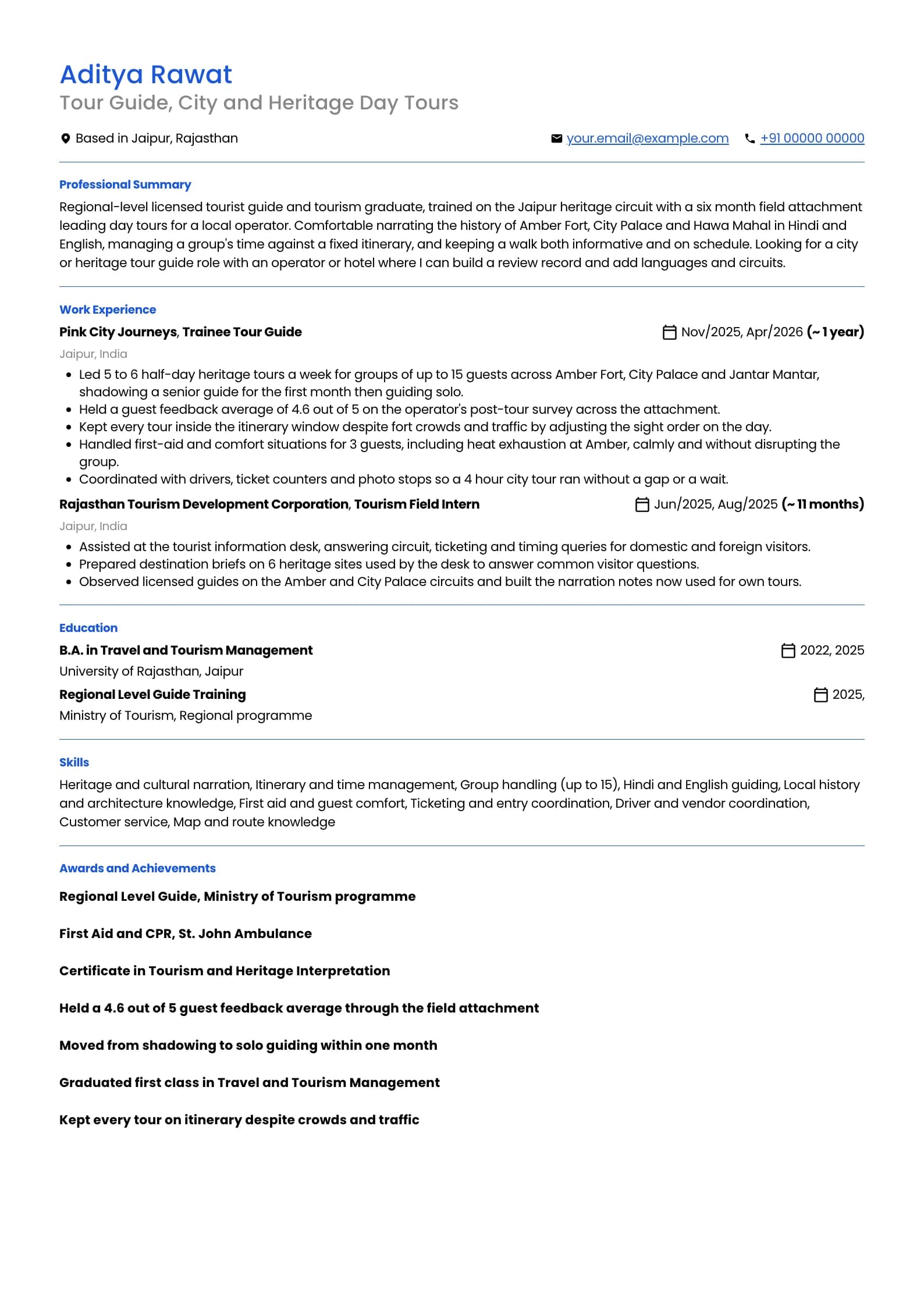
Build my resumeTour Guide resume example, Fresher (0 years)
professional templateIs your resume good enough?
Upload the resume you have now and see what an applicant tracking system reads before a tour guide recruiter ever does.
Free to run. Sign in with your mobile number to see your score.
Tour Guide resume example, Heritage and Cultural Guide (6 years)
header-band template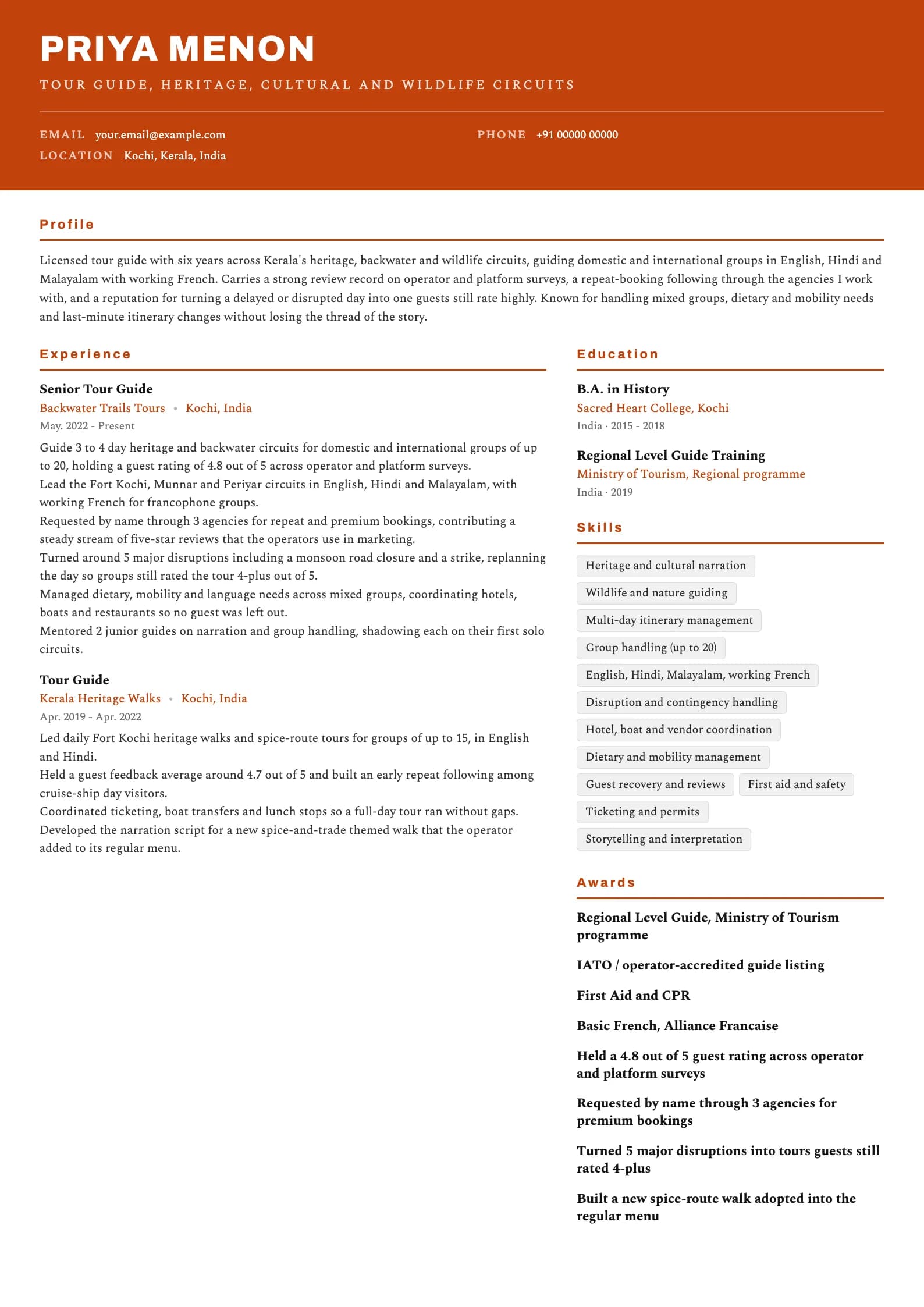
Want this structure with your own details? Build it in the resume builder.
Tour Guide resume example, Senior Tour Leader (12 years)
modern template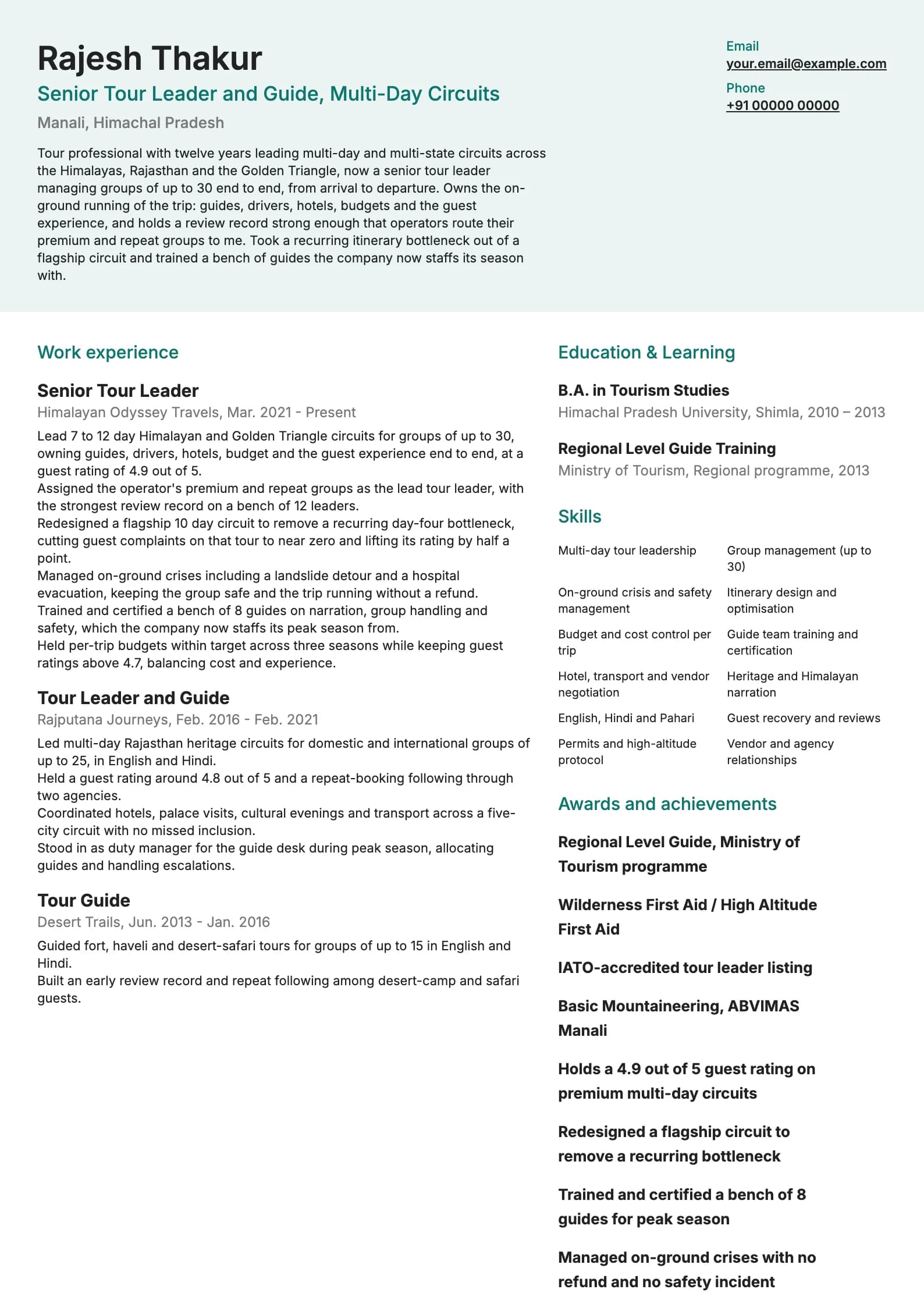
The format that works for tour guide resumes in India
Reverse chronological is the layout to use. Put the most recent operator or role first, work backwards, and let the dates and the seasons sit in plain view. Tourism is a seasonal, reference-driven industry, so a functional resume that groups everything under skills and hides the timeline reads as an attempt to cover a gap, and an operator staffing a season will move to the next candidate rather than guess. Keep it to one page. A guide's resume, even a senior tour leader's, fits a single page: the circuits, the languages, the guest ratings and the licence do not need two. A second page in this trade almost always means padding, a long hobbies line and a declaration paragraph, which weakens the page rather than strengthening it. Four things do not belong on it: a photograph, date of birth, marital status and father's name. They survive from an older template and add nothing to a decision about whether you can hold a group of twenty and keep them on time. Every line they take is a line a circuit, a language or a rating could have used. Lead with your guide licence and languages high on the page, because for a tour guide these are the two facts an operator screens on first. Send a PDF unless the posting asks otherwise, name the file with your own name and 'tour guide', and keep a single column all the way down. The table below sets out the section order.
| Section | Where it goes | Why |
|---|---|---|
| Name and headline | Top, above everything | The headline is the role and your circuit or specialism, for example 'Heritage and Cultural Guide'. |
| Licence and languages | High, near the header | The two facts an operator screens on first. Guide level and every language you work in. |
| Professional summary | Under the header | Three lines. Years, circuits, languages and one number, the guest rating. |
| Work experience | Next, for anyone with a job | Most recent operator first. Newest role gets the most bullets. |
| Skills | Below experience, grouped | Narration, group handling, itinerary, coordination. Not a list of adjectives. |
| Field training | Above experience for a fresher | For a fresher the field attachment is the evidence, so it leads. |
| Education and certifications | Bottom, unless you are a fresher | Degree, guide training, first aid. Guide licence repeated near the top. |
The numbers a tour guide resume must carry
The single most common tour guide resume failure is a page that lists every city and monument covered, with not one number to show guests actually enjoyed the tours. An operator is not hiring a list of sights, they are hiring someone whose groups leave good reviews, tip, come back and never file a complaint. Those are the numbers the resume has to reach for. Guest rating is the number an operator reads first, because reviews are how a guide is judged by both guests and booking platforms. Write it as a figure out of five and name where it comes from, the operator survey or a platform, and give the group size it held across, since a 4.8 across groups of twenty is harder than across pairs. If you were the top-rated guide on the team, or the one premium bookings are routed to, say so. Repeat bookings and requests by name are the proof that your guiding, not just the destination, is the draw. A line like 'requested by name through 3 agencies for premium bookings' tells an operator you generate demand. Disruption recovery is the third number that matters in tourism, because the day that goes wrong, the closed monument, the monsoon road, the strike, is where a good guide earns the rating. 'Turned 5 disruptions into tours guests still rated 4-plus' is worth more than another smooth-day claim. Even a fresher has numbers: tours a week in the field attachment, the feedback average, group size handled, tours kept on itinerary. Reach for the honest one rather than leaving the page a bare list of monuments.
Experience bullet, guest experience
Weak
Responsible for conducting city tours and providing information about historical places to the tourists.
Strong
Guided 3 to 4 day heritage circuits for groups of up to 20, holding a guest rating of 4.8 out of 5 across operator and platform surveys.
'Responsible for' describes the job description; the rewrite gives the group size, the circuit length and the rating a real operator can verify.
For a tour guide the numbers that matter are guest rating, repeat bookings and disruption recovery. A resume that names circuits but reaches none of these describes where you went, not how well the guests were looked after.
Writing a summary a tour operator actually reads
The block under your name is the part most likely to be read, so it should carry four facts: how long you have been guiding, the circuits you run, the languages you work in, and your guest rating. Three or four lines, no adjectives an operator cannot check. The old objective line, seeking a challenging position in a reputed travel company to utilise my communication skills, tells the reader nothing they did not assume. Replace it with a summary. An objective says what you want; a summary says what you have already delivered and what you can be booked for, and only one of those helps an operator plan a season. Freshers often feel they have nothing to summarise. Look at the fresher sample: it names the guide licence, the field attachment, the specific circuit, the languages and a rating. It avoids 'passionate about travel and meeting new people', a phrase so common on tourism resumes that it now carries no information. A practical test: read your summary and ask whether any tourism graduate from your batch could paste it onto their resume unchanged. If they could, it describes the degree, not you. Add your specific circuits, your languages and your rating until it stops being transferable.
Professional summary, experienced guide
Weak
Enthusiastic and passionate tour guide with 6+ years of experience in the travel industry, seeking a challenging role in a reputed company to utilise my skills.
Strong
Licensed tour guide with six years across Kerala's heritage, backwater and wildlife circuits, guiding groups in English, Hindi and Malayalam with working French, at a 4.8 out of 5 guest rating and a repeat following through three agencies.
The rewrite trades self-description for circuits, languages, a rating and a repeat following an operator can verify.
Experience bullets: action, group, result
Every strong bullet in the samples follows the same shape. It opens with an action, names the circuit or the group situation, and closes with what measurably moved. The verb establishes that you did it. The circuit or context tells the operator whether the work is relevant. The number, usually a rating or a group size, does the persuading. Start with the outcome and work backwards. Guides usually write the duty first, which produces bullets like 'conducted tours and gave information about the places'. Instead ask what was different because you led the group: guests rated the tour higher, a disrupted day was saved, a repeat booking came in, a new walk got adopted, a junior guide was trained. Then write the sentence that ends in that fact. Vary the number. A page of nothing but 'guided groups of X' reads as one fact repeated. Across a real role you can honestly reach for guest rating, group size, circuit length, disruptions recovered, agencies that request you, guides trained and budget held. The mid-level and senior samples move across several of these, which reads as range. Where you lack a clean number, give scope: how many guests in a group, how many days in the circuit, how many cities, how many languages you guided it in. 'Led a five-city Rajasthan circuit with no missed inclusion' carries weight without inventing a rating. Allocate bullets by recency. Current operator gets five or six, the previous one four or five, anything older two or three.
| Level | What bullets must prove | Typical number |
|---|---|---|
| Fresher | You can run a tour on time and guests enjoy it | Tours a week, feedback average, group size, tours kept on itinerary |
| 1 to 5 years | Guests rate you highly and rebook you | Guest rating, repeat following, circuits run, languages guided in |
| 6 to 10 years | You save the hard days and guests request you | Rating across large groups, disruptions recovered, agencies requesting you |
| 10 years and up | You own the trip and the guide bench | Premium-group rating, crises managed, guides trained, budget held |
If a bullet would read identically on another guide's resume from the same operator, it is describing the itinerary, not you. Rewrite it until it only fits the groups and the ratings you actually earned.
Languages and destinations are the assignment, not decoration
On most resumes the languages line is an afterthought at the bottom. On a tour guide's resume it is close to the most important thing on the page, because every language you work in is a category of group an operator can assign you to. A guide who works in English, Hindi, Malayalam and working French can take francophone groups the English-only guide cannot, and that directly changes the bookings you earn. Put languages high, and mark the level honestly: fluent, conversational or working. Destinations and circuits are the second half of the assignment. Name the specific circuits you can run, the Fort Kochi heritage walk, the Munnar and Periyar circuit, the Golden Triangle, the Amber and City Palace loop, because an operator staffing a route wants to know which ones you can lead tomorrow without a recce. 'City tours' is vague; a named circuit is a slot you can fill. Specialisms matter too. Heritage and cultural, wildlife and nature, adventure and trekking, pilgrimage, food and culinary, each is a distinct market with its own guests and its own operators. A guide who states a specialism, and backs it with the circuits and ratings to match, is easier to place than one who claims all of them. Do not inflate a language you cannot guide in. A German group will find out in the first ten minutes, and the operator will hear about it. List working French if that is what it is, and let the fluent languages carry the demanding groups.
Every language you list is a category of group you can be booked for, and every named circuit is a route you can run tomorrow. Together they are the single strongest reason an operator picks one guide's resume over another.
The skills section: grouped, specific and honest
A tour guide's skills section has two audiences. Travel agencies and larger operators increasingly run an applicant tracking system that wants literal terms it can match, heritage narration and group handling and itinerary management. A human wants a short, organised list that signals what kind of guide you are. Grouping serves both. Group by function rather than one long line. Guiding and narration, operations and logistics, guest and safety, and languages is a grouping that works for almost every guide. The exact headings matter less than the fact that structure exists. Write the terms the industry uses, itinerary management, group handling, disruption recovery, so an operator reads them without translating. Be honest about your range. List the circuits and specialisms you can genuinely run, because a recce or a first live tour will surface a claim you cannot back. Twelve to sixteen grouped skills is the working range; below eight it looks thin, above twenty it stops being a signal. Do not pad with a wall of adjectives, hardworking, punctual, good communication, positive attitude, stacked five deep. Communication is assumed in a guide; what an operator wants to know is the operational skills, whether you can hold a group, manage time, recover a disrupted day and coordinate drivers, hotels and tickets without help. One line of real operational skill is worth more than a paragraph of self-praise.
| Group | What goes in it | How many |
|---|---|---|
| Guiding and narration | Heritage narration, storytelling, interpretation, specialism circuits | 3 to 5 |
| Operations and logistics | Itinerary management, ticketing, driver and vendor coordination, permits | 3 to 5 |
| Guest and safety | Group handling, disruption recovery, first aid, guest recovery | 3 to 4 |
| Languages | Each language and its level, fluent, conversational or working | 2 to 5 |
| Leadership (senior) | Tour leadership, guide training, budget control, agency relationships | 2 to 4 |
Skills section
Weak
Skills: Hardworking, Good communication, Punctual, Friendly, Travel lover, Team player, Positive attitude, Knowledge of history, Management, Hindi English
Strong
Guiding: heritage narration, cultural interpretation. Operations: itinerary management, ticketing, driver coordination. Guest: group handling, disruption recovery, first aid. Languages: English (fluent), Hindi (fluent), Malayalam (fluent), French (working).
Cuts the adjectives, names the operational skills an operator screens on, and states each language with its real level.
Where the licence, training and education belong
For a tour guide the guide licence is not buried at the bottom, it goes high, near the header, because many circuits and monuments in India legally require a licensed guide and an operator screens on it first. State the level, regional or state, and the issuing programme. A Ministry of Tourism regional guide licence or a state tourism accreditation is a hard credential, not a nice-to-have, so it earns a place near the top and can be repeated in the education block. For a fresher, the field training or attachment is the evidence, so it sits high, right under the summary, ahead of a thin work section. Name the operator, the circuit, the length and what you can honestly quantify, tours a week, feedback average, group size. This is where an operator sees whether you have led live groups or only studied tourism. Education, the degree and institute, goes near the top for a fresher and drops toward the bottom once you have operators and ratings on the page. A tourism, history or hospitality degree is relevant and worth naming; keep the first-class or distinction while you are early. Certifications sit with education. A current first aid and CPR certificate matters on the page, because a guide is often the first responder on a tour, and for adventure or mountain circuits a wilderness or high-altitude first aid credential is close to essential. Language certificates, an Alliance Francaise level or a Goethe certificate, back up the languages you claim. Write the full name, the body and the year, and keep the licence and first aid current, since an expired licence is easy to check.
Getting through the applicant tracking system
Larger travel companies, DMCs and hotel groups increasingly run applications through an applicant tracking system before a human sees them. An ATS is a parser and a search index, not a judge. It reads your file, tries to split it into name, dates, operators, titles and skills, and stores the result so a recruiter can search across candidates. Almost every ATS problem is a parsing problem, and parsing problems come from layout, not wording. The layout rules are short. One column. Standard section headings, so use Work Experience rather than My Adventures, and Skills rather than My Toolkit. No text inside images, because a decorative travel-photo header reads as empty space. Keep the licence, circuits and languages as plain text in the body, not in a header or footer region some parsers drop. On wording, mirror the posting where it is honest. If the job says 'heritage tours' write heritage tours, if it names a circuit you run, name it, if it asks for a specific language, list that language with its level. Spell out the licence in full at least once so a keyword search finds it. Keyword stuffing does not work. A hidden block of every city in India in white text gets caught, and the outcome is worse than being filtered. Write real bullets that naturally carry the right terms, because a bullet describing the Fort Kochi circuit you guided contains the destination in a context that survives human review too. Save as PDF from a tool that embeds real text, then open the file and confirm you can select and copy a sentence. If you cannot select the text, neither can the parser.
Section heading
Weak
My Travel Adventures
Strong
Work Experience
Parsers look for standard headings; a creative one can push the entire block into an unclassified bucket the recruiter never searches.
What gets tour guide resumes rejected
Most rejections at the resume stage are not close calls. They come from a small set of recurring problems, and all of them are fixable in an afternoon. The list below covers what tour operators and travel recruiters see most often on Indian tour guide resumes, in rough order of how much damage each one does.
- A list of cities and monuments with not a single guest rating or review number. The itinerary is not the achievement.
- The guide licence buried at the bottom or left off, when many circuits legally require it and operators screen on it first.
- Languages listed vaguely or inflated. 'German' when you cannot guide in it is caught in the first ten minutes of a tour.
- Duties copied from a job description, 'responsible for conducting tours', instead of what guests actually experienced.
- No mention of disruption handling, so an operator cannot tell whether you can save the day a monument is closed.
- A photo, date of birth, marital status or father's name, none of which belongs on the page and all of which takes a circuit's space.
- A generic objective line. Replace it with a summary that states years, circuits, languages and a rating.
- A wall of adjectives, passionate, friendly, punctual, in place of real guiding and operational skills.
- No first aid credential, when a guide is often the first responder on a tour and adventure circuits require it.
- Inflated titles, dates or ratings that a reference check or a trial tour will expose in a reference-driven industry.
Read your resume as if you were the operator staffing next season. Every circuit and language you list is one you may be booked for tomorrow, so list only the ones you can lead on the day.
Skills to put on a tour guide resume
Technical
- Heritage and cultural narration
- Wildlife and nature guiding
- Itinerary and route management
- Multi-day tour leadership
- Group handling
- Disruption and contingency management
- Ticketing and permits
- Hotel and transport coordination
- First aid and safety
- Budget control per trip
- Guest recovery
- Destination research and interpretation
Tools and platforms
- Booking and reservation systems
- GPS and mapping apps
- Tour management software
- Ticketing and permit portals
- Translation and language apps
- PA and headset guiding systems
- Payment and expense apps
- Messaging and group-coordination apps
Working skills
- Storytelling and public speaking
- Multilingual communication
- Patience with mixed groups
- Punctuality and time management
- Calm under disruption
- Cultural sensitivity
- Guest empathy and comfort
- Negotiation with vendors
- Team and guide leadership
Certifications worth listing as a tour guide
| Certification | Full name | Worth it for |
|---|---|---|
| Regional Guide Licence | Ministry of Tourism Regional Level Guide | The core credential for a tour guide in India, worth it for anyone guiding at monuments and circuits that legally require a licensed guide. Essential for heritage and monument work; the level, regional or state, sets which sites you can legally guide, so it belongs near the top of the resume. |
| State Tourism Accreditation | State Tourism Department Guide Accreditation | State-level guide accreditation, worth it for guides working a particular state's circuits, from Rajasthan to Kerala to Himachal. Complements the regional licence and is what many state operators and DMCs ask for when they staff local guides. |
| IATO Listing | IATO / IATA-accredited tour operator guide listing | Being listed or accredited with recognised operator bodies signals you work to industry standards, worth it for guides who take inbound and international groups through DMCs. Less relevant for a purely local day-tour guide, more so as you move toward premium and international circuits. |
| Wilderness First Aid | Wilderness / High Altitude First Aid Certificate | Close to essential for adventure, trekking and Himalayan tour leaders, where the guide is the first responder far from a hospital. Worth it for anyone leading mountain, forest or remote circuits; a standard first aid and CPR certificate is enough for city and heritage guiding. |
| Language Certificate | Alliance Francaise / Goethe / other language proficiency certificate | A formal language certificate backs up a claimed foreign language, worth it for guides targeting francophone, German or other international groups where languages directly drive bookings. Most valuable when the certificate matches a real, in-demand tourist market for your circuits. |
Keywords an ATS scans for in a tour guide resume
These are the literal terms a parser matches against the job description. Use the ones that are true of you, in the sentences where you did the work, not as a list at the bottom.
- tour guide
- tourist guide
- tour leader
- heritage tours
- cultural tours
- itinerary management
- group handling
- guest satisfaction
- guide licence
- regional guide
- customer service
- multilingual
- wildlife guiding
- first aid
- ticketing
- vendor coordination
- storytelling
- travel and tourism
- guest rating
- disruption recovery
Tour Guide resume FAQ
What salary can a tour guide expect in India?
Guiding income is often part fixed and part per-tour, so it varies with the season and the circuit. A fresher on city day tours typically earns around 1.5 to 3 LPA equivalent once tips and per-tour fees are counted. A licensed guide with five or six years, multiple languages and a strong rating usually earns 3.5 to 7 LPA, more in peak season and on premium inbound circuits. Senior tour leaders on multi-day and international circuits commonly earn 7 to 14 LPA and above with allowances. Foreign languages, a strong review record and adventure or luxury specialisms push the top of every band upward.
Do I need a licence to be a tour guide in India?
For many monuments and heritage sites, yes. A Ministry of Tourism regional level guide licence or a state tourism accreditation is legally required to guide at a lot of protected monuments and circuits, and operators screen for it first. Put your licence and its level, regional or state, high on the resume near the header, not buried in the education block. Some private and adventure tours do not strictly require a licence, but having one still widens the work you can be booked for.
How long should a tour guide resume be?
One page. A guide's resume, even a senior tour leader's, fits a single page: the circuits, languages, guest ratings, licence and certifications do not need two. If you are struggling to fit, cut the oldest role to a single line, remove any unrelated course, and delete the hobbies and declaration lines. In a fast-moving, seasonal industry, an operator wants a page they can read in under a minute.
How important are languages on a tour guide resume?
Very. Every language you work in is a category of group an operator can assign you to, so languages belong high on the page, not at the bottom, and each should be marked with its real level, fluent, conversational or working. English and Hindi are the baseline; a regional language plus an in-demand foreign language like French, German, Spanish or Japanese directly increases the bookings you can take. Do not inflate a language you cannot guide in, because a live group finds out within minutes.
How does a fresher write a tour guide resume with no job?
Lead with your guide licence and languages, then the field training or attachment, then education. Treat the training like a job: which operator, which circuit, how long, the group sizes you handled and what you can honestly quantify, tours a week, feedback average, tours kept on itinerary. Name the specific sites you can already guide rather than saying 'city tours'. Include a first aid certificate and any language certificate. Verifiable facts and a real rating beat adjectives like passionate or enthusiastic.
Which numbers should a tour guide put on a resume?
The ones an operator reads first are guest rating, repeat bookings and disruption recovery. Give your guest rating out of five, say where it comes from and the group size it held across. Show repeat bookings or requests by name through agencies, since that proves your guiding is the draw. Add disruptions you turned into tours guests still rated highly, because the day that goes wrong is where a guide earns the rating. Group size, circuit length and guides trained work well as supporting numbers.
Should I list every city and monument I have covered?
List the circuits and specialisms you can genuinely lead, grouped and named, rather than a long roll-call of every place you have visited. An operator wants to know which routes you can run tomorrow without a recce, so 'Fort Kochi heritage walk, Munnar and Periyar circuit' is stronger than a list of thirty city names. Pair the named circuits with a specialism, heritage, wildlife, adventure, pilgrimage, and the guest rating that backs it, and leave off the places you have only seen as a tourist.
Do I need a photo on a tour guide resume in India?
No, not built into the resume. An operator decides on a trial tour or a reference check, not a photo, and it takes space a circuit, language or rating should use. The same goes for date of birth, marital status, father's name and a declaration paragraph. If a specific luxury or client-facing operator asks for a photograph in the posting, attach it as a separate file rather than designing it into the page.
How do I get a tour guide resume through an ATS?
Use a single-column layout with standard headings like Work Experience and Skills, keep the licence, circuits and languages as plain text rather than inside images or the header region, and mirror the posting's wording where it is honest. If the job says heritage tours or names a circuit or language, use those exact terms. Spell out your guide licence in full at least once. Then save as a text-based PDF and confirm you can select and copy the text, because whatever you can select is what the parser reads.
Related resume examples and guides
Build your own tour guide resume
Start from a blank resume or upload the one you have. Goodspace renders it in 24 templates and flags the circuit, language and guest-rating keywords a travel operator's applicant tracking system will look for, and the padding it will not credit.
Build my resume