SAP Consultant Resume Format, with 3 Full Samples
An SAP consultant is hired on evidence of implementations delivered, business processes configured to actually run, and go-lives survived without the plant grinding to a halt. Most SAP resumes instead list every module and transaction code and forget the one process redesign that cut a client's month-end close from a week to a day. Below are three complete resumes, one for an SAP-certified fresher who has finished a real training project, one for a functional consultant with five years across implementation and support, and one for a senior lead consultant owning end-to-end S/4HANA rollouts. After the samples come the format rules, the difference between listing modules and proving delivery, the terms a parser matches literally, and the mistakes that end a screening before a delivery manager sees the page.
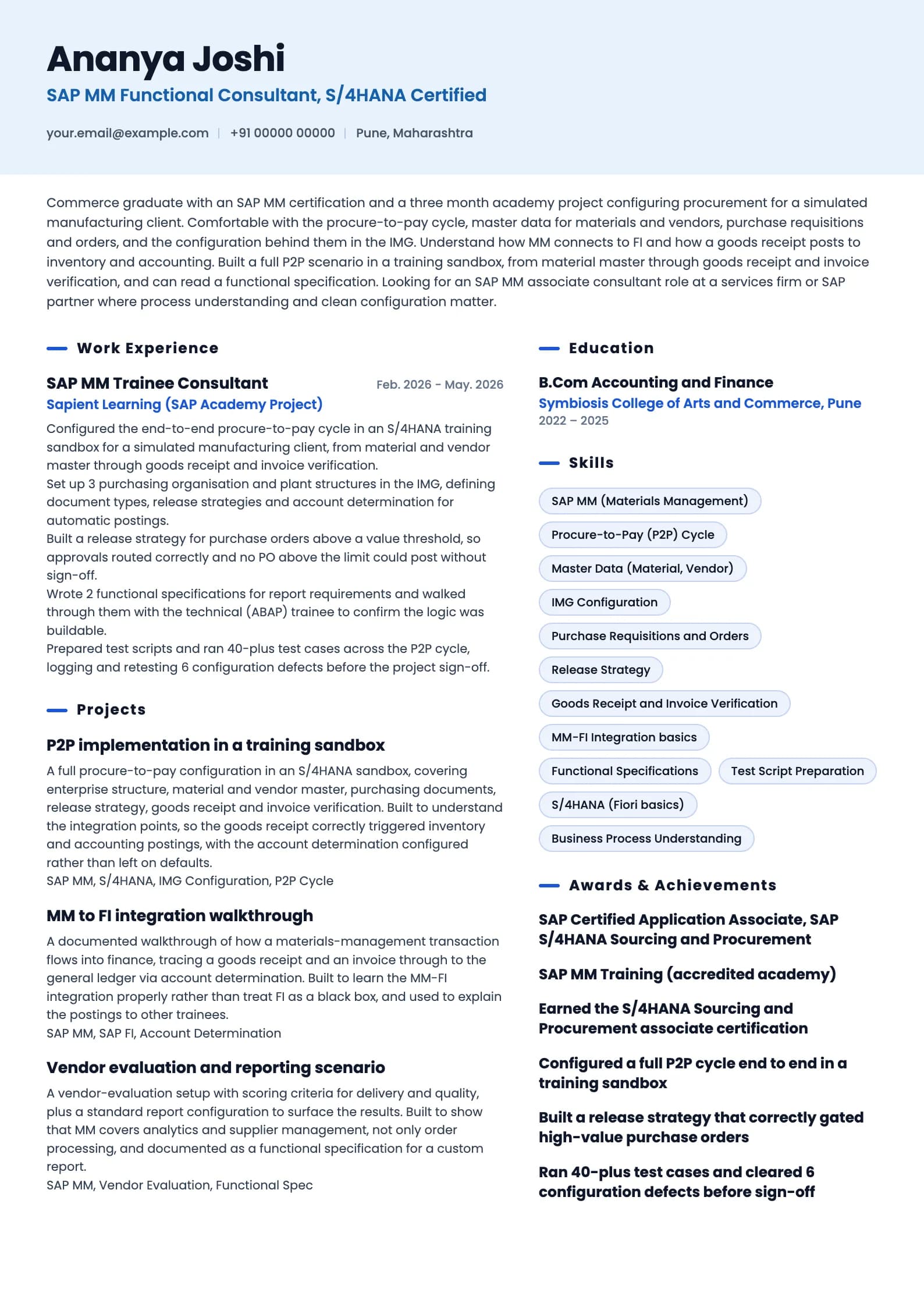
Build my resumeSAP Consultant resume example, Fresher (0 to 1 year)
ai-era templateIs your resume good enough?
Upload the resume you have now and see what an applicant tracking system reads before a sap consultant recruiter ever does.
Free to run. Sign in with your mobile number to see your score.
SAP Consultant resume example, Functional Consultant (5 years)
professional template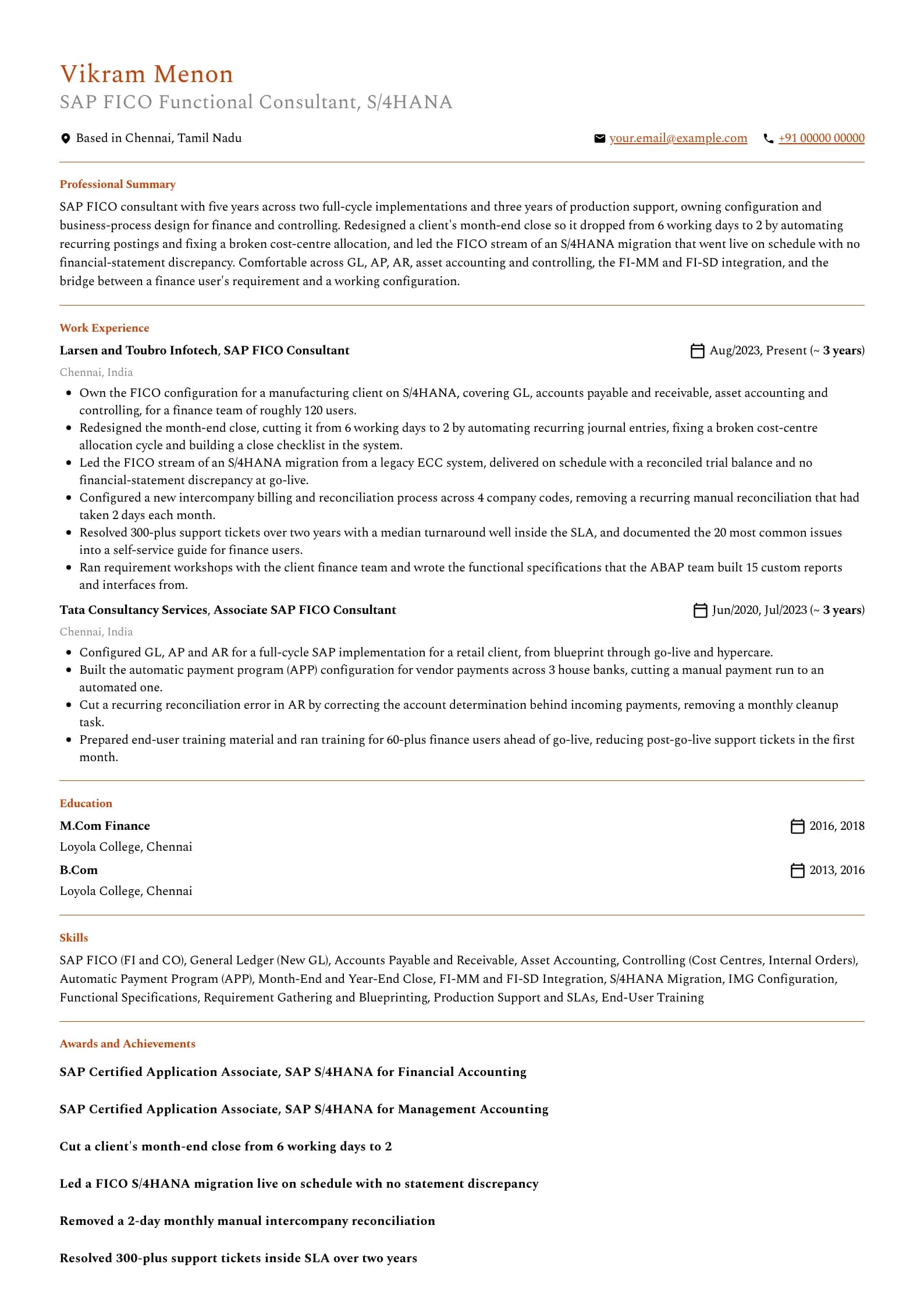
Want this structure with your own details? Build it in the resume builder.
SAP Consultant resume example, Senior Lead (12 years)
header-band template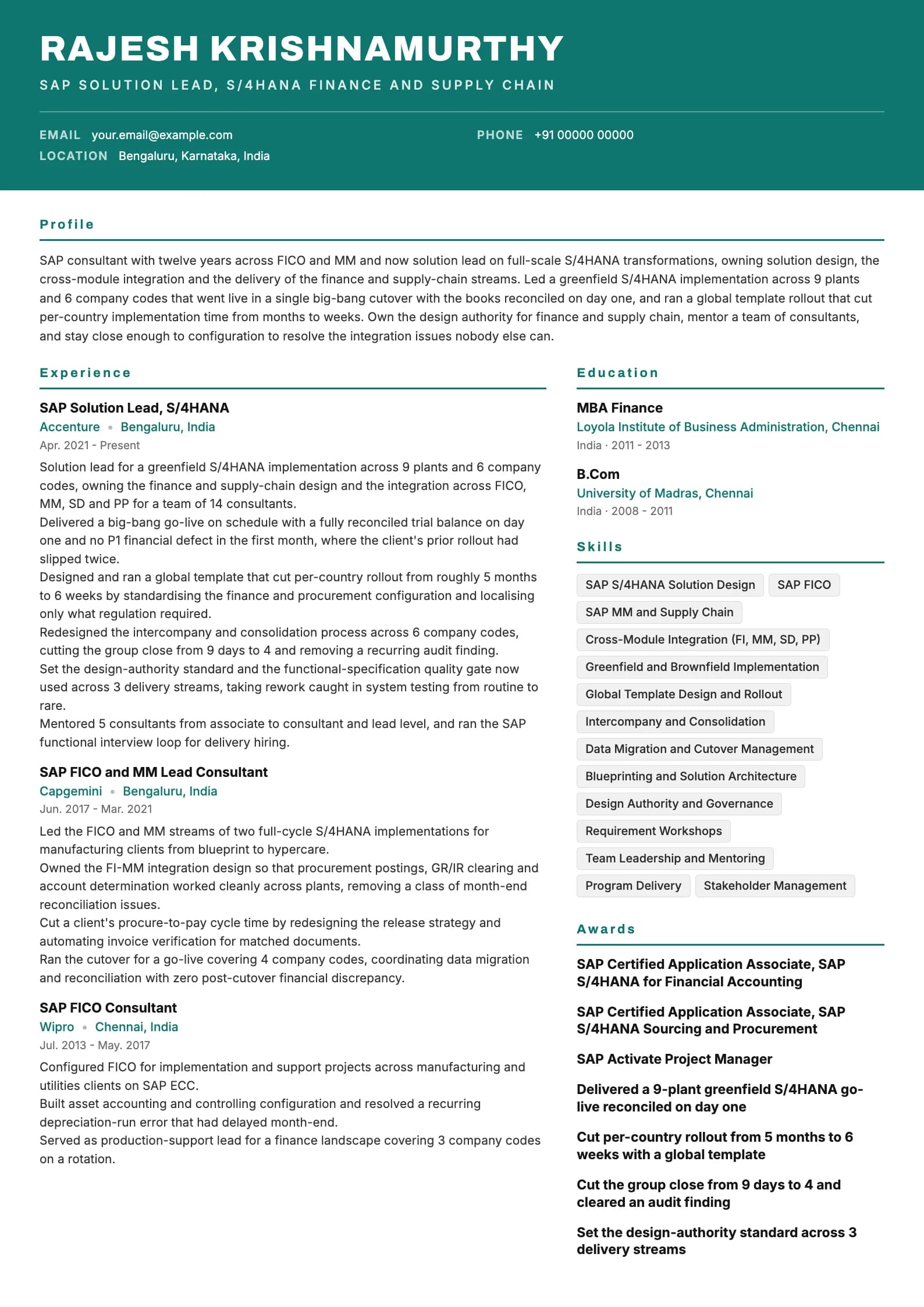
The format that works for SAP consultant resumes in India
Reverse chronological is the layout to use, and for SAP it usually means a project-wise structure inside each role. Most recent role first, and within it, list the projects with client type, module, your role and the phase you worked (implementation, rollout, support). SAP delivery managers read for project experience, so a resume that lists years at a company without naming the projects underneath is missing its most important information. Length is more generous here than for a pure coding role, because SAP careers are project-based and each project is genuine evidence. One page is right for a fresher. A consultant with five years and multiple implementations will usually run to two pages, and a senior lead with a dozen years and several full-cycle rollouts may reach three. What justifies the length is real project detail, not a longer list of transaction codes. A page built from a transaction-code dump and a declaration paragraph is padding at any length. Four things belong nowhere on an SAP consultant resume: a photograph, date of birth, marital status and father's name. They survive from an older template and add nothing to a delivery screen. Every line they occupy is a line a project or a business outcome could have used. Name your module clearly in the headline, because SAP hiring filters hard on module. An SAP MM consultant and an SAP FICO consultant are different searches. Send a PDF unless the posting asks otherwise, name the file with your own name, module and role, and keep to a single column so a parser does not read a sidebar of skills into the middle of your project history. The table below sets out the section order.
| Section | Where it goes | Why |
|---|---|---|
| Name and headline | Top, above everything | The headline names the module: SAP FICO Consultant, SAP MM Consultant. Recruiters filter on it. |
| Professional summary | Directly under the header | Three or four lines. Module, years, number of implementations, and the single strongest business outcome. |
| Core competencies | Under the summary | The processes and sub-modules you own, grouped. Helps both the parser and a quick human scan. |
| Project experience | Next, the heart of the resume | Per project: client type, module, your role, phase, and what you delivered. Most recent first. |
| Certifications | After experience, or high up for a fresher | SAP certification names are strong keywords. Write them in full. |
| Skills | Grouped with the modules and processes | Modules, processes, integration, tools. Not a wall of transaction codes. |
| Education | Bottom, unless you are a fresher | Degree, institution, years. B.Com, M.Com or MBA finance is relevant for FICO. |
Listing modules is not the same as proving delivery
The single most common SAP resume failure is a page dense with module names and transaction codes and thin on anything that shows you delivered a working process. A parser matches MM, SD, FICO, PP, QM, WM, and a delivery manager sees a candidate who has memorised the menu but may never have taken a client from blueprint to a reconciled go-live. SAP hiring is unusually outcome-focused, because a botched configuration costs a client real money at month-end, so the resume has to prove delivery, not familiarity. The fix is to let the projects prove the modules. For every module you claim, there should be a project that shows you configured a real process in it and what that did for the client. FICO is backed by a month-end close you shortened, MM by a procure-to-pay cycle you configured, integration by a reconciliation you fixed across modules. The functional consultant sample lists FICO and then shows a close cut from six days to two, so the module and the outcome agree. Be specific about the phase and the integration. Implementation, rollout, support and upgrade are different kinds of work, and a delivery manager wants to know which you have done. Naming the integration points, FI-MM, FI-SD, MM-PP, tells a reviewer you understand SAP as one connected system, which is exactly where configuration goes wrong for people who learned modules in isolation. Do not lean the resume on transaction codes. A long list of T-codes (ME21N, MIGO, FB50, F110) is not evidence of consulting skill, because anyone can memorise them. Name the business process and the outcome, and let a T-code appear only where it makes a bullet clearer.
For every module on your page, ask: is there a project bullet that shows I configured a real process in it and what it did for the client. A resume heavy on module names and transaction codes but light on delivered outcomes reads as training, not consulting.
Writing a summary a delivery manager actually reads
The block under your name is the part you can be reasonably sure gets read, so it should carry four facts: your module, how long you have been consulting, how many implementations you have delivered, and the strongest business outcome your work produced. Three or four lines, no adjectives that cannot be checked. The old objective line, seeking a challenging SAP position in a reputed organisation to utilise my functional skills, tells the reader nothing they did not assume. Replace it with a summary. An objective describes what you want, a summary describes what you have already delivered, and only one is evidence. Freshers often think they have nothing to summarise. Look at the fresher sample: it names the certification, the module, the training project and the specific process configured. That is a genuine summary built from a certification and an academy project. What it avoids is "passionate about SAP", a phrase so common on training-batch resumes it now carries no information. A practical test: read your summary and ask whether anyone from your certification batch could paste it onto their resume unchanged. If they could, it describes the training, not you. Add the specific process, the specific outcome and the specific number of implementations until it stops being transferable.
Professional summary, functional consultant
Weak
Passionate and result-oriented SAP FICO consultant with 5+ years of experience in SAP FICO configuration and support, seeking a challenging role in a reputed organisation to utilise my skills.
Strong
SAP FICO consultant with five years across two full-cycle implementations and three years of support. Redesigned a client's month-end close from 6 working days to 2, and led the FICO stream of an S/4HANA migration live on schedule with no financial-statement discrepancy.
The rewrite trades self-description for the number of implementations and two verifiable business outcomes a finance stakeholder recognises instantly.
Project bullets: what you configured and what it did for the business
Every strong bullet in the samples follows the same shape. It names the process or configuration you delivered, and closes with what measurably changed for the client. SAP is a business-outcome role, so the number is usually a business number: days off a close, tickets cleared, a reconciliation removed, a rollout time cut, a go-live delivered clean. The configuration is how you got there; the outcome is what you were hired for. Start with the business outcome and work backwards. SAP consultants often write the configuration first, then forget the outcome, which produces bullets like "configured GL, AP and AR as per client requirements". Instead ask what was different for the finance or procurement team after you delivered: the close is shorter, a manual reconciliation is gone, a payment run is automated, an audit finding cleared, a go-live reconciled on day one. Then write the sentence that ends in that fact. Vary the outcome. SAP work has honest numbers beyond the close: tickets resolved inside SLA, users trained, company codes covered, rollout time, defects at go-live, manual effort removed. Do not make every bullet a close-time number, because range reads as breadth of delivery. Where you lack a number, give scope: how many company codes, how many plants, how many users, which phase, how many implementations. "Delivered a big-bang go-live across 6 company codes with a reconciled trial balance on day one" carries weight without inventing a percentage. Structure each role by project. For a role that spanned several projects, a short project header (client type, module, phase) followed by three or four outcome bullets reads far better than a flat list.
| Level | What bullets must prove | Typical outcome |
|---|---|---|
| Fresher | You understand a business process and can configure it | A cycle configured end to end, test cases cleared, a spec written |
| 2 to 4 years | You deliver configuration and handle support | Tickets inside SLA, a process automated, users trained |
| 5 to 8 years | You own a module stream through full-cycle delivery | Close-time cut, reconciliation removed, go-live delivered clean |
| 9 years and up | You own solution design and cross-module integration | Rollout time cut, group close cut, template built, go-live reconciled day one |
Project bullet, FICO consultant
Weak
Responsible for configuration of GL, AP, AR and asset accounting as per client requirements and providing support to end users.
Strong
Redesigned the month-end close, cutting it from 6 working days to 2 by automating recurring journal entries, fixing a broken cost-centre allocation cycle and building an in-system close checklist.
"Responsible for" lists modules; the rewrite names the process redesigned, the mechanism, and the business outcome a finance director cares about.
Project bullet, MM consultant
Weak
Worked on procure-to-pay process and configured purchase orders and goods receipt as per the requirement.
Strong
Configured a release strategy and automated invoice verification for matched documents, cutting the procure-to-pay cycle time and removing a recurring three-way-match exception at month-end.
Turns a vague configuration list into a specific change with a measurable process and reconciliation outcome.
If a bullet names a module and a configuration but no business outcome, it is describing a task, not delivery. Rewrite it until it ends in what changed for the client's finance or supply-chain team.
The skills section: modules, processes and integration, grouped
An SAP resume's skills section has two audiences with opposite preferences. The parser wants literal terms it can match, FICO and S/4HANA and procure-to-pay. A human wants a short, organised view of your module, the sub-modules you own, the processes you know and the integration you understand. Grouping satisfies both. Group by function rather than one long line. Module and sub-modules, business processes, integration, and tools and methodology is a grouping that works for almost every functional consultant. The exact headings matter less than the fact that structure exists. Write names the way SAP writes them: S/4HANA not S4 Hana, FICO not FiCo, procure-to-pay or P2P spelled out once. A parser matches on strings. Keep the list proportionate to what you have delivered. SAP resumes pad in two directions: claiming several modules (FICO plus MM plus SD plus PP) when you have only truly worked in one or two, and dumping a long list of transaction codes as if they were skills. A delivery manager reads a broad module claim with suspicion, because deep single-module consultants are more valuable and more common than genuine multi-module ones. List the module you own, the processes you have configured, and only the additional modules you can actually defend in an interview. Do not include a proficiency bar. Star ratings invite an argument you cannot win, and nobody agrees on what four stars in FICO means. Let the projects prove the depth instead.
| Group | What goes in it | How much |
|---|---|---|
| Module and sub-modules | Your primary module and the sub-modules you own (e.g. FICO: GL, AP, AR, AA, CO) | Your core, in detail |
| Business processes | Procure-to-pay, order-to-cash, record-to-report, month-end close | 2 to 4 you have delivered |
| Integration | FI-MM, FI-SD, MM-PP, the touchpoints you understand | 2 to 3 |
| Delivery | Implementation, rollout, support, S/4HANA migration, blueprinting | The phases you have done |
| Tools and methodology | SAP Activate, ASAP, Solution Manager, LSMW, Fiori, test management | 2 to 4 |
Skills section
Weak
Skills: SAP FICO, SAP MM, SAP SD, SAP PP, SAP QM, SAP WM, SAP HR, ME21N, MIGO, MIRO, FB50, FB60, F110, KO01, S_ALR reports, MS Excel, MS Word, SAP GUI
Strong
Module: SAP FICO (GL, AP, AR, asset accounting, controlling). Processes: record-to-report, month-end close, procure-to-pay. Integration: FI-MM, FI-SD. Delivery: full-cycle implementation, S/4HANA migration, production support. Tools: SAP Activate, Solution Manager, LSMW.
Cuts the modules you cannot defend and the transaction-code dump, and replaces them with the processes, integration and delivery phases a delivery manager actually filters on.
Projects and training: what to include and how to describe it
For an experienced SAP consultant, the project experience is the resume, so there is no separate projects section, the roles are the projects. This section is mainly for freshers and career switchers, for whom a training or academy project is the only hands-on evidence and deserves the same care an experienced consultant gives a real implementation. The common failure is describing SAP instead of the work. "Worked on SAP MM in a training project covering procurement" tells a reviewer nothing. Describe the process you configured, the integration you touched, and what you had to get right. The P2P sandbox project in the fresher sample is a stronger entry than a vaguer one, because it names the enterprise structure, the release strategy, the account determination and the integration postings, which are the things a real project actually turns on. Be honest that it is a training or sandbox project. Delivery managers know the difference between an academy sandbox and a live client, and a fresher who is straightforward about it and shows genuine process understanding reads far better than one who dresses a training exercise up as production experience. The credibility you gain from honesty outweighs the little you lose from the label. Career switchers, who are common in SAP, should connect their domain background to the module. A commerce graduate configuring FICO, or a supply-chain professional moving into MM, has real business-process understanding that a pure-technical candidate lacks, and naming that connection is a genuine advantage rather than something to hide.
Training project description, fresher resume
Weak
SAP MM Project: worked on a training project in SAP MM covering the procurement process and master data.
Strong
P2P configuration (S/4HANA training sandbox): configured enterprise structure, material and vendor master, a value-based PO release strategy, and account determination so goods receipts posted correctly to inventory and accounting.
Swaps a vague module mention for the specific configuration and the integration postings, which shows real process understanding rather than exposure.
Where education and certifications belong
Education goes at the bottom for an experienced consultant, and near the top for a fresher. Degree, institution, years. SAP is unusual in that the degree often matters to the module: a B.Com, M.Com or MBA finance is a genuine asset for a FICO consultant, and a supply-chain or engineering background helps for MM, PP or SD. So while education sits low for the experienced, it is worth keeping the finance or domain qualification visible because it supports the functional credibility. Percentage or CGPA is worth keeping while you are a fresher and it is good, because early-career screening still filters on it. Once you have delivered projects, drop it. Project outcomes are far more predictive than a college number. SAP certification carries real weight, more than in many fields, because it is expensive, controlled by SAP, and specific to a module and release. Write the full name, including the module and the S/4HANA release, because SAP versioning is public and a delivery manager reads it precisely. The associate certifications (S/4HANA for Financial Accounting, Sourcing and Procurement) are the standard credentials. The SAP Activate project-management certification is a useful addition for consultants moving toward lead and delivery-management roles. An out-of-date certification on an old release is not a disqualifier, since experience matters more, but list the release honestly. Claiming a current S/4HANA certification you do not hold is easy to catch, because certification IDs are verifiable.
Getting through the applicant tracking system
An applicant tracking system is a parser and a search index, not a judge. It reads your file, tries to break it into name, dates, employers, titles and skills, and stores the result so a recruiter can search across candidates. For SAP specifically, recruiters search hard on module and release, so getting those terms in as clean text matters more than usual. The layout rules are short. One column. Standard section headings, so use Work Experience or Project Experience rather than My Journey, and Certifications rather than My Achievements. No text inside images. No critical information in the header or footer region, which some parsers drop. Avoid text boxes and nested tables in the resume body, which SAP resumes often overuse to lay out project tables. On wording, mirror the job description where it is honest. If the posting says SAP FICO, write SAP FICO and also spell out FI and CO. If it says S/4HANA, write S/4HANA rather than only SAP. Name the specific processes the posting mentions, procure-to-pay, order-to-cash, record-to-report, because recruiters search on those too. Include the module abbreviation and the expansion at least once, for example "MM (Materials Management)", so both searches find you. Keyword stuffing does not work. Listing every SAP module in a hidden block to match more searches gets you screened by a delivery manager who asks about the module you clearly have not touched, and that is worse than not matching. Write real project bullets that naturally contain the module and process terms. Save as PDF from a tool that embeds real text, then open the file and confirm you can select and copy your module names, certification names and client-project details. If you cannot select the text, neither can the parser.
Module keyword in the headline
Weak
SAP Consultant with experience in various SAP modules and implementations.
Strong
SAP FICO Consultant (FI, CO) with S/4HANA implementation and support experience.
SAP recruiters filter on the specific module and release; "various modules" matches no targeted search, while the named module and S/4HANA land in the searches recruiters actually run.
Test your own file before you send it. Copy the text out of the PDF into a plain text editor and confirm your module, release and certification names come through as clean words. SAP recruiter searches are module-specific, so a scrambled module name means you never appear in the shortlist.
What gets SAP consultant resumes rejected
Most rejections at the resume stage are not close calls. They come from a small set of recurring problems, and all of them are fixable in an afternoon. The list below covers what reviewers of Indian SAP consultant resumes see most often, in rough order of how much damage each one does.
- A module and transaction-code list with no project bullet showing a delivered business outcome, which reads as training rather than consulting.
- Claiming several modules when you have truly worked in one, which a delivery manager exposes with a single process question.
- Project experience with no client context, phase or outcome, so a reviewer cannot tell what you actually did on each engagement.
- No business numbers anywhere. Close-time, tickets inside SLA, reconciliation removed, go-live reconciled, users trained. Pick whichever is honest.
- Dressing a training or sandbox project up as live production experience, which is easy to catch and destroys credibility.
- A photo, date of birth, marital status or father's name, none of which belongs on a consulting resume and each of which takes a project's space.
- A generic objective line. Replace it with a summary that states module, years, implementations and one outcome.
- A vague headline like "SAP Consultant" with no module, so a module-specific recruiter search never surfaces the resume.
- Ignoring integration entirely, so a reviewer suspects you learned your module in isolation and will struggle at cross-module month-end.
- Listing certifications without the release, or claiming a current S/4HANA certification you do not hold, which is verifiable and ends the process.
Read each project bullet and ask whether a finance or supply-chain stakeholder would recognise the outcome. If a bullet only makes sense to someone who already knows SAP, rewrite it to name the business result the client actually got.
Skills to put on a sap consultant resume
Technical
- SAP S/4HANA
- SAP FICO (FI and CO)
- SAP MM (Materials Management)
- IMG Configuration
- Record-to-Report (Month-End Close)
- Procure-to-Pay (P2P)
- Order-to-Cash (O2C) awareness
- Cross-Module Integration (FI-MM, FI-SD)
- Asset Accounting and Controlling
- Automatic Payment Program (APP)
- Data Migration (LSMW, Migration Cockpit)
- Fiori and S/4HANA Apps
- Functional Specifications
- S/4HANA Migration and Conversion
Tools and platforms
- SAP GUI
- SAP Solution Manager
- SAP Activate Methodology
- ASAP Methodology
- LSMW
- SAP Fiori Launchpad
- HP ALM / test management
- SAP Query and reporting
- MS Excel (advanced)
- JIRA / ServiceNow (ticketing)
- Data Migration Cockpit
- SAP Signavio (process)
Working skills
- Requirement gathering and workshops
- Business process analysis
- Stakeholder management
- Client communication
- Documentation (BPML, functional specs)
- End-user training
- Cutover and go-live coordination
- Cross-functional collaboration
- Mentoring
Certifications worth listing as a sap consultant
| Certification | Full name | Worth it for |
|---|---|---|
| S/4HANA Finance | SAP Certified Application Associate, SAP S/4HANA for Financial Accounting | The core credential for a FICO consultant and a strong signal on any finance-track SAP resume. Certifies the finance configuration on the current release, which matters because clients are migrating off ECC. Most valuable for freshers and consultants up to the mid-career range; beyond that, delivered implementations outweigh the badge. |
| S/4HANA Procurement | SAP Certified Application Associate, SAP S/4HANA Sourcing and Procurement | The core credential for an MM consultant, covering procurement configuration on S/4HANA. A clear signal for freshers and career switchers entering materials management, and a useful release-currency marker for experienced consultants moving from ECC to S/4HANA. |
| S/4HANA Management Accounting | SAP Certified Application Associate, SAP S/4HANA for Management Accounting | Worth it for FICO consultants who want to prove the controlling (CO) side specifically, including cost centres, internal orders and product costing. Complements the financial accounting certification for consultants who own the full FICO stream rather than only FI. |
| SAP Activate | SAP Certified Associate, SAP Activate Project Manager | Worth it for consultants moving toward lead, solution-architect and delivery-management roles, since SAP Activate is the standard methodology for S/4HANA projects. Signals you can run the delivery, not only configure a module. Less relevant for a pure functional configurator early in their career. |
| S/4HANA Sales | SAP Certified Application Associate, SAP S/4HANA Sales | The core credential for an SD consultant, covering order-to-cash configuration. Relevant only if sales and distribution is your module or a genuine secondary; listing it without SD project experience behind it is padding a delivery manager will question. |
Keywords an ATS scans for in a sap consultant resume
These are the literal terms a parser matches against the job description. Use the ones that are true of you, in the sentences where you did the work, not as a list at the bottom.
- sap consultant
- sap fico
- sap mm
- s/4hana
- functional consultant
- implementation
- configuration
- procure-to-pay
- record-to-report
- month-end close
- fi-mm integration
- production support
- blueprinting
- go-live
- cutover
- data migration
- sap activate
- solution manager
- functional specification
- sap certified
SAP Consultant resume FAQ
What salary can an SAP consultant expect in India?
A certified fresher or associate consultant typically starts around 3.5 to 6 LPA, with SAP partners and product companies paying more than large services firms. A functional consultant with five to eight years and multiple implementations usually sits in the 12 to 25 LPA band. Senior and lead consultants and solution architects with a dozen years and full-cycle S/4HANA delivery commonly earn 28 to 55 LPA and more. SAP is one of the higher-paid enterprise skills in India, and module scarcity matters: in-demand modules and S/4HANA solution-design skills push the top of every band upward.
How long should an SAP consultant resume be?
Longer than a coding resume, because SAP careers are project-based and each project is real evidence. One page for a fresher, two pages for a consultant with several years and multiple implementations, and up to three for a senior lead with many full-cycle rollouts. What justifies the length is genuine project detail with outcomes, not a longer list of transaction codes. If the resume is running long on module lists rather than delivered projects, cut the lists, not the projects.
Should I focus on one SAP module or list several?
Focus on the module you can actually defend, and add a second only if you have real project experience in it. Deep single-module consultants are more valuable and more sought after than candidates who claim four modules and can configure none of them well. A delivery manager reads a broad multi-module claim with suspicion and tests it in the interview. Name your primary module clearly in the headline, since SAP recruiters filter hard on it, and let genuine secondary experience appear only where you have delivered in it.
Do I need SAP certification to get hired?
It helps a great deal for freshers and career switchers, where a current S/4HANA associate certification is often what gets the resume shortlisted, and it matters less once you have delivered implementations. SAP certification is expensive and controlled, so it carries more weight than certifications in many other fields. For experienced consultants, delivered projects and business outcomes outweigh the badge, but keeping your certification current on the S/4HANA release signals that you have moved with the platform as clients migrate off ECC.
How does a fresher write an SAP consultant resume?
Lead with your certification, then your training or academy project, then education and skills. Treat the training project as a real implementation: name the process you configured, the enterprise structure, the integration you touched and what you had to get right, such as account determination or a release strategy. Be honest that it is a sandbox project, because delivery managers value the honesty and the genuine process understanding over a training exercise dressed up as production. If you are a career switcher, connect your domain background, such as commerce for FICO, to the module.
Should I list transaction codes on my SAP resume?
Sparingly. A long block of transaction codes (ME21N, MIGO, FB50, F110) is not evidence of consulting skill, because anyone can memorise them, and it crowds out the project outcomes a delivery manager reads for. Name the business process, the configuration and the result, and let a transaction code appear only where it genuinely makes a bullet clearer. Your value is in configuring a working process and delivering a clean go-live, not in reciting the menu.
How do I show implementation versus support experience?
Label the phase on every project, because implementation, rollout, support and upgrade are different kinds of work and delivery managers want to know which you have done. Full-cycle implementation experience, from blueprint through go-live and hypercare, is especially valued, so make it explicit where you have it. Support experience shows you can keep a production landscape running and resolve real issues inside an SLA, which is genuine and worth quantifying with tickets cleared and turnaround. Consultants who have done both should show both clearly.
Does the applicant tracking system handle SAP resumes well?
It handles them fine if the module and release names are clean text and the layout is single-column. SAP recruiters search hard on the specific module and the S/4HANA release, so a scrambled or image-based module name means you never appear in the shortlist. Spell out the module and its abbreviation at least once, for example MM (Materials Management), name the processes the posting mentions, and test your file by copying the text out of the PDF to confirm the module, release and certification names come through as words.
What business outcomes should an SAP consultant highlight?
The ones a finance or supply-chain stakeholder recognises: days off the month-end or group close, a manual reconciliation removed, a payment run automated, rollout time cut, a go-live delivered on schedule with the books reconciled, support tickets cleared inside SLA, and an audit finding closed. These are the numbers that separate a consultant who configured a module from one who delivered a working process. Lead your bullets with the outcome and let the configuration explain how you achieved it.
Related resume examples and guides
Build your own in any of these formats
Start from a blank resume or upload the one you have. Goodspace renders it in 24 templates and flags the module, S/4HANA and process keywords an applicant tracking system will look for, and the transaction-code padding it will not credit.
Build my resume