Recruiter Resume Format, with 3 Full Samples
A recruiter is hired on evidence of roles closed, time-to-fill cut and offers that candidates actually accept, yet most recruiter resumes list the ATS and job boards and forget the funnel they moved. Below are three complete resumes, one for a fresher entering recruitment, one for an IT recruiter with four years closing hard technical roles, and one for a senior recruiter or lead owning a hiring function and a team. After the samples come the format rules, the difference between listing job boards and proving a funnel, the terms a parser matches literally, and the mistakes that end a screening before a human reads the page.
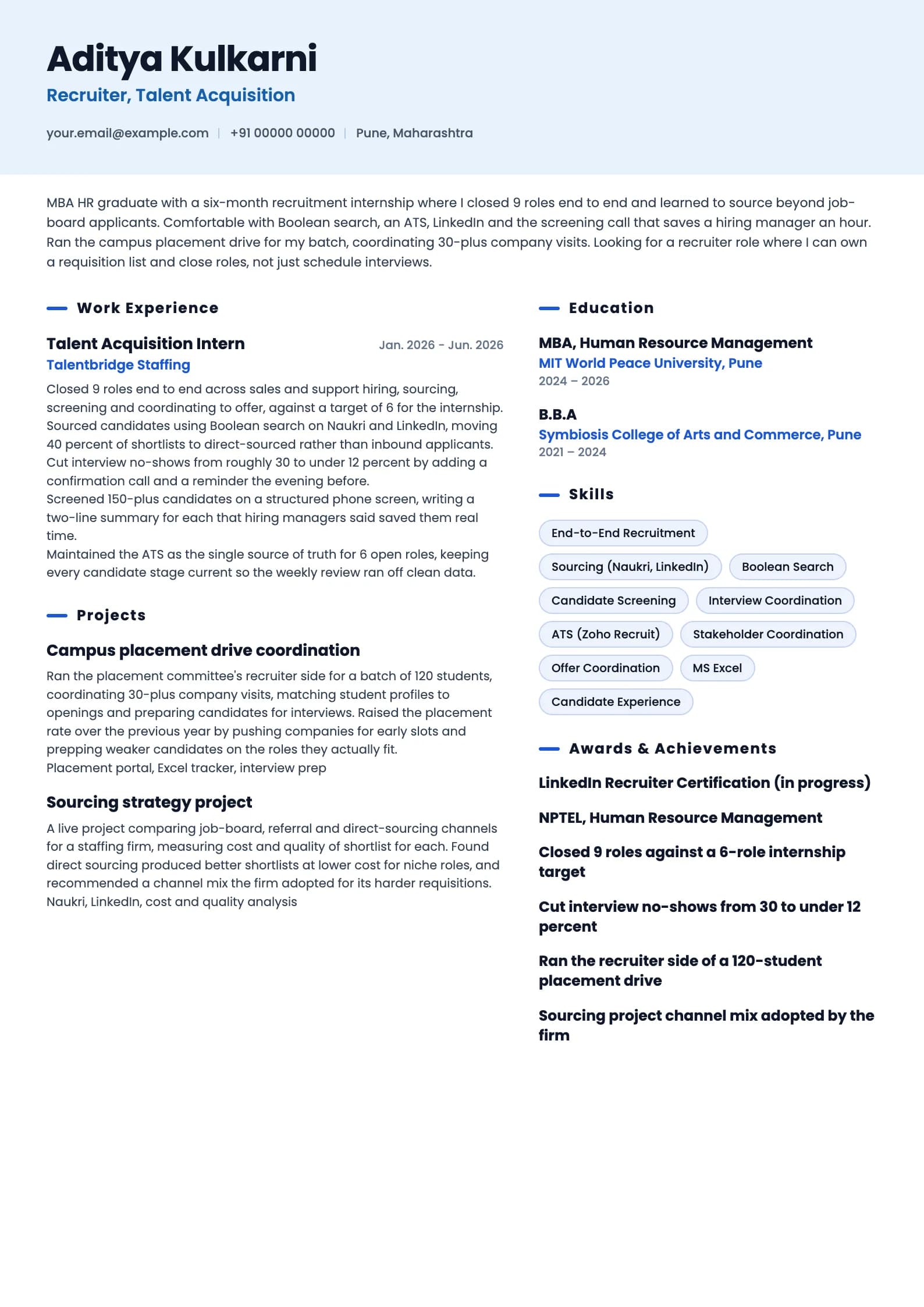
Build my resumeRecruiter resume example, Fresher (0 years)
ai-era templateIs your resume good enough?
Upload the resume you have now and see what an applicant tracking system reads before a recruiter recruiter ever does.
Free to run. Sign in with your mobile number to see your score.
Recruiter resume example, IT Recruiter (4 years)
professional template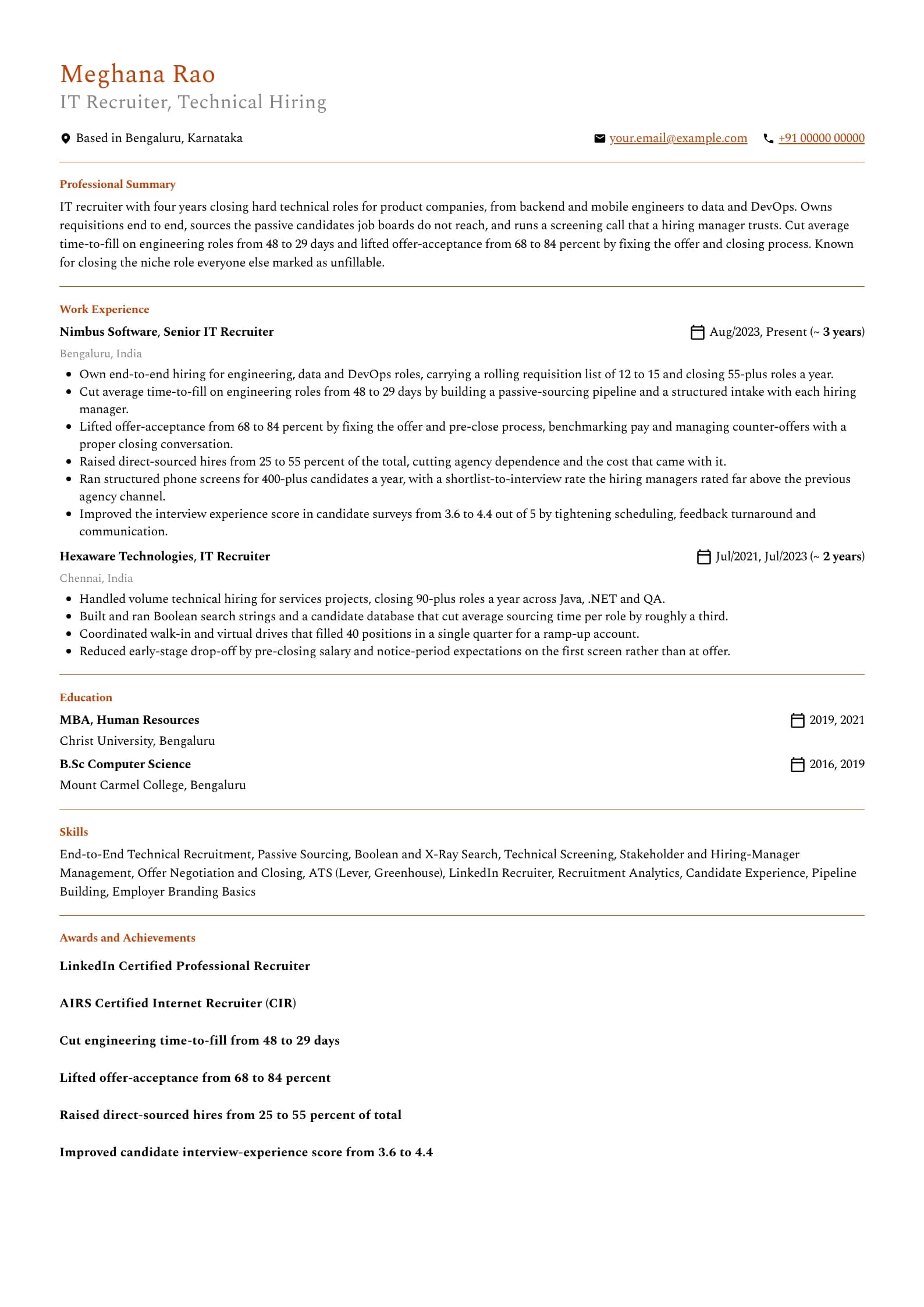
Want this structure with your own details? Build it in the resume builder.
Recruiter resume example, Talent Acquisition Lead (9 years)
header-band template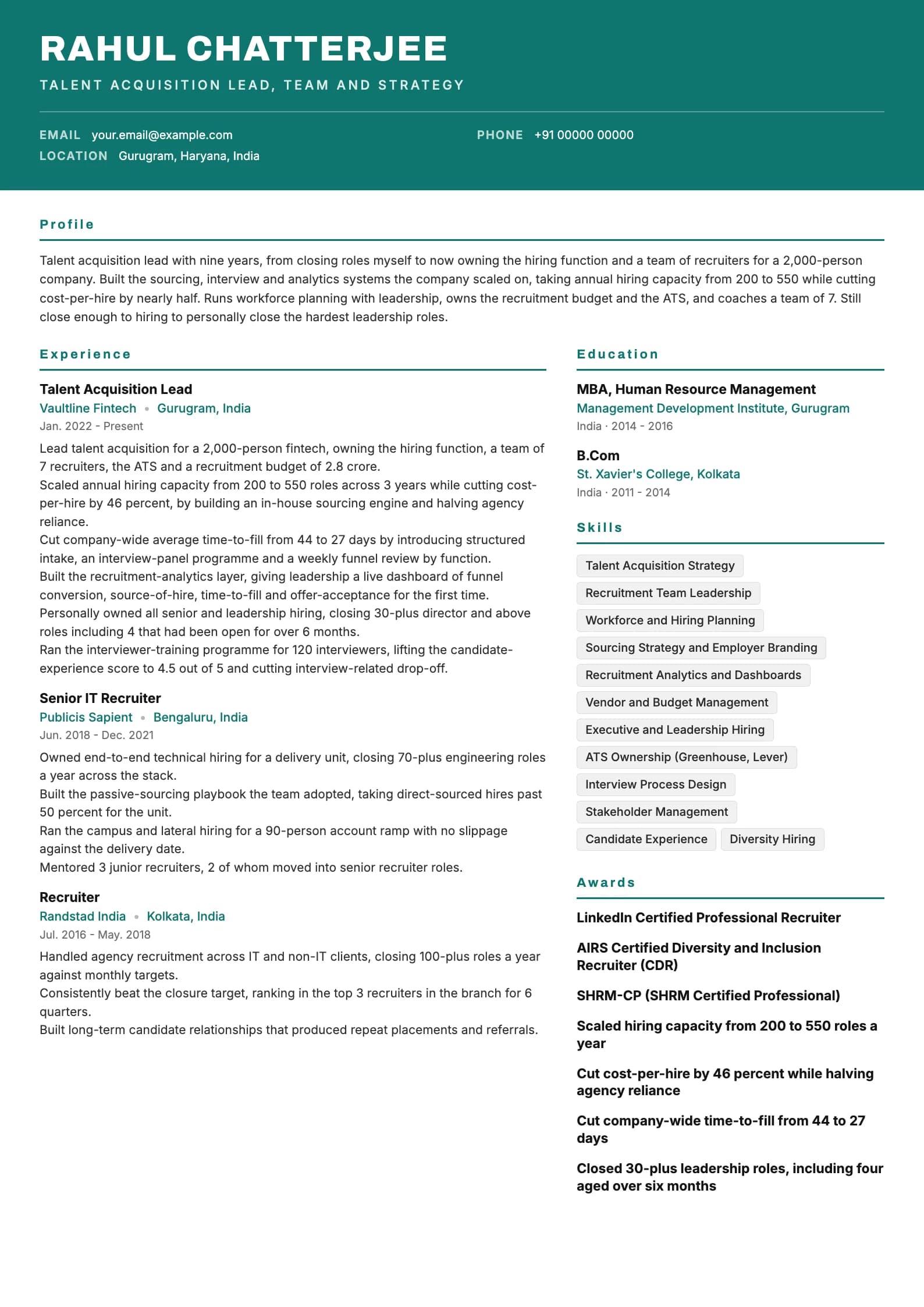
The format that works for recruiter resumes in India
Reverse chronological is the layout to use. Most recent role first, work backwards, dates in plain view. A functional resume that hides dates under skill headings reads as an attempt to conceal a gap or a run of short stints, and recruiters, who screen resumes for a living, spot it instantly. One honest line about a gap beats a layout built to hide it. Length is set by evidence. One page holds a fresher and most recruiters up to roughly seven years. A senior recruiter or TA lead with a team, a budget and built systems earns a second page, provided it carries real outcomes rather than a longer list of job boards. A second page built from a philosophy line and a hobbies section is a padded one-pager. Recruiters have a particular irony to watch: they know exactly what a good resume looks like, then hand in one that lists tools and duties. You screen for outcomes in candidates, so put outcomes on your own page. Roles closed, time-to-fill, offer-acceptance and source mix are the recruiter's version of revenue, and they belong up front. Send a PDF unless the posting asks for DOCX, name the file with your own name and target role, and keep it single-column so the parser reads it in order. The table below sets out the section order.
| Section | Where it goes | Why |
|---|---|---|
| Name and headline | Top, above everything | The headline is the role you want, Recruiter, IT Recruiter or TA Lead. Recruiters match on it. |
| Professional summary | Directly under the header | Three lines. What you hire for, years, and the single strongest funnel result. |
| Work experience | Next, the core of the page | Most recent first. Each bullet a funnel outcome, not a duty. |
| Key metrics | Optional, below summary or experience | Roles closed, time-to-fill, offer-acceptance, source mix. |
| Skills | Below experience | Grouped: sourcing, screening, tools, stakeholder and closing. |
| Education | Bottom, unless you are a fresher | MBA HR or degree, institution, years. Drop the percentage after your first job. |
| Certifications | After education, or beside skills if only one or two | LinkedIn Recruiter, AIRS, SHRM. Name, body, year. |
Listing job boards is not the same as proving a funnel
The single most common recruiter resume failure is a page of tools and duties: sourcing candidates from Naukri and LinkedIn, screening resumes, scheduling interviews, coordinating with hiring managers, using an ATS. Every recruiter does all of that. A parser matches the terms, but a hiring leader reads the list and cannot tell whether you close roles or only move them along the pipe. The fix is to convert the activity into the funnel outcome it produced. You sourced candidates, so what share came from direct sourcing rather than inbound. You screened resumes, so what was your shortlist-to-interview or interview-to-offer rate. You coordinated interviews, so what happened to time-to-fill and no-show rate. The mid-level sample keeps the same activities every recruiter claims, but attaches numbers: time-to-fill 48 to 29, offer-acceptance 68 to 84, direct-sourced 25 to 55 percent. That is the line between a sourcer and a recruiter who owns results. Recruiting is one of the most measurable roles in a company, so use its metrics. Roles closed, time-to-fill, time-to-hire, offer-acceptance rate, source-of-hire mix, funnel-conversion rates, candidate-experience score, cost-per-hire, and quality-of-hire where you can honestly claim it. A run of these outperforms a paragraph describing how relationship-driven you are. Where a raw count misleads, add the constraint. "Closed 55 roles" says less than "closed 55 roles against a 12 to 15 rolling requisition list, cutting time-to-fill to 29 days", because the first is a function of headcount pressure and the second is a function of you.
You screen candidates for outcomes, not duties. Screen your own resume the same way. If a bullet does not move a funnel metric, it describes activity, not recruiting.
Writing a summary a hiring leader actually reads
The block under your name is the part most likely to be read, so it must carry three facts: what you hire for, how long you have recruited, and the strongest funnel result you have produced. Three or four lines, no unverifiable adjectives. The old objective, seeking a challenging recruiter role in a reputed organisation to utilise my sourcing and communication skills, tells the reader nothing new. Replace it with a summary. An objective describes what you want, a summary describes what you have already closed, and only one is evidence. For a recruiter, specialism and a funnel number lead. "IT recruiter closing backend and DevOps roles, time-to-fill cut from 48 to 29 days" places you and proves capability in one line, where "passionate talent acquisition professional" does neither. Follow the specialism with the result you would open a conversation with. Freshers often think they have nothing to summarise. Look at the fresher sample: it names the internship, the roles closed against target, and the sourcing skill that separates a recruiter from a coordinator. That is a genuine summary from one internship. What it avoids is claiming to be a seasoned closer, which the interview would quickly disprove. A practical test: read your summary and ask whether another recruiter with the same background could paste it on unchanged. If they could, it describes the job, not you. Add the specific specialism, number and ownership until it stops being transferable.
Professional summary, mid-level recruiter
Weak
Passionate and result-oriented talent acquisition professional with 4+ years of experience in end-to-end recruitment, sourcing and stakeholder management seeking a challenging role.
Strong
IT recruiter with four years closing backend, data and DevOps roles for product companies. Cut engineering time-to-fill from 48 to 29 days and lifted offer-acceptance from 68 to 84 percent.
The rewrite trades adjectives and a keyword list for a specialism and two funnel metrics a hiring leader tracks.
Experience bullets: verb, recruiting action, funnel result
Every strong bullet in the samples follows the same shape. It opens with an action verb, names the specific recruiting action you owned, and closes with the funnel metric that moved. The verb establishes that you did it. The action tells a hiring leader whether the work is the kind they need. The number does the persuading. Start with the outcome and work backwards. Recruiters usually write the activity first, then cannot attach a number, producing lines like "handled end-to-end recruitment for multiple positions". Instead ask what was different after you ran it: time-to-fill fell, offer-acceptance rose, direct sourcing climbed, no-shows dropped, a stuck role finally closed. Then write the sentence that ends in that fact. Vary the metric so the page does not read as one lever. Across a real recruiter role you can honestly reach for roles closed, time-to-fill, offer-acceptance, source mix, funnel conversion, candidate-experience score, cost-per-hire and no-show rate. The samples spread across several on purpose. Where you lack a number, give scope: how many open roles carried, how many candidates screened, how many drives run, how many recruiters mentored. "Carried a rolling requisition list of 12 to 15 and closed 55-plus roles a year" is scope that carries weight without an invented percentage. Allocate bullets by recency. Current role gets five or six, the previous role three or four, anything older two or three.
| Level | What bullets must prove | Typical metric |
|---|---|---|
| Fresher | You can close a role, not just schedule interviews | Roles closed vs target, no-show rate, candidates screened |
| 1 to 3 years | You own a requisition list and source beyond inbound | Time-to-fill, direct-sourced share, shortlist quality |
| 4 to 6 years | You own the funnel end to end, including closing | Time-to-fill, offer-acceptance, source mix, candidate experience |
| 7 years and up | You own the hiring function and a team | Cost-per-hire, capacity scaled, budget, team, leadership hires |
Experience bullet, sourcing
Weak
Responsible for sourcing candidates through various job portals and social media for multiple open positions.
Strong
Raised direct-sourced hires from 25 to 55 percent of the total by building a passive-sourcing pipeline, cutting agency dependence and the cost that came with it.
"Responsible for sourcing" describes activity; the rewrite gives the source-mix shift, the method and the business consequence.
Experience bullet, closing
Weak
Coordinated with candidates and hiring managers to ensure smooth offer rollout and joining.
Strong
Lifted offer-acceptance from 68 to 84 percent by benchmarking pay, managing counter-offers and adding a structured pre-close conversation.
Names the exact metric moved, the before and after, and the three closing techniques that moved it.
If a bullet would read identically on another recruiter's resume, it is describing the role, not you. Rewrite it until it only fits the requisitions you actually closed.
The skills section: grouped, honest, and short enough to defend
A recruiter's skills section has two audiences with opposite preferences. The parser wants literal terms it can match, Boolean search, LinkedIn Recruiter, ATS, sourcing. A hiring leader wants a short, organised list that signals what kind of recruiter you are. Grouping satisfies both. Group by function rather than one long line. Sourcing, screening and assessment, tools and systems, and stakeholder and closing is a grouping that fits almost every recruiter. The exact headings matter less than that structure exists. Name the actual tools, Naukri, LinkedIn Recruiter, Greenhouse, Lever, Zoho Recruit, because a shop on Greenhouse wants to know you have used it, and write them the way the industry does. A parser matches on strings. Twelve to sixteen skills is the working range. Below eight it looks thin. Above twenty it stops being a signal, and recruiter resumes are prone to a specific padding: listing Naukri, LinkedIn, Indeed, Monster, Shine and every job board as separate skills, when sourcing is one skill and the boards are where you do it. The list is a contract, every item a question you have agreed to answer. Do not include a proficiency bar. Nobody agrees what four stars in stakeholder management means. Let the experience prove the depth instead.
Skills section
Weak
Skills: Naukri, LinkedIn, Indeed, Monster, Shine, Sourcing, Screening, Recruitment, Hiring, Talent Acquisition, Interview Scheduling, Coordination, ATS, MS Office, MS Excel, Communication, Negotiation, Team Player, Hardworking, Multitasking
Strong
Sourcing: passive sourcing, Boolean and X-ray search, pipeline building. Screening: structured phone screens, technical screening. Tools: LinkedIn Recruiter, Greenhouse ATS, Naukri. Stakeholder and closing: hiring-manager intake, offer negotiation, candidate experience.
Collapses the job-board list and the recruitment synonyms into real skills, cuts the personality adjectives, and groups the rest so a leader reads it in one pass.
Signalling your specialism: IT, non-IT, volume or executive
Recruiter is a broad title, and the fastest way to be sorted into the wrong pile is to hide which kind of recruiter you are. An engineering hiring manager scanning for someone who can screen a backend candidate does not want a resume that could equally be for retail hiring. Name your specialism in the headline and prove it in the bullets. The main lanes each have their own signals. IT and technical recruiting rewards naming the stacks you hire for and any technical background, because it tells a hiring manager you can screen rather than forward. Non-IT and corporate recruiting rewards breadth across functions and stakeholder depth. Volume and BPO hiring rewards throughput numbers, drives run and cost-per-hire. Executive and leadership hiring rewards discretion, mapping, and the seniority of roles closed. A resume that tries to claim all four at once reads as none of them. Agency and in-house are a second axis worth being clear about. Agency recruiters live on closure numbers, targets beaten and client relationships. In-house recruiters live on funnel quality, hiring-manager partnership and process built. If you are moving from one to the other, translate: an agency closer moving in-house should foreground quality-of-hire and stakeholder work, not only volume, because the in-house reviewer reads pure volume as churn. The mid-level sample commits to IT recruiting and backs it with a CS degree and named stacks. The senior sample commits to leading a function. Neither hedges, and the clarity is what makes each credible for the role it targets.
| Specialism | What to foreground | Key metric |
|---|---|---|
| IT / technical | Stacks hired for, technical screening, passive sourcing | Time-to-fill on hard roles, direct-sourced share |
| Non-IT / corporate | Breadth across functions, stakeholder depth | Roles closed across functions, offer-acceptance |
| Volume / BPO | Throughput, drives run, cost discipline | Positions closed per quarter, cost-per-hire |
| Executive / leadership | Mapping, discretion, seniority of roles | Leadership roles closed, aged-role closures |
Where education and certifications belong
Education goes at the bottom for anyone with a full-time recruiting role, and near the top for a fresher, who has nothing stronger to lead with. Degree, institution, years. For most recruiters an MBA in HR is the common entry, though recruiting is one of the more degree-flexible functions and a strong track record outweighs the degree quickly. CGPA or percentage is worth keeping while you are a fresher and it is good, roughly 7.5 out of 10 and above, because early-career screening still filters on it. Once you have closed roles in a real job, drop it. A closure record predicts your next role far better than an MBA percentage. A technical background is worth surfacing for IT recruiting specifically. A CS or engineering degree, even an unfinished one or a bootcamp, tells an engineering hiring manager you can hold a screening conversation. The mid-level sample keeps its B.Sc Computer Science line for exactly this reason. Outside technical recruiting, the degree matters less. Certifications sit just below education, or beside skills if you hold only one or two. Write the full name, the issuing body and the year. For recruiters, the LinkedIn Certified Professional Recruiter and the AIRS credentials (CIR, CDR) are the most recognised, and SHRM helps if you are moving toward a broader TA-leadership role. An expired certification listed as current is a small dishonesty a recruiter reviewer catches quickly, so renew it or remove it.
Getting through the applicant tracking system
An applicant tracking system is a parser and a search index, not a judge, and as a recruiter you run one every day, which makes it a little embarrassing to be filtered by one. It reads your file, tries to break it into name, dates, employers, titles and skills, and stores the result so a recruiter can search across candidates. Almost every ATS problem is a parsing problem, and parsing problems come from layout, not wording. The layout rules are short. One column. Standard section headings, so use Work Experience rather than My Recruiting Journey, and Skills rather than My Superpowers. No text inside images, because a metrics infographic or a logo strip reads as empty space. No critical information in the header or footer region, which some parsers drop. Avoid text boxes and nested tables in the body. On wording, mirror the language of the job description where it is honest. If the posting says technical recruiter, use that exact title in your headline. If it says stakeholder management, sourcing or talent acquisition, use those literal terms. Include the expansion alongside an acronym at least once, for example "TA (talent acquisition)", so both searches find you. Keyword stuffing does not work, and a recruiter of all people should not do it. A hidden white-text block of every sourcing term is exactly the trick you would catch and reject in a candidate. Write real bullets that naturally contain the right terms, because a bullet describing the roles you closed contains the word closed in a context that survives human review too. Save as PDF from a tool that embeds real text, then open the file and confirm you can select and copy a sentence. If you cannot select the text, neither can the parser.
Test your own file the way you would a candidate's. Copy the text out of the PDF into a plain text editor. Whatever you can read there is roughly what the parser sees, and anything scrambled is a real risk.
What gets recruiter resumes rejected
Most rejections at the resume stage are not close calls. They come from a small set of recurring problems, and all of them are fixable in an afternoon. The list below covers what hiring leaders reviewing Indian recruiter resumes see most often, in rough order of how much damage each one does.
- Tools and duties instead of funnel outcomes. Sourcing, screening and scheduling are activities; roles closed and time-to-fill are results.
- No numbers, when recruiting is one of the most measurable roles in the company. Time-to-fill, offer-acceptance and source mix all exist in your ATS.
- Hiding the specialism, so an IT hiring manager cannot tell you can screen a technical candidate. Name the lane in the headline.
- Every job board listed as a separate skill. Naukri, LinkedIn, Indeed and Monster are where you source, not four different skills.
- Pure volume with no quality signal, which an in-house reviewer reads as churn. Pair closures with offer-acceptance or quality-of-hire.
- A generic objective line. Replace it with a summary that states specialism, years and one funnel result.
- Writing "scheduled interviews" as the achievement. That is a coordinator's line; a recruiter closes roles.
- A photo, date of birth, marital status or father's name. None of it belongs on a professional resume and it takes a result's space.
- Inflated closure numbers or titles that do not match reality. A recruiter interview probes the funnel, and an inflated number collapses fast.
- Typos in tool and stack names. Writing Greenhouse as Greenhosue or LinkedIn as Linkdin undoes an otherwise strong page, especially from a recruiter.
Screen your own resume as you would a candidate's for one of your roles. Any line you would reject or probe hard is a line to cut or rewrite.
Skills to put on a recruiter resume
Technical
- End-to-End Recruitment
- Passive Sourcing
- Boolean and X-Ray Search
- Technical and Behavioural Screening
- Offer Negotiation and Closing
- Pipeline and Talent-Pool Building
- Recruitment Analytics
- Stakeholder and Hiring-Manager Management
- Candidate Experience
- Employer Branding
- Diversity Hiring
- Workforce and Hiring Planning
Tools and platforms
- LinkedIn Recruiter
- Naukri
- Greenhouse
- Lever
- Zoho Recruit
- Workday Recruiting
- Indeed
- Hirect and Instahyre
- MS Excel
- Google Workspace
Working skills
- Closing and persuasion
- Stakeholder communication
- Relationship building
- Resilience and follow-up
- Judgement of fit
- Negotiation
- Time and pipeline management
- Discretion in executive search
- Working to targets
Certifications worth listing as a recruiter
| Certification | Full name | Worth it for |
|---|---|---|
| LinkedIn Recruiter | LinkedIn Certified Professional Recruiter | The most widely recognised recruiter certification in the Indian market, worth it for any recruiter who sources on LinkedIn, which is most of them. Signals you can use the platform's search and pipeline tools properly rather than just browse profiles. A clean, low-cost credential for a resume at any level. |
| AIRS CIR | AIRS Certified Internet Recruiter | Focused on sourcing and internet-search technique, worth it for recruiters who want to prove real Boolean and X-ray sourcing skill rather than reliance on inbound applicants. Most valuable in the one-to-five-year range where sourcing craft is the differentiator. |
| AIRS CDR | AIRS Certified Diversity and Inclusion Recruiter | Useful for recruiters at companies with a serious diversity-hiring mandate, and increasingly for TA leads who own the hiring strategy. Pairs well with a senior profile that owns funnel design, and less relevant for a pure volume-hiring role. |
| SHRM-CP | SHRM Certified Professional | Worth it for a recruiter moving toward broader talent-acquisition leadership or an HR-generalist blend, since it signals HR breadth beyond sourcing. Less essential for a specialist recruiter whose value is in the funnel, where the LinkedIn and AIRS credentials speak more directly. |
| ATS Vendor Certs | Greenhouse, Lever or Workday recruiting certifications | Product-specific credentials worth it when you already work in that ATS and your target companies use it, since tool familiarity is a real hiring factor. Practical rather than prestigious, so list it when it matches the posting and skip it when it does not. |
Keywords an ATS scans for in a recruiter resume
These are the literal terms a parser matches against the job description. Use the ones that are true of you, in the sentences where you did the work, not as a list at the bottom.
- recruiter
- talent acquisition
- technical recruiter
- IT recruiter
- end-to-end recruitment
- sourcing
- boolean search
- candidate screening
- stakeholder management
- offer negotiation
- time-to-fill
- offer acceptance
- ATS
- LinkedIn Recruiter
- pipeline
- candidate experience
- cost-per-hire
- hiring manager
- passive sourcing
- recruitment analytics
Recruiter resume FAQ
What salary can a recruiter expect in India?
A fresher recruiter typically starts around 2.5 to 4 LPA, higher in product companies and specialist IT staffing. A recruiter with four to six years, especially in technical hiring, usually sits in the 6 to 12 LPA band. Senior recruiters and talent-acquisition leads with nine years and above who own a team and a budget commonly earn 14 to 28 LPA, and more at large product companies. Technical-hiring depth, a strong closure and funnel record, and moving in-house all push the top of each band upward.
How long should a recruiter resume be?
One page up to about seven years of experience, two pages after that only if the second page carries a team, a budget and built systems rather than a longer list of job boards. Nobody has been rejected for a resume that was too easy to read. If you cannot fit one page, cut the oldest role to a single line, remove any philosophy paragraph, and delete adjectives that describe you rather than your funnel results.
What metrics should a recruiter put on a resume?
The numbers that persuade are the funnel: roles closed, time-to-fill, time-to-hire, offer-acceptance rate, source-of-hire mix, funnel-conversion rates, candidate-experience score and cost-per-hire. Pull them from the ATS you already run, put a before and after on the ones your work moved, and vary the metric across bullets. A recruiter resume built on funnel outcomes reads as someone who owns results, where one built on tools and duties reads as someone who moves resumes along.
How does a fresher write a recruiter resume with no experience?
Lead with projects and the internship, then education, then skills. Treat each project as real recruiting work: roles closed against a target, a sourcing study a firm adopted, a placement drive coordinated. Show the one skill that separates a recruiter from a coordinator, sourcing candidates who did not apply, even at small scale. Quantify the funnel you touched, such as no-shows cut or candidates screened, and be honest about depth rather than claiming to be a seasoned closer.
How do I show I am a technical or IT recruiter specifically?
Name the specialism in your headline and prove it in the bullets. State the stacks you hire for, backend, data, DevOps, mobile, and surface any technical background such as a CS degree, because it tells an engineering hiring manager you can screen rather than forward. Foreground the metrics that matter for hard roles, time-to-fill and direct-sourced share, and do not hedge by also claiming volume BPO and executive search on the same page, which reads as no specialism at all.
Do recruiter certifications like LinkedIn Recruiter or AIRS help?
They help, especially early on. The LinkedIn Certified Professional Recruiter is the most recognised in India and worth having since most sourcing happens on LinkedIn, and the AIRS credentials (CIR, CDR) prove sourcing craft. For a TA lead moving toward strategy, SHRM adds HR breadth. Keep the list short, name the issuing body and year, and remember that a strong closure and funnel record outweighs any certificate once you have a real track record.
I am an agency recruiter moving in-house. What changes on my resume?
Translate volume into quality. Agency reviewers value closure numbers, targets beaten and client relationships, while in-house reviewers value funnel quality, hiring-manager partnership and process built. Keep your closure record but pair it with offer-acceptance, quality-of-hire and stakeholder work, because pure volume reads to an in-house reviewer as churn. Reframe client management as stakeholder management, and add any process or pipeline you built rather than only roles you filled.
Do I need a photo on a recruiter resume in India?
No. It takes space a funnel result should occupy, and as a recruiter you know it is the kind of bias-inviting element hiring is meant to design out. The same goes for date of birth, marital status, father's name, nationality and a declaration paragraph, all from an older template that spread through placement cells. The only exception is a role whose posting explicitly asks for a photograph, which is rare in recruiting.
Related resume examples and guides
Build your own in any of these formats
Start from a blank resume or upload the one you have. Goodspace renders it in 24 templates and flags the recruiting keywords an applicant tracking system will look for, from sourcing and time-to-fill to offer-acceptance and stakeholder management, and the job-board filler it will not credit.
Build my resume